15-1
CHAPTER 15
15-1 The single-rate (cost-allocation) method makes no distinction between fixed costs and
variable costs in the cost pool. It allocates costs in each cost pool to cost objects using the same
15-2 The dual-rate method provides information to division managers about cost behavior.
Knowing how fixed costs and variable costs behave differently is useful in decision making.
15-4 Examples of bases used to allocate support department cost pools to operating
15-5 The use of budgeted indirect cost allocation rates rather than actual indirect rates has
several attractive features to the manager of a user department:
15-6 Disagree. Allocating costs on “the basis of estimated long-run use by user department
15-7 The three methods differ in how they recognize reciprocal services among support
departments:
a. The direct (allocation) method ignores any services rendered by one support
15-2
15-8 The reciprocal method is theoretically the most defensible method because it fully
15-9 The stand-alone cost-allocation method uses information pertaining to each user of a cost
object as a separate entity to determine the cost-allocation weights.
The incremental cost-allocation method ranks the individual users of a cost object in the
15-11 Areas of dispute between contracting parties can be reduced by making the “rules of the
game” explicit and in writing at the time the contract is signed.
15-12 Companies increasingly are selling packages of products or services for a single price.
15-13 The stand-alone revenue-allocation method uses product-specific information on the
products in the bundle as weights for allocating the bundled revenues to the individual products.
15-14 Managers typically will argue that their individual product is the prime reason why
15-15 A dispute over allocation of revenues of a bundled product could be resolved by (a)
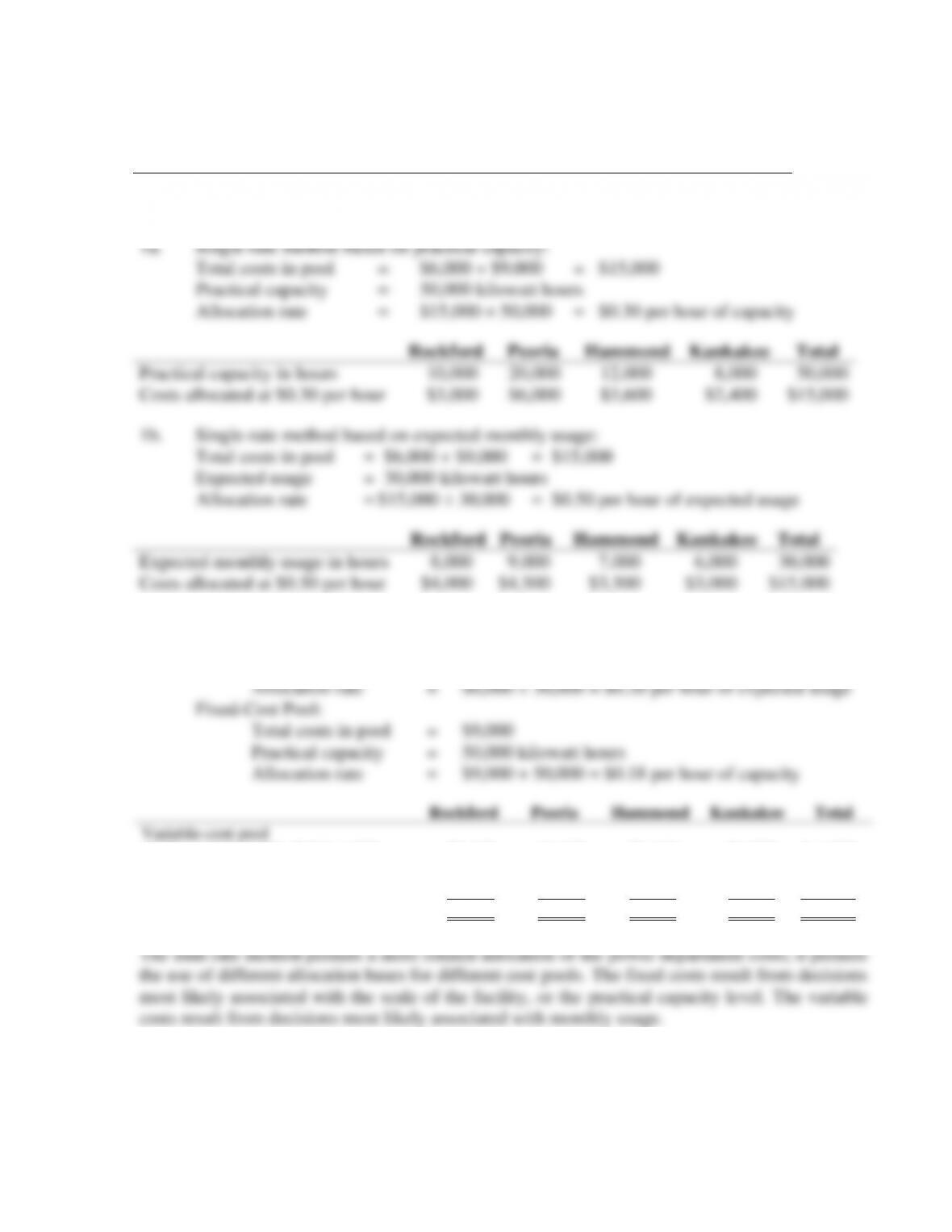
15-16 (20 min.) Single-rate versus dual-rate methods, support department.
Bases available (kilowatt hours):
Rockford
Peoria
Hammond
Kankakee
Total
Practical capacity
Expected monthly usage
10,000
8,000
20,000
9,000
12,000
7,000
8,000
6,000
50,000
30,000
15-4
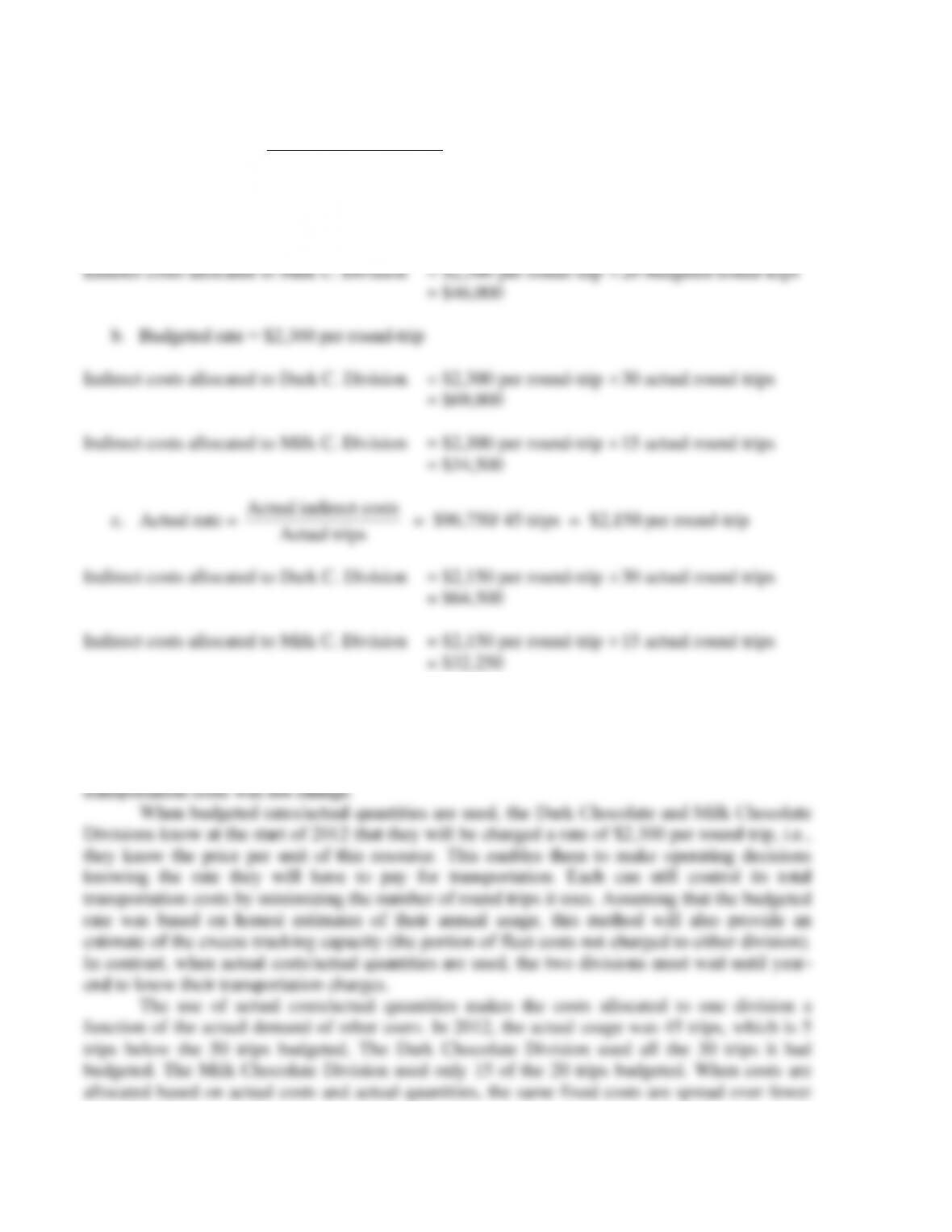
15-17 (20–25 min.) Single-rate method, budgeted versus actual costs and quantities.
1. a. Budgeted rate =
Budgeted indirect costs
Budgeted trips
= $115,000/50 trips = $2,300 per round-trip
Indirect costs allocated to Dark C. Division = $2,300 per round-trip
30 budgeted round trips
= $69,000
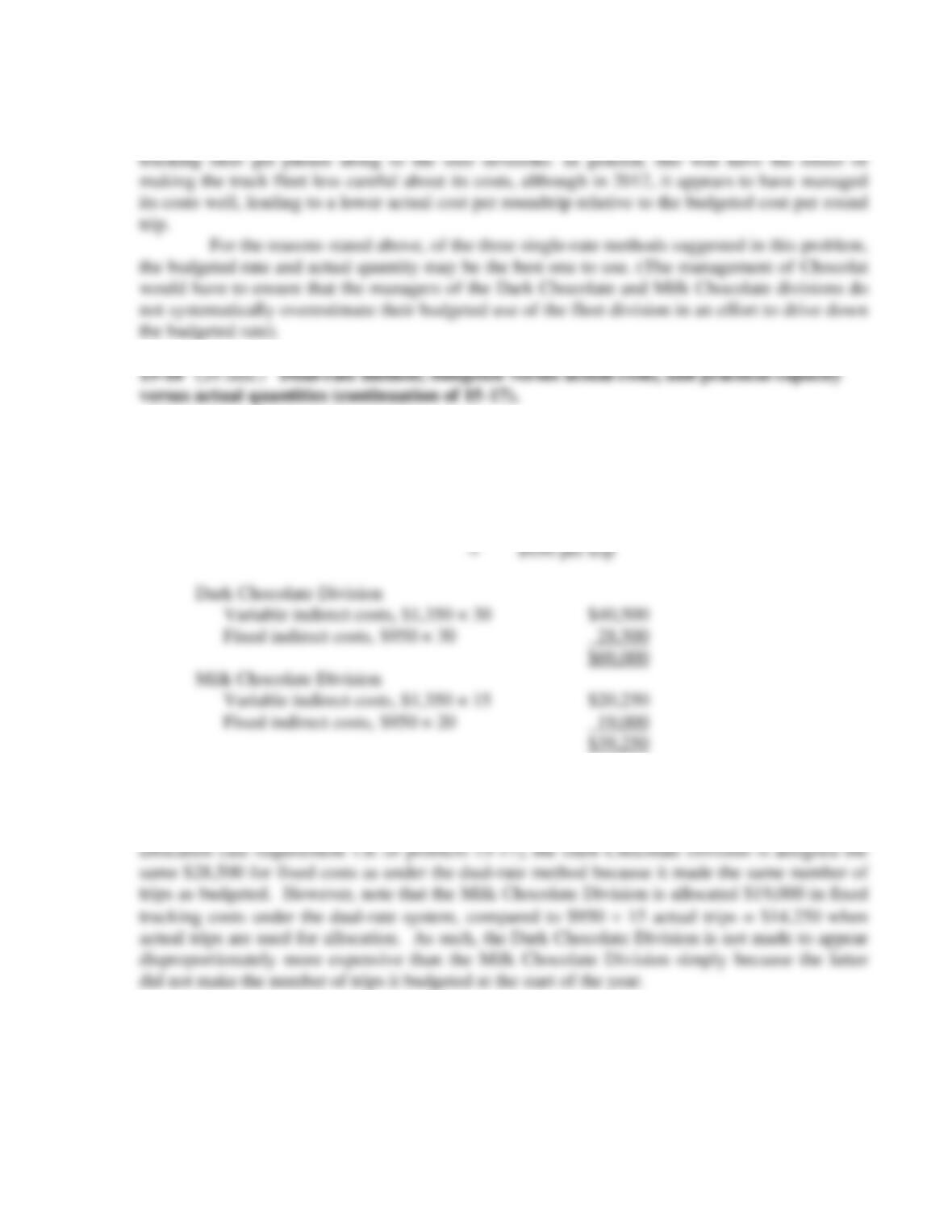
2. When budgeted rates/budgeted quantities are used, the Dark Chocolate and Milk
Chocolate Divisions know at the start of 2012 that they will be charged a total of $69,000 and
$46,000 respectively for transportation. In effect, the fleet resource becomes a fixed cost for each
division. Then, each may be motivated to over-use the trucking fleet, knowing that their 2012
15-5
trips resulting in a higher rate than if the Milk Chocolate Division had used its budgeted 20 trips.
As a result, the Dark Chocolate Division bears a proportionately higher share of the fixed costs.
Using actual costs/actual rates also means that any efficiencies or inefficiencies of the
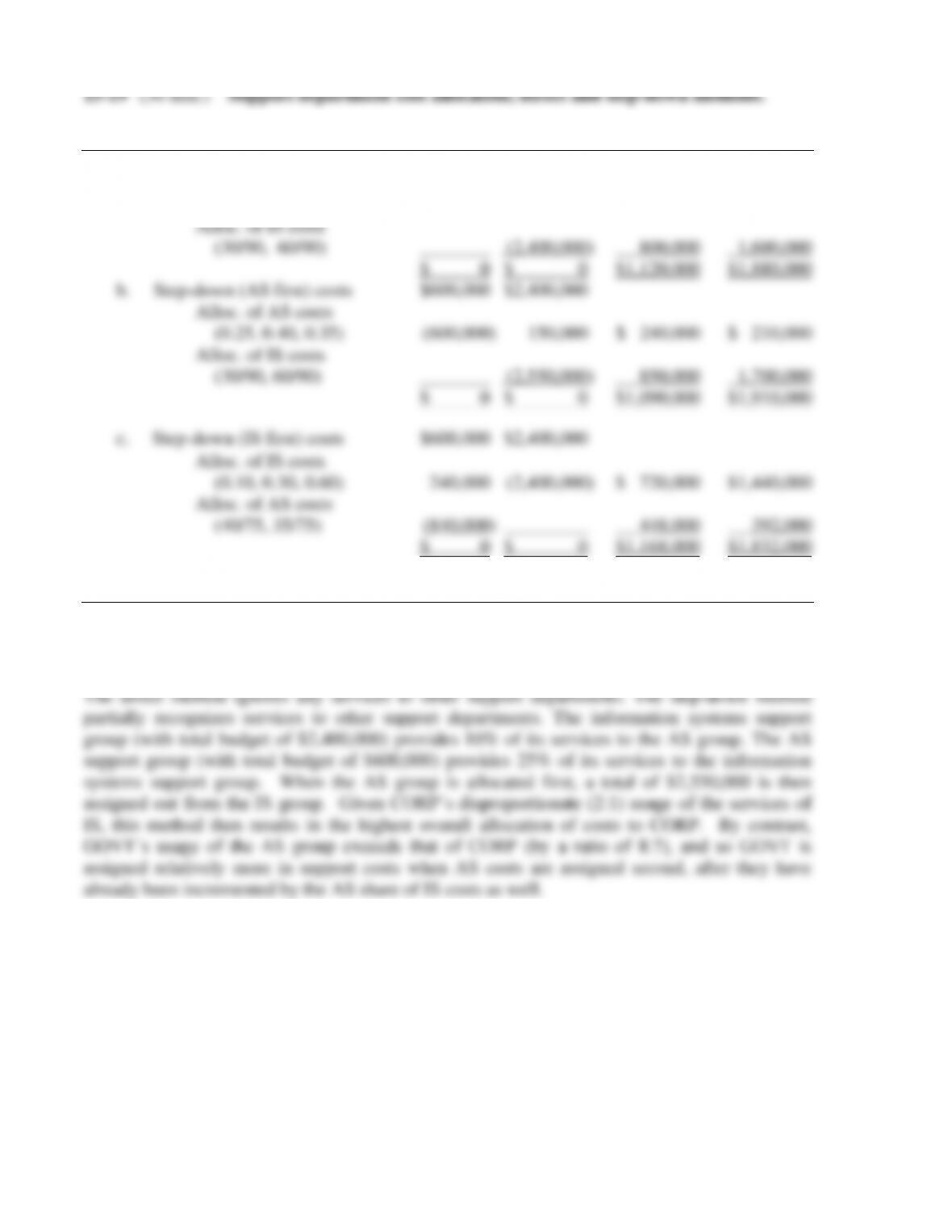
1. Charges with dual rate method.
Variable indirect cost rate = $1,350 per trip
Fixed indirect cost rate = $47,500 budgeted costs/ 50 round trips budgeted
2. The dual rate changes how the fixed indirect cost component is treated. By using
budgeted trips made, the Dark Chocolate Division is unaffected by changes from its own
budgeted usage or that of other divisions. When budgeted rates and actual trips are used for
15-6
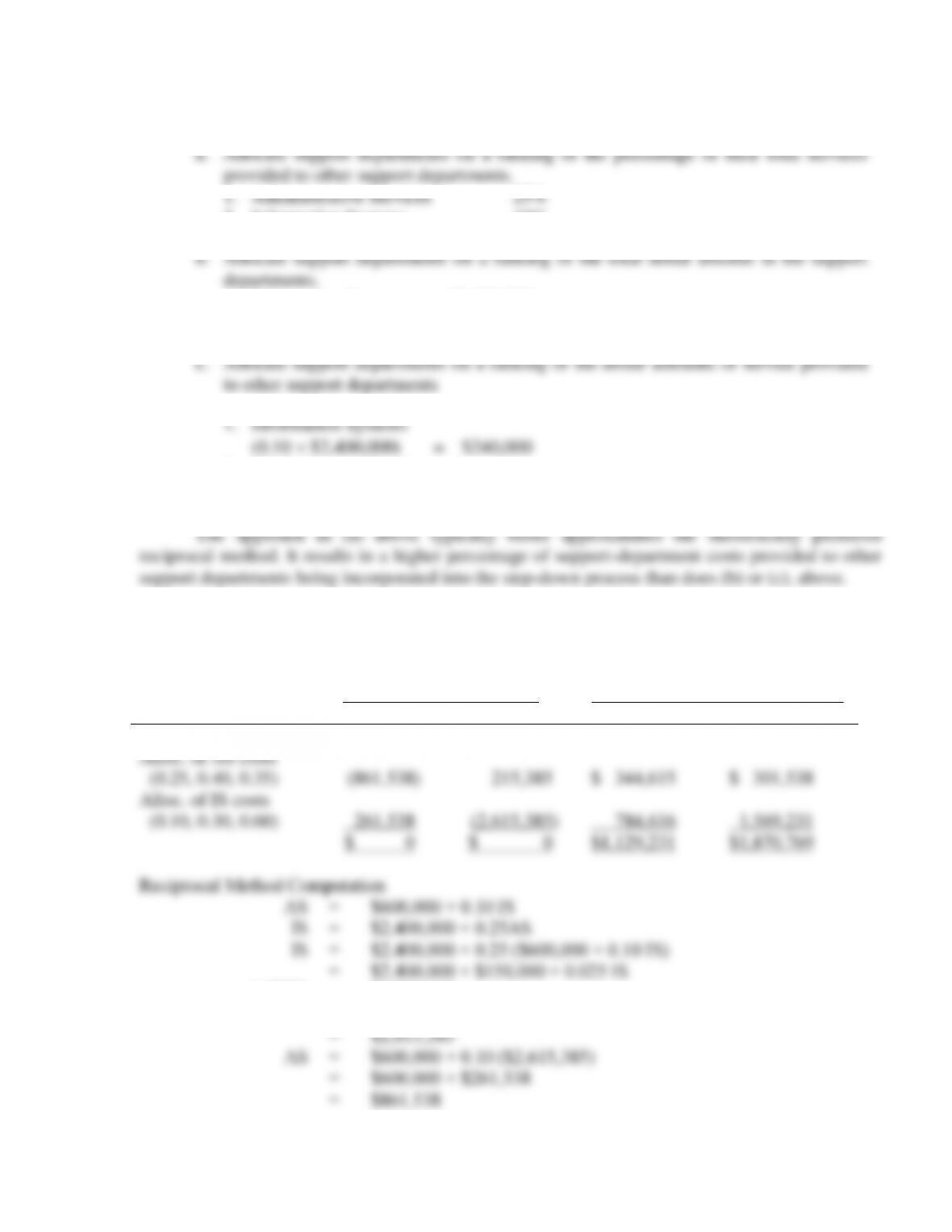
1. AS IS GOVT CORP
a. Direct method costs $600,000 $2,400,000
Alloc. of AS costs
(40/75, 35/75) (600,000) $ 320,000 $ 280,000
2. GOVT CORP
Direct method $1,120,000 $1,880,000
Step-down (AS first) 1,090,000 1,910,000
Step-down (IS first) 1,168,000 1,832,000
15-7
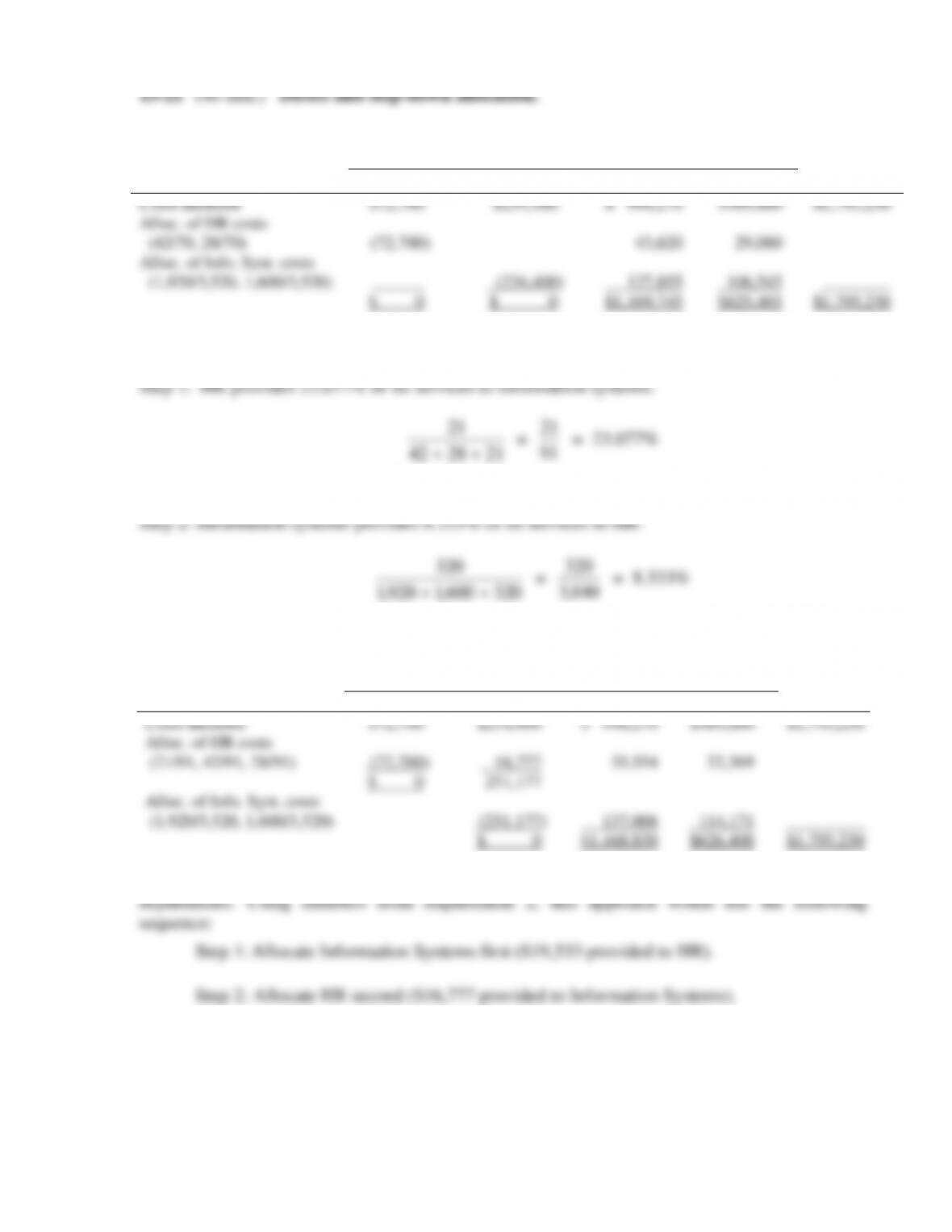
3. Three criteria that could determine the sequence in the step-down method are:
2. Information Systems 10%
1. Information Systems $2,400,000
2. Administrative Services $ 600,000
2. Administrative Services
(0.25 $600,000) = $150,000
15-20 (50 min.) Support-department cost allocation, reciprocal method (continuation of 15-19).
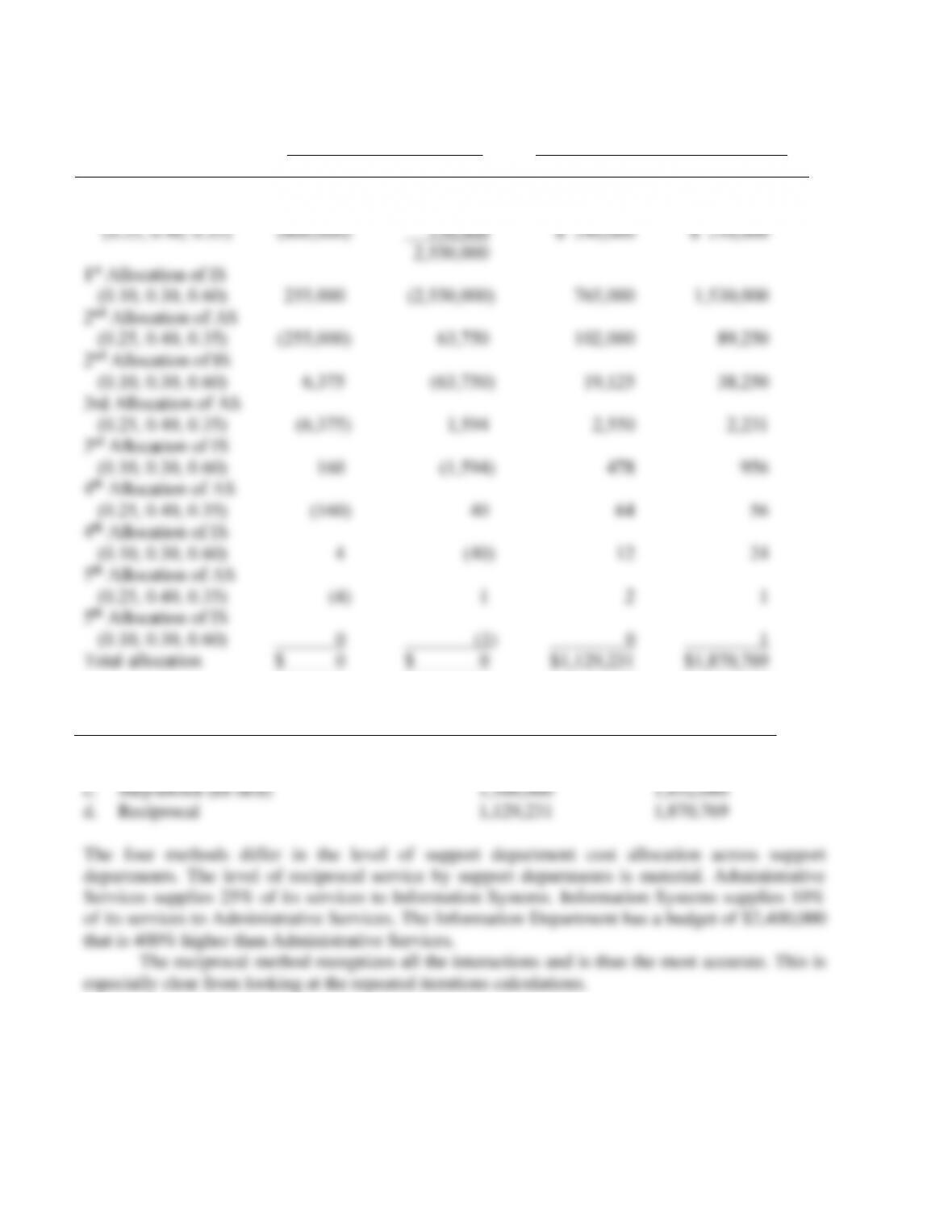
1a.
Support Departments
Operating Departments
AS I S Govt. Corp.
Costs
$600,000
$2,400,000
Alloc. of AS costs
(0.25, 0.40, 0.35)
(861,538)
215,385
$ 344,615
$ 301,538
Alloc. of IS costs
(0.10, 0.30, 0.60)
261,538
(2,615,385)
784,616
1,569,231
$ 0
$ 0
$1,129,231
$1,870,769
0.975IS = $2,550,000
IS = $2,550,000 ÷ 0.975
15-8
1b.
Support Departments
Operating Departments
AS I S Govt. Corp.
Costs
$600,000
$2,400,000
1st Allocation of AS
(0.25, 0.40, 0.35)
(600,000)
150,000
$ 240,000
$ 210,000
2,550,000
1st Allocation of IS
(0.10, 0.30, 0.60)
255,000
(2,550,000)
765,000
1,530,000
2nd Allocation of AS
(0.25, 0.40, 0.35)
(255,000)
63,750
102,000
89,250
2nd Allocation of IS
(0.10, 0.30, 0.60)
6,375
(63,750)
19,125
38,250
3rd Allocation of AS
(0.25, 0.40, 0.35)
(6,375)
1,594
2,550
2,231
3rd Allocation of IS
(0.10, 0.30, 0.60)
160
(1,594)
478
956
4th Allocation of AS
(0.25, 0.40, 0.35)
(160)
40
64
56
4th Allocation of IS
(0.10, 0.30, 0.60)
4
(40)
12
24
5th Allocation of AS
(0.25, 0.40, 0.35)
(4)
1
2
1
5th Allocation of IS
(0.10, 0.30, 0.60)
0
(1)
0
1
Total allocation
$ 0
$ 0
$1,129,231
$1,870,769
2.
Govt. Consulting
Corp. Consulting
a. Direct $1,120,000 $1,880,000
b. Step-Down (AS first) 1,090,000 1,910,000
15-9
1.
Support Departments
Operating Departments
HR
Info. Systems
Corporate
Consumer
Total
Costs Incurred
$72,700
$234,400
$ 998,270
$489,860
$1,795,230
Alloc. of HR costs
(42/70, 28/70)
(72,700)
43,620
29,080
Alloc. of Info. Syst. costs
(1,920/3,520, 1,600/3,520)
______
(234,400)
127,855
106,545
________
$ 0
$ 0
$1,169,745
$625,485
$1,795,230
2. Rank on percentage of services rendered to other support departments.
212842
++
91
This 23.077% of $72,700 HR department costs is $16,777.
320600,1920,1
++
840,3
This 8.333% of $234,400 information systems department costs is $19,533.
Support Departments
Operating Departments
HR
Info. Systems
Corporate
Consumer
Total
Costs Incurred
$72,700
$234,400
$ 998,270
$489,860
$1,795,230
Alloc. of HR costs
(21/91, 42/91, 28/91)
(72,700)
16,777
33,554
22,369
$ 0
251,177
Alloc. of Info. Syst. costs
(1,920/3,520, 1,600/3,520)
(251,177)
137,006
114,171
$ 0
$1,168,830
$626,400
$1,795,230
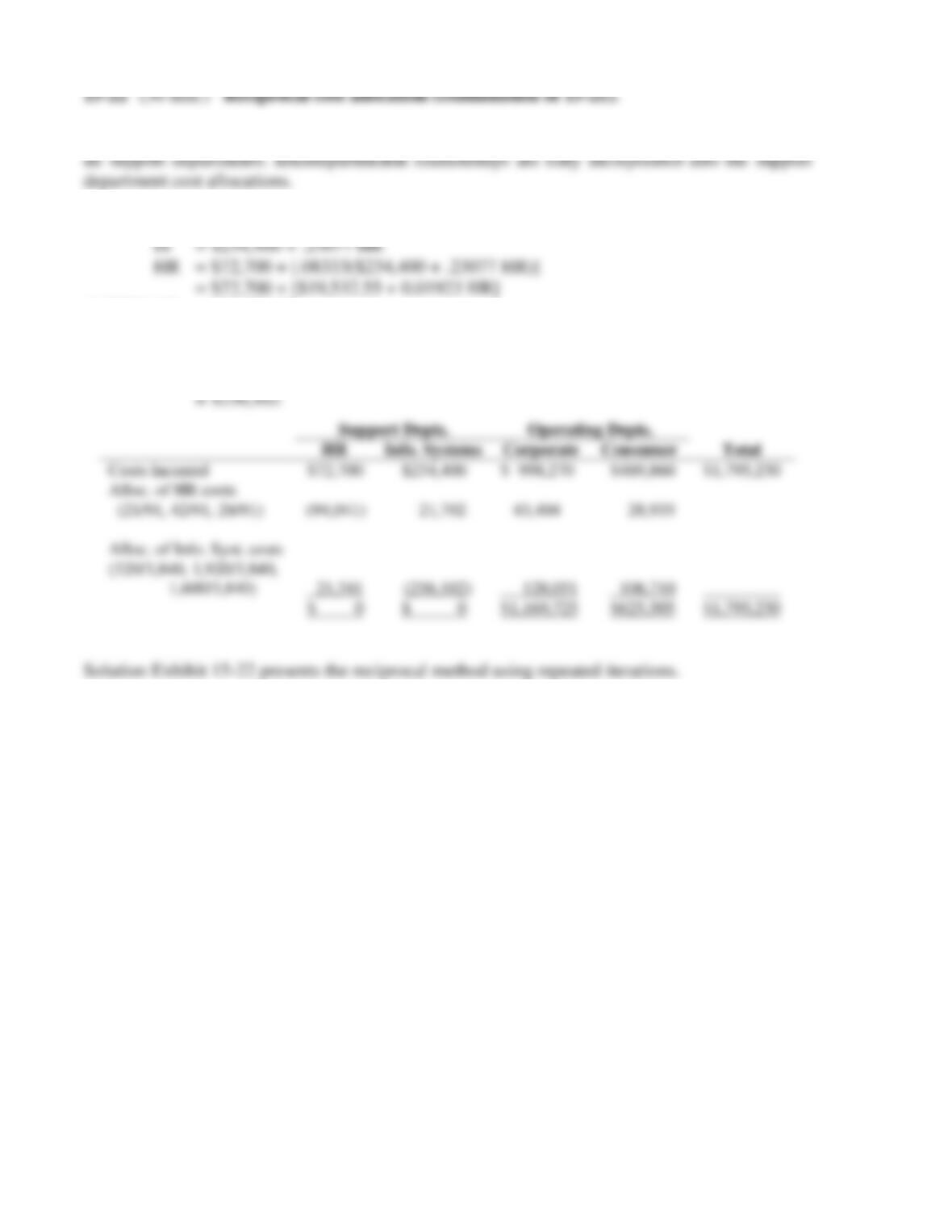
3. An alternative ranking is based on the dollar amount of services rendered to other support
15-10
1. The reciprocal allocation method explicitly includes the mutual services provided among
2. HR = $72,700 + .08333 IS
0.98077 HR = $92,232.55
HR = $92,232.55 0.98077
= $94,041
IS = $234,400 + (0.23077 $94,041)