15-31
3. To use the Shapley value method, consider each party as first the primary party and then
the incremental party. Compute the average of the two to determine the allocation.
Wright Inc.:
Allocation as the primary party $40,000
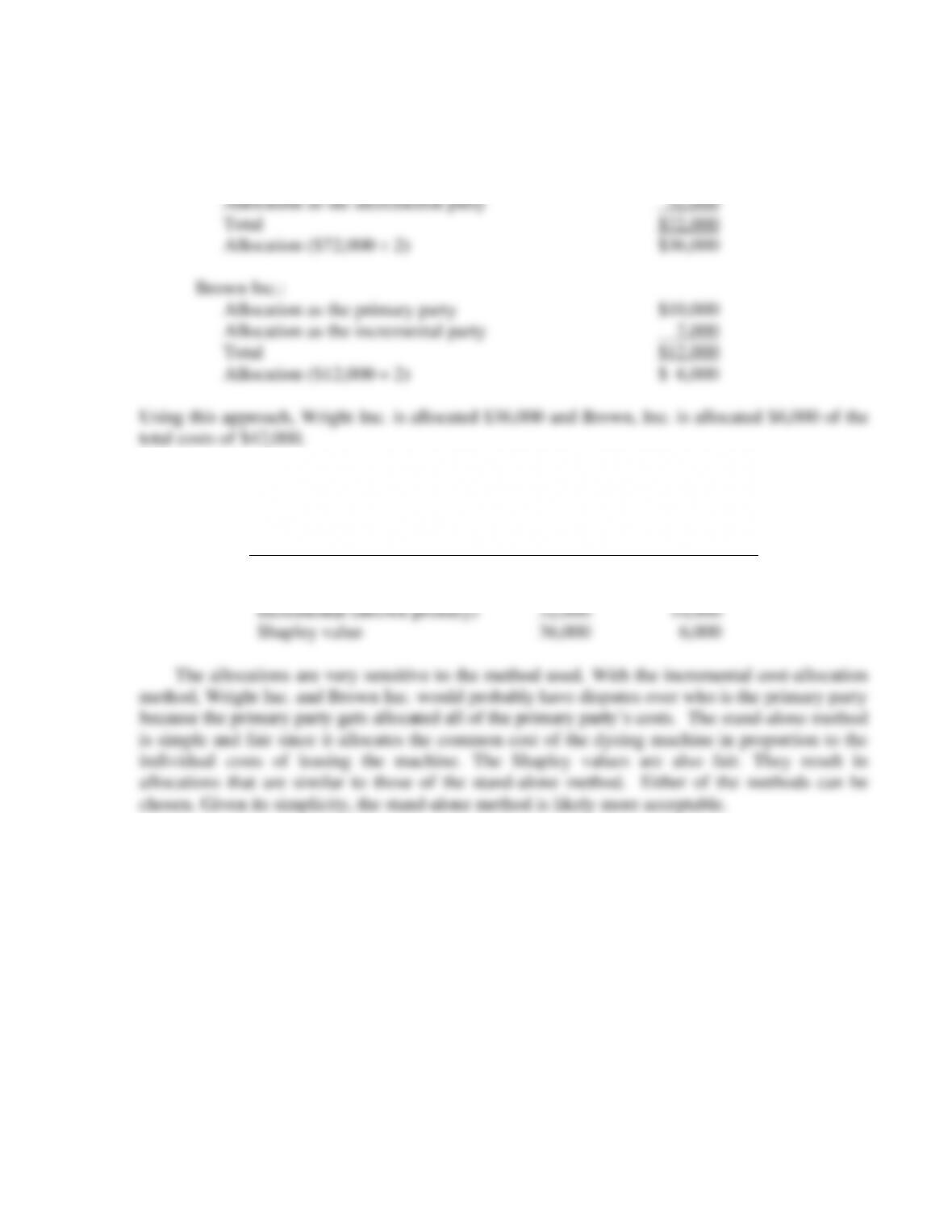
4. The results of the four cost-allocation methods are shown below.
Wright Inc.
Brown Inc.
Stand-alone method
$33,600
$8,400
Incremental (Wright primary)
40,000
2,000
Incremental (Brown primary)
32,000
10,000
Shapley value
36,000
6,000
The allocations are very sensitive to the method used. With the incremental cost-allocation
method, Wright Inc. and Brown Inc. would probably have disputes over who is the primary party
because the primary party gets allocated all of the primary party’s costs. The stand-alone method
is simple and fair since it allocates the common cost of the dyeing machine in proportion to the
individual costs of leasing the machine. The Shapley values are also fair. They result in
allocations that are similar to those of the stand-alone method. Either of the methods can be
chosen. Given its simplicity, the stand-alone method is likely more acceptable.
15-32
15-33 (20-25 mins.) Stand-alone revenue allocation
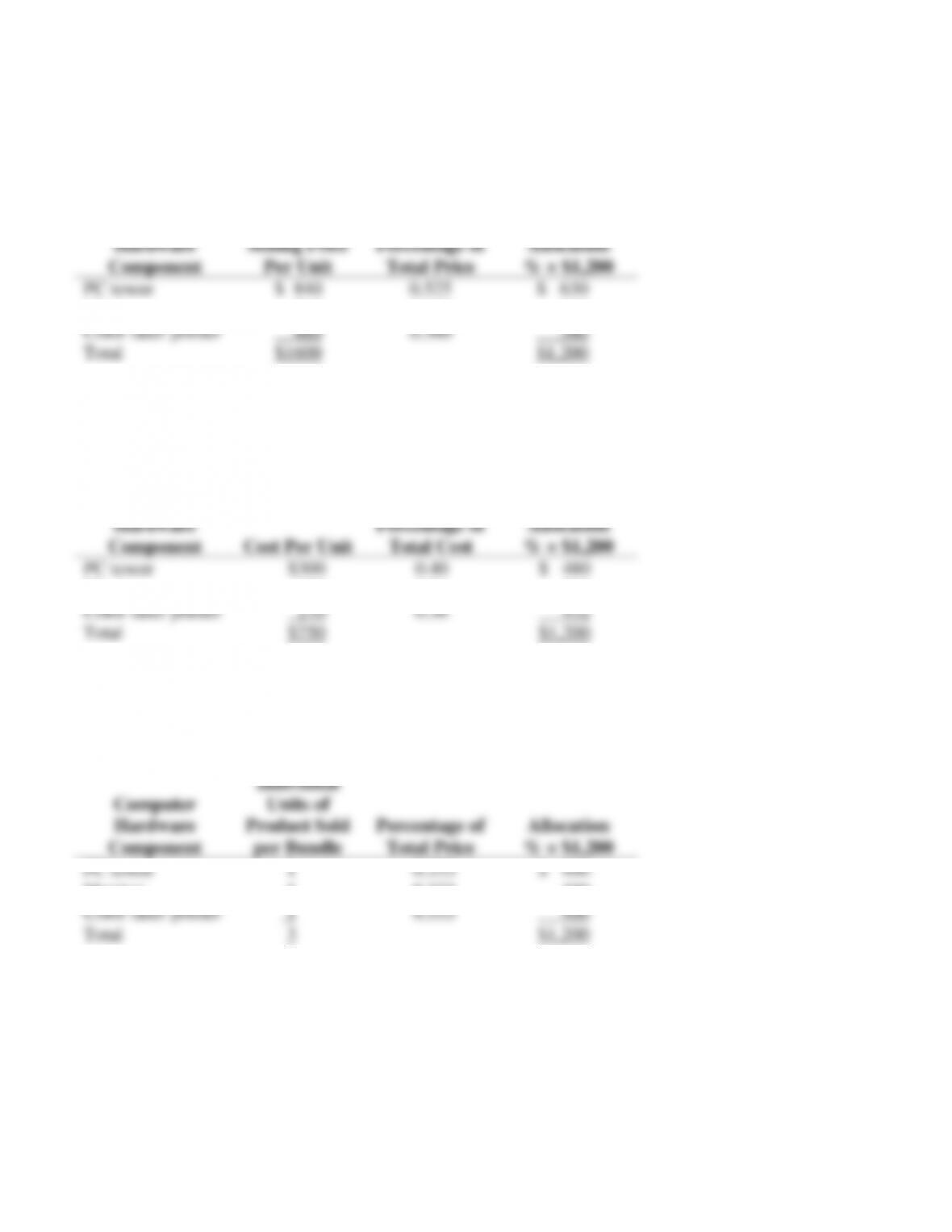
1. Allocation using individual selling price per unit.
Computer
Hardware
Component
Individual
Selling Price
Per Unit
Percentage of
Total Price
Allocation
% × $1,200
PC tower
$ 840
0.525
$ 630
Monitor
280
0.175
210
Color laser printer
480
0.300
360
Total
$1600
$1,200
2. Allocation using cost per unit
Computer
Hardware
Component
Cost Per Unit
Percentage of
Total Cost
Allocation
% × $1,200
PC tower
$300
0.40
$ 480
Monitor
180
0.24
288
Color laser printer
270
0.36
432
Total
$750
$1,200
3. Allocation using number of individual units of product sold per bundle
Computer
Hardware
Component
Individual
Units of
Product Sold
per Bundle
Percentage of
Total Price
Allocation
% × $1,200
PC tower
1
0.333
$ 400
Monitor
1
0.333
400
Color laser printer
1
0.333
400
Total
3
$1,200
15-33
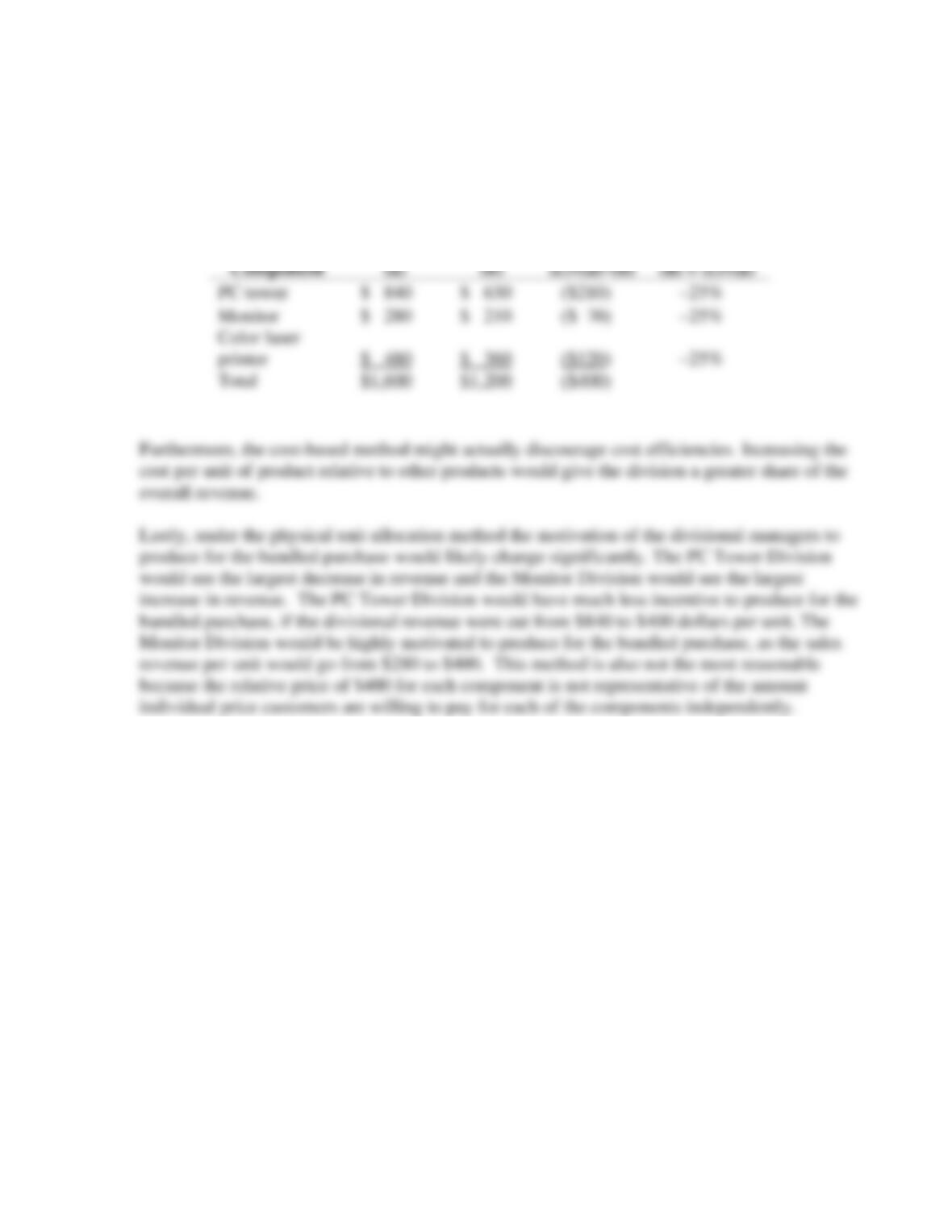
4. Sharing on the basis of revenue makes the most sense. Using this method each division takes
a uniform percentage decrease in the revenue received regardless of the cost of the division’s
individual products. For example:
Computer
Hardware
Component
Individual
Price per
Unit
(a)
Allocated
Revenue
per Unit
(b)
Decrease
in Price
(c)=(a)–(b)
Percentage
Decrease in
Price by
Product
(d) = (c)÷(a)
PC tower
$ 840
$ 630
($210)
–25%
Monitor
$ 280
$ 210
($ 70)
–25%
Color laser
printer
$ 480
$ 360
($120)
–25%
Total
$1,600
$1,200
($400)
Furthermore, the cost-based method might actually discourage cost efficiencies. Increasing the
cost per unit of product relative to other products would give the division a greater share of the
overall revenue.
Lastly, under the physical unit allocation method the motivation of the divisional managers to
produce for the bundled purchase would likely change significantly. The PC Tower Division
would see the largest decrease in revenue and the Monitor Division would see the largest
increase in revenue. The PC Tower Division would have much less incentive to produce for the
bundled purchase, if the divisional revenue were cut from $840 to $400 dollars per unit. The
Monitor Division would be highly motivated to produce for the bundled purchase, as the sales
revenue per unit would go from $280 to $400. This method is also not the most reasonable
because the relative price of $400 for each component is not representative of the amount
individual price customers are willing to pay for each of the components independently.
15-34
15-34 (10-15 min.) Support-department cost allocations: single-department cost pools;
direct, step–down, and reciprocal methods
1. a. Allocate the total Support Department costs to the production departments under the
Direct Allocation Method:
Clothing
Shoes
Departmental Costs
$10,000
$8,000
From:
Information Technology
(5,000/8,000) × $2,000
$ 1,250
(3,000/8,000) × $2,000
$ 750
Human Resources
(120/160) × $1,000
$ 750
(40/160) × $1,000
______
$ 250
Total Departmental Costs
$12,000
$ 9,000
Total Costs to account for: $21,000
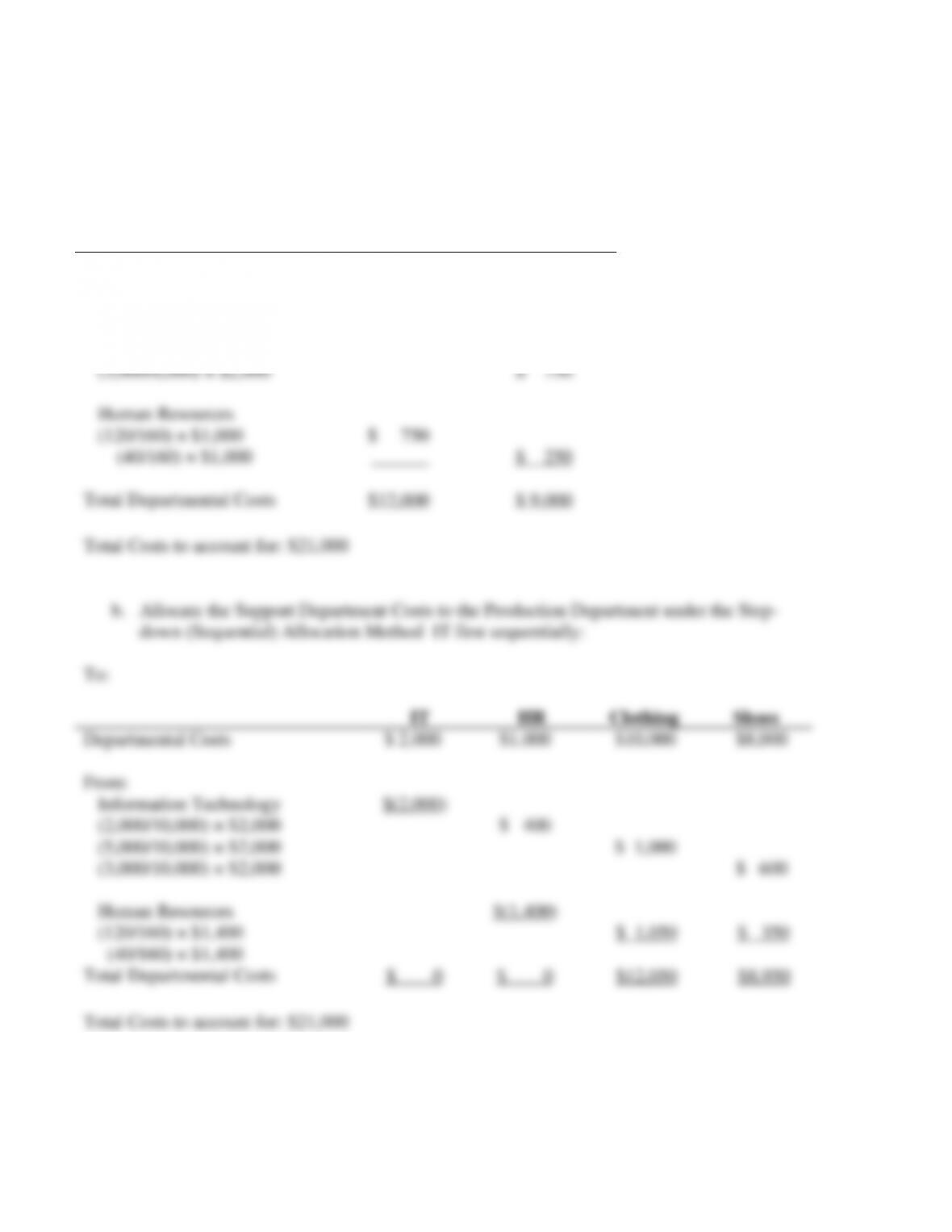
b. Allocate the Support Department Costs to the Production Department under the Step–
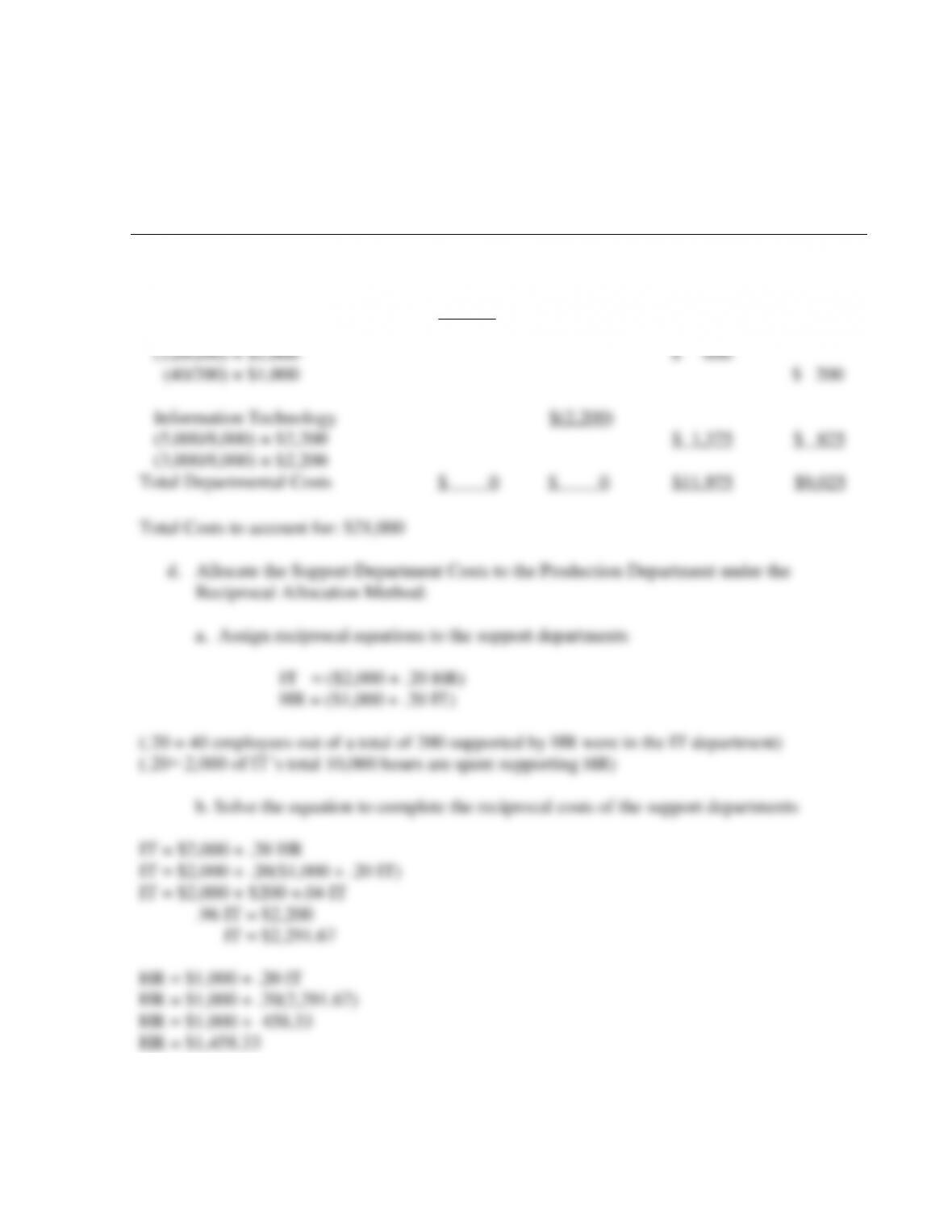
down (Sequential) Allocation Method IT first sequentially:
To:
IT
HR
Clothing
Shoes
Departmental Costs
$ 2,000
$1,000
$10,000
$8,000
From:
Information Technology
$(2,000)
(2,000/10,000) × $2,000
$ 400
(5,000/10,000) × $2,000
$ 1,000
(3,000/10,000) × $2,000
$ 600
Human Resources
$(1,400)
(120/160) × $1,400
$ 1,050
$ 350
(40/160) × $1,400
Total Departmental Costs
$ 0
$ 0
$12,050
$8,950
Total Costs to account for: $21,000
15-35
c. Allocate the Support Department Costs to the Production Department under the Step–
down (Sequential) Allocation Method HR first sequentially:
To:
HR
IT
Clothing
Shoes
Departmental Costs
$ 1,000
$ 2,000
$10,000
$8,000
From:
Human Resources
$(1,000)
(40/200) × $1,000
$ 200
(120/200) × $1,000
$ 600
(40/200) × $1,000
$ 200
Information Technology
$(2,200)
(5,000/8,000) × $2,200
$ 1,375
$ 825
(3,000/8,000) × $2,200
Total Departmental Costs
$ 0
$ 0
$11,975
$9,025
Total Costs to account for: $21,000
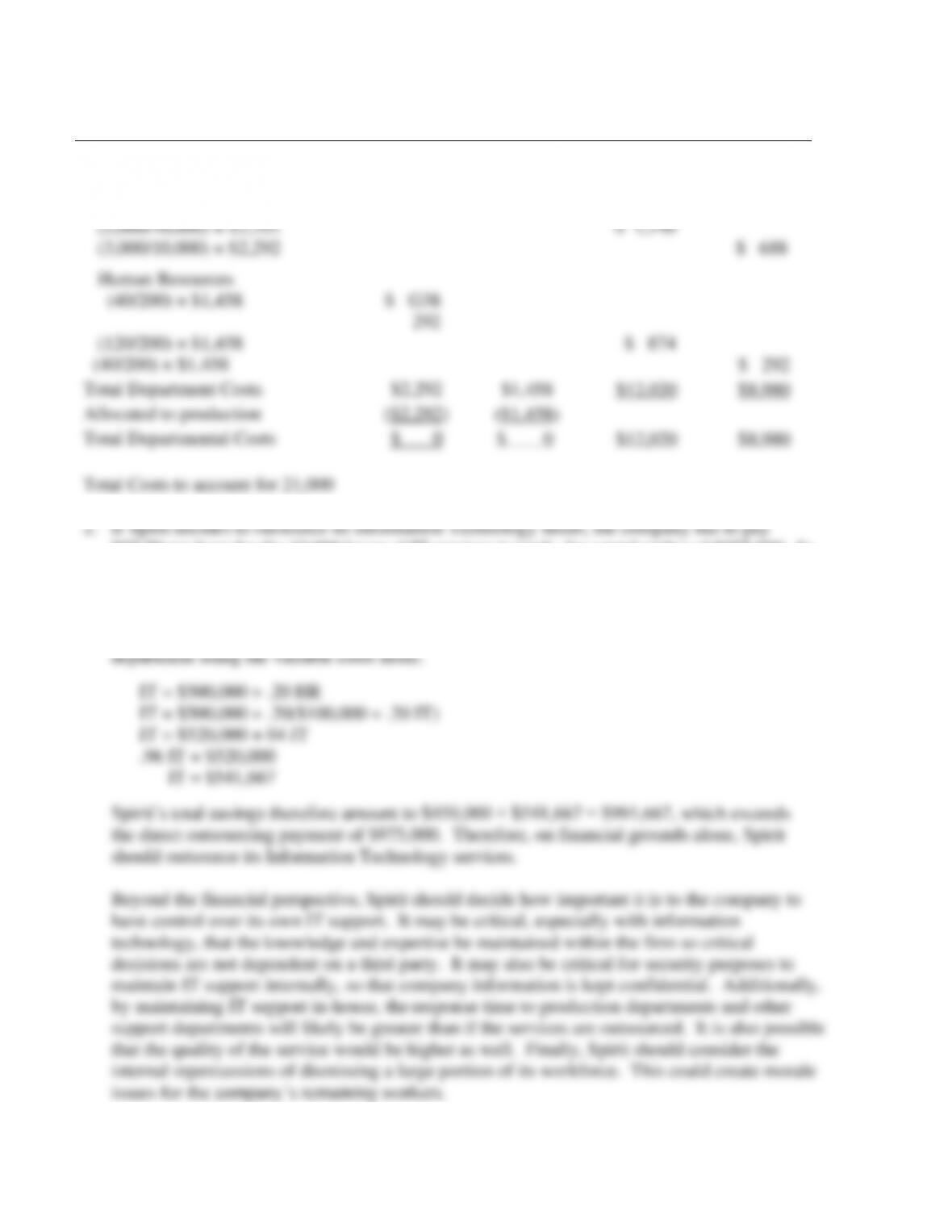
d. Allocate the Support Department Costs to the Production Department under the
Reciprocal Allocation Method:
a. Assign reciprocal equations to the support departments
IT = ($2,000 + .20 HR)
HR = ($1,000 + .20 IT)
(.20 = 40 employees out of a total of 200 supported by HR were in the IT department)
(.20= 2,000 of IT’s total 10,000 hours are spent supporting HR)
b. Solve the equation to complete the reciprocal costs of the support departments
IT = $2,000 + .20 HR
IT = $2,000 + .20($1,000 + .20 IT)
IT = $2,000 + $200 +.04 IT
.96 IT = $2,200
IT = $2,291.67
HR = $1,000 + .20 IT
HR = $1,000 + .20(2,291.67)
HR = $1,000 + 458.33
HR = $1,458.33
15-36
c. Allocate Reciprocal costs to departments (all numbers rounded to nearest dollar)
IT
HR
Clothing
Shoes
Departmental Costs
$2,000
$1,000
$10,000
$8,000
Information Technology
(2,000/10,000) × $2,292
$ 458
(5,000/10,000) × $2,292
$ 1,146
(3,000/10,000) × $2,292
$ 688
Human Resources
(40/200) × $1,458
$ G38
292
(120/200) × $1,458
$ 874
(40/200) × $1,458
$ 292
Total Department Costs
$2,292
$1,458
$12,020
$8,980
Allocated to production
($2,292)
($1,458)
Total Departmental Costs
$ 0
$ 0
$12,020
$8,980
Total Costs to account for 21,000
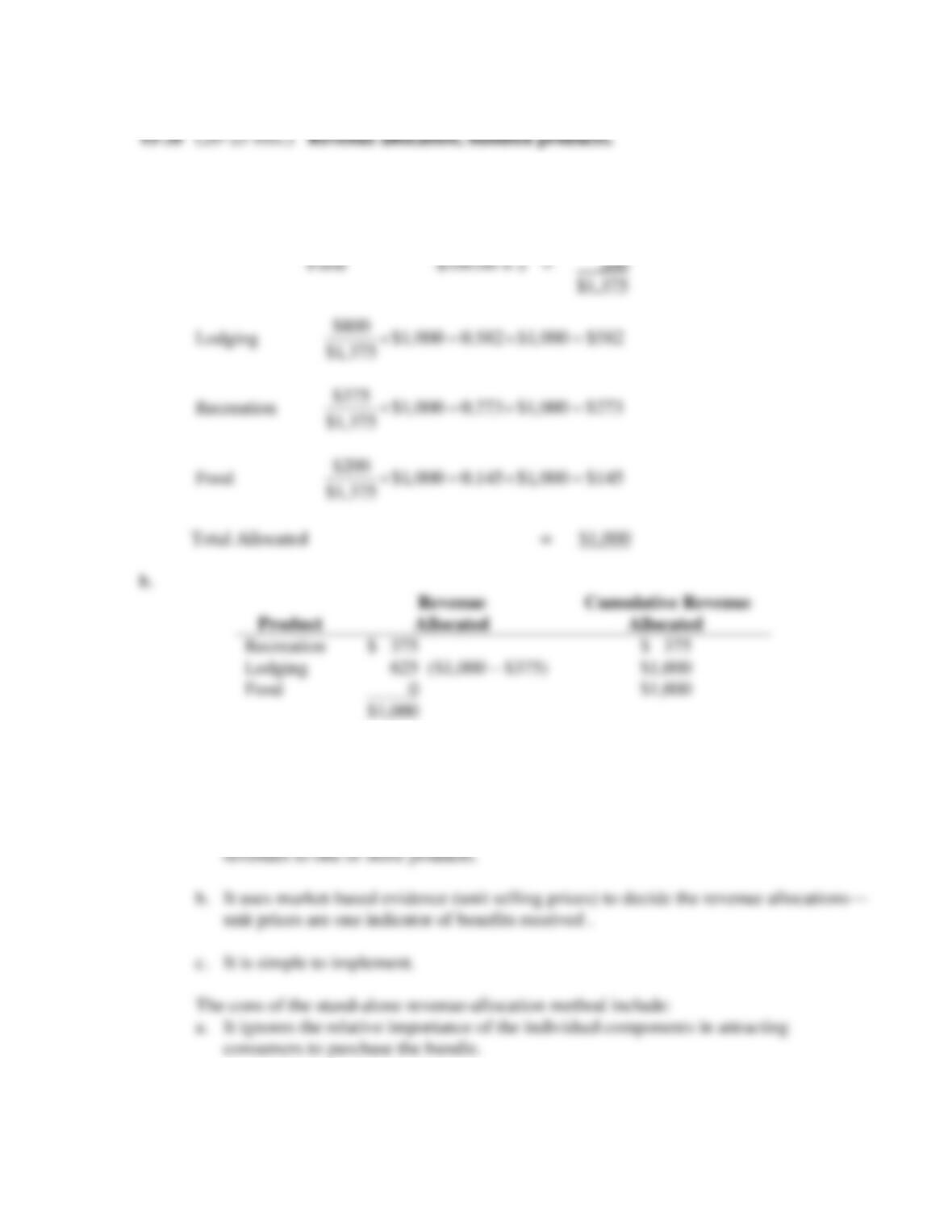
$97.50 per hour for the 10,000 hours of IT services it needs, for a total outlay of $975,000. In
return, Spirit saves 30% of the IT department’s fixed costs ($1,500,000 × 0.30 = $450,000).
The issue then is how much it saves in variable costs. The key is to recognize that Spirit saves
more than the $500,000 of variable costs assigned to IT because of the interlinks between the
IT and HR groups. To quantify this, we have to calculate the reciprocated cost of the IT
Collaborative Learning Problem
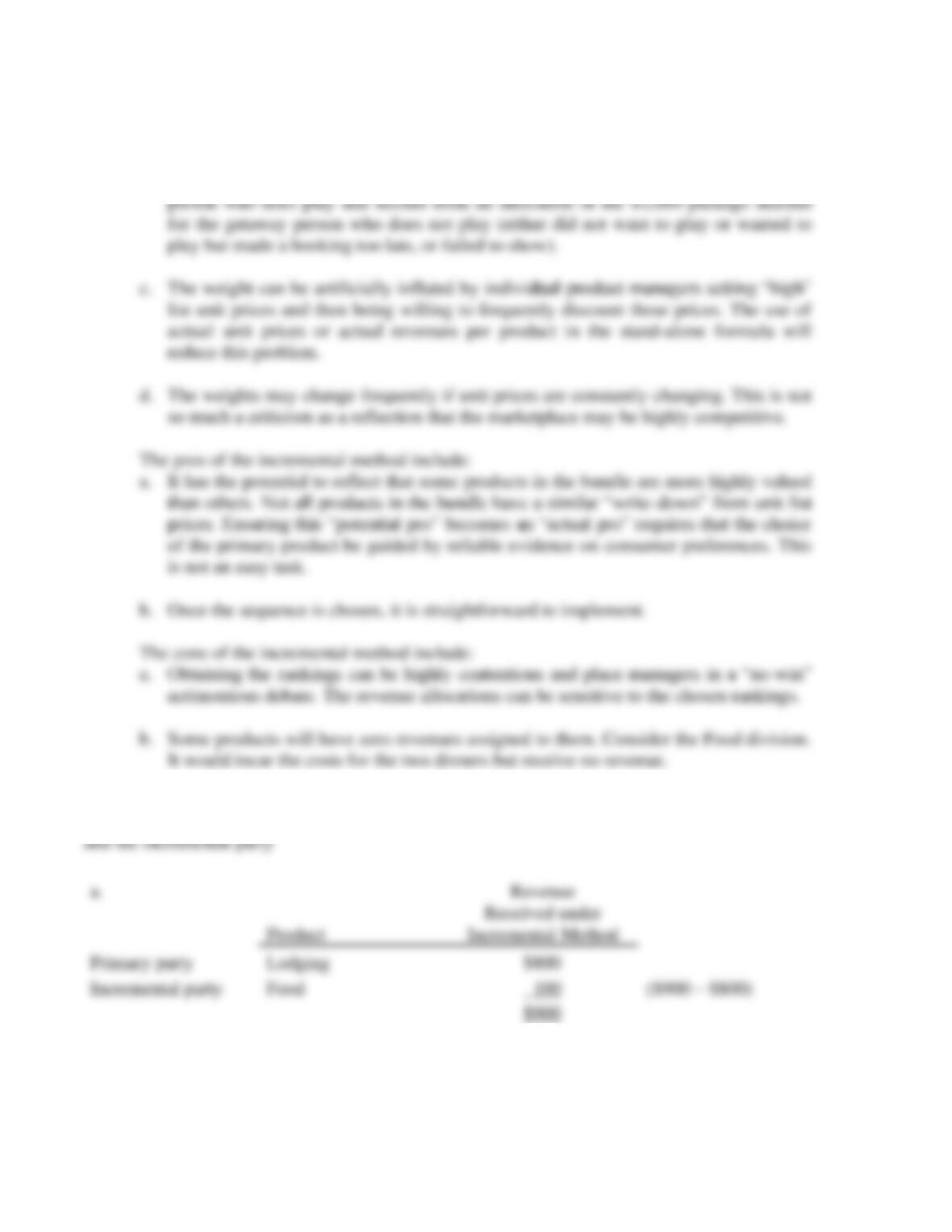
1.a. The stand-alone revenues (using unit selling prices) of the three components of the
$1,000 package are:
Lodging $400.00 × 2 = $ 800
Recreation $187.50 × 2 = 375
b. It ignores the opportunity cost of the individual components in the bundle. The golf
course operates at 100% capacity. Getaway participants must reserve a golf booking
one week in advance, or else they are not guaranteed playing time. A getaway
participant who does not use the golf option may not displace anyone. Thus, under the
stand-alone method, the golf course may be paid twice—once from the non-getaway
3. Under the Shapley value method the revenue allocated represents an average of the revenue
that would have been received if each product or service were ranked as both the primary party
Product
Revenue Received
under Incremental
Method
Primary Party
Food
$200
Incremental Party
Lodging
700
($900 – $200)
$900