15-11
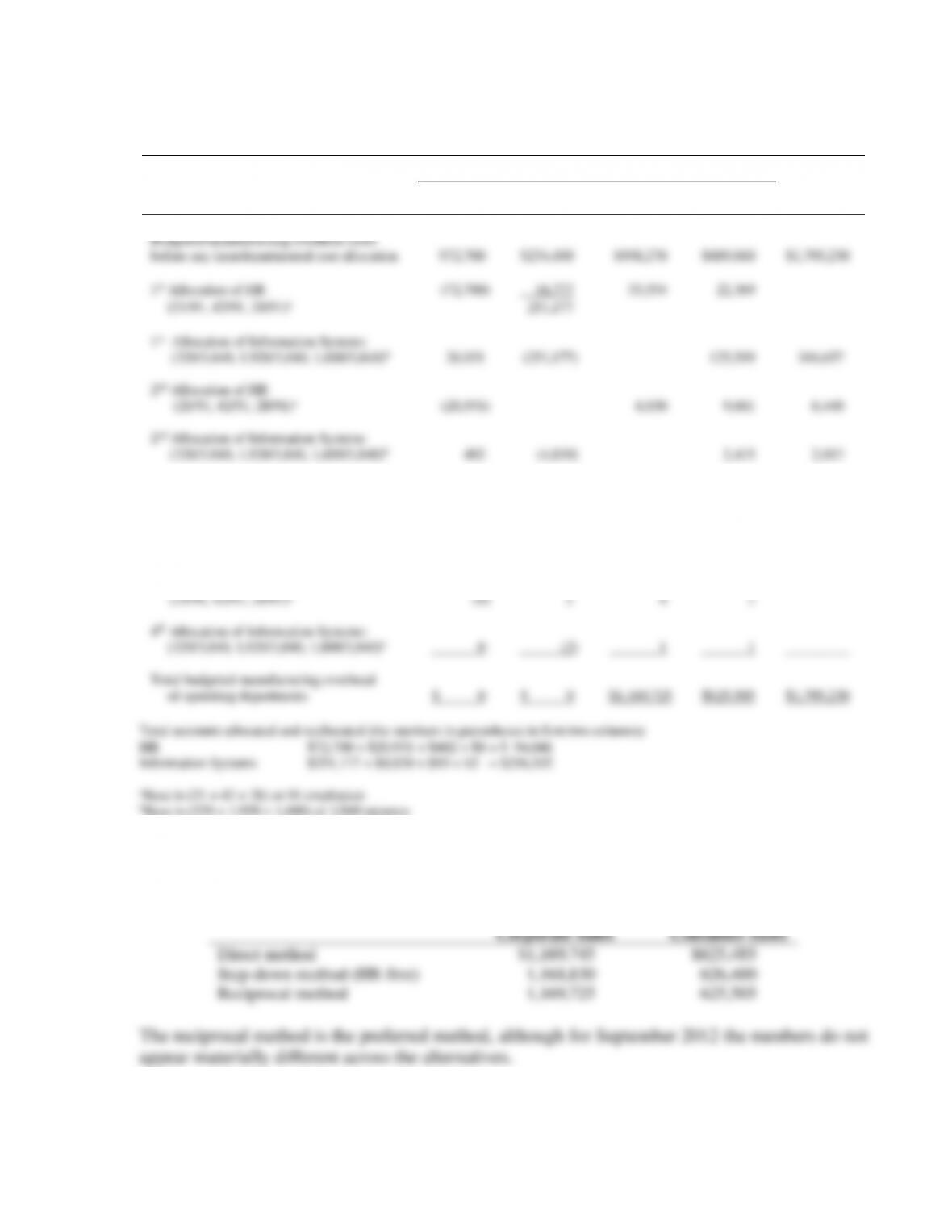
SOLUTION EXHIBIT 15-22
Reciprocal Method of Allocating Support Department Costs for September 2012 at
E-books Using Repeated Iterations
Support Departments
Operating Departments
Human
Resources
Information
Systems
Corporate
Sales
Consumer
Sales
Total
Budgeted manufacturing overhead costs
before any interdepartmental cost allocation
$72,700
$234,400
$998,270
$489,860
$1,795,230
1st Allocation of HR
(72,700)
16,777
33,554
22,369
(21/91, 42/91, 28/91)a
251,177
1st Allocation of Information Systems
(320/3,840, 1,920/3,840, 1,600/3,840)b
20,931
(251,177)
125,589
104,657
2nd Allocation of HR
(21/91, 42/91, 28/91)a
(20,931)
4,830
9,661
6,440
2nd Allocation of Information Systems
(320/3,840, 1,920/3,840, 1,600/3,840)b
402
(4,830)
2,415
2,013
3rd Allocation of HR
(21/91, 42/91, 28/91)a
(402)
93
185
124
3rd Allocation of Information Systems
(320/3,840, 1,920/3,840, 1,600/3,840)b
8
(93)
46
39
4th Allocation of HR
(21/91, 42/91, 28/91)a
(8)
2
4
2
4th Allocation of Information Systems:
(320/3,840, 1,920/3,840, 1,600/3,840)b
0
(2)
1
1
_________
Total budgeted manufacturing overhead
of operating departments
$ 0
$ 0
$1,169,725
$625,505
$1,795,230
Total accounts allocated and reallocated (the numbers in parentheses in first two columns)
HR $72,700 + $20,931 + $402 + $8 = $ 94,041
Information Systems $251,177 + $4,830 + $93 + $2 = $256,102
aBase is (21 + 42 + 28) or 91 employees
bBase is (320 + 1,920 + 1,600) or 3,840 minutes
3. The reciprocal method is more accurate than the direct and step-down methods when there
are reciprocal relationships among support departments.
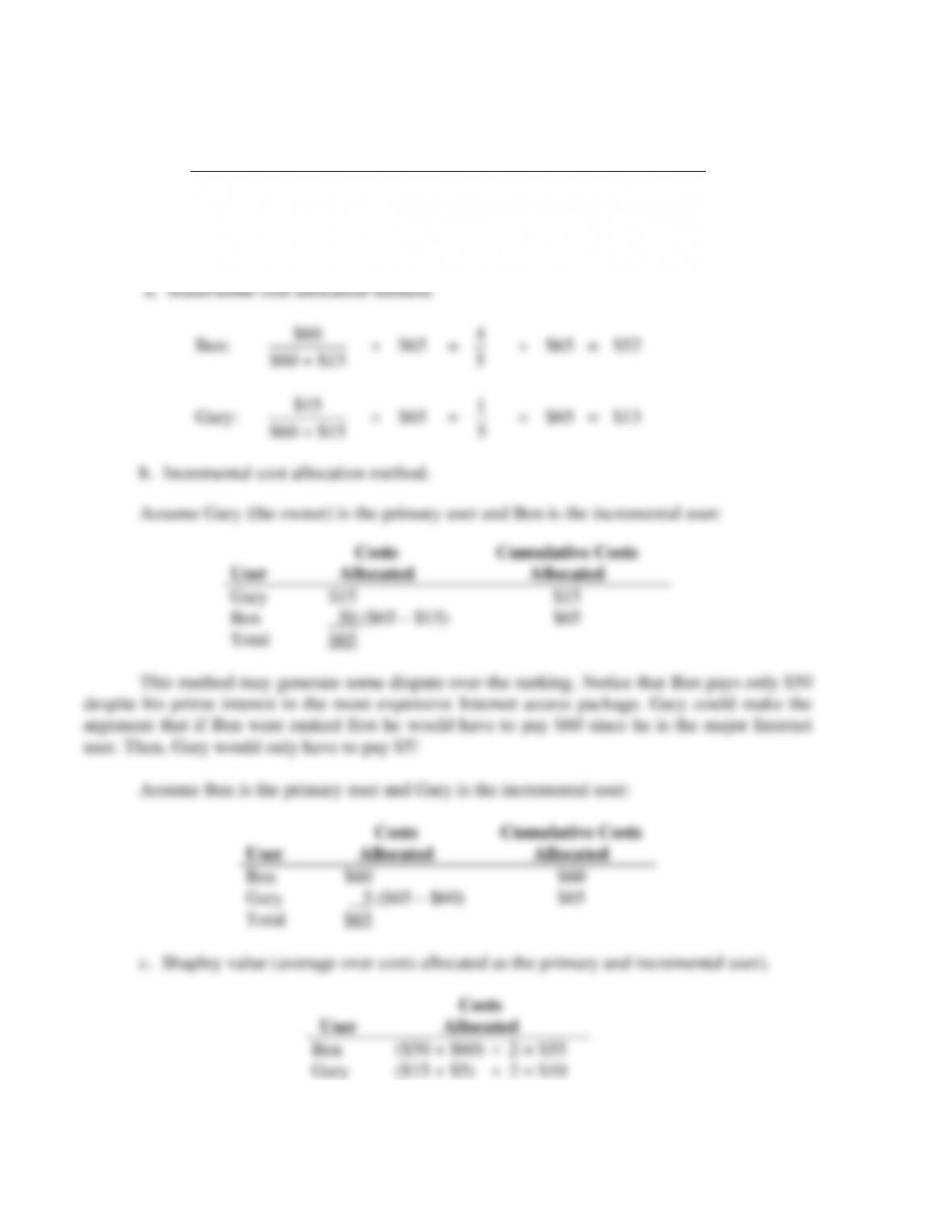
A summary of the alternatives is:
Corporate Sales
Consumer Sales
Direct method
$1,169,745
$625,485
Step-down method (HR first)
1,168,830
626,400
Reciprocal method
1,169,725
625,505
The reciprocal method is the preferred method, although for September 2012 the numbers do not
appear materially different across the alternatives.
15-23 (20−25 min.) Allocation of common costs.
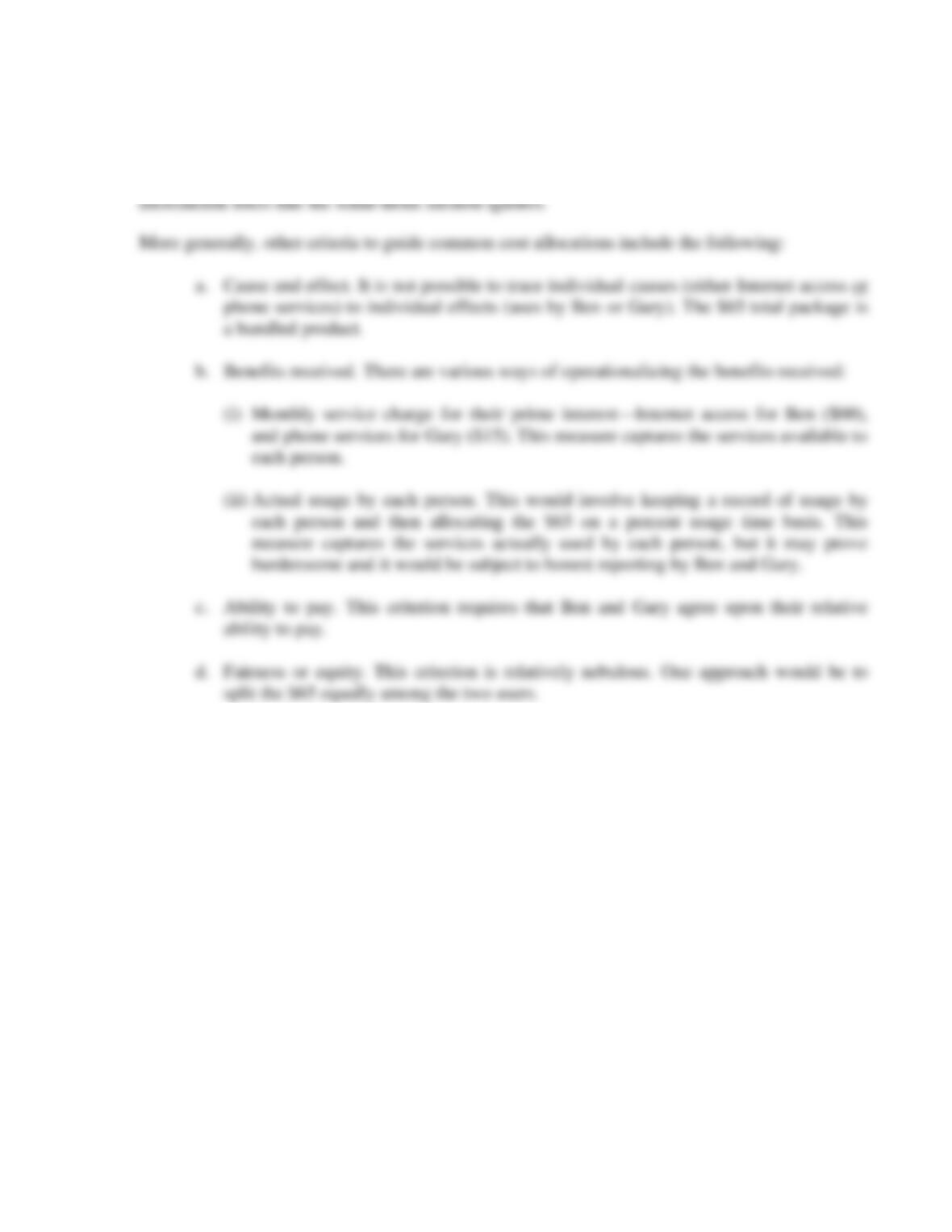
1. Three methods of allocating the $55 are:
Ben
Gary
Stand-alone
Incremental (Gary primary)
Incremental (Ben primary)
Shapley value
$52
15
60
55
$13
50
5
10
15-13
2. The Shapley value approach is recommended. It is fairer than the incremental method
because it avoids considering one user as the primary user and allocating more of the common
costs to that user. It also avoids disputes about who is the primary user. It allocates costs in a
manner that is close to the costs allocated under the stand-alone method but takes a more
comprehensive view of the common cost allocation problem by considering primary and
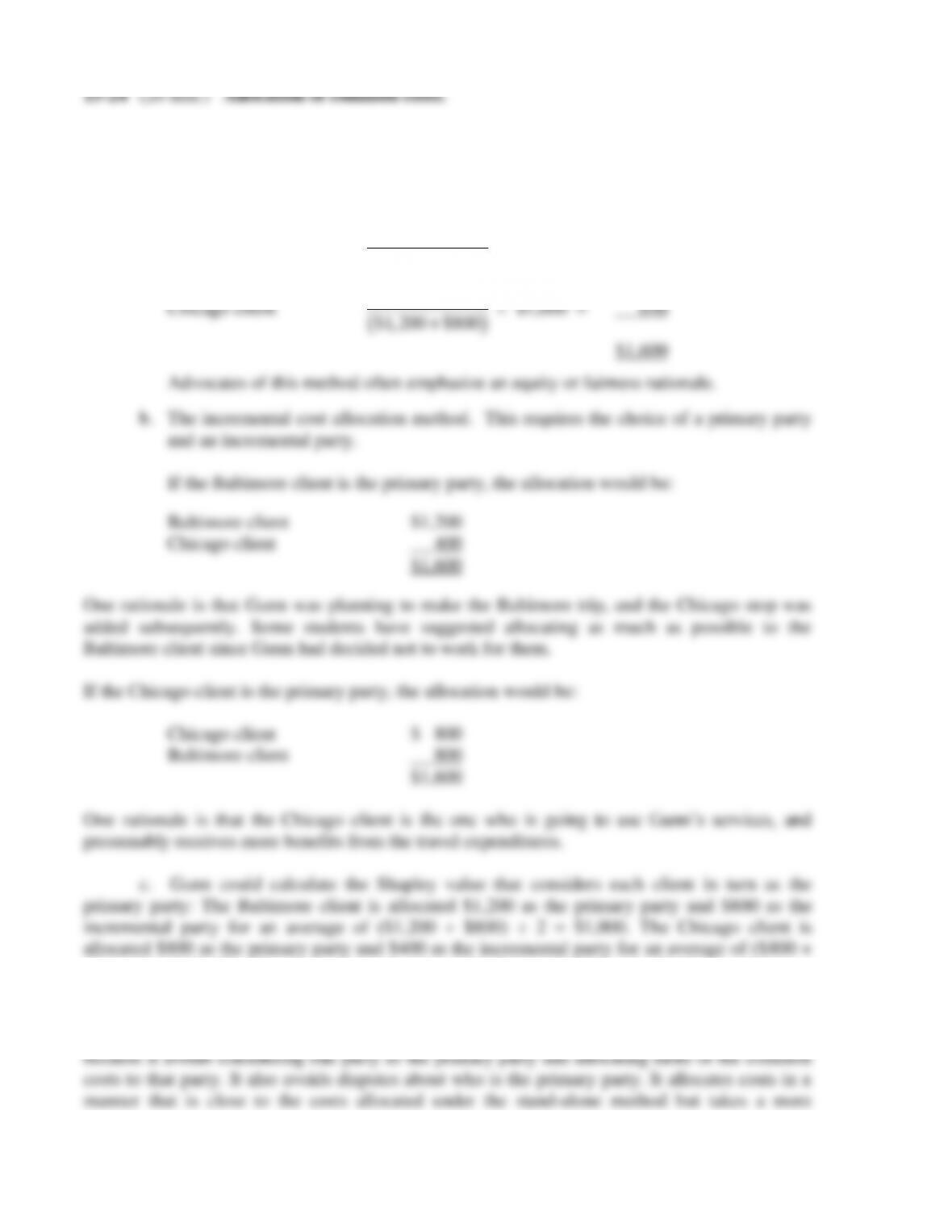
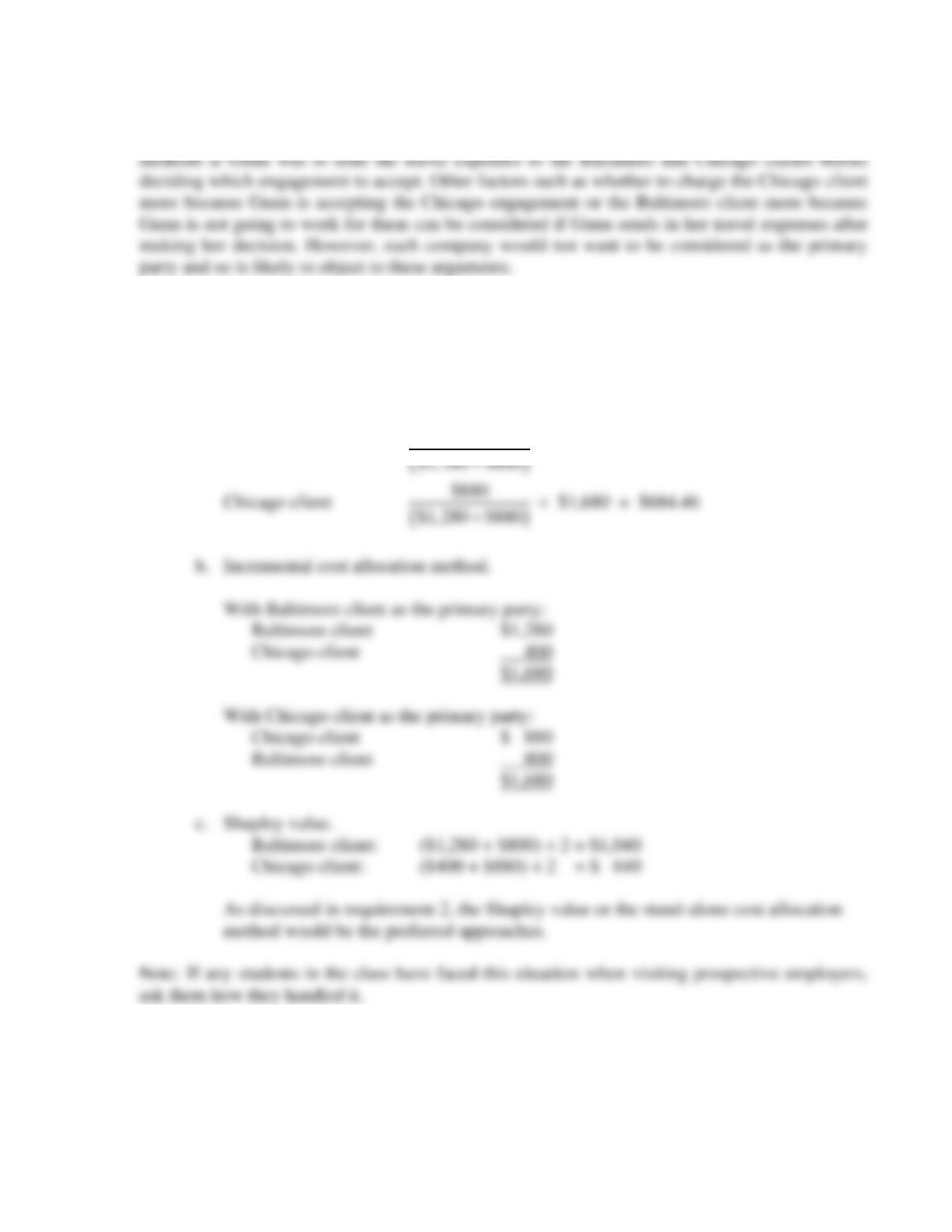
1. Alternative approaches for the allocation of the $1,600 airfare include the following:
a. The stand-alone cost allocation method. This method would allocate the air fare on
the basis of each client’s percentage of the total of the individual stand-alone costs.
Baltimore client
( )
$1,200
$1,200 $800+
$1,600 = $ 960
$800
15-15
comprehensive view of the common cost allocation problem by considering primary and
incremental users, which the stand-alone method ignores.
The Shapley value (or the stand-alone cost allocation method) would be the preferred
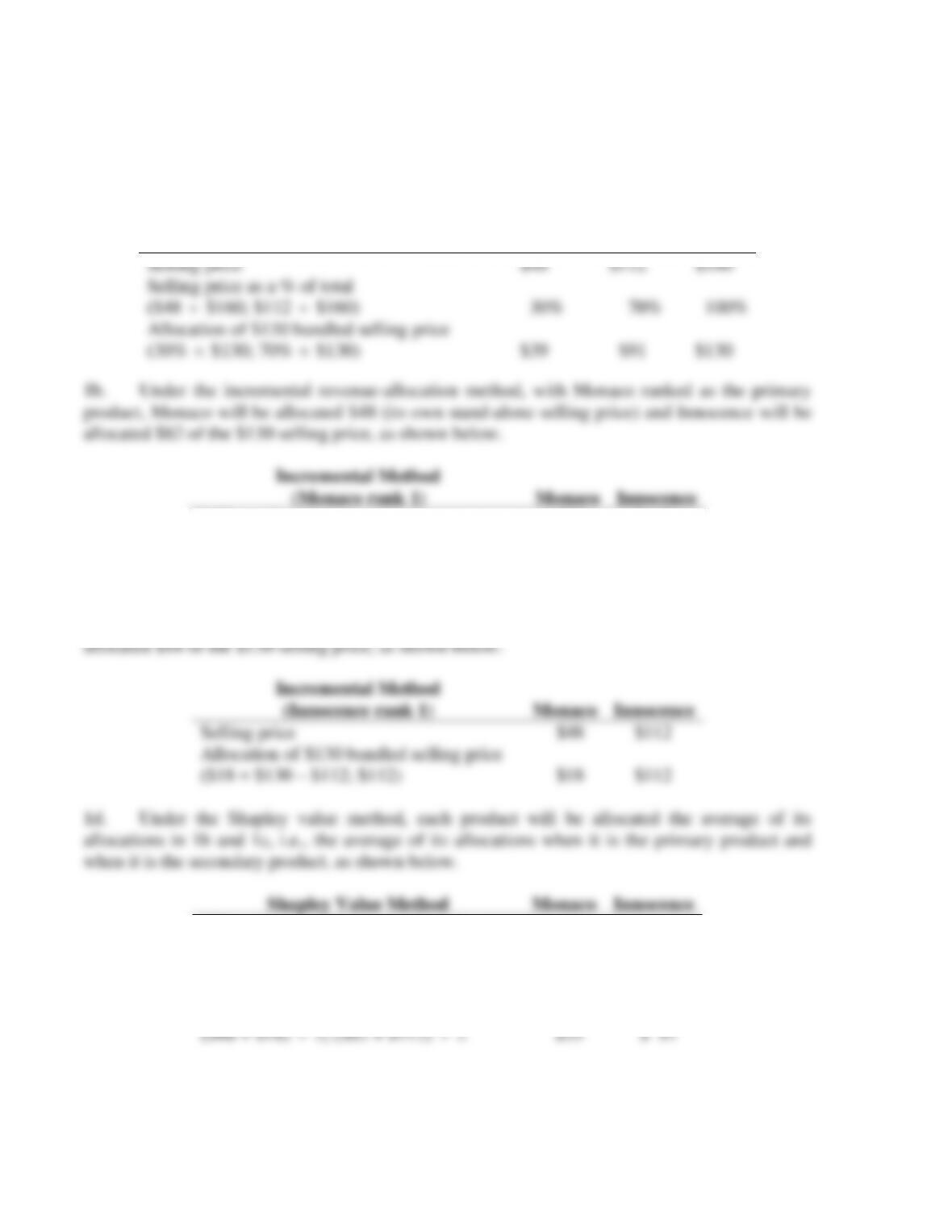
3. A simple approach is to split the $80 equally between the two clients. The limousine
costs at the Sacramento end are not a function of distance traveled on the plane.
An alternative approach is to add the $80 to the $1,600 and repeat requirement 1:
a. Stand-alone cost allocation method.
Baltimore client
( )
$1,280
$1,280 $880+
$1,680 = $995.56
( )
$1,280 $880+
$880
15-25 (20 min.) Revenue allocation, bundled products.
1a. Under the stand alone revenue-allocation method based on selling price, Monaco will be
allocated 30% of all revenues, or $39 of the bundled selling price, and Innocence will be
allocated 70% of all revenues, or $91 of the bundled selling price, as shown below.
Stand-alone method, based on selling
prices
Monaco
Innocence
Total
Selling price
$48
$112
$160
Selling price as a % of total
($48
$160; $112
$160)
30%
70%
100%
Allocation of $130 bundled selling price
(30%
$130; 70%
$130)
$39
$91
$130
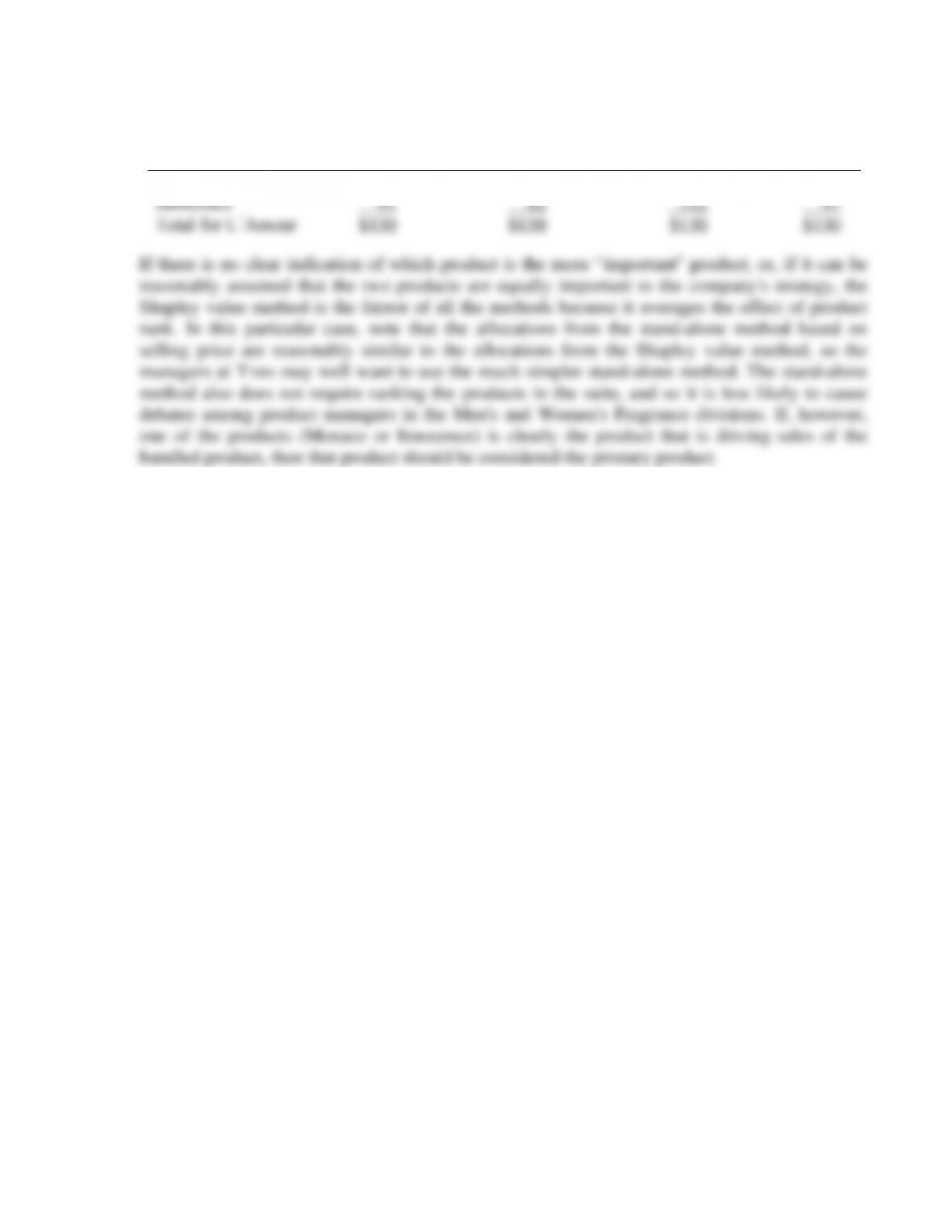
1b. Under the incremental revenue-allocation method, with Monaco ranked as the primary
product, Monaco will be allocated $48 (its own stand-alone selling price) and Innocence will be
allocated $82 of the $130 selling price, as shown below.
Incremental Method
(Monaco rank 1)
Monaco
Innocence
Selling price
$48
$112
Allocation of $130 bundled selling price
($48; $82 = $130 – $48)
$48
$82
1c. Under the incremental revenue-allocation method, with Innocence ranked as the primary
product, Innocence will be allocated $112 (its own stand-alone selling price) and Monaco will be
Selling price
$112
Allocation of $130 bundled selling price
$112
Monaco
Innocence
Allocation when Monaco = Rank 1;
Average of allocated selling price
15-17
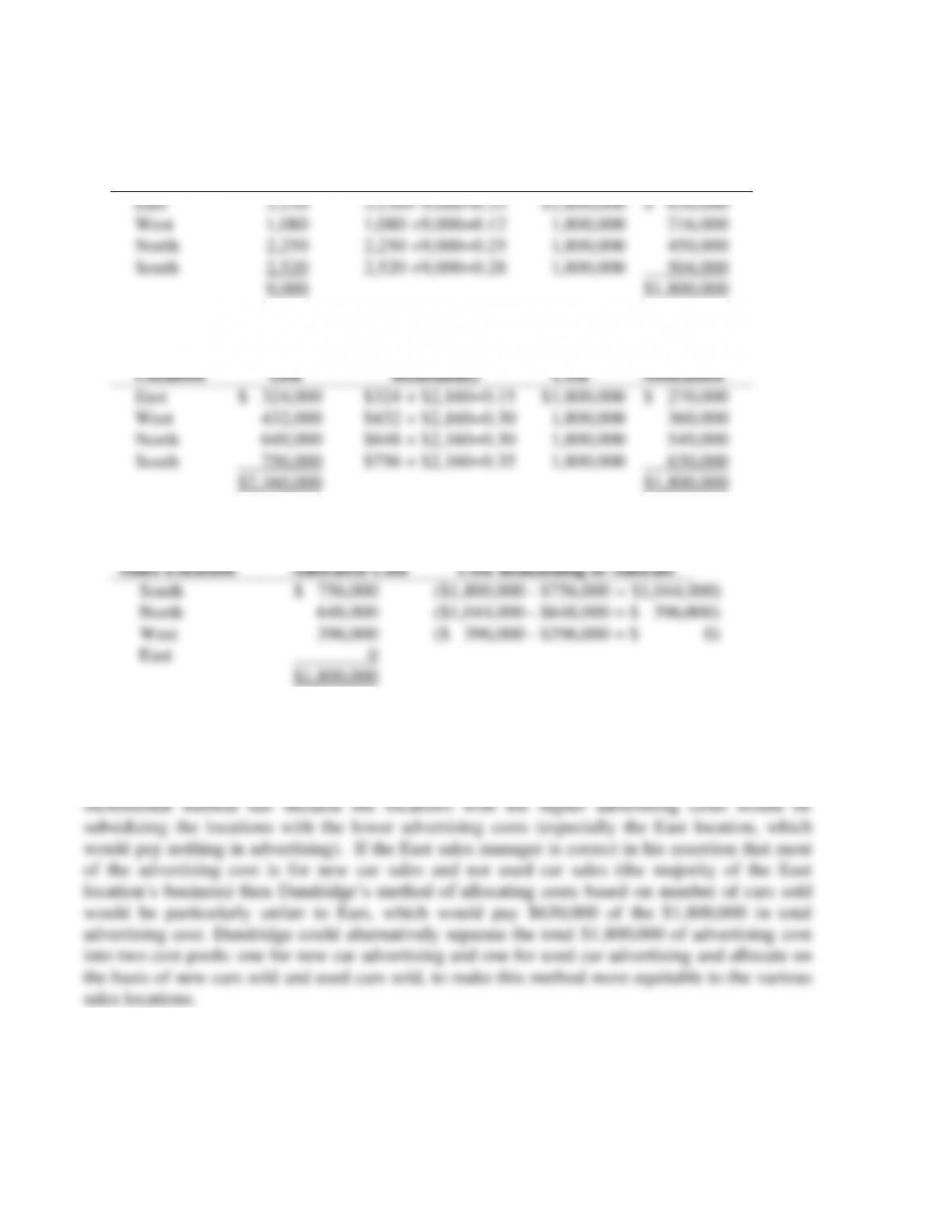
2. A summary of the allocations based on the four methods in requirement 1 is shown below.
Stand-alone
(Selling Prices)
Incremental
(Monaco first)
Incremental
(Innocence first)
Shapley
Monaco
$ 39
$ 48
$ 18
$ 33
Innocence
91
82
112
97
Total for L’Amour
$130
$130
$130
$130
15-18
15-26 (20-25 min. ) Allocation of Common Costs
1. a. Dandridge’s method based on number of cars sold:
Sales
Location
Number of
cars sold
Percentage
Joint
Cost
Allocation
1. b. Stand-alone method:
Sales
Location
Stand-alone
cost
Percentage (costs in
thousands)
Joint
Cost
Allocation
1. c. Incremental method (locations ranked in order of largest advertising dollars to smallest
advertising dollars):
Sales Location
Allocated Cost
Cost Remaining to Allocate
South $ 756,000 ($1,800,000 – $756,000 = $1,044,000)
North 648,000 ($1,044,000 – $648,000 = $ 396,000)
West 396,000 ($ 396,000 – $396,000 = $ 0)
East 0
$1,800,000
2. In this situation, the stand-alone method is probably the best method because the weights it
uses for allocation are based on the individual advertising cost for each location as a separate
entity. Therefore, each entity gets the same relative proportion of advertising costs and each
location will have lower total advertising costs. The sales managers would likely not consider the
15-19
15-27 (20 min.) Single-rate, dual-rate, and practical capacity allocation.
Budgeted number of gifts wrapped = 6,650
1.a. Allocation based on budgeted usage of gift-wrapping services:
Women’s Face Wash (2,470 × $1.40)
$3,458
Men’s Face Wash (825 × $1.40)
1,155
Fragrances (1,805 × $1.40)
2,527
Body Wash (430 × $1.40)
602
Hair Products (1,120 × $1.40)
1,568
Total
$9,310
1.b. Allocation based on actual usage of gift-wrapping services:
Women’s Face Wash (2,020 × $1.40)
$2,828
Men’s Face Wash (730 × $1.40)
1,022
Fragrances (1,560 × $1.40)
2,184
Body Wash (545 × $1.40)
763
Hair Products (1,495 × $1.40)
2,093
Total
$8,890
1.c. Practical gift-wrapping capacity = 7,000
Budgeted fixed costs = $6,650
Fixed cost per gift based on practical capacity = $6,650 ÷ 7,000 = $0.95
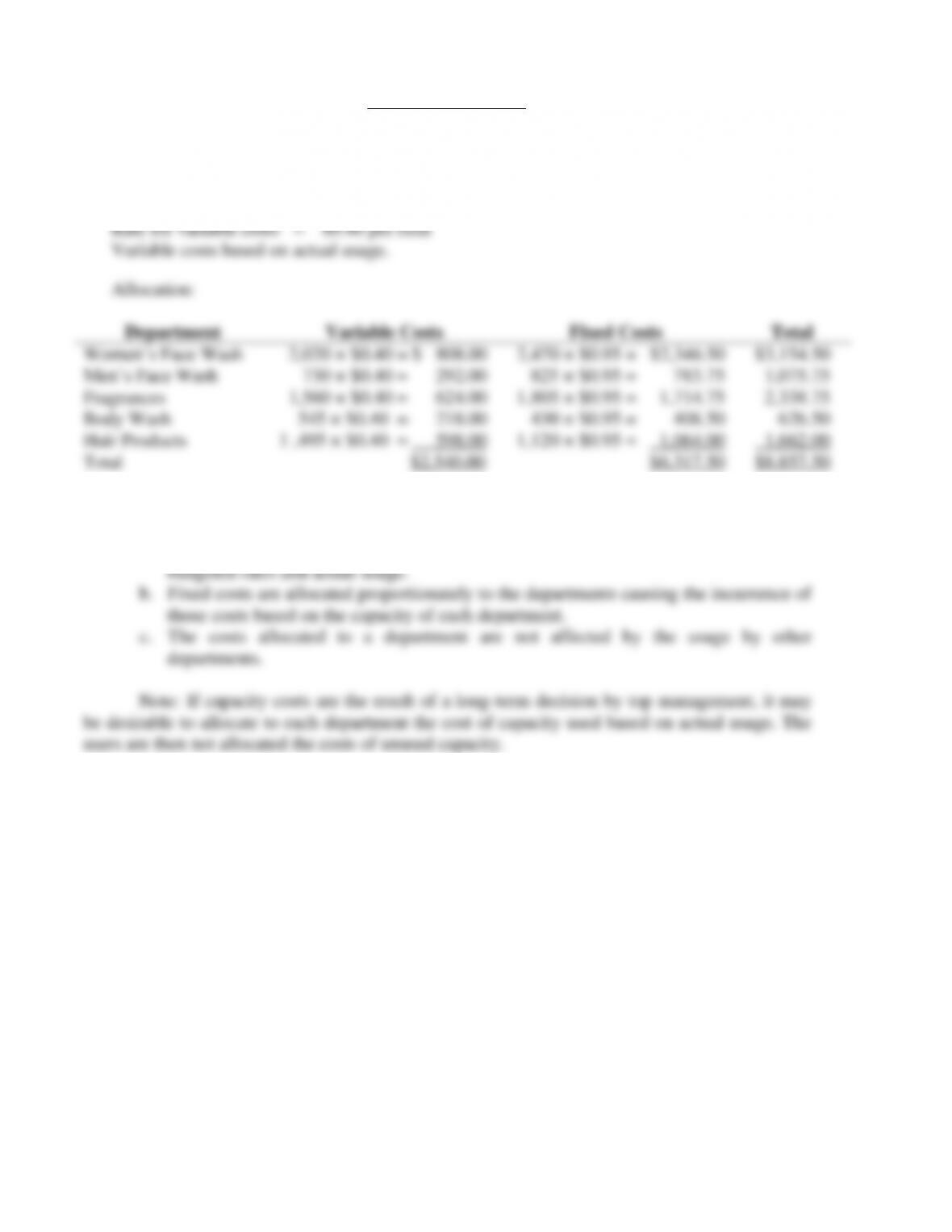
2. Budgeted rate for fixed costs =
Budgeted fixed costs
Practical capacity
= $6,650 ÷ 7,000 gifts = $0.95 per gift
Fixed costs allocated on budgeted usage.