13-1
CHAPTER 13
13-2 The five key forces to consider in industry analysis are: (a) competitors, (b) potential
13-3 Two generic strategies are (1) product differentiation, an organization’s ability to offer
products or services perceived by its customers to be superior and unique relative to the products
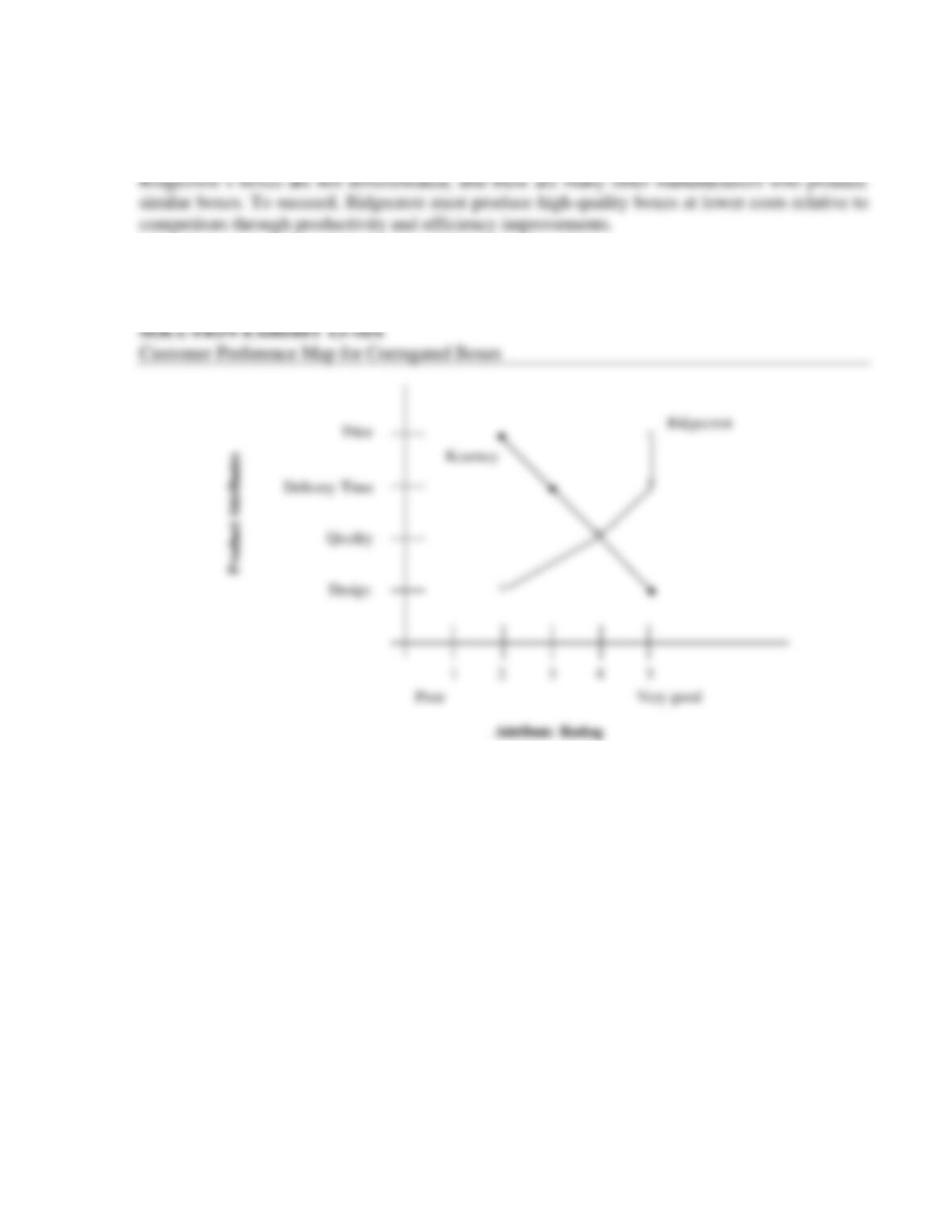
13-4 A customer preference map describes how different competitors perform across various
product attributes desired by customers, such as price, quality, customer service and product
features.
13-5 Reengineering is the fundamental rethinking and redesign of business processes to
13-6 The four key perspectives in the balanced scorecard are: (1) Financial perspective—this
perspective evaluates the profitability of the strategy and the creation of shareholder value, (2)
Customer perspective—this perspective identifies the targeted customer and market segments
13-7 A strategy map is a diagram that describes how an organization creates value by
1. It tells the story of a company’s strategy by articulating a sequence of cause-and-effect
relationships.
targets.
3. It places strong emphasis on financial objectives and measures in for-profit companies.
4. It limits the number of measures to only those that are critical to the implementation of
strategy.
13-2
5. It highlights suboptimal tradeoffs that managers may make when they fail to consider
operational and financial measures together.
1. Don’t assume the cause-and-effect linkages are precise; they are merely hypotheses. An
organization must gather evidence of these linkages over time.
3. Don’t use only objective measures in the balanced scorecard.
5. Don’t ignore nonfinancial measures when evaluating managers and employees.
1. The growth component which measures the change in operating income attributable
solely to the change in quantity of output sold from one year to the next.
next.
3. The productivity component which measures the change in costs attributable to a change
13-11 An analyst can incorporate other factors such as the growth in the overall market and
reductions in selling prices resulting from productivity gains into a strategic analysis of operating
13-12 Engineered costs result from a cause-and-effect relationship between the cost driver,
13-13 Downsizing (also called rightsizing) is an integrated approach configuring processes,
13-14 A partial productivity measure is the quantity of output produced divided by the quantity
of an individual input used (e.g., direct materials or direct manufacturing labor).
13-15 No. Total factor productivity (TFP) and partial productivity measures work best together
because the strengths of one offset weaknesses in the other. TFP measures are comprehensive,
13-3
13-16 (15 min.) Balanced scorecard.
1. Ridgecrest’s 2012 strategy is a cost leadership strategy. Ridgecrest plans to grow by
producing high-quality boxes at a low cost delivered to customers in a timely manner.
2. Solution Exhibit 13-16A shows the customer preference map for corrugated boxes for
Ridgecrest and Mesa on price, timeliness, quality and design.
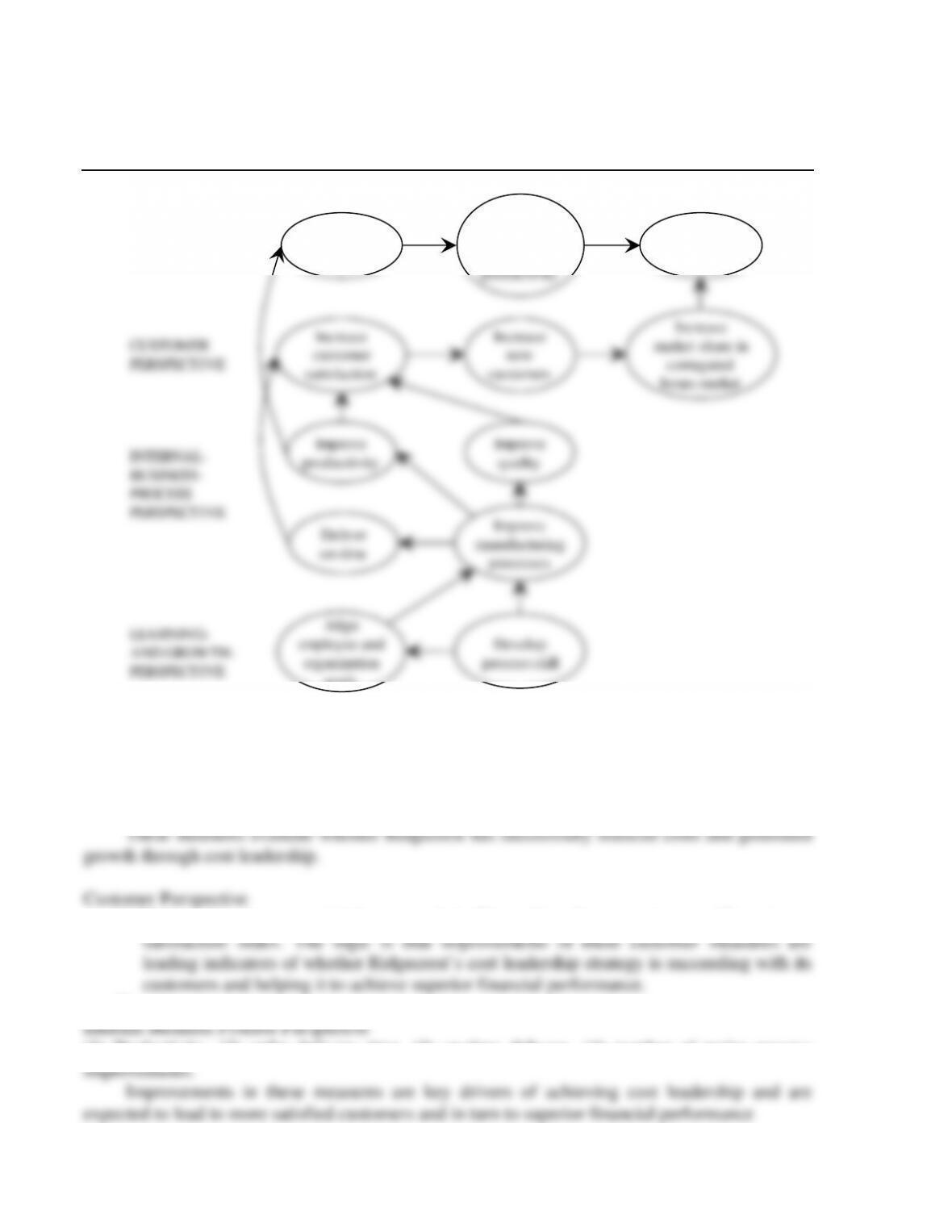
3. Solution Exhibit 13-16B presents the strategy map for Ridgecrest for 2012.
SOLUTION EXHIBIT 13-16B
Strategy Map for Ridgecrest for 2012
FINANCIAL
PERSPECTIVE
CUSTOMER
PERSPECTIVE
INTERNAL–
BUSINESS-
PROCESS
PERSPECTIVE
LEARNING-
AND GROWTH–
PERSPECTIVE
Reduce
Costs
Increase
operating
income from
productivity
Improve
manufacturing
processes
Develop
process skill
Increase
market share in
corrugated
boxes market
Grow
operating
income
Increase
customer
satisfaction
Increase
new
customers
Improve
productivity Improve
quality
Deliver
on–time
Align
employee and
organization
goals
4. Measures that we would expect to see on a Ridgecrest’s balanced scorecard for 2012 are
Financial Perspective
(1) Operating income from productivity gain, (2) operating income from growth, (3) cost
13-5
Learning and Growth Perspective
(1) Percentage of employees trained in process and quality management, (2) employee
satisfaction ratings.
1. Ridgecrest’s operating income gain is consistent with the cost leadership strategy
identified in requirement 1 of Exercise 13-16. The increase in operating income in 2012 was
2. The productivity component measures the change in costs attributable to a change in the
quantity and mix of inputs used in a year relative to the quantity and mix of inputs that would
have been used in a previous year to produce the current year output. It measures the amount by
which operating income increases and costs decrease through the productive use of input
13-6
13-18 (20 min.) Strategy, balanced scorecard, merchandising operation.
1. Roberto & Sons follows a product differentiation strategy. Roberto’s designs are
product.
2. Possible key elements of Roberto’s balance scorecard, given its product differentiation
strategy:
Financial Perspective
(1) Increase in operating income from charging higher margins, (2) price premium earned on
products.
(1) Market share in distinctive, name-brand T-shirts, (2) customer satisfaction, (3) new
customers, (4) number of mentions of Roberto’s T–shirts in the leading fashion magazines
(1) Quality of silk-screening (number of colors, use of glitter, durability of the design), (2)
frequency of new designs, (3) time between concept and delivery of design
(3) continuous education and skill levels of marketing and sales staff, (4) employee satisfaction.
Improvements in these measures are expected to improve Roberto’s capabilities to
1. Operating Income Statement
2010
2011
Revenues ($25
198,000; $26
246,700)
$4,950,000
$6,414,200
Costs
T-shirts purchased ($10
200,000; $8.50
250,000)
2,000,000
2,125,000
Administrative costs
1,200,000
1,162,500
Total costs
3,200,000
3,287,500
Operating income
$1,750,000
$3,126,700
Change in operating income
$1,376,700 F
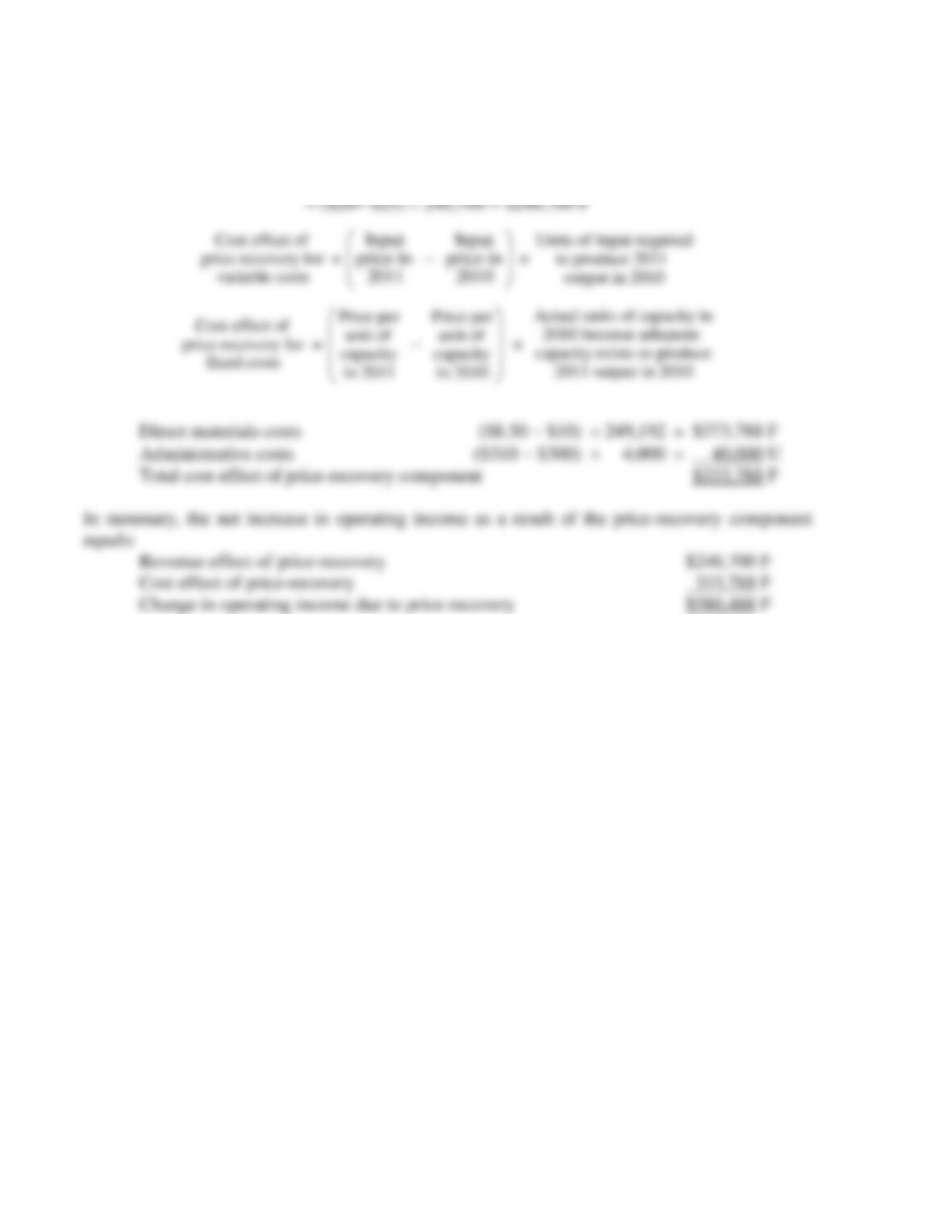
2. The Growth Component
Revenue effect
of growth
=
Actual units of Actual units of
output sold output sold
in 2011 in 2010
−
×
Selling
price
in 2010
price
in 2010
13-8
The Price-Recovery Component
Revenue effect of
price-recovery
( )
Actual units
Selling price Selling price
= of output
in 2011 in 2010 sold in 2011
−
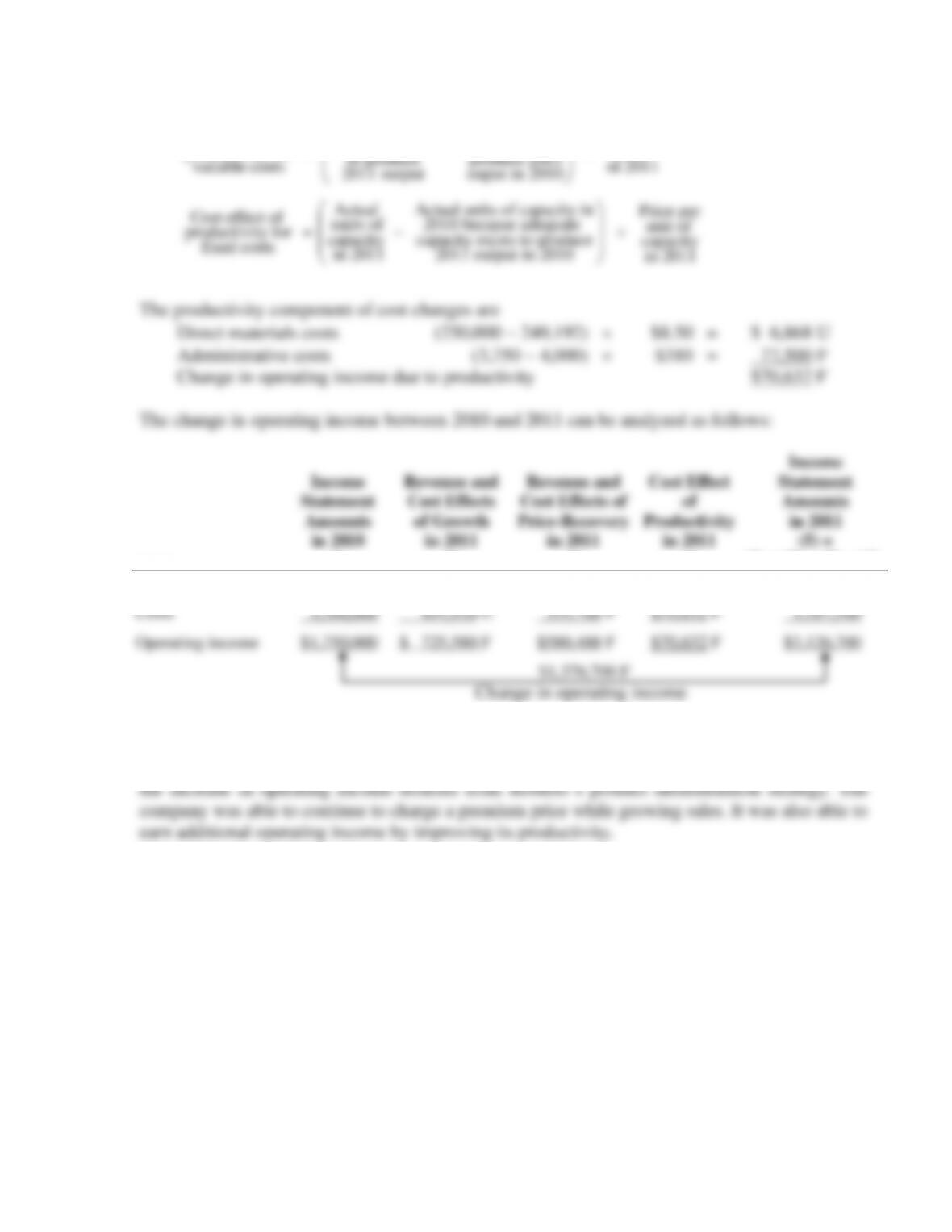
The Productivity Component
Cost effect of
productivity for
variable costs
=
Actual units of Units of input
input used required to
to produce produce 2011
2011 output ouput in 2010
−
Input
price
in 2011
Cost effect of
Actual Actual units of capacity in
units of 2010 because adequate
Price per
unit of
Income
Statement
Amounts
in 2010
(1)
Revenue and
Cost Effects
of Growth
in 2011
(2)
Revenue and
Cost Effects of
Price-Recovery
in 2011
(3)
Cost Effect
of
Productivity
in 2011
(4)
Income
Statement
Amounts
in 2011
(5) =
(1) + (2) + (3) + (4)
Revenues
$4,950,000
$1,217,500 F
$246,700 F
−−
$6,414,200
Costs
3,200,000
491,920 U
333,788 F
$70,632 F
3,287,500
Operating income
$1,750,000
$ 725,580 F
$580,488 F
$70,632 F
$3,126,700
$1,376,700 F
Change in operating income
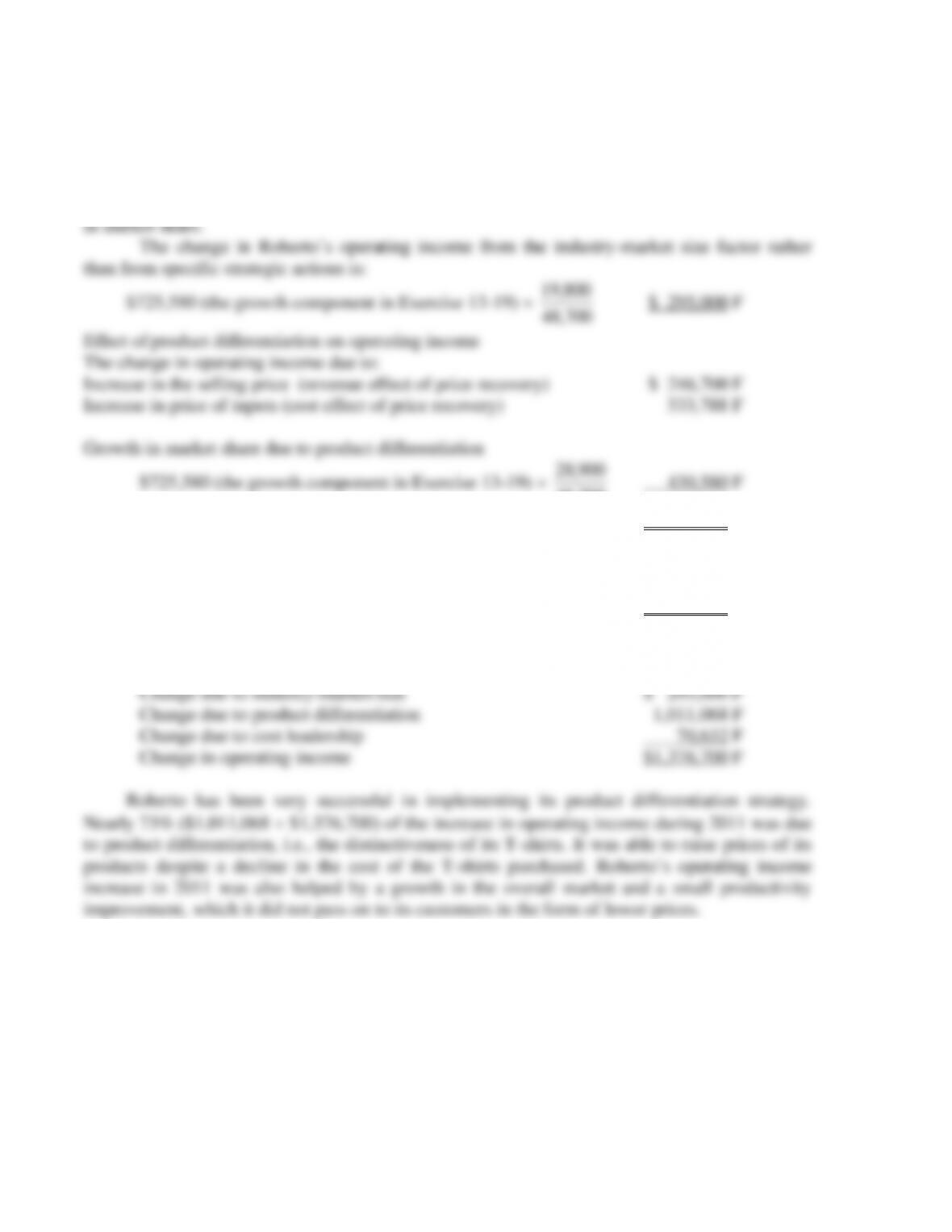
3. The analysis of operating income indicates that growth, price-recovery, and productivity
all resulted in favorable changes in operating income in 2011. Further, a significant amount of
13-10
13-20 (20 min.) Analysis of growth, price-recovery, and productivity components
(continuation of 13-19).
Effect of the industry–market-size factor on operating income
Of the 48,700-unit (246,700 – 198,000) increase in sales between 2010 and 2011, 19,800
(10% 198,000) units are due to growth in market size, and 28,900 units are due to an increase
700,48
Change in operating income due to product differentiation $1,011,068 F
Effect of cost leadership on operating income
The change in operating income from cost leadership is:
Productivity component $ 70,632 F
The change in operating income between 2010 and 2011 can be summarized as follows: