12-20
12-30 (25 min.) Cost-plus, target return on investment pricing.
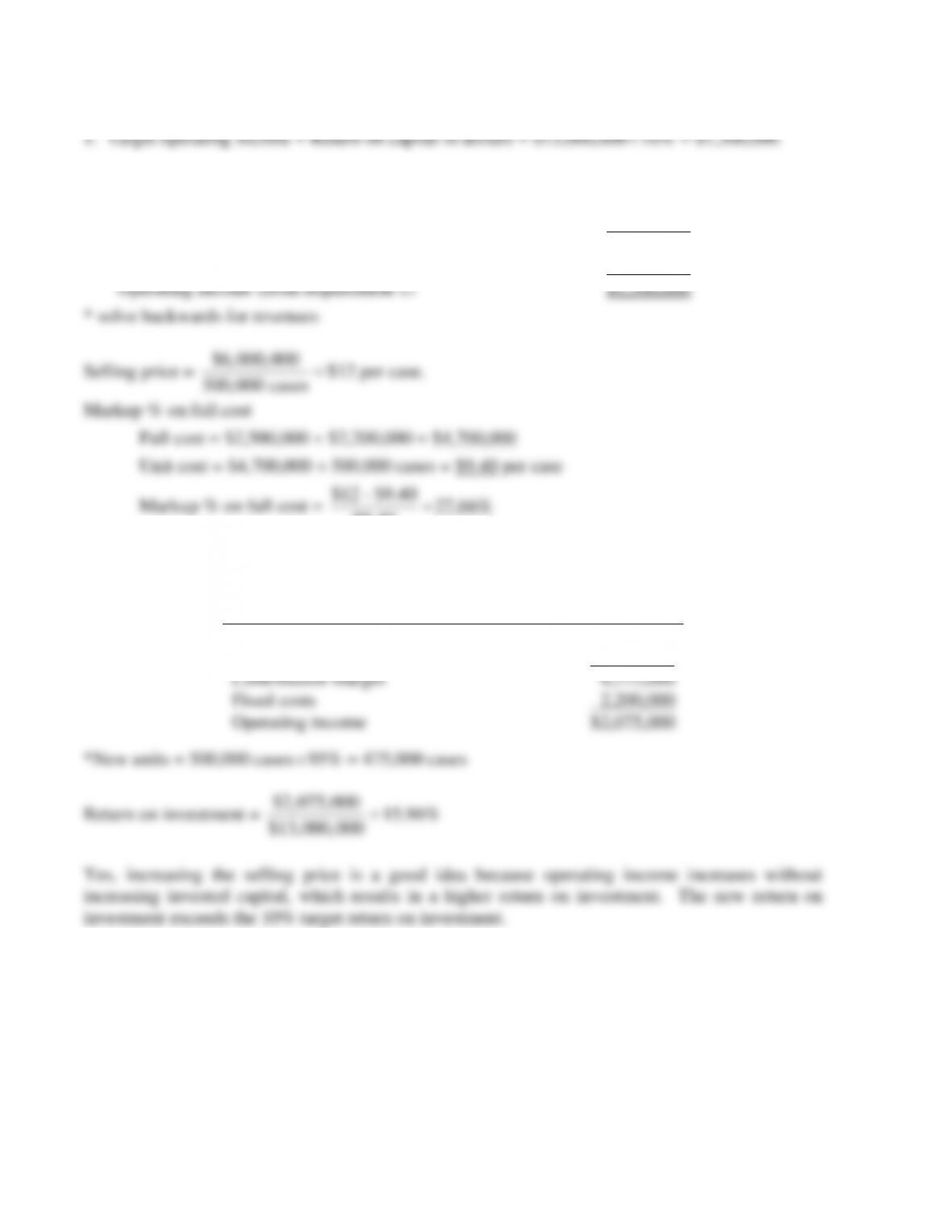
2.
Revenues*
$6,000,000
Variable costs [($3.50 + $1.50)
500,000 cases
2,500,000
Contribution margin
3,500,000
Fixed costs ($1,000,000 + $700,000 + $500,000)
2,200,000
Operating income (from requirement 1)
$1,300,000
* solve backwards for revenues
Selling price =
$6,000,000
500,000 cases =
$12 per case.
Markup % on full cost
Full cost = $2,500,000 + $2,200,000 = $4,700,000
Unit cost = $4,700,000 ÷ 500,000 cases = $9.40 per case
$12 – $9.40
$9.40 =
3.
Budgeted Operating Income
For the year ending December 31, 20xx
Revenues ($14
475,000 cases*)
$6,650,000
Variable costs ($5
475,000 cases)
2,375,000
Contribution margin
4,275,000
Fixed costs
2,200,000
Operating income
$2,075,000
12-21
12-31 (20 min.) Cost-plus, time and materials, ethics.
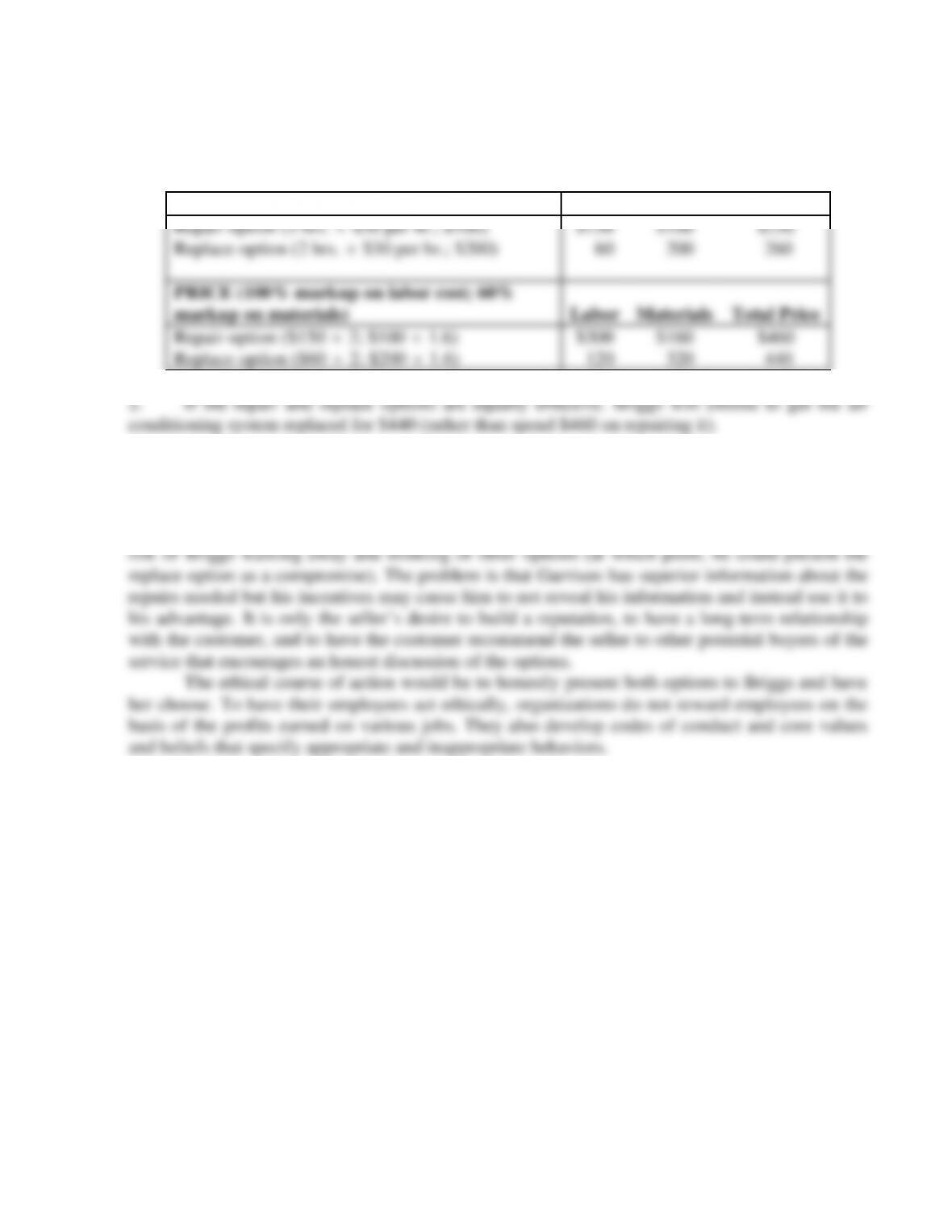
1. As shown in the table below, Garrison will tell Briggs that she will have to pay $460 to get
the air conditioning system repaired and $440 to get it replaced.
COST
Labor
Materials
Total Cost
Repair option (5 hrs.
$30 per hr.; $100)
$150
$100
$250
Replace option (2 hrs.
$30 per hr.; $200)
60
200
260
PRICE (100% markup on labor cost; 60%
markup on materials)
Labor
Materials
Total Price
Repair option ($150
2; $100
1.6)
$300
$160
$460
Replace option ($60
2; $200
1.6)
120
320
440
3. R&C Mechanical will earn a greater contribution toward overhead in the repair option
($210 = $460 – $250) than in the replace option ($180 = $440 – $260). Therefore, Garrison will
recommend the repair option to Briggs which is not the one she would prefer. Recognizing this
conflict, Garrison may even present only the repair option to Ashley Briggs. Of course, he runs the
12-22
1. California Temps’ full cost per hour of supplying contract labor is
Variable costs $13
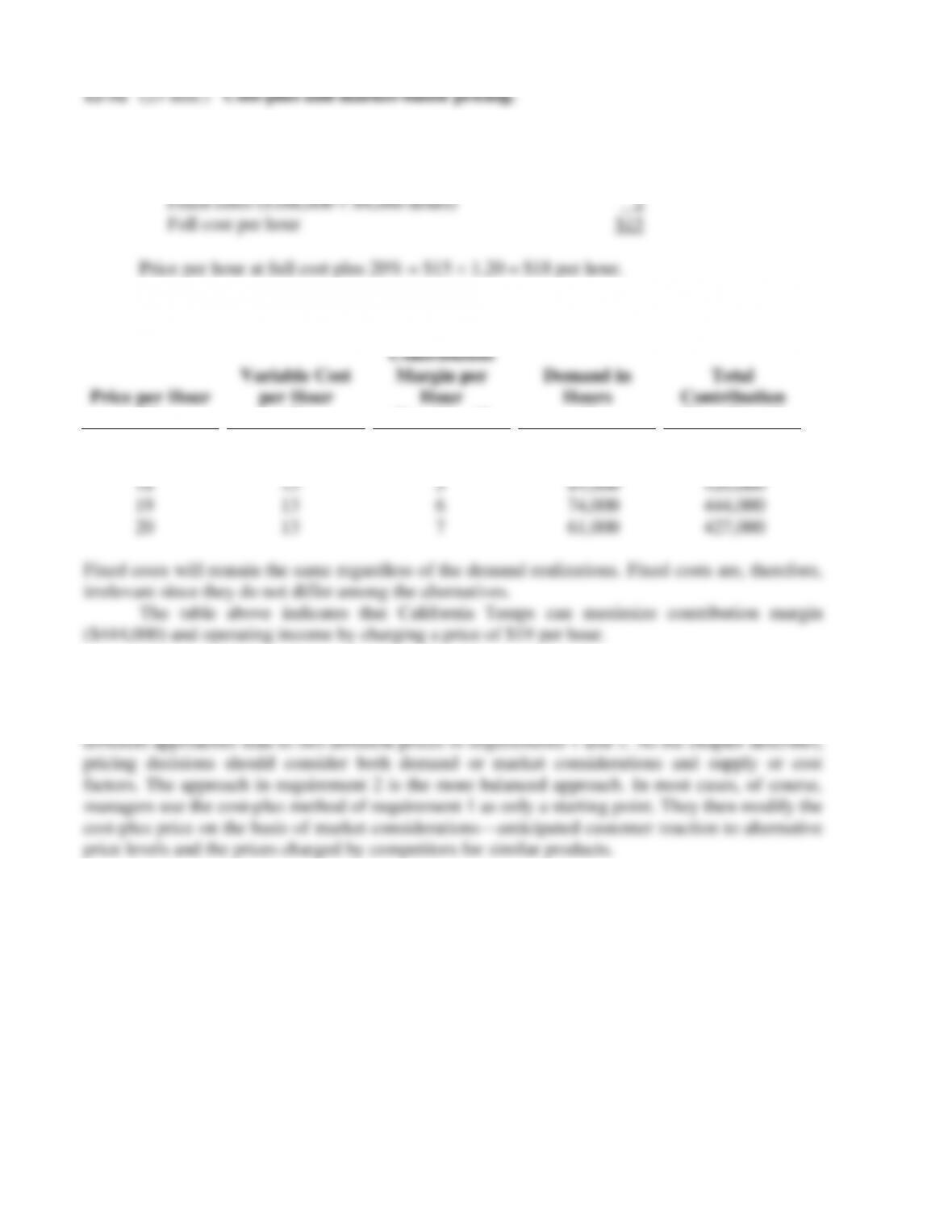
2. Contribution margins for different prices and demand realizations are as follows:
Price per Hour
(1)
Variable Cost
per Hour
(2)
Contribution
Margin per
Hour
(3) = (1) – (2)
Demand in
Hours
(4)
Total
Contribution
(5) = (3) × (4)
$16
17
$13
13
$3
4
124,000
104,000
$372,000
416,000
18
19
20
13
13
13
5
6
7
84,000
74,000
61,000
420,000
444,000
427,000
Fixed costs will remain the same regardless of the demand realizations. Fixed costs are, therefore,
irrelevant since they do not differ among the alternatives.
The table above indicates that California Temps can maximize contribution margin
($444,000) and operating income by charging a price of $19 per hour.
3. The cost-plus approach to pricing in requirement 1 does not explicitly consider the effect
of prices on demand. The approach in requirement 2 models the interaction between price and
demand and determines the optimal level of profitability using concepts of relevant costs. The two
12-23
1. Single rate =
$1,262,460
106,000 testing hours =
$11.91 per test-hour (TH)
2. Labor and supervision =
$ 491,840
106,000 test-hours
= $4.64 per test-hour
$402,620
10,000 machine-hours
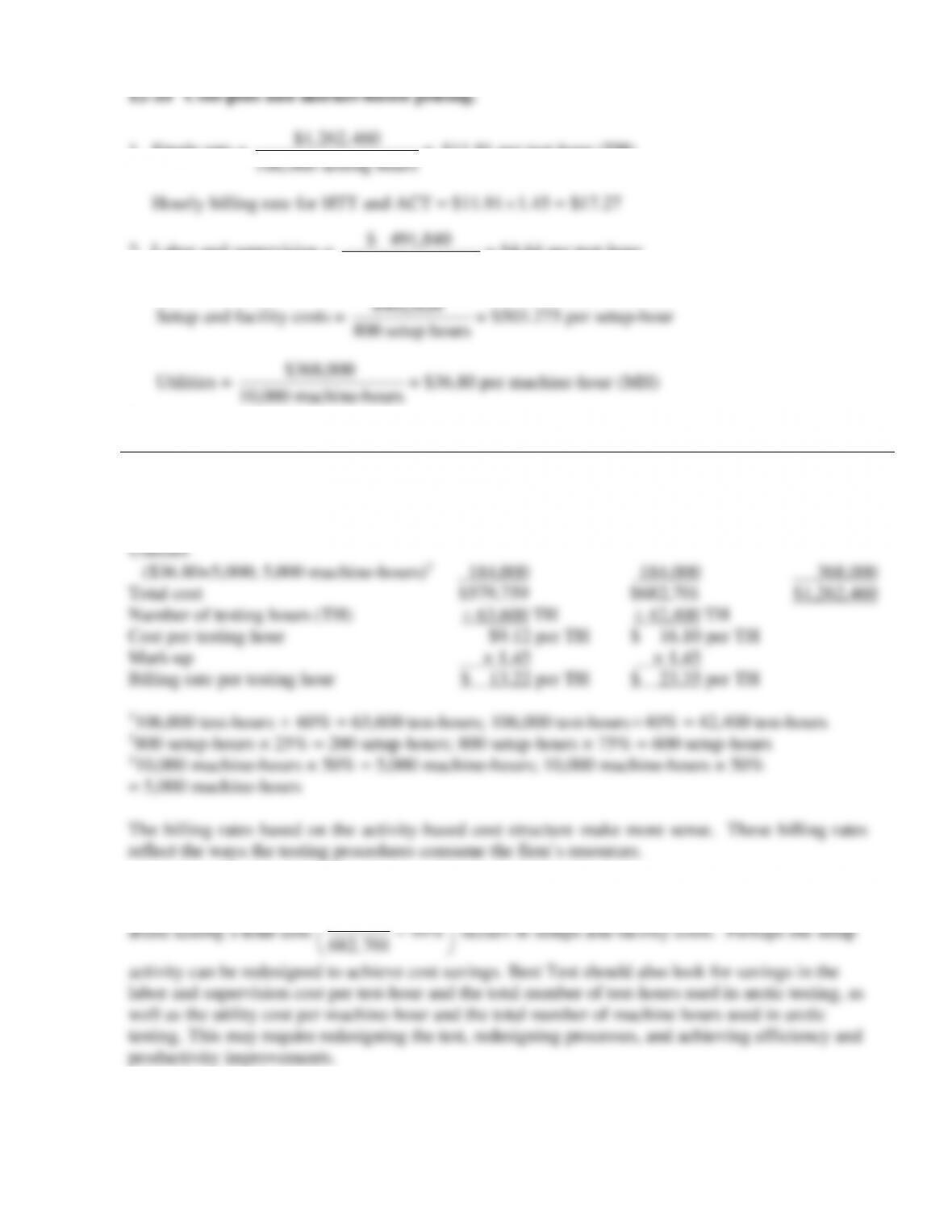
3.
HTT
ACT
Total
Labor and supervision
($4.64×63, 600; 42,400 test-hours)1
$295,104
$196,736
$ 491,840
Setup and facility cost
($503.275×200; 600 setup-hours)2
100,655
301,965
402,620
Utilities
($36.80×5,000; 5,000 machine-hours)3
184,000
184,000
368,000
Total cost
$579,759
$682,701
$1,262,460
Number of testing hours (TH)
÷ 63,600 TH
÷ 42,400 TH
Cost per testing hour
$9.12 per TH
$ 16.10 per TH
Mark-up
× 1.45
× 1.45
Billing rate per testing hour
$ 13.22 per TH
$ 23.35 per TH
1106,000 test-hours
60% = 63,600 test-hours; 106,000 test-hours
40% = 42,400 test-hours
2800 setup-hours × 25% = 200 setup-hours; 800 setup-hours × 75% = 600 setup-hours
310,000 machine-hours × 50% = 5,000 machine-hours; 10,000 machine-hours × 50%
= 5,000 machine-hours
The billing rates based on the activity-based cost structure make more sense. These billing rates
reflect the ways the testing procedures consume the firm’s resources.
4. To stay competitive, Best Test needs to be more efficient in arctic testing. Roughly 44% of
301,965 44%
682,701
activity can be redesigned to achieve cost savings. Best Test should also look for savings in the
labor and supervision cost per test-hour and the total number of test-hours used in arctic testing, as
well as the utility cost per machine-hour and the total number of machine hours used in arctic
testing. This may require redesigning the test, redesigning processes, and achieving efficiency and
productivity improvements.
12-24
1.
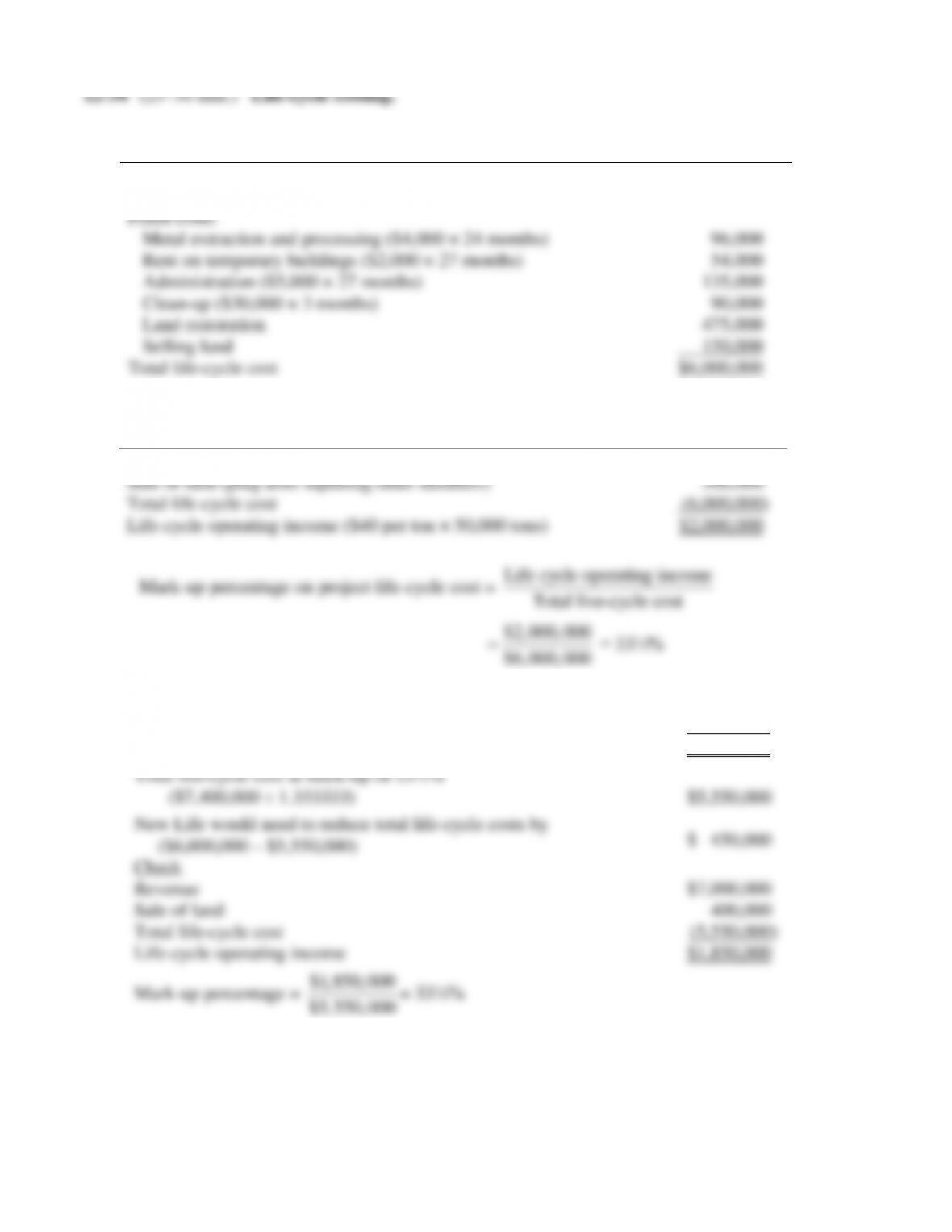
Total Project Life-Cycle Costs
Variable costs:
Metal extraction and processing ($100 per ton × 50,000 tons)
$5,000,000
Fixed costs:
Metal extraction and processing ($4,000 × 24 months)
96,000
Rent on temporary buildings ($2,000 × 27 months)
54,000
Administration ($5,000 × 27 months)
135,000
Clean-up ($30,000 × 3 months)
90,000
Land restoration
475,000
Selling land
150,000
Total life-cycle cost
$6,000,000
2.
Projected Life Cycle Income Statement
Revenue ($150 per ton
50,000 tons)
$7,500,000
Sale of land (plug after inputting other numbers)
500,000
Total life-cycle cost
(6,000,000)
Life-cycle operating income ($40 per ton × 50,000 tons)
$2,000,000
Mark-up percentage on project life-cycle cost =
Life cycle operating income
Total live-cycle cost
$2,000,000
$6,000,000
=
= 33⅓%
3.
Revenue ($140 per ton
50,000 tons)
$7,000,000
Sale of land
400,000
Total revenue
$7,400,000
Total life-cycle cost at mark-up of 33⅓%
($7,400,000 ÷ 1.333333)
$5,550,000
New Life would need to reduce total life-cycle costs by
($6,000,000 – $5,550,000)
$ 450,000
Check
Revenue
$7,000,000
Sale of land
400,000
Total life-cycle cost
(5,550,000)
Life-cycle operating income
$1,850,000
Mark-up percentage =
$1,850,000
$5,550,000
= 33⅓%
12-25
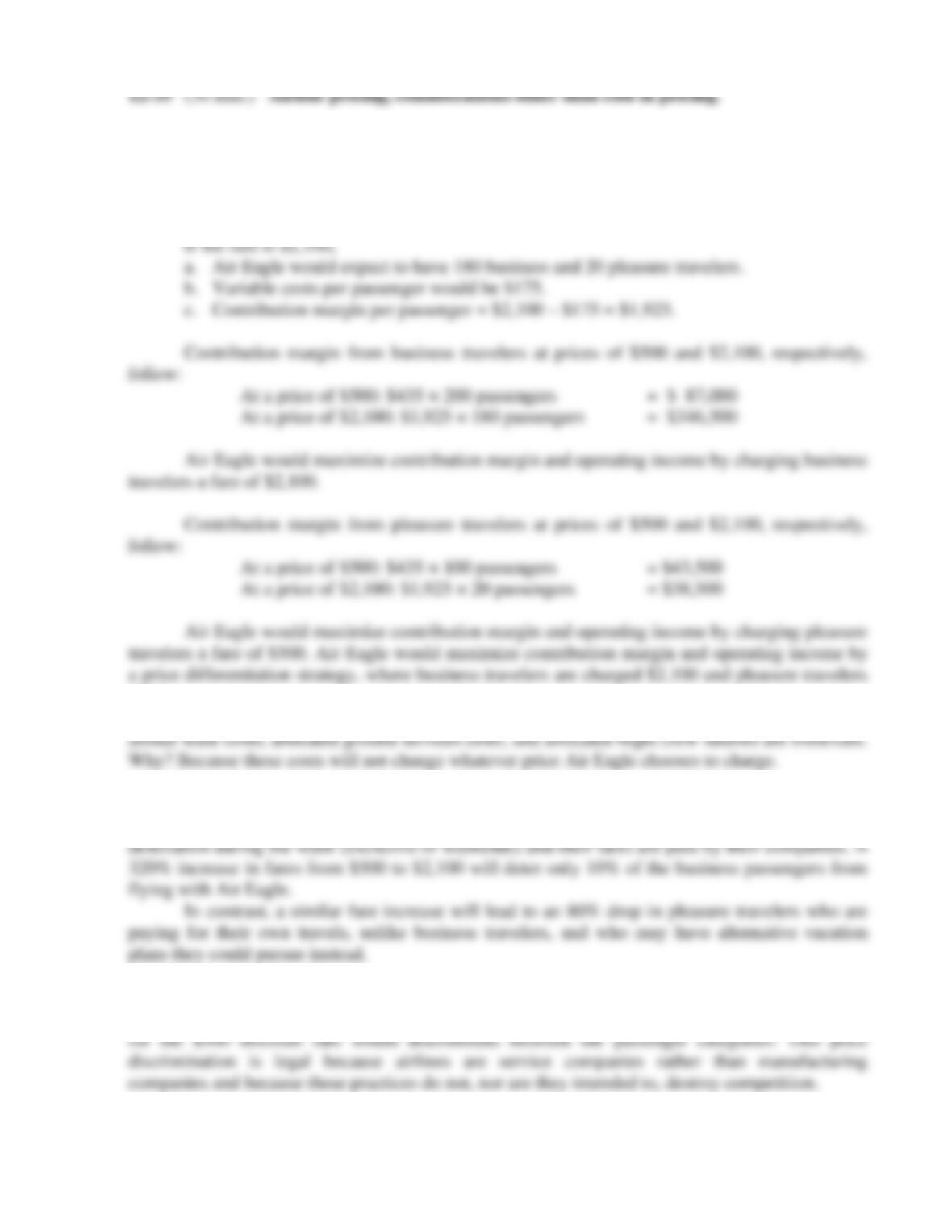
1. If the fare is $500,
a. Air Eagle would expect to have 200 business and 100 pleasure travelers.
b. Variable costs per passenger would be $65.
c. Contribution margin per passenger = $500 – $65 = $435.
$500.
In deciding between the alternative prices, all other costs such as fuel costs, allocated
2. The elasticity of demand of the two classes of passengers drives the different demands of
the travelers. Business travelers are relatively price insensitive because they must get to their
3. Since business travelers often want to return within the same week, while pleasure
travelers often stay over weekends, a requirement that a Saturday night stay is needed to qualify
12-26
1. The $500 spent on the basketball tickets is a sunk (past) cost, and is therefore irrelevant to
the bid decision. Apex will incur the $500 cost whether it bids, loses the bid, or wins the bid.
1.25). The difference in full cost is $5,000 ($121,000 – $116,000). Therefore, the target cost of
3. It was unethical for Grant to use the basketball tickets to get the tip out of the purchasing
agent. Knowing about Grant’s action and suggesting a way to use it is unethical on the part of
Gomes. In assessing the situation, the specific “Standards of Ethical Conduct for Management
Accountants,” described in Chapter 1 that the management accountant should consider are listed
below.
Integrity
12-27
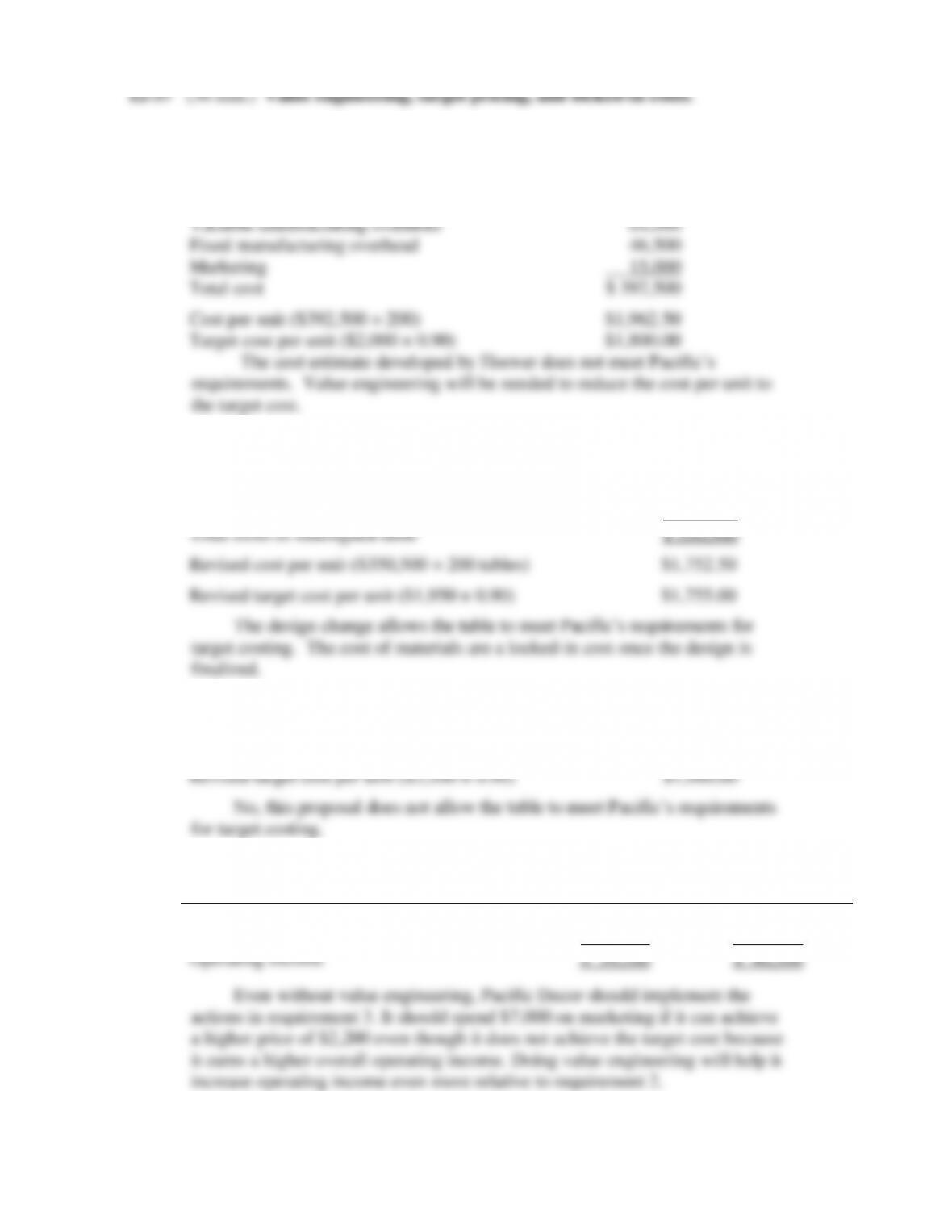
1.
Design cost
$ 5,000
Direct materials
120,000
Direct manufacturing labor
142,000
Variable manufacturing overhead
64,000
Fixed manufacturing overhead
46,500
Marketing
15,000
Total cost
$ 392,500
Cost per unit ($392,500 ÷ 200)
$1,962.50
Target cost per unit ($2,000 × 0.90)
$1,800.00
The cost estimate developed by Hoover does not meet Pacific’s
requirements. Value engineering will be needed to reduce the cost per unit to
the target cost.
2.
Total costs (requirement 1)
$ 392,500
Less: Reduction in material costs ($120,000 × 40%)
(48,000)
Add: Increase in design costs
6,000
Total costs of redesigned table
$ 350,500
Revised cost per unit ($350,500 ÷ 200 tables)
$1,752.50
Revised target cost per unit ($1,950 × 0.90)
$1,755.00
The design change allows the table to meet Pacific’s requirements for
target costing. The cost of materials are a locked-in cost once the design is
finalized.
3.
Revised total cost ($392,500 + $7,000)
$ 399,500
Revised cost per unit ($399,500 ÷ 200)
$1,997.50
Revised target cost per unit ($2,200 × 0.90)
$1,980.00
4.
Requirement 2
Requirement 3
Revenue ($1,950 × 200; $2,200 × 200)
$390,000
$440,000
Total costs
350,500
399,500
Operating income
$ 39,500
$ 40,500
Even without value engineering, Pacific Decor should implement the
actions in requirement 3. It should spend $7,000 on marketing if it can achieve
a higher price of $2,200 even though it does not achieve the target cost because
it earns a higher overall operating income. Doing value engineering will help it
increase operating income even more relative to requirement 2.