11-1
CHAPTER 11
DECISION MAKING AND RELEVANT INFORMATION
1. Identify the problem and uncertainties
3. Make predictions about the future
5. Implement the decision, evaluate performance, and learn
11-2 Relevant costs are expected future costs that differ among the alternative courses of
11-3 No. Relevant costs are defined as those expected future costs that differ among
11-4 Quantitative factors are outcomes that are measured in numerical terms. Some
quantitative factors are financial––that is, they can be easily expressed in monetary terms. Direct
11-5 Two potential problems that should be avoided in relevant cost analysis are
(i) Do not assume all variable costs are relevant and all fixed costs are irrelevant.
relevant.
11-7 No. Some of the total manufacturing cost per unit of a product may be fixed, and, hence,
will not differ between the make and buy alternatives. These fixed costs are irrelevant to the
11-8 Opportunity cost is the contribution to income that is forgone (rejected) by not using a
limited resource in its next-best alternative use.
11-2
11-9 No. When deciding on the quantity of inventory to buy, managers must consider both the
purchase cost per unit and the opportunity cost of funds invested in the inventory. For example,
11-10 No. Managers should aim to get the highest contribution margin per unit of the
11-11 No. For example, if the revenues that will be lost exceed the costs that will be saved, the
11-12 Cost written off as depreciation is irrelevant when it pertains to a past cost such as
11-13 No. Managers often favor the alternative that makes their performance look best so they
11-14 The three steps in solving a linear programming problem are
11-15 The text outlines two methods of determining the optimal solution to an LP problem:
(i) Trial-and-error approach
11-3
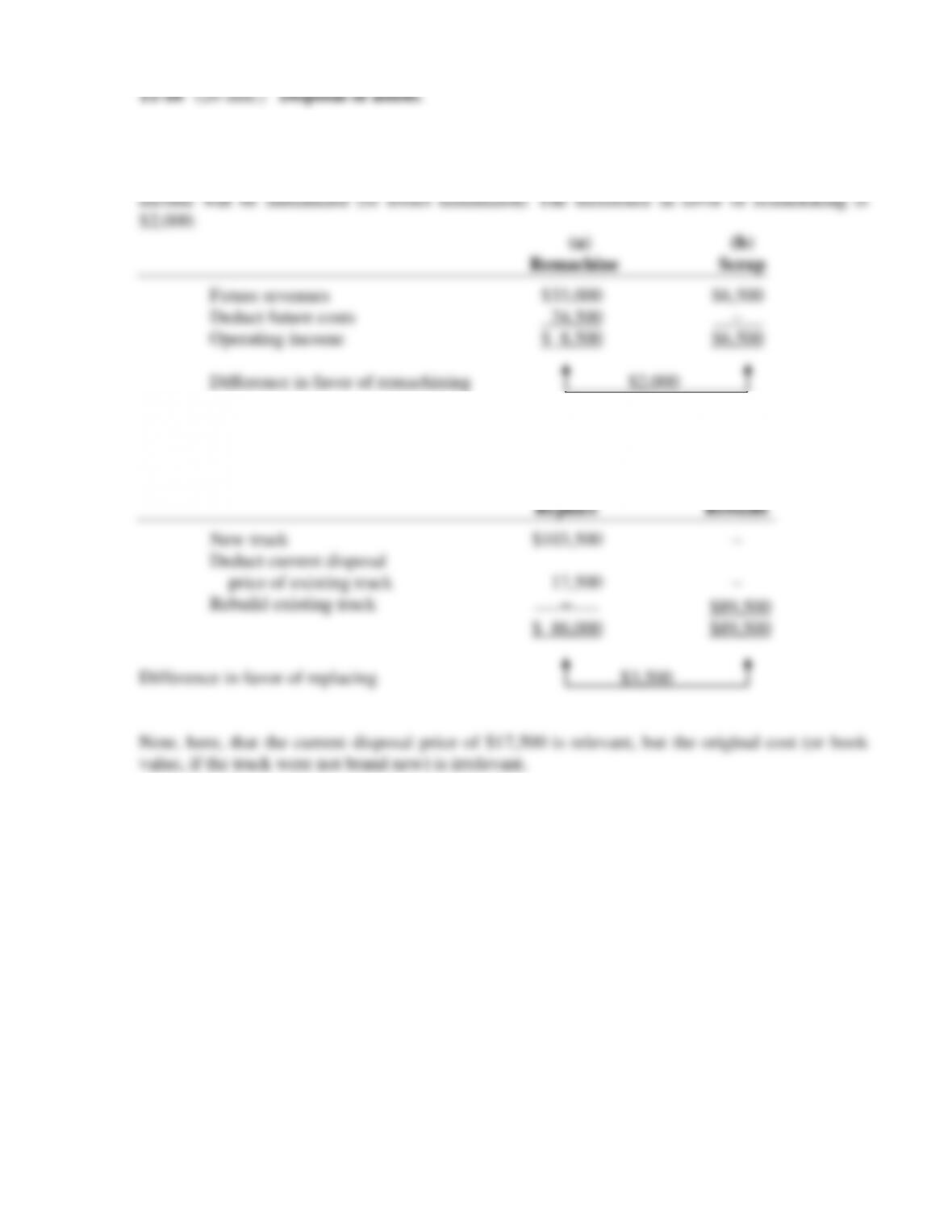
1. This is an unfortunate situation, yet the $78,000 costs are irrelevant regarding the
decision to remachine or scrap. The only relevant factors are the future revenues and future costs.
By ignoring the accumulated costs and deciding on the basis of expected future costs, operating
2. This, too, is an unfortunate situation. But the $101,000 original cost is irrelevant to this
decision. The difference in relevant costs in favor of replacing is $3,500 as follows:
(a) (b)
11-4
1.
Make
Buy
Relevant costs
Variable costs
$190
Avoidable fixed costs
10
Purchase price
____
$260
Unit relevant cost
$200
$260
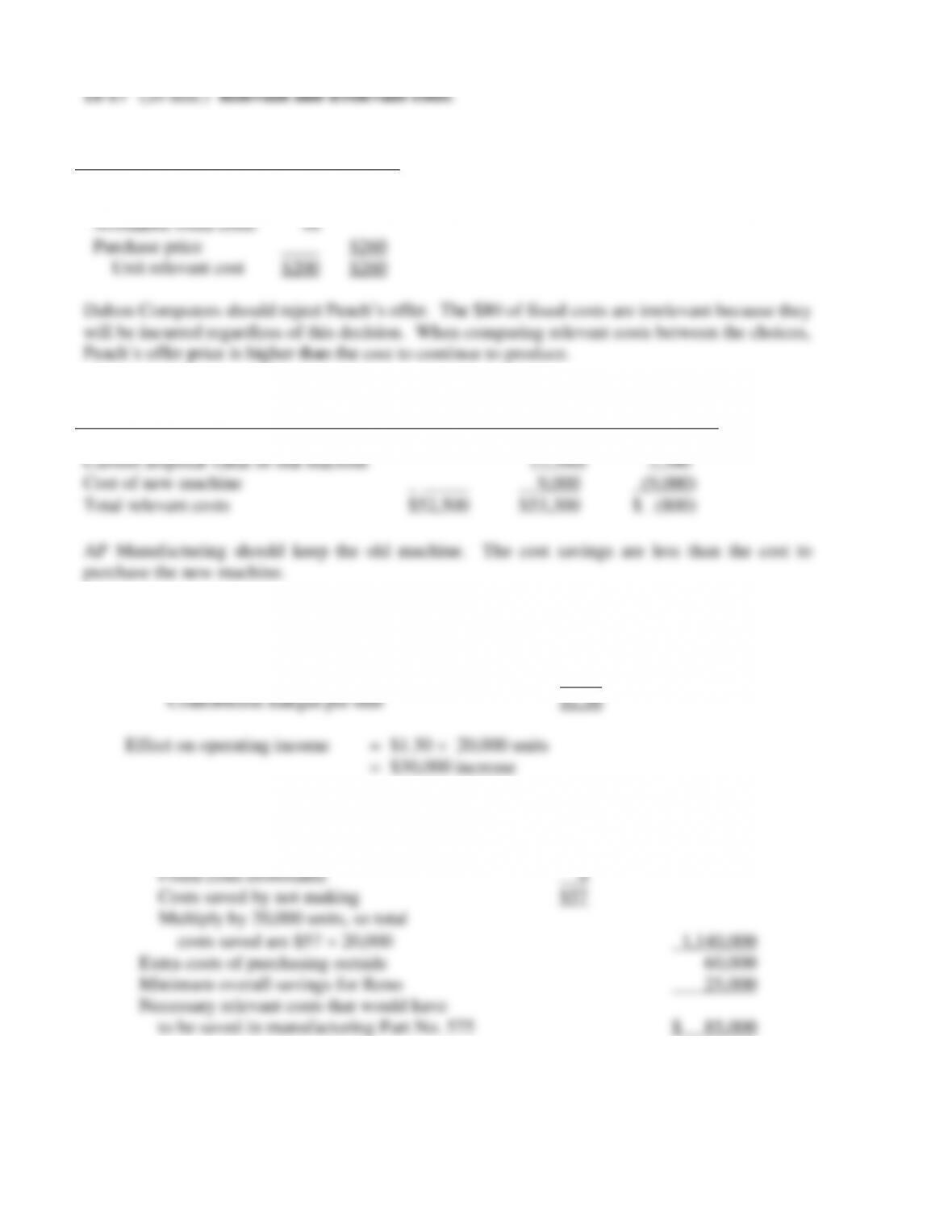
Dalton Computers should reject Peach’s offer. The $80 of fixed costs are irrelevant because they
will be incurred regardless of this decision. When comparing relevant costs between the choices,
Peach’s offer price is higher than the cost to continue to produce.
2.
Keep
Replace
Difference
Cash operating costs (3 years)
$52,500
$46,500
$6,000
Current disposal value of old machine
(2,200)
2,200
Cost of new machine
_ _____
9,000
(9,000)
Total relevant costs
$52,500
$53,300
$ (800)
AP Manufacturing should keep the old machine. The cost savings are less than the cost to
purchase the new machine.
11-18 (15 min.) Multiple choice.
1. (b) Special order price per unit $6.00
Variable manufacturing cost per unit 4.50
2. (b) Costs of purchases, 20,000 units $60 $1,200,000
Total relevant costs of making:
Variable manufacturing costs, $6 + $30 + $12 $48
11-5
11-19 (30 min.) Special order, activity-based costing.
1. Direct materials cost per unit ($262,500 7,500 units) = $35 per unit
Direct manufacturing labor cost per unit ($300,000 7,500 units) = $40 per unit
Variable cost per batch = $500 per batch
Award Plus’ operating income under the alternatives of accepting/rejecting the special
order are:
Without One-
Time Only
Special Order
7,500 Units
With One–
Time Only
Special Order
10,000 Units
Difference
2,500 Units
Revenues $1,125,000 $1,375,000 $250,000
Variable costs:
Direct materials 262,500 350,0001 87,500
Direct manufacturing labor 300,000 400,0002 100,000
Batch manufacturing costs 75,000 87,5003 12,500
Fixed costs:
Fixed manufacturing costs 275,000 275,000 ––
Fixed marketing costs 175,000 175,000 ––
Total costs 1,087,500 1,287,500 200,000
Operating income $ 37,500 $ 87,500 $ 50,000
1$262,500 + ($35 2,500 units) 2$300,000 + ($40 2,500 units) 3$75,000 + ($500 25 batches)
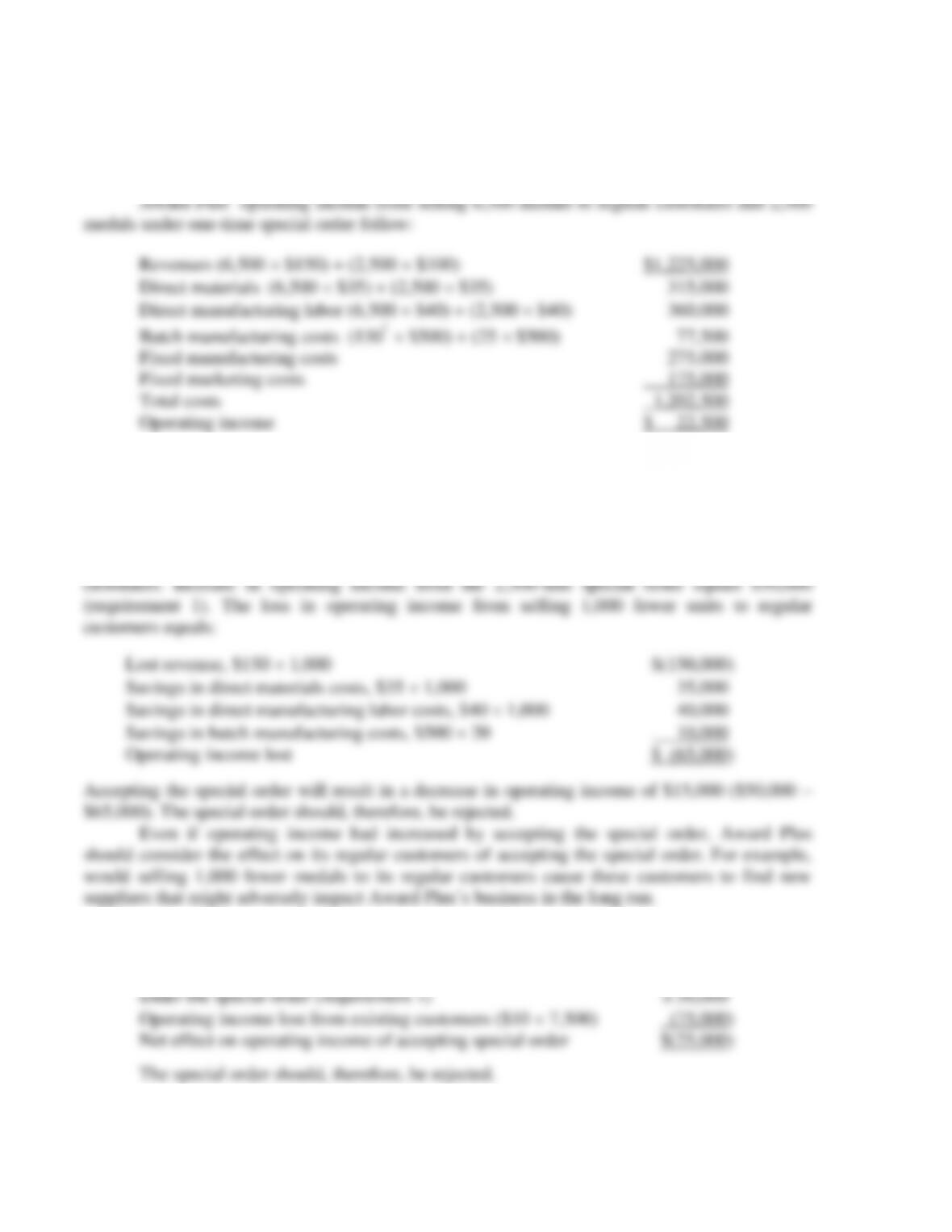
Alternatively, we could calculate the incremental revenue and the incremental costs of the
11-6
2. Award Plus has a capacity of 9,000 medals. Therefore, if it accepts the special one-time
order of 2,500 medals, it can sell only 6,500 medals instead of the 7,500 medals that it currently
sells to existing customers. That is, by accepting the special order, Award Plus must forgo sales
of 1,000 medals to its regular customers. Alternatively, Award Plus can reject the special order
and continue to sell 7,500 medals to its regular customers.
1Award Plus makes regular medals in batch sizes of 50. To produce 6,500 medals requires 130 (6,500 ÷ 50) batches.
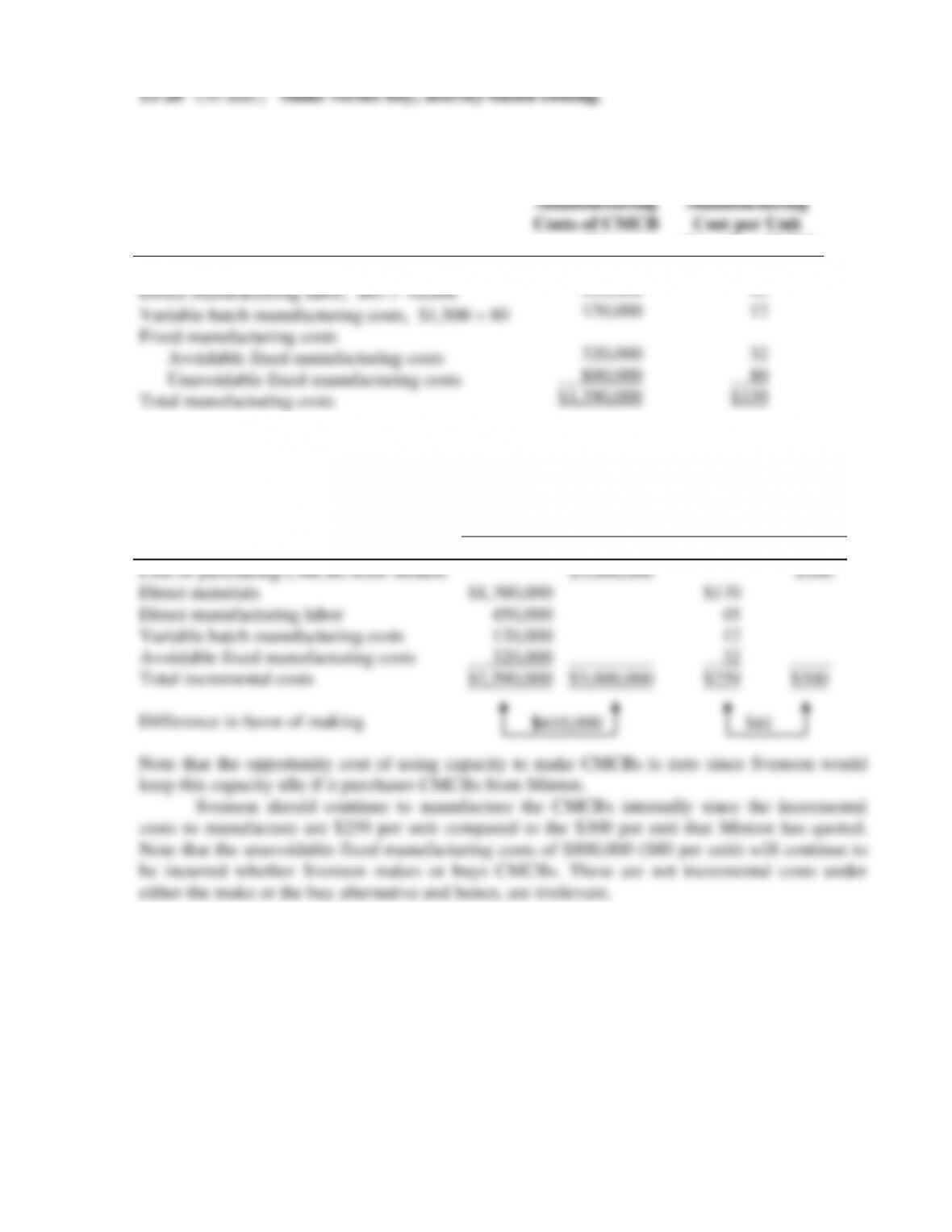
Accepting the special order will result in a decrease in operating income of $15,000
($37,500 – $22,500). The special order should, therefore, be rejected.
A more direct approach would be to focus on the incremental effects––the benefits of
accepting the special order of 2,500 units versus the costs of selling 1,000 fewer units to regular
3. Award Plus should not accept the special order.
Increase in operating income by selling 2,500 units
1. The expected manufacturing cost per unit of CMCBs in 2012 is as follows:
Total
Manufacturing
Costs of CMCB
(1)
Manufacturing
Cost per Unit
(2) = (1) ÷ 10,000
Direct materials, $170 10,000
Direct manufacturing labor, $45 10,000
Variable batch manufacturing costs, $1,500 80
Fixed manufacturing costs
Avoidable fixed manufacturing costs
Unavoidable fixed manufacturing costs
Total manufacturing costs
$1,700,000
450,000
120,000
320,000
800,000
$3,390,000
$170
45
12
32
80
$339
2. The following table identifies the incremental costs in 2012 if Svenson (a) made CMCBs
and (b) purchased CMCBs from Minton.
Total
Incremental Costs
Per-Unit
Incremental Costs
Incremental Items
Make
Buy
Make
Buy
Cost of purchasing CMCBs from Minton
Direct materials
Direct manufacturing labor
Variable batch manufacturing costs
Avoidable fixed manufacturing costs
Total incremental costs
$1,700,000
450,000
120,000
320,000
$2,590,000
$3,000,000
$3,000,000
$170
45
12
32
$259
$300
$300
Difference in favor of making
$410,000
$41
Note that the opportunity cost of using capacity to make CMCBs is zero since Svenson would
keep this capacity idle if it purchases CMCBs from Minton.
Svenson should continue to manufacture the CMCBs internally since the incremental
costs to manufacture are $259 per unit compared to the $300 per unit that Minton has quoted.
Note that the unavoidable fixed manufacturing costs of $800,000 ($80 per unit) will continue to
be incurred whether Svenson makes or buys CMCBs. These are not incremental costs under
either the make or the buy alternative and hence, are irrelevant.
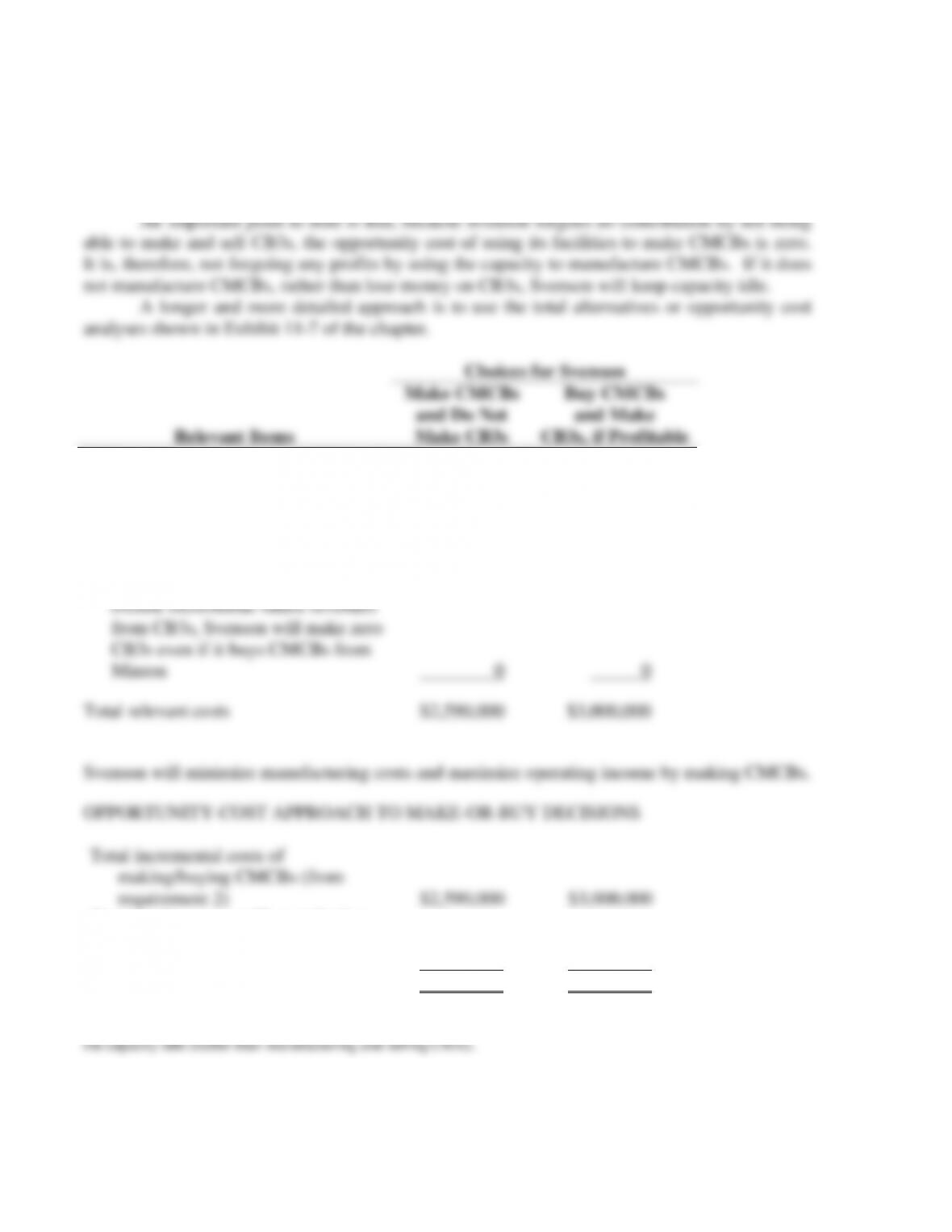
3. Svenson should continue to make CMCBs. The simplest way to analyze this problem is
to recognize that Svenson would prefer to keep any excess capacity idle rather than use it to
make CB3s. Why? Because expected incremental future revenues from CB3s, $2,000,000, are
less than expected incremental future costs, $2,150,000. If Svenson keeps its capacity idle, we
know from requirement 2 that it should make CMCBs rather than buy them.
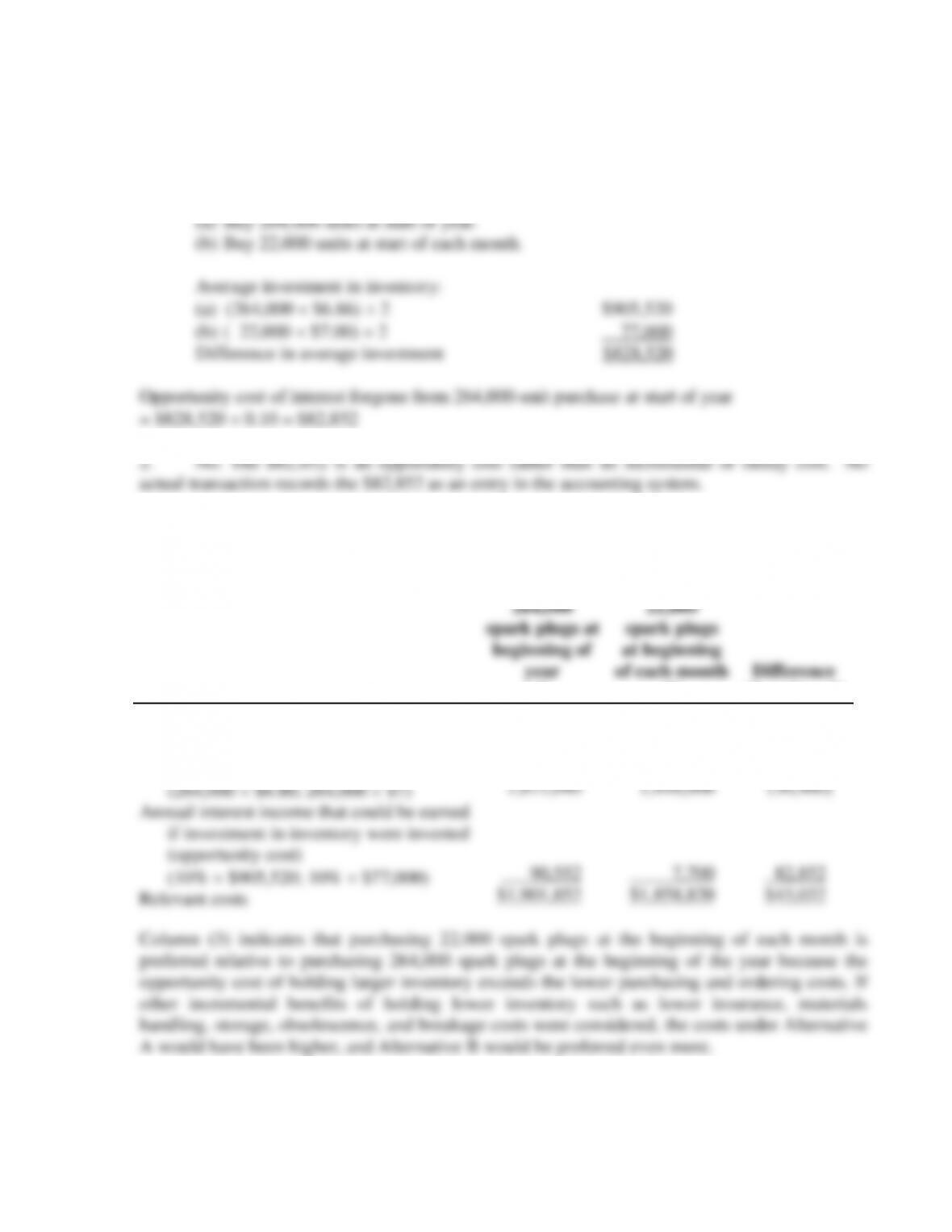
11-21 (10 min.) Inventory decision, opportunity costs.
1. Unit cost, orders of 22,000 $7.00
Unit cost, order of 264,000 (0.98 $7.00) $6.86
Alternatives under consideration:
3. The following table presents the two alternatives:
Alternative A:
Purchase
264,000
spark plugs at
beginning of
year
(1)
Alternative B:
Purchase
22,000
spark plugs
at beginning
of each month
(2)
Difference
(3) = (1) – (2)
Annual purchase-order costs
(1 $260; 12 $260)
Annual purchase (incremental) costs
(264,000 $6.86; 264,000 $7)
Annual interest income that could be earned
if investment in inventory were invested
(opportunity cost)
(10% $905,520; 10% $77,000)
Relevant costs
$ 260
1,811,040
90,552
$1,901,852
$ 3,120
1,848,000
7,700
$1,858,820
$ (2,860)
(36,960)
82,852
$43,032
Column (3) indicates that purchasing 22,000 spark plugs at the beginning of each month is
preferred relative to purchasing 264,000 spark plugs at the beginning of the year because the
opportunity cost of holding larger inventory exceeds the lower purchasing and ordering costs. If
other incremental benefits of holding lower inventory such as lower insurance, materials
handling, storage, obsolescence, and breakage costs were considered, the costs under Alternative
A would have been higher, and Alternative B would be preferred even more.
11-10
1.
Cola
Lemonade
Punch
Natural
Orange
Juice
Selling price $18.75 $20.50 $27.75 $39.30
2. The argument fails to recognize that shelf space is the constraining factor. There are only
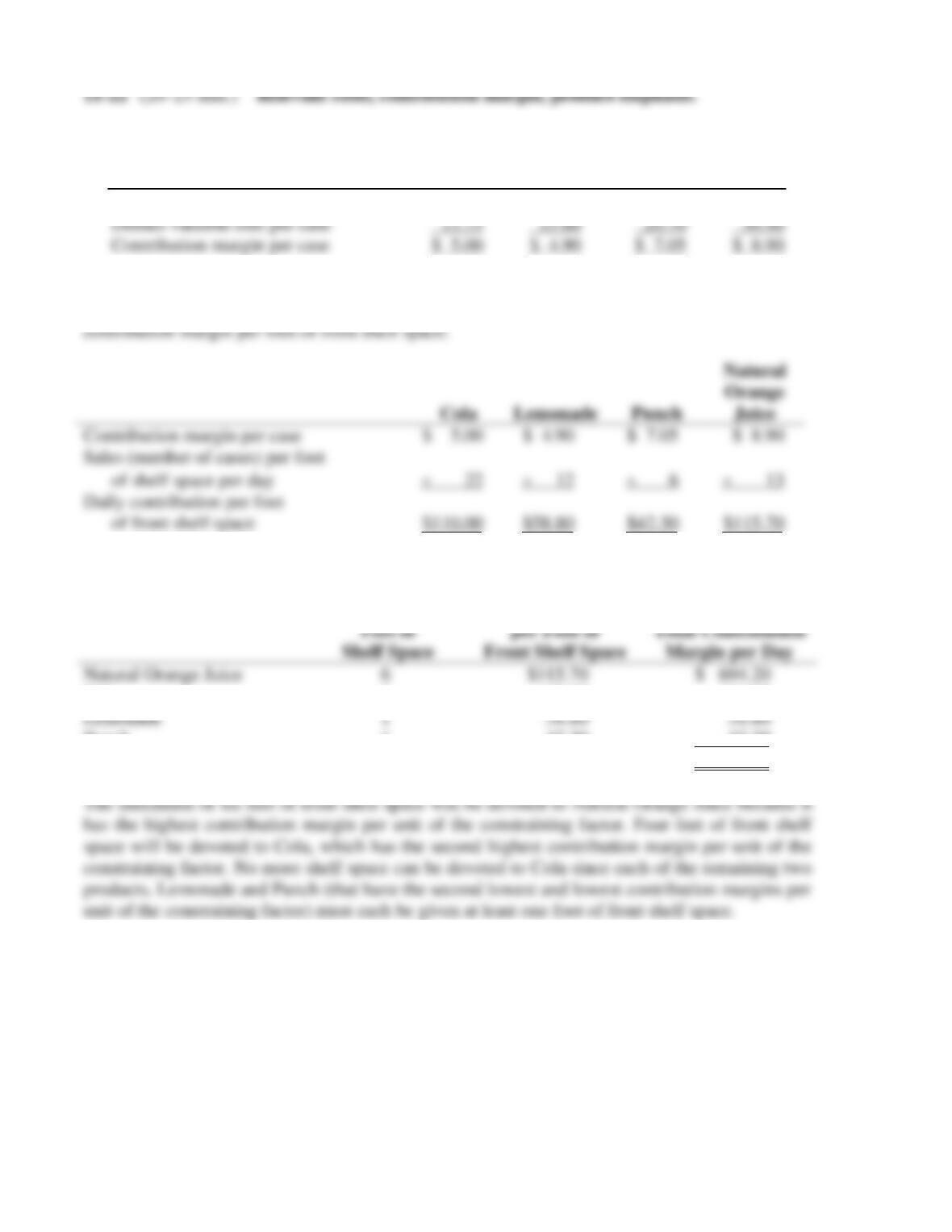
12 feet of front shelf space to be devoted to drinks. Sexton should aim to get the highest daily
Cola
Lemonade
Punch
Natural
Orange
Juice
Contribution margin per case $ 5.00 $ 4.90 $ 7.05 $ 8.90
Sales (number of cases) per foot
of shelf space per day 22 12 6 13
Daily contribution per foot
of front shelf space $110.00 $58.80 $42.30 $115.70
3. The allocation that maximizes the daily contribution from soft drink sales is:
Daily Contribution
Feet of
per Foot of
Total Contribution
Shelf Space
Front Shelf Space
Margin per Day
Natural Orange Juice
6
$115.70
$ 694.20
Cola
4
110.00
440.00
Lemonade
1
58.80
58.80
Punch
1
42.30
42.30
$1,235.30