11-32 (20 min.) Opportunity costs.
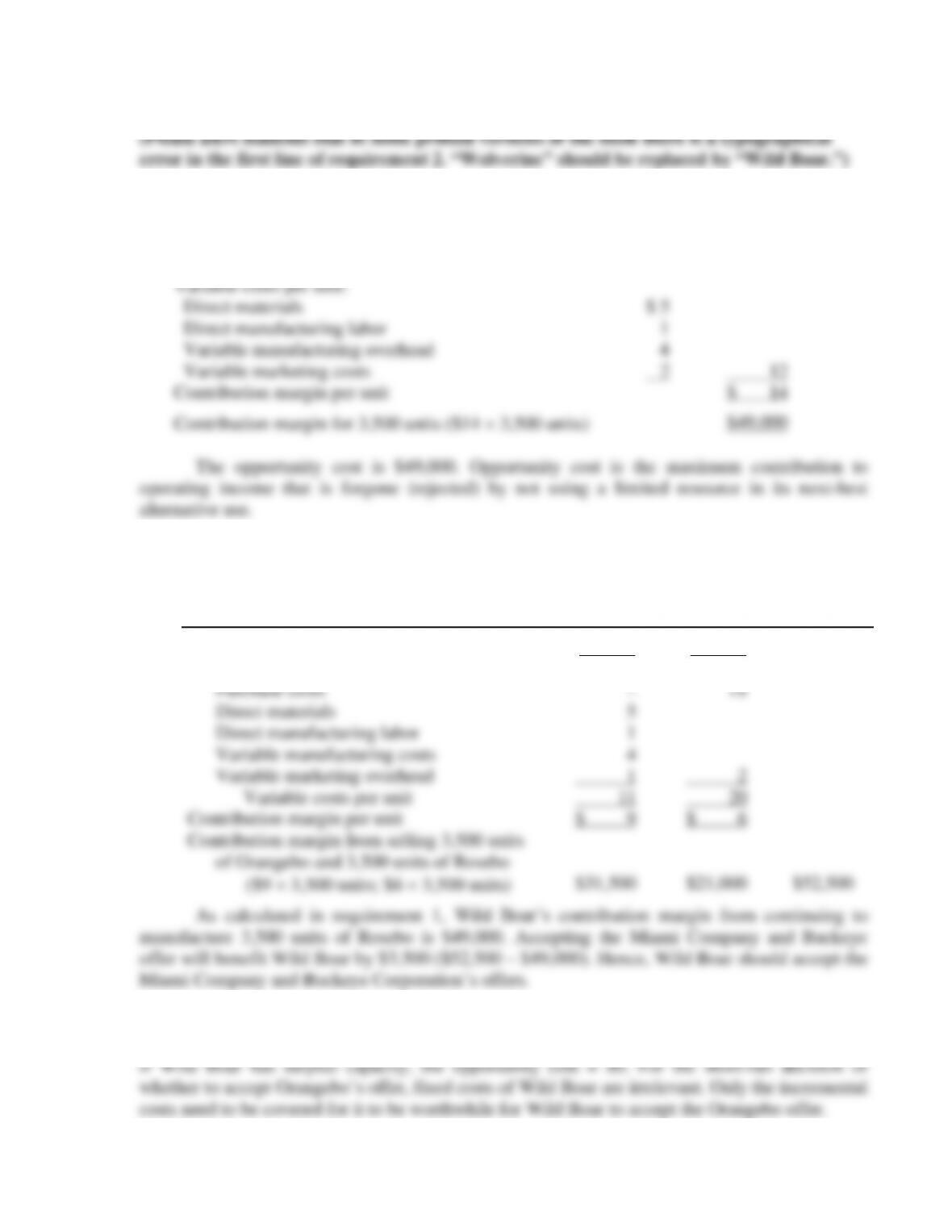
1. The opportunity cost to Wild Boar of producing the 3,500 units of Orangebo is the
contribution margin lost on the 3,500 units of Rosebo that would have to be forgone, as
computed below:
Selling price
Variable costs per unit:
Direct materials
Direct manufacturing labor
Variable manufacturing overhead
Variable marketing costs
Contribution margin per unit
Contribution margin for 3,500 units ($14 3,500 units)
$ 26
$ 5
1
4
2 12
$ 14
$49,000
The opportunity cost is $49,000. Opportunity cost is the maximum contribution to
operating income that is forgone (rejected) by not using a limited resource in its next-best
alternative use.
2. Contribution margin from manufacturing 3,500 units of Orangebo and purchasing 3,500
units of Rosebo from Buckeye is $52,500, as follows:
Manufacture
Orangebo
Purchase
Rosebo
Total
Selling price
Variable costs per unit:
Purchase costs
Direct materials
Direct manufacturing labor
Variable manufacturing costs
Variable marketing overhead
Variable costs per unit
Contribution margin per unit
Contribution margin from selling 3,500 units
of Orangebo and 3,500 units of Rosebo
($9 3,500 units; $6 3,500 units)
$ 20
–
5
1
4
1
11
$ 9
$31,500
$ 26
18
2
20
$ 6
$21,000
$52,500
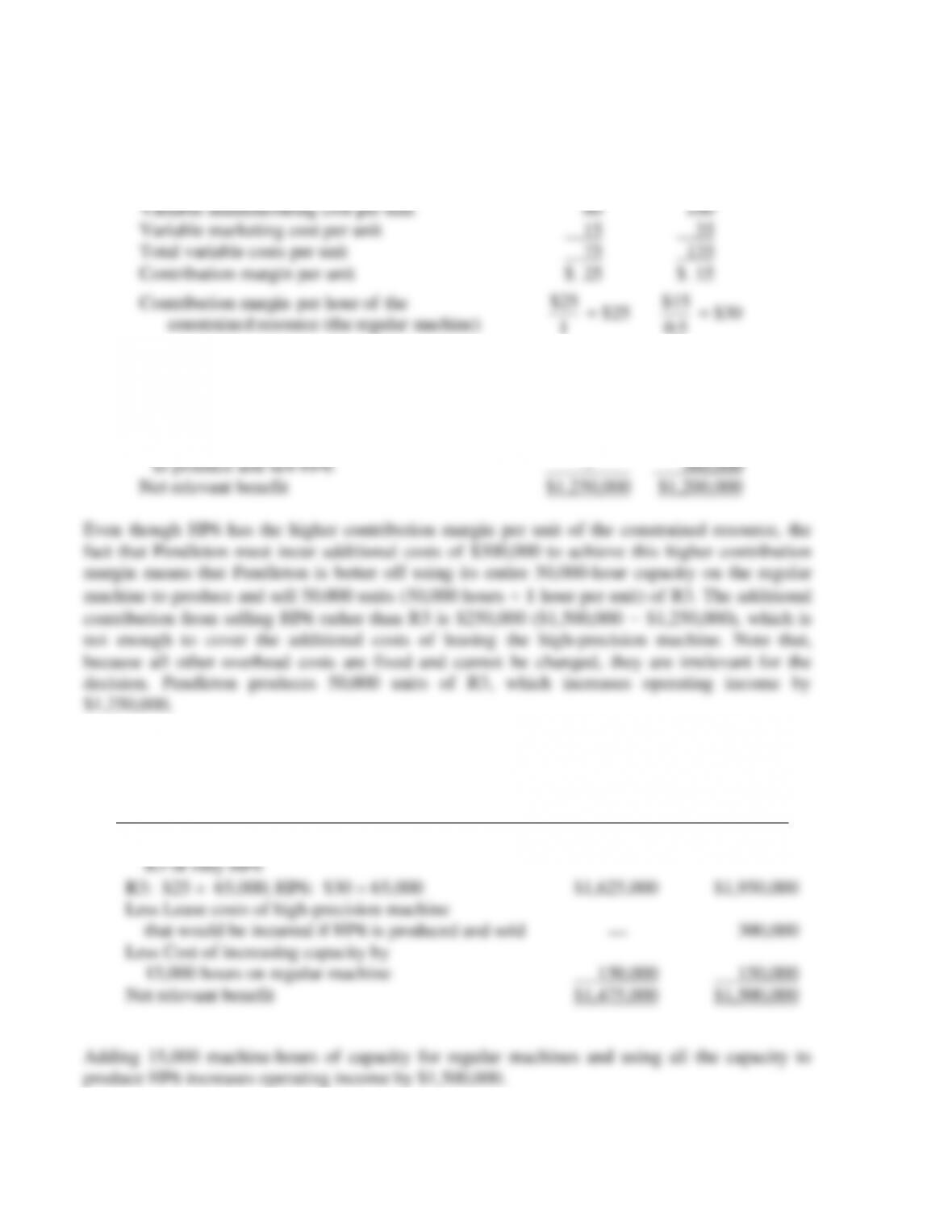
As calculated in requirement 1, Wild Boar’s contribution margin from continuing to
manufacture 3,500 units of Rosebo is $49,000. Accepting the Miami Company and Buckeye
offer will benefit Wild Boar by $3,500 ($52,500 – $49,000). Hence, Wild Boar should accept the
Miami Company and Buckeye Corporation’s offers.
11-22
11-33 (30–40 min.) Product mix, relevant costs.
1. R3 HP6
Selling price $100 $150
machine)regular (the resource dconstraine theofhour per margin on Contributi
1
0.5
Total contribution margin from selling
only R3 or only HP6
R3: $25 50,000; HP6: $30 50,000 $1,250,000 $1,500,000
Less Lease costs of high-precision machine
2. If capacity of the regular machines is increased by 15,000 machine-hours to 65,000
machine-hours (50,000 originally + 15,000 new), the net relevant benefit from producing R3 and
HP6 is as follows:
R3 HP6
Total contribution margin from selling only
11-23
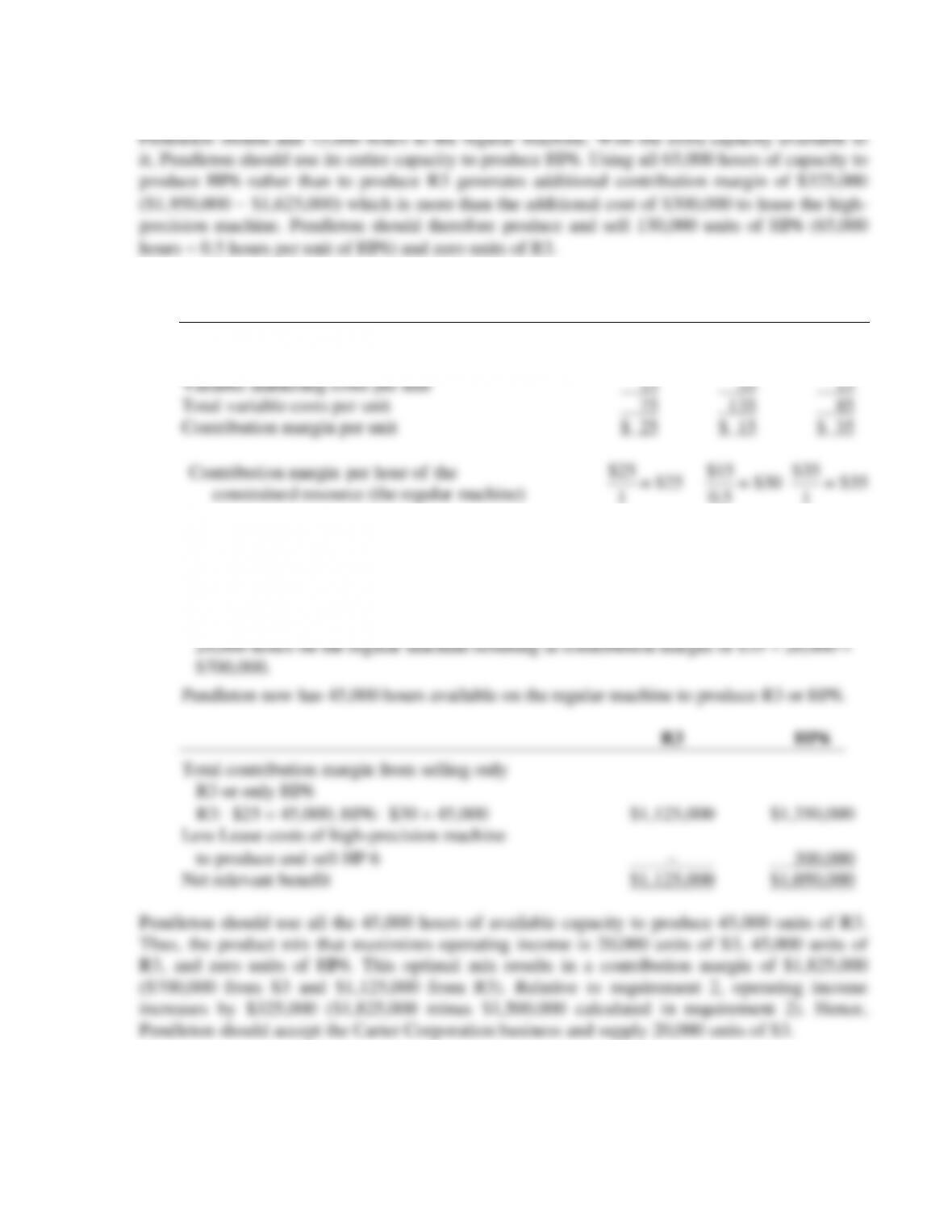
Investing in the additional capacity increases Pendleton’s operating income by $250,000
($1,500,000 calculated in requirement 2 minus $1,250,000 calculated in requirement 1), so
3. R3 HP6 S3
Selling price $100 $150 $120
Variable manufacturing costs per unit 60 100 70
machine)regular (the resource dconstraine theofhour per margin on Contributi
1
5.0
1
The first step is to compare the operating profits that Pendleton could earn if it accepted
the Carter Corporation offer for 20,000 units with the operating profits Pendleton is
currently earning. S3 has the highest contribution margin per hour on the regular machine
and requires no additional investment such as leasing a high-precision machine. To
produce the 20,000 units of S3 requested by Carter Corporation, Pendleton would require
11-24
11-34 (35–40 min.) Dropping a product line, selling more units.
1. The incremental revenue losses and incremental savings in cost by discontinuing the
Tables product line follows:
Difference:
Incremental
(Loss in Revenues)
and Savings in Costs
from Dropping
Tables Line
Revenues
Direct materials and direct manufacturing labor
Depreciation on equipment
Marketing and distribution
General administration
Corporate office costs
Total costs
Operating income (loss)
$(500,000)
300,000
0
70,000
0
0
370,000
$(130,000)
Dropping the Tables product line results in revenue losses of $500,000 and cost savings
of $370,000. Hence, Grossman Corporation’s operating income will be $130,000 lower if it
drops the Tables line.
Note that, by dropping the Tables product line, Home Furnishings will save none of the
depreciation on equipment, general administration costs, and corporate office costs, but it will
save variable manufacturing costs and all marketing and distribution costs on the Tables product
line.
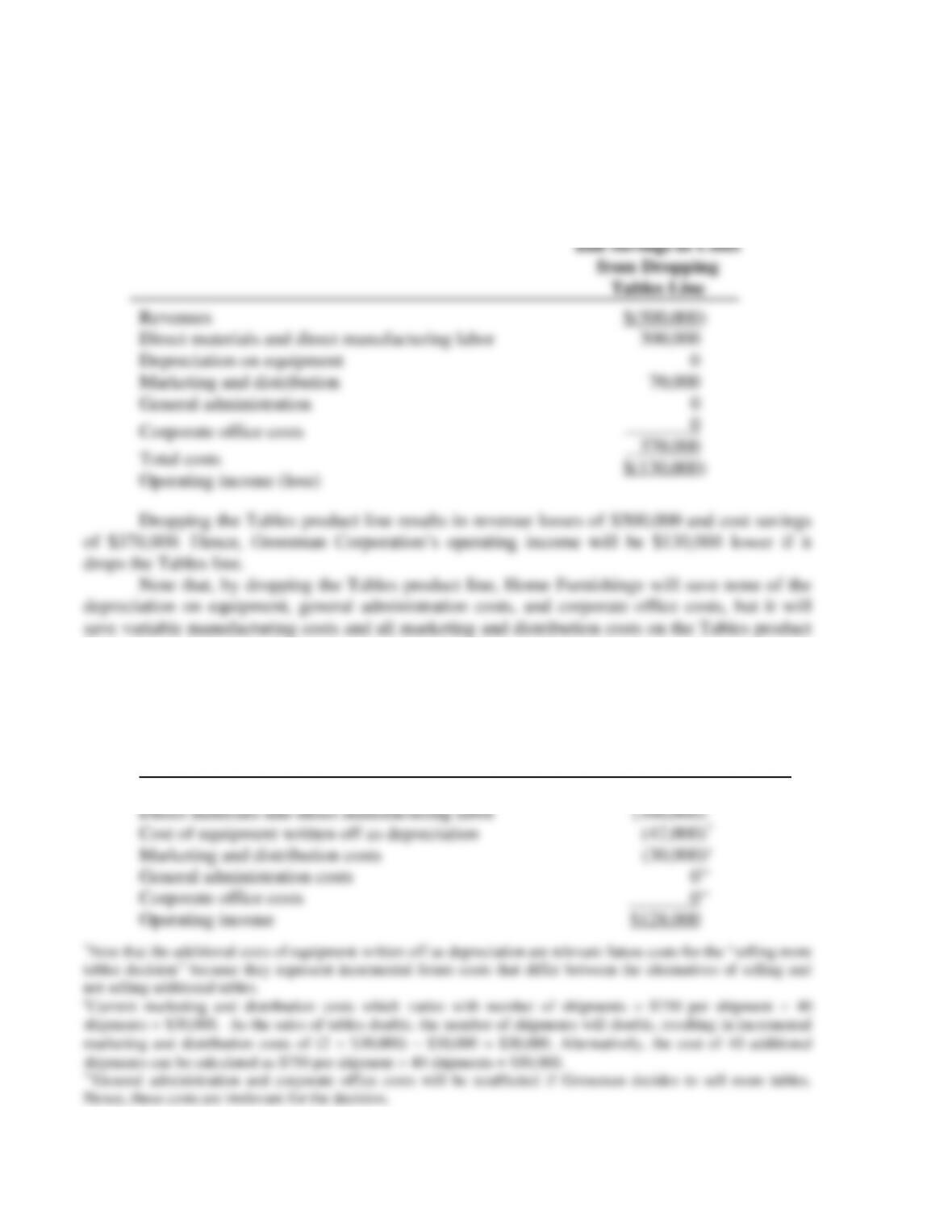
2. Grossman’s will generate incremental operating income of $128,000 from selling 4,000
additional tables and, hence, should try to increase table sales. The calculations follow:
Incremental Revenues
(Costs) and Operating Income
Revenues $500,000
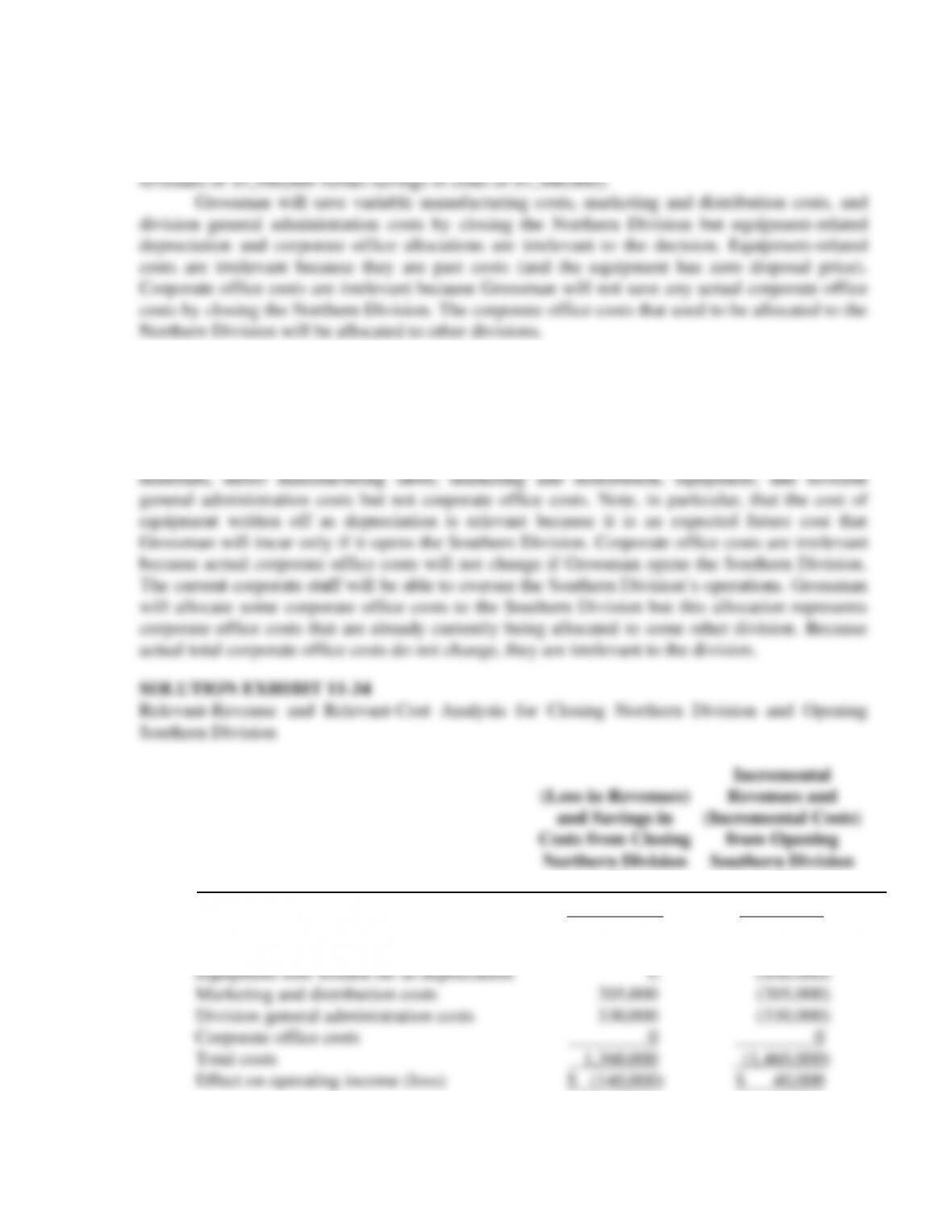
3. Solution Exhibit 11-34, Column 1, presents the relevant loss of revenues and the relevant
savings in costs from closing the Northern Division. As the calculations show, Grossman’s
operating income would decrease by $140,000 if it shut down the Northern Division (loss in
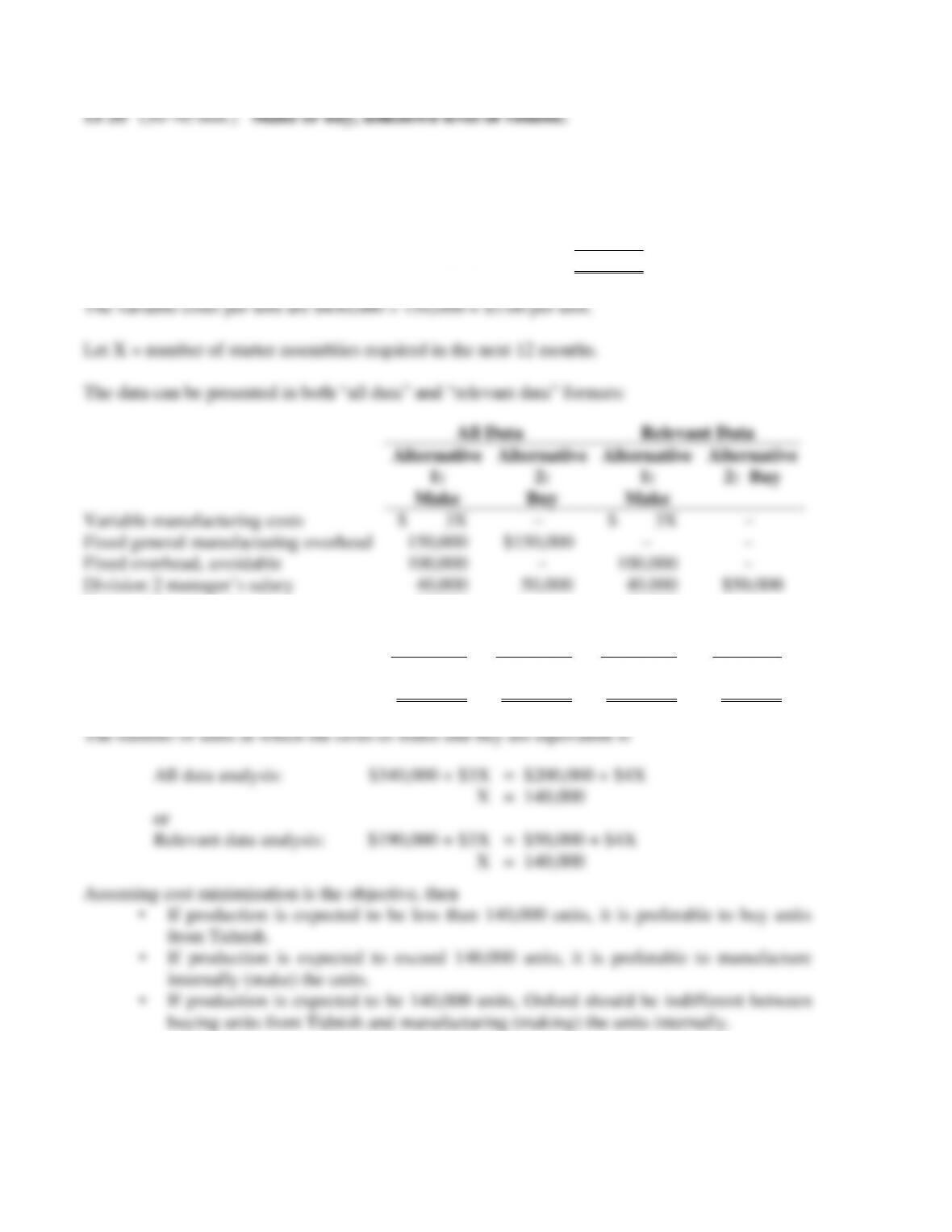
4. Solution Exhibit 11-34, Column 2, presents the relevant revenues and relevant costs of
opening the Southern Division (a division whose revenues and costs are expected to be identical
to the revenues and costs of the Northern Division). Grossman should open the Southern
Division because it would increase operating income by $40,000 (increase in relevant revenues
of $1,500,000 and increase in relevant costs of $1,460,000). The relevant costs include direct
11-26
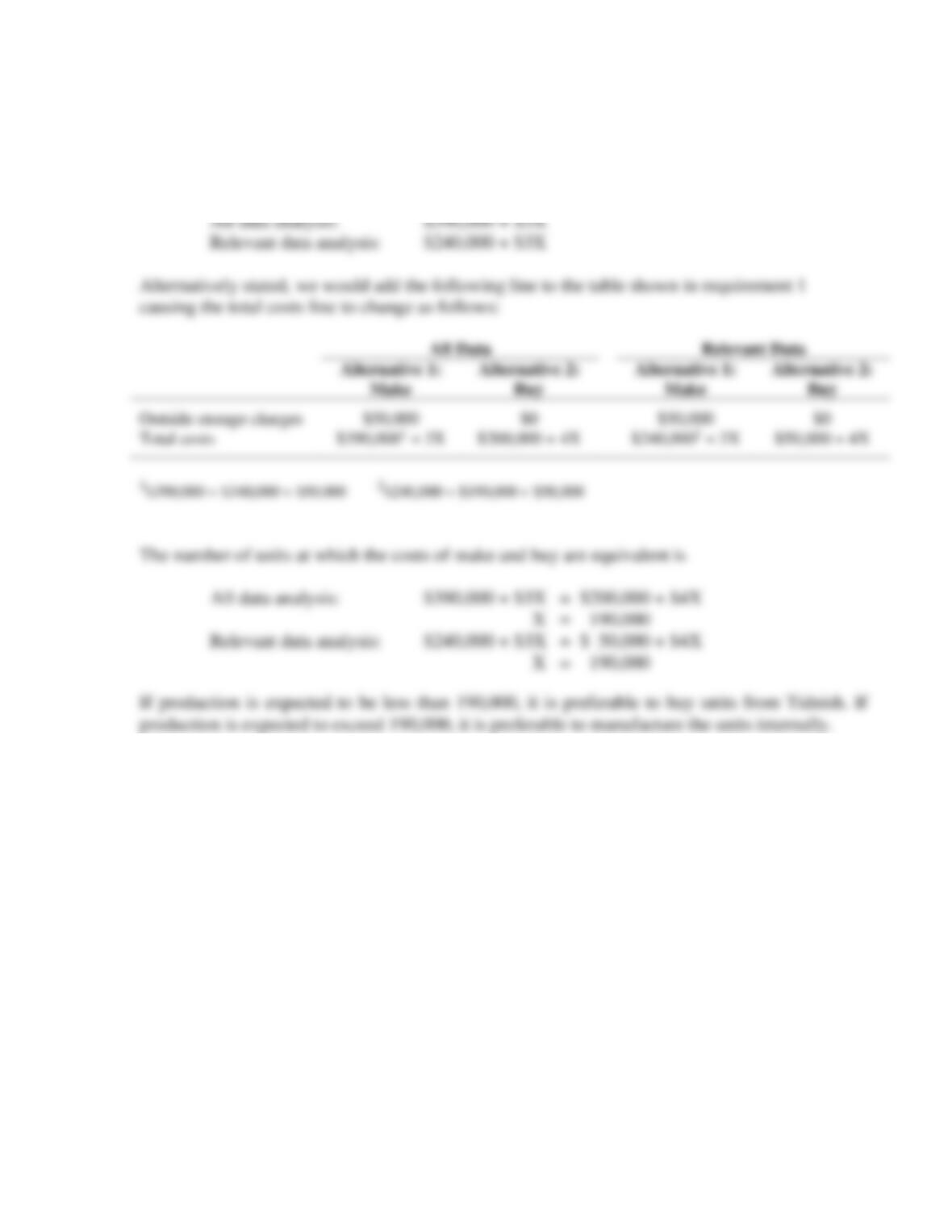
1. The variable costs required to manufacture 150,000 starter assemblies are
Direct materials $200,000
Direct manufacturing labor 150,000
Variable manufacturing overhead 100,000
Total variable costs $450,000
11-27
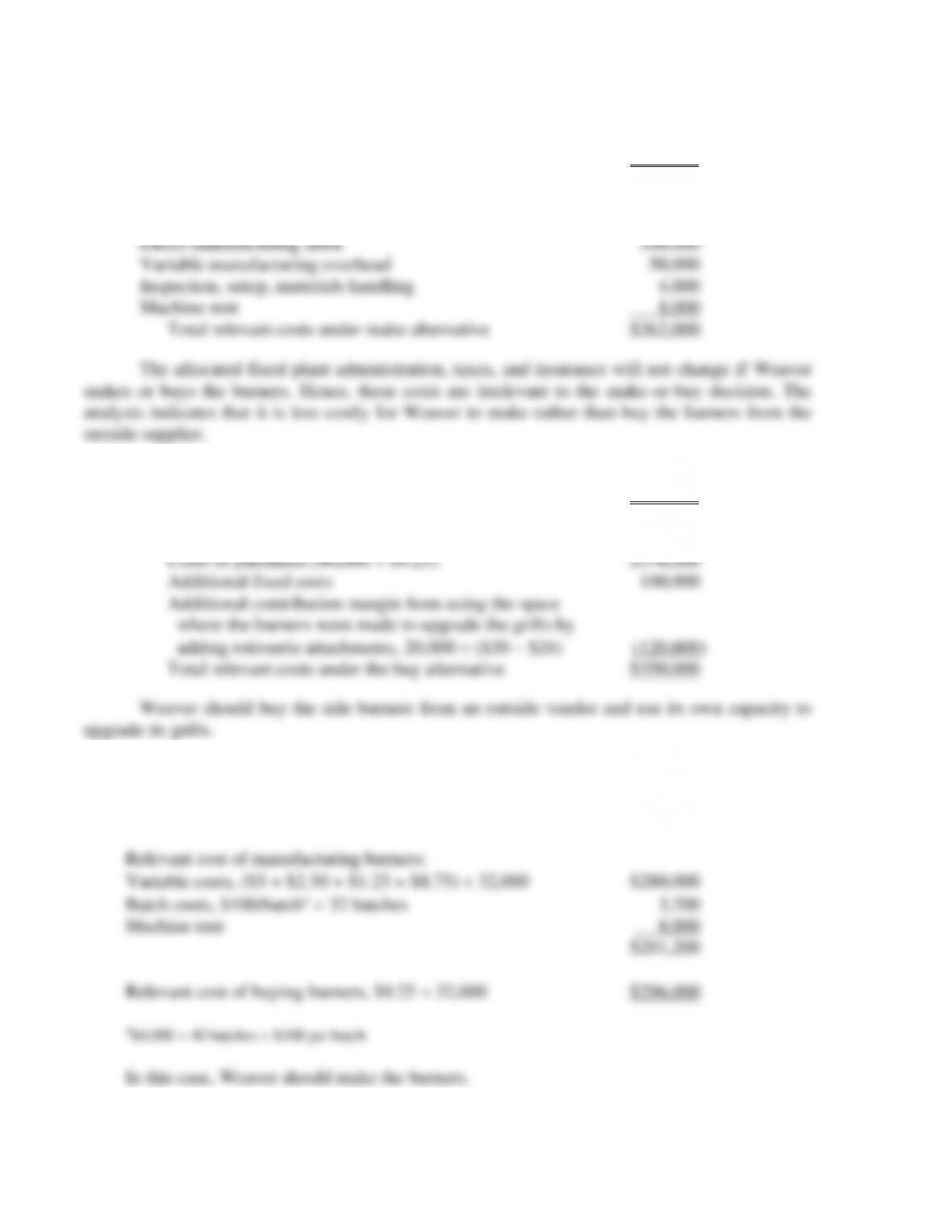
2. The information on the storage cost, which is avoidable if self-manufacture is
discontinued, is relevant; these storage charges represent current outlays that are avoidable if
self-manufacture is discontinued. Assume these $50,000 charges are represented as an
opportunity cost of the make alternative. The costs of internal manufacture that incorporate this
$50,000 opportunity cost are
11-28
11-36 (30 min.) Make versus buy, activity-based costing, opportunity costs.
1. Relevant costs under buy alternative:
Purchases, 40,000 $9.25 $370,000
Relevant costs under make alternative:
Direct materials $200,000
2. Relevant costs under the make alternative:
Relevant costs (as computed in requirement 1) $362,000
Relevant costs under the buy alternative:
3. In this requirement, the decision on making the rotisserie attachments is irrelevant to the
analysis because the rotisserie attachments increase operating income and they will be
made whether the burners are purchased or made.
11-29
11-37 (60 min.) Multiple choice, comprehensive problem on relevant costs.
You may wish to assign only some of the parts.
Per Unit
Fixed 0.90 2.40 0.90 1.50
$5.90 $1.40 $4.50
Fixed 0.50
Total $3.50
2. (e) None of the above. Decrease in operating income is $16,800.
Old
Differential
New
Revenues 240,000 $6.00 $1,440,000 + $ 91,200* 264,000 $5.80 $1,531,200
Variable costs
11-30
3. (c) $3,500
If this order were not landed, fixed manufacturing overhead would be underallocated by
$2,500, $0.50 per unit 5,000 units. Therefore, taking the order increases operating income by
4. (a) $4,000 less ($7,500 – $3,500)
Alternative B: 5,000 units sold Alternative A: 5,000 units
under Government Contract sold to Regular Customers
5. (b) $4.15
Differential costs:
6. (e) $1.50, the variable marketing costs. The other costs are past costs and therefore, are
irrelevant.