11-11
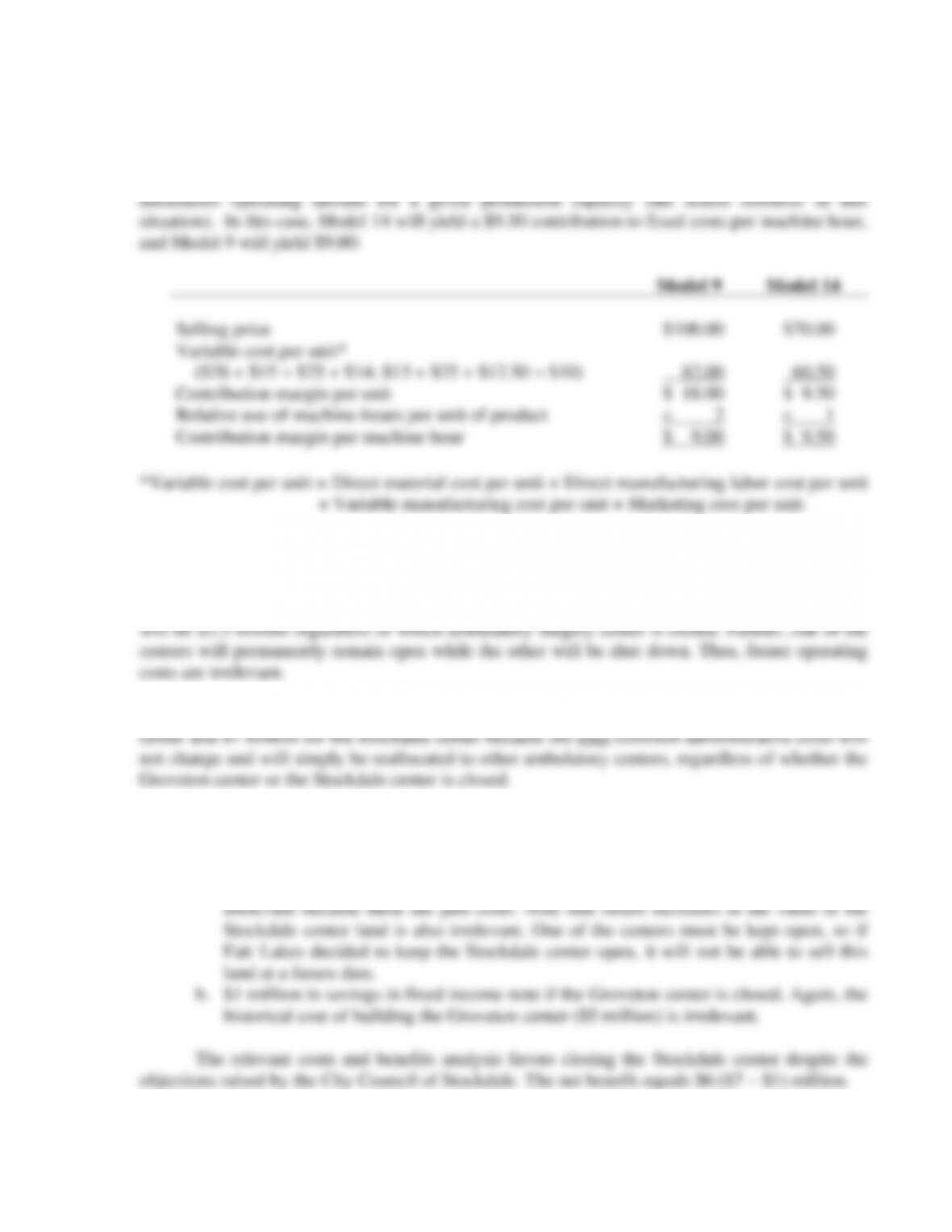
11-23 (10 min.) Selection of most profitable product.
Only Model 14 should be produced. The key to this problem is the relationship of manufacturing
overhead to each product. Note that it takes twice as long to produce Model 9; machine-hours for
Model 9 are twice that for Model 14. Management should choose the product mix that
11-24 (20 min.) Which center to close, relevant-cost analysis, opportunity costs.
1. The annual operating costs of $2.5 million for the Groveton center and $3 million for the
Stockdale center are irrelevant because these are past costs. The future annual operating costs
2. Also irrelevant are the allocated common administrative costs of $800,000 for the Groveton
3. The only relevant revenue and cost comparisons are:
a. $7 million from sale of the Stockdale center. Note that the historical cost of building
the Stockdale center ($4.8 million) and the cost of renovation ($2 million) are
11-12
11-25 (25−30 min.) Closing and opening stores.
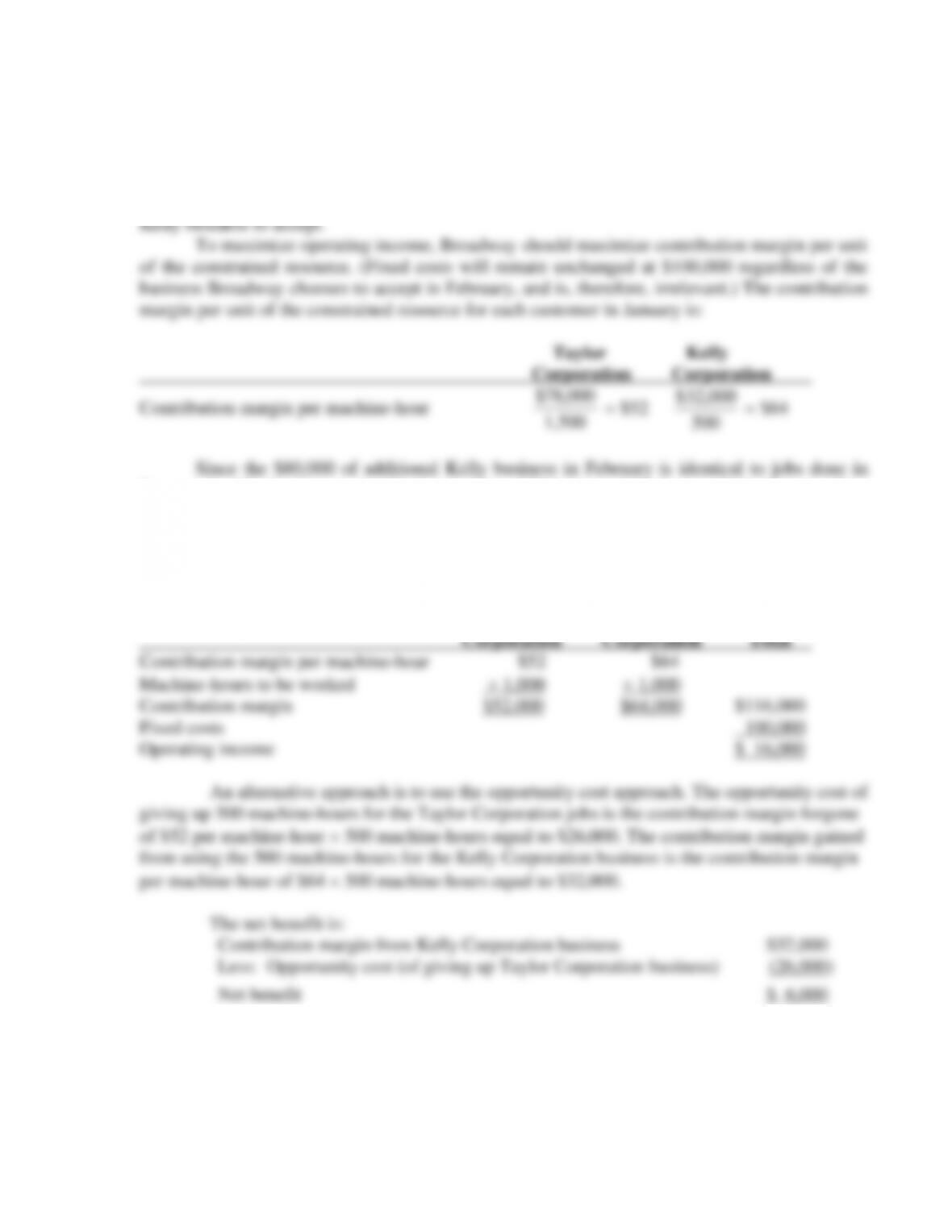
1. Solution Exhibit 11-25, Column 1, presents the relevant loss in revenues and the relevant
savings in costs from closing the Rhode Island store. Lopez is correct that Sanchez Corporation’s
operating income would increase by $7,000 if it closes down the Rhode Island store. Closing
2. Solution Exhibit 11-25, Column 2, presents the relevant revenues and relevant costs of
opening another store like the Rhode Island store. Lopez is correct that opening such a store
would increase Sanchez Corporation’s operating income by $11,000. Incremental revenues of
$860,000 exceed the incremental costs of $849,000 (from higher cost of goods sold, rent, labor,
utilities, and some additional corporate costs). Note that the cost of equipment written off as
much, presumably because the existing corporate staff will be able to oversee the new store as
well.
SOLUTION EXHIBIT 11-25
Relevant-Revenue and Relevant-Cost Analysis of Closing Rhode Island Store and Opening
Another Store Like It.
Incremental
11-26 (20 min.) Choosing customers.
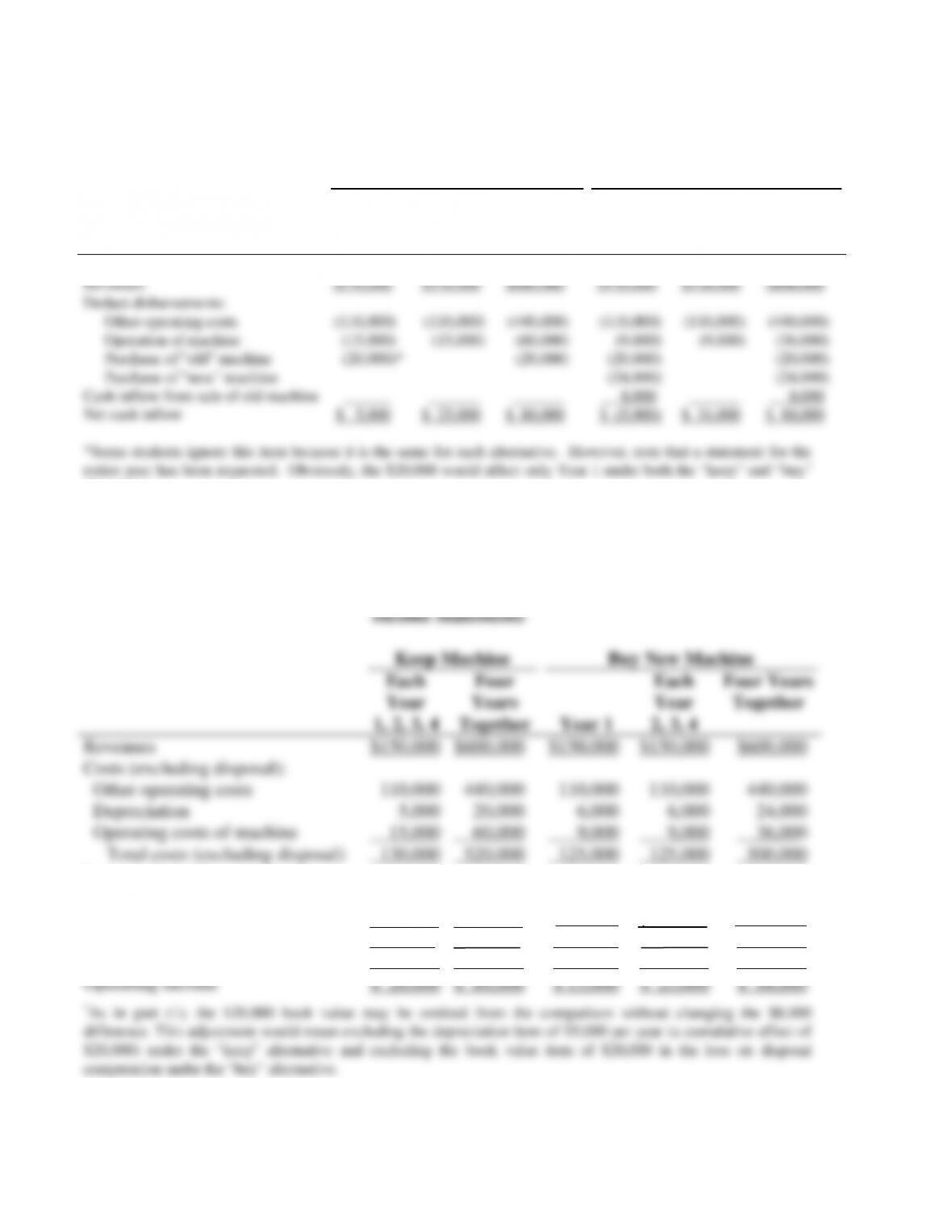
If Broadway accepts the additional business from Kelly, it would take an additional 500
machine-hours. If Broadway accepts all of Kelly’s and Taylor’s business for February, it would
require 2,500 machine-hours (1,500 hours for Taylor and 1,000 hours for Kelly). Broadway has
only 2,000 hours of machine capacity. It must, therefore, choose how much of the Taylor or
January, it will also have a contribution margin of $64 per machine-hour, which is greater than
the contribution margin of $52 per machine-hour from Taylor. To maximize operating income,
Broadway should first allocate all the capacity needed to take the Kelly Corporation business
(1,000 machine-hours) and then allocate the remaining 1,000 (2,000 – 1,000) machine-hours to
Taylor.
Taylor Kelly
11-14
11-27 (30–40 min.) Relevance of equipment costs.
1a. Statements of Cash Receipts and Disbursements
Keep Machine
Buy New Machine
Year 1
Each
Year
2, 3, 4
Four
Years
Together
Year 1
Each
Year
2, 3, 4
Four
Years
Together
Receipts from operations:
Revenues
$150,000
$150,000
$600,000
$150,000
$150,000
$600,000
Deduct disbursements:
Other operating costs
(110,000)
(110,000)
(440,000)
(110,000)
(110,000)
(440,000)
Operation of machine
(15,000)
(15,000)
(60,000)
(9,000)
(9,000)
(36,000)
Purchase of “old” machine
(20,000)*
(20,000)
(20,000)
(20,000)
Purchase of “new” machine
(24,000)
(24,000)
Cash inflow from sale of old machine
8,000
8,000
Net cash inflow
$ 5,000
$ 25,000
$ 80,000
$ (5,000)
$ 31,000
$ 88,000
*Some students ignore this item because it is the same for each alternative. However, note that a statement for the
entire year has been requested. Obviously, the $20,000 would affect only Year 1 under both the “keep” and “buy”
alternatives.
The difference is $8,000 for four years taken together. In particular, note that the $20,000
book value of the old machine can be omitted from the comparison. Merely cross out the entire
line; although the column totals are affected, the net difference is still $8,000.
1b. Again, the difference is $8,000:
Keep Machine
Buy New Machine
Each
Year
1, 2, 3, 4
Four
Years
Together
Year 1
Each
Year
2, 3, 4
Four Years
Together
Revenues
Costs (excluding disposal):
Other operating costs
Depreciation
Operating costs of machine
Total costs (excluding disposal)
Loss on disposal:
Book value (“cost”)
Proceeds (“revenue”)
Loss on disposal
Total costs
Operating income
$150,000
110,000
5,000
15,000
130,000
130,000
$ 20,000
$600,000
440,000
20,000
60,000
520,000
520,000
$ 80,000
$150,000
110,000
6,000
9,000
125,000
20,000
(8,000)
12,000
137,000
$ 13,000
$150,000
110,000
6,000
9,000
125,000
125,000
$ 25,000
$600,000
440,000
24,000
36,000
500,000
20,000*
(8,000)
12,000
512,000
$ 88,000
*As in part (1), the $20,000 book value may be omitted from the comparison without changing the $8,000
difference. This adjustment would mean excluding the depreciation item of $5,000 per year (a cumulative effect of
$20,000) under the “keep” alternative and excluding the book value item of $20,000 in the loss on disposal
computation under the “buy” alternative.
11-15
1c. The $20,000 purchase cost of the old machine, the revenues of $150,000 each year, and
2. The net difference would be unaffected. Any number may be substituted for the original
$20,000 figure without changing the final answer. Of course, the net cash outflows under both
3. Book value is irrelevant in decisions about the replacement of equipment, because it is a
past (historical) cost. All past costs are down the drain. Nothing can change what has already
been spent or what has already happened. The $20,000 has been spent. How it is subsequently
accounted for is irrelevant. The analysis in requirement (1) clearly shows that we may completely
ignore the $20,000 and still have a correct analysis. The only relevant items are those expected
11-16
11-28 (30 min.) Equipment upgrade versus replacement.
1. Based on the analysis in the table below, TechGuide will be better off by $337,500 over
three years if it replaces the current equipment.
Over 3 years
Difference in
Comparing Relevant Costs of Upgrade and
Upgrade
Replace
favor of Replace
Replace Alternatives
(1)
(2)
(3) = (1) – (2)
Cash operating costs
$150; $75 per desk
7,500 desks per yr.
3 yrs.
$3,375,000
$1,687,500
$1,687,5000
Current disposal price
(450,000)
450,000
One time capital costs, written off periodically as
depreciation
3,000,000
4,800,000
(1,800,000)
Total relevant costs
$6,375,000
$6,037,500
$ 337,500
Note that the book value of the current machine, $1,800,000
3
5
= $1,080,000 would either be
written off as depreciation over three years under the upgrade option, or, all at once in the current
year under the replace option. Its net effect would be the same in both alternatives: to increase
costs by $1,080,000 over three years, hence it is irrelevant in this analysis.
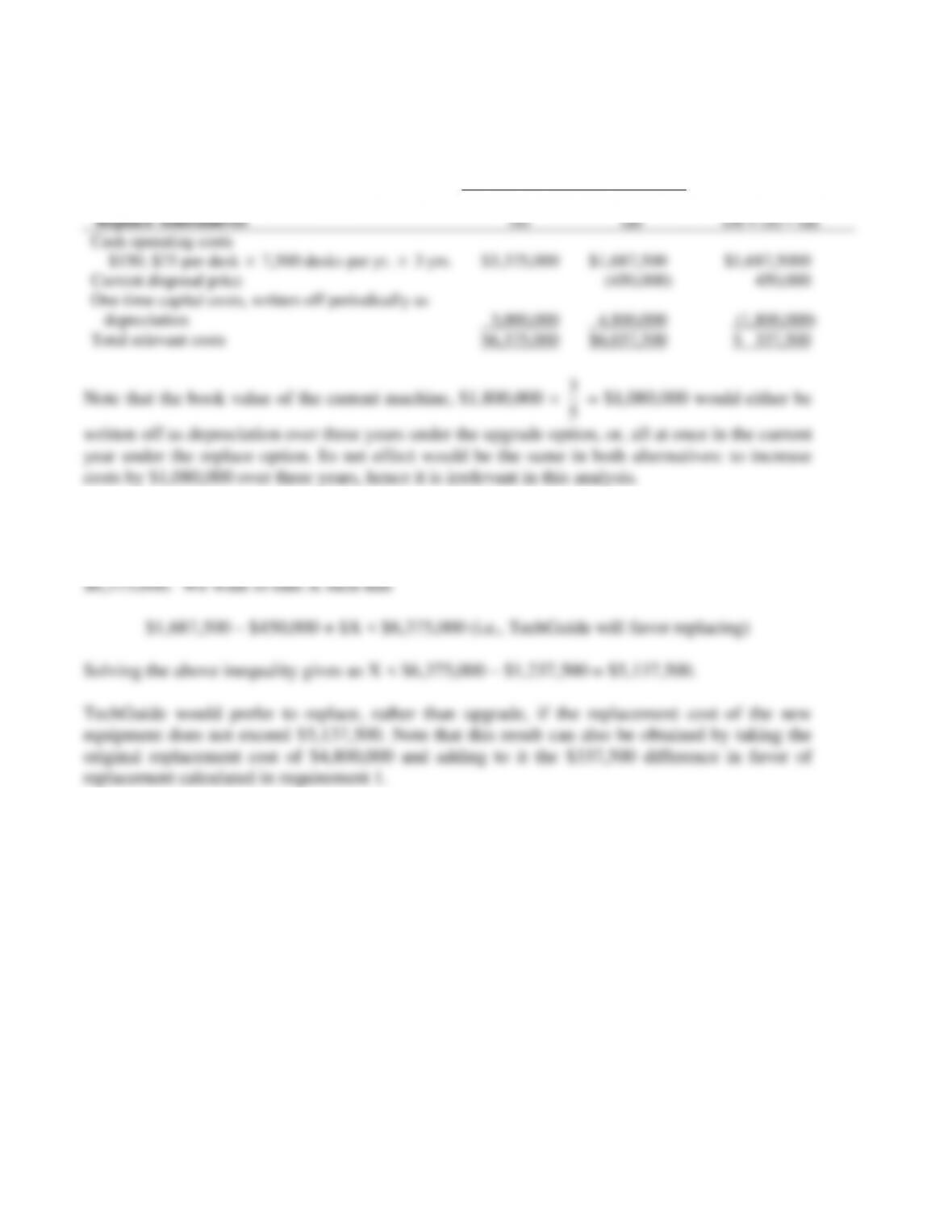
2. Suppose the capital expenditure to replace the equipment is $X. From requirement 1,
column (2), substituting for the one-time capital cost of replacement, the relevant cost of
replacing is $1,687,500 – $450,000 + $X. From column (1), the relevant cost of upgrading is
11-17
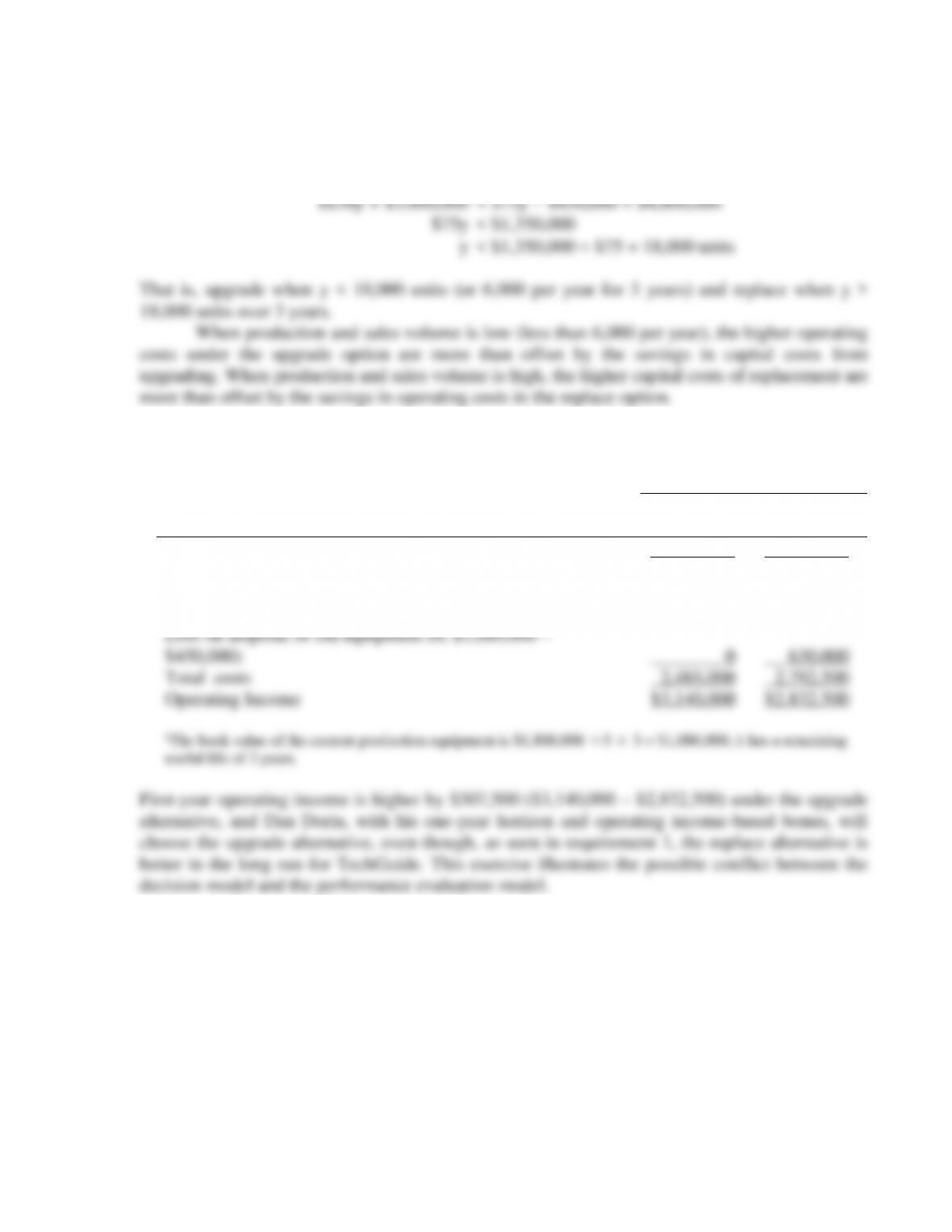
3. Suppose the units produced and sold over 3 years equal y. Using data from requirement
1, column (1), the relevant cost of upgrade would be $150y + $3,000,000, and from column (2),
the relevant cost of replacing the equipment would be $75y – $450,000 + $4,800,000.
TechGuide would want to upgrade when
4. Operating income for the first year under the upgrade and replace alternatives are shown
below:
Year 1
Upgrade
Replace
(1)
(2)
Revenues (7,500
$750)
$5,625,000
$5,625,000
Cash operating costs
$150; $75 per desk
7,500 desks per year
1,125,000
562,500
Depreciation ($1,080,000a + $3,000,000)
3; $4,800,000
3
1,360,000
1,600,000
Loss on disposal of old equipment (0; $1,080,000 –
$450,000)
0
630,000
Total costs
2,485,000
2,792,500
Operating Income
$3,140,000
$2,832,500
aThe book value of the current production equipment is $1,800,000
5
3 = $1,080,000; it has a remaining
useful life of 3 years.
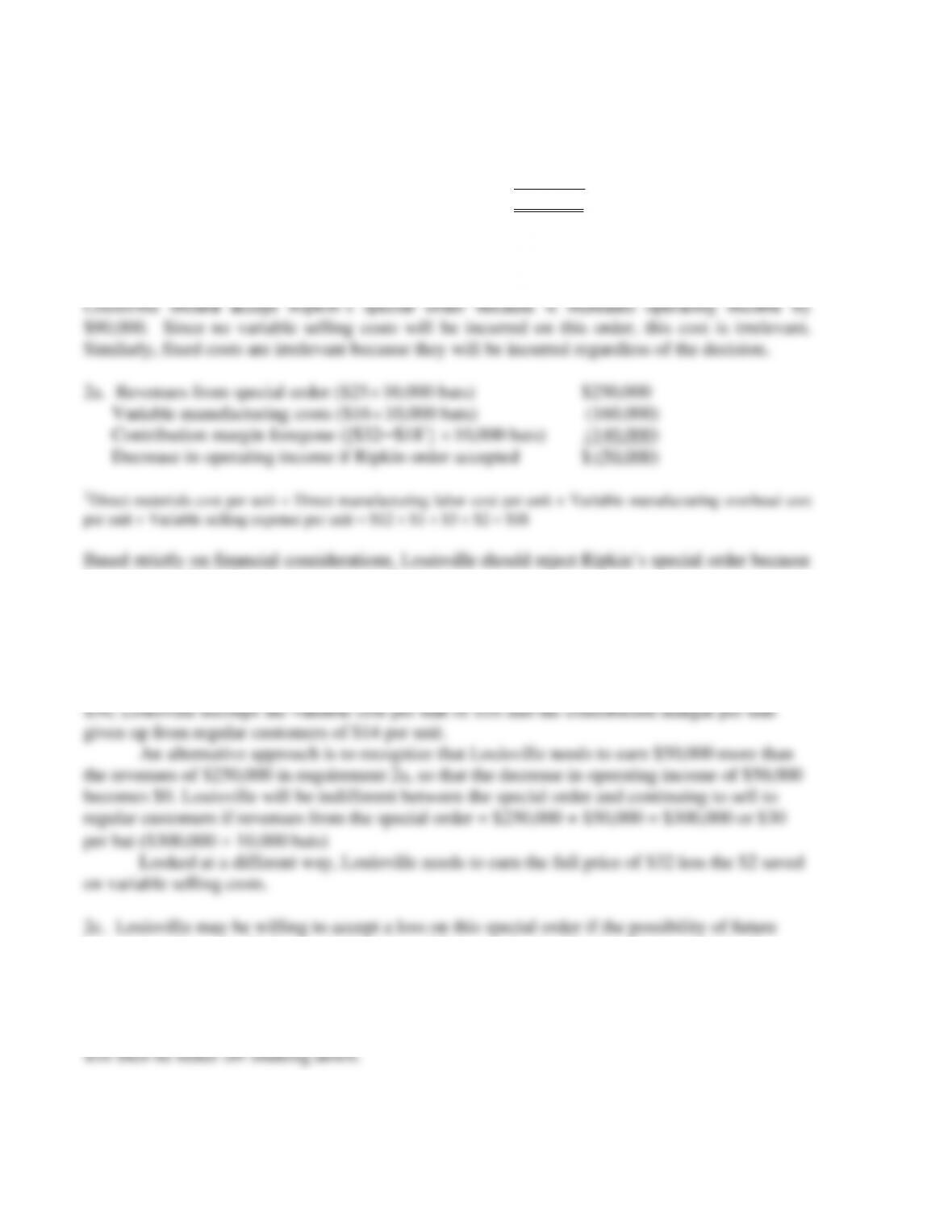
First-year operating income is higher by $307,500 ($3,140,000 – $2,832,500) under the upgrade
alternative, and Dan Doria, with his one-year horizon and operating income-based bonus, will
choose the upgrade alternative, even though, as seen in requirement 1, the replace alternative is
better in the long run for TechGuide. This exercise illustrates the possible conflict between the
decision model and the performance evaluation model.
11-18
11-29 (20 min.) Special Order.
1.
Revenues from special order ($25
10,000 bats)
$250,000
Variable manufacturing costs ($161
10,000 bats)
(160,000)
Increase in operating income if Ripkin order accepted
$ 90,000
1Direct materials cost per unit + Direct manufacturing labor cost per unit + Variable manufacturing overhead cost
per unit = $12 + $3 + $1 = $16
2a. Revenues from special order ($25
10,000 bats)
$250,000
Variable manufacturing costs ($16
10,000 bats)
(160,000)
Contribution margin foregone ([$32─$181]
10,000 bats)
(140,000)
Decrease in operating income if Ripkin order accepted
$ (50,000)
it results in a $50,000 reduction in operating income.
2b. Louisville will be indifferent between the special order and continuing to sell to regular
customers if the special order price is $30. At this price, Louisville recoups the variable
manufacturing costs of $160,000 and the contribution margin given up from regular customers of
$140,000 ([$160,000 + $140,000] ÷ 10,000 units = $30). That is, at the special order price of
long-term sales seem likely at a higher price. Moreover, Louisville should also consider the
negative long-term effect on customer relationships of not selling to existing customers.
Louisville cannot afford to sell bats to customers at the special order price for the long term
because the $25 price is less than the full cost of the product of $27. This means that in the long
term the contribution margin earned will not cover the fixed costs and result in a loss. Louisville
11-19
11-30 (20 min.) International outsourcing.
1. Cost to purchase each figurine from Indonesian supplier =
27,300 IDR $3.
9,100 IDR/$ =
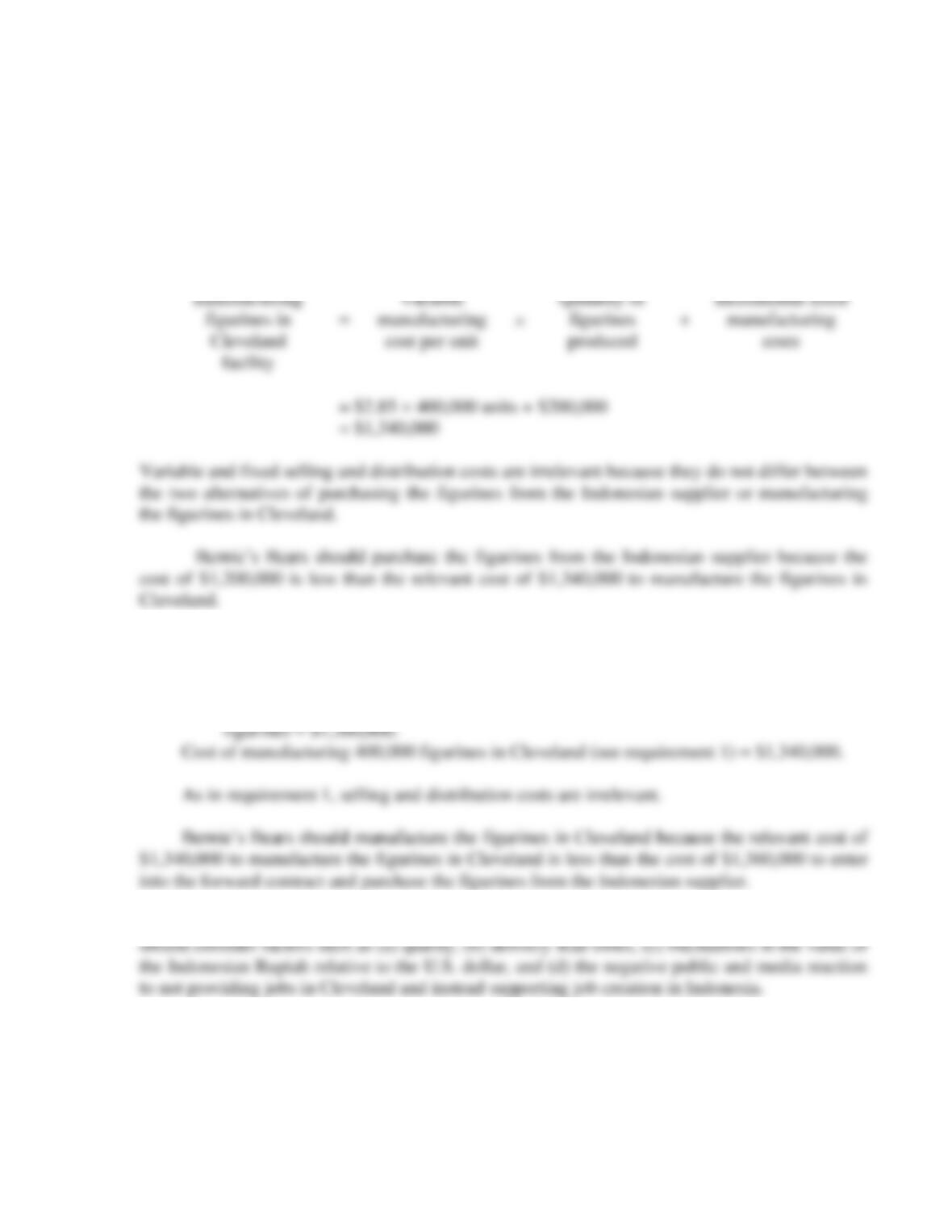
Cost of purchasing 400,000 figurines from Indonesian supplier = $3 400,000 figurines =
$1,200,000.
Costs of
manufacturing
figurines in
Cleveland
facility
=
Variable
manufacturing
cost per unit
Quantity of
figurines
produced
+
Incremental fixed
manufacturing
costs
= $2.85 400,000 units + $200,000
= $1,340,000
Variable and fixed selling and distribution costs are irrelevant because they do not differ between
the two alternatives of purchasing the figurines from the Indonesian supplier or manufacturing
the figurines in Cleveland.
Bernie’s Bears should purchase the figurines from the Indonesian supplier because the
cost of $1,200,000 is less than the relevant cost of $1,340,000 to manufacture the figurines in
Cleveland.
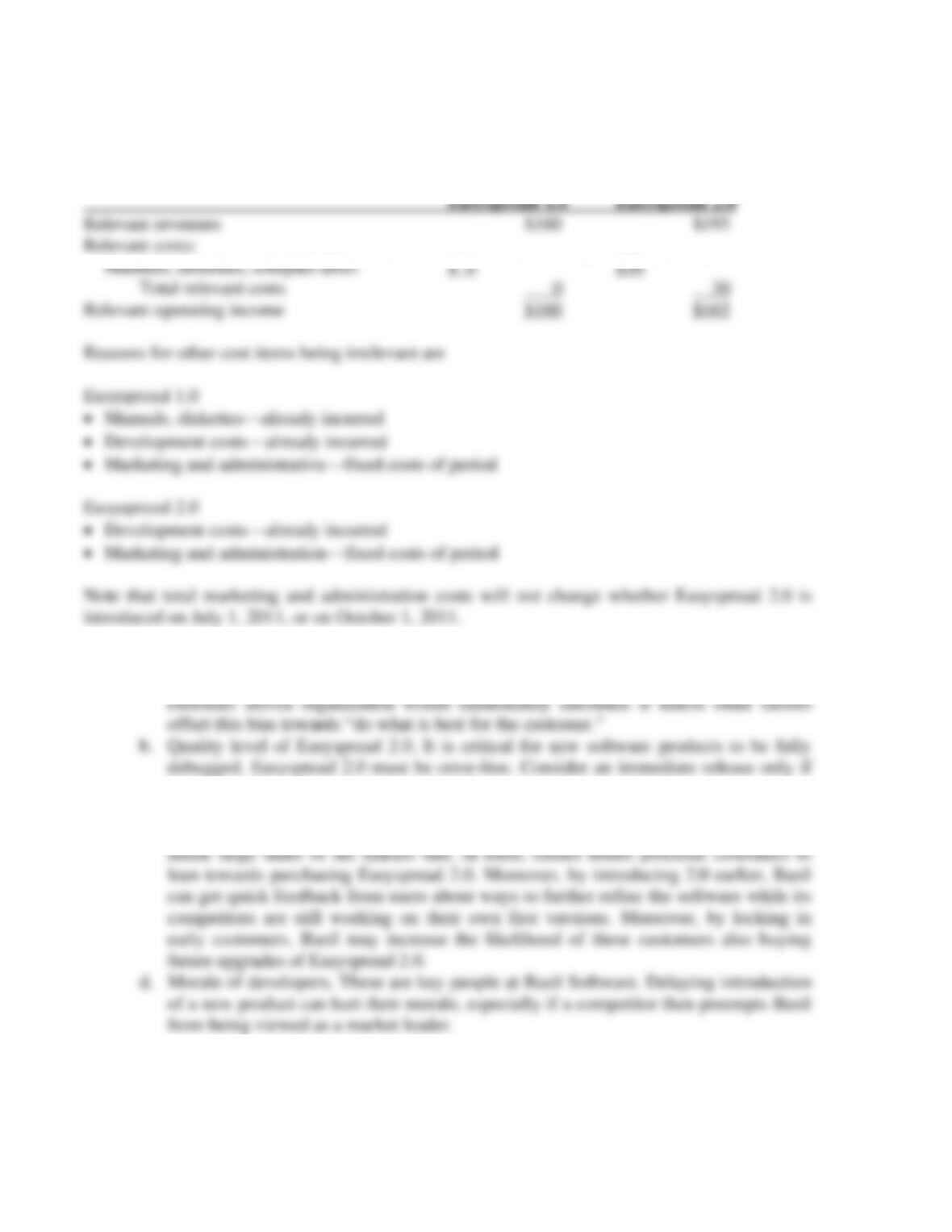
2. If Bernie’s Bears enters into a forward contract to purchase 27,300 IDRs for $3.40, each
figurine acquired from the Indonesian supplier will cost $3.40.
Total cost of purchasing 400,000 figurines from Indonesian supplier = $3.40 400,000
3. In deciding whether to purchase figurines from the Indonesian supplier, Bernie’s Bears
11-20
11-31 (30 min.) Relevant costs, opportunity costs.
1. Easyspread 2.0 has a higher relevant operating income than Easyspread 1.0. Based on this
analysis, Easyspread 2.0 should be introduced immediately:
2. Other factors to be considered:
a. Customer satisfaction. If 2.0 is significantly better than 1.0 for its customers, a
2.0 passes all quality tests and can be fully supported by the salesforce.
c. Importance of being perceived to be a market leader. Being first in the market with a
new product can give Basil Software a “first–mover advantage,” e.g., capturing an