7-18. New
Capital investment = $18,000; net annual cash flow (before taxes) = $8,000
during year 1-4, and equals $3,000 during years 5-8; estimated salvage value
= 0; t = 0.40; MACRS = 5 year recovery period.
EOY
(A)
BTCF
(B)
Depr
(C)=
(A)-(B)
TI
(D)=
-t (C)
IT
(E)=
(A)+(D)
ATCF
0 -$18
,
000 — — — -$18
,
000
1 8,000 $3,600 $4,400 -$1,760 6,240
dk = 000,1$
years 8
83
7-19. To determine the tax bracket: TI = R – E – d
TI = $190,000 – $50,000 – $40,000 = $100,000
Increased income moves company into 39% income tax bracket.
EOY
(A)
BTCF
(B)
Depr
(C)
=(A)–(B)
TI
(D)
= -t (C)
IT
(E)
(A)+(D)
ATCF
0 -$50
,
000 — — — -$50
,
000
1 20,000 $10,000 $10,000 -$3,900 16,100
84
,
,
,
7-20.
(a) Use the tabular format given below to compute the after tax cash flow.
EOY (A) (B)
(C ) =
(A) -(B) (D) = -0.4(C) (E)=(A)+(D)
Before
Tax Cash
Flow ($)
Depr.
Deduction($)
Taxable
Income($)
Cash flow for
income
taxes($)
After-tax
cash
flow($)
0 -130,000 — — — -130,000
1 24,000 20,000 4,000 -1,600 22,400
85
7-21. Assume repeatability of investments over a common multiple of lives.
System A
(A) (B) (C)= (A)-(B)
EOY BTCF Depr TI (D)= -t (C)
IT
(E)=
(A)+(D)
ATCF
(F)
PW (10%)
0 –
$
100
,
000 — — — –
$
100
,
000 –
$
100
,
000
1 20,000 $20,000 $0 $0 20,000 18,182
2 20,000 32,000 -12,000 4,800 24,800 20,496
3 20,000 19,200 800 -320 19,680 14,786
System B
EOY
(A)
BTCF
(B)
Depr
(C)
=(A)-(B)
TI
(D)
-t (C)
IT
(E)
(A)+(D)
ATCF
(F)
PW (10%)
0 -$200
,
000 — — — -$200
,
000 -$200
,
000
1 40,000 $40,000 $0 $0 40,000 36,364
86
7-22.
(a)
EOY
(A)
BTCF
(B)
Depr
(C)=
(A)-(B)
TI
(D)=
-t (C)
IT
(E)=
(A)+(D)
ATCF
(F)
PW (12%)
0 –
$
5
,
000 — — — –
$
5
,
000 –
$
5
,
000
1 1,200 $1,000 $200 -$30 1,170 1,045
2 1,200 1,600 -400 60 1,260 1,004
3 1,200 960 240 -36 1,164 829
87
7-23. ALT. R – (Continue to Rent)
YR BTCF Depr. TI IT ATCF
1-8 -$4,000 – -$4,000 $1,600 -$2,400
5.3349
PWR (10%) = -2,400(P /A, 10%, 8)
= -12,803.76
88
7-24.
EOY
(A)
BTCF
(B)
Depr
(C)=
(A)-(B)
TI
(D)=
-t (C)
IT (40%)
(E)=
(A)+(D)
ATCF
0 -$50,000 —– —– — -$50,000
7-25 Section 179 deduction in year 0 = $17,500.
New cost basis = $100,000 – $17,500 = $82,500
YR BTCF D TI T ATCF
0 -100,000 – 17,500 -$82,500
1 30,000 11,789 18,211 -7,284 22,716
2 30,000 20,204 9,796 –3,918 26,082
89
7-26. (a) No depreciation can be claimed by the lease.
BOY
(A)
Lease Cost
(B)
Other Cost
(C)=
(A)-(B)
BTCF
(D)=
-t (C)
IT
(E)=
(,C)+(D)
ATCF
(F)
PW (15%)
0 — — — — — —
1 -$80,000 $4,000 -$84,000 $33,600 -$50,400 -46,667
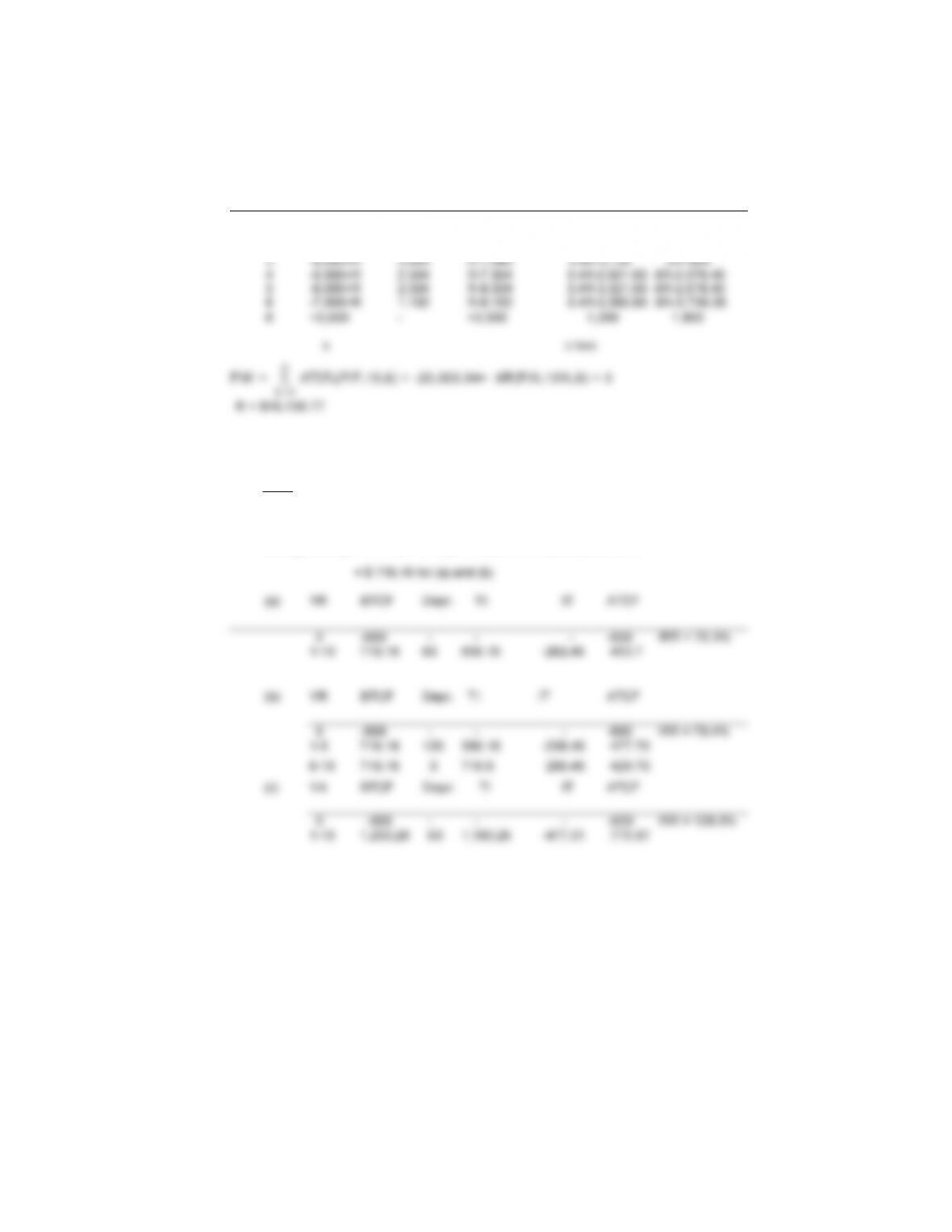
7-27. Let R = Annual Benefits (Returns)
EOY (A) (B)
(C ) = (A) –
(B) (D) (E)
BTCF Depr. TI IT ATCF
0 -21,000 — — — -21,000
1 -2000+R 3,000 -5000+R 2000-0.4R +0.6R
90
7-28.
EOY k BTCF Depr.
TI IT
ATCF
0 -20
,
000 -20
,
000
1 -2,000+R 4,000 R-6,000 0.4R-2,400 .6R+400
2 -3,000+R 6,400 R-9,400 0.4R-3,760 .6R+760
7-29. BÆA (incremental analysis)
Investment -$600
Depreciation $60
Energy Savings = (13 hp – 10 hp)(0.746)(8,000 hrs/year)(cost/kwhr)
91
7-30.
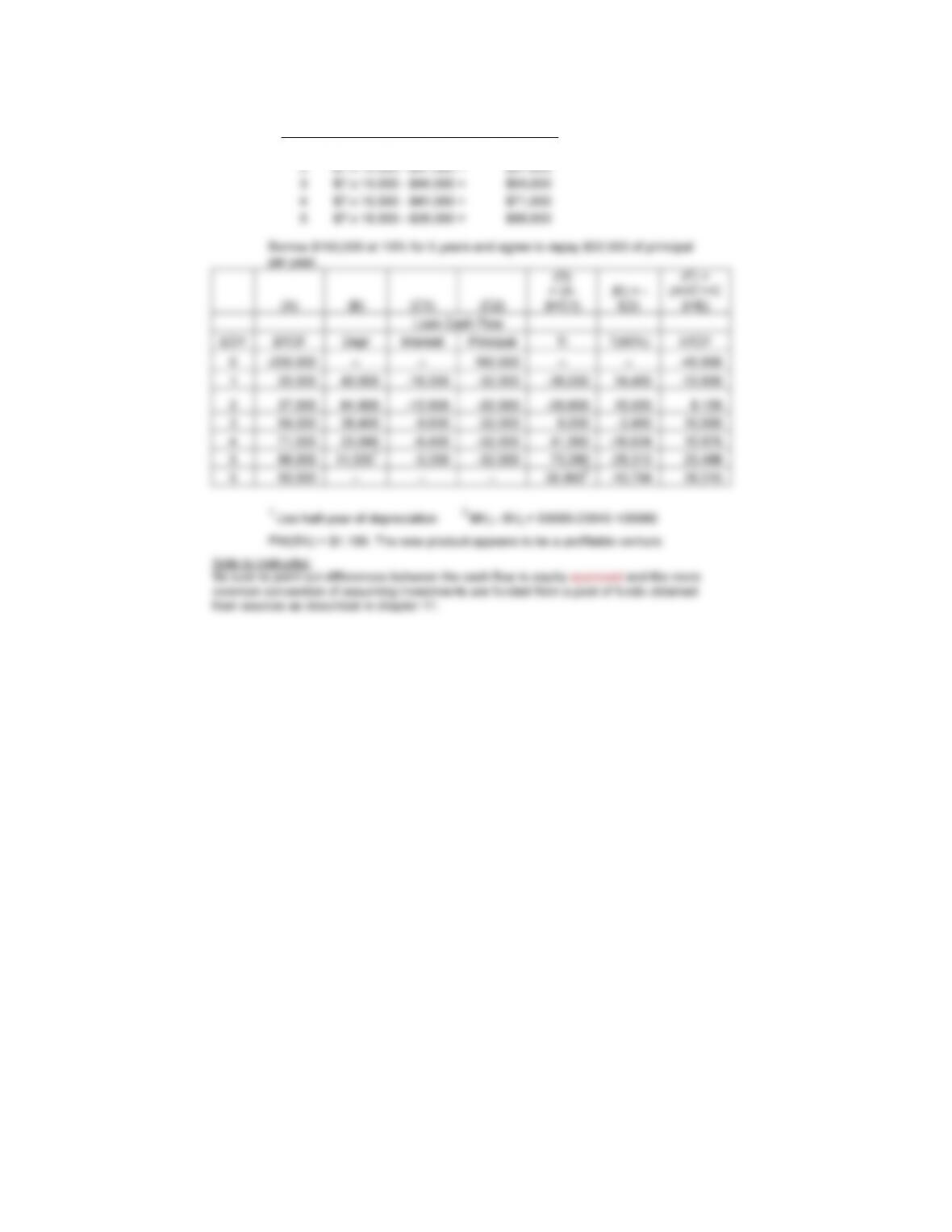
Year Revenues Less Expenses = BTCF
1 $7 x 10,000 – $50,000 = $20,000
2 $7 x 12,000 – $47,000 = $37,000
92
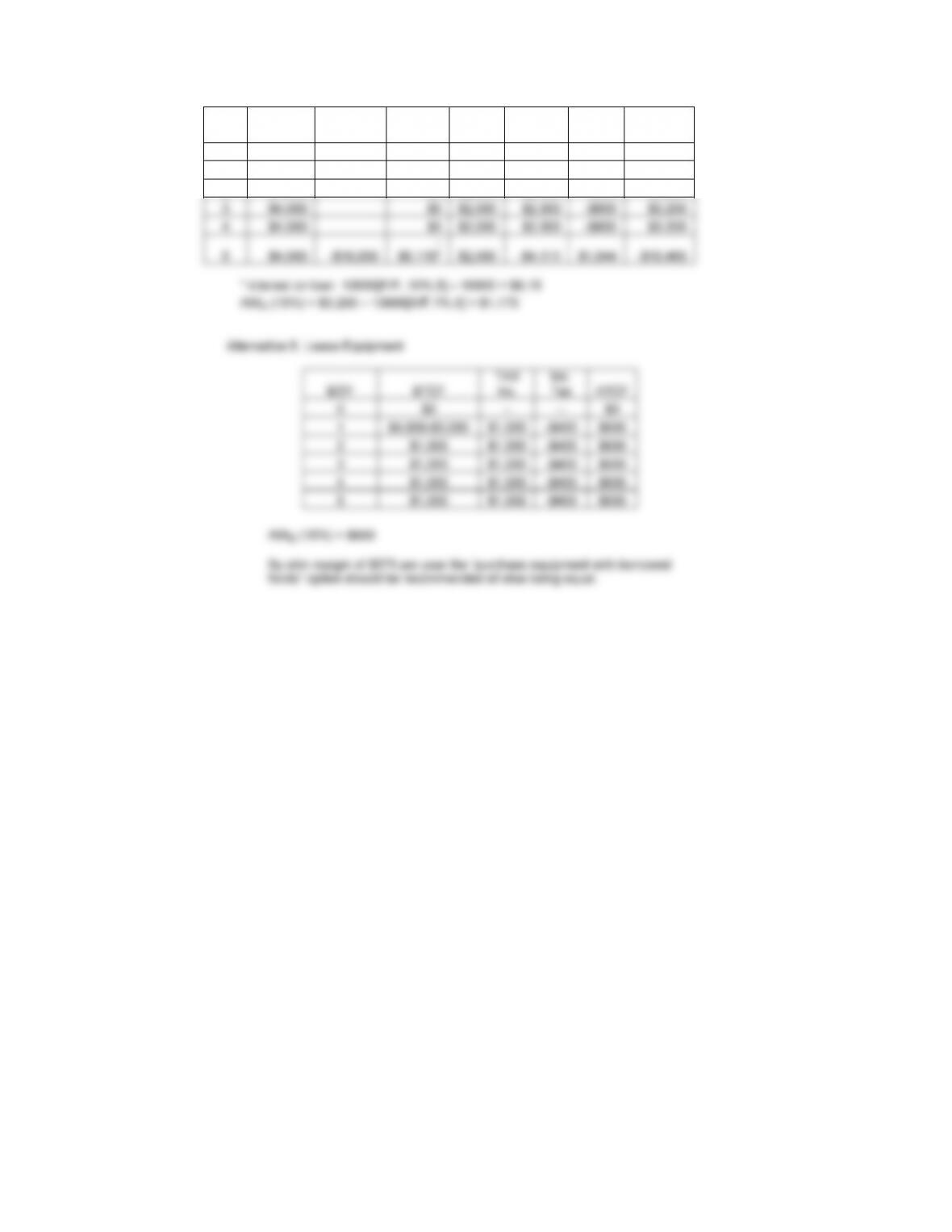
7-31. Alternative A. Purchase equipment with borrowed funds.
EOY BTCF
Loan
Principal interest Depr. Tax Inc.
Inc.
Tax ATCF
0 -$10,000 $10,000 — — — — $0
1 $4,000 $0 $2,000 $2,000 -$800 $3,200
2 $4,000 $0 $2,000 $2,000 -$800 $3,200
AWB (15%) = $600
By slim margin of $573 per year the “purchase equipment with borrowed
funds” option should be recommended all else being equal.
93
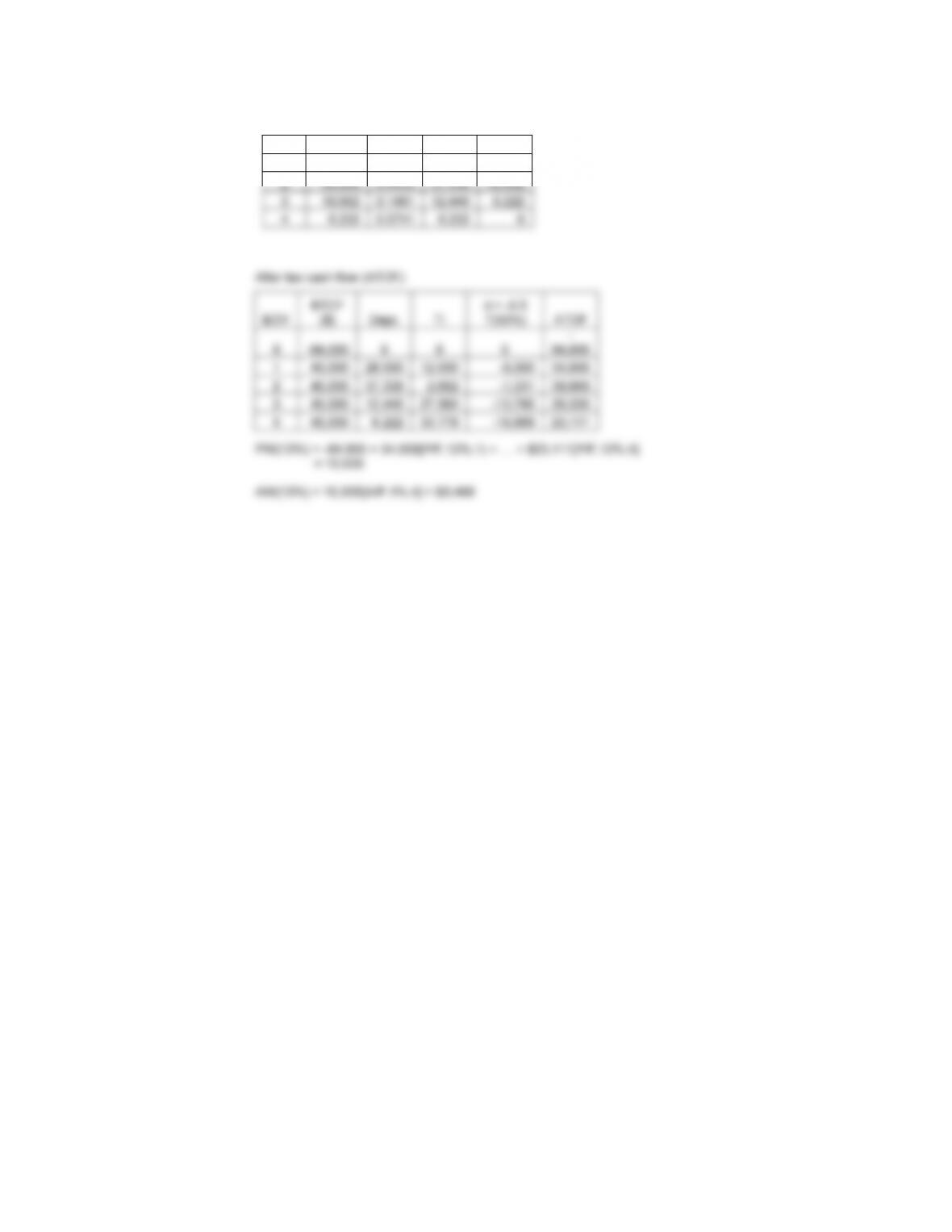
7-32. Depreciation schedule (3 year property class). The cost basis (B) is assumed
to be $84,000
Year BVk-1 rk dk BVk
1 $84,000 0.3333 28,000 56,000
PW(12%) = -84,000 + 34,000[P/F,12%,1) + … + $23,111[P/F,12%,4]
= 10,535
AW(12%) = 10,535[A/P,1%,4] = $3,468
94