SOLUTIONS TO CHAPTER 19 PROBLEMS
Multiple Attribute Decision Making and AHP
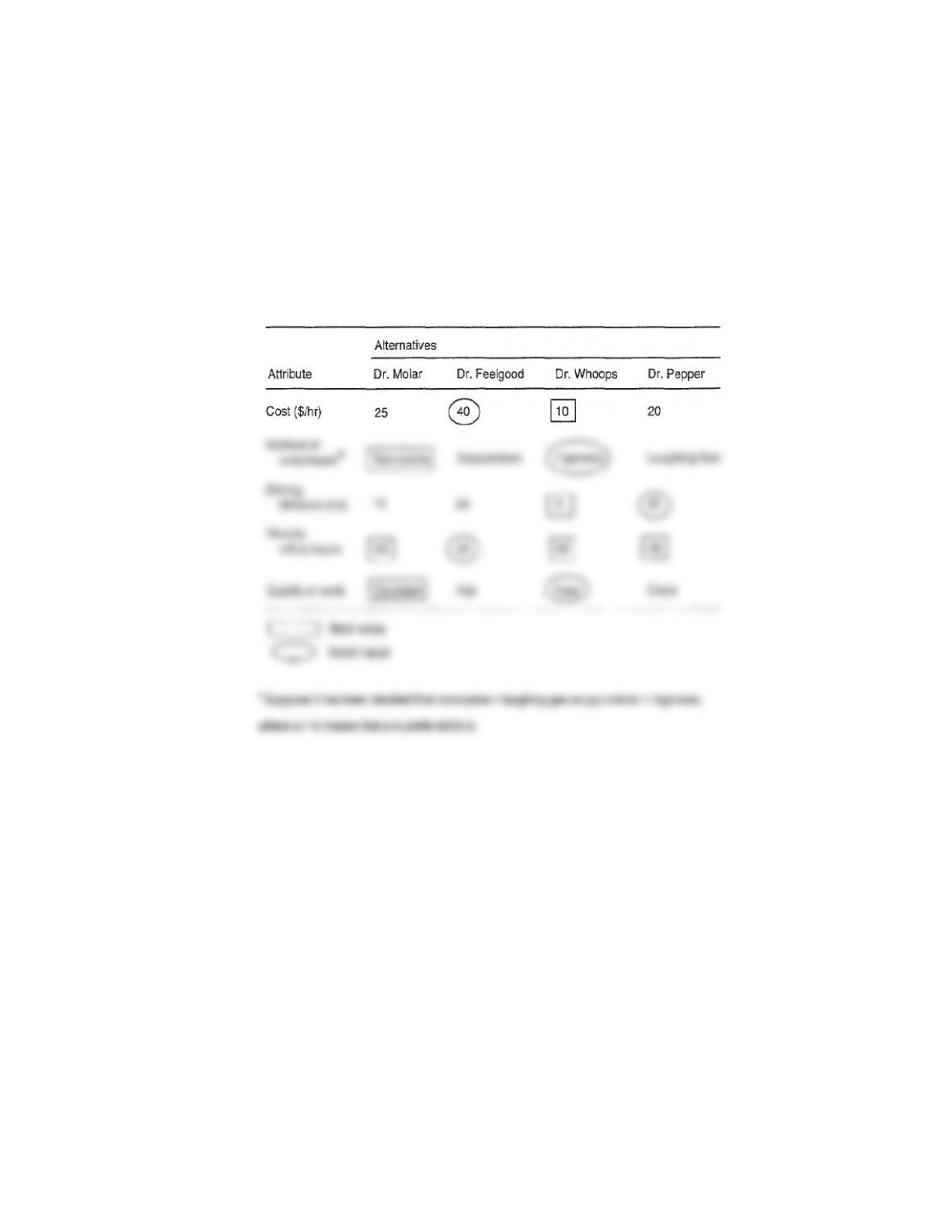
19-1. In this typical multiple attribute decision problem, the choice of a dentist is outlined. The
students in your class could use this as a starting point for a more detailed analysis of
selecting a personal dentist (or physician).
224
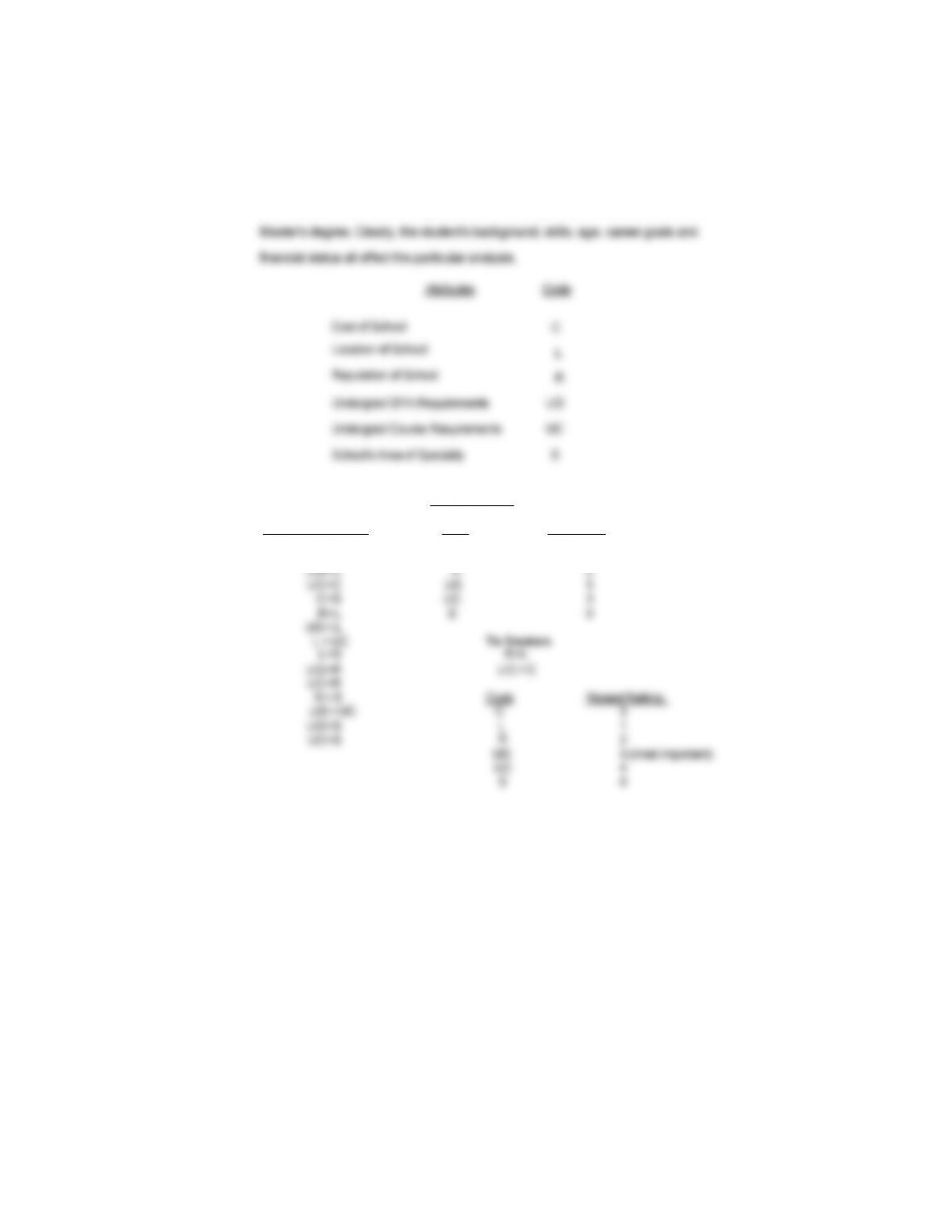
19-2. As an example of how this question could be answered, suppose a student has just
received his/her Bachelor’s degree and is attempting to decide where to enroll for a
Location of School
Reputation of School
L
R
Undergrad GPA Requirements UG
Undergrad Course Requirements UC
School’s Area of Specialty S
Ordinal Rankin
g
# of Times
Paired Comparisons Code on Left of >
C>L C 3
C>R L 2
225
19-2. (continued)
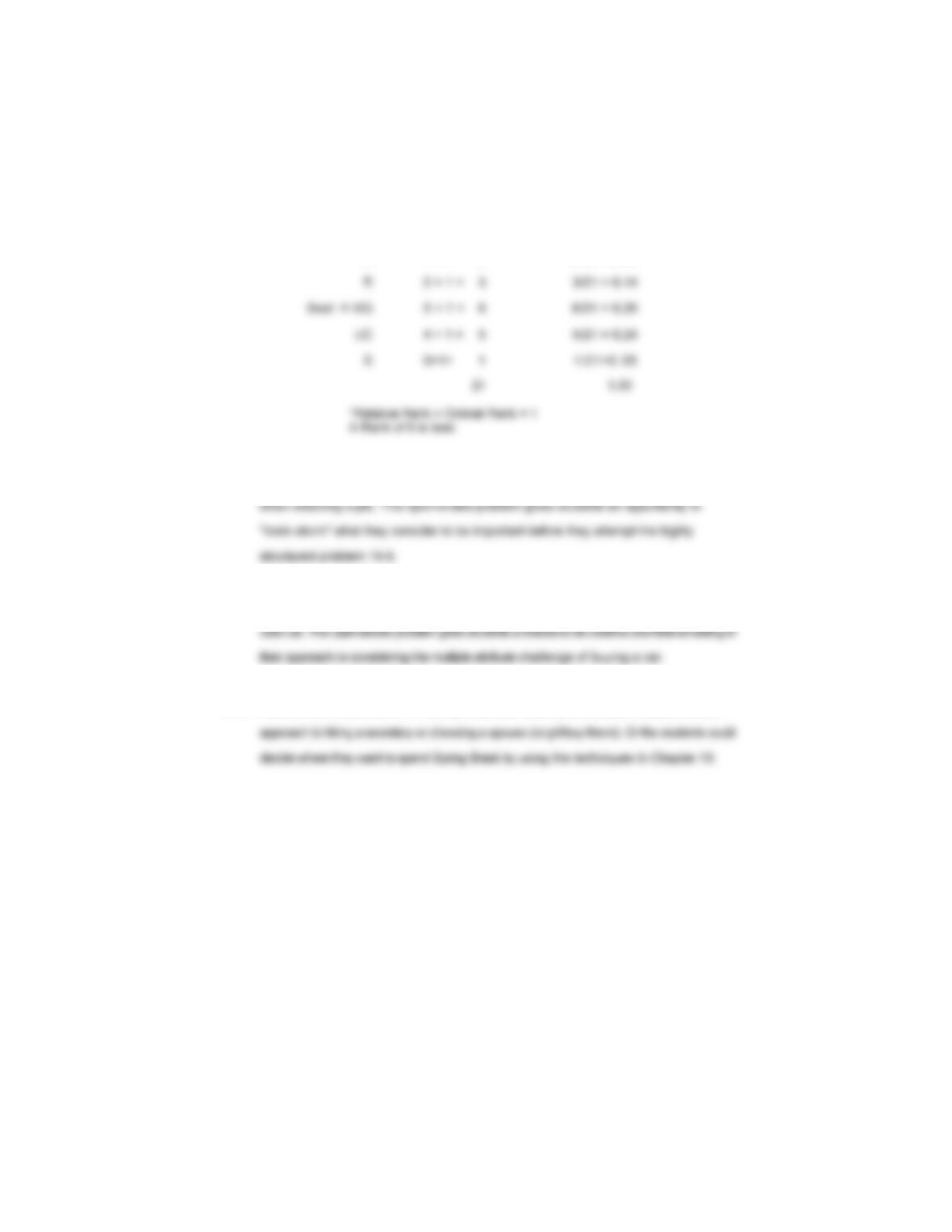
Code Relative Rank* Normalized Wt.
C 3 + 1 = 4 4/21 = 0,19
L 1+1= 2 2/21=0,09
19–3. Refer to the solution to problem 19-8 for typical attributes that one might consider
19-4. Refer to the solution to problem 19-7 for typical attributes associated with purchasing a
19–5. Have fun with this problem! For example, ask your students to develop a multiple attribute
226
19-6. Left to student and his / her own perception.
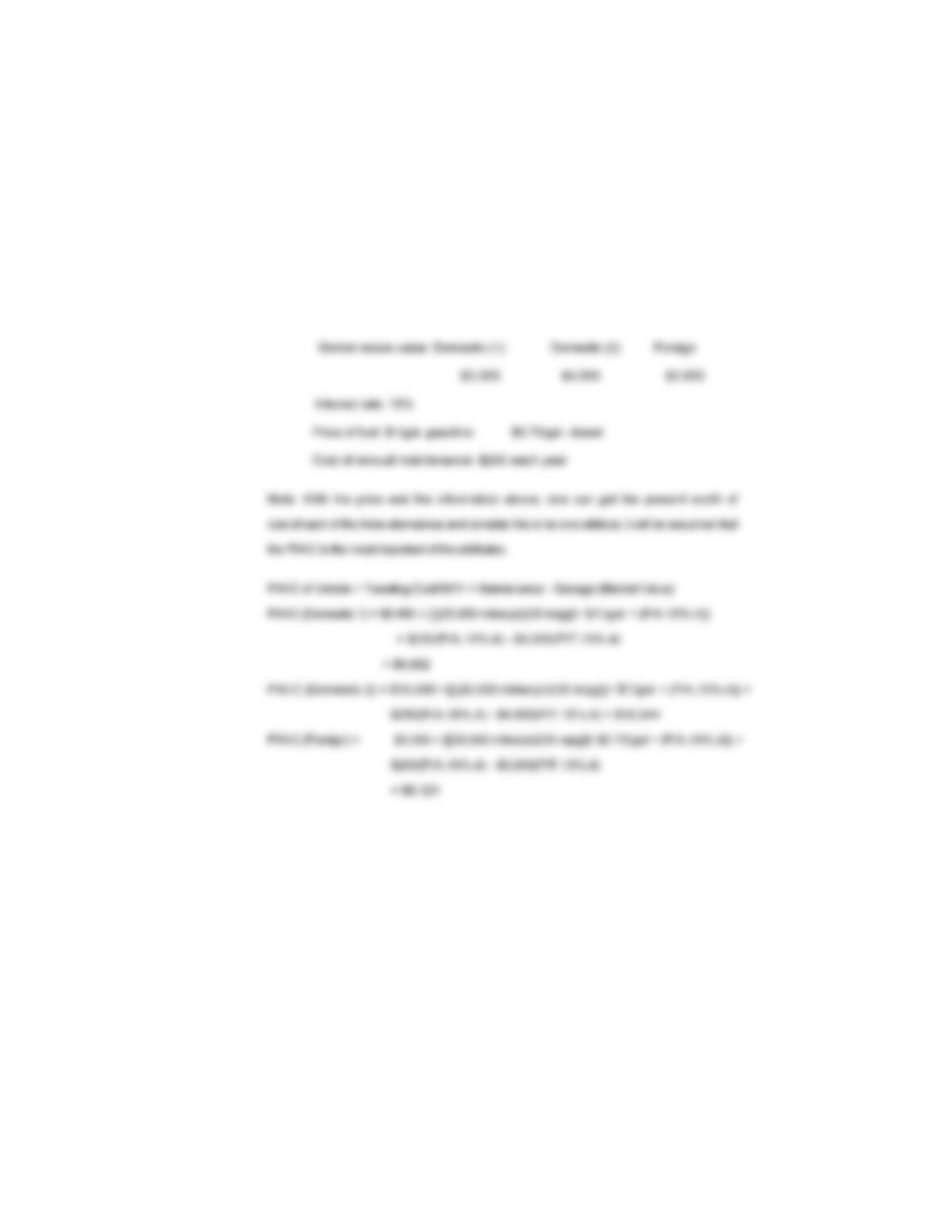
19-7, (a) Left to the student. Below are evaluation ratings etc. to show an example
(With obsolete cost numbers!)
Assumptions:
Miles driven each year: 20,000 miles
Life of the automobile: 4 years
227
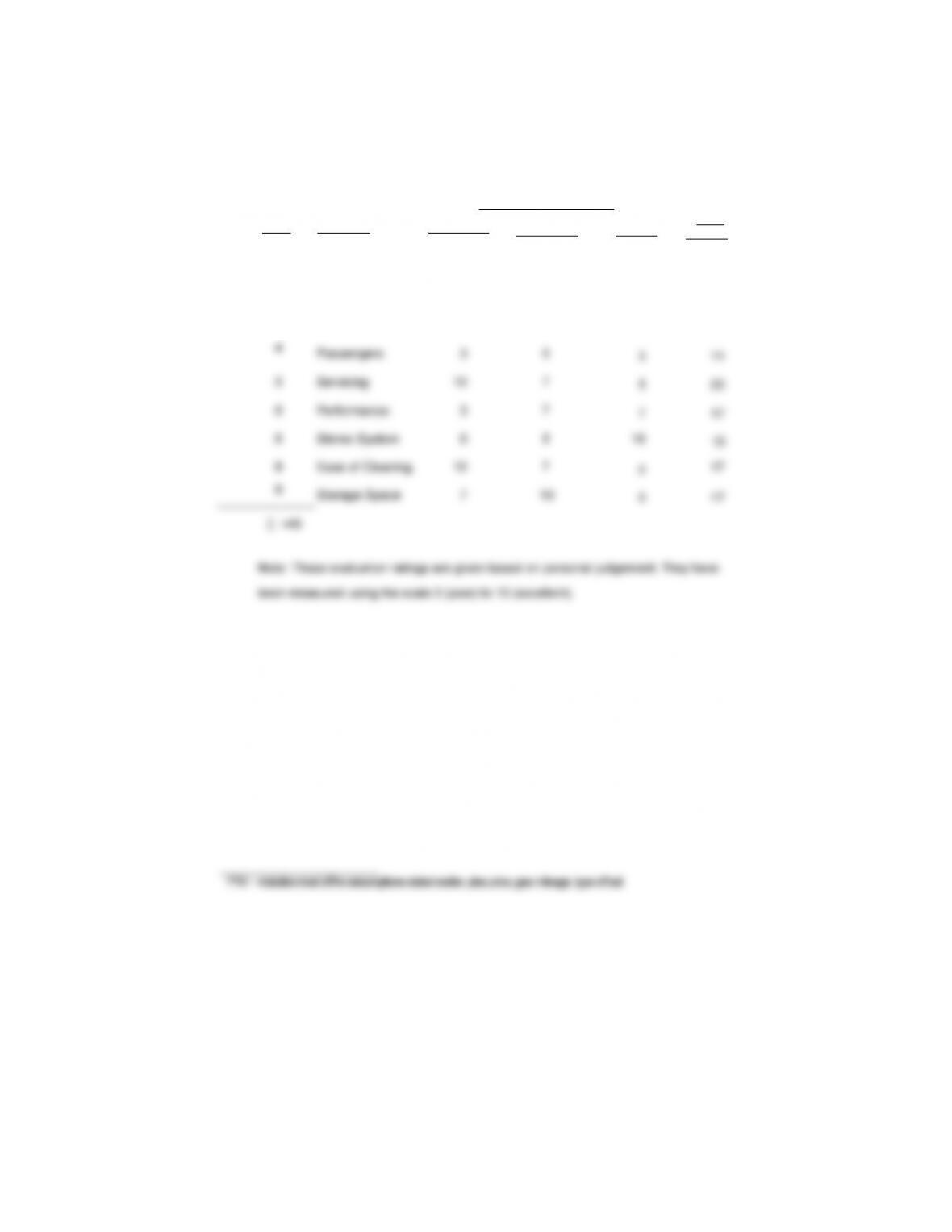
19-7. (continued)
Alternative Eval, Ratings
Rank Attributes Domestic 1 Domestic 2 Foreign Eval,
Ratings
1 P W’ 5 3 9 15
2 Comfort 7 10 10
27
3 Appeal 5 7 9 21
228
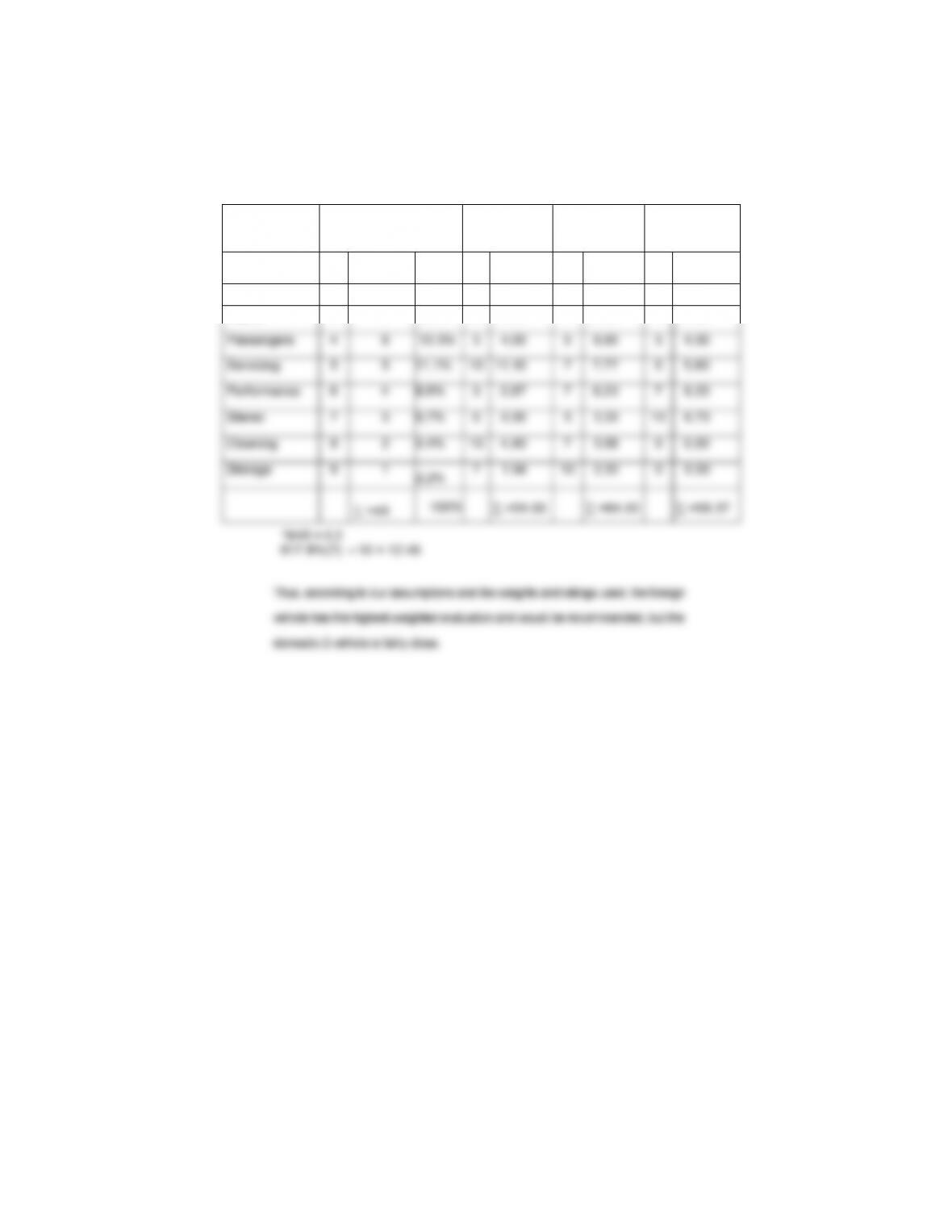
19-7, (continued)
WEIGHTED EVALUATION
Attribute
Rank Sum
Rank Reverse Weight
Alt, Dom, 1
Eval Wgt.
Rat. Eval/10
Alt, Dom, 2
Eval Wgt.
Rat. Eval/10
Alt, Foreign
Eval Wgt.
Rat. Eval/10
PW 1 9
20,0%* 5 10,00 3 6,00 7 14.00
Comfort 2 8 17,8% 7 12,46θ 10 17,80 10 17,80
Appeal 3 7 15,6% 5 7,80 7 10,92 9 14,04
229
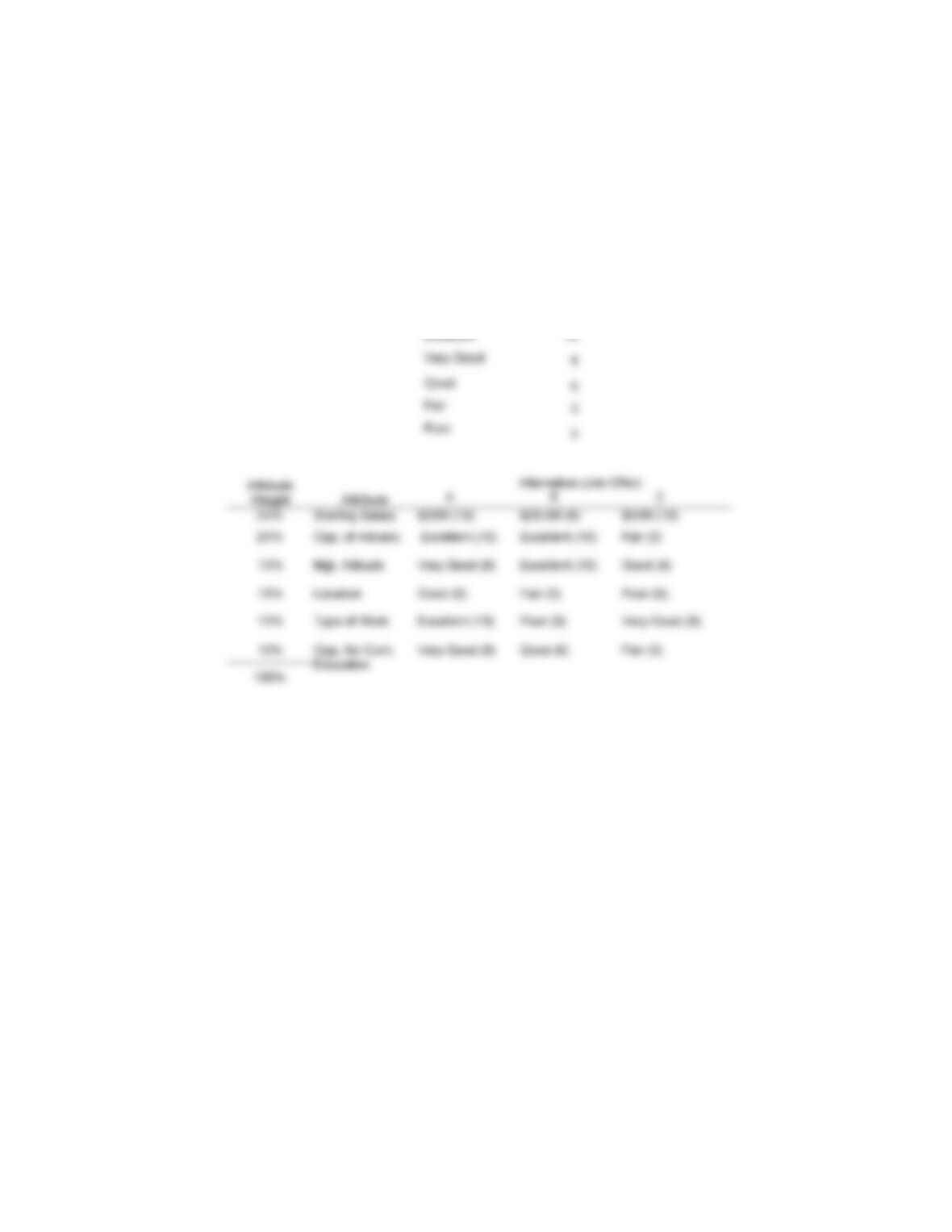
19-8. Note: The weighted evaluation technique with some assumed numbers will be
presented here, The diligent student is encouraged to try other possible techniques
(M- thousands),
Key forEvaluation Ratings
$29M < X ≤ $40M 10
$25M < X ≤$29M 8
Salary:
230
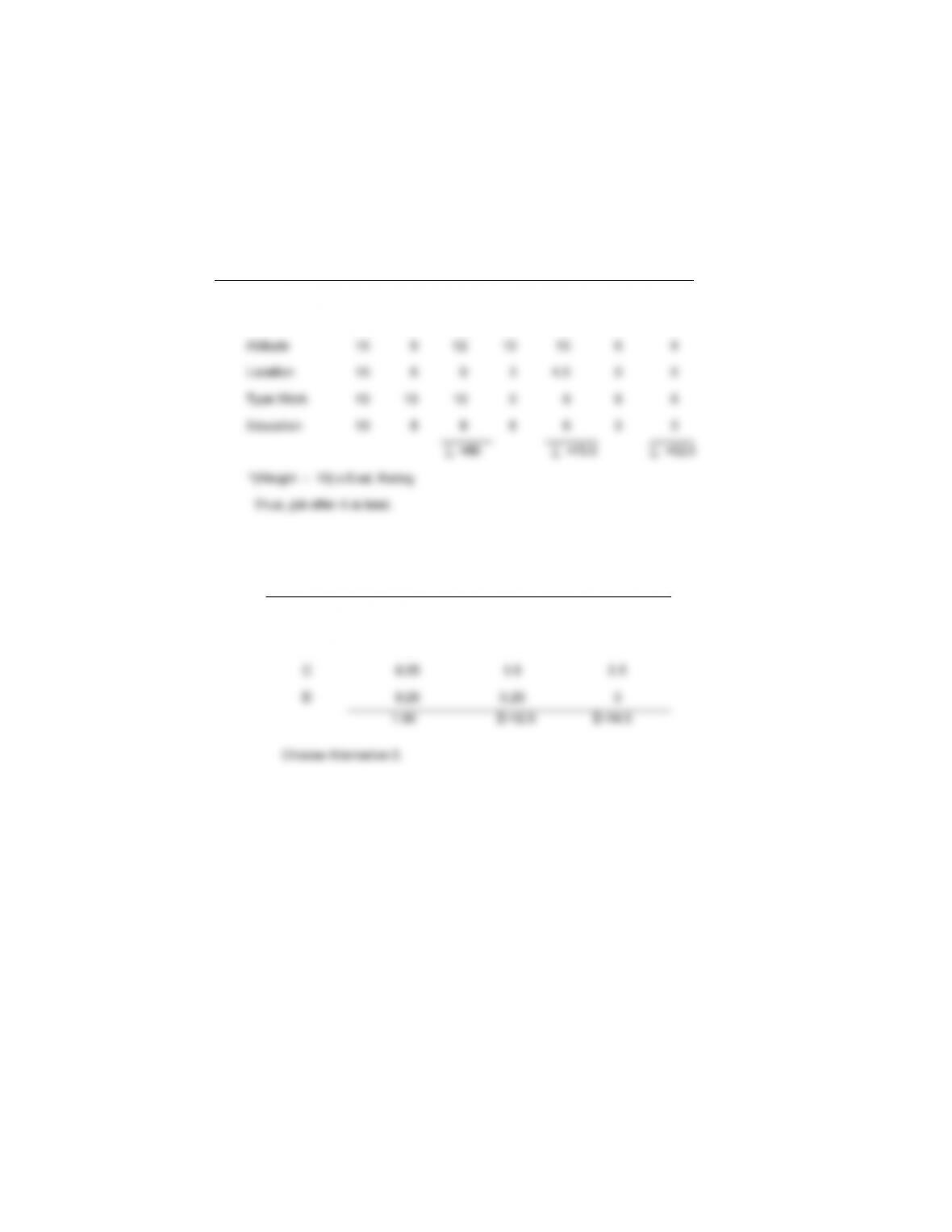
19-8, (continued)
WEIGHTED EVALUATION
Alternatives
Attribute
Att.
Wgt.
A
Eval.
Rat.
Wgt.
Eval.*
B
Eval.
Rat.
Wgt
Eval
C
Eval.
Rat.
Wgt.
Eval.
Salary 25 10 25 8 20 10 25
Advancement 25 10 25 10 25 3 7.5
19-9, (a) Uniform
Attribute Norm, Attrib, Wet. Wet.Eval, Alt., 1 Wet. Eval, Alt., 2
A 0.25 3.75 3
B 0.25 2 5
231
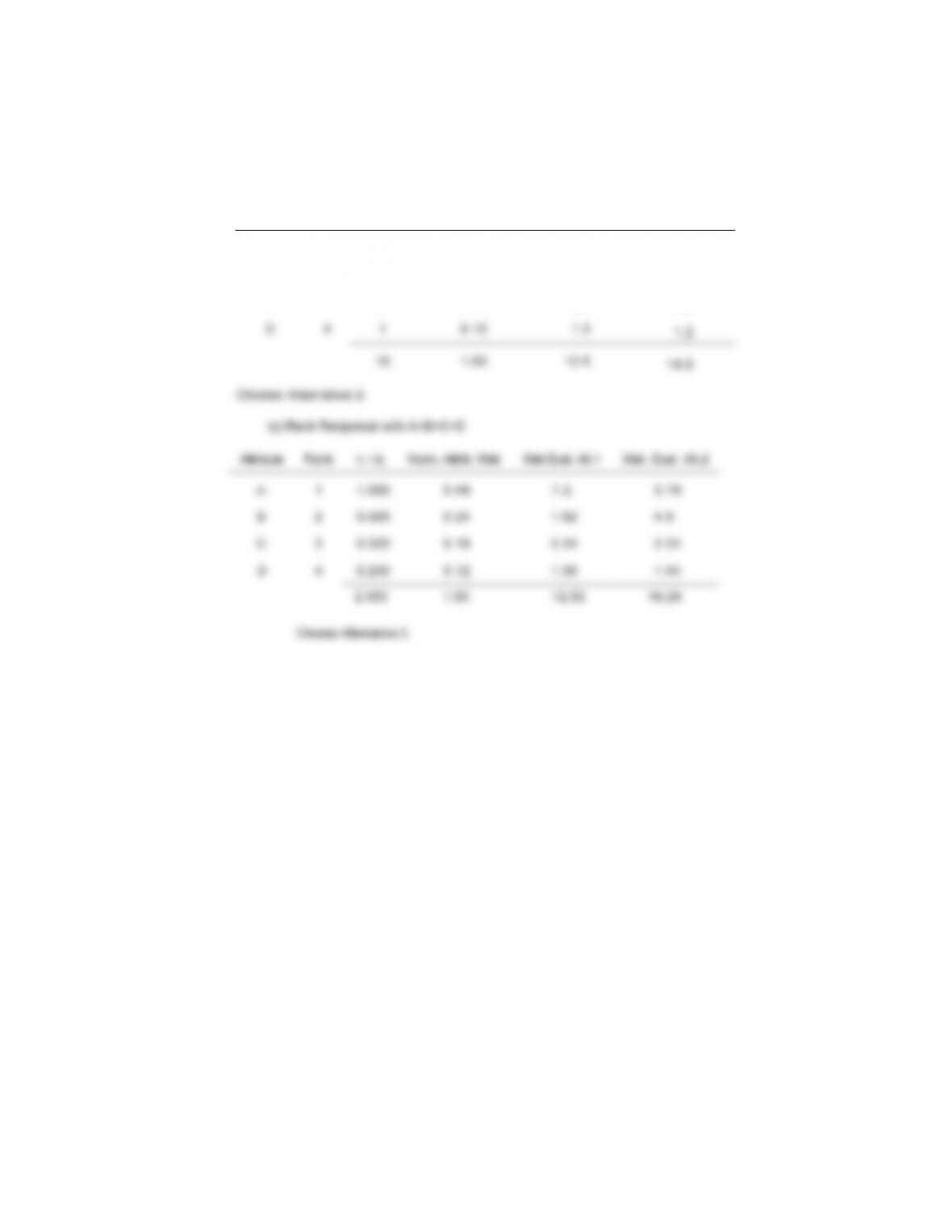
19–9, (continued)
(b) Rank Sum with A>B>C>D
Attribute Rank N-R;+1 Norm. Attrib. Wet. Wet. Eval. Alt.1 Wet. Eval. Alt.2
A 1 4 0.40 64.8
B 2 3 0.30 2.4 6
C 3 2 0.20 2.8 2.8
232
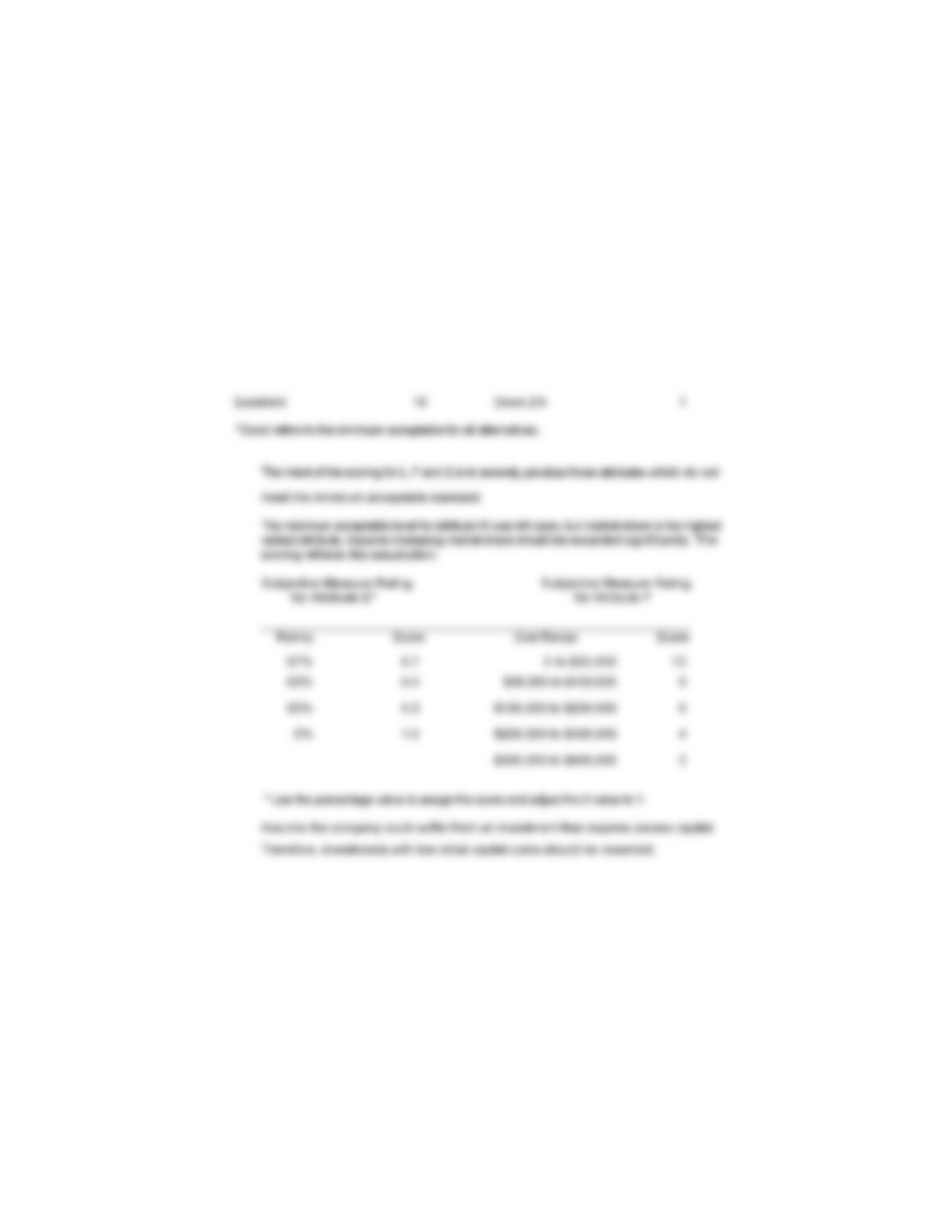
19-10. Left to the student
19-11.
Subjective Measure Rating
for Attributes L, F, and Q
Subjective Measure Rating
for Attribute M
Rating Score Rating Score
Poor 1 Up 2% 10
Fair 2 Up 1% 8
*Good 6 Even 5
Very Good 8 Down 1% 3
233
19-11. (continued)
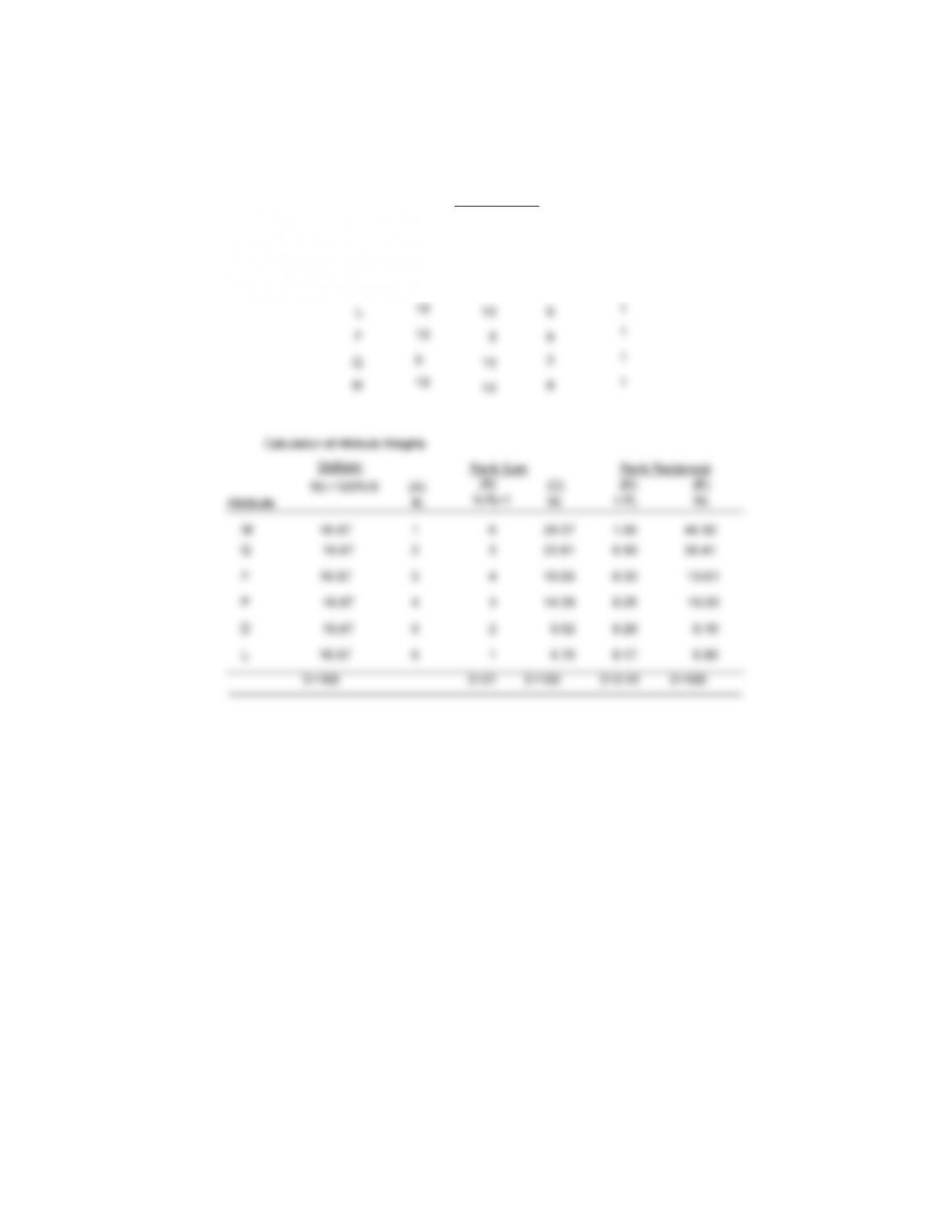
Raw Subjective Measure Ratings
AMS Alternative
Attribute A B C
Do
Nothing
P
D
6
6
2
6.7
10
5
10
1
234
19-11 (continued)
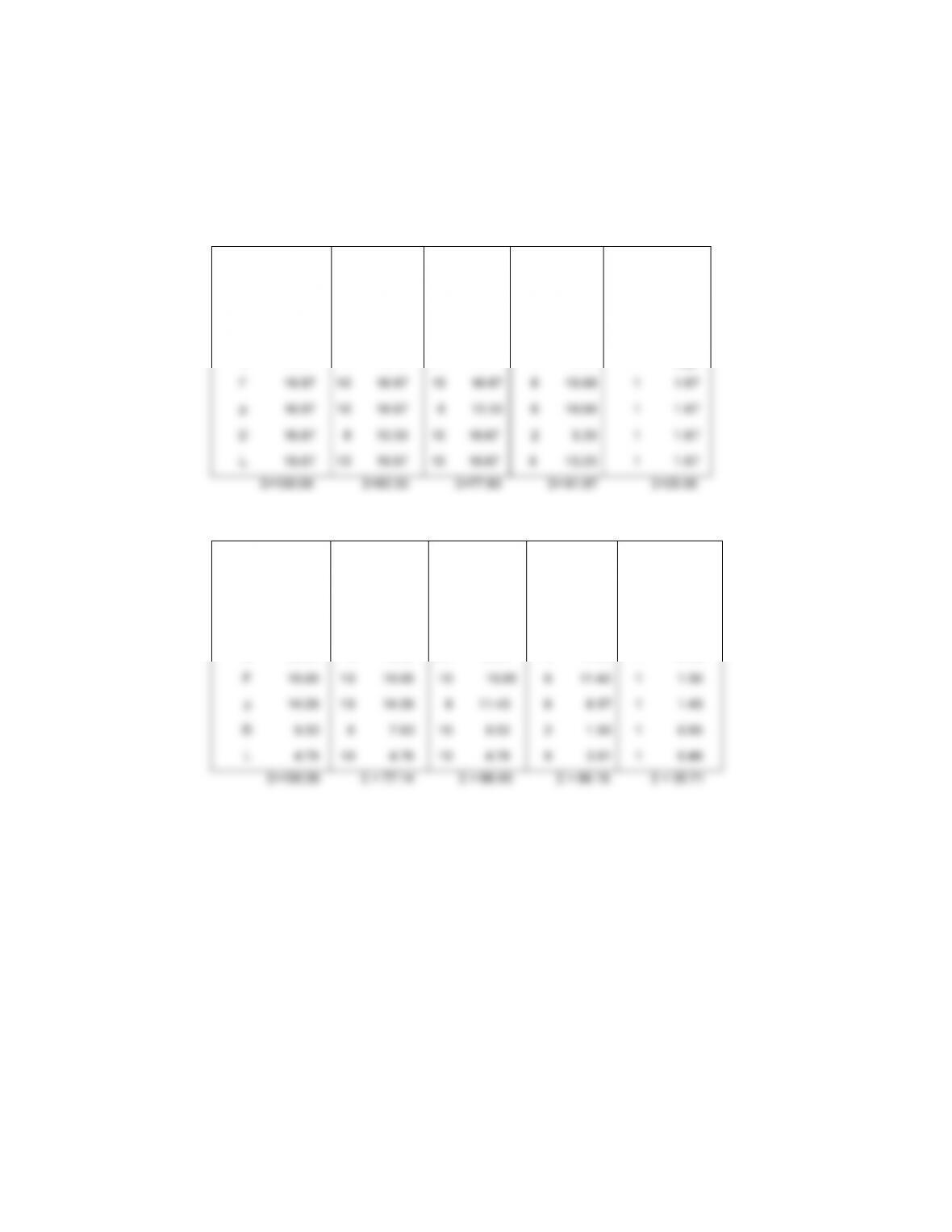
Calculation of Uniform Weighted Evaluation
A
ttribute Weight
A
lternative A
Eval. Wghtd.
Rating Eval.
A
lternative B
Eval. Wghtd.
Rating Eval
A
lternative C
Eval. Wghtd.
Rating Eval
Do Nothing
Eval. Wghtd.
Rating Eval
M 16.67 6 10.00 2 3.33 10 16.67 10 16.67
Q 16.67 6 10.00 6.7 11.17 5 8.33 1
1.67
Calculation of Rank Sum Weighted Evaluation
A
ttribute Weight
A
lternative A
Eval. Wghtd.
Rating Eval
A
lternative B
Eval. Wghtd.
Rating Eval
A
lternative C
Eval. Wghtd.
Rating Eval
Do Nothing
Eval. Wghtd.
Rating Eval
M 28.57 6 17.14 2 5.71 10 28.57 10 28.57
O 23.81 6 14.29 6.7 15.95 5 11.90 1 2.38
235
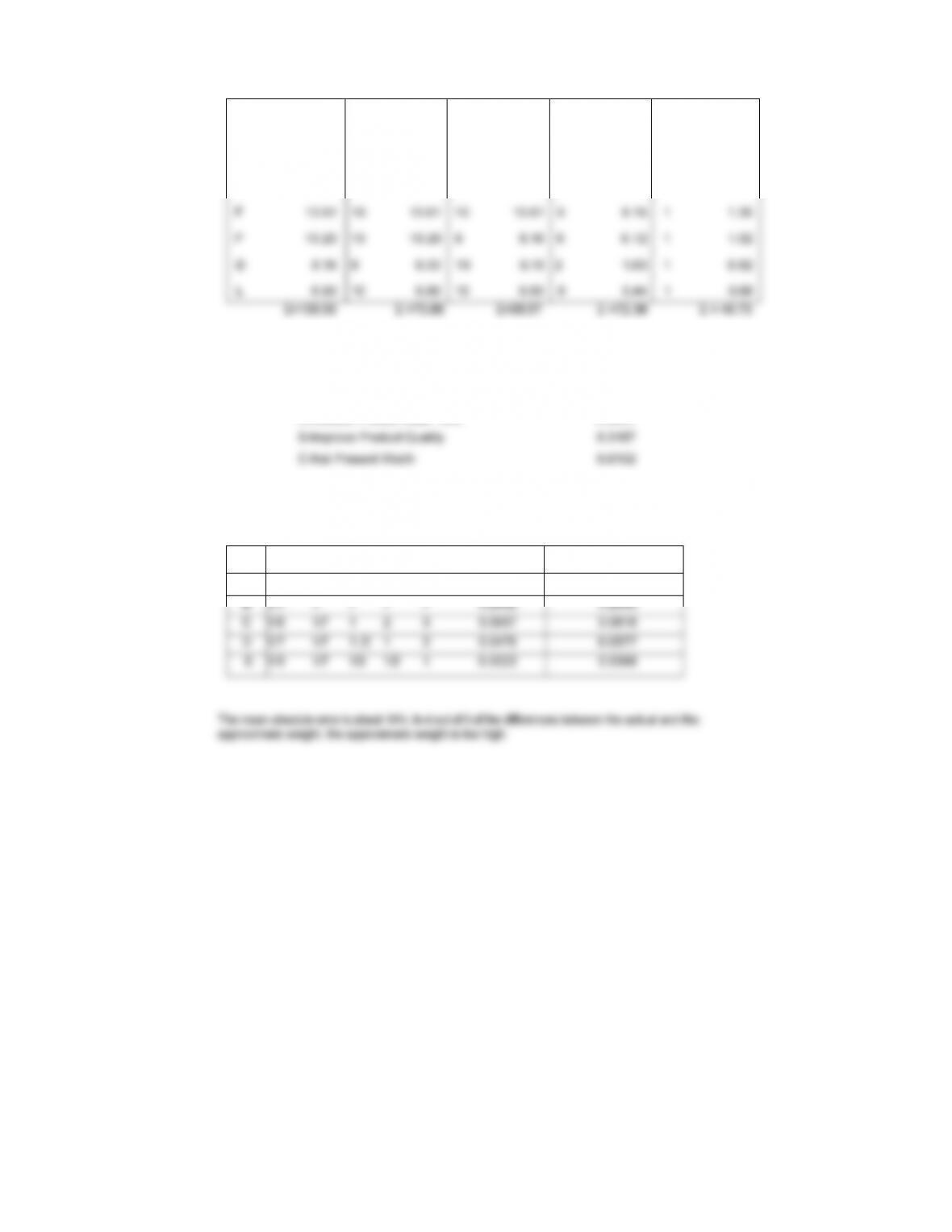
19-11. (continued) Calculation of Rank Reciprocal Weighted Evaluation
Thus, we would recommend Alternative A for each attribute weighting method.
19-12 (a)
Improve Manufacturing Operations: Priority Weight
19-13.
A B C D E Priority Weight
_Approximate Weight
A 1 7 8 7 9 0.6143 0.5544
Rank
Attribute Recip.
Alternative A
Eval. Wghtd.
Rating Eval.
Alternative B
Eval. Wghtd.
Rating Eval.
Alternative C
Eval. Wghtd.
Rating Eval.
Do Nothing
Eval. Wghtd.
Rating Eval.
M 40.82 6 24.49 2 8.16 10 40.82 10 40.82
Q 20.41 6 12.24 6,7 13.67 5 10.20 1 2.04
236
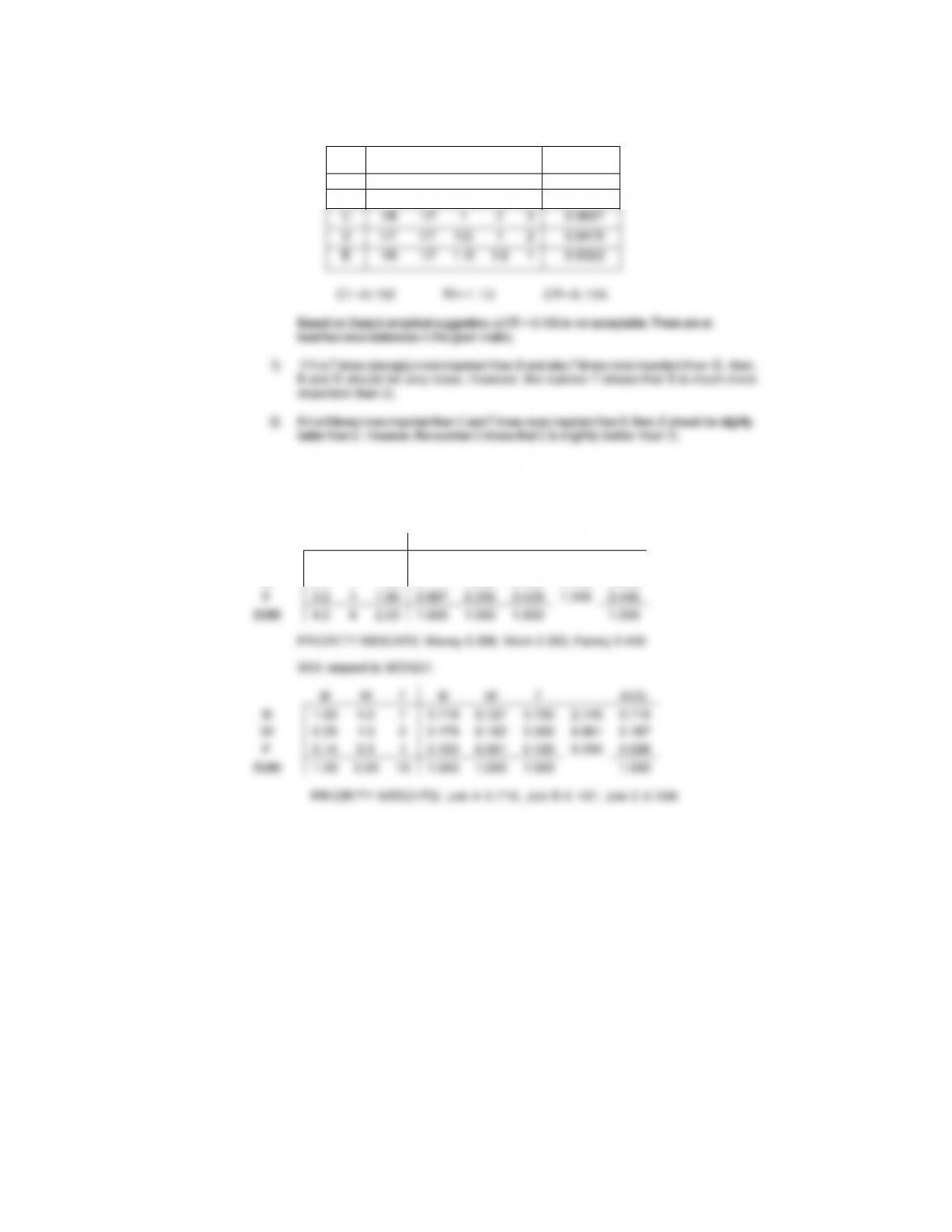
19-14.
A B C D E Priority
Wei
g
ht
A 1 7 8 7 9 0.6143
B 1 /7 1 7 7 7 0.2402
19-15. (a) With respect to CAREER SATISFACTION:
M W F M W F AVG.
M 1.0 2 0.33 0.222 0.500 0.142 0.864 0.288
W 0.5 1 1.00 0.111 0.250 0.429 0.790 0.263
237

19-15. (continued)
With respect to WORK:
M W F M W F AVG.
M 1.00 0.5 1.00 0.250 0.111 0.429 0.790 0.263
PRIORITY WEIGHTS: Job A 0.263, Job B 0.88, Job C 0.449
Attribute
Money Work Family
Attribute Wgts. 0,288 0.263 0.449
Alternative
Weighted
CONCLUSION: Accept Job A
238
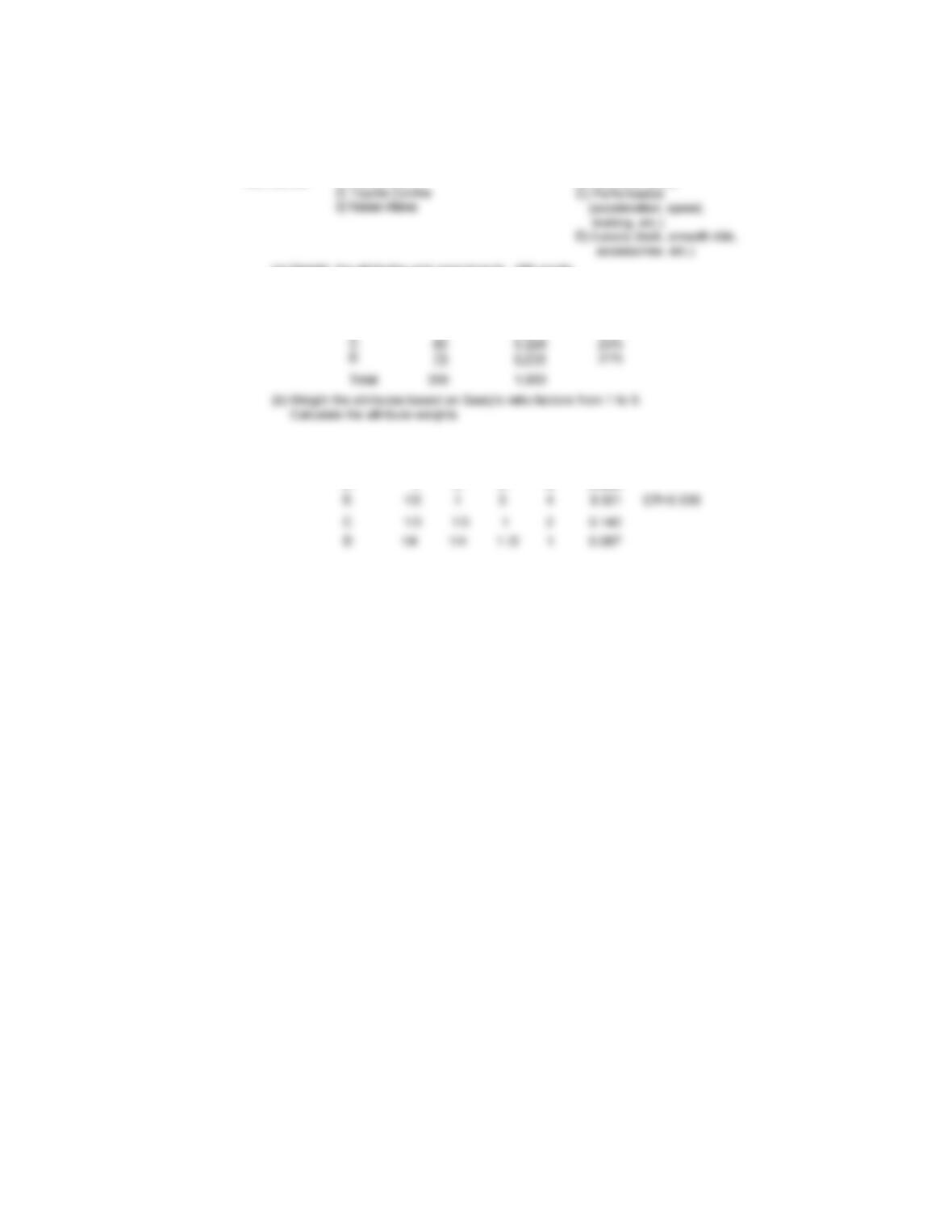
19-16. One possible example.
Decision:
Alternatives
To buy a compact automobile
1) Honda Civic
Attributes A) Reliability
B) Cost (life cycle)
(a) Weight the attributes and normalize to
Attributes Weights
A 100
B 95
100 points.
Normalize Percentage
0.286 29%
0.271 27%
Attributes A B C D Priority
Weights
A 1 2 3 4 0.450
239
19-16. (continued)
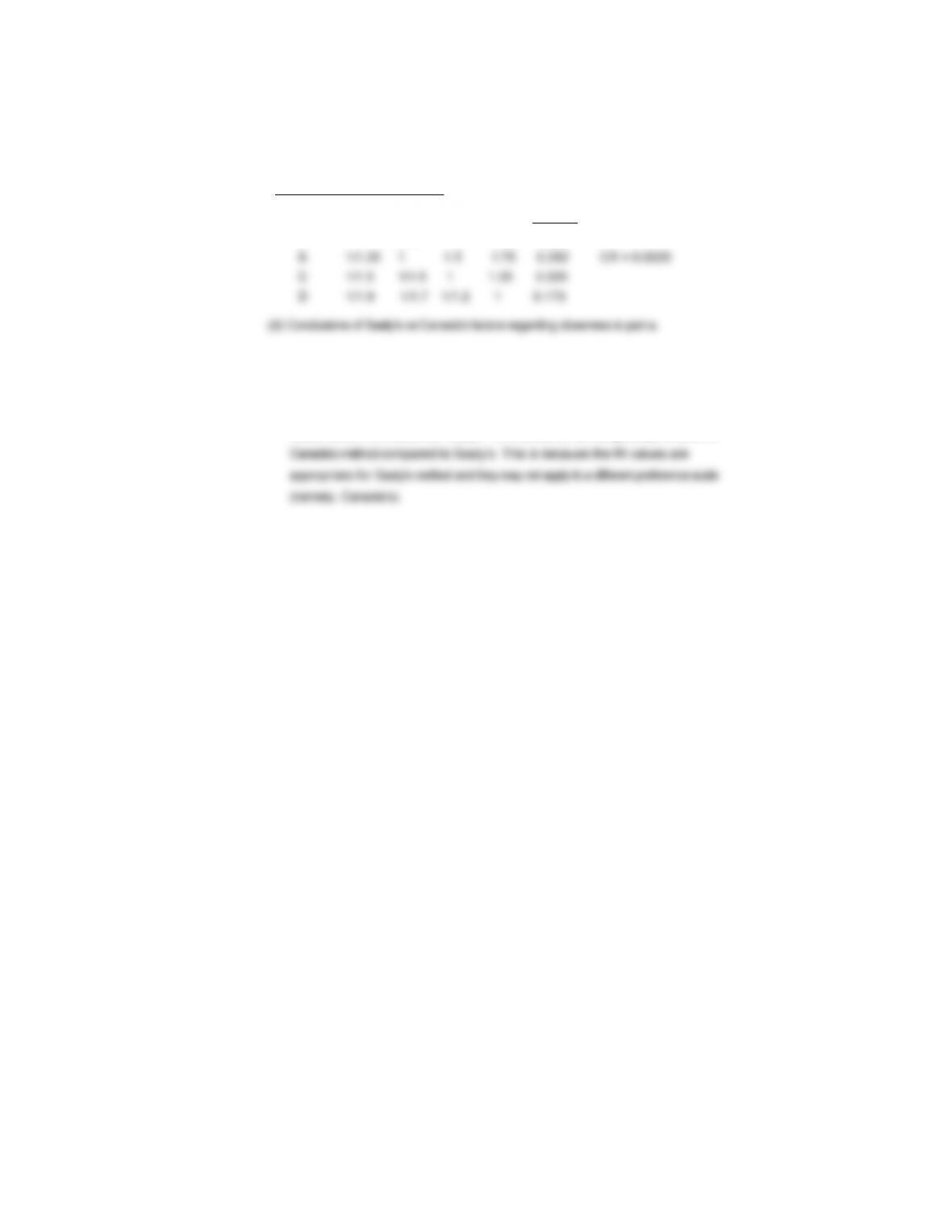
(c) Weight the attributes based on Canada’s ratio factors from 1 to 3.
Calculate the attribute weights
Priority
Attributes A B C D Weights
A 1 1.25 1.5 1.75 0.326
If used properly, both of them should give the same results and conclusions. However, the
increment of 0.5 will make Canada’s factors less sensitive (6 steps) than Saaty’s (9 steps) in
making the pairwise comparisons. Therefore, we could say that in some cases, Canada’s
factors will be more useful than Saaty’s. The consistency ratio will generally be lower for
240
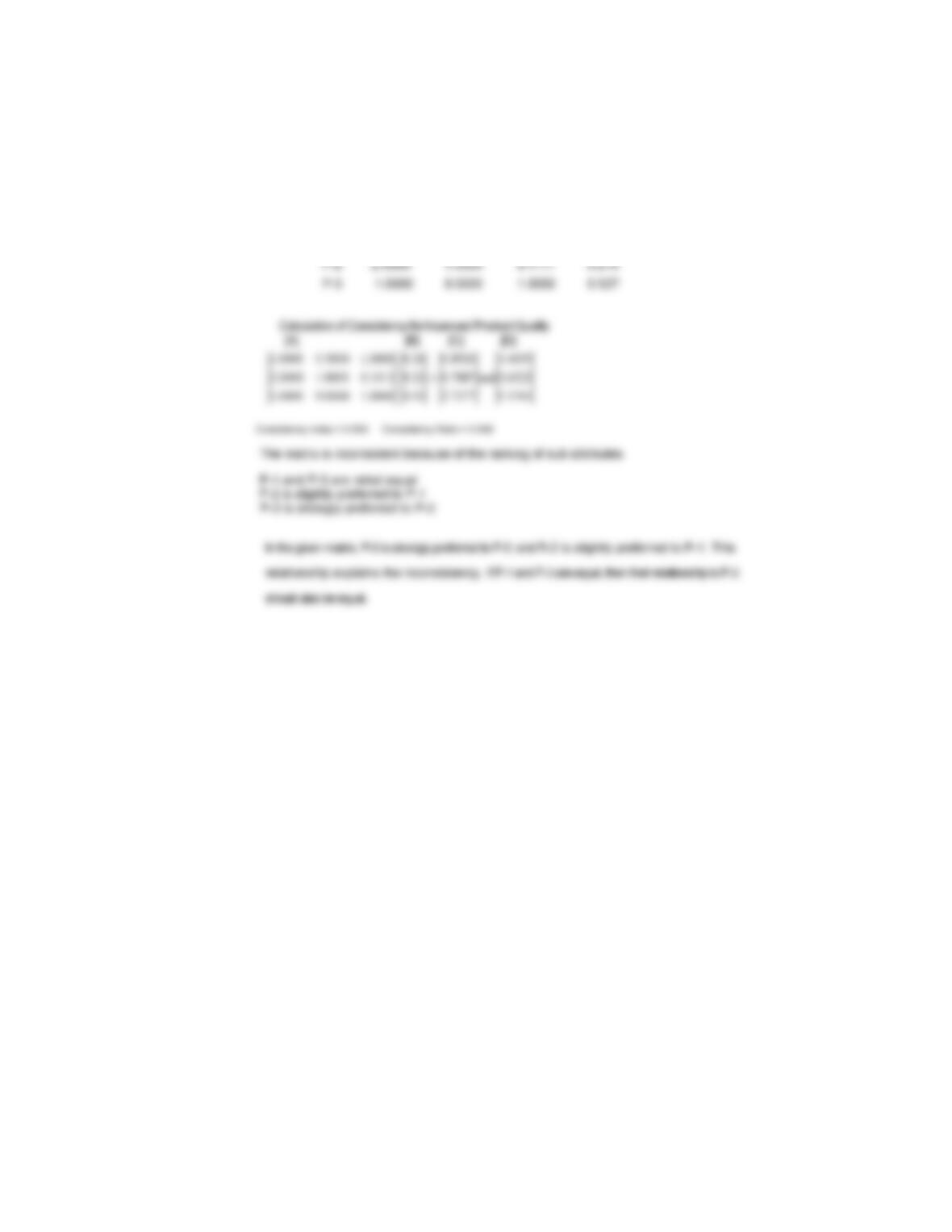
19-17. Calculation of Priority Weights for Improved Product Quality
Matrix of Paired Comparisons
Priority
P-1 P-2 P-2 Weight
P-1 1.0000 0.5000 1.0000 0.257
241
19-18. Measurement Scales
A nominal scale exists in name only with no numerical value. It is a stated characteristic of an
attribute.
A ratio scale has an absolute or natural zero and a constant unit of measurement. Weight
and dollars of profit, and distance are ratio scales. Ratio scale numbers can be subjected to
AHP Measurement Scale
AHP employs an interval scale (at best) or perhaps an ordinal scale. The decision maker ranks
attributes by pairwise comparisons which will indicate the degree to which one attribute is
preferred over the other. The scaling process is translated into weights for the comparison of
242
19-19. The Apex Inc. Mini-Case Study (Incorporating Broad Concepts Not Particularly For
Multi-Attribute Analysis)
Neither approach is adequate, nor is either approach in the best interest of APEX. Both
sides exhibit typically unenlightened approaches to issues in this case. The facts stated
clearly indicate the lack of strategic business plan, which defines the needs and goals
for implementation of automation at APEX. The I.E. proposal is obviously a narrow,
incompletely analyzed, ill defined, poorly justified, isolated “island of technology” for its
Significantly, there is a total absence of valuation of intangible benefits, as well as
other direct/indirect savings. There also appears to be a lack of consideration for the
less obvious investment costs associated with training, facilities modification, support
systems, warehouse and production impacts, vendor/supplier reactions and
maintenance / upkeep requirements. . Because of the lack of a stated business need,
there are serious questions to be answered. Without an integrative automation strategy,
243