149
Chapter Eight
A
AP
PP
PL
LI
IC
CA
AT
TI
IO
ON
NS
S
I
IN
NV
VO
OL
LV
VI
IN
NG
G
S
SH
HO
OC
CK
KS
S
A
AN
ND
D
E
EX
XP
PA
AN
NS
SI
IO
ON
N
F
FA
AN
NS
S
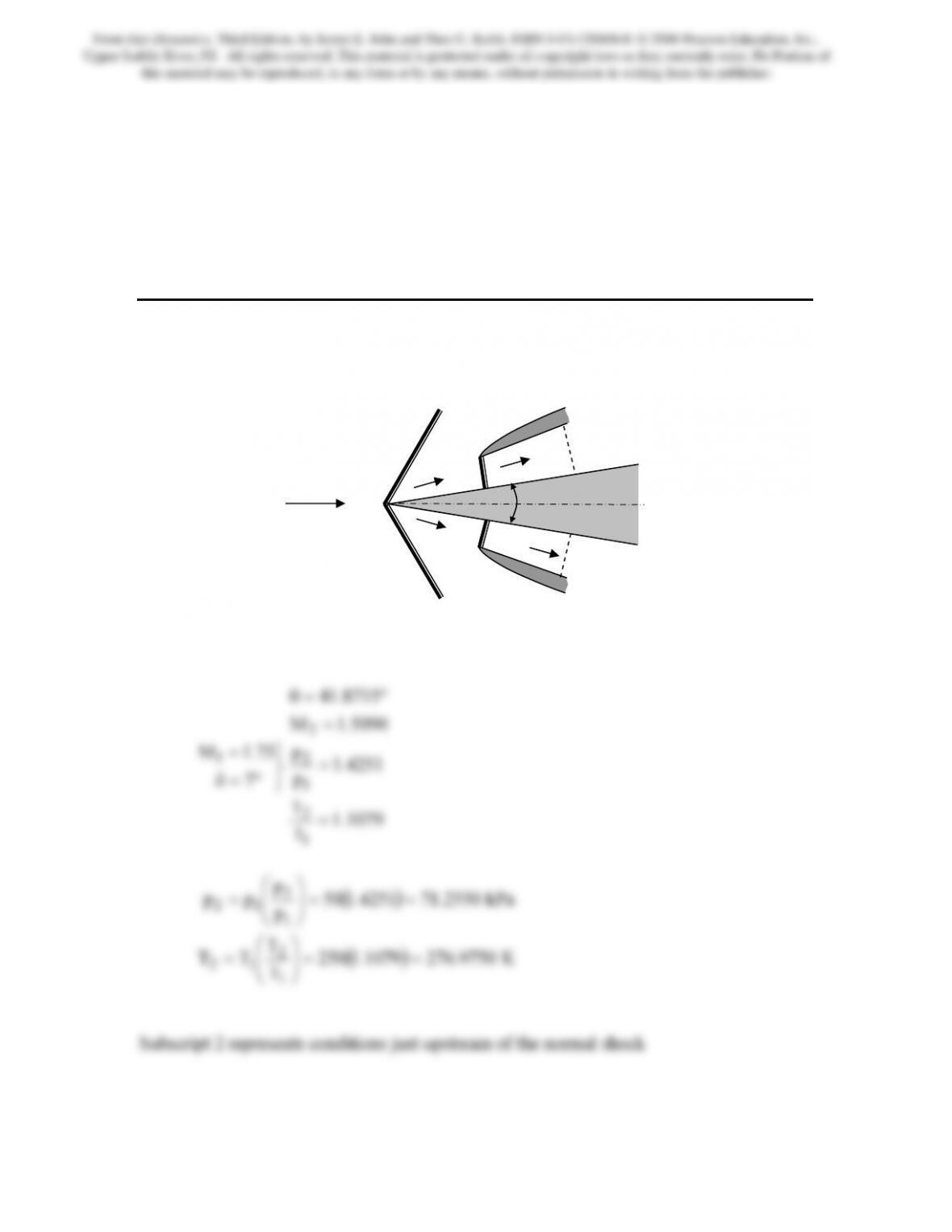
Problem 1. – A supersonic inlet (Figure P8.1) is to be designed to handle air (γ = 1.4,
R = 287 J/kg·K) at Mach 1.75 with static pressure and temperature of 50 kPa and 250 K.
Determine the diffuser inlet area Ai if the device is to handle 10 kg/s of air.
Figure P8.1
Using the oblique shock solution method we obtain
Ai
Ae
M1 = 1.75
14°
123
From Gas Dynamics, Third Edition, by James E. John and Theo G. Keith. ISBN 0-13-120668-0. © 2006 Pearson Education, Inc.,
Upper Saddle River, NJ. All rights reserved. This material is protected under all copyright laws as they currently exist. No Portion of
this material may be reproduced, in any form or by any means, without permission in writing from the publisher.
p
p
2
2
⎞
⎛
⎞
⎛
()
3
2m 0222.0
s/m4015.503)kg/m 8964.0(
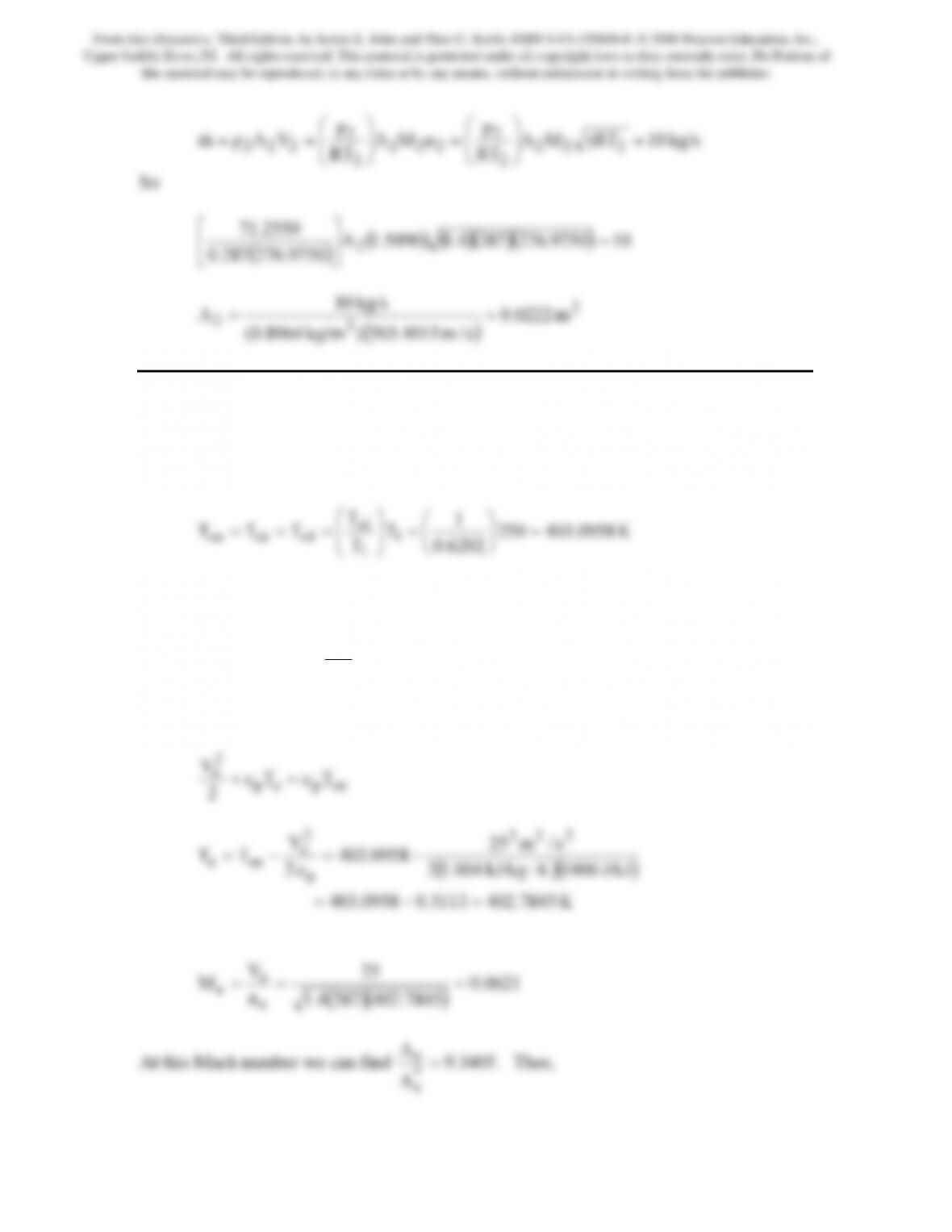
Problem 2. – The diffuser in Problem 1 is to further decelerate flow after the normal
shock so that the velocity entering the compressor is not to exceed 25 m/s. Assuming
isentropic flow after the shock, determine the area Ae required. For this condition, find
the static pressure pe. Take γ = 1.4 and cp = 1.004 kJ/kg·K.
6202.0
T
1
1ooioe =
⎠
⎝
⎟
⎠
⎜
⎝
For M2 = 1.5090, the Mach number downstream of the normal shock is found to be
6979.0M3=. Hence, the area ratio for this Mach number can be obtained from the
isentropic flow tables, 0959.1
A
A
*
3
3=. And since the flow downstream of the normal
shock is assumed to be isentropic *
3
*
eAA =. Now
2
eTcTc
V=+
From Gas Dynamics, Third Edition, by James E. John and Theo G. Keith. ISBN 0-13-120668-0. © 2006 Pearson Education, Inc.,
Upper Saddle River, NJ. All rights reserved. This material is protected under all copyright laws as they currently exist. No Portion of
this material may be reproduced, in any form or by any means, without permission in writing from the publisher.
151
1
A
A
A
A
A
3
*
3
*
e
e
e=
⎞
⎛
i
ie m 1892.05231.80222.0
A
⎟
⎠
⎜
⎝
Using the various Mach numbers that have been determined we can find the following
corresponding pressure ratios from isentropic flow and normal shock relations
p
7223.0
p
p
,6979.0M
9973.0
p
p
,0621.0M
3
3o
3
3
oe
e
e
==
==
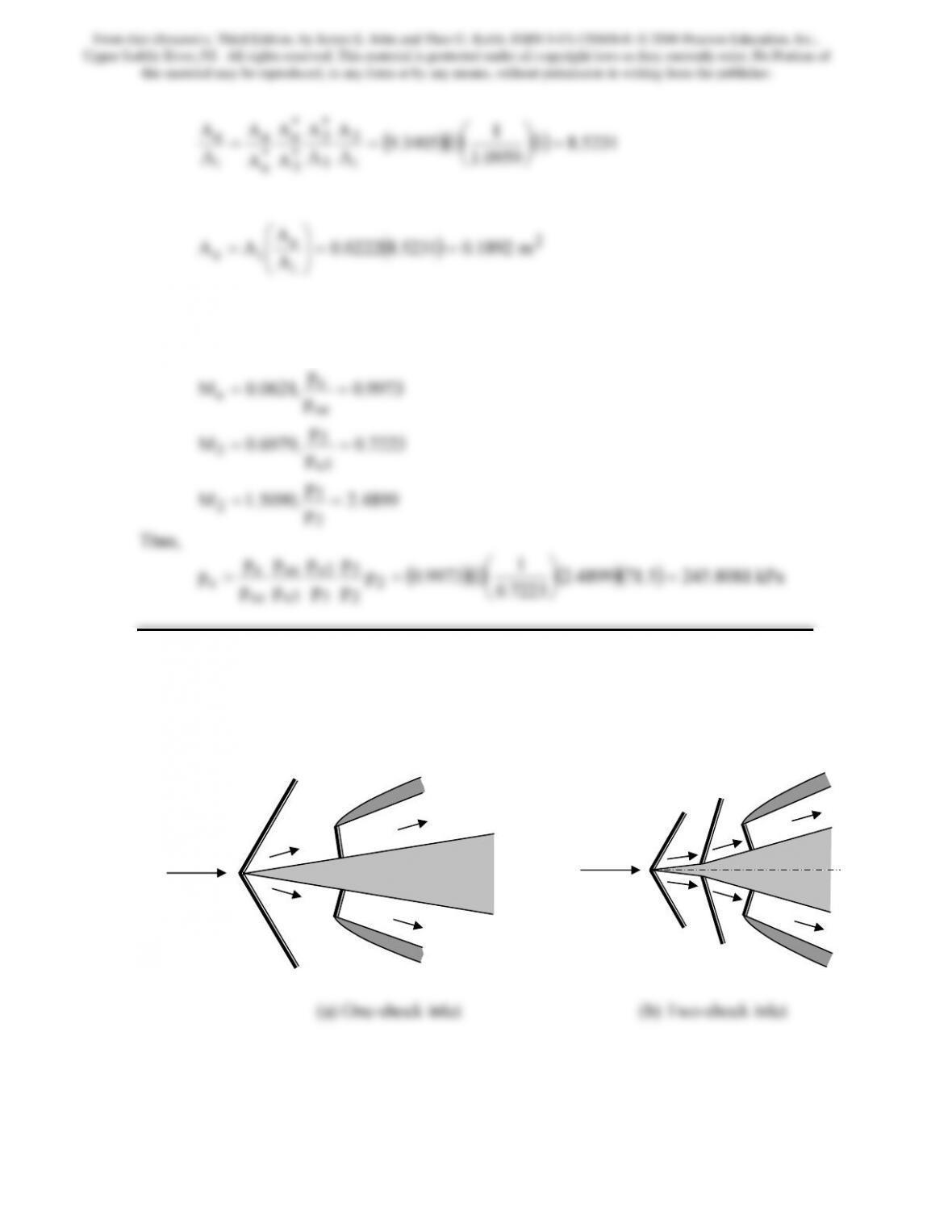
Problem 3. – Compare the loss in total pressure incurred by a one-shock spike diffuser
with that incurred by a two-shock diffuser operating at Mach 2.0. Repeat at Mach 4.0 (see
Figure 8.5). Assume that each oblique shock turns the flow through an angle of 10°. Take
γ = 1.3.
Figure 8.5 Flow Regions within the Spike Diffusers of Example 8.1
M1
3
2
1
M1
3 1 2 4
From Gas Dynamics, Third Edition, by James E. John and Theo G. Keith. ISBN 0-13-120668-0. © 2006 Pearson Education, Inc.,
Upper Saddle River, NJ. All rights reserved. This material is protected under all copyright laws as they currently exist. No Portion of
this material may be reproduced, in any form or by any means, without permission in writing from the publisher.
152
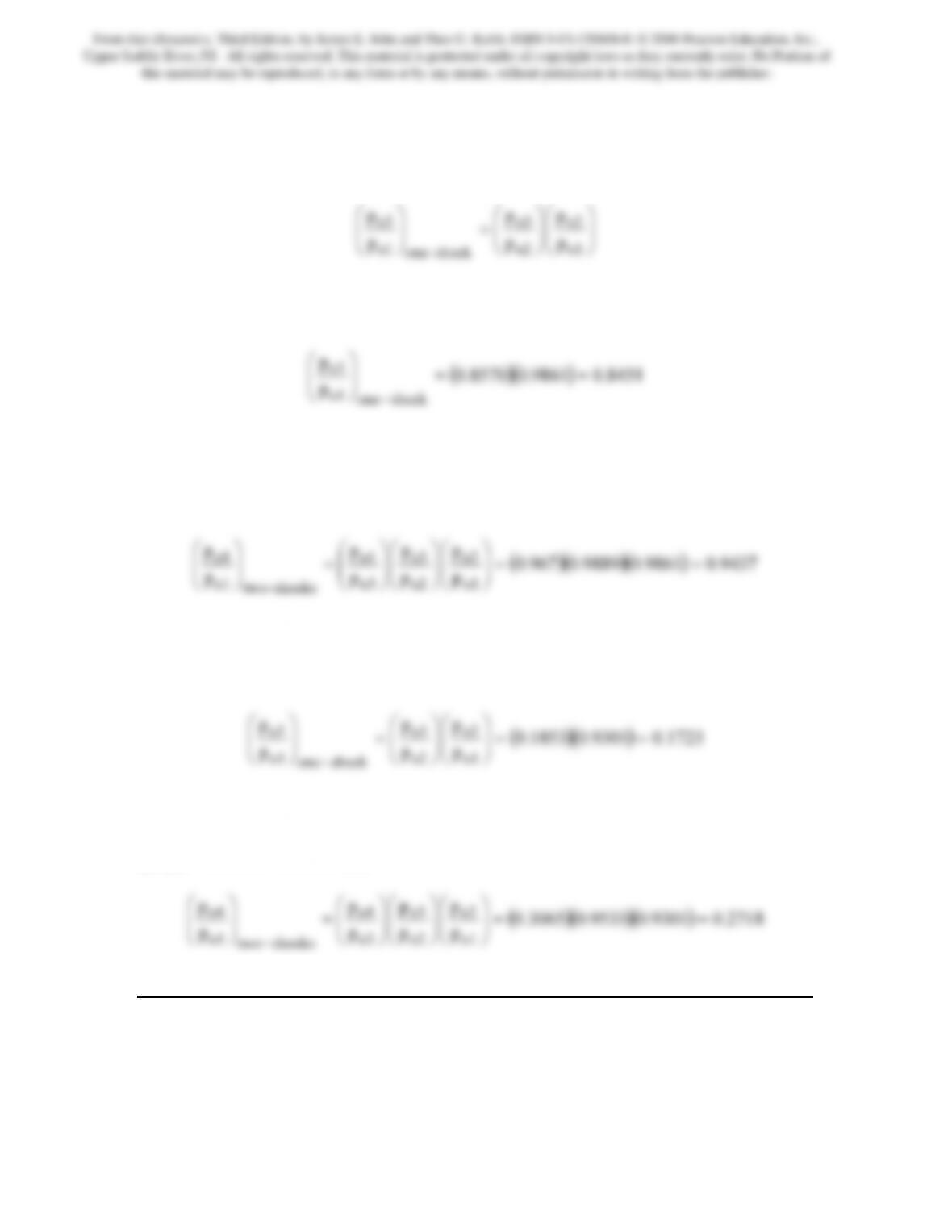
From the oblique shock solver at γ = 1.3, M1 = 2.0 and δ = 10°, the weak solution yields
θ = 38.8127°. Moreover the Mach number downstream of the shock is, M2 = 1.6765. For
the one-shock diffuser,
⎟
⎟
⎠
⎞
⎜
⎜
⎝
⎛
⎟
⎟
⎠
⎞
⎜
⎜
⎝
⎛
=
⎟
⎟
⎠
⎞
⎜
⎜
⎝
⎛
o1
o2
o2
o3
shock–one
o1
o3
p
p
p
p
p
p
From the oblique shock relations at M1 = 2.0, po2/pol = 0.9861 and from the normal shock
relations at M2 = 1.6765, po3/po2 = 0.8570. Hence,
p
shockone
o1
⎟
⎠
⎜
⎝
−
For the two-shock inlet, M2 = 1.6765. At the latter Mach number and δ = 10°, the wave
angle for the weak shock solution is θ = 47.3152º, po3/po2 = 0.9889 and M3 = 1.3533. At
M3 from the normal shock relations po4/po3 = 0.9677. Thus,
()( )( )
9437.09861.09889.0967.0
p
p
p
p
o1
o2
o2
o3
o3
o4
shocks–two
o1
o4 ==
⎟
⎟
⎠
⎜
⎜
⎝
⎟
⎟
⎠
⎜
⎜
⎝
⎟
⎟
⎠
⎜
⎜
⎝
=
⎟
⎟
⎠
⎜
⎜
⎝
Now at M1 = 4.0 and δ = 10°, the weak solution yields θ = 21.8411°, po2/pol = 0.9301
and M2 = 3.4050. From the normal shock relations at M2 = 3.4050, po3/po2 = 0.1853.
Therefore, for the one oblique shock diffuser,
p
p
p
o1
o2
shockone
o1
⎟
⎠
⎜
⎝
⎟
⎠
⎜
⎝
⎟
⎠
⎜
⎝
−
For the two-shock inlet, M2 = 3.4050. At M2 = 3.4050 and δ = 10°, θ = 24.4808°,
po3/po2 = 0.9533 and M3 = 2.9186. Using M3 in the normal shock relations gives
po4/po3 = 0.3065. For this case,
p
p
p
p
p
p
p
p
o1
o2
o2
o3
o3
o4
shockstwo
o1
o4 ==
⎟
⎠
⎞
⎜
⎝
⎛
⎟
⎠
⎞
⎜
⎝
⎛
⎟
⎠
⎞
⎜
⎝
⎛
⎟
⎠
⎞
⎜
⎝
⎛
−
Problem 4. – A converging nozzle is supplied from a large air (γ = 1.4, R = 287 J/kg·K)
reservoir maintained at 600K and 2 MPa. If the nozzle back pressure is 101 kPa,
determine the pressure and Mach number that exist at the nozzle exit plane. Since the
nozzle is operating in the underexpanded regime, expansion waves occur at the nozzle
From Gas Dynamics, Third Edition, by James E. John and Theo G. Keith. ISBN 0-13-120668-0. © 2006 Pearson Education, Inc.,
Upper Saddle River, NJ. All rights reserved. This material is protected under all copyright laws as they currently exist. No Portion of
this material may be reproduced, in any form or by any means, without permission in writing from the publisher.
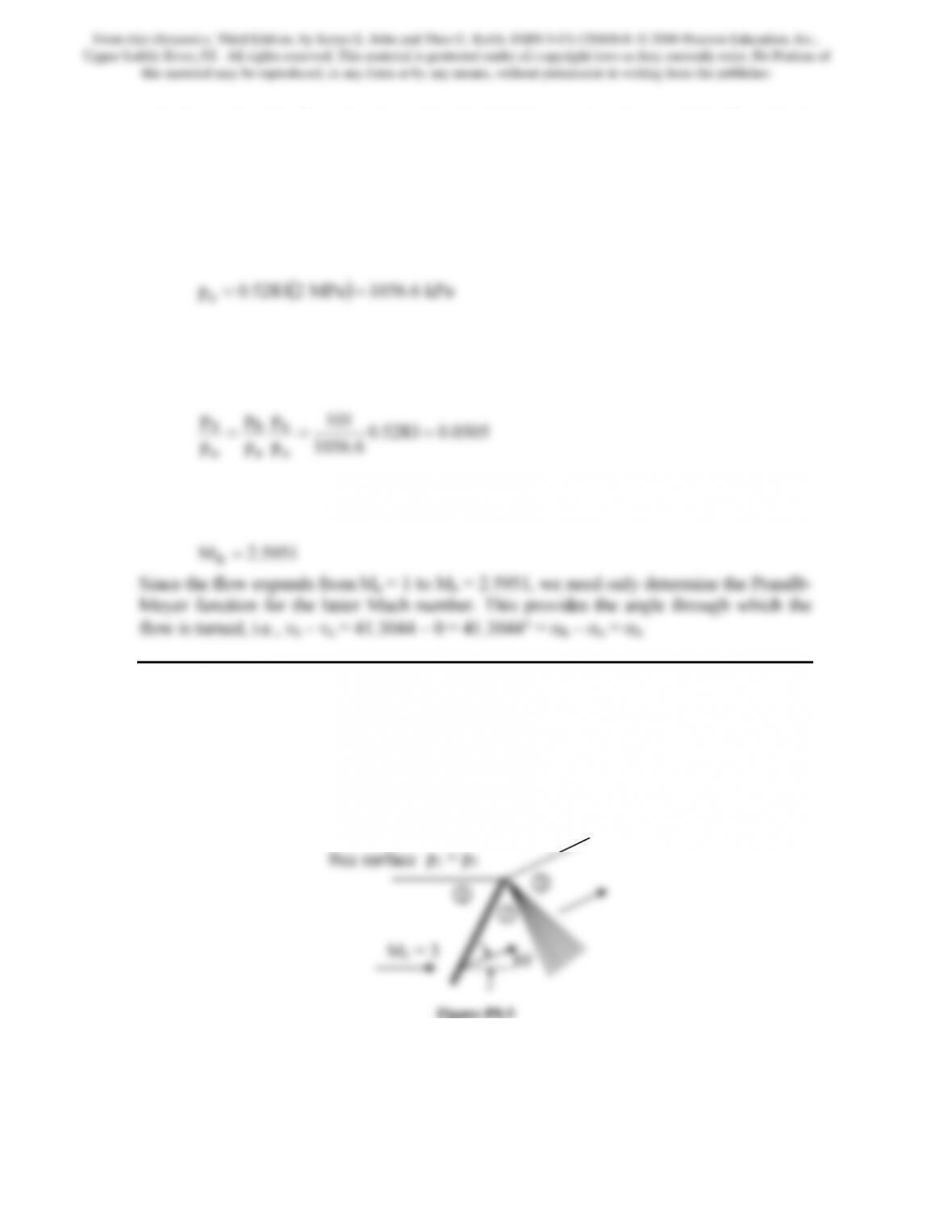
exit. Determine the flow direction after the initial expansion fans and the flow Mach
number.
Since the nozzle is operating in the underexpanded flow regime, the nozzle is choked.
Accordingly, the Mach number at the exit is Me = 1.0 and the exit pressure to reservoir
pressure ratio is pe/po = 0.5283 for γ = 1.4. Thus the exit pressure is
The expansion fans turn the supersonic flow and reduce the pressure to that of the back
pressure. Now
0505.05283.0
6.1056
p
p
p
o
e
o
From this pressure ratio we can find the corresponding Mach number
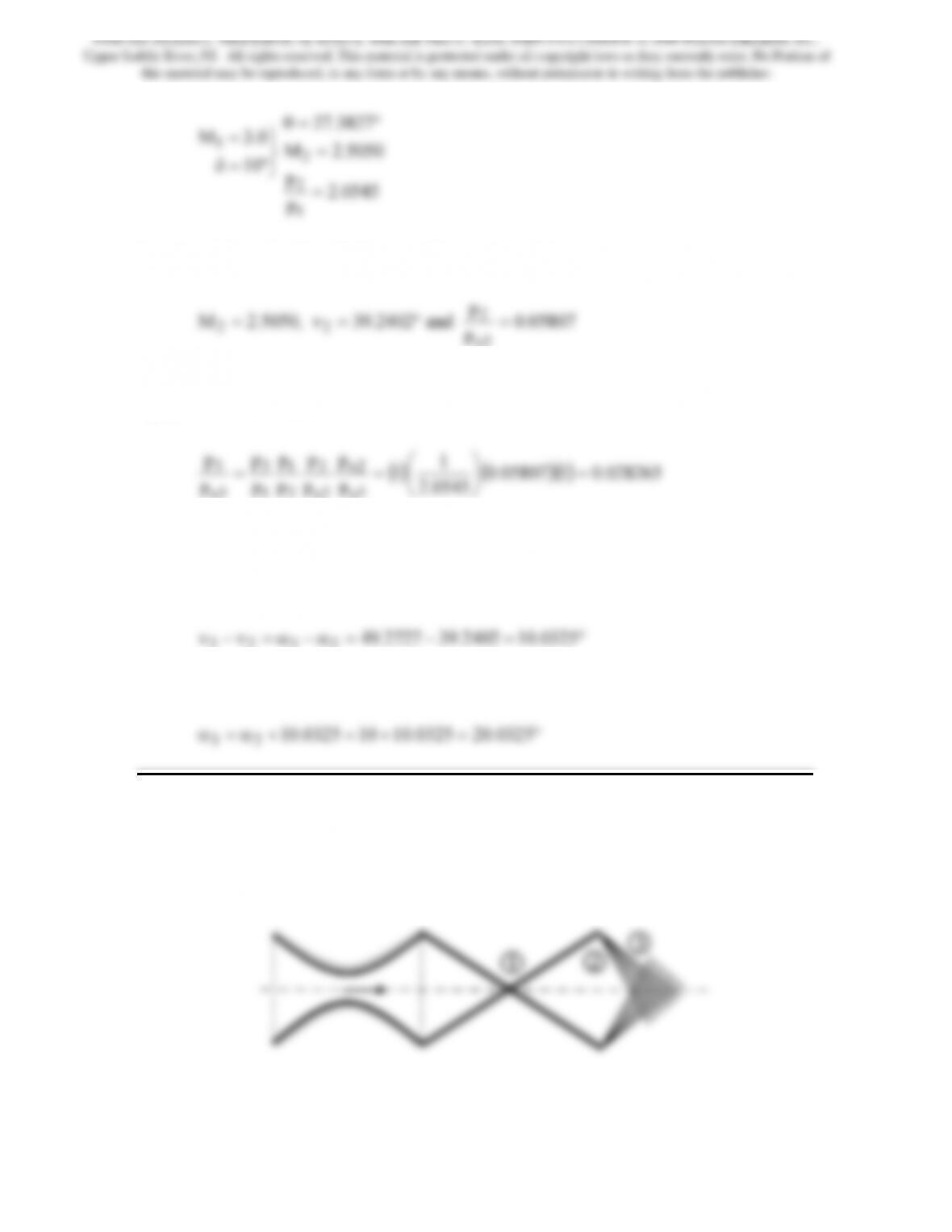
Problem 5. – An oblique shock wave occurs in a supersonic flow in which M1 = 3. The
shock turns the supersonic stream through 10°. The shock impinges on a free surface
along which the pressure is constant and equal to p1, i.e., the pressure upstream of the
shock. The shock is reflected from the free surface as an expansion fan. Determine the
Mach number and the angle of the flow just downstream of the fan. Assume γ = 1.4.
free surface
p1 = p3
From Gas Dynamics, Third Edition, by James E. John and Theo G. Keith. ISBN 0-13-120668-0. © 2006 Pearson Education, Inc.,
Upper Saddle River, NJ. All rights reserved. This material is protected under all copyright laws as they currently exist. No Portion of
this material may be reproduced, in any form or by any means, without permission in writing from the publisher.
⎬
⎫
°=δ
=
10
0.3M1
5050.2M
3827.27
2
=
°=θ
In region 2 from the Prandtl-Meyer and isentropic relations
p
2o
Because the flow across the expansion fan is isentropic po2 = po3 and because of the
constant pressure free surface p1 = p3, thus we may form the following string of pressure
ratios
0545.2
p
p
p
p
p
3o
2o
2
1
3o
⎠
⎝
With this pressure ratio, using the static to total pressure-Mach number relation, we
obtain M3 = 2.9750 and therefore from the Prandtl-Meyer relation ν3 = 49.2727˚. Finally
then, for this flow geometry
2323
Accordingly,
Problem 6. – A converging-diverging nozzle is designed to provide exit flow at Mach
2.2. With the nozzle exhausting to a back pressure of 101 kPa, however, and a reservoir
pressure of 350 kPa, the nozzle is overexpanded, with oblique shocks appearing at the
exit. Determine the flow direction, static pressure, and Mach number in regions 1,2, and
3 of Figure P8.6.
From Gas Dynamics, Third Edition, by James E. John and Theo G. Keith. ISBN 0-13-120668-0. © 2006 Pearson Education, Inc.,
Upper Saddle River, NJ. All rights reserved. This material is protected under all copyright laws as they currently exist. No Portion of
this material may be reproduced, in any form or by any means, without permission in writing from the publisher.
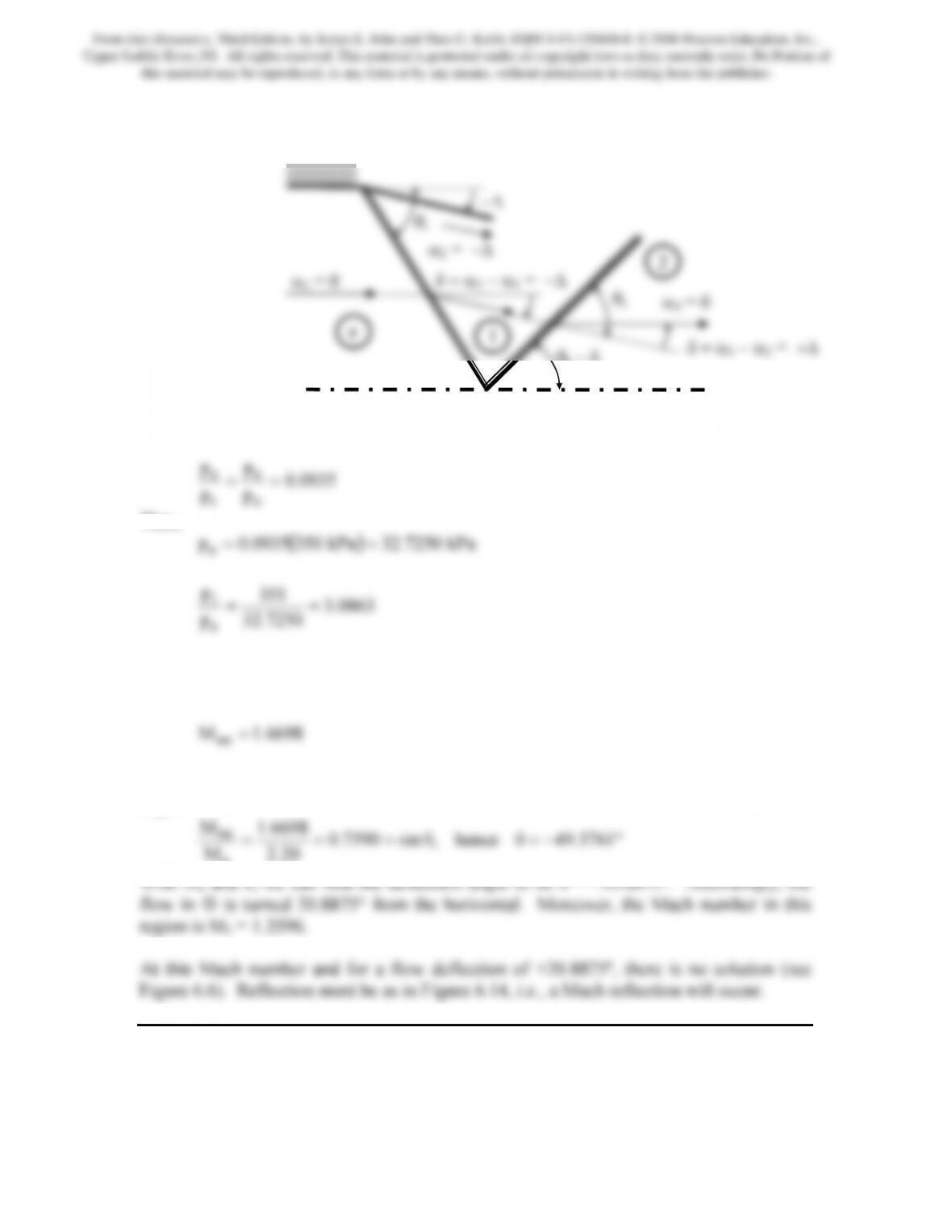
Consider the following geometry
From Gas Dynamics, Third Edition, by James E. John and Theo G. Keith. ISBN 0-13-120668-0. © 2006 Pearson Education, Inc.,
Upper Saddle River, NJ. All rights reserved. This material is protected under all copyright laws as they currently exist. No Portion of
this material may be reproduced, in any form or by any means, without permission in writing from the publisher.
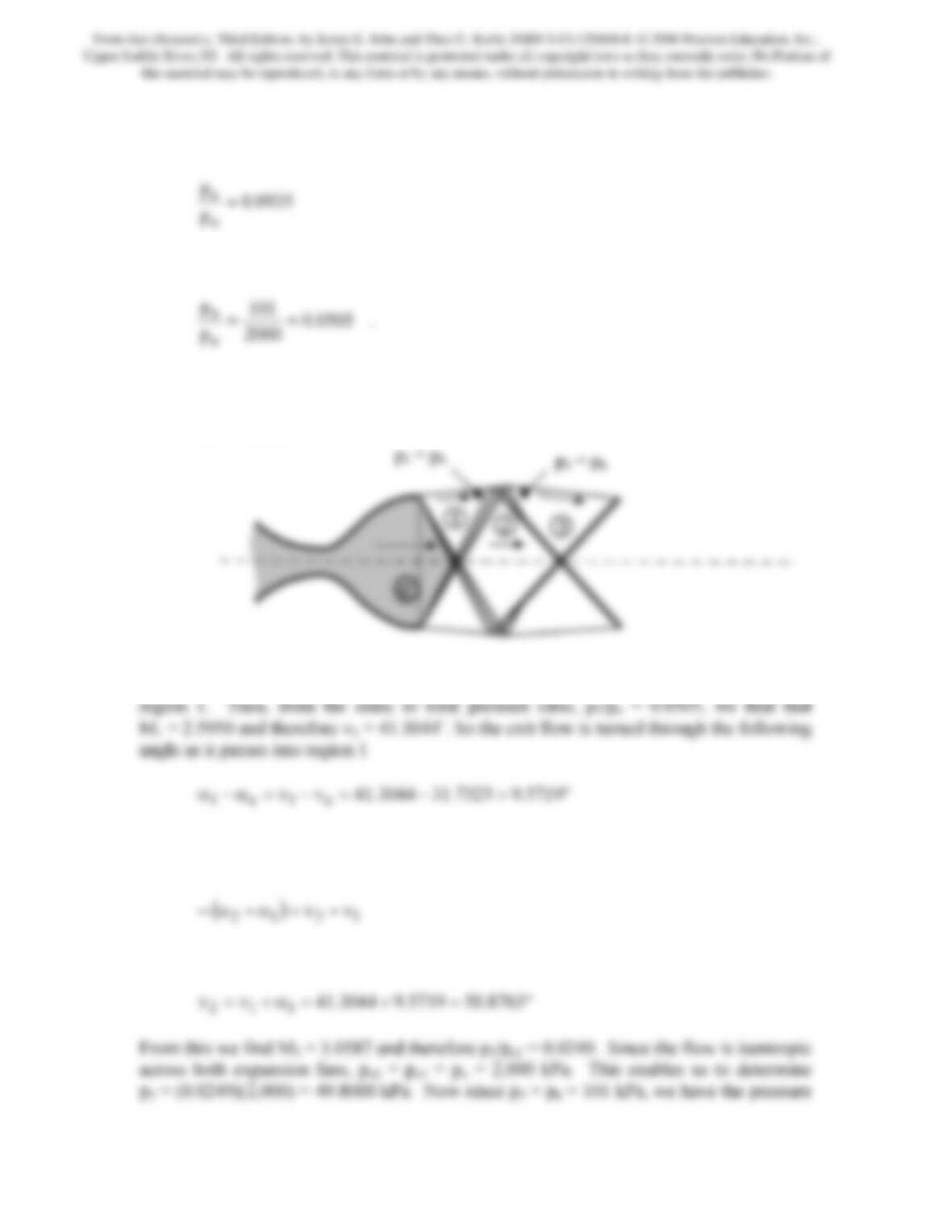
Because the nozzle is designed for an exit Mach number, Me, of 2.2, it follows that the
static to total pressure ratio at the nozzle exit is
0935.0
p
p
o
e=
The back pressure is 101 kPa and the reservoir pressure is 2,000 kPa, therefore,
. 0505.0
2000
p
o
Since pb/po < pe/po, the nozzle is underexpanded for this back pressure-reservoir pressure
combination. The following provides nomenclature and a sketch of the flow field.
From the Prandtl-Meyer relation at Me = 2.2, we find that νe = 31.7325˚. Since pb = p1 in
Since αe = 0˚, then it follows that α1 = 9.5719˚. The flow in region 2 must be horizontal,
i.e., α2 = 0˚, and since we must pass through another expansion fan, we may write that
Hence,
From Gas Dynamics, Third Edition, by James E. John and Theo G. Keith. ISBN 0-13-120668-0. © 2006 Pearson Education, Inc.,
Upper Saddle River, NJ. All rights reserved. This material is protected under all copyright laws as they currently exist. No Portion of
this material may be reproduced, in any form or by any means, without permission in writing from the publisher.
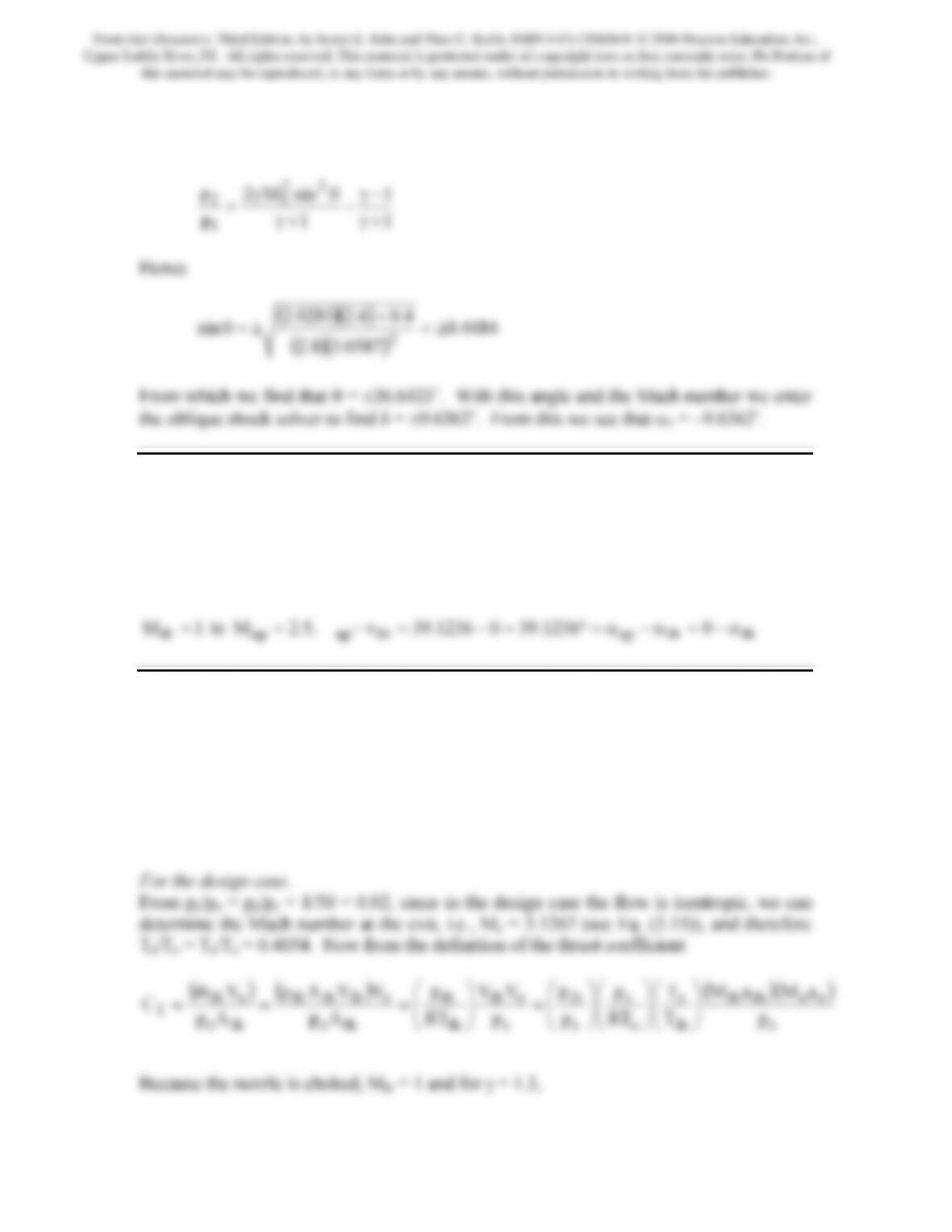
ratio across the oblique shock, i.e., p3/p2 = 101/49.8 = 2.0281. With this pressure ratio
and M2 = 3.0587 we can first determine the shock angle from Eq.(6.10)
()( )
0587.38.2
Problem 8. – A plug nozzle is designed to produce Mach 2.5 flow in the axial direction at
the plug apex. Flow at the throat cowling must therefore be directed toward the axis.
Determine the flow direction at the throat cowling to produce axial flow at the apex.
Assume γ = 1.4.
α
−
α
=
°
=
−
=
ν−==
Problem 9. – A rocket nozzle is designed to operate with a ratio of chamber pressure to
ambient pressure (pc/pa) of 50. Compare the performance of a plug nozzle with that of a
converging-diverging nozzle for two cases where the nozzle is operating overexpanded;
pc/pa = 40 and pc/pa = 20. Compare on the basis of thrust coefficient; CT = T/(pcAth),
where T is the thrust and Ath is the area of throat. Assume γ = 1.3 and in both cases
neglect the effect of nonaxial exit velocity components.
From Gas Dynamics, Third Edition, by James E. John and Theo G. Keith. ISBN 0-13-120668-0. © 2006 Pearson Education, Inc.,
Upper Saddle River, NJ. All rights reserved. This material is protected under all copyright laws as they currently exist. No Portion of
this material may be reproduced, in any form or by any means, without permission in writing from the publisher.
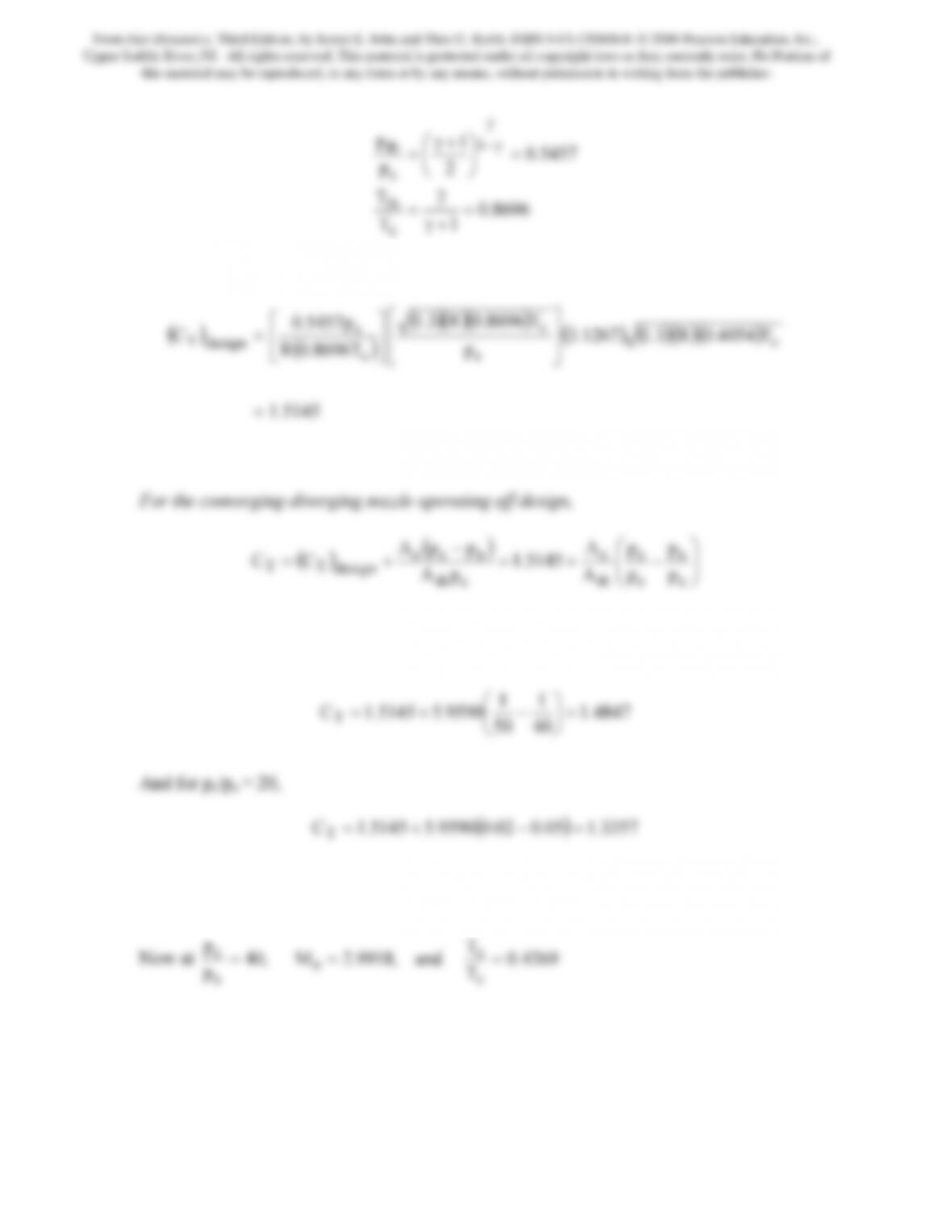
8696.0
1
2
T
T
5457.0
2
1
p
p
c
th
1
c
th
=
+γ
=
=
⎟
⎠
⎞
⎜
⎝
⎛+γ
=γ−
γ
Using these values and the values at the exit, we get
5145.1
=
Note, R, pc and Tc drop out of the above expression.
⎟
⎠
⎜
⎝
c
c
th
cth
design
TT p
p
A
pA
where at Me = 3.1267, Ae/Ath = Ae/A* = 5.9590. So for pc/pa = 40,
1
1
⎞
⎛−+=
For the plug nozzle,
Flow in the plug nozzle does not continue to expand below ambient pressure, so there is
no pressure term in the expression for thrust.
T
p
e
c===
From Gas Dynamics, Third Edition, by James E. John and Theo G. Keith. ISBN 0-13-120668-0. © 2006 Pearson Education, Inc.,
Upper Saddle River, NJ. All rights reserved. This material is protected under all copyright laws as they currently exist. No Portion of
this material may be reproduced, in any form or by any means, without permission in writing from the publisher.
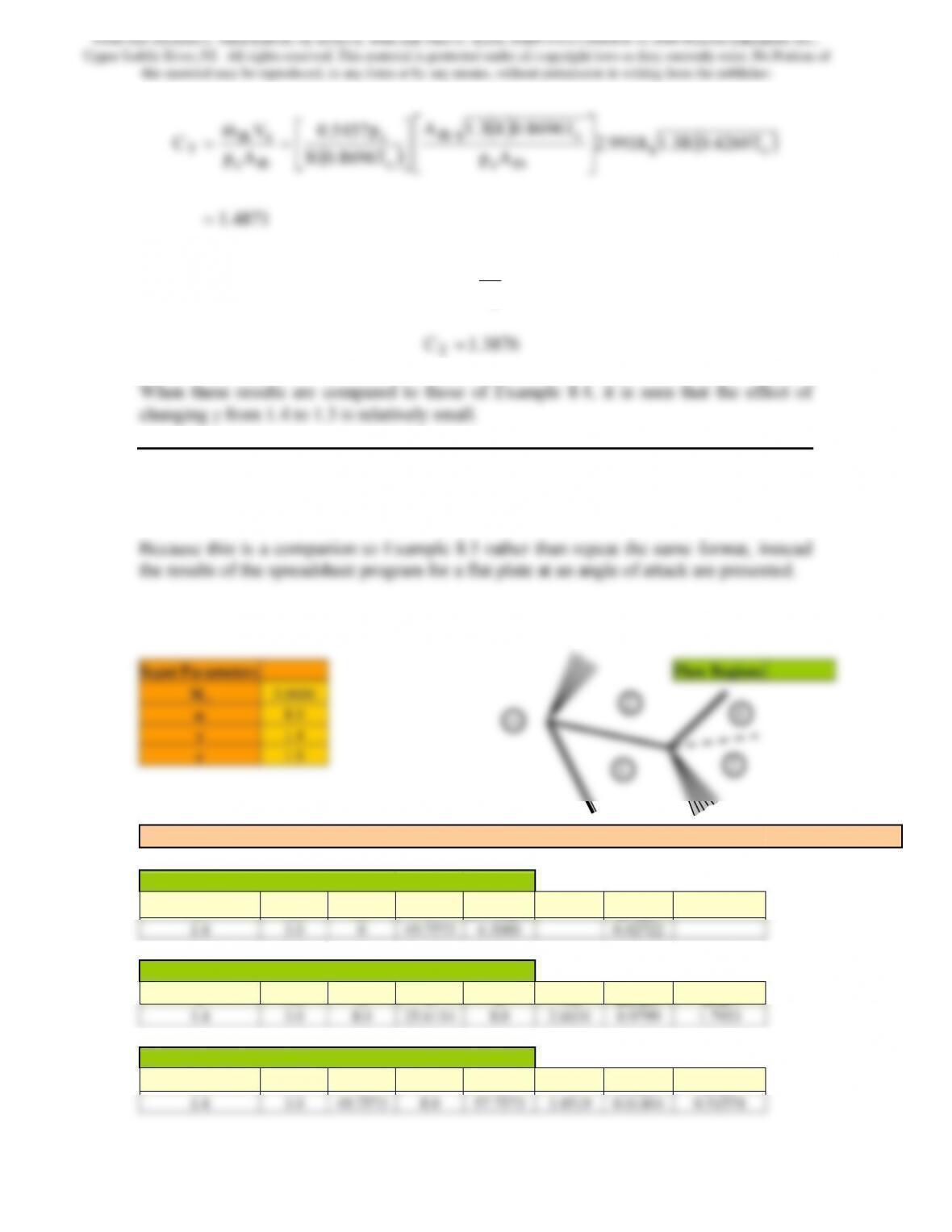
(
)()
4871.1
T4269.0R3.19918.2
T8696.0R3.1A
p5457.0
Vm
Cc
cth
c
eth
T
=
⎥
⎤
⎢
⎡
⎥
⎤
⎢
⎡
== &
Whereas for pc/pa = 20, 5009.0
T
T
and5773.2M
c
e
e==
Problem 10. – Compute the lift and drag coefficients for a flat plate airfoil of chord
length c = 1m in supersonic flow through air (γ = 1.4) at M∞ = 3 and α = 8°.
Results
Region ∞: freestream
γ M∞ α∞ ν∞ ρv2/(2p∞) p∞/po∞
Region 1: lower region behind oblique shock
γ M∞ δ θ α M1 po1/po∞ p1/p∞
Region 2: upper region behind expansion fan
γ M∞ ν∞ α ν2 M2 p2/po2 p2/p∞
From Gas Dynamics, Third Edition, by James E. John and Theo G. Keith. ISBN 0-13-120668-0. © 2006 Pearson Education, Inc.,
Upper Saddle River, NJ. All rights reserved. This material is protected under all copyright laws as they currently exist. No Portion of
this material may be reproduced, in any form or by any means, without permission in writing from the publisher.
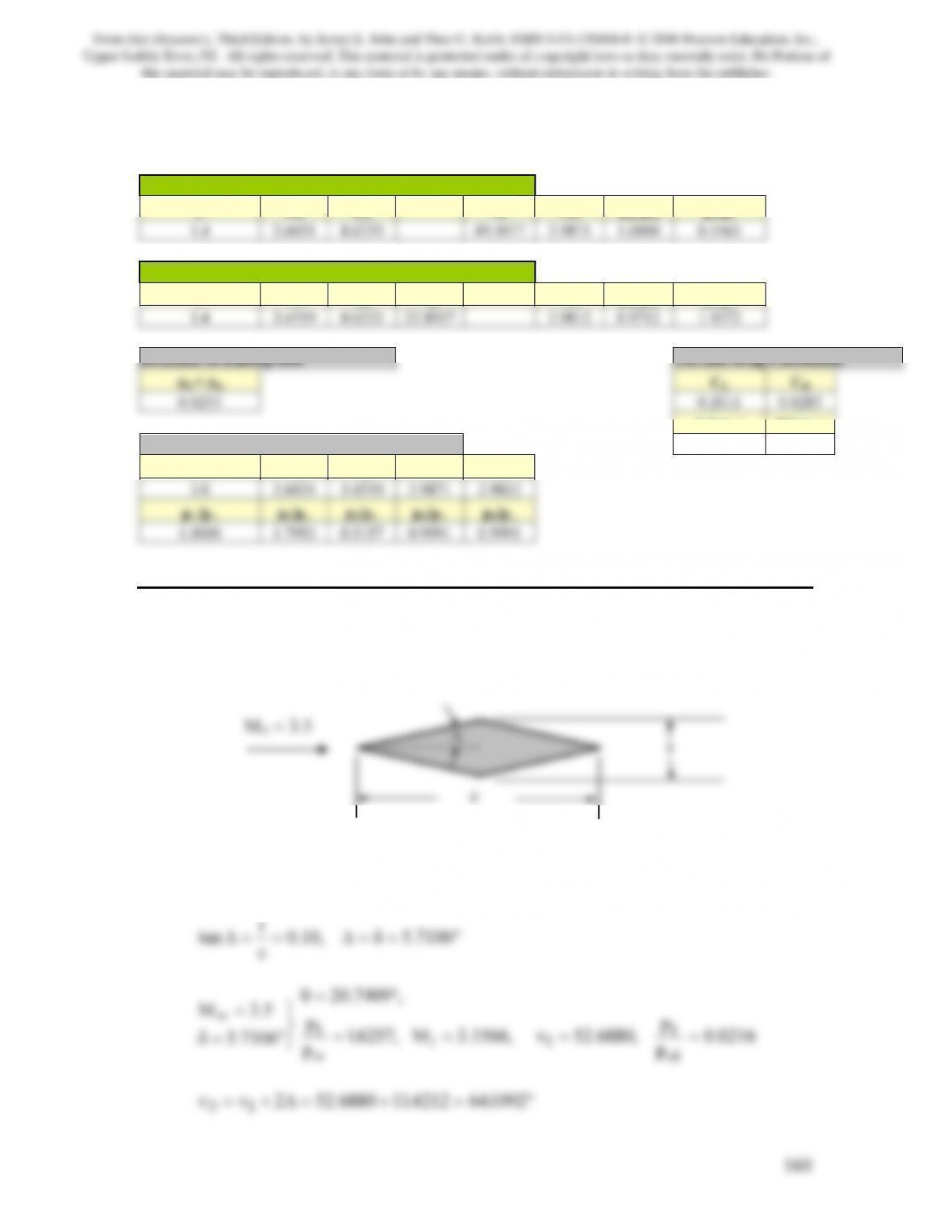
Region 3: lower region behind expansion fan
γ M1 δ13 ν3 M3 po3/po1 p3/p1
Region 4: upper region behind oblique shock
γ M2 δ24 θ24 M4 po4/po2 p4/p2
L/(cp∞) D/(cp∞)
Mach numbers and pressure ratios 1.2671 0.1781
M∞ M1 M2 M3 M4
Problem 11. – Compute the drag coefficient for a symmetric, diamond-shaped airfoil
(Figure P8.11) with a thickness to chord ratio, t/c, equal to 0.10 flying at Mach 3.5 in air
(γ = 1.4) at 10 km at zero angle of attack.
Figure P8.11
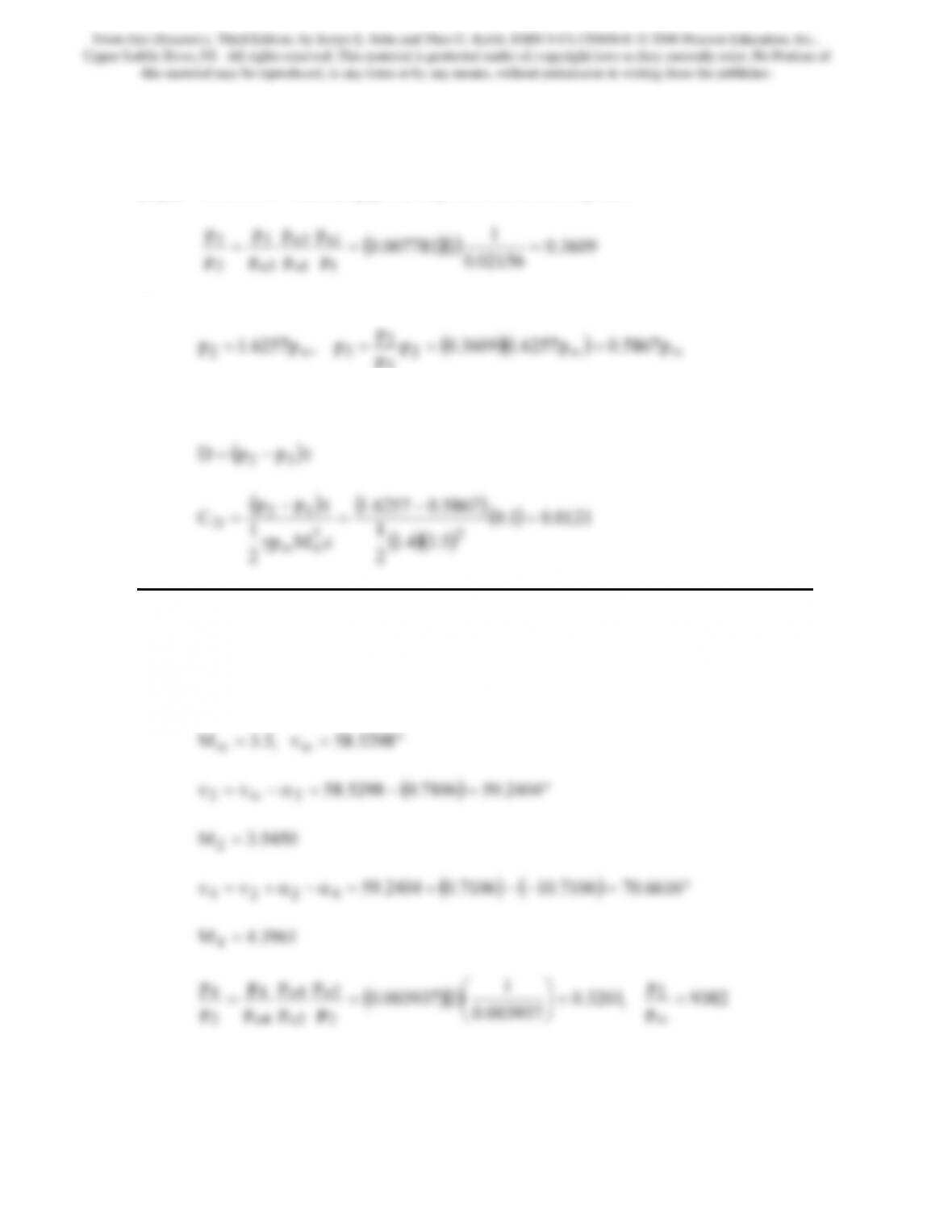
For an oblique shock at the nose of the airfoil,
t
From Gas Dynamics, Third Edition, by James E. John and Theo G. Keith. ISBN 0-13-120668-0. © 2006 Pearson Education, Inc.,
Upper Saddle River, NJ. All rights reserved. This material is protected under all copyright laws as they currently exist. No Portion of
this material may be reproduced, in any form or by any means, without permission in writing from the publisher.
161
Using this value of the Prandtl-Meyer function we find the corresponding Mach number
is M3 = 3.8760 and in turn the corresponding static to total pressure ratio is
p3/po3 = 0.007781. Accordingly, we may form the following ratio
Therefore,
p
p
2
Because of the symmetry and the 0º angle of attack, the lift coefficient is zero. The drag
coefficient may be determined in the following way
()() ()
5.34.1
2
1
cMpγ
2
1
2
2
D=
∞∞
Problem 12. Compute the lift and drag coefficients for the airfoil described in Problem
11 for an angle of attack of 5°.
Upper Surface
p
003937.0
p
p
p
p
2
2o
4o
2
⎠
⎝
∞
Lower Surface
From Gas Dynamics, Third Edition, by James E. John and Theo G. Keith. ISBN 0-13-120668-0. © 2006 Pearson Education, Inc.,
Upper Saddle River, NJ. All rights reserved. This material is protected under all copyright laws as they currently exist. No Portion of
this material may be reproduced, in any form or by any means, without permission in writing from the publisher.
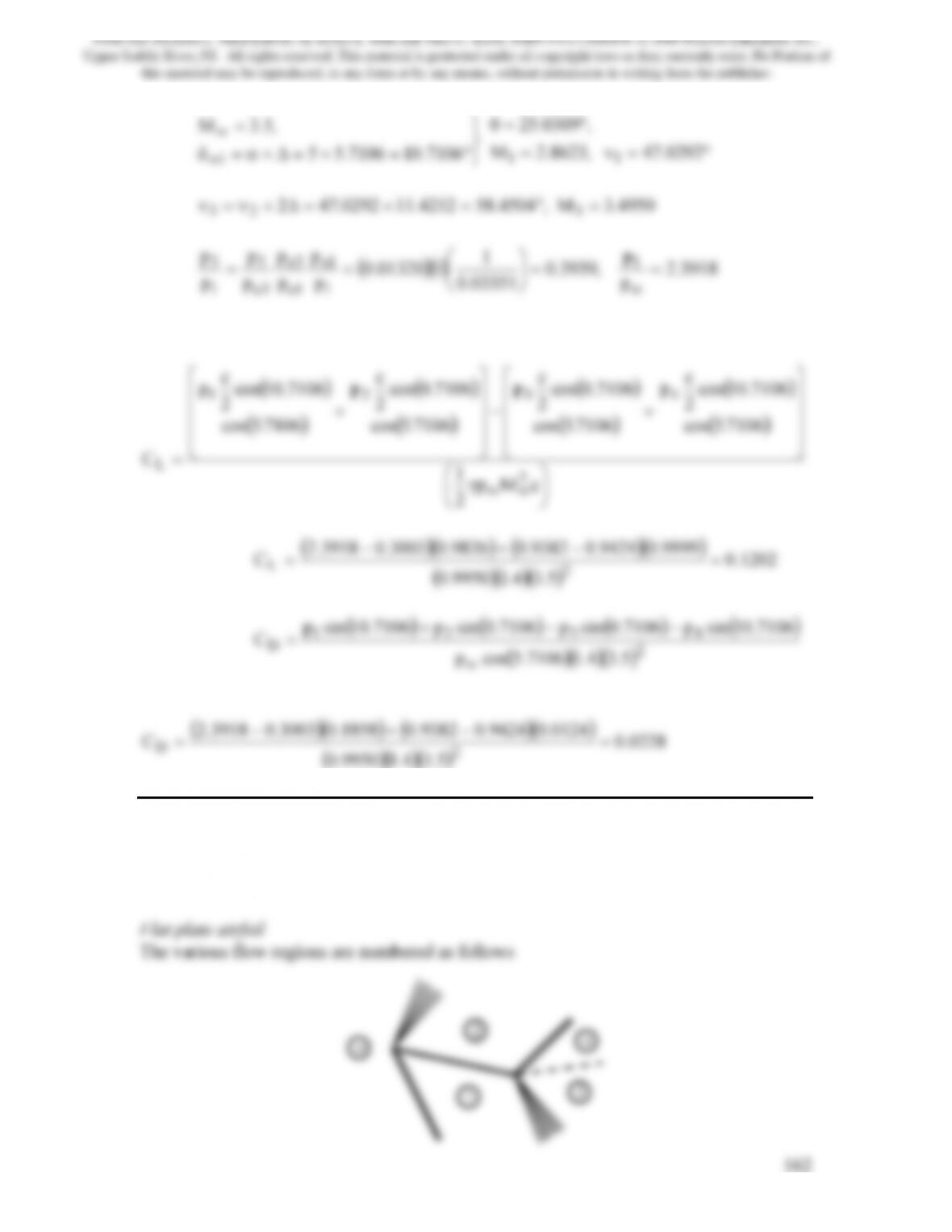
7106.107106.55δ
,5.3M
1⎭
⎬
⎫
°=+=∆+α=
=
∞
∞
°=ν=
°
=
0292.47 ,8623.2M
,0309.25θ
11
4950.3M , 4504.584212.110292.472ν323
=
°
=
+
=∆+ν=
()()
3918.2
p
p
,3939.0
03351.0
1
101320.0
p
p
p
p
p
p
p
p1
1
1o
1o
3o
3o
3
1
3==
⎟
⎠
⎞
⎜
⎝
⎛
==
∞
()
()
()
()
()
()
()
()
⎟
⎠
⎞
⎜
⎝
⎛
⎥
⎥
⎥
⎥
⎦
⎤
⎢
⎢
⎢
⎢
⎣
⎡
+−
⎥
⎥
⎥
⎥
⎦
⎤
⎢
⎢
⎢
⎢
⎣
⎡
+
=
∞∞ cMpγ
2
1
7106.5cos
7106.10cos
2
c
p
7106.5cos
7106.0cos
2
c
p
7106.5cos
7106.0cos
2
c
p
7106.5cos
7106.10cos
2
c
p
C
2
4321
L
()
(
)
(
)
(
)
()()()
1202.0
5.34.19950.0
9999.09424.09382.09826.03003.03918.2
C2
L=
−
+
−
=
()
(
)
(
)()
()()()
2
4321
D5.34.17106.5cosp
7106.10sinp7106.0sinp7106.0sinp7106.10sinp
C
∞
−
−
+
=
()()
(
)
(
)
()()()
0228.0
5.34.19950.0
0124.09424.09382.01858.03003.03918.2
C2
D=
−
+
−
=
Problem 13. – Compare the lift to drag ratio of the diamond airfoil in problem 12 with
that of a flat-plate airfoil for the same freestream Mach number of 3.5 and angle of attack
of 5°. Assume γ = 1.4.
From Gas Dynamics, Third Edition, by James E. John and Theo G. Keith. ISBN 0-13-120668-0. © 2006 Pearson Education, Inc.,
Upper Saddle River, NJ. All rights reserved. This material is protected under all copyright laws as they currently exist. No Portion of
this material may be reproduced, in any form or by any means, without permission in writing from the publisher.
163
Upper Surface
Using the freestream Mach number
From this and the angle of attack we can find ν2 from which we can find M2
and so M2 = 3.8344. Furthermore using the Mach of the freestream and in region 2 we
can use the isentropic relations to determine the corresponding static to stagnation
pressure ratios. Since the flow from the freestream into region 2 is isentropic
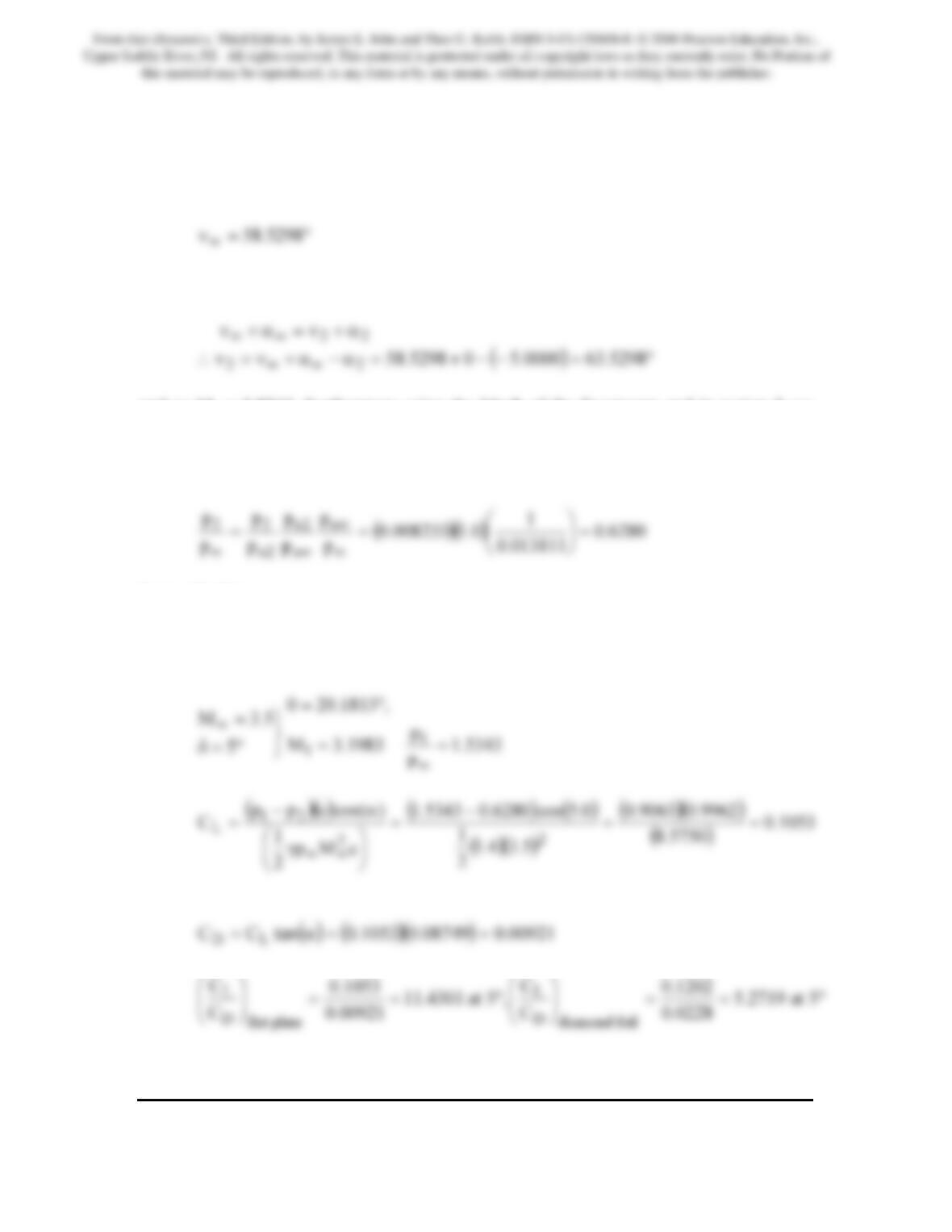
Lower Surface
Because the freestream flow must be turned through 5º as it passes through the oblique
shock
°==
⎟
⎟
⎠
⎞
⎜
⎜
⎝
⎛
°==
⎟
⎟
⎠
⎞
⎜
⎜
⎝
⎛5 at 2719.5
0228.0
1202.0
C
C
,5 at 4301.11
00921.0
1053.0
C
C
ildiamond fo
D
L
flat plate
D
L
From Gas Dynamics, Third Edition, by James E. John and Theo G. Keith. ISBN 0-13-120668-0. © 2006 Pearson Education, Inc.,
Upper Saddle River, NJ. All rights reserved. This material is protected under all copyright laws as they currently exist. No Portion of
this material may be reproduced, in any form or by any means, without permission in writing from the publisher.
164
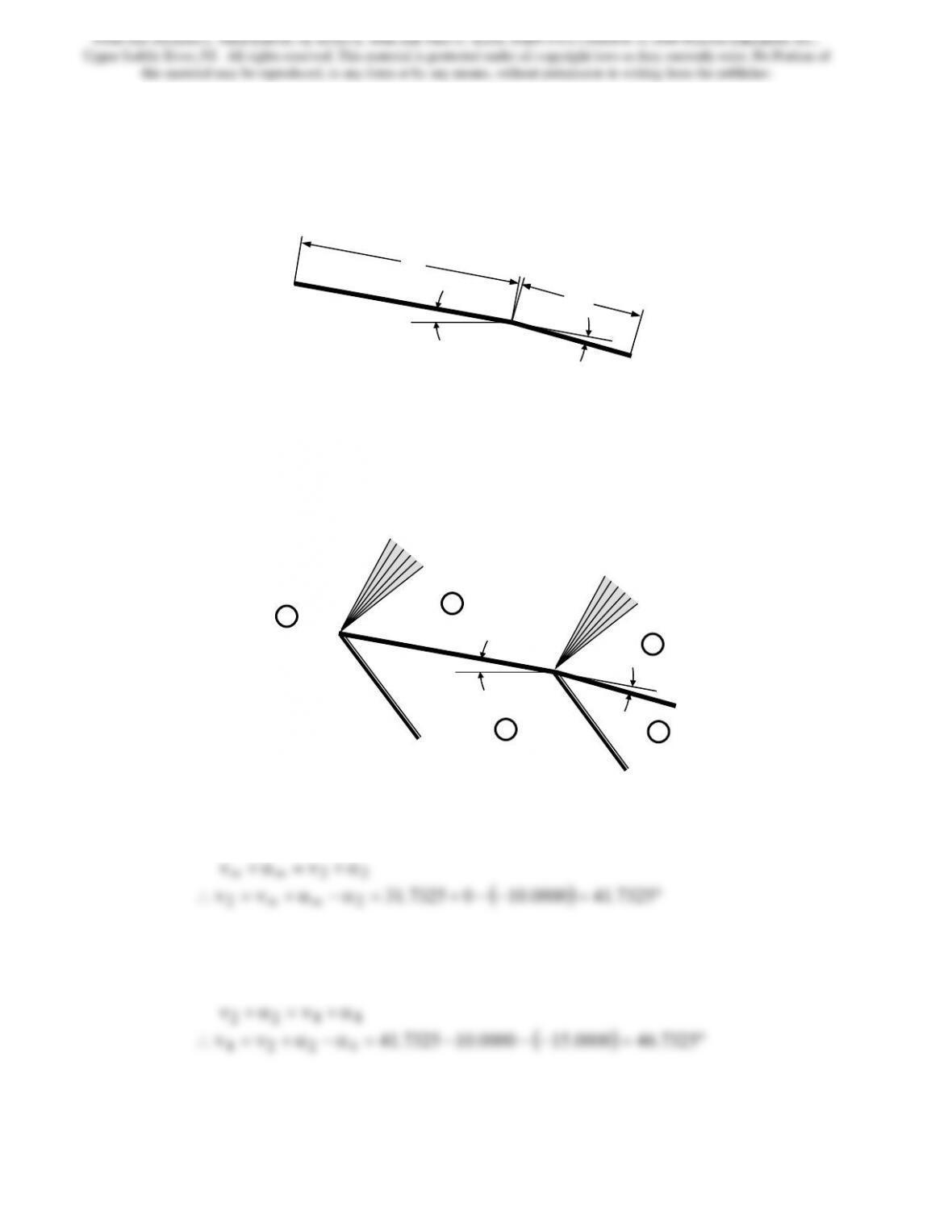
Problem 14. – Consider a flat-plate supersonic airfoil with a flap, as shown in Figure
P8.10. For a flap angle of 5°, an angle of attack 10°, and a flight Mach number of 2.2,
find the lift and drag coefficients of the airfoil.
Figure P8.14
Except for the trailing edge phenomena, there will be two expansion fans on the top of
the plate and two oblique shocks on the lower portion. The regions for the calculations
are numbered as follows
From this and the angle of attack we can find ν2, which will lead to M2
()
°=−−+=α−α+ν=ν
∴
α+ν=α+ν
∞∞
∞∞
7325.410000.1007325.31
22
22
and so M2 = 2.6142. This process is repeated in passing through the expansion fan at the
corner of the flat plate and the flap
()
°=−−−=α−α+ν=ν
∴
α+ν=α+ν
7325.460000.150000.107325.41
4224
4422
10º
5º
4
2
3
1
∞
c
c/3
10º
5º
From Gas Dynamics, Third Edition, by James E. John and Theo G. Keith. ISBN 0-13-120668-0. © 2006 Pearson Education, Inc.,
Upper Saddle River, NJ. All rights reserved. This material is protected under all copyright laws as they currently exist. No Portion of
this material may be reproduced, in any form or by any means, without permission in writing from the publisher.
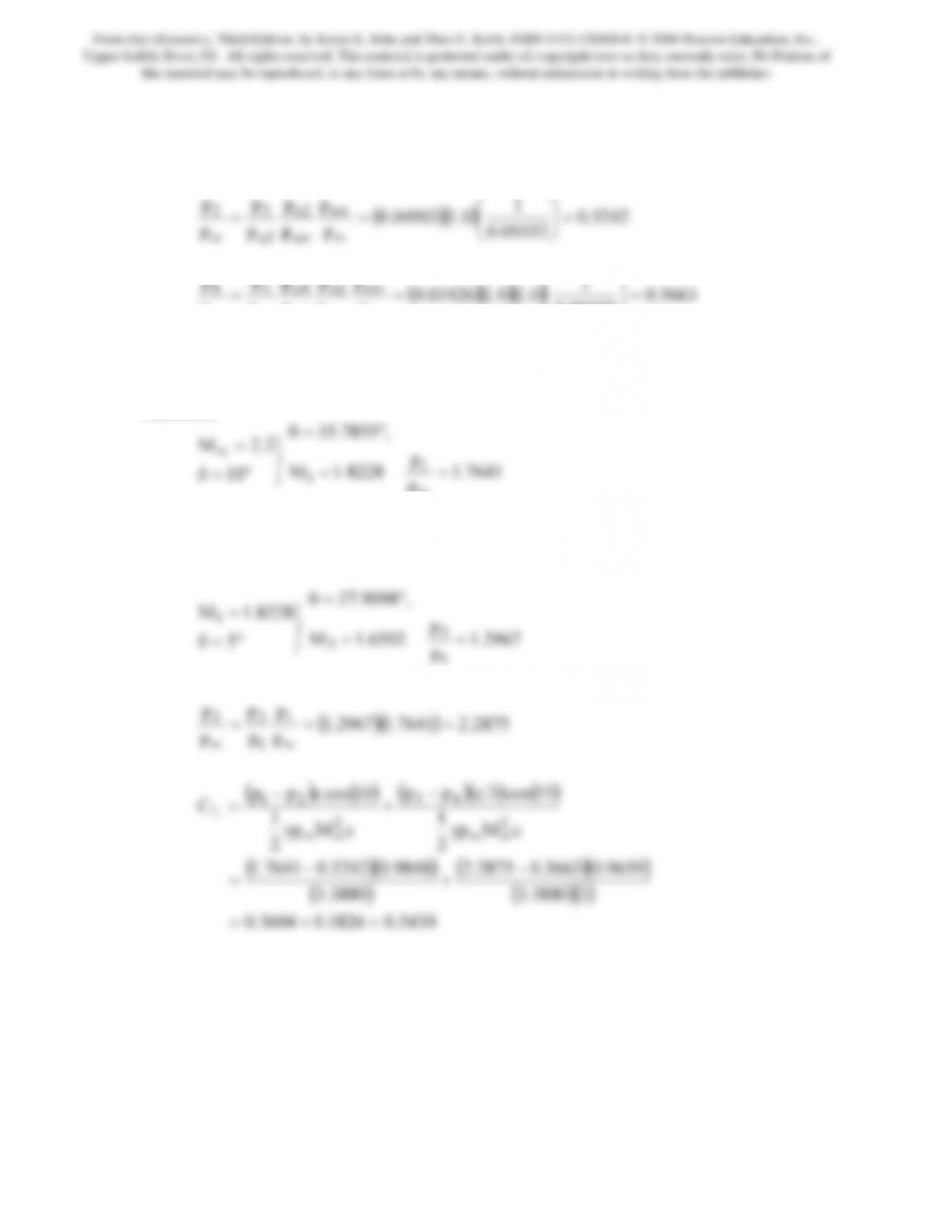
and so M4 = 2.8478. Furthermore using M∞, M2, M4, we can use the isentropic relations
to determine the corresponding static to stagnation pressure ratios. Since the flows from
the freestream into region 2 and from region 2 to 4 are isentropic
1
p
p
p
po
2o
22 =
⎞
⎛
∞
09352.0
p
p
p
p
p
o
2o
4o
⎠
⎝
∞
∞∞
Lower Surface
The freestream flow is turned through 10º as it passes through the first oblique shock.
Therefore,
⎭
⎬
⎫
°=δ
=
∞
10
2.2M
7641.1
p
p
8228.1M
,7855.35
1
1==
°=θ
∞
The stream in region 1 is turned through 5º as it passes through the second oblique shock
as it flows into region 3. Therefore,
1
And so
()()
2875.27641.12967.1
p
p
p
p
p
p1
1
33 ===
∞∞
From Gas Dynamics, Third Edition, by James E. John and Theo G. Keith. ISBN 0-13-120668-0. © 2006 Pearson Education, Inc.,
Upper Saddle River, NJ. All rights reserved. This material is protected under all copyright laws as they currently exist. No Portion of
this material may be reproduced, in any form or by any means, without permission in writing from the publisher.
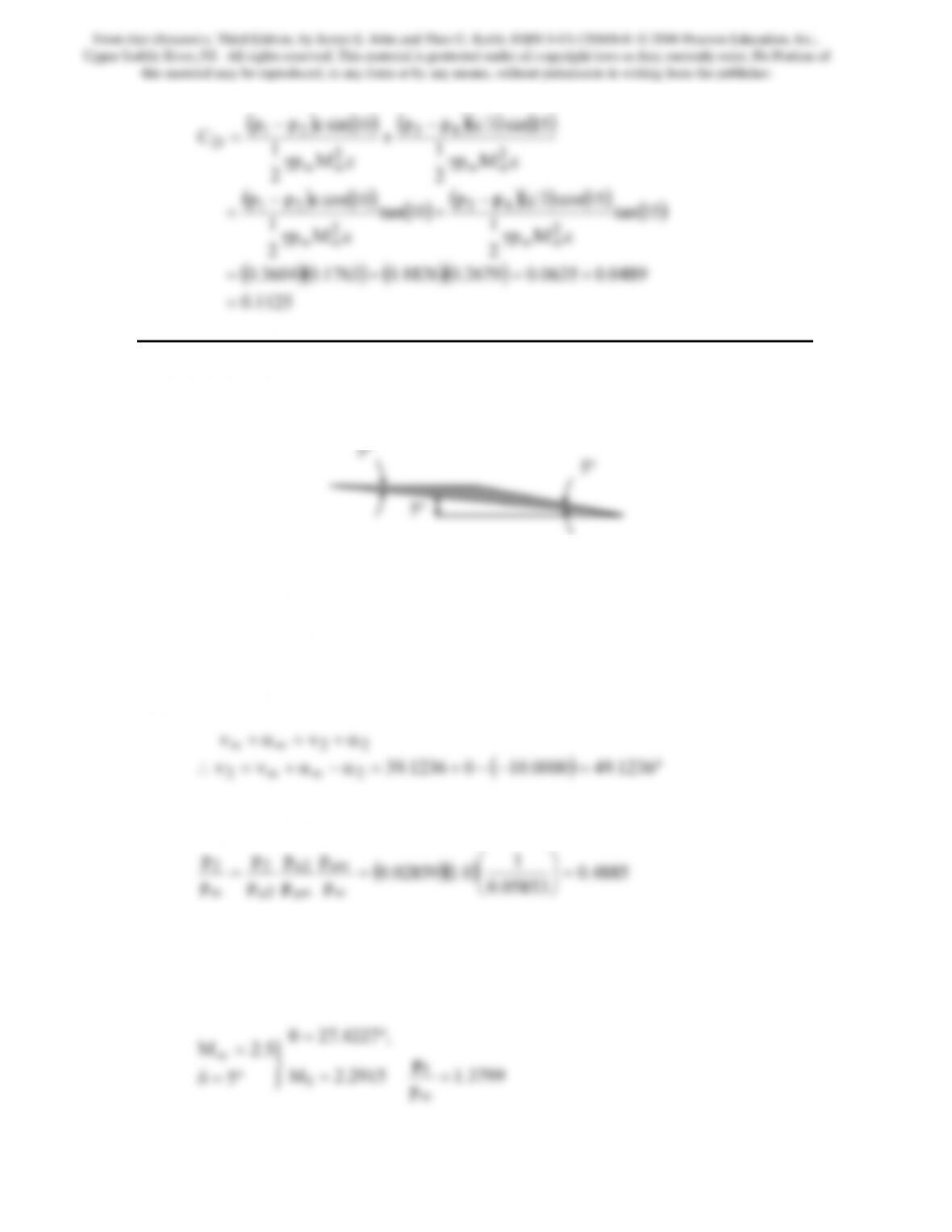
−
()()()()
1125.0
0489.00635.02679.01826.01763.03604.0
cMγp
2
1
cMγp
2
1
2
2
=
+=+=
∞∞∞∞
Problem 15. – Compute the lift and drag coefficients for the supersonic, symmetric
airfoil shown flying in air (γ = 1.4) at Mach 2.5 at an angle of attack of 5° in Figure
P8.15.
Figure P8.l5
Because the angle of attack and the wedge angle have the same value, the flow will
experience only one expansion fan on the upper surface where the slope changes and an
oblique shock on the bottom at the leading edge.
Upper Surface
()
°=−−+=α−α+ν=ν
∴
∞∞
1236.490000.1001236.39
22
and so M2 = 2.9674.
05853.0
1
p
p
p
p
p
p
p
po
o
2o
2o
22 =
⎠
⎞
⎝
⎛
∞
∞
∞∞
Lower Surface
The freestream flow is turned through 5º as it passes through the forward oblique shock.
Therefore,
5º
From Gas Dynamics, Third Edition, by James E. John and Theo G. Keith. ISBN 0-13-120668-0. © 2006 Pearson Education, Inc.,
Upper Saddle River, NJ. All rights reserved. This material is protected under all copyright laws as they currently exist. No Portion of
this material may be reproduced, in any form or by any means, without permission in writing from the publisher.
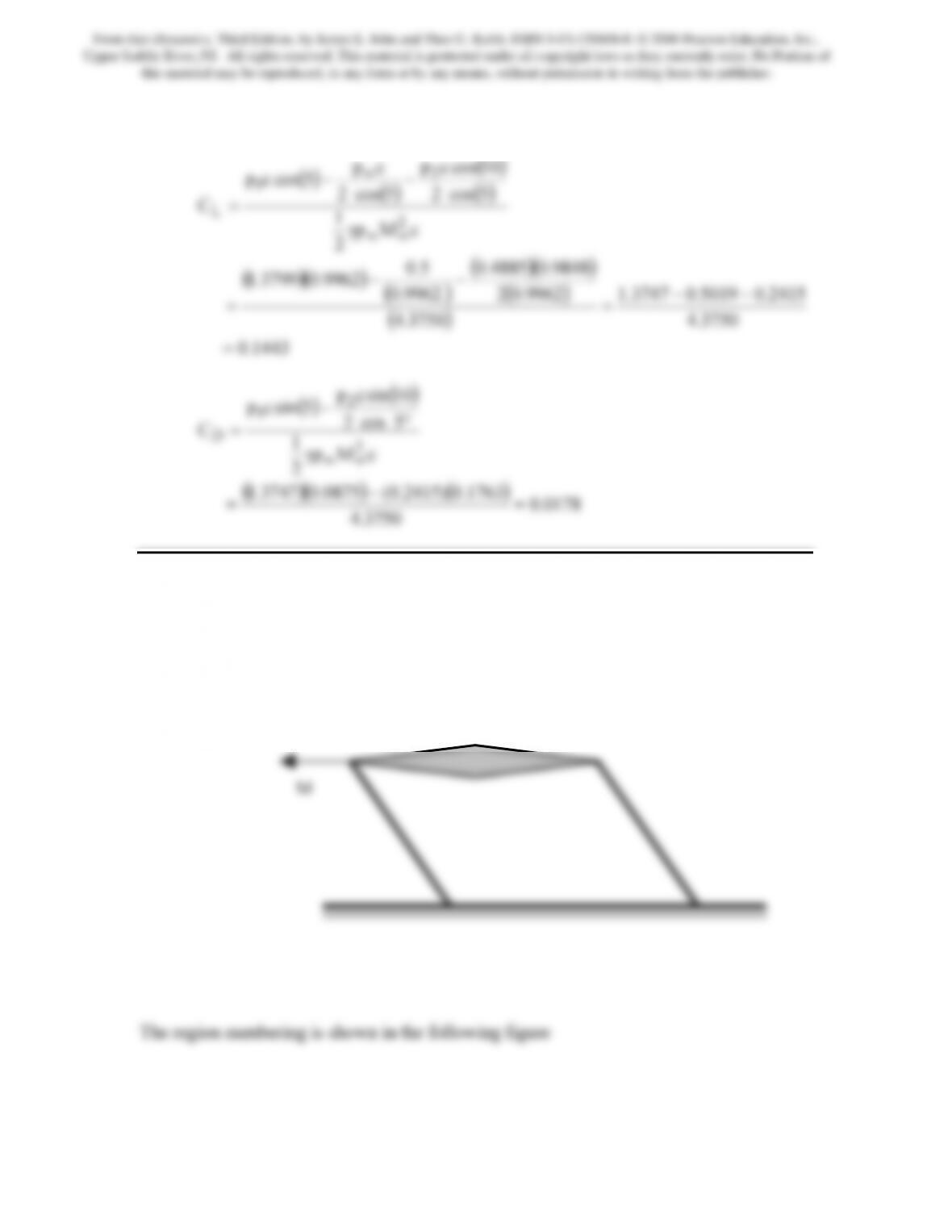
() ()
(
)
()
()()
()
()()
()
2415.05019.03747.1
9962.02
9848.04885.0
.9962.0
5.0
9962.03799.1
cMγp
2
1
5cos 2
10cos cp
5cos 2
cp
5cos cp
C
2
2
1
L
−−
−−
−−
=
∞∞
∞
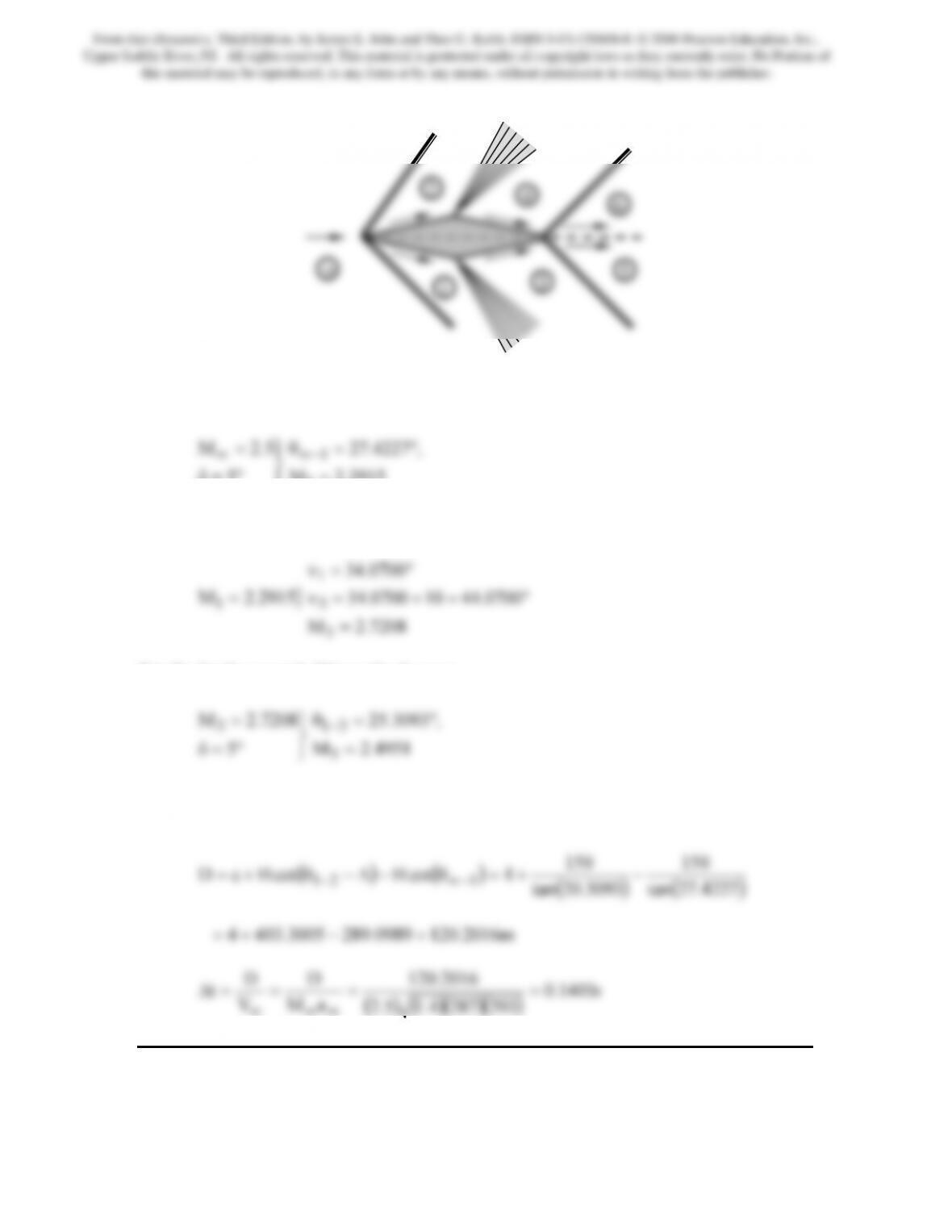
Problem 16. – A supersonic jet plane is flying horizontally at 150 m above ground level
at a Mach number of 2.5, as shown in Figure P8.16. The airfoil is symmetric and
diamond shaped, with 2∆ = 10º and a chord length of 4m. As the plane passes over, a
ground observer hears the “sonic boom” caused by the shock waves. Find the time
between the two “booms,” one from the shock at the leading edge and one from the shock
at the trailing edge. Ambient pressure and temperature are 100 kPa and 20°C.
From Gas Dynamics, Third Edition, by James E. John and Theo G. Keith. ISBN 0-13-120668-0. © 2006 Pearson Education, Inc.,
Upper Saddle River, NJ. All rights reserved. This material is protected under all copyright laws as they currently exist. No Portion of
this material may be reproduced, in any form or by any means, without permission in writing from the publisher.
From Gas Dynamics, Third Edition, by James E. John and Theo G. Keith. ISBN 0-13-120668-0. © 2006 Pearson Education, Inc.,
Upper Saddle River, NJ. All rights reserved. This material is protected under all copyright laws as they currently exist. No Portion of
this material may be reproduced, in any form or by any means, without permission in writing from the publisher.