106
C
Ch
ha
ap
pt
te
er
r
S
Si
ix
x
O
OB
BL
LI
IQ
QU
UE
E
S
SH
HO
OC
CK
K
W
WA
AV
VE
ES
S
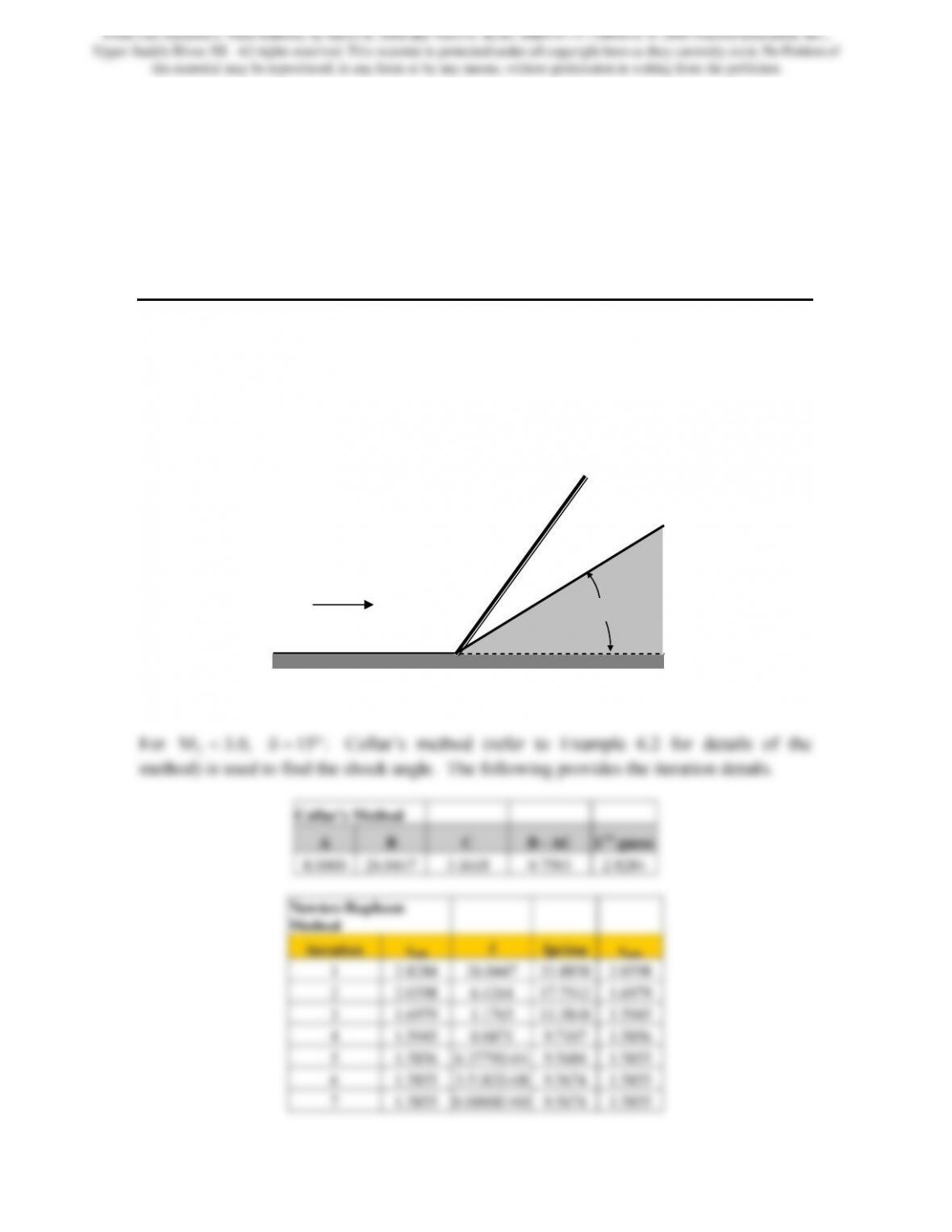
Problem 1. – Uniform airflow (γ = 1.4, R = 287 J/kg·K) at Mach 3 passes into a concave
corner of angle 15°, as shown in Figure P6.1. The pressure and temperature in the
supersonic flow are, respectively, 72 kPa and 290 K. Determine the tangential and normal
components of velocity and Mach number upstream and downstream of the wave for the
weak shock solution. Also find the static and stagnation pressure ratios across the wave.
How great would the corner angle have to be before the shock would detach from the
corner?
Figure P6.1
1
M = 3
∆
= 15°
From Gas Dynamics, Third Edition, by James E. John and Theo G. Keith. ISBN 0-13-120668-0. © 2006 Pearson Education, Inc.,
Upper Saddle River, NJ. All rights reserved. This material is protected under all copyright laws as they currently exist. No Portion of
this material may be reproduced, in any form or by any means, without permission in writing from the publisher.
107
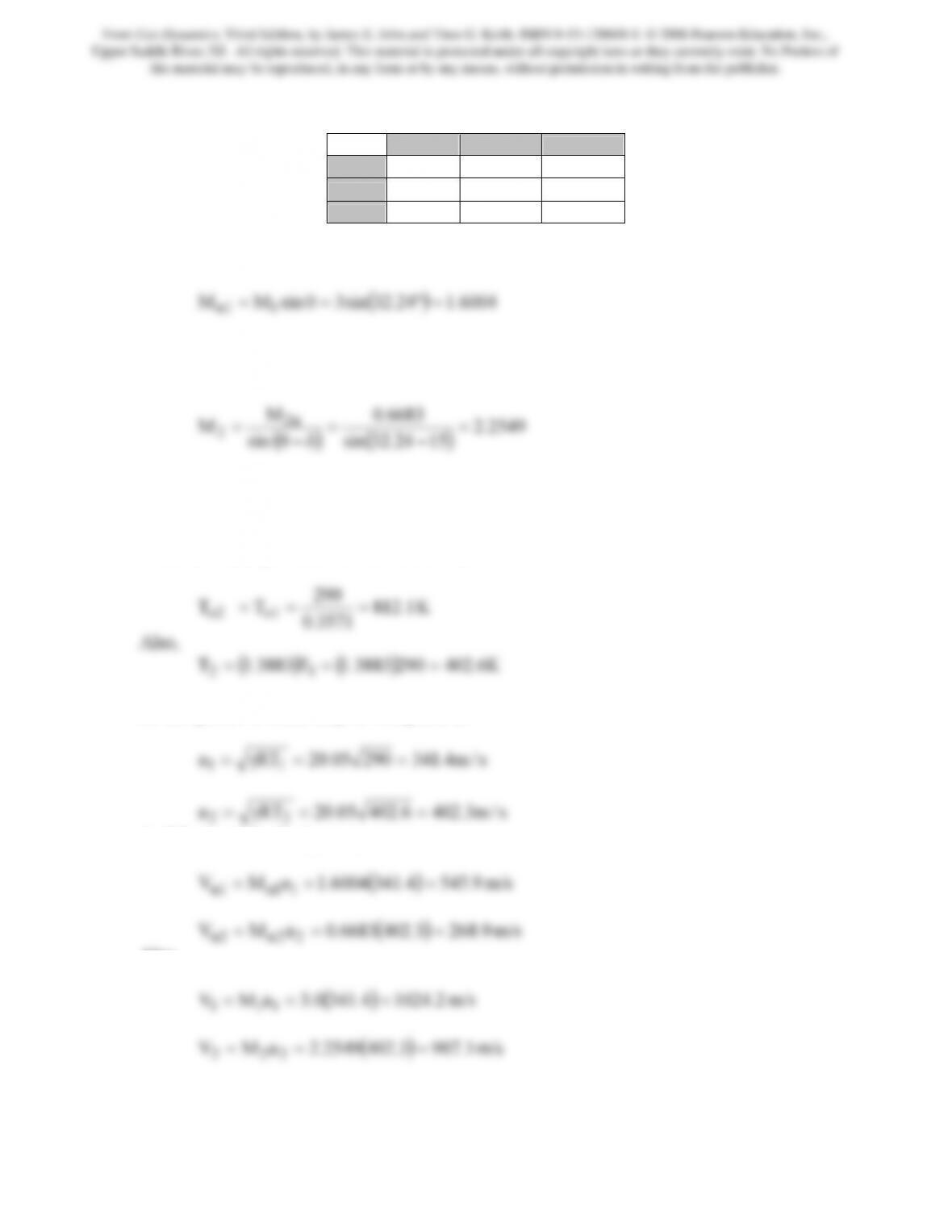
cotθ tanθ angle (deg)
weak 1.5855 0.6307 32.24
strong 0.0977 10.2387 84.42
neg root -4.8450 -0.2064 -11.66
So for the weak solution, the shock angle is 32.24°
From the shock tables at this Mach number M n 2 = 0.6683, p2/p1 = 2.8215, T2/T1 = 1.3882
and po2/po1 = 0.8950. From Eq.(6.9b)
() ()
1524.32sin
sin
2=
−
δ−θ
Too be sure, these could also be computed from the oblique shock relations of this
Chapter [Eqs.(6.10), (6.12), (6.13) and (6.17)].
From the isentropic tables at M1 = 3.0, T/To = 0.3571
So the speeds of sound may be computed as
And the normal velocity components are
Also,
The tangential velocity component can be computed from either Eq.(6.6a) or (6.7a)
From Gas Dynamics, Third Edition, by James E. John and Theo G. Keith. ISBN 0-13-120668-0. © 2006 Pearson Education, Inc.,
Upper Saddle River, NJ. All rights reserved. This material is protected under all copyright laws as they currently exist. No Portion of
this material may be reproduced, in any form or by any means, without permission in writing from the publisher.
108
3.402
a
2
From Table 6.4 for γ = 1.4 and M1 = 3.0, δmax is found to be 34.07°.
Problem 2. – In a helium (γ = 5/3) wind tunnel, flow at Mach 4.0 passes over a wedge of
unknown half-angle aligned symmetrically with the flow. An oblique shock is observed
attached to the wedge, making an angle of 30° with the flow direction. Determine the
half-angle of the wedge and the ratios of stagnation pressure and stagnation temperature
across the wave.
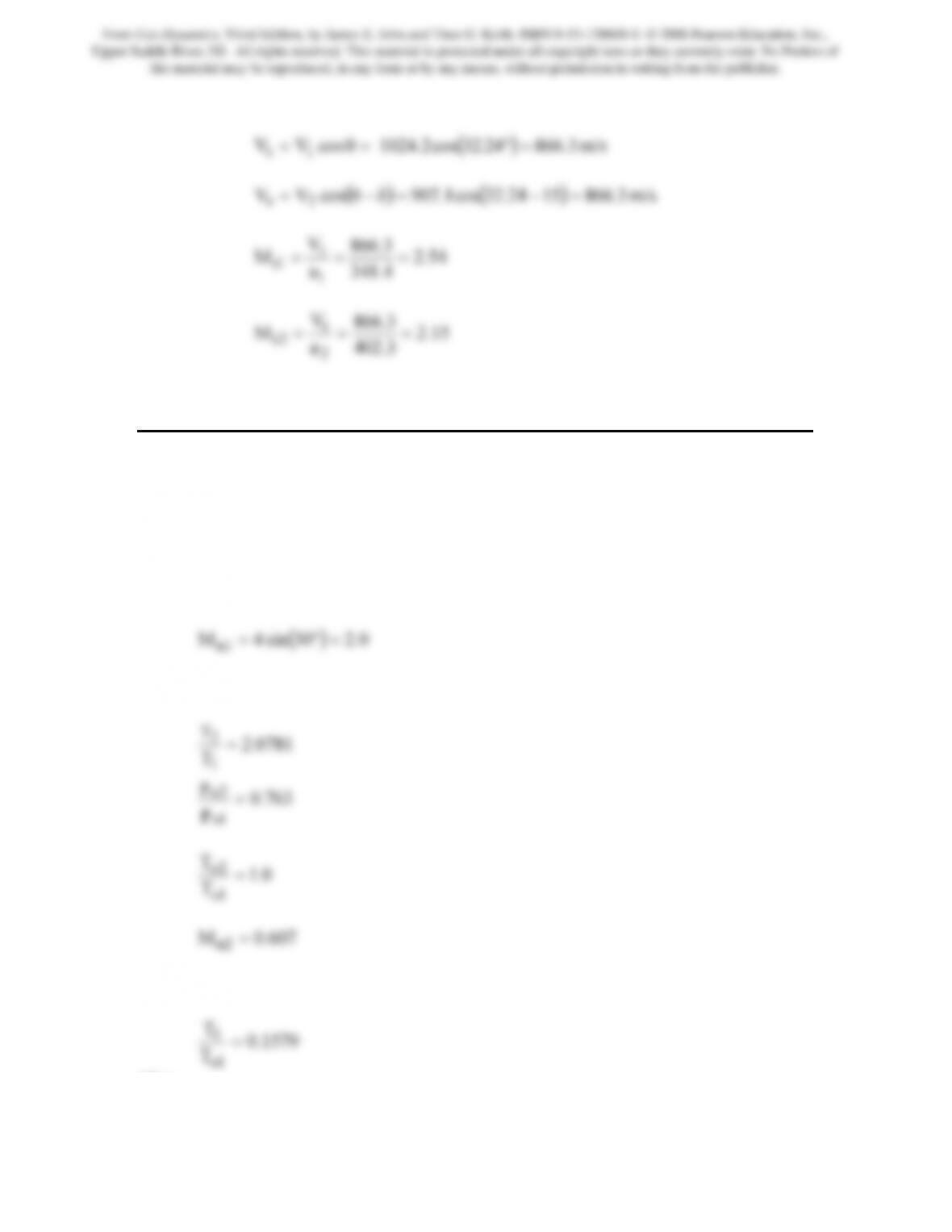
Method 1: Use of normal shock tables.
Using this value we can enter the normal shock table at a γ = 5/3 to find
Entering the isentropic flow table at M1 = 4 we find that
1579.0
T
1o
Thus,
From Gas Dynamics, Third Edition, by James E. John and Theo G. Keith. ISBN 0-13-120668-0. © 2006 Pearson Education, Inc.,
Upper Saddle River, NJ. All rights reserved. This material is protected under all copyright laws as they currently exist. No Portion of
this material may be reproduced, in any form or by any means, without permission in writing from the publisher.
T
T
T
T
T
T
1o
1
1
2
2o
2==
⎟
⎠
⎞
⎜
⎝
⎛
⎟
⎠
⎞
⎜
⎝
⎛
Entering the isentropic flow tables with this temperature ratio provides the downstream
Mach number
Method 2: Oblique shock equations
Problem 3. – A wedge is to be used as an instrument to determine the Mach number of a
supersonic airstream (γ = 1.4); that is, with the wedge axis aligned to the flow, the wave
angle of the attached oblique shock is measured; this permits a determination of the
incident Mach number. If the total included angle of such a wedge is 45°, give the Mach
number range over which such an instrument would be effective.
Refer to Example 6.3. That example concerned the prediction of the minimum upstream
Mach number to produce an attached oblique shock. This is a similar problem; only here,
the half angle ∆ = 45/2 = 22.5°. So for a deflection angle δ of 22.5° and γ = 1.4,
computations following Example 6.3 are as follows:
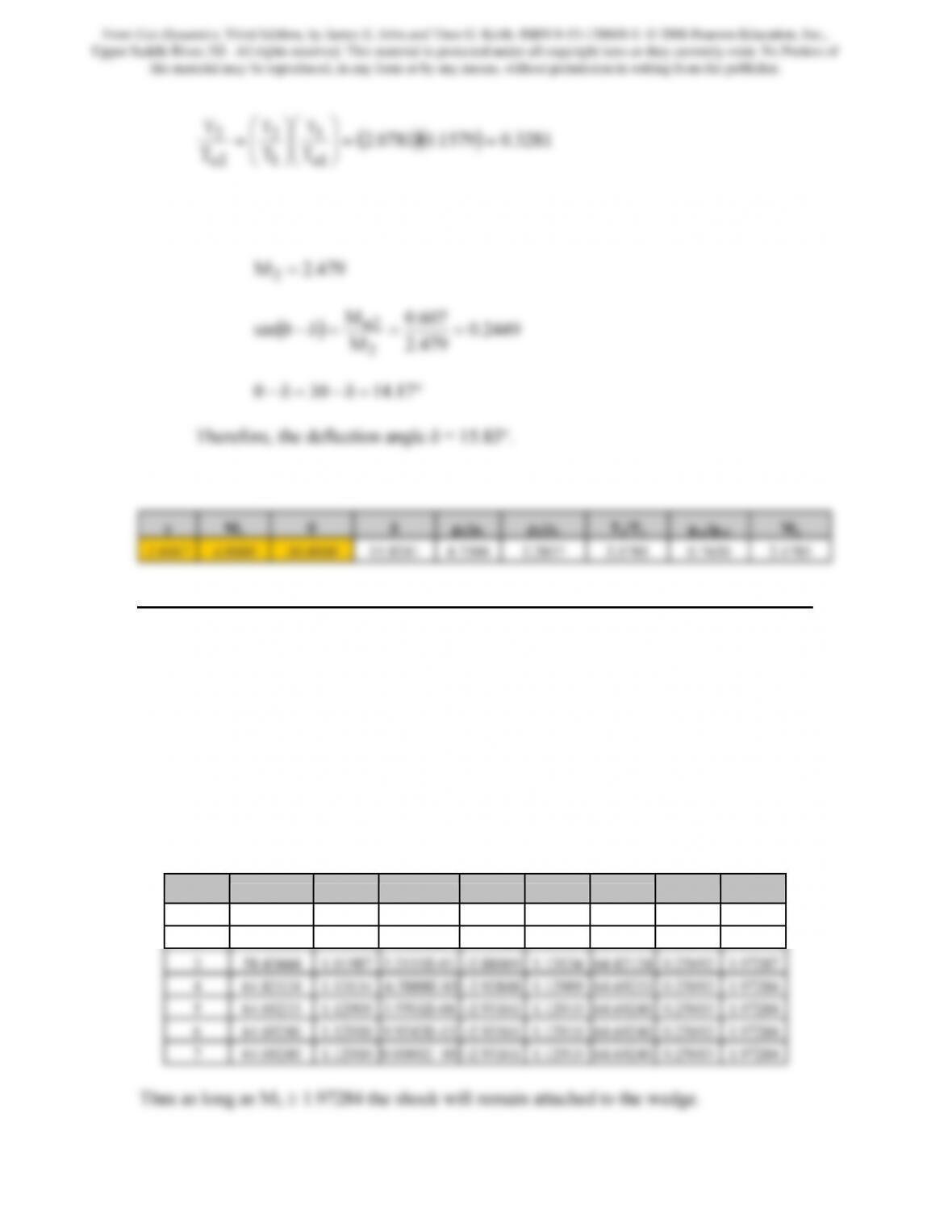
Iteration θ (deg) θ(rad) f(θ) df/dθ θnew θ (deg) 1/M1
2 M1
1 45.00000 0.78540 0.85858 -1.41421 1.39250 79.78466 0.13234 2.74886
2 79.78466 1.39250 -0.64460 -1.72985 1.01987 58.43444 0.24273 2.02971
From Gas Dynamics, Third Edition, by James E. John and Theo G. Keith. ISBN 0-13-120668-0. © 2006 Pearson Education, Inc.,
Upper Saddle River, NJ. All rights reserved. This material is protected under all copyright laws as they currently exist. No Portion of
this material may be reproduced, in any form or by any means, without permission in writing from the publisher.
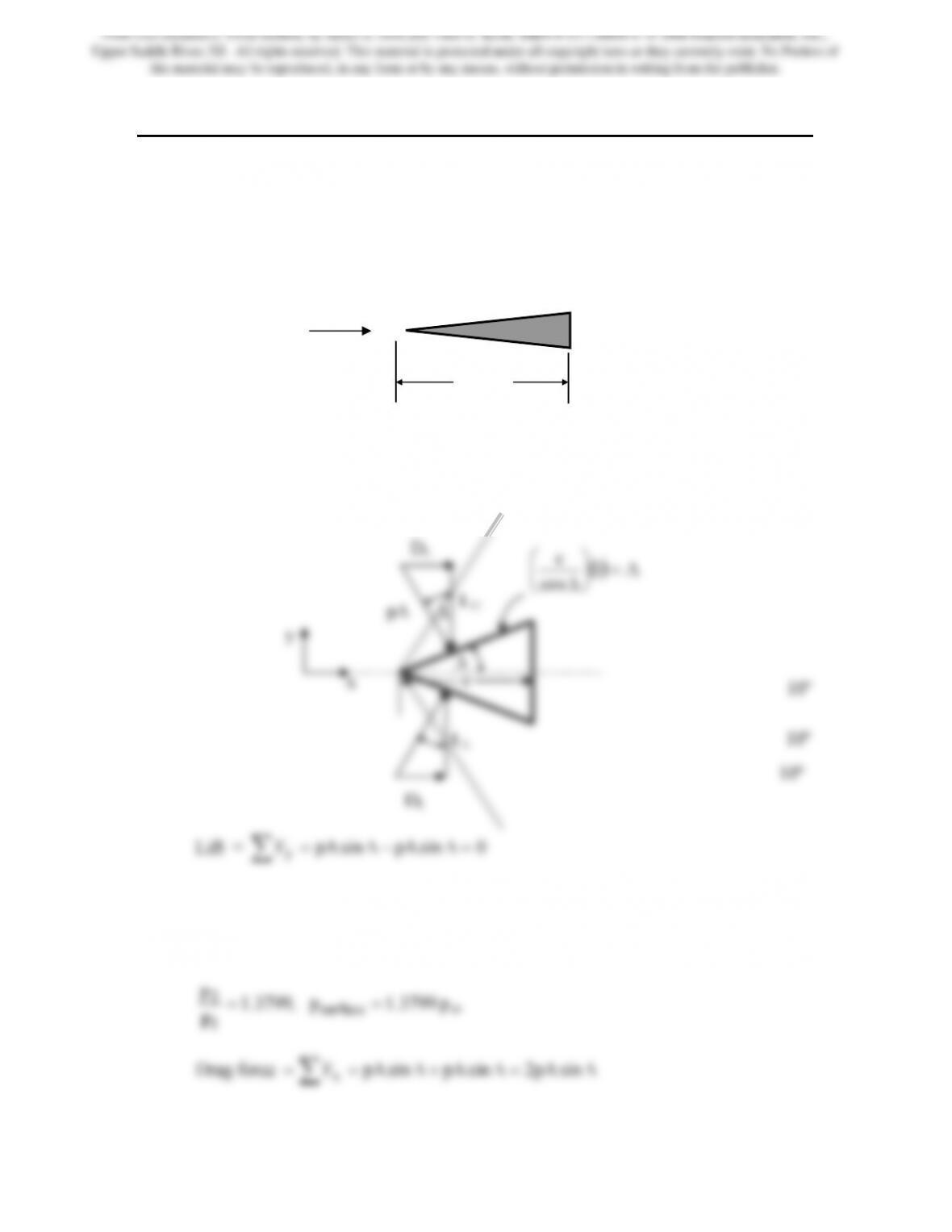
Problem 4. – The leading edge of a supersonic wing is wedge shaped, with a total
included angle of 10° (Figure P6.4). If the wing is flying at zero angle of attack,
determine the lift and drag force on the wing per meter of span. Repeat for an angle of
attack of 3°. Assume the wing is traveling at Mach 2.5.
Figure P6.4
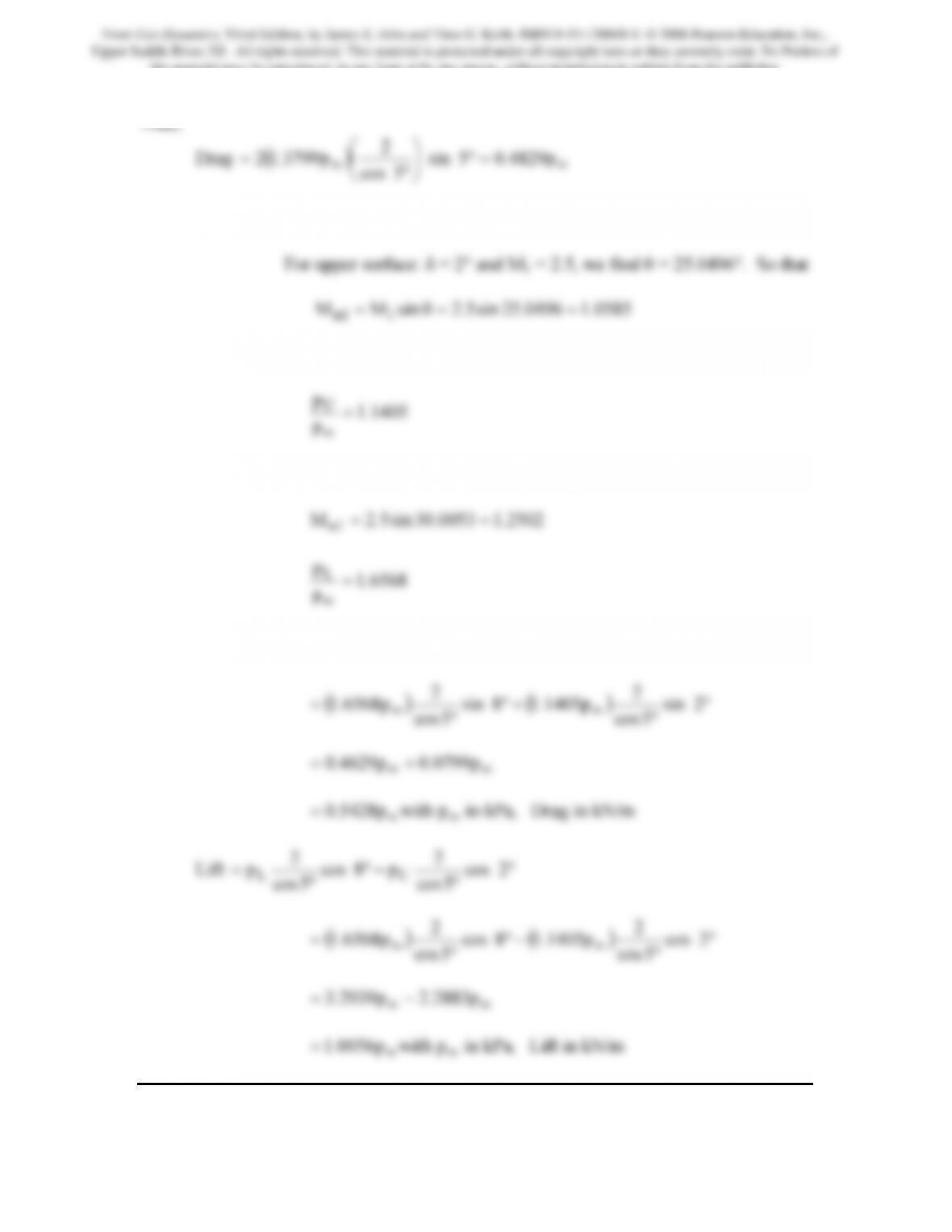
Case I: Zero angle of attack:
First draw a figure (exaggerated) showing the forces acting on the surface:
M∞ = 2.5
2.0 m
From Gas Dynamics, Third Edition, by James E. John and Theo G. Keith. ISBN 0-13-120668-0. © 2006 Pearson Education, Inc.,
Upper Saddle River, NJ. All rights reserved. This material is protected under all copyright laws as they currently exist. No Portion of
this material may be reproduced, in any form or by any means, without permission in writing from the publisher.
111
∞∞ =°
⎠
⎝
°
5 cos
Case II: Angle of attack = 3
°
:
Using the normal shock relations we obtain
p
∞
For lower surface: δ = 2° and M1 = 2.5, we find θ = 30.0053°. So that
p
∞
Drag °+°=2 sinA p8 sinA p UL
∞
∞
∞
∞
∞
∞
∞
∞
From Gas Dynamics, Third Edition, by James E. John and Theo G. Keith. ISBN 0-13-120668-0. © 2006 Pearson Education, Inc.,
Upper Saddle River, NJ. All rights reserved. This material is protected under all copyright laws as they currently exist. No Portion of
this material may be reproduced, in any form or by any means, without permission in writing from the publisher.
112
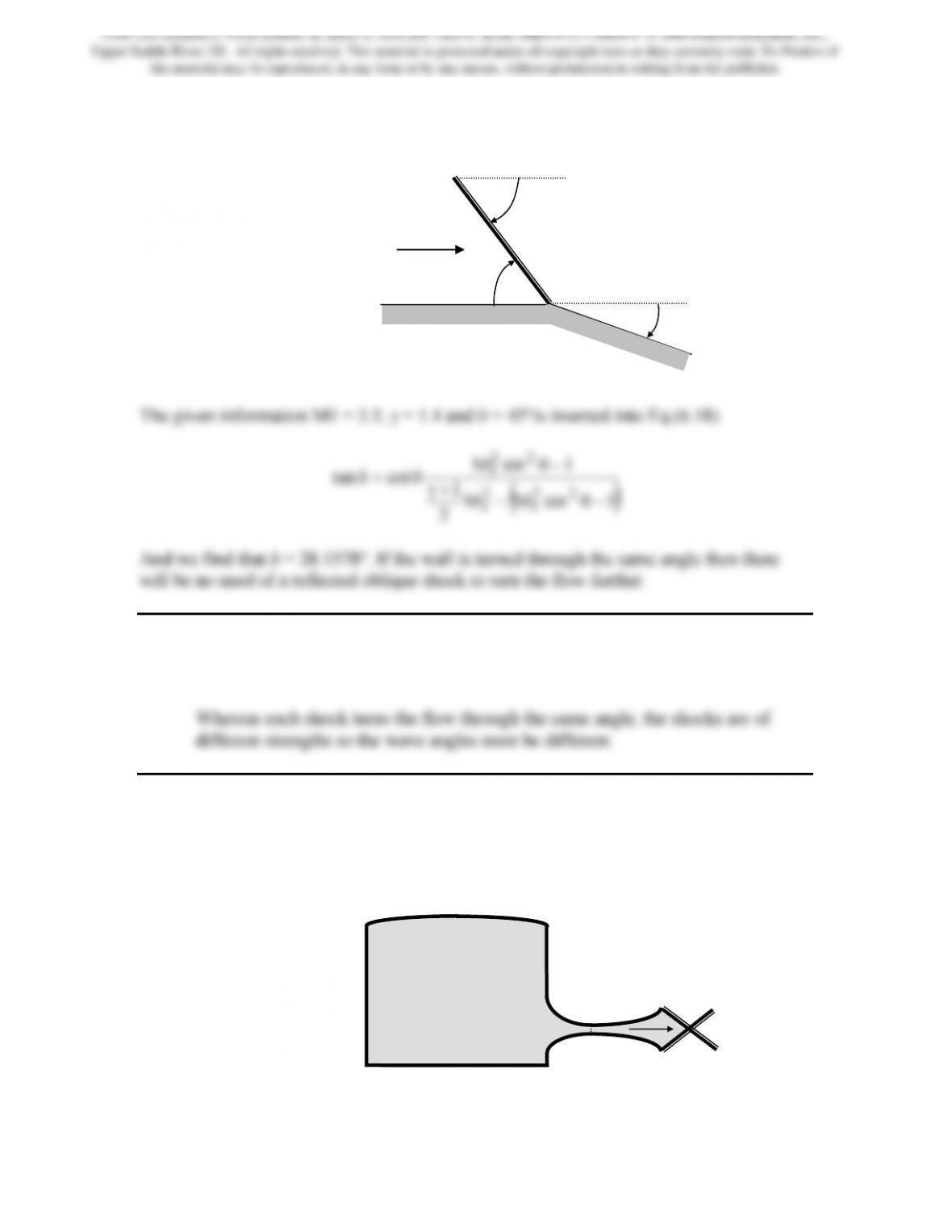
Problem 5. – An oblique shock wave is incident on a solid boundary, as shown in Figure
P6.5. The boundary is to be turned through such an angle that there will be no reflected
wave. Determine the angle β.
Figure P6.5
Problem 6. – Explain in physical terms why the angle of incidence and the angle of
reflection of a reflected oblique shock are not equal.
Problem 7. –A converging-diverging nozzle is designed to provide flow at Mach 2.0.
With the nozzle exhausting to a back pressure of 80 kPa, however, and a reservoir
pressure of 280 kPa, the nozzle is overexpanded, with oblique shocks at the exit (Figure
P6.7). Determine the flow direction and flow Mach number in region R with air the
working fluid.
Figure P6.7
θ
θ
= 45°
β
M1 = 3.5
Very Large
Reservoir
po ≈ constant
R
R
From Gas Dynamics, Third Edition, by James E. John and Theo G. Keith. ISBN 0-13-120668-0. © 2006 Pearson Education, Inc.,
Upper Saddle River, NJ. All rights reserved. This material is protected under all copyright laws as they currently exist. No Portion of
this material may be reproduced, in any form or by any means, without permission in writing from the publisher.
113
At the exit plane,
p
1
⎞
⎛
Across shock, 2356.2
7840.35
p
p
e
1
Entering the normal shock tables at this pressure ratio we find, 4350.1M 1n =
⎠
⎝
2
Now at Mn1
T
T
T
T
2o
1o
1
2o
⎟
⎠
⎜
⎝
⎟
⎠
⎜
⎝
⎟
⎠
⎜
⎝
At this static to total temperature ratio we can find M2 = 1.4301
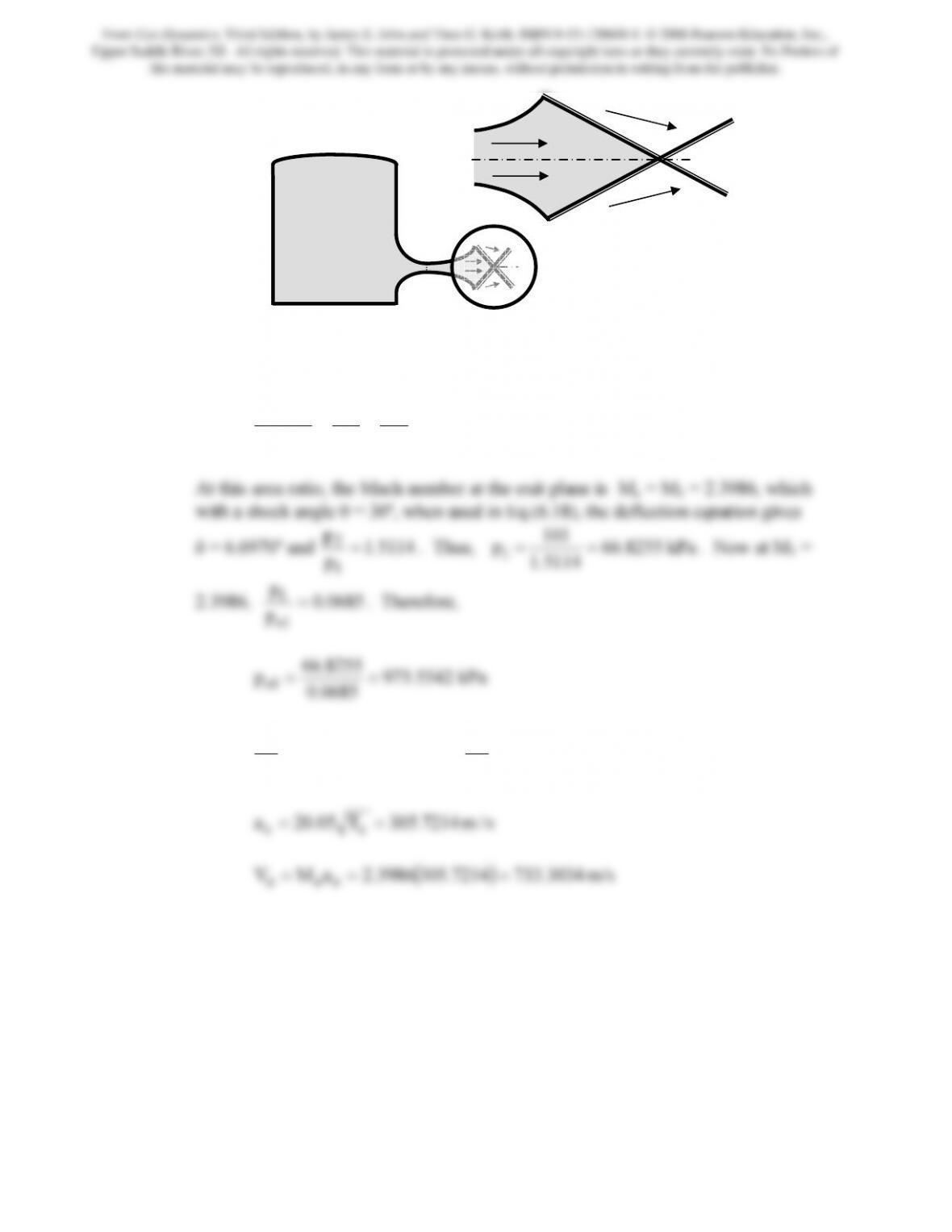
Problem 8. –(a) Oblique shock waves appear at the exit of a supersonic nozzle, as shown
in Figure P6.8. Air is the working fluid. If the nozzle back pressure is 101 kPa,
determine the nozzle inlet stagnation pressure. The stagnation temperature of the flow is
500 K. Nozzle throat area is 50 cm2, and nozzle exit area is 120 cm2. (b) Find the
velocity at the nozzle exit plane. (c) Find the mass flow rate through the nozzle.
From Gas Dynamics, Third Edition, by James E. John and Theo G. Keith. ISBN 0-13-120668-0. © 2006 Pearson Education, Inc.,
Upper Saddle River, NJ. All rights reserved. This material is protected under all copyright laws as they currently exist. No Portion of
this material may be reproduced, in any form or by any means, without permission in writing from the publisher.
114
Figure P6.8
(a) 4.2
50
120
*A
A
A
Ae
throat
exit ===
(b)
()
K5000.2325004650.0T
T
T
T hus,T 4650.0
T
T
o
o
e
e
o
e==
⎟
⎟
⎠
⎞
⎜
⎜
⎝
⎛
==
(c)
()
throat
AVm ρ=
&
Reservoir
30º
30º
From Gas Dynamics, Third Edition, by James E. John and Theo G. Keith. ISBN 0-13-120668-0. © 2006 Pearson Education, Inc.,
Upper Saddle River, NJ. All rights reserved. This material is protected under all copyright laws as they currently exist. No Portion of
this material may be reproduced, in any form or by any means, without permission in writing from the publisher.
115
()
()
aMA
TTTR
ppp
m
ttt
oot
1o1ot
⎥
⎦
⎤
⎢
⎣
⎡
=
&
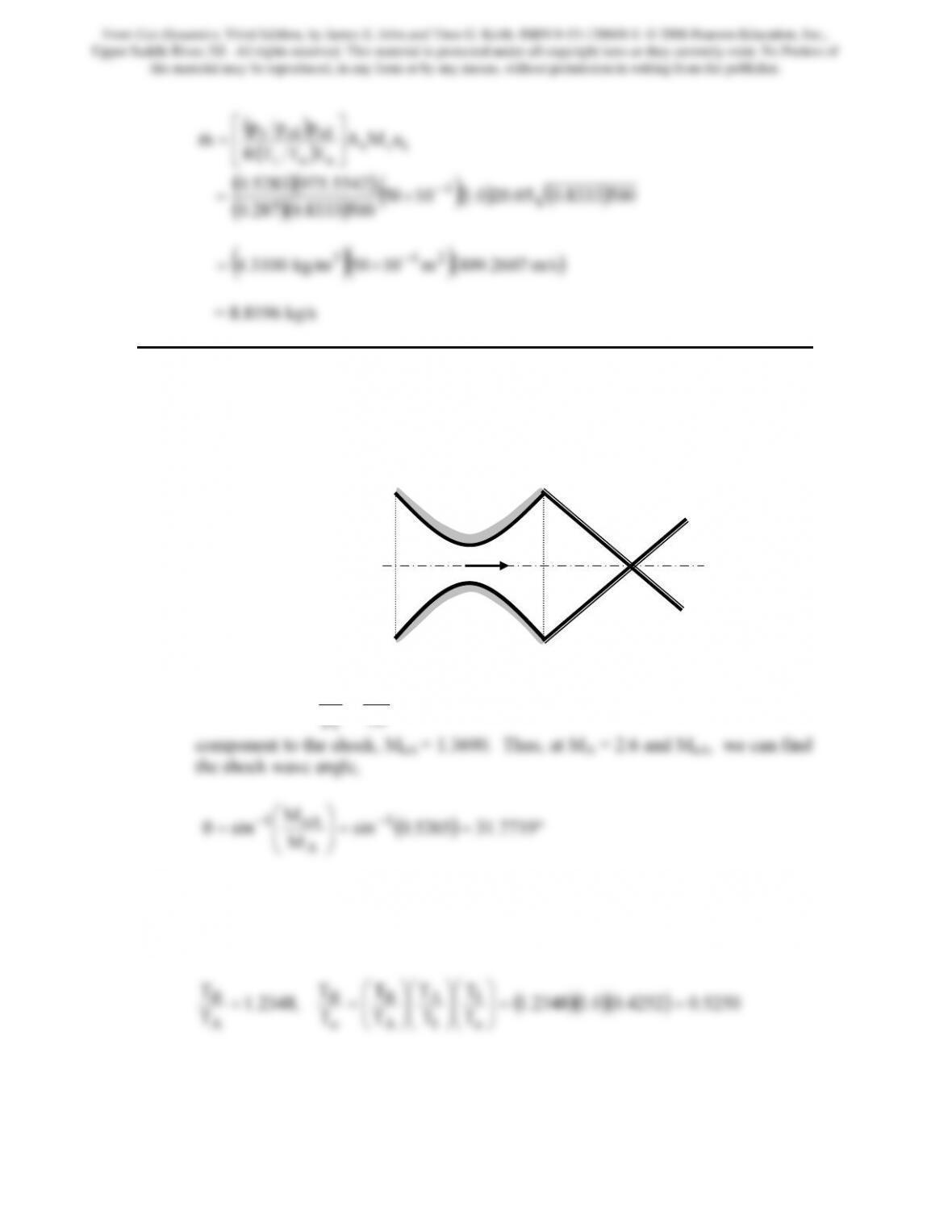
Problem 9. – A supersonic flow leaves a two-dimensional nozzle in parallel, horizontal
flow (region A) with a Mach number of 2.6 and static pressure (in region A) of 50 kPa.
The pressure of the atmosphere into which the jet discharges is 101 kPa. Find the
pressures in regions B and C of Figure P6.9.
Figure P6.9
0200.2
50
101
p
p
kPa,101p
2
2=== . At this pressure ratio we can find the normal
()
°==
⎟
⎟
⎠
⎜
⎜
⎝
=θ −− 7719.315265.0sin
M
sin 1
A
°
=
δ
→°=θ= 0346.117719.31 ,6.2M1 So second shock must turn flow back
by 11.0346°. With the flow angles and MA, the temperature ratio across the shock
is found to be
T
T
T
T
T
o
1
A
o
A
⎟
⎠
⎜
⎝
⎟
⎠
⎜
⎝
⎟
⎠
⎜
⎝
Using this value with the isentropic flow relations gives
A B C
From Gas Dynamics, Third Edition, by James E. John and Theo G. Keith. ISBN 0-13-120668-0. © 2006 Pearson Education, Inc.,
Upper Saddle River, NJ. All rights reserved. This material is protected under all copyright laws as they currently exist. No Portion of
this material may be reproduced, in any form or by any means, without permission in writing from the publisher.
116
()
kPa7188.1851018388.1p so8388.1
p
C
B
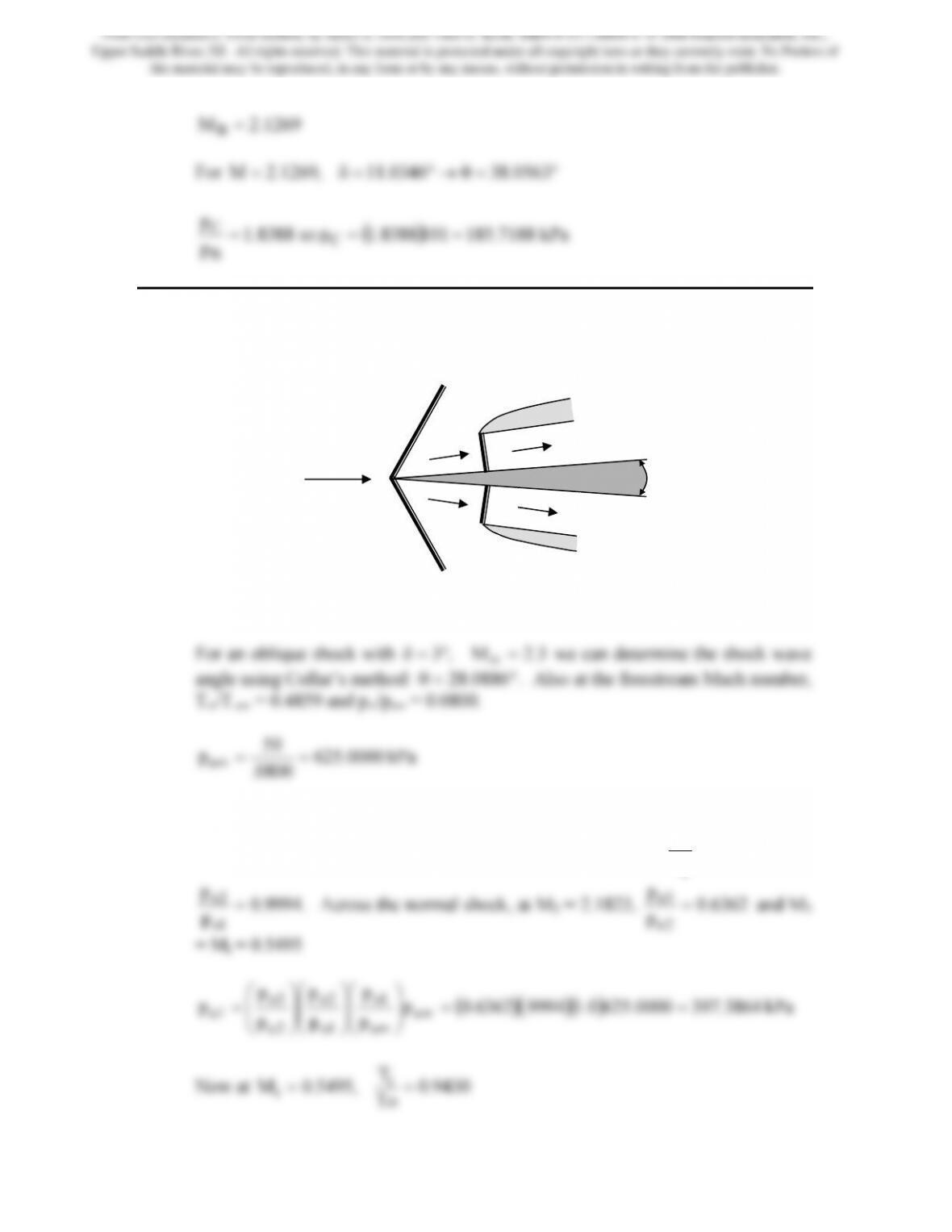
Problem 10. – For the two-dimensional diffuser shown in Figure P6.10, find Vi and poi,
Figure P6.10
0800.
There is enough information to determine the Mach number downstream of the
shock M2 = 2.1823 as well as several other ratios, viz., 0540.1
T
T
1
2=and
p
2o = Across the normal shock, at M2 = 2.1823, 6362.0
p
3o = and M3
To
6º
Vi, poi
Vi, poi
M∞ = 2.3
p∞ = 50 kPa
T∞ = 0º C
From Gas Dynamics, Third Edition, by James E. John and Theo G. Keith. ISBN 0-13-120668-0. © 2006 Pearson Education, Inc.,
Upper Saddle River, NJ. All rights reserved. This material is protected under all copyright laws as they currently exist. No Portion of
this material may be reproduced, in any form or by any means, without permission in writing from the publisher.
117
Problem 11. – A two-dimensional supersonic inlet is to be designed to operate at Mach
2.4. Deceleration is to occur through a series of oblique shocks followed by a normal
shock, as shown in Figure 6.12. Determine the loss of stagnation pressure for the cases of
two, three, and four oblique shocks. Assume the wedge turning angles are each 6°.
Case I:
Two oblique shocks:
⎫
=
4.2M1
1589.2M
2
=
°=δ
6
9959.0
p
2o
3o
=
Normal Shock
M
3 = 1.9354, 7510.0
p
p
3o
4o =
()()()
7440.09948.09959.07510.0
p
p
p
p
1o
2o
3o
1o
Three oblique shocks:
°=δ
6
9966.0
p
3o
4o
=
Normal Shock
M
3 = 1.7240, 8457.0
p
p
4o
5o =
From Gas Dynamics, Third Edition, by James E. John and Theo G. Keith. ISBN 0-13-120668-0. © 2006 Pearson Education, Inc.,
Upper Saddle River, NJ. All rights reserved. This material is protected under all copyright laws as they currently exist. No Portion of
this material may be reproduced, in any form or by any means, without permission in writing from the publisher.