()
()()
2
11
1
1
1
1
1
13
p
2
γ
−γ++γ
⎟
⎟
⎠
⎞
⎜
⎜
⎝
⎛
+γ
−γ
+
⎞
⎛
−γ
⎞
⎛
−γ
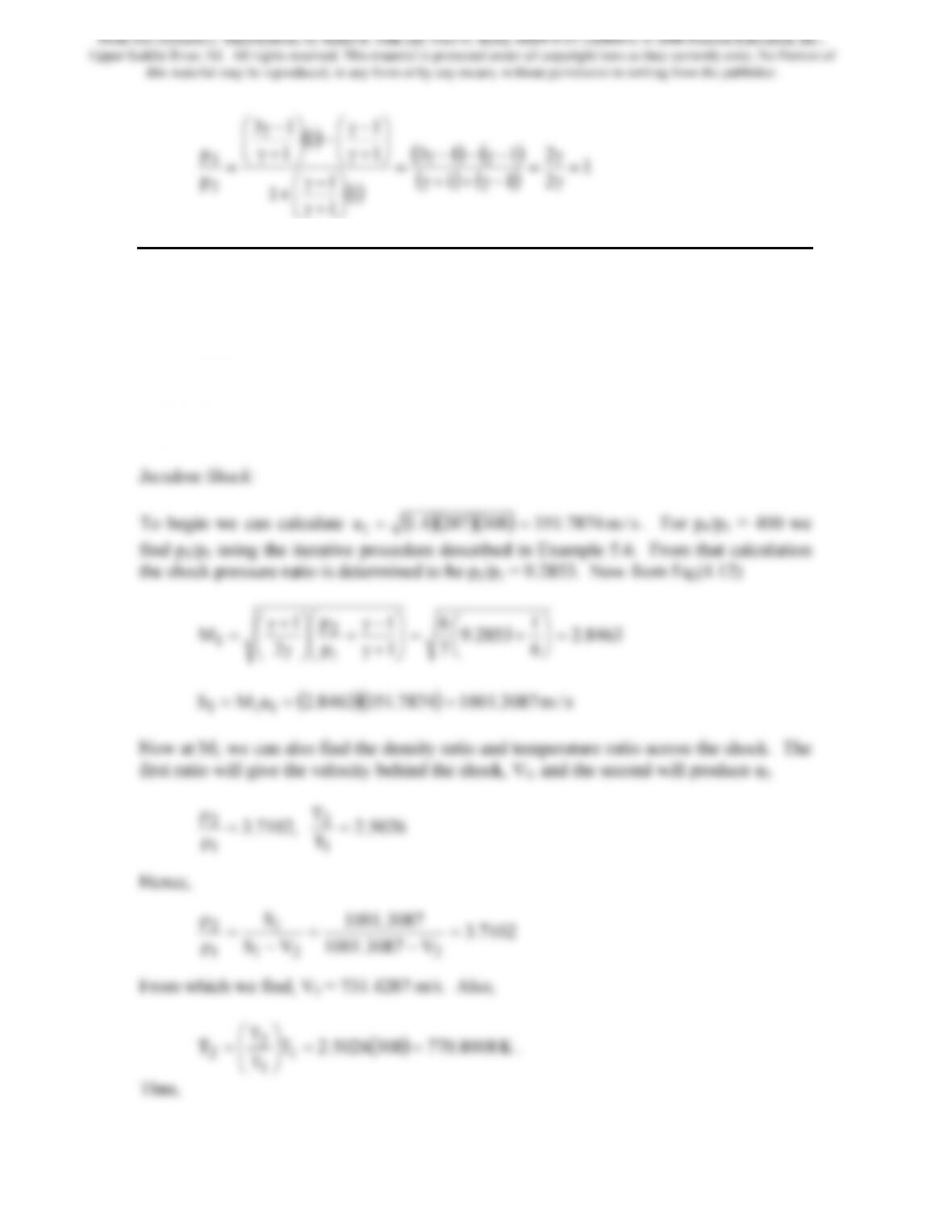
Problem 10. – A shock tube is to be used to subject an object to momentary conditions of
high pressure and temperature. To provide an adequate measuring time, the tube is to be
made long enough so that a period of 100 ms is provided between the time of passage
over the body of the initial shock and the time of passage of the shock reflected from the
closed end of the tube. The initial pressure ratio across the diaphragm is 400 to 1, with
the object located 3 m from the diaphragm. The initial temperature of the air (
γ
= 1.4, R =
287 J/kg·K) in the shock tube is 35°C. Determine a suitable length for the low-pressure
end of the tube.
From Gas Dynamics, Third Edition, by James E. John and Theo G. Keith. ISBN 0-13-120668-0. © 2006 Pearson Education, Inc.,
Upper Saddle River, NJ. All rights reserved. This material is protected under all copyright laws as they currently exist. No Portion of
this material may be reproduced, in any form or by any means, without permission in writing from the publisher.
From Gas Dynamics, Third Edition, by James E. John and Theo G. Keith. ISBN 0-13-120668-0. © 2006 Pearson Education, Inc.,
Upper Saddle River, NJ. All rights reserved. This material is protected under all copyright laws as they currently exist. No Portion of
this material may be reproduced, in any form or by any means, without permission in writing from the publisher.
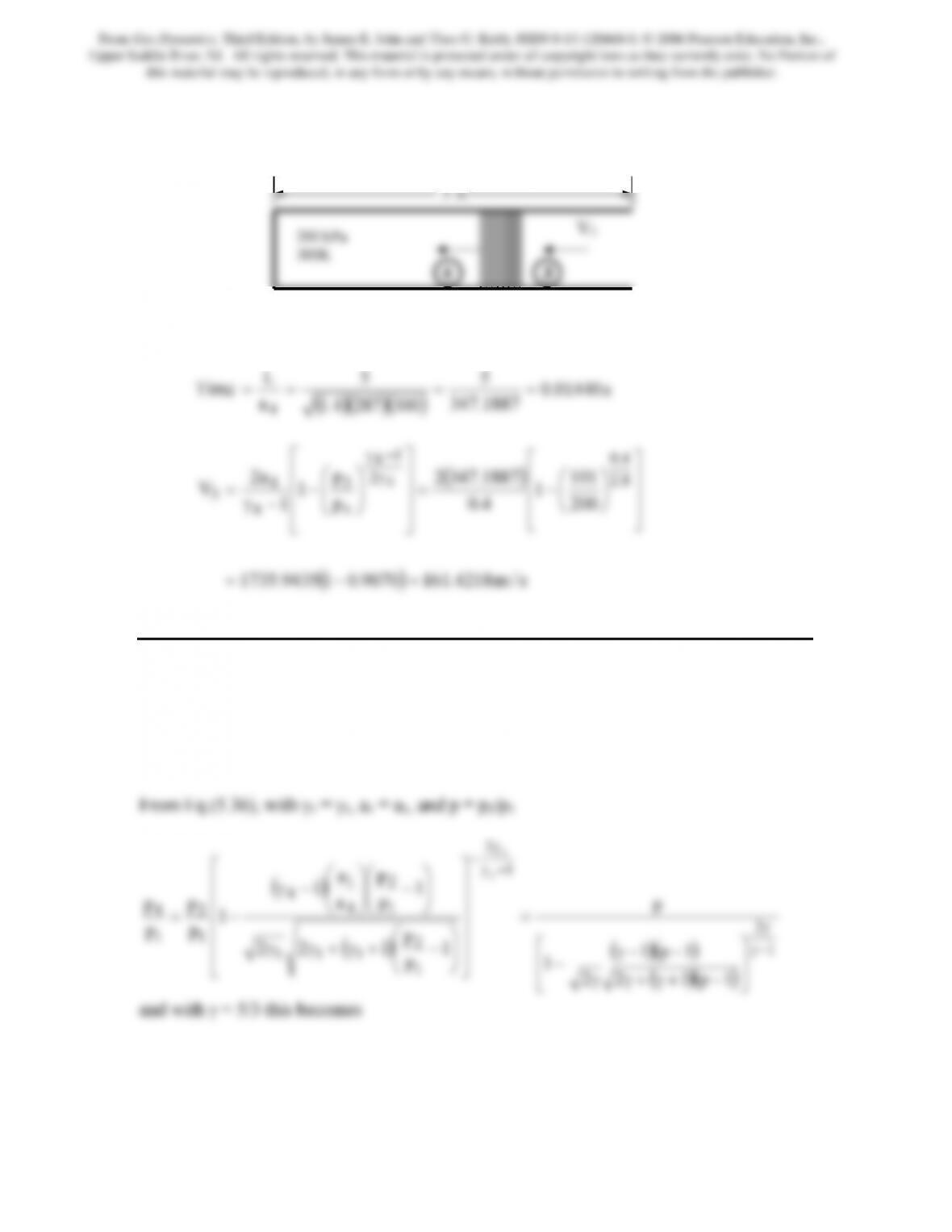
the first expansion wave to reach the closed end of the tube and the velocity of the air
behind the expansion waves.
Figure P5.11
5
5
L
()
s/m4218.1619070.019435.1735
=−=
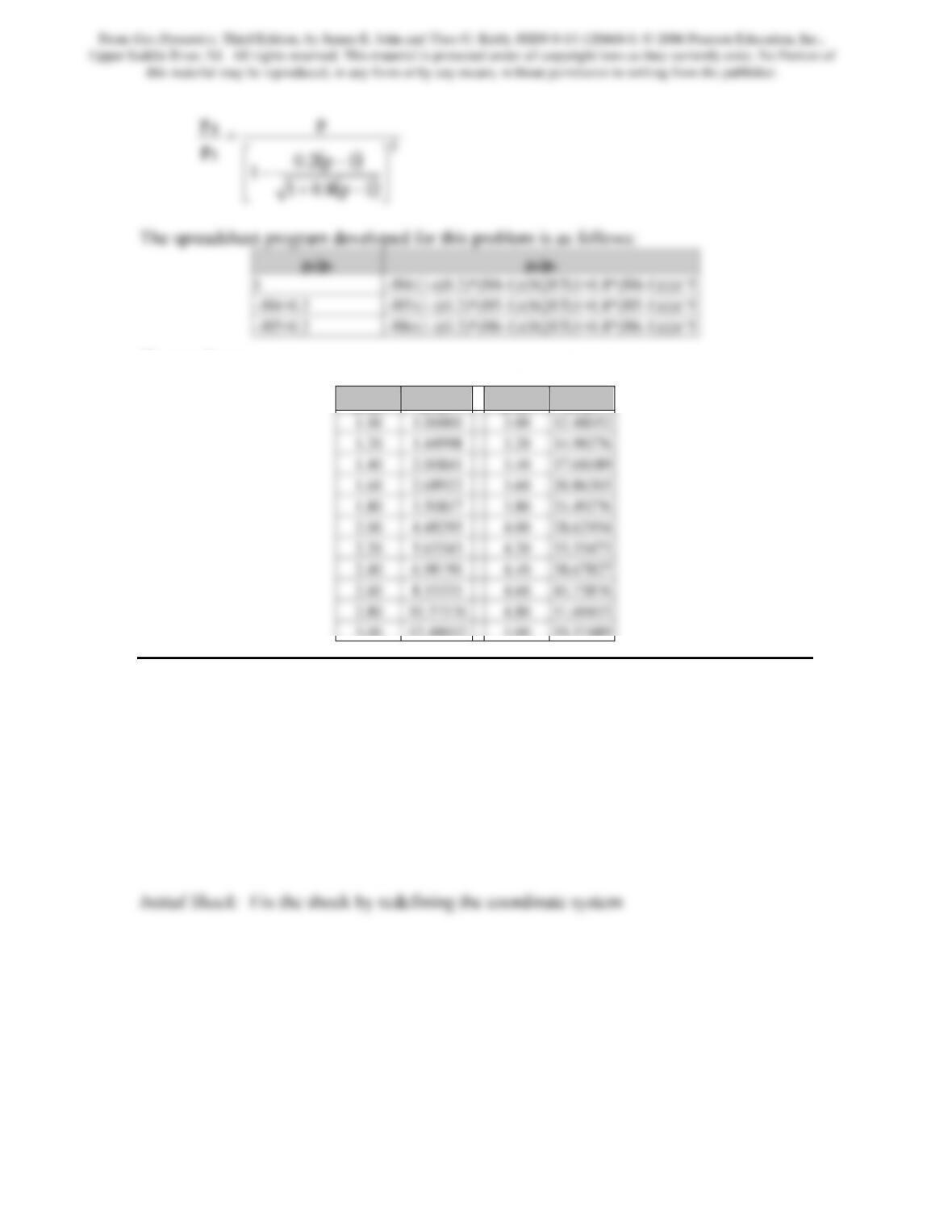
Problem 12. – Write a computer program that will yield values of the diaphragm pressure
ratio for given values of the shock pressure ratio for a shock tube with helium (γ = 5/3)
with the same temperature on both sides of the diaphragm. Determine values of
diaphragm pressure ratio for shock pressure ratios from 1.0 to 5.0, using increments of
0.2.
1
2
2
1
p
a
4
4
−γ
γ
−
⎤
⎡
⎞
⎛−
⎞
⎛
From Gas Dynamics, Third Edition, by James E. John and Theo G. Keith. ISBN 0-13-120668-0. © 2006 Pearson Education, Inc.,
Upper Saddle River, NJ. All rights reserved. This material is protected under all copyright laws as they currently exist. No Portion of
this material may be reproduced, in any form or by any means, without permission in writing from the publisher.
97
5
1
4
p
p
p
=
The results are
p2/p1 p4/p1 p2/p1 p4/p1
3.00 12.48052 5.00 59.37489
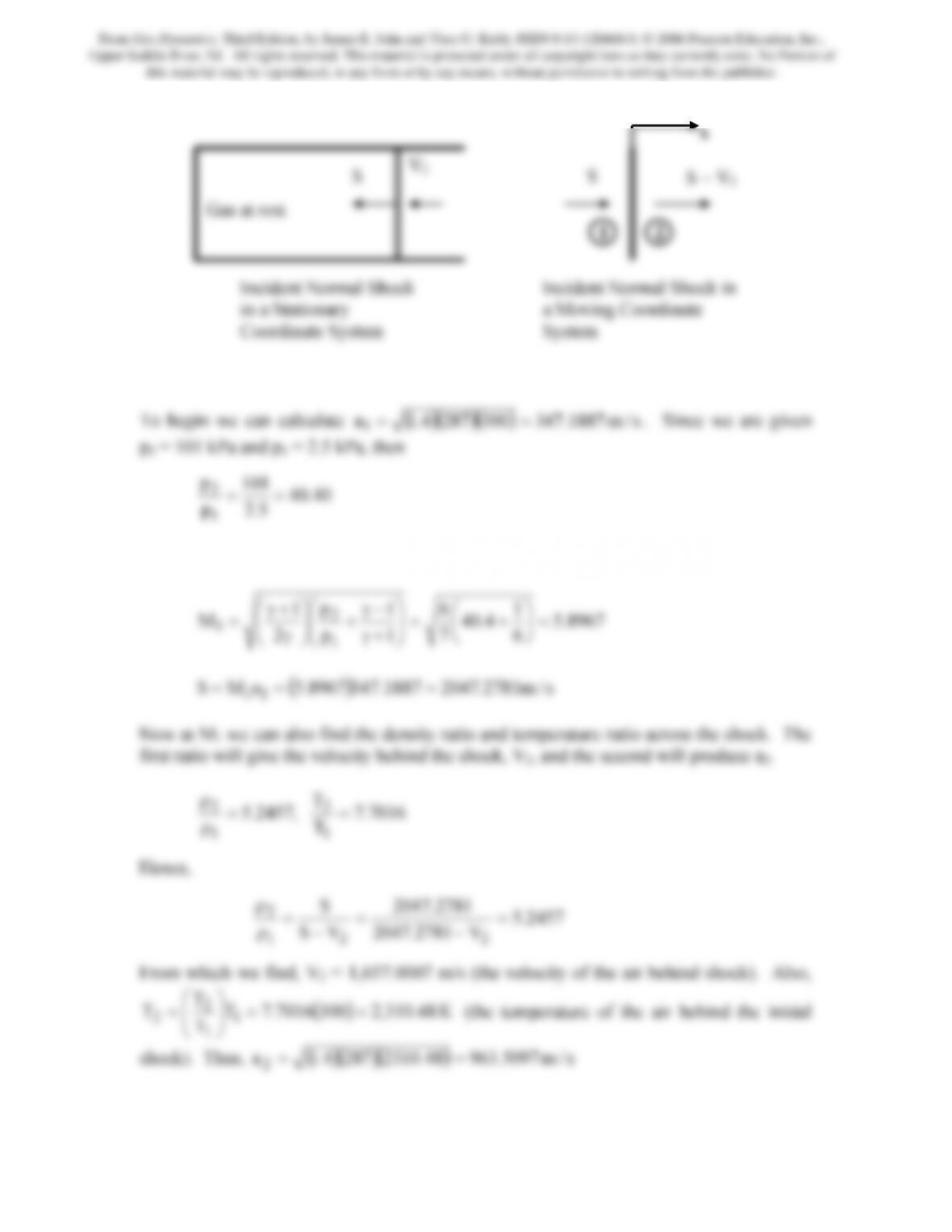
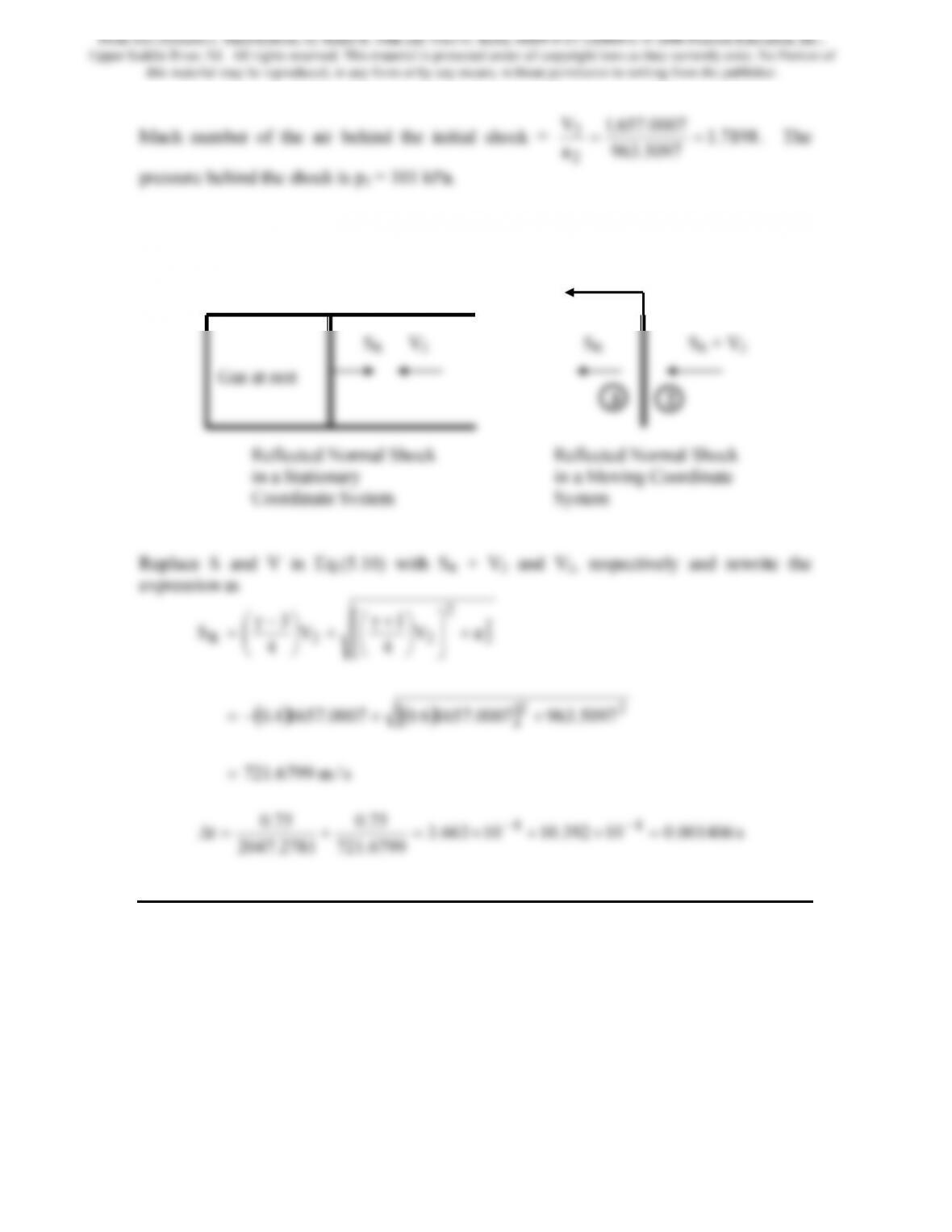
Problem 13. – A circular tube of length 1.5 m is evacuated to a pressure of 2.5 kPa, with
the ambient pressure at 101 kPa. A diaphragm at the end of the tube is ruptured, which
causes a normal shock to move down the tube. Determine the velocity of the initial shock
that moves down the tube, the velocity and Mach number of the air (γ = 1.4, R = 287
J/kg·K) behind the shock, and the velocity of the shock that reflects from the closed end.
Initial air temperature before diaphragm rupture is 300 K. A test object is located midway
along the tube. Determine the time that this object is subjected to the pressure and
temperature conditions behind the initial shock (before arrival of the reflected shock).
Find the static pressure and temperature behind the initial shock.
From Gas Dynamics, Third Edition, by James E. John and Theo G. Keith. ISBN 0-13-120668-0. © 2006 Pearson Education, Inc.,
Upper Saddle River, NJ. All rights reserved. This material is protected under all copyright laws as they currently exist. No Portion of
this material may be reproduced, in any form or by any means, without permission in writing from the publisher.
40.40
5.2
p
1
From Eq,(4.12)
From Gas Dynamics, Third Edition, by James E. John and Theo G. Keith. ISBN 0-13-120668-0. © 2006 Pearson Education, Inc.,
Upper Saddle River, NJ. All rights reserved. This material is protected under all copyright laws as they currently exist. No Portion of
this material may be reproduced, in any form or by any means, without permission in writing from the publisher.
0007.657,1
V
2== . The
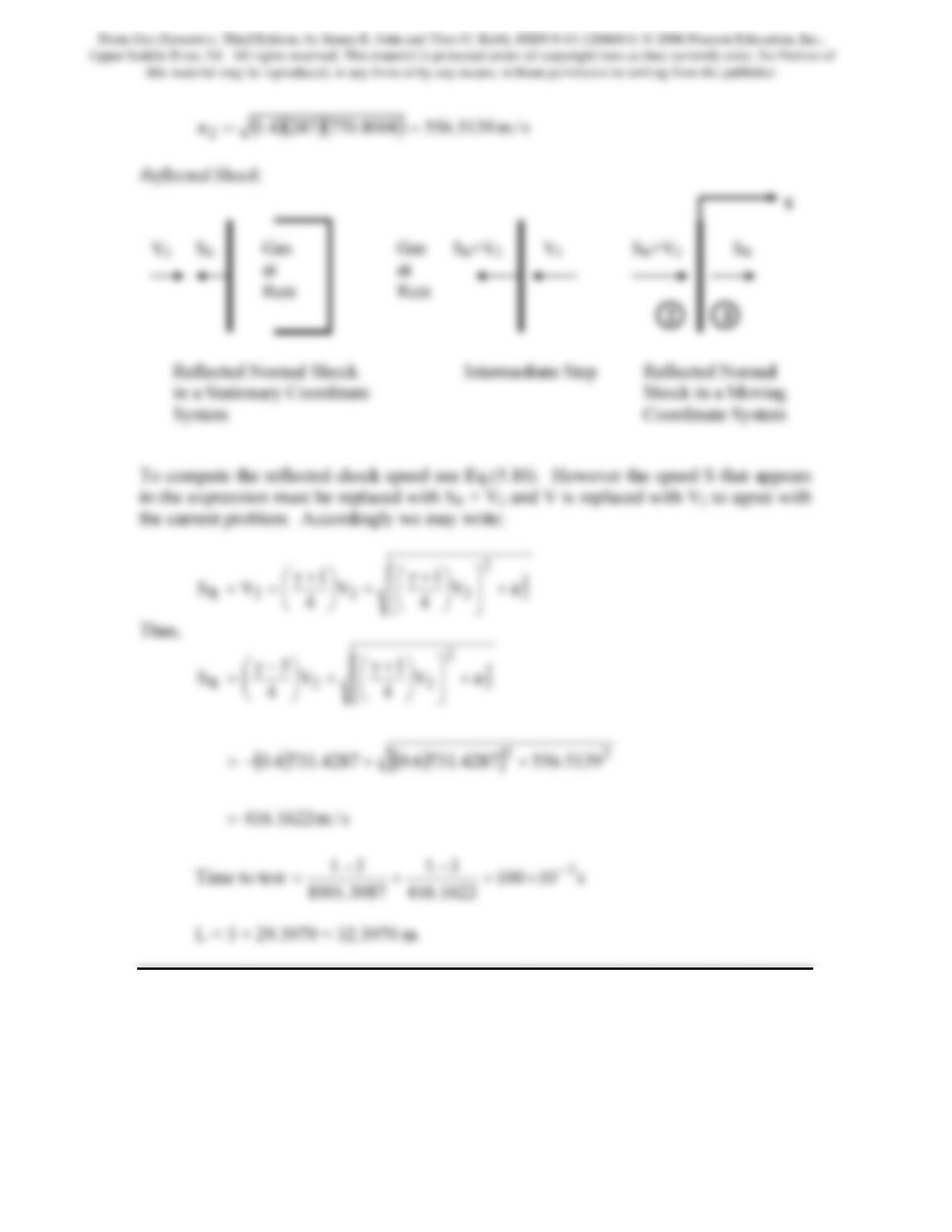
Reflected Shock: Define a moving coordinate system for the reflected wave as usual.
x
From Gas Dynamics, Third Edition, by James E. John and Theo G. Keith. ISBN 0-13-120668-0. © 2006 Pearson Education, Inc.,
Upper Saddle River, NJ. All rights reserved. This material is protected under all copyright laws as they currently exist. No Portion of
this material may be reproduced, in any form or by any means, without permission in writing from the publisher.
()( )
(
)
s/m0295.3462982874.1RTa 11 ==γ=
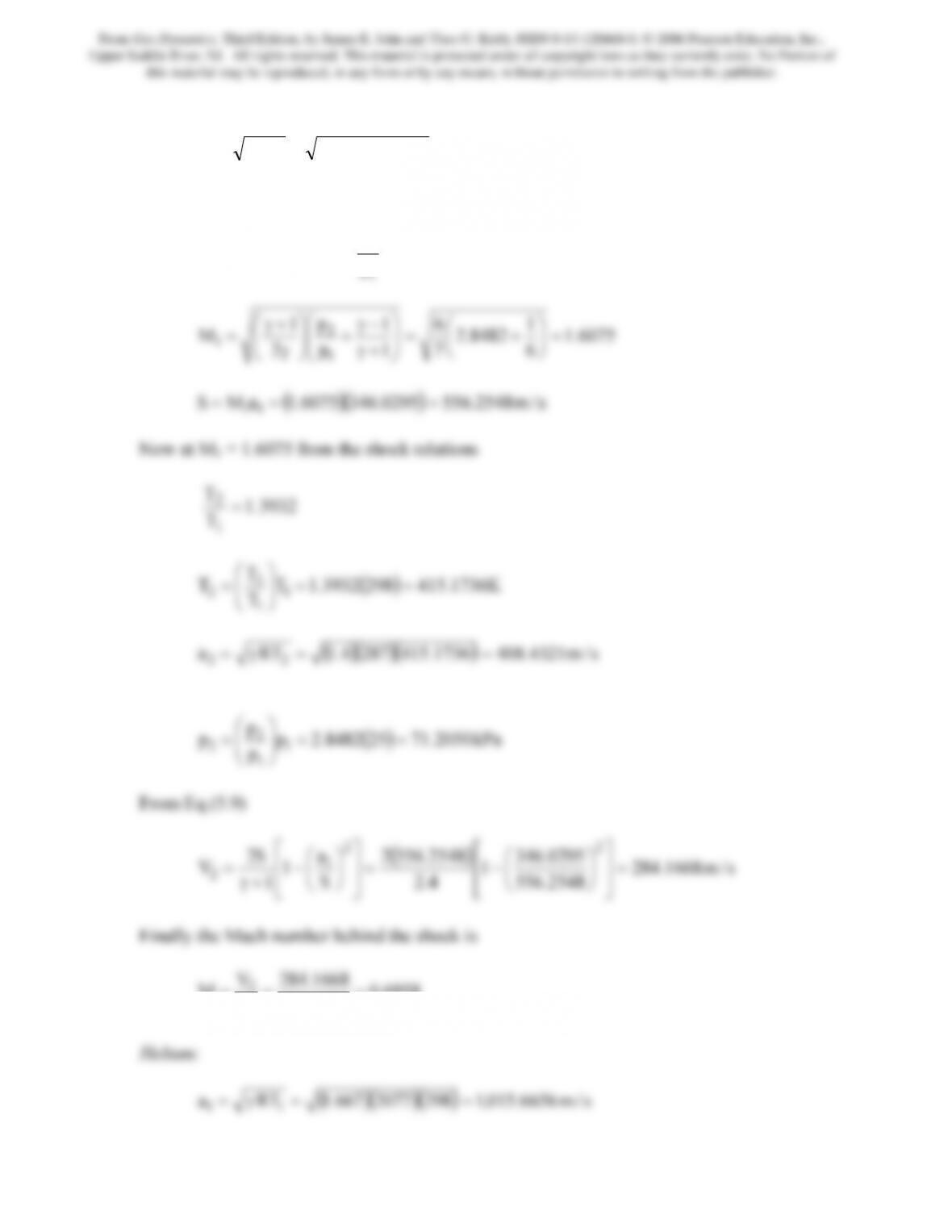
Using the iterative procedure described in Example problem 5.6 for p4/p1 = 10 and γ =1.4,
we find :
shock pressure ratio: 8482.2
p
p
2= from which
(
From Gas Dynamics, Third Edition, by James E. John and Theo G. Keith. ISBN 0-13-120668-0. © 2006 Pearson Education, Inc.,
Upper Saddle River, NJ. All rights reserved. This material is protected under all copyright laws as they currently exist. No Portion of
this material may be reproduced, in any form or by any means, without permission in writing from the publisher.
101
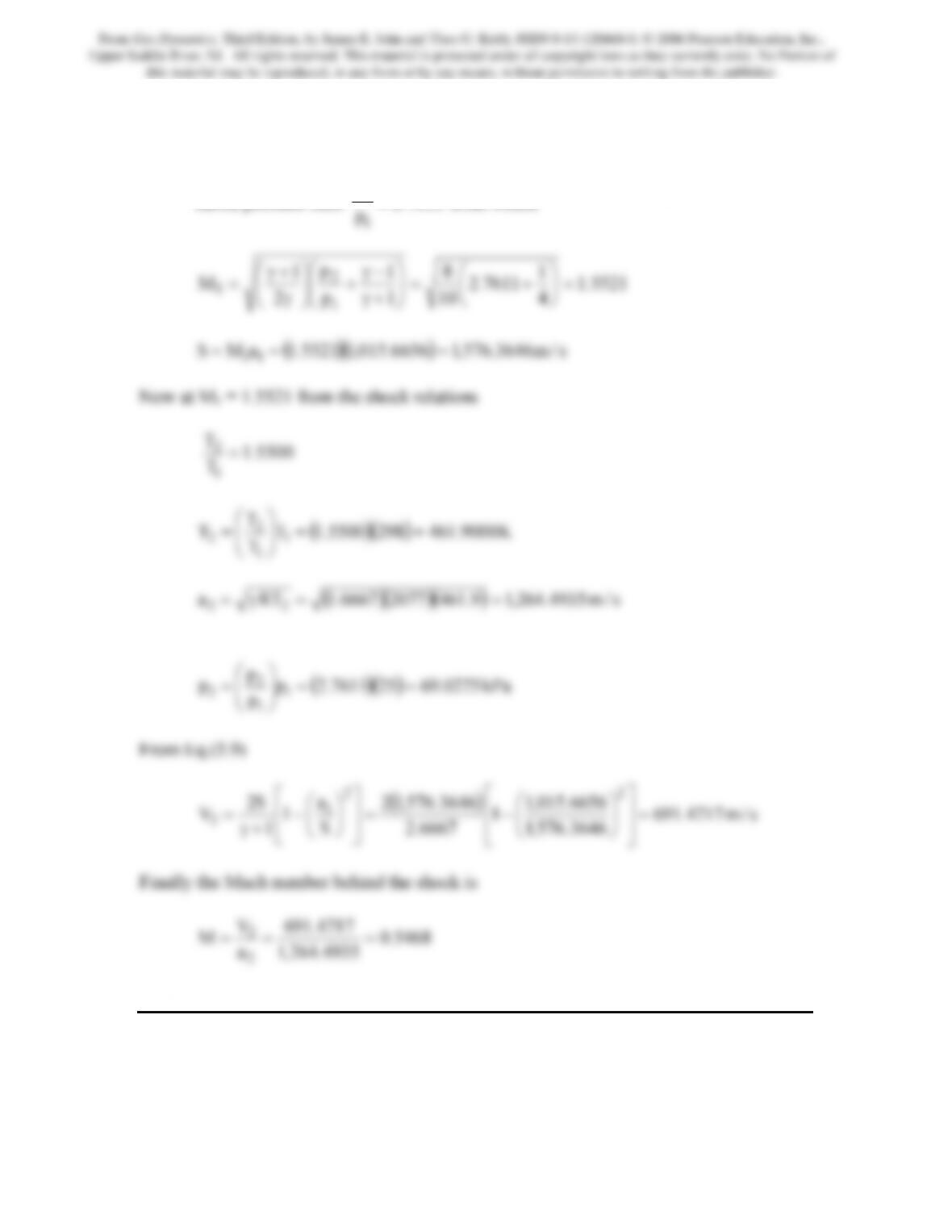
Using the iterative procedure described in Example problem 5.6 for p4/p1 = 10 and
γ =5/3, we find :
shock pressure ratio 7611.2
p
2= from which
5468.0
4935.264,1
a
M
2
Problem 15. – A normal shock moves down an open-ended tube with a velocity of
1,000 m/s (Figure P5.15). The ambient air (γ = 1.4, R = 287 J/kg·K) pressure and
temperature are 101 kPa and 25°C, respectively. Determine the velocity of the first and
From Gas Dynamics, Third Edition, by James E. John and Theo G. Keith. ISBN 0-13-120668-0. © 2006 Pearson Education, Inc.,
Upper Saddle River, NJ. All rights reserved. This material is protected under all copyright laws as they currently exist. No Portion of
this material may be reproduced, in any form or by any means, without permission in writing from the publisher.
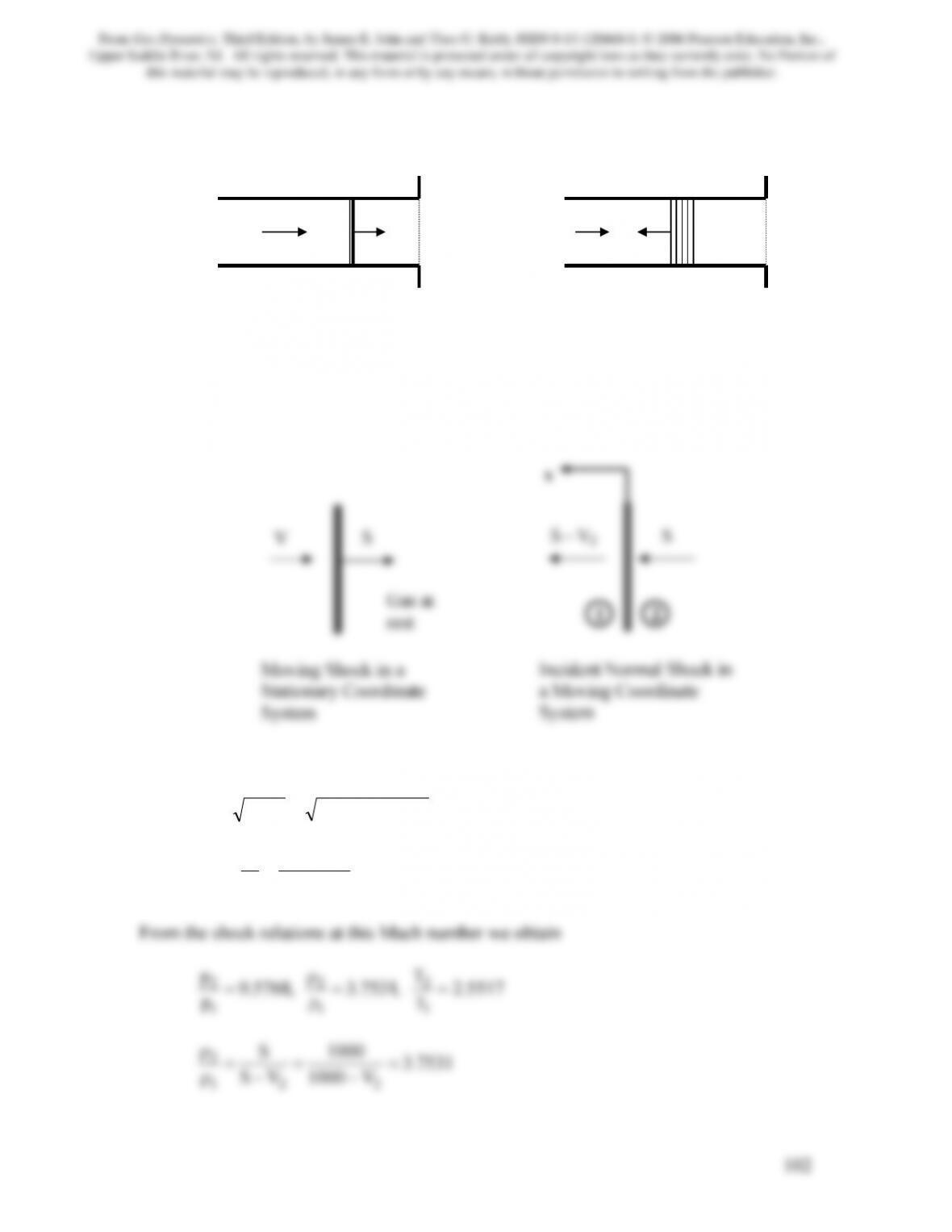
last expansion waves that move down the tube after reflection of the shock from the open
end.
Figure P5.15
Shock: Fix the moving shock by defining a moving coordinate system
Incident Normal Shock on Open
End of Tube
Reflected Expansion Waves
Ambient
Air
From Gas Dynamics, Third Edition, by James E. John and Theo G. Keith. ISBN 0-13-120668-0. © 2006 Pearson Education, Inc.,
Upper Saddle River, NJ. All rights reserved. This material is protected under all copyright laws as they currently exist. No Portion of
this material may be reproduced, in any form or by any means, without permission in writing from the publisher.
103
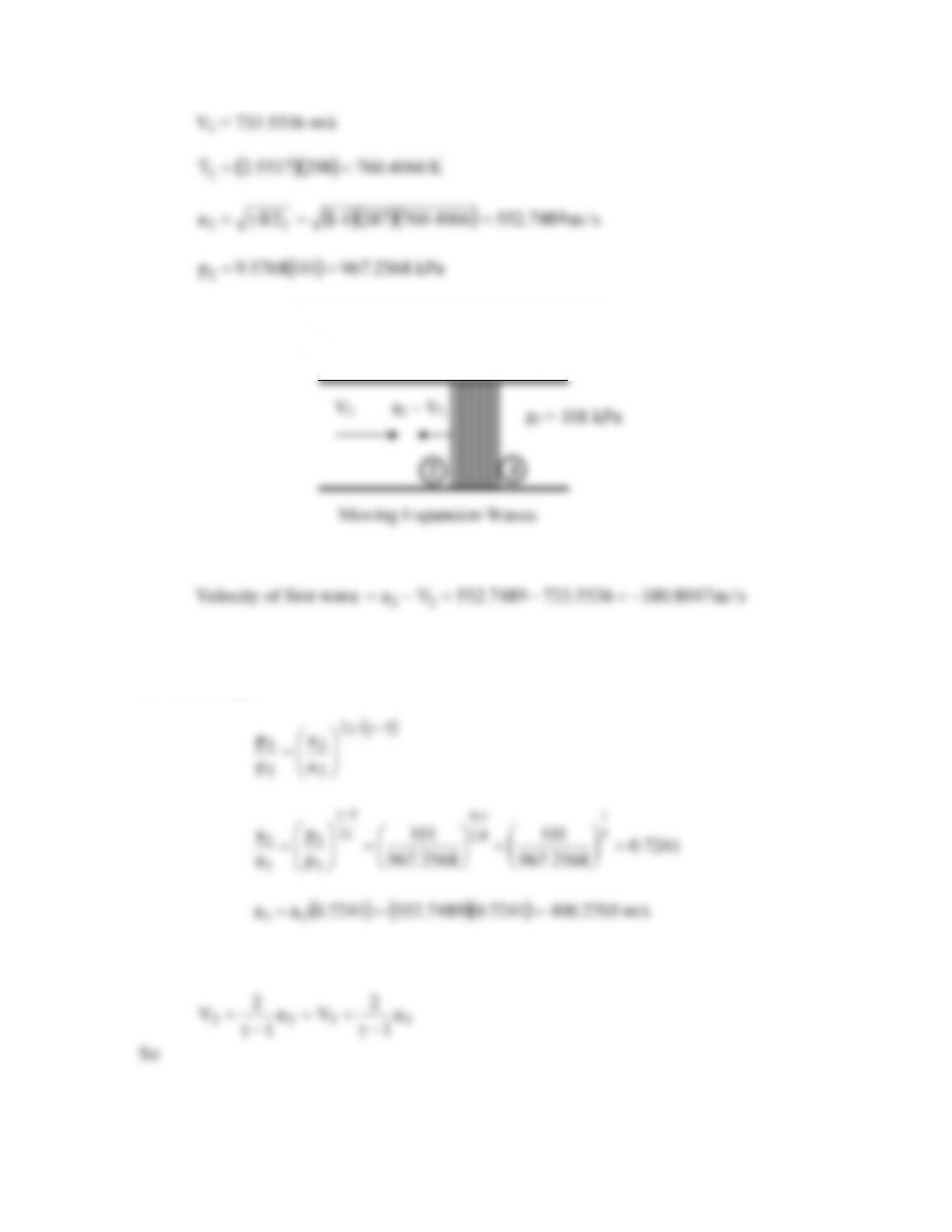
Expansion Waves:
The minus sign means that it is moving to the right, i.e., because V2 exceeds the speed of
sound, the disturbance is unable to move upstream. Because the flow in the expansion
fan is isentropic
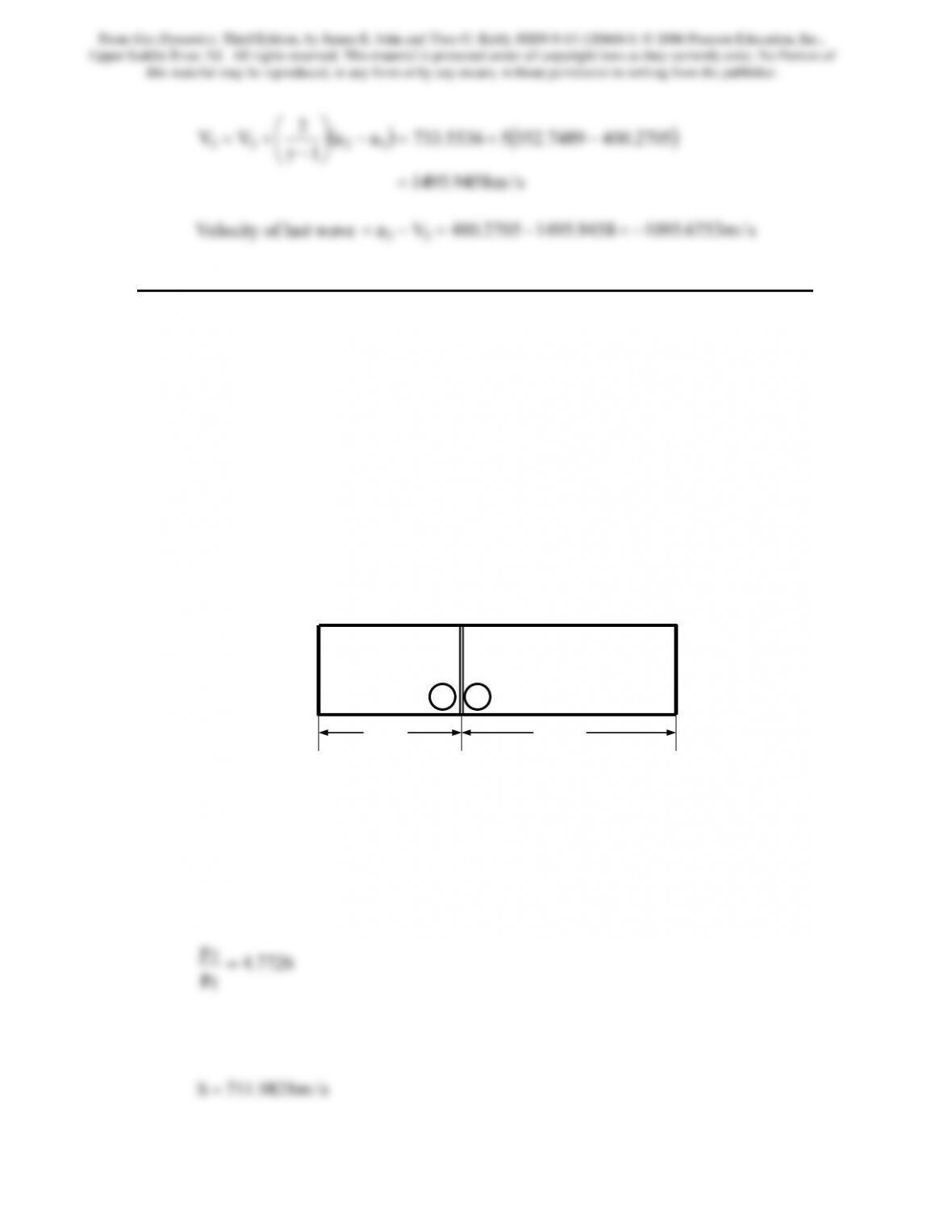
Now for a left running wave,
2
2
From Gas Dynamics, Third Edition, by James E. John and Theo G. Keith. ISBN 0-13-120668-0. © 2006 Pearson Education, Inc.,
Upper Saddle River, NJ. All rights reserved. This material is protected under all copyright laws as they currently exist. No Portion of
this material may be reproduced, in any form or by any means, without permission in writing from the publisher.
104
2
⎞
⎛
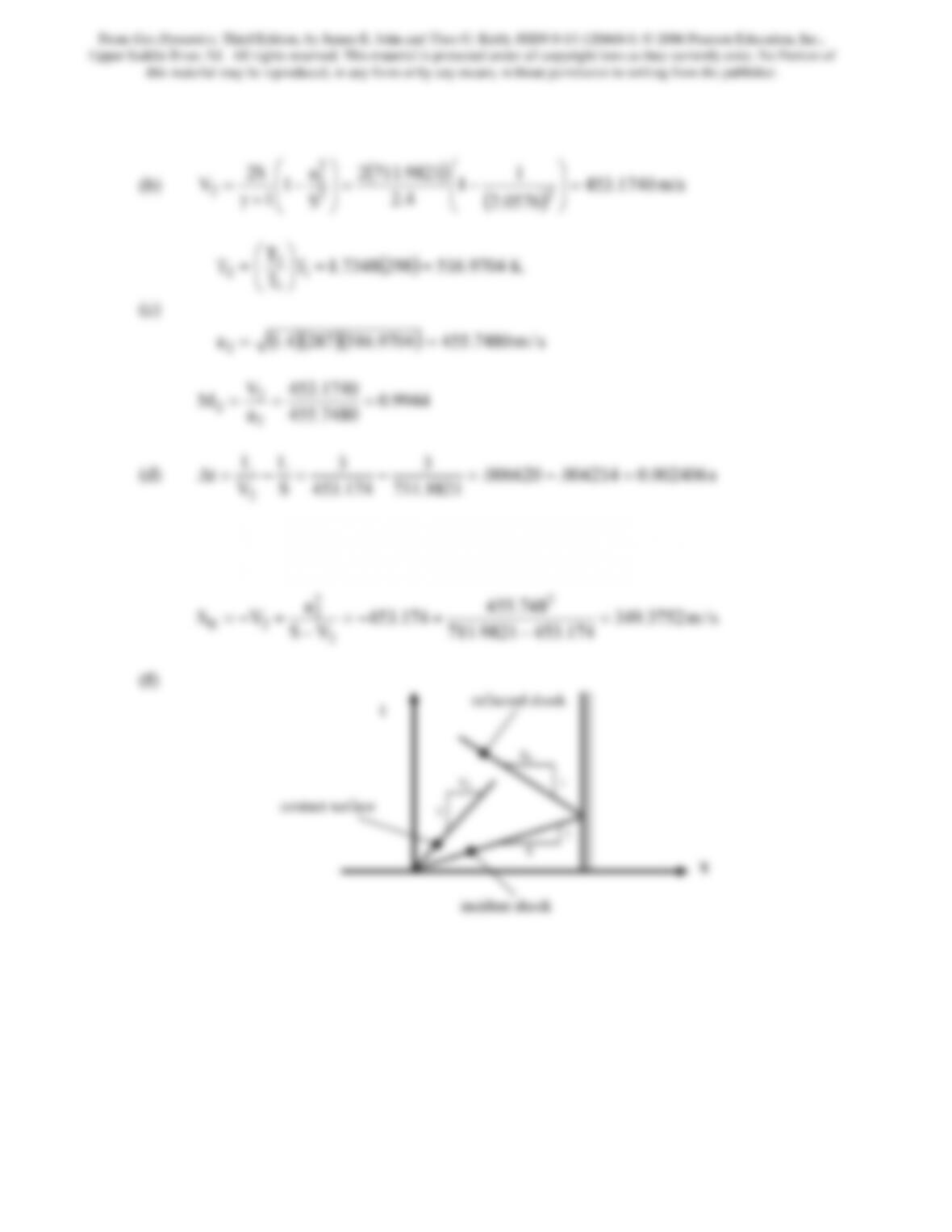
Problem 16. – A shock tube is 10 m long with a 30-cm diameter. The high-pressure
section is 4 m long and contains air (γ = 1.4, R = 287 J/kg·K) at 200 kPa; the low-
pressure section is 6 m long and contains air at 5 kPa. A test object is placed in the low-
pressure section, 3 m from the diaphragm. Both sections initially contain air at 25°C. The
diaphragm is suddenly ruptured, which causes a shock to move into the low-pressure
section. Determine the following:
(a) Shock velocity
(b) Contact surface velocity
(c) Mach number of air behind shock
(d) Time between passage of normal shock and contact surface over test object
(e) Reflected shock velocity
(f) Sketch a x-t diagram showing the initial shock, reflected shock, and contact
surface as functions of time.
(a) For a diaphragm pressure ratio = 40, we may use the method described in Example
5.6 to find that the shock pressure ratio is,
7726.4
p
p
1
2=
With this pressure ratio and the speed of sound in Zone 1, (a1 = 346.0295 m/s), we can
find the shock speed from Eq. (5.8)
4 1
p = 200 kPa p = 5 kPa
4 m 6 m
From Gas Dynamics, Third Edition, by James E. John and Theo G. Keith. ISBN 0-13-120668-0. © 2006 Pearson Education, Inc.,
Upper Saddle River, NJ. All rights reserved. This material is protected under all copyright laws as they currently exist. No Portion of
this material may be reproduced, in any form or by any means, without permission in writing from the publisher.
()
1
9821.7112
a
S2
2
1
⎞
⎛−=
⎞
⎛−
9821.711
174.453
S
V
2
(e) From Eq.(5.21)
748.455
a
2
2
2
From Gas Dynamics, Third Edition, by James E. John and Theo G. Keith. ISBN 0-13-120668-0. © 2006 Pearson Education, Inc.,
Upper Saddle River, NJ. All rights reserved. This material is protected under all copyright laws as they currently exist. No Portion of
this material may be reproduced, in any form or by any means, without permission in writing from the publisher.