C
Ch
ha
ap
pt
te
er
r
F
Fi
iv
ve
e
M
MO
OV
VI
IN
NG
G
N
NO
OR
RM
MA
AL
L
S
SH
HO
OC
CK
K
W
WA
AV
VE
ES
S
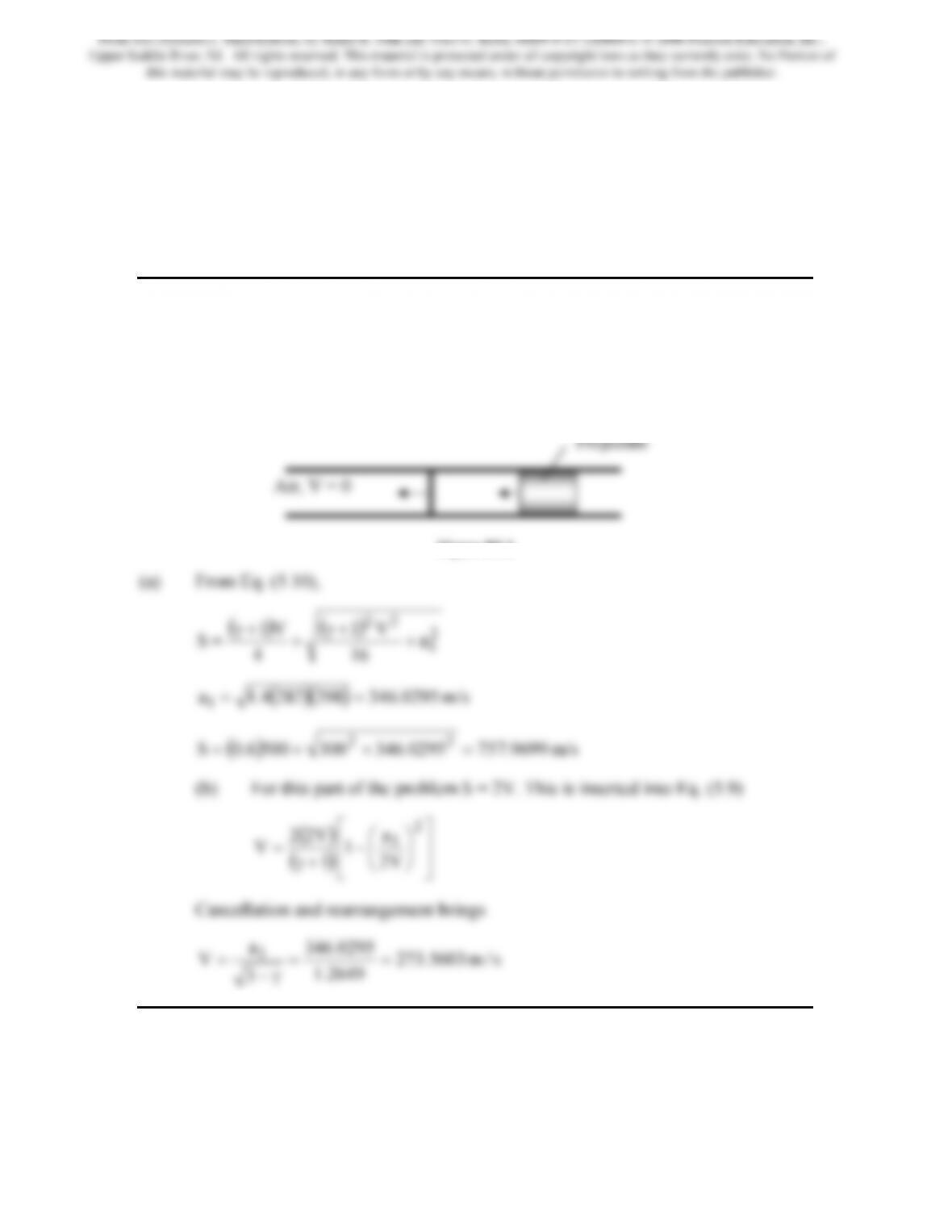
Problem 1. – A projectile moves down a gun barrel with a velocity of 500 m/s (Figure
P5.1). (a) Calculate the velocity of the normal shock that would precede the projectile.
Assume the pressure in the undisturbed air (γ = 1.4, R = 287 J/kg·K) to be 101 kPa and
the temperature to be 25°C. (b) How fast would the projectile have to be moving in order
for the shock velocity to be two times the projectile velocity?
From Gas Dynamics, Third Edition, by James E. John and Theo G. Keith. ISBN 0-13-120668-0. © 2006 Pearson Education, Inc.,
Upper Saddle River, NJ. All rights reserved. This material is protected under all copyright laws as they currently exist. No Portion of
this material may be reproduced, in any form or by any means, without permission in writing from the publisher.
(c) the stagnation temperature behind the wave
1124.551
a
2
2
12o =
⎥
⎦
⎢
⎣
⎠
⎝
⎥
⎦
⎢
⎣
⎟
⎠
⎜
⎝
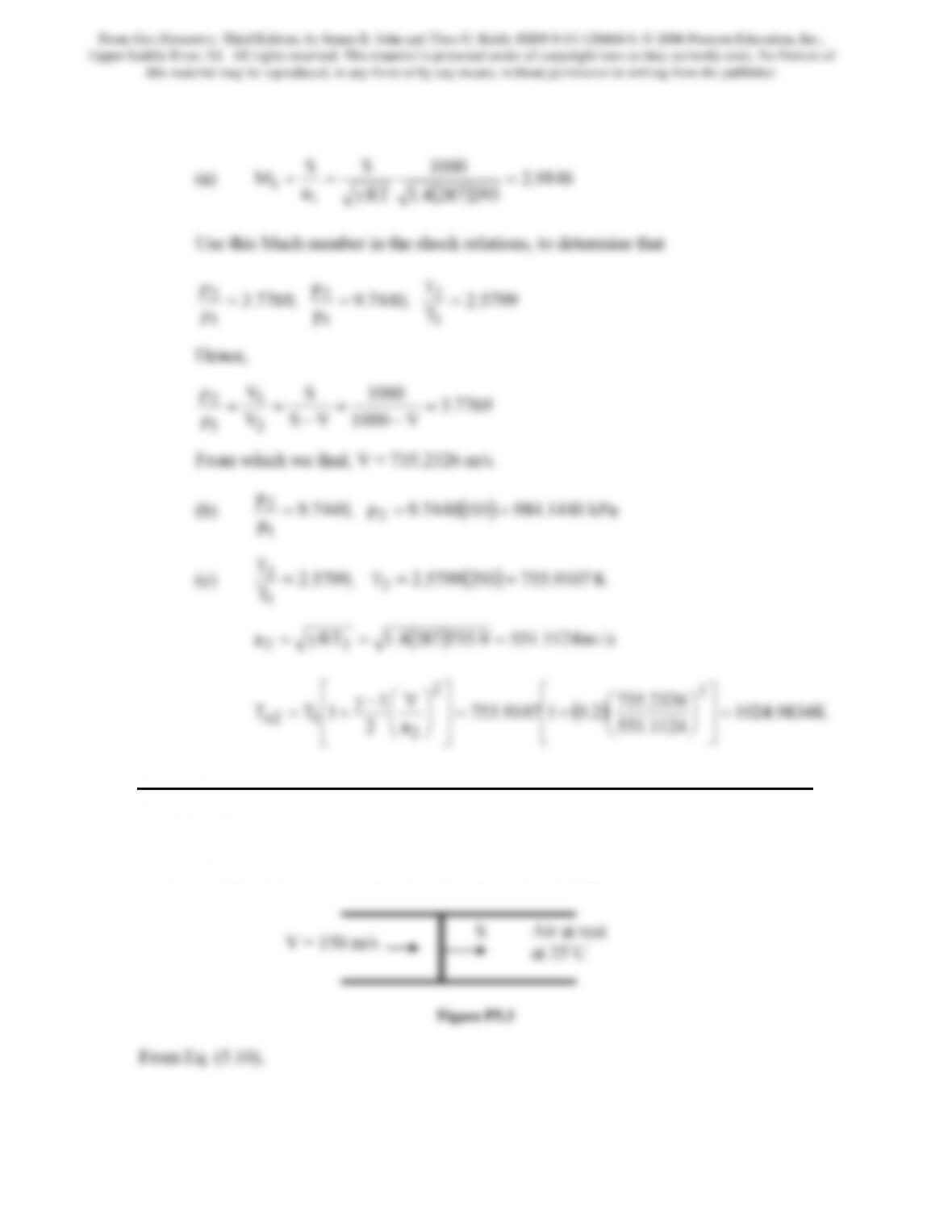
Problem 3. – A normal shock is observed to move through a constant-area tube into air
(γ = 1.4, R = 287 J/kg·K) at rest at 25°C (Figure P5.3). The velocity of the air behind the
wave is measured to be 150 m/s. Calculate the shock velocity.
From Gas Dynamics, Third Edition, by James E. John and Theo G. Keith. ISBN 0-13-120668-0. © 2006 Pearson Education, Inc.,
Upper Saddle River, NJ. All rights reserved. This material is protected under all copyright laws as they currently exist. No Portion of
this material may be reproduced, in any form or by any means, without permission in writing from the publisher.
2
2
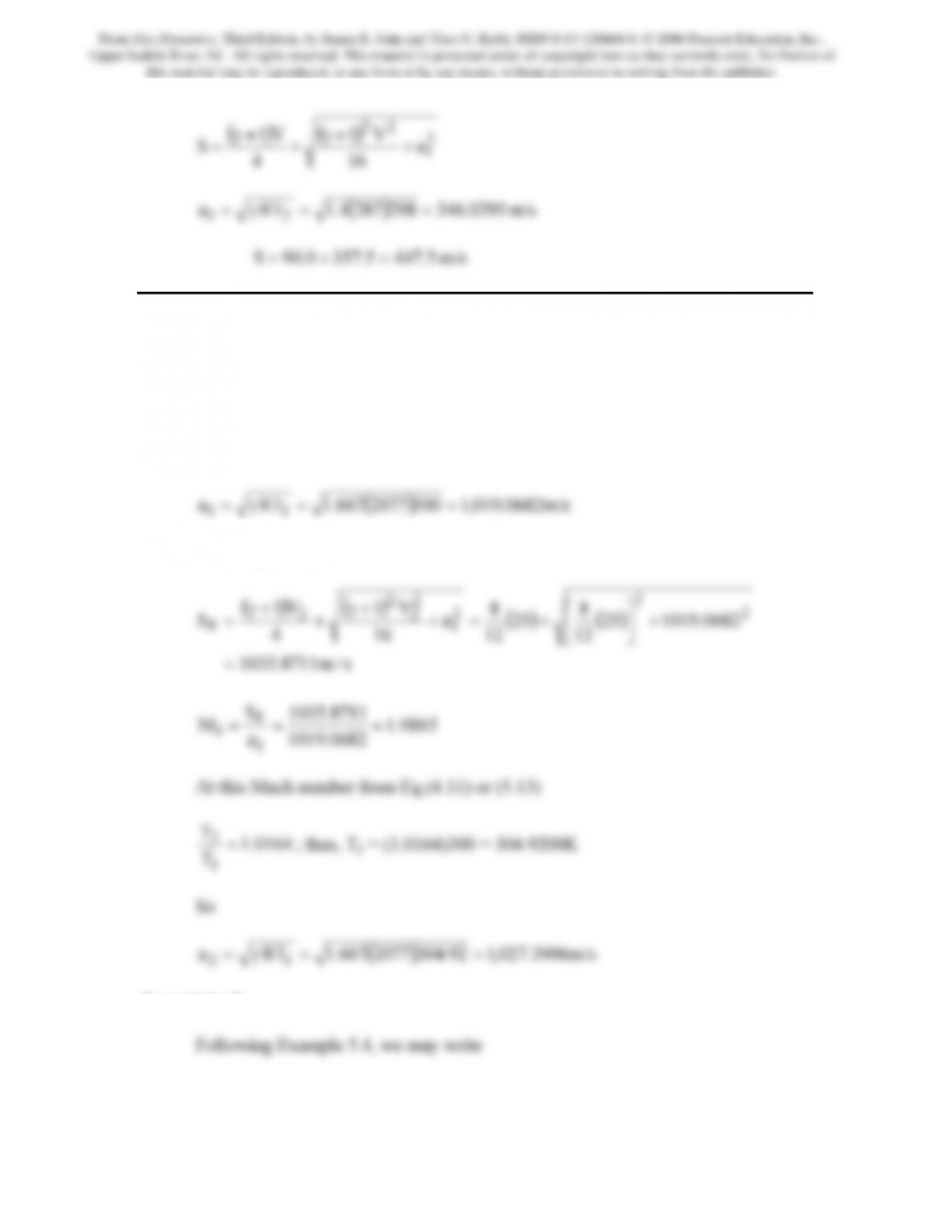
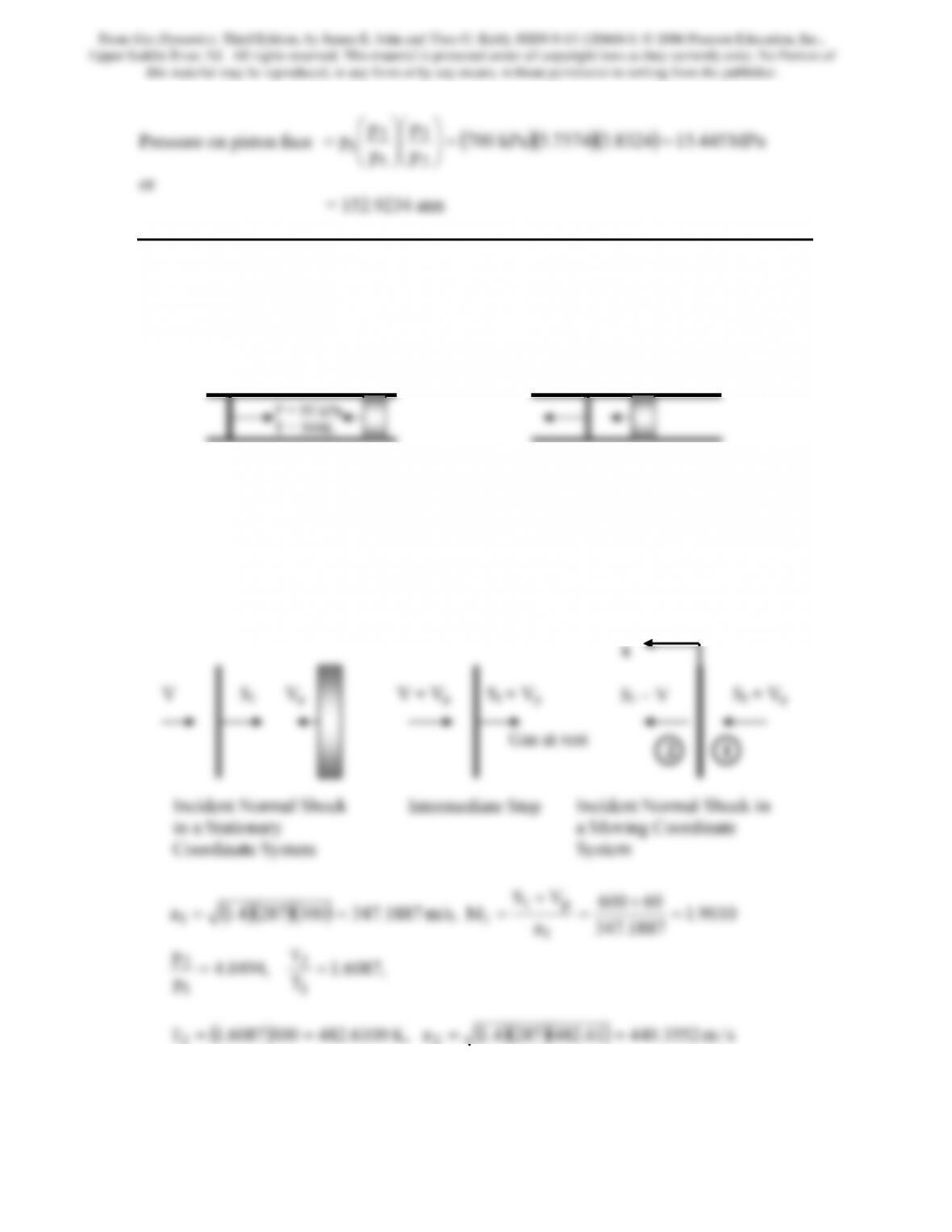
Problem 4. – A piston in a tube is suddenly accelerated to a velocity of 25 m/s causing a
normal shock to move into helium (γ = 5/3, R = 2077 J/kg·K) at rest in the tube and at a
temperature of 27 C in the tube. One second later, the piston is suddenly accelerated from
25 to 50 m/s causing a second shock to move down the tube. How much time will elapse
from the initial acceleration of the piston to the intersection of the two shocks?
First shock:
From Eq. (5.10)
Second shock:
From Gas Dynamics, Third Edition, by James E. John and Theo G. Keith. ISBN 0-13-120668-0. © 2006 Pearson Education, Inc.,
Upper Saddle River, NJ. All rights reserved. This material is protected under all copyright laws as they currently exist. No Portion of
this material may be reproduced, in any form or by any means, without permission in writing from the publisher.
2
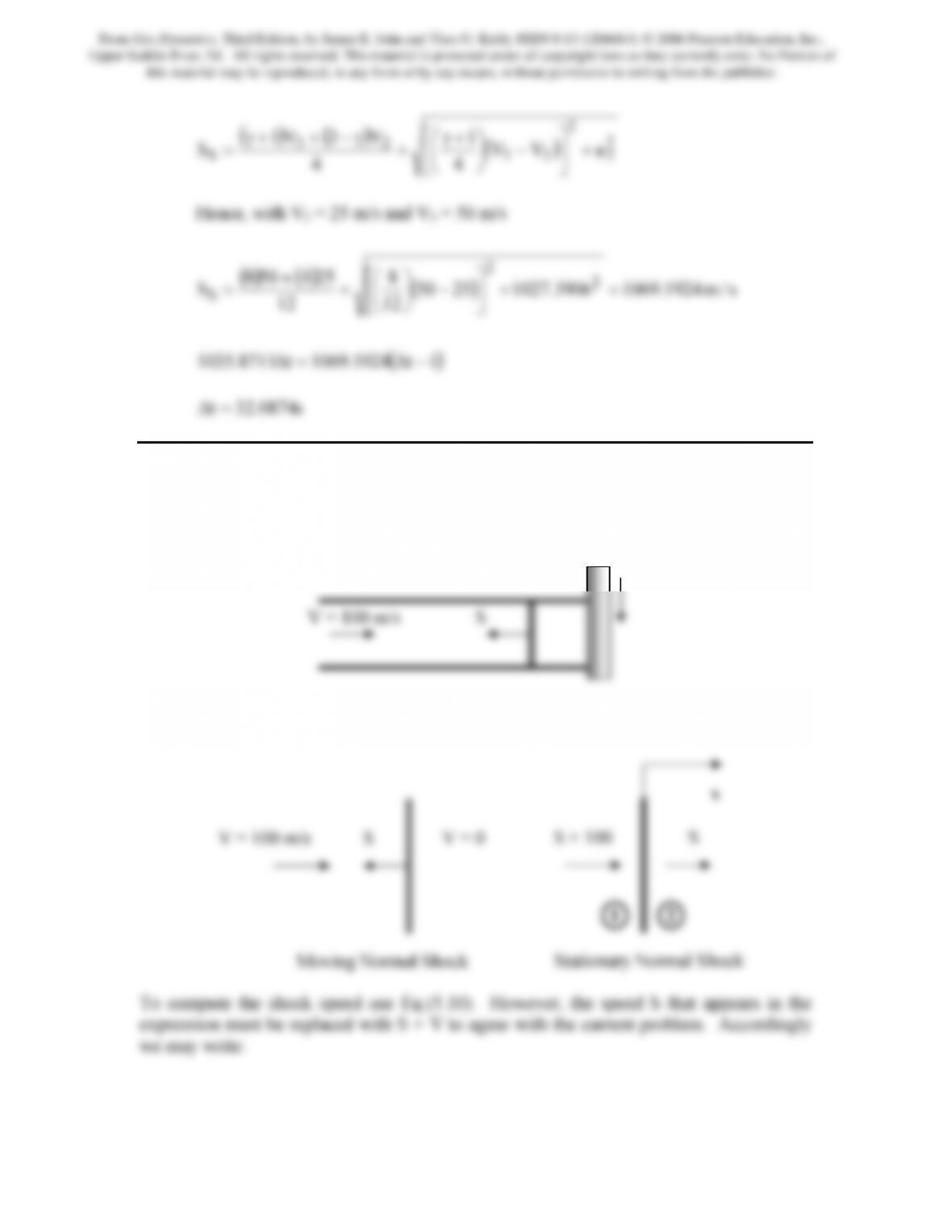
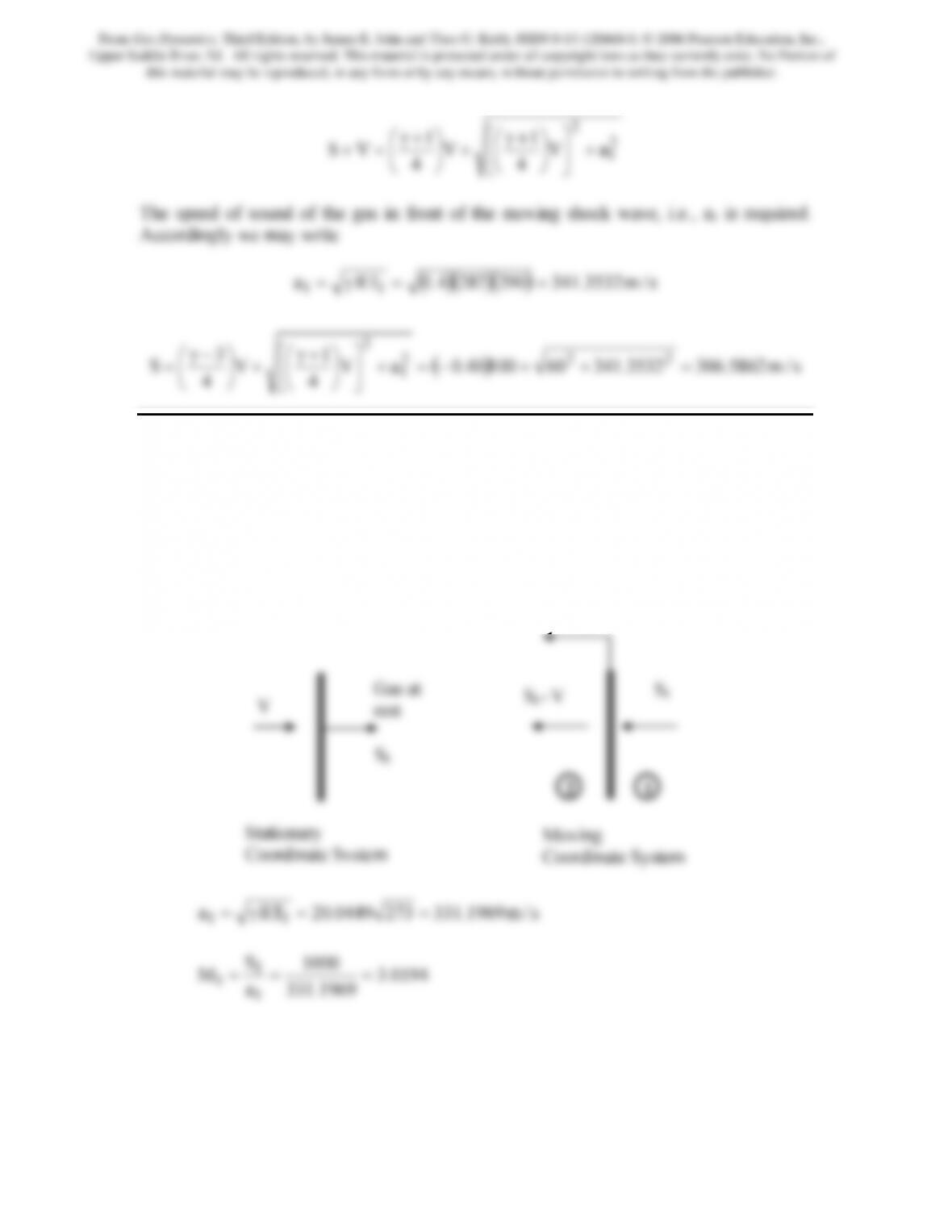
Problem 5. – Air (γ = 1.4, R = 287 J/kg·K) at 100 kPa and 290 K is flowing in a constant-
area tube with a velocity of 100 m/s (Figure P5.5). Suddenly the end of the tube is closed,
which causes a normal shock to propagate back through the airstream. Find the absolute
velocity of this shock.
Figure P5.5
First fix the shock
From Gas Dynamics, Third Edition, by James E. John and Theo G. Keith. ISBN 0-13-120668-0. © 2006 Pearson Education, Inc.,
Upper Saddle River, NJ. All rights reserved. This material is protected under all copyright laws as they currently exist. No Portion of
this material may be reproduced, in any form or by any means, without permission in writing from the publisher.
2
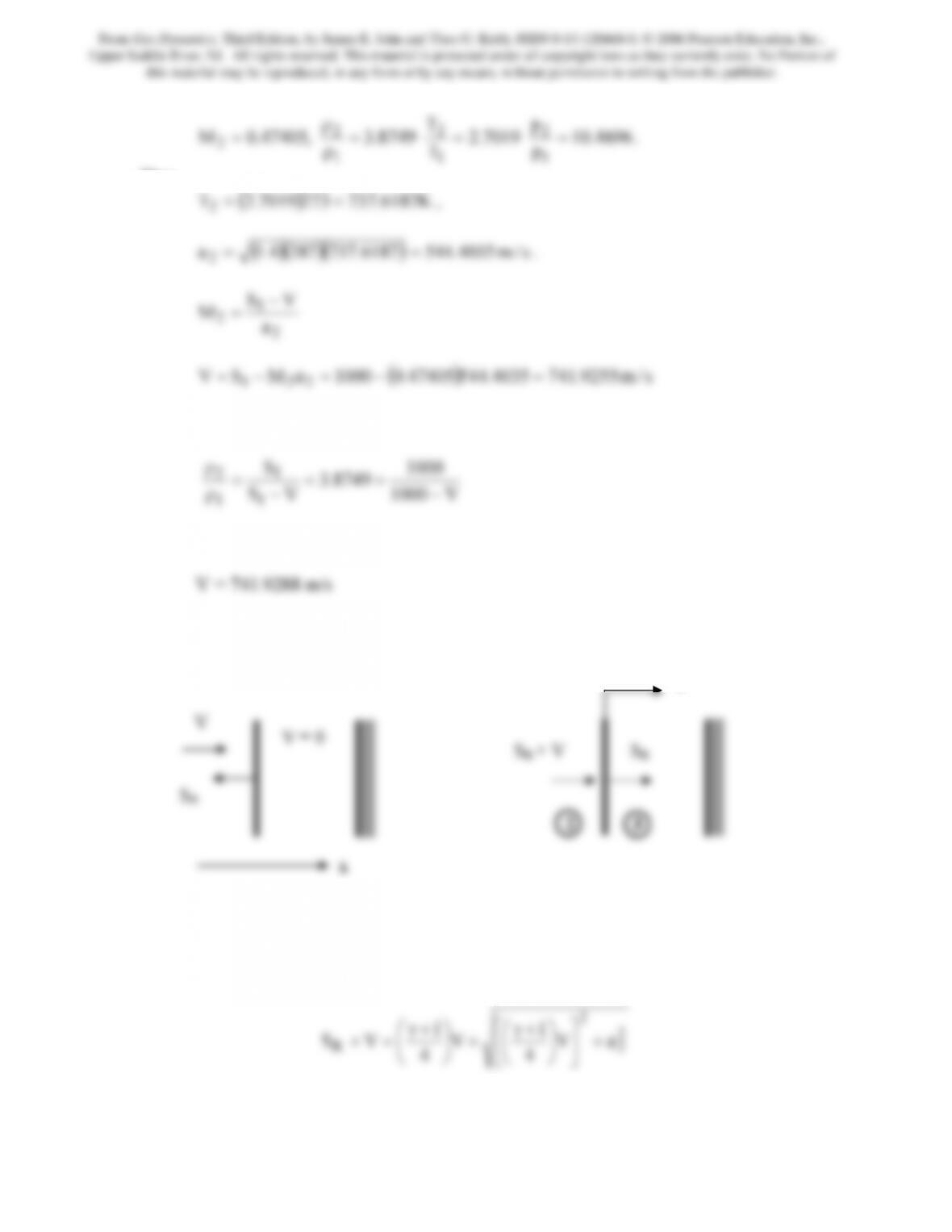
Problem 6. – A normal shock traveling at 1,000 m/s into still air (γ = 1.4, R = 287 J/kg·K)
at 0°C and 101 kPa reflects from a plane wall. Determine the velocity of the reflected
shock. Compare the pressure ratio across the reflected shock with that across the incident
shock. Find the stagnation pressure that would be measured by a stationary observer
behind the reflected wave.
Incident shock: First we must immobilize the shock by redefining a coordinate system
that moves with the shock
x
From Gas Dynamics, Third Edition, by James E. John and Theo G. Keith. ISBN 0-13-120668-0. © 2006 Pearson Education, Inc.,
Upper Saddle River, NJ. All rights reserved. This material is protected under all copyright laws as they currently exist. No Portion of
this material may be reproduced, in any form or by any means, without permission in writing from the publisher.
p
p
T
T
1
2
1
2
1
2
2===
ρ
ρ
Thus,
Alternately,
V1000
8749.3
VS
I
I
1
2
−
==
−
=
ρ
Solve to obtain
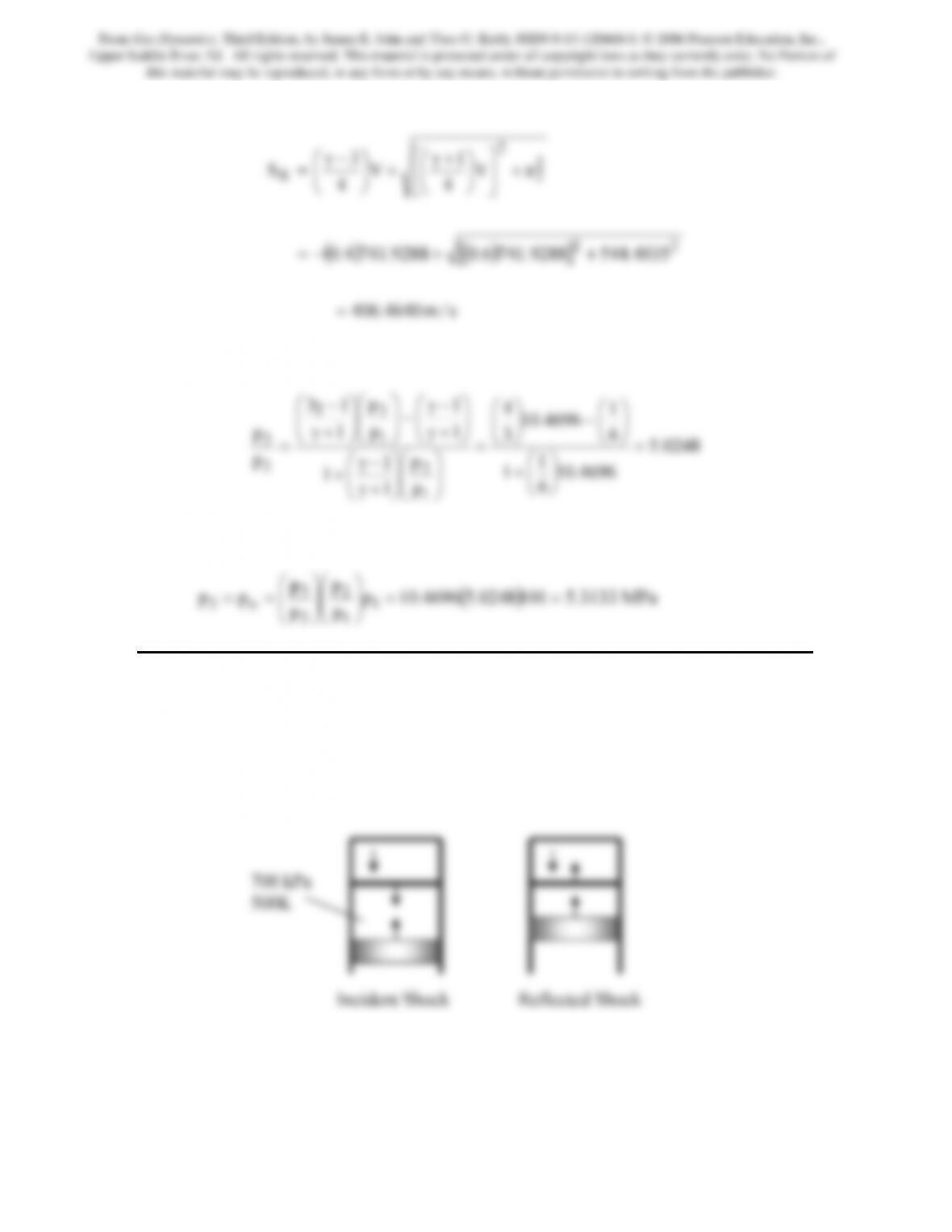
Reflected shock: Again the first step is to fix the moving shock by redefining the
coordinate system.
x
From Gas Dynamics, Third Edition, by James E. John and Theo G. Keith. ISBN 0-13-120668-0. © 2006 Pearson Education, Inc.,
Upper Saddle River, NJ. All rights reserved. This material is protected under all copyright laws as they currently exist. No Portion of
this material may be reproduced, in any form or by any means, without permission in writing from the publisher.
s/m4640.406
=
From Eq.(5.24)
4696.10
6
1
1
6
1
4696.10
3
4
p
p
1
1
1
1
1
p
p
1
13
p
p
1
2
1
2
2
3=
⎟
⎠
⎞
⎜
⎝
⎛
+
⎟
⎠
⎞
⎜
⎝
⎛
−
⎟
⎠
⎞
⎜
⎝
⎛
⎟
⎟
⎠
⎞
⎜
⎜
⎝
⎛
⎟
⎟
⎠
⎞
⎜
⎜
⎝
⎛
+γ
−γ
+
⎟
⎟
⎠
⎞
⎜
⎜
⎝
⎛
+γ
−γ
−
⎟
⎟
⎠
⎞
⎜
⎜
⎝
⎛
⎟
⎟
⎠
⎞
⎜
⎜
⎝
⎛
+γ
−γ
Behind reflected wave, because the velocity = 0
p
p
p
p
1
2
2
3
o3 ==
⎟
⎠
⎞
⎜
⎝
⎛
⎟
⎠
⎞
⎜
⎝
⎛
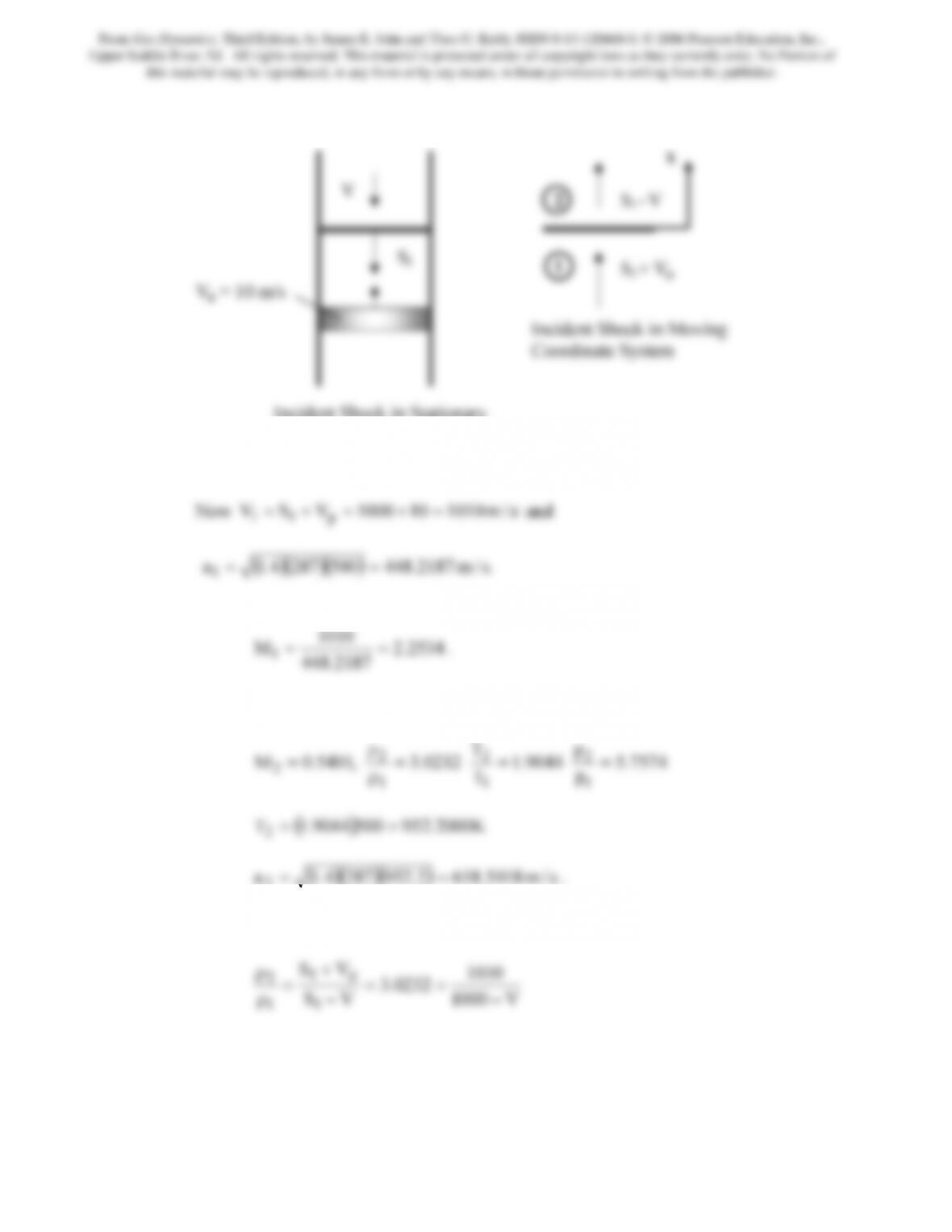
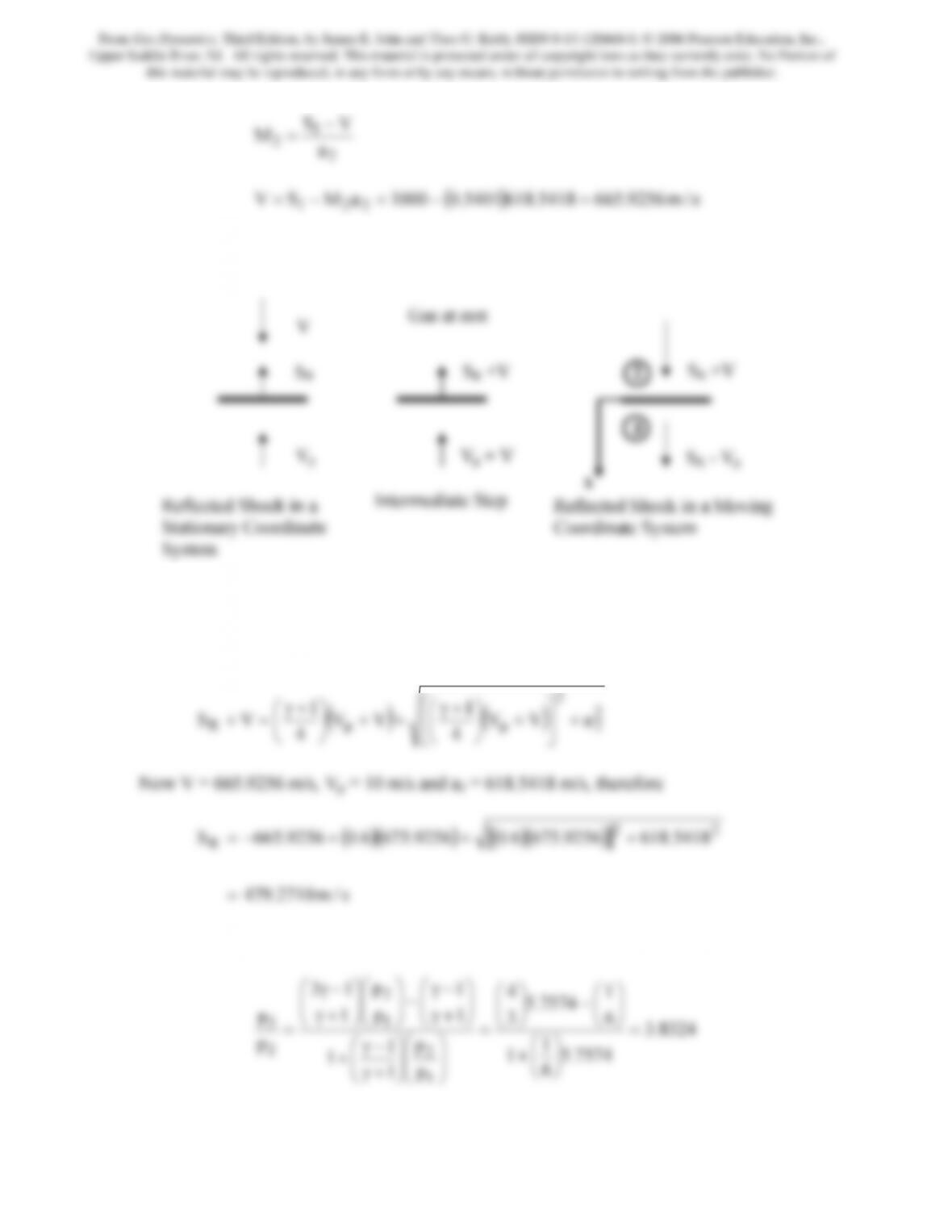
Problem 7. – Under a certain operating condition, the piston speed in an auto engine is 10
m/s. Approximate engine knock as the occurrence of a normal shock wave traveling at
1000 m/s downward, as shown in Figure P5.7, into the unburned mixture at 700 kPa and
500 K. Determine the pressure acting on the piston face after the shock reflects from it.
Assume the gas has the properties of air (R = 287 J/kg·K) and acts as a perfect gas, with
γ = 1.4.
From Gas Dynamics, Third Edition, by James E. John and Theo G. Keith. ISBN 0-13-120668-0. © 2006 Pearson Education, Inc.,
Upper Saddle River, NJ. All rights reserved. This material is protected under all copyright laws as they currently exist. No Portion of
this material may be reproduced, in any form or by any means, without permission in writing from the publisher.
From Gas Dynamics, Third Edition, by James E. John and Theo G. Keith. ISBN 0-13-120668-0. © 2006 Pearson Education, Inc.,
Upper Saddle River, NJ. All rights reserved. This material is protected under all copyright laws as they currently exist. No Portion of
this material may be reproduced, in any form or by any means, without permission in writing from the publisher.
I
2a
VS
M−
=
Reflected shock: Fix reflected shock:
From the intermediate step, which results in a normal shock moving into a fluid at rest
(the fundamental problem), we may use the equations of Section 5.2. However, we must
replace the shock speed, S, in those relations, with SR + V and we must replace the gas
speed behind the shock V with Vp + V. Accordingly, we may rewrite Eq.(5.10) as
2
2
1
1
⎤
⎡+
⎞
⎛+γ
⎞
⎛+γ
s/m2710.479
=
From Eq.(5.24)
System
From Gas Dynamics, Third Edition, by James E. John and Theo G. Keith. ISBN 0-13-120668-0. © 2006 Pearson Education, Inc.,
Upper Saddle River, NJ. All rights reserved. This material is protected under all copyright laws as they currently exist. No Portion of
this material may be reproduced, in any form or by any means, without permission in writing from the publisher.
p
p
3
2
⎞
⎛
⎞
⎛
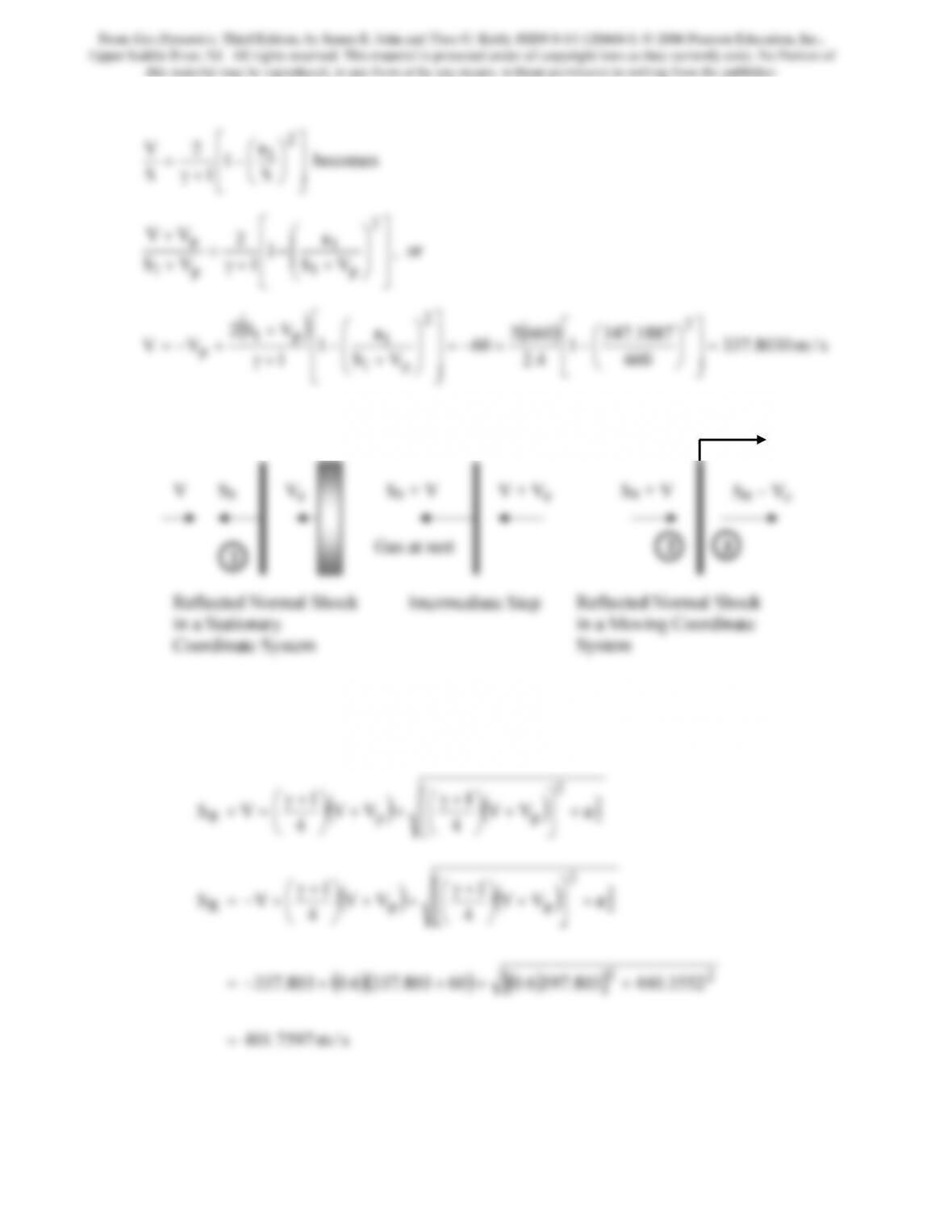
Problem 8. – A normal shock moves down a tube with a velocity of 600 m/s into a gas
with static p = 50 kPa and static temperature of 300 K. At the end of the tube, a piston is
moving with a velocity of 60 m/s, as shown in Figure P5.8. Calculate the velocity of the
reflected wave and the static pressure behind the reflected wave. Assume the gas has the
properties of air (γ = 1.4, R = 287 J/kg·K).
Figure P5.8
Incident Shock: As usual we perform the coordinate transformation to fix the incident
shock. Because the gas in front of the shock is moving it is helpful to perform an
intermediate step in which this gas is brought to rest. In this way the equations pertaining
to a normal shock moving into a stationary gas may be transformed to this problem.
Incident Normal Shock Reflected Normal Shock
x
From Gas Dynamics, Third Edition, by James E. John and Theo G. Keith. ISBN 0-13-120668-0. © 2006 Pearson Education, Inc.,
Upper Saddle River, NJ. All rights reserved. This material is protected under all copyright laws as they currently exist. No Portion of
this material may be reproduced, in any form or by any means, without permission in writing from the publisher.
92
660
4.2
VS
1
pI
p=
⎥
⎦
⎢
⎣
⎠
⎝
⎥
⎥
⎦
⎢
⎢
⎣
⎟
⎠
⎜
⎝
+
+γ
Reflected Shock:
Now from Eq.(5.10) with S replaced by SR + V and V replaced by V + Vp (see the
intermediate step), i.e.,
() ()
2
2
2
ppR aVV
4
1
VV
4
1
VS +
⎥
⎦
⎤
⎢
⎣
⎡+
⎟
⎠
⎞
⎜
⎝
⎛+γ
++
⎟
⎠
⎞
⎜
⎝
⎛+γ
=+
() ()
()( ) ()
[]
s/m7597.401
3552.440803.3976.060803.3376.0803.337
aVV
4
1
VV
4
1
VS
2
2
2
2
2
ppR
=
++++−=
+
⎥
⎦
⎤
⎢
⎣
⎡+
⎟
⎠
⎞
⎜
⎝
⎛+γ
++
⎟
⎠
⎞
⎜
⎝
⎛+γ
+−=
x
From Gas Dynamics, Third Edition, by James E. John and Theo G. Keith. ISBN 0-13-120668-0. © 2006 Pearson Education, Inc.,
Upper Saddle River, NJ. All rights reserved. This material is protected under all copyright laws as they currently exist. No Portion of
this material may be reproduced, in any form or by any means, without permission in writing from the publisher.
8030.3377597.401
VS
R
+
+
p
p
2
1
1==
⎟
⎠
⎜
⎝
⎟
⎠
⎜
⎝
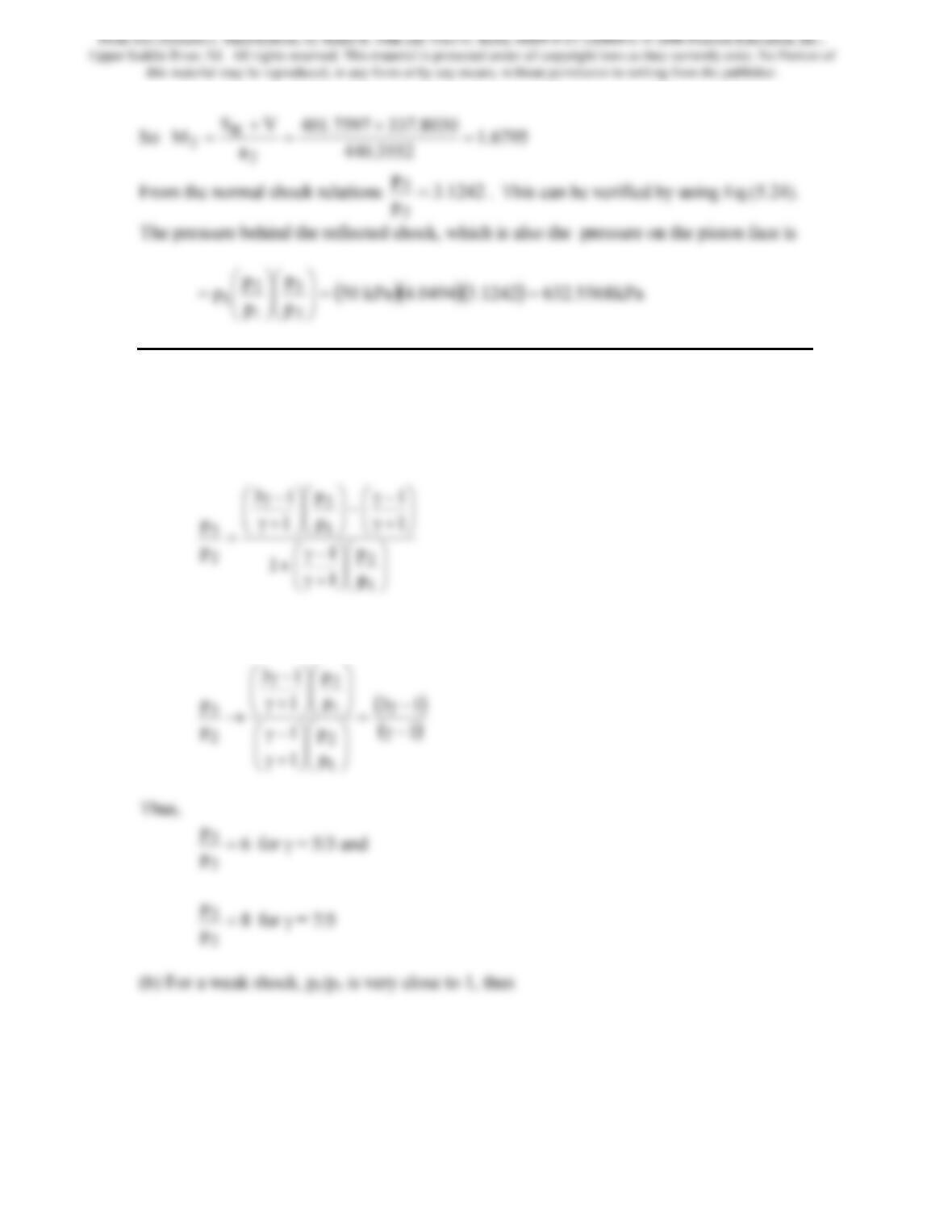
Problem 9. – For both γ = 7/5 and 5/3, determine the limits of the pressure ratio of a
reflected normal shock, i.e., p3/p2, (a) for a strong incident shock, i.e., p2/p1 → ∞, and (b)
for a weak incident wave, , i.e., p2/p1 → 1.
From Eq.(5.24)
⎟
⎟
⎠
⎞
⎜
⎜
⎝
⎛
⎟
⎟
⎠
⎞
⎜
⎜
⎝
⎛
+γ
−γ
+
=
1
2
2
3
p
p
1
1
1
p
(a) For the strong shock case since p2/p1 is infinite the ratio simply becomes
p
13
2
⎟
⎟
⎞
⎜
⎜
⎛
⎟
⎟
⎞
⎜
⎜
⎛
−γ
From Gas Dynamics, Third Edition, by James E. John and Theo G. Keith. ISBN 0-13-120668-0. © 2006 Pearson Education, Inc.,
Upper Saddle River, NJ. All rights reserved. This material is protected under all copyright laws as they currently exist. No Portion of
this material may be reproduced, in any form or by any means, without permission in writing from the publisher.