69
() ()
b2
b1
2
1
b2
1b
2
1
2
1
1o
2o
bM1b
1
b1bM
M
p
p
−+
⎥
⎥
⎦
⎤
⎢
⎢
⎣
⎡
−+
⎥
⎥
⎦
⎤
⎢
⎢
⎣
⎡
−+
=
M1 p2/p1 ρ2/ρ1 T2/T1 po2/po1
1.00 1.0000 1.0000 1.0000 1.0000
1.90 3.8473 2.9177 1.3186 0.7320
1.95 4.0573 3.0304 1.3388 0.7045
2.00 4.2727 3.1429 1.3595 0.6767
2.40 6.1927 4.0203 1.5404 0.4636
2.45 6.4573 4.1261 1.5650 0.4395
2.50 6.7273 4.2308 1.5901 0.4162
M1 p2/p1 ρ2/ρ1 T2/T1 po2/po1
Problem 14. – A converging-diverging nozzle has an area ratio (exit to throat) of 3.0. The
nozzle is supplied from an air (γ = 1.4, R = 287 J/kg·K) reservoir in which the pressure
and temperature are maintained at 270 kPa and 35°C, respectively. The nozzle is
From Gas Dynamics, Third Edition, by James E. John and Theo G. Keith. ISBN 0-13-120668-0. © 2006 Pearson Education, Inc.,
Upper Saddle River, NJ. All rights reserved. This material is protected under all copyright laws as they currently exist. No Portion of
this material may be reproduced, in any form or by any means, without permission in writing from the publisher.
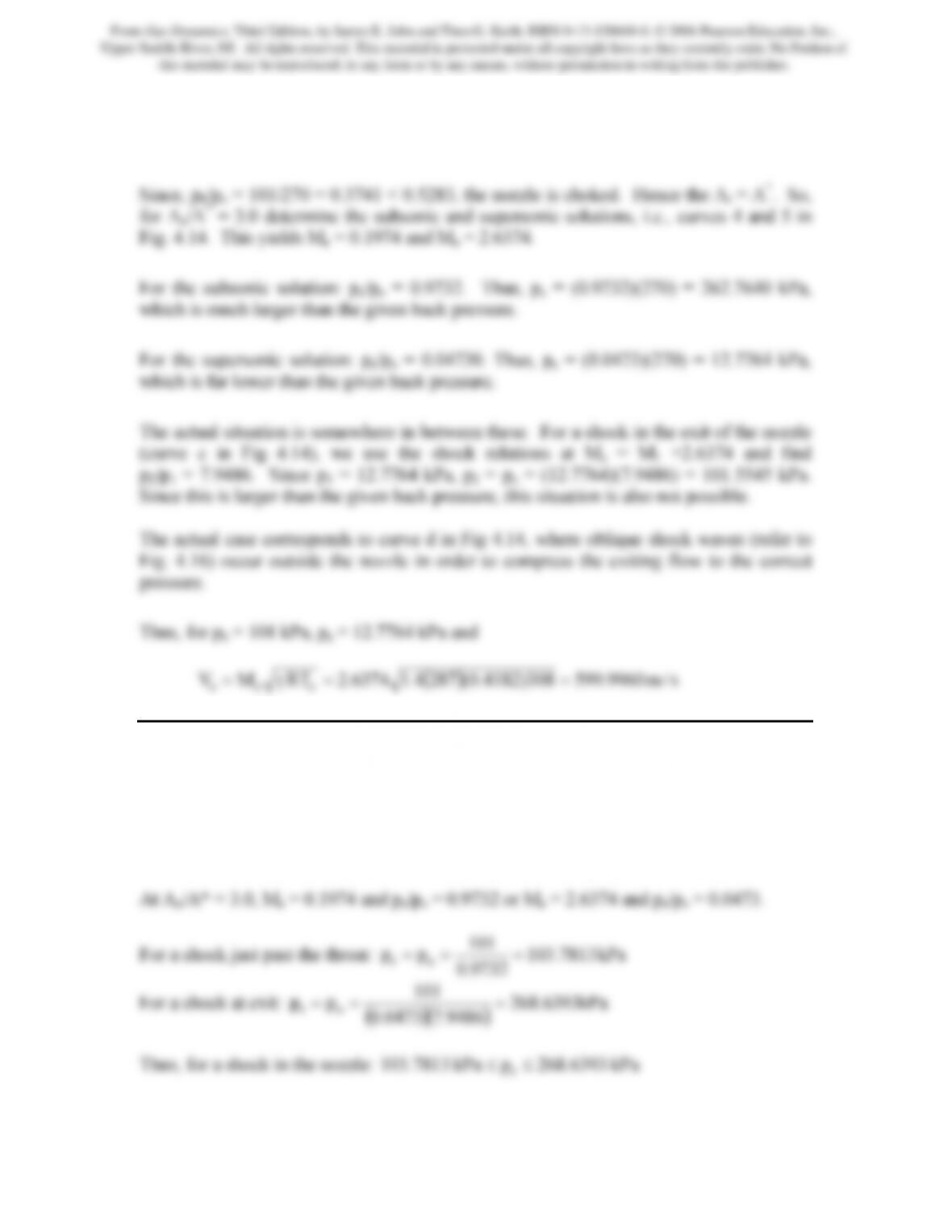
exhausted to a back pressure of 101 kPa. Find the nozzle exit velocity and nozzle exit-
plane static pressure.
Problem 15. – A supersonic nozzle possessing an area ratio (exit to throat) of 3.0 is
supplied from a large reservoir and is allowed to exhaust to atmospheric pressure (101
kPa). Determine the range of reservoir pressures over which a normal shock will appear
in the nozzle. For what value of reservoir pressure will the nozzle be perfectly expanded,
with supersonic flow at the exit plane? Find the minimum reservoir pressure to produce
sonic flow at the nozzle throat. Assume isentropic flow except for shocks, with γ = 1.4.
From Gas Dynamics, Third Edition, by James E. John and Theo G. Keith. ISBN 0-13-120668-0. © 2006 Pearson Education, Inc.,
Upper Saddle River, NJ. All rights reserved. This material is protected under all copyright laws as they currently exist. No Portion of
this material may be reproduced, in any form or by any means, without permission in writing from the publisher.
71
101
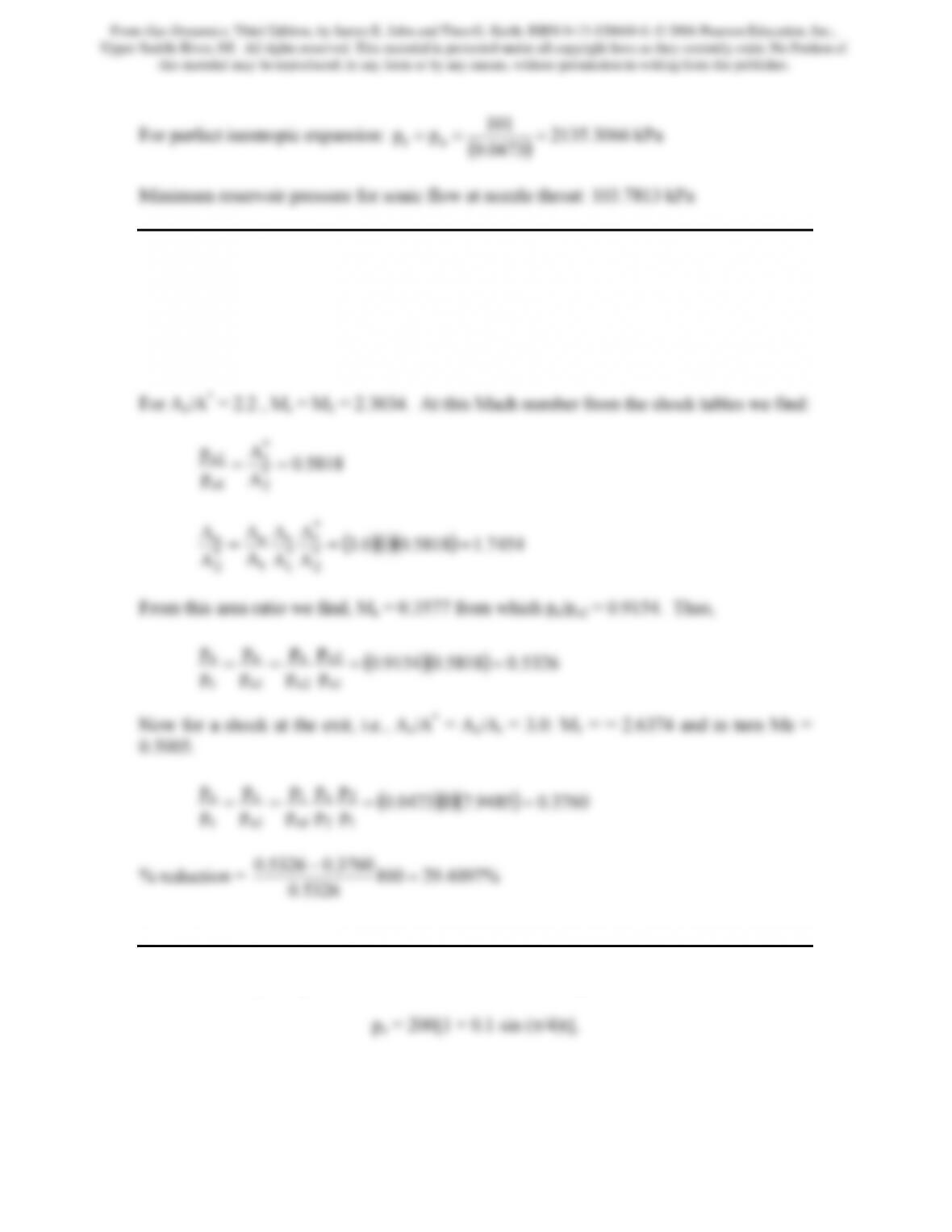
Problem 16. – A converging-diverging nozzle with an area ratio (exit to throat) of 3.0
exhausts air (γ = 1.4) from a large high-pressure reservoir to a region of back pressure pb.
Under a certain operating condition, a normal shock is observed in the nozzle at an area
equal to 2.2 times the throat area. What percent of decrease in back pressure would be
necessary to rid the nozzle of the normal shock?
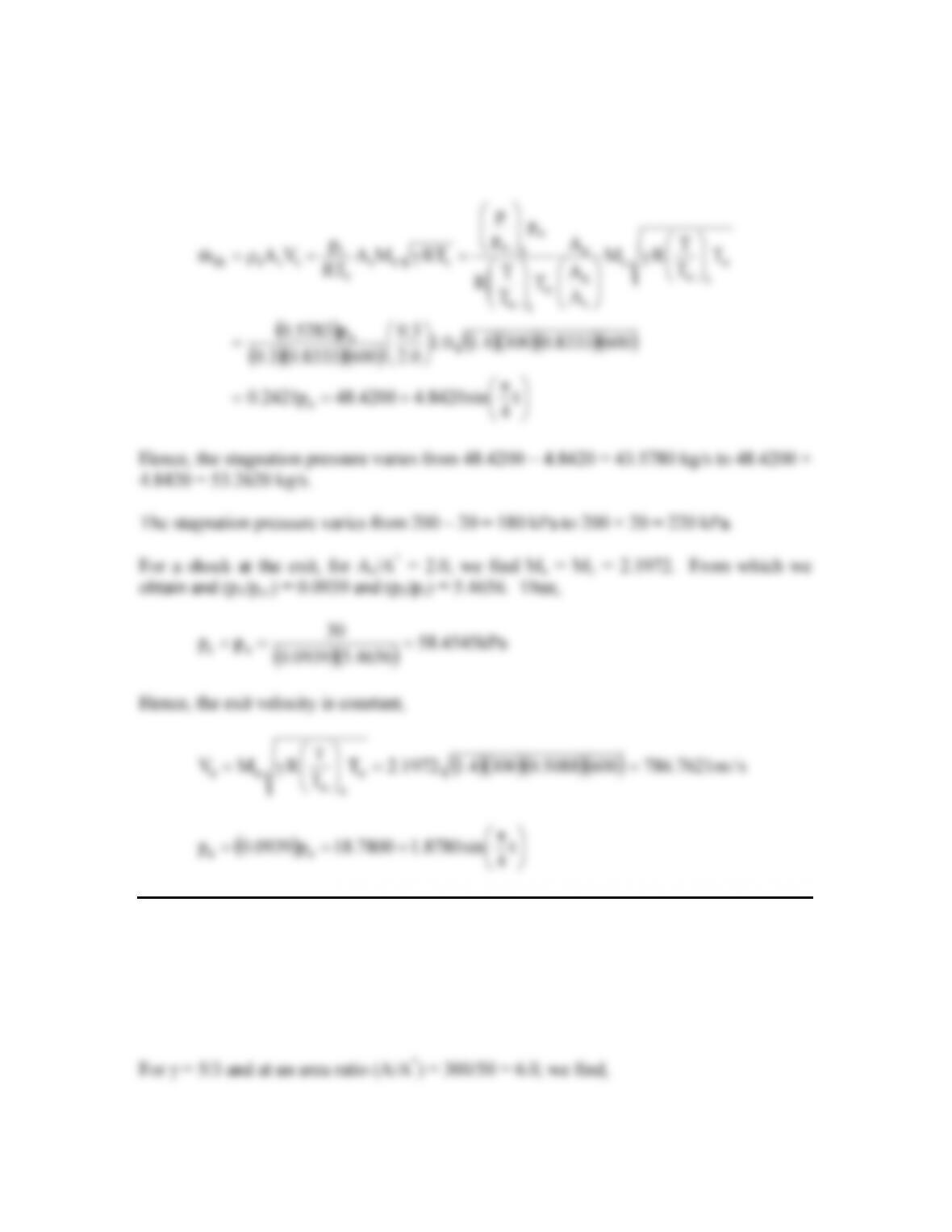
Problem 17. – Due to variations in fuel flow rate, it is found that the stagnation pressure
at the inlet to a jet-engine nozzle varies with time according to:
with t in seconds and po in kilopascals. Determine the resultant variation in nozzle flow
rate, nozzle exhaust velocity, and exit-plane static pressure. The nozzle area ratio (exit to
From Gas Dynamics, Third Edition, by James E. John and Theo G. Keith. ISBN 0-13-120668-0. © 2006 Pearson Education, Inc.,
Upper Saddle River, NJ. All rights reserved. This material is protected under all copyright laws as they currently exist. No Portion of
this material may be reproduced, in any form or by any means, without permission in writing from the publisher.
72
throat) is 2.0 to 1, and the inlet stagnation temperature is 600 K. Assume negligible inlet
velocity. The nozzle exhausts to an ambient pressure of 30 kPa; γ = 1.4; nozzle exit area
is 0.3 m2; R = 0.3 kJ/kg · K.
⎟
⎟
⎠
⎞
⎜
⎜
⎝
⎛
γ
⎟
⎟
⎠
⎞
⎜
⎜
⎝
⎛
⎟
⎟
⎠
⎞
⎜
⎜
⎝
⎛
⎟
⎟
⎠
⎞
⎜
⎜
⎝
⎛
=γ=ρ=
T
T
T
RM
A
A
A
T
T
T
R
p
p
p
RTMA
RT
p
VAm
o
t
o
t
t
e
e
o
t
o
o
t
o
ttt
t
t
tttth
&
⎠
⎝
4
Problem 18. – Helium enters a converging-diverging nozzle with a negligible velocity;
stagnation pressure is 500 kPa and stagnation temperature is 300 K. The nozzle throat
area is 50 cm2, and the exit area is 300 cm2. Determine the range of nozzle back
pressures over which a normal shock will appear in the nozzle. Also, find the nozzle exit
velocity if the nozzle exhausts into a vacuum.
From Gas Dynamics, Third Edition, by James E. John and Theo G. Keith. ISBN 0-13-120668-0. © 2006 Pearson Education, Inc.,
Upper Saddle River, NJ. All rights reserved. This material is protected under all copyright laws as they currently exist. No Portion of
this material may be reproduced, in any form or by any means, without permission in writing from the publisher.
3
T
e
o
ee =
⎠
⎝
⎟
⎠
⎜
⎝
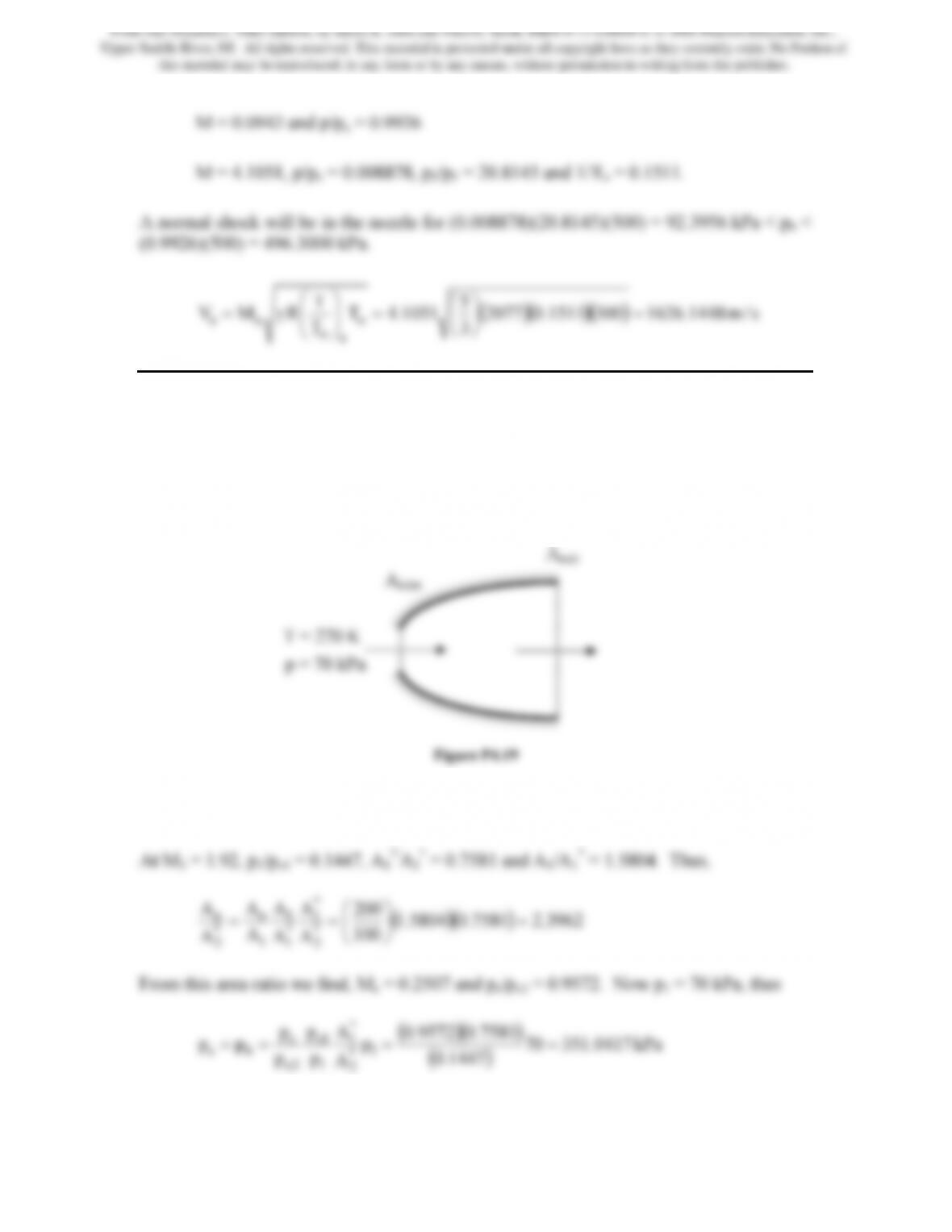
Problem 19. – A jet plane uses a diverging passage as a diffuser (Figure P4.19). For a
flight Mach number of 1.92, determine the range of back pressures over which a normal
shock will appear in the diffuser. Ambient pressure and temperature are 70 kPa and 270
K. Find the mass flow rates handled by the diffuser for the determined back pressure
ranges, with Ainlet = 100 cm2 and Aexit = 200 cm2. Assume isentropic air flow (γ = 1.4,
R = 287 J/kg·K) except for across the shocks.
From Gas Dynamics, Third Edition, by James E. John and Theo G. Keith. ISBN 0-13-120668-0. © 2006 Pearson Education, Inc.,
Upper Saddle River, NJ. All rights reserved. This material is protected under all copyright laws as they currently exist. No Portion of
this material may be reproduced, in any form or by any means, without permission in writing from the publisher.
100
A
A
A
*
1
i
*
1
⎠
⎝
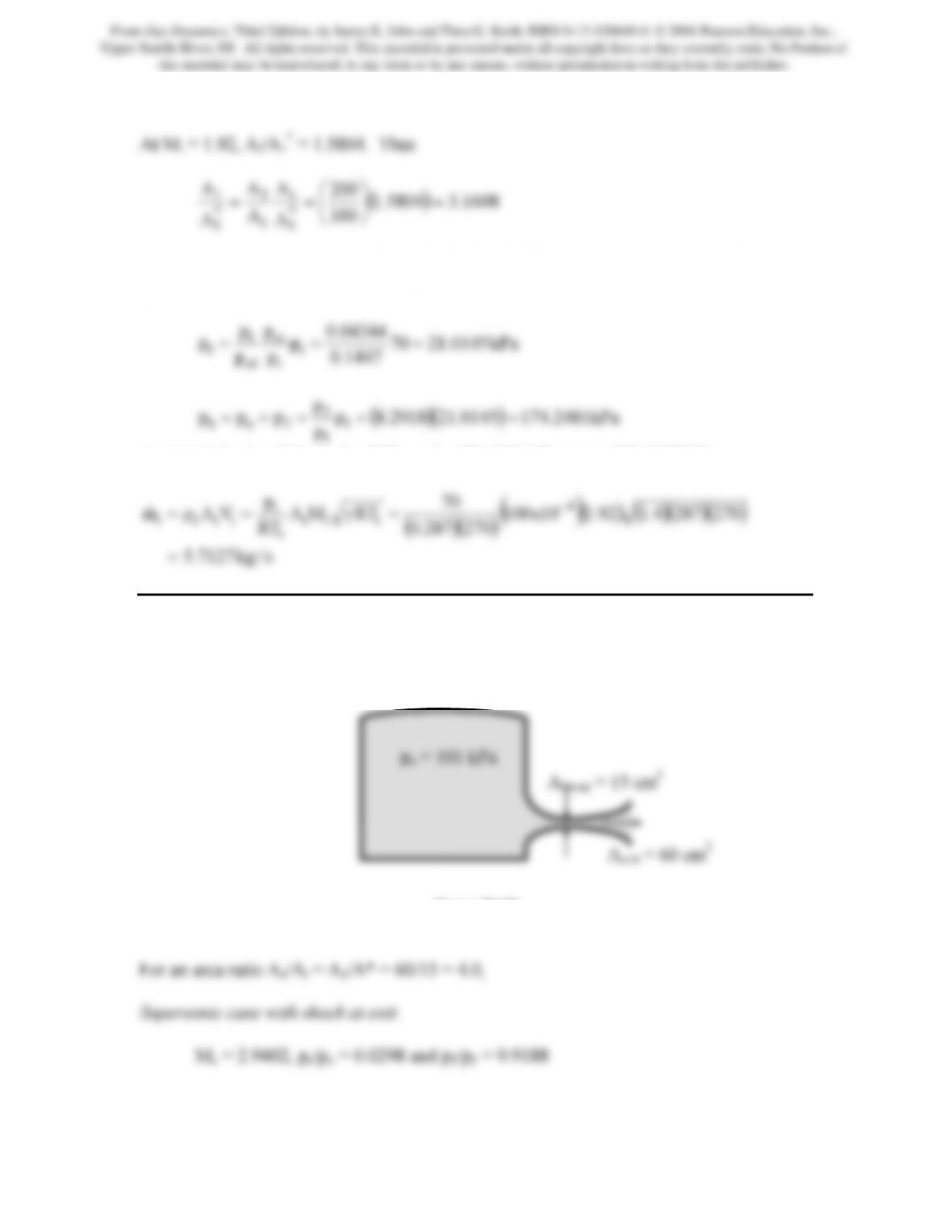
From this area ratio we find, M1 = 2.6926, p2/p1 = 8.2918 and p1/po1 = 0.04344. Because
the flow is isentropic from i to 1 we may write,
04344.0
p
p
oi
1
p
1
A normal shock will be in the diffuser for 174.2481 kPa ≤ pb ≤ 351.0417 kPa
s/kg7127.5
=
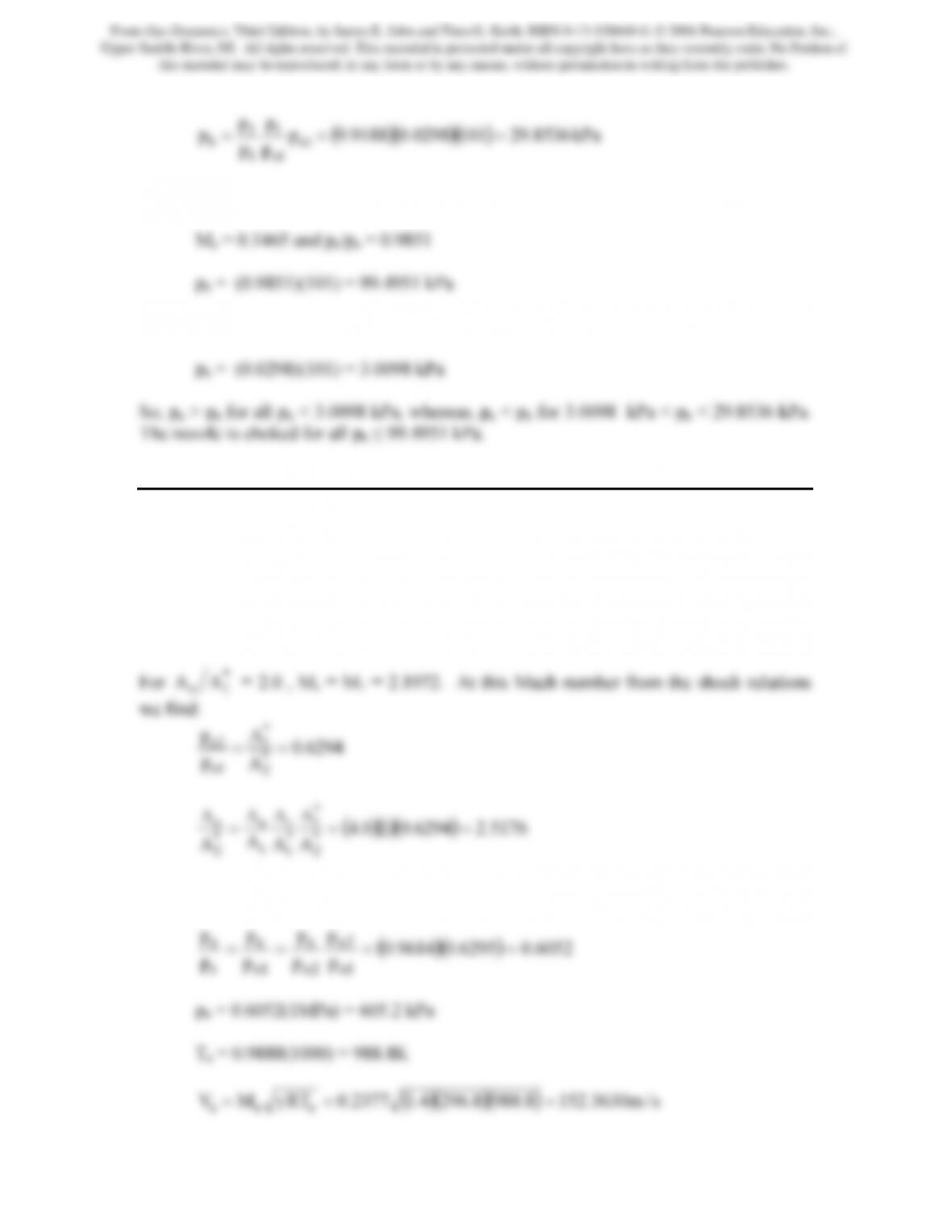
Problem 20. – For the converging-diverging nozzle shown in Figure P4.20, find the range
of back pressures for which pe > pb, the range of back pressures for which pe < pb, and the
range of back pressures over which the nozzle is choked. Take γ = 1.4.
Figure P4.20
From Gas Dynamics, Third Edition, by James E. John and Theo G. Keith. ISBN 0-13-120668-0. © 2006 Pearson Education, Inc.,
Upper Saddle River, NJ. All rights reserved. This material is protected under all copyright laws as they currently exist. No Portion of
this material may be reproduced, in any form or by any means, without permission in writing from the publisher.
p
p
p
p
1o
1
1
2
Subsonic case with shock just downstream of throat:
For perfectly expanded flow in nozzle:
Problem 21. – Nitrogen (γ = 1.4, R = 296.8 J/kg·K) expands in a converging-diverging
nozzle from negligible velocity, a stagnation pressure of 1 MPa, and a stagnation
temperature of 1000 K to supersonic velocity in the diverging portion of the nozzle. If the
area ratio of the nozzle is 4.0, determine the back-pressure necessary for a normal shock
to position itself at an area equal to twice the throat area. For this condition, find the
nozzle exit velocity.
()()( )
5176.26294.010.4
A
A
A
A
*
2
*
1
t
*
2
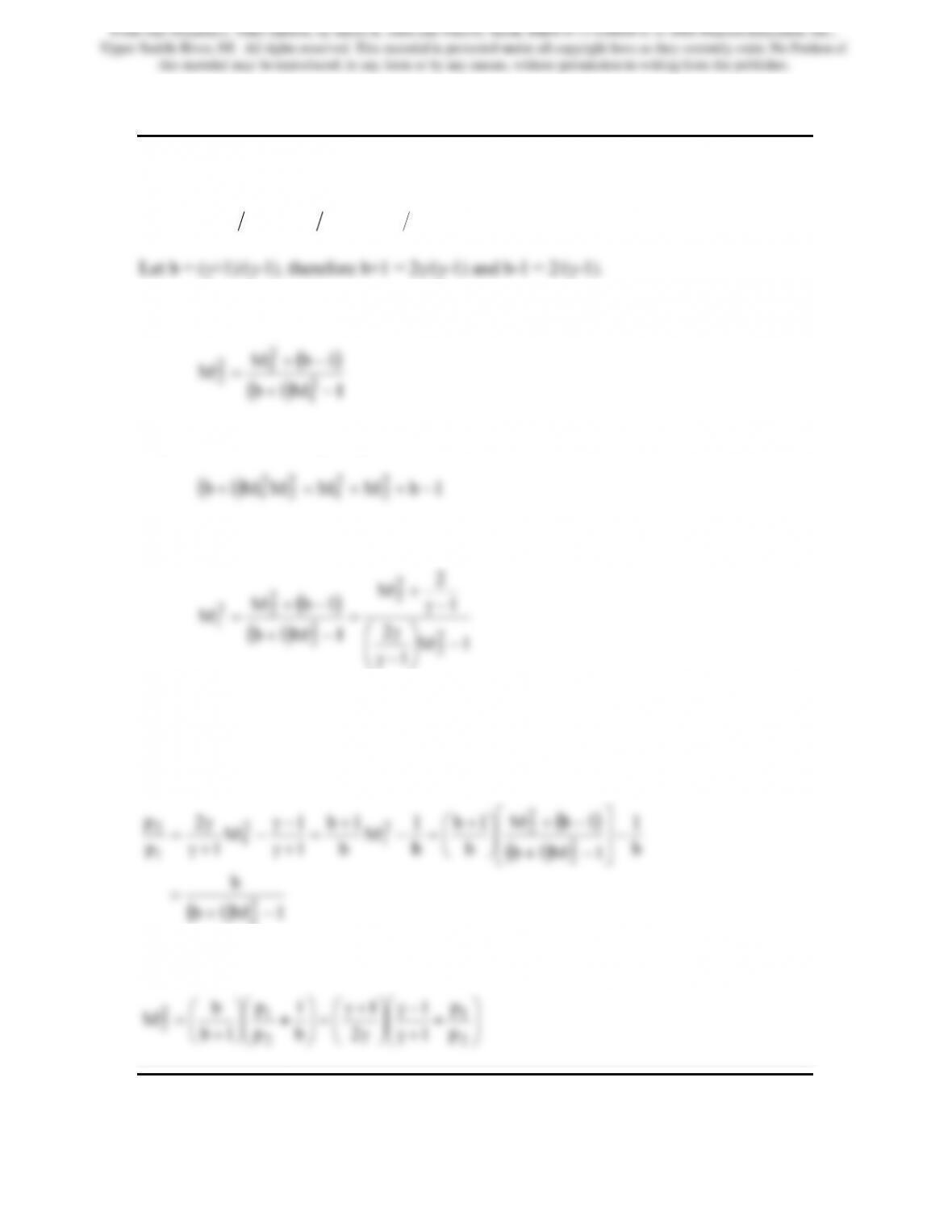
From this area ratio we find, Me = 0.2377 from which pe/po2 = 0.9614 and Te/To = 0.9888.
Thus,
p
p
p
p
2o
e
e
e====
From Gas Dynamics, Third Edition, by James E. John and Theo G. Keith. ISBN 0-13-120668-0. © 2006 Pearson Education, Inc.,
Upper Saddle River, NJ. All rights reserved. This material is protected under all copyright laws as they currently exist. No Portion of
this material may be reproduced, in any form or by any means, without permission in writing from the publisher.
76
Problem 22. – (a) Develop a relation for the upstream Mach number, M1, in terms of the
downstream Mach number, M2. (b) Use the result from (a) and Eq. (4.12) to prove that
()
[]
()()
[]
21
2
2pp1121M ++γ−γγ+γ= .
(a) Equation (4.9) may be written as
()
1M1b
1
2−+
Expand this and rearrange to get
Note by interchanging the subscripts the relation is unchanged, therefore it is obvious that
()
1M
1
2
2
M
1M1b
2
2
2
2
2
2
2
1
−
⎟
⎟
⎠
⎞
⎜
⎜
⎝
⎛
−γ
γ
+
−+
The result is also apparent from Fig. 4.10 in which we may observe that the curve is
symmetrical about the line M2 = M1.
(b) Equation (4.12) can be written as
()
1M1b
b
2
2
2
−+
=
⎤
⎡
or
⎟
⎟
⎠
⎞
⎜
⎜
⎝
⎛+
+γ
−γ
⎟
⎟
⎠
⎞
⎜
⎜
⎝
⎛
γ
+γ
=
⎟
⎟
⎠
⎞
⎜
⎜
⎝
⎛+
⎟
⎠
⎞
⎜
⎝
⎛
+
=
2
1
2
1
2
2p
p
1
1
2
1
b
1
p
p
1b
b
M
From Gas Dynamics, Third Edition, by James E. John and Theo G. Keith. ISBN 0-13-120668-0. © 2006 Pearson Education, Inc.,
Upper Saddle River, NJ. All rights reserved. This material is protected under all copyright laws as they currently exist. No Portion of
this material may be reproduced, in any form or by any means, without permission in writing from the publisher.
77
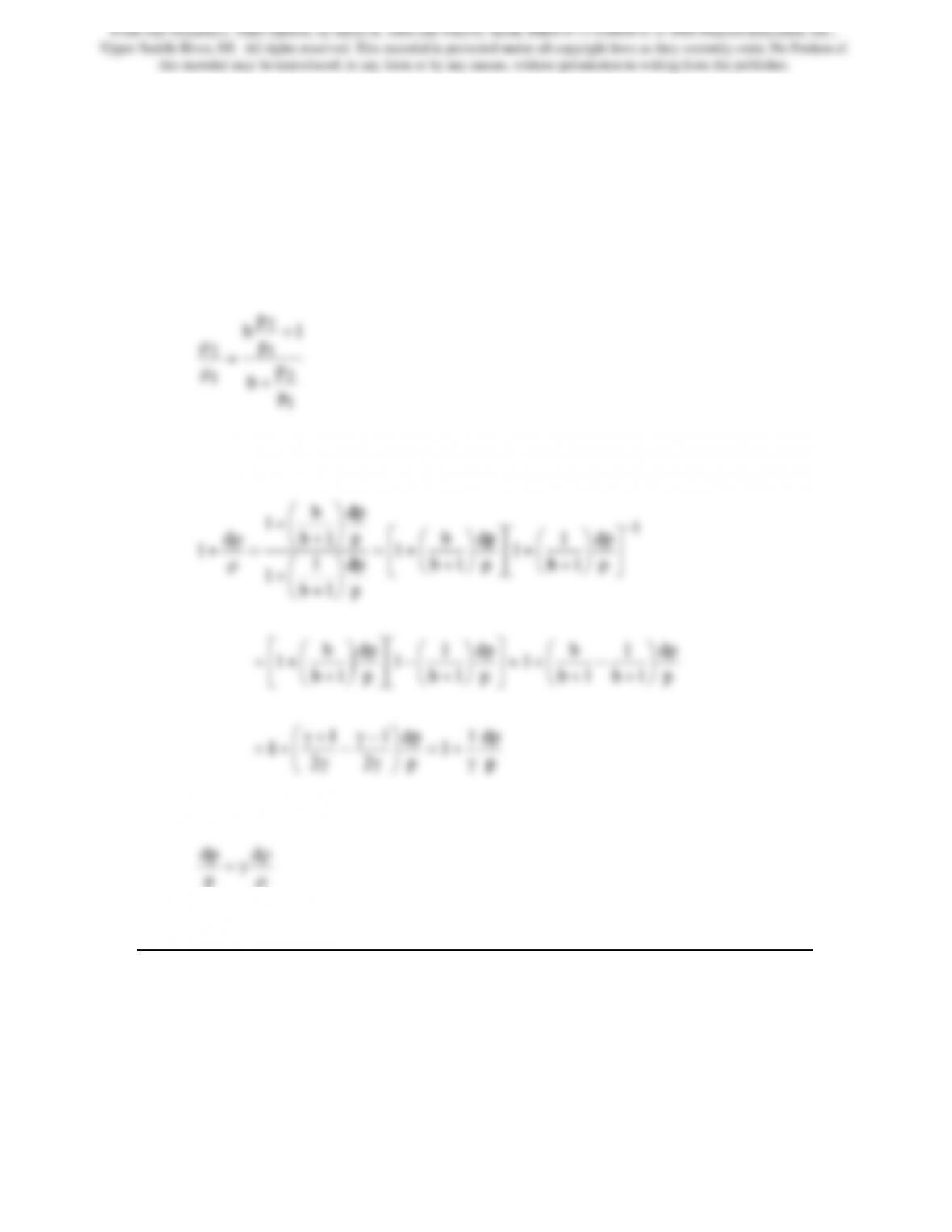
Problem 23. – Prove that the Rankine-Hugoniot relation reduces to the equation for an
isentropic process for very weak shocks. Hint: start from Eq. (4.16b) and replace p2 with
p + dp and p1 with p. Repeat this for the densities. Then use the expansion technique
that was employed in Example 4.1. Note to properly use the expansion approach we must
first express the term to be expanded as 1 + (small quantity).
Let b = (γ+1)/(γ-1), therefore b+1 = 2γ/(γ-1) and b-1 = 2/(γ-1). Thus, Eq. (4.16b) may be
written as
1
2
1
2
1
2
p
p
b
1
p
p
b
+
+
=
ρ
ρ
Now replace the downstream terms with the upstream value + a differential and rearrange
the result to get
p
dp1
1
p
dp
2
1
2
1
1
p
1b
1b
p
1b
p
1b
γ
+=
⎟
⎟
⎠
⎞
⎜
⎜
⎝
⎛
γ
−γ
−
γ
+γ
+=
⎠
⎝
+
+
⎥
⎦
⎢
⎣
⎠
⎝
+
⎥
⎦
⎢
⎣
⎠
⎝
+
Thus,
ρ
γ= d
p
Integration gives the isentropic relation γ
ρ=Cp
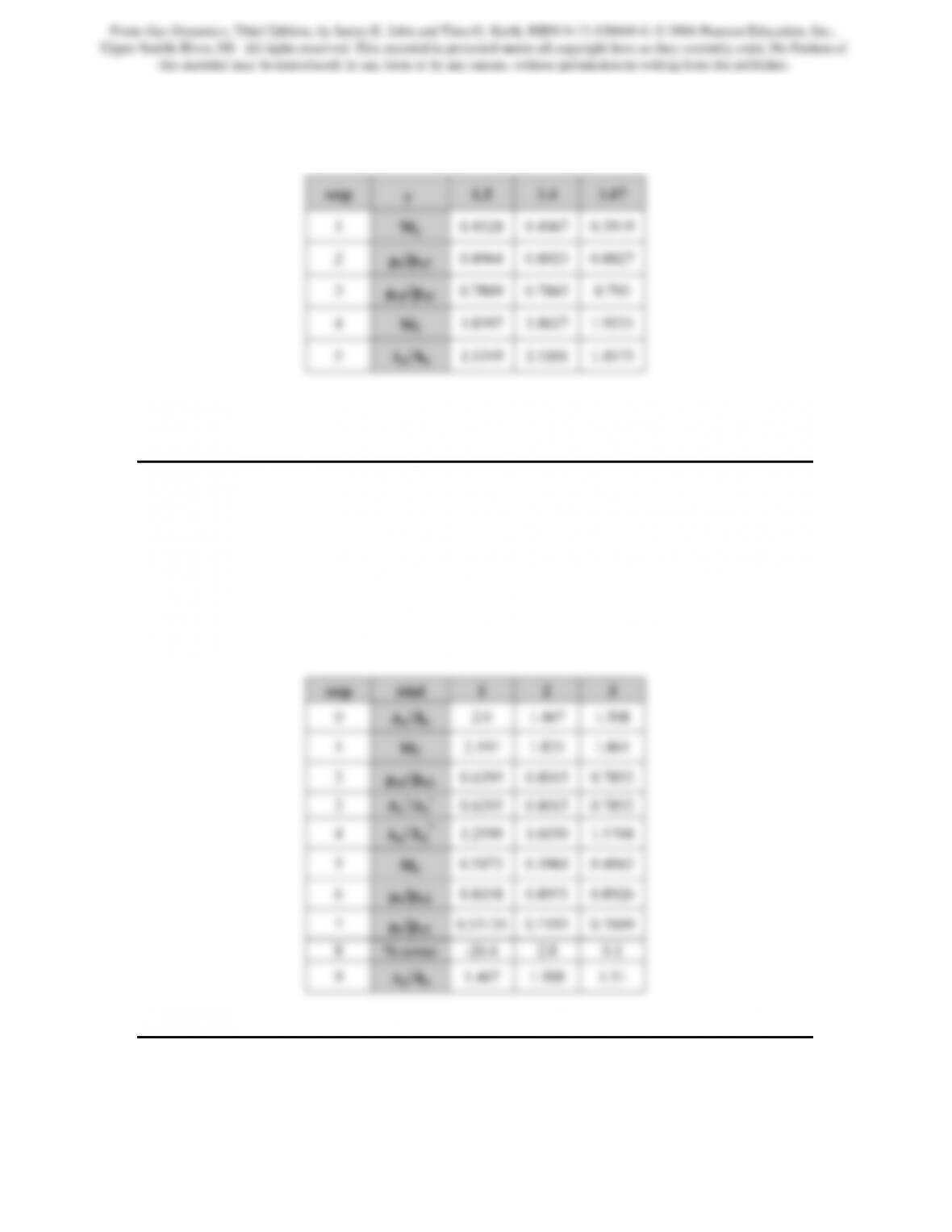
Problem 24. – The back pressure to reservoir pressure ratio is 0.7 for a C-D nozzle, with
an exit to throat area ratio of 2.0. Use the procedure when the shock location is not
specified, i.e., the direct approach to determine the location of a normal shock for a ratio
of specific heats equal to 1.3. Repeat the problem for γ = 5/3. Draw a conclusion
regarding shock location and the value of γ.
From Gas Dynamics, Third Edition, by James E. John and Theo G. Keith. ISBN 0-13-120668-0. © 2006 Pearson Education, Inc.,
Upper Saddle River, NJ. All rights reserved. This material is protected under all copyright laws as they currently exist. No Portion of
this material may be reproduced, in any form or by any means, without permission in writing from the publisher.
78
The following table showing the calculation results was prepared from a simple
spreadsheet program
As may be seen as γ is increased the shock moves upstream.
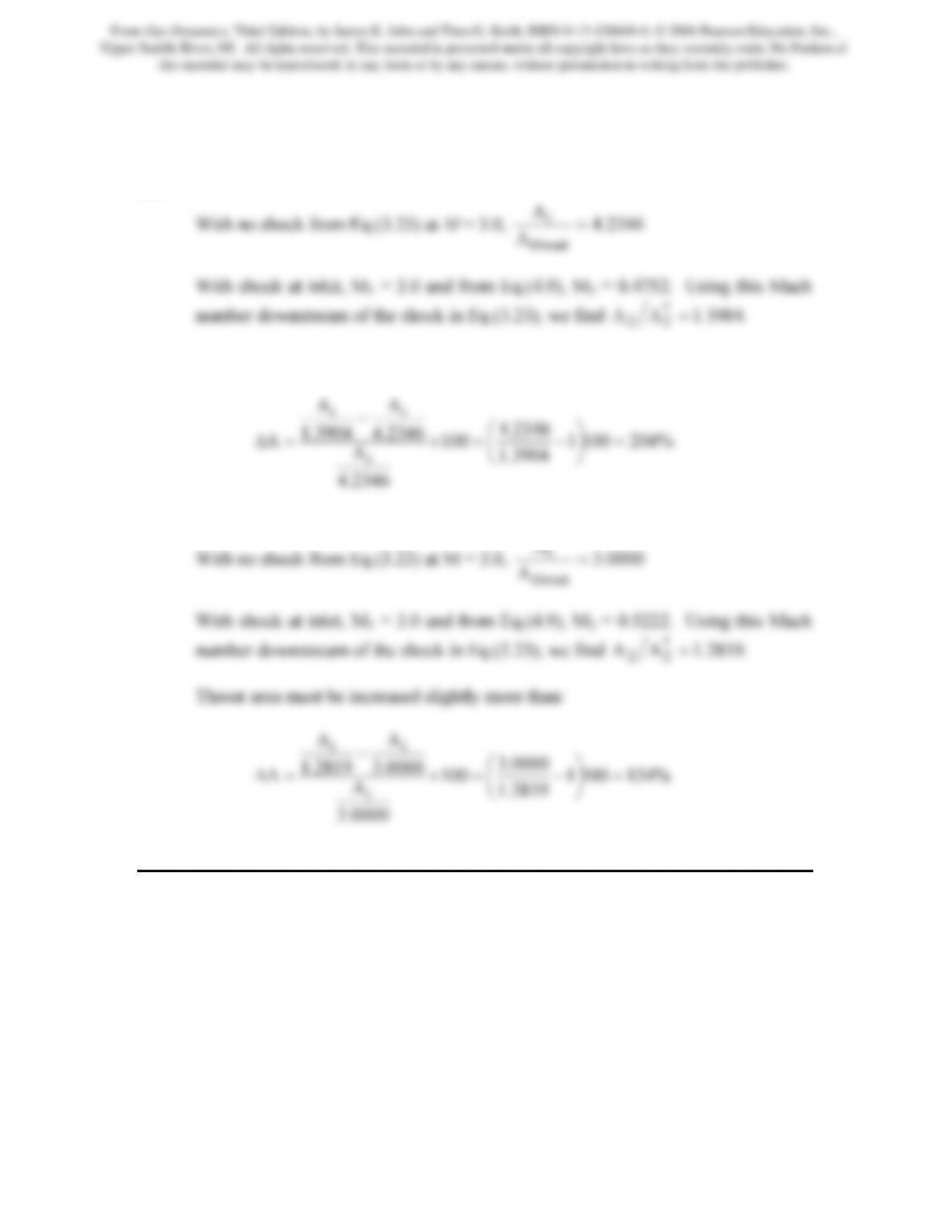
Problem 25. – The back-pressure to reservoir pressure ratio is 0.7 for a C-D nozzle, with
an exit to throat area ratio of 2.0. Use the procedure for the situation when the shock
location is specified, i.e., the trial and error approach to determine the location of a
normal shock for a ratio of specific heats equal to 1.4. To start the calculations assume
the shock is at the exit of the nozzle.
The following table summarizes the calculations for each trial.
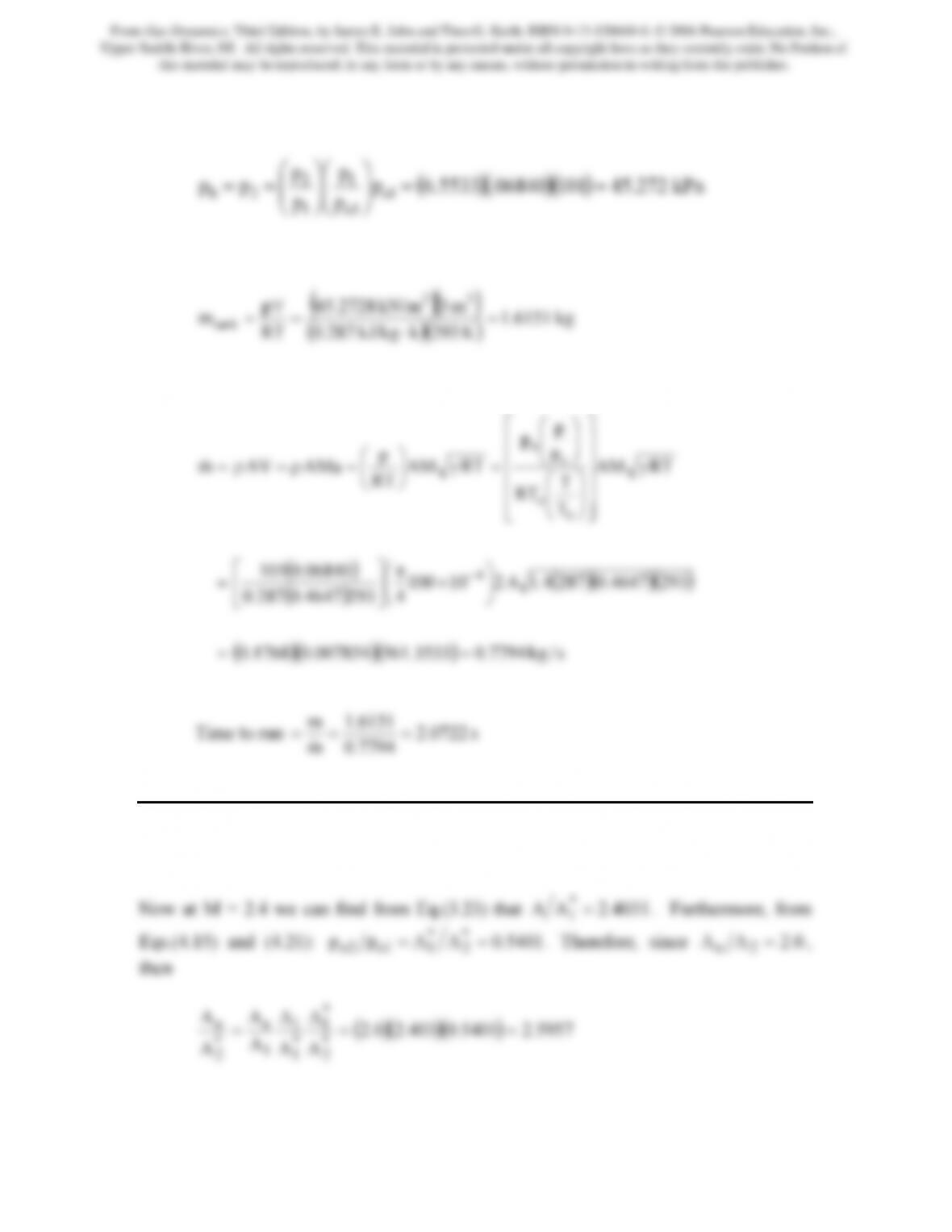
Problem 26. – A converging-diverging supersonic diffuser is to be used at Mach 3.0. The
diffuser is to use a variable throat area so as to swallow the starting shock. What percent
From Gas Dynamics, Third Edition, by James E. John and Theo G. Keith. ISBN 0-13-120668-0. © 2006 Pearson Education, Inc.,
Upper Saddle River, NJ. All rights reserved. This material is protected under all copyright laws as they currently exist. No Portion of
this material may be reproduced, in any form or by any means, without permission in writing from the publisher.
79
of increase in throat area will be necessary? Solve for air (
γ
= 1.4) and for helium (γ =
5/3) as working fluids.
Air:
A
i=
Throat area must be increased slightly more than:
3904.1
2346.4
2346.4
A
2346.4
A
3904.1
A
i
ii
⎠
⎞
⎝
⎛−=×
−
Helium:
A
i=
2819.1
0000.3
A
i
⎠
⎝
Problem 27. –A supersonic wind tunnel is to be constructed as shown in Figure 4.27,
with air (γ = 1.4, R = 287 J/kg·K) at atmospheric pressure passing through a converging-
diverging nozzle into a constant-area test section and then into a large vacuum tank. The
test run is started with a pressure 0 kPa in the tank. How long can uniform flow
conditions be maintained in the test section (i.e., how long will it be before the tank
pressure rises to a value such that a shock will appear in the test section)? Assume the
test section to be circular, 10 cm in diameter, with a design Mach number of 2.4. The
tank volume is 3 m3, with atmospheric conditions of 101 kPa and 20°C. Assume the air to
be brought to rest adiabatically in the tank.
From Gas Dynamics, Third Edition, by James E. John and Theo G. Keith. ISBN 0-13-120668-0. © 2006 Pearson Education, Inc.,
Upper Saddle River, NJ. All rights reserved. This material is protected under all copyright laws as they currently exist. No Portion of
this material may be reproduced, in any form or by any means, without permission in writing from the publisher.
For a shock at the nozzle exit
p
p
p
p
1o
1
1
2
2b ==
⎟
⎟
⎠
⎞
⎜
⎜
⎝
⎛
⎟
⎠
⎞
⎜
⎝
⎛
Tunnel will run until
()()
K 293kkJ/kg 287.0
RT
tank =
⋅
The mass flow rate is constant while tunnel is running, so
()
06840.0101
RTMA
T
T
RT
p
p
p
RTMA
RT
p
AMaAVm
4
o
o
o
o
⎞
⎛×
π
⎤
⎡
γ
⎥
⎥
⎥
⎥
⎥
⎦
⎤
⎢
⎢
⎢
⎢
⎢
⎣
⎡
⎟
⎟
⎠
⎞
⎜
⎜
⎝
⎛
⎟
⎟
⎠
⎞
⎜
⎜
⎝
⎛
=γ
⎟
⎠
⎞
⎜
⎝
⎛
=ρ=ρ=
−
&
Time to run s 0722.2
7794.0
m
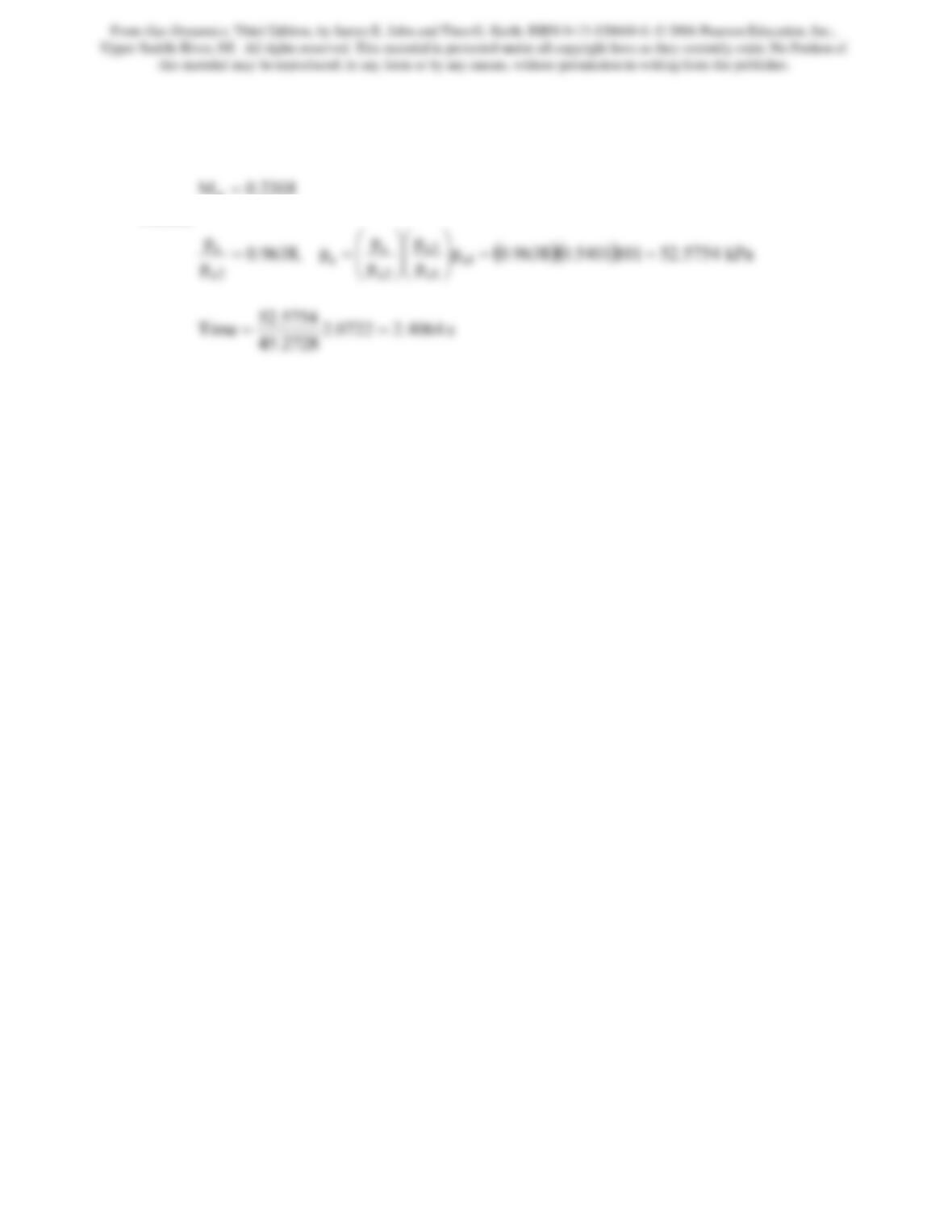
Problem 28. – Repeat Problem 27 but assume that there is a diffuser of area ratio 2 to 1
between the test section and the tank.
From Gas Dynamics, Third Edition, by James E. John and Theo G. Keith. ISBN 0-13-120668-0. © 2006 Pearson Education, Inc.,
Upper Saddle River, NJ. All rights reserved. This material is protected under all copyright laws as they currently exist. No Portion of
this material may be reproduced, in any form or by any means, without permission in writing from the publisher.
81
Using the area ratio-Mach number numerical procedure, the subsonic solution gives for
this area ratio
Hence,
p
p
p
2o
e
e==
⎞
⎛
⎞
⎛
From Gas Dynamics, Third Edition, by James E. John and Theo G. Keith. ISBN 0-13-120668-0. © 2006 Pearson Education, Inc.,
Upper Saddle River, NJ. All rights reserved. This material is protected under all copyright laws as they currently exist. No Portion of
this material may be reproduced, in any form or by any means, without permission in writing from the publisher.