56
C
Ch
ha
ap
pt
te
er
r
F
Fo
ou
ur
r
S
ST
TA
AT
TI
IO
ON
NA
AR
RY
Y
N
NO
OR
RM
MA
AL
L
S
SH
HO
OC
CK
K
W
WA
AV
VE
ES
S
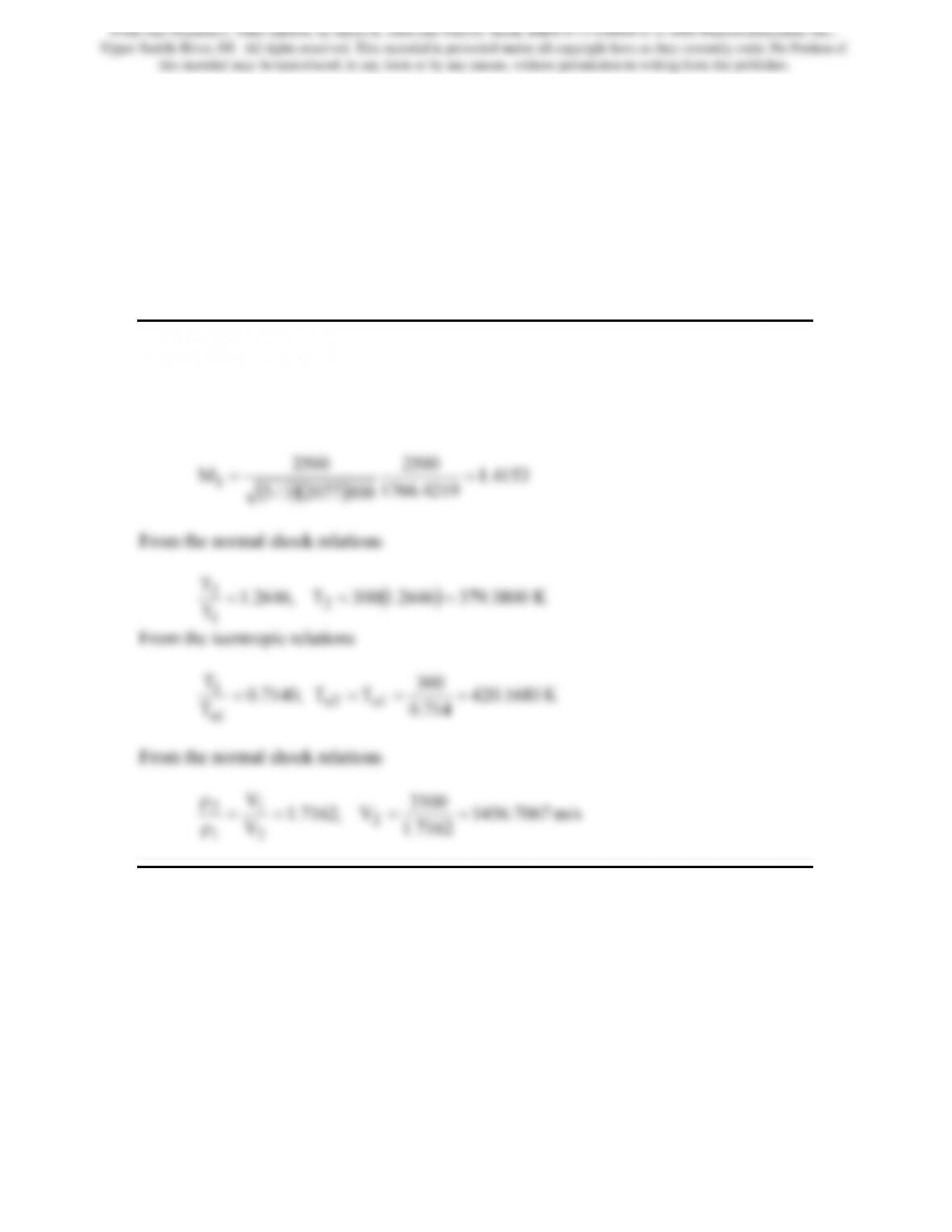
Problem 1. – A helium flow with a velocity of 2500 m/s and static temperature of 300 K
undergoes a normal shock. Determine the helium velocity and the static and stagnation
temperatures after the wave. Assume the helium to behave as a perfect gas with constant
γ = 5/3 and R = 2077 J/kg·K.
m/s 7067.1456
7162.1
V ,7162.1
V
2
2
1
1
2====
ρ
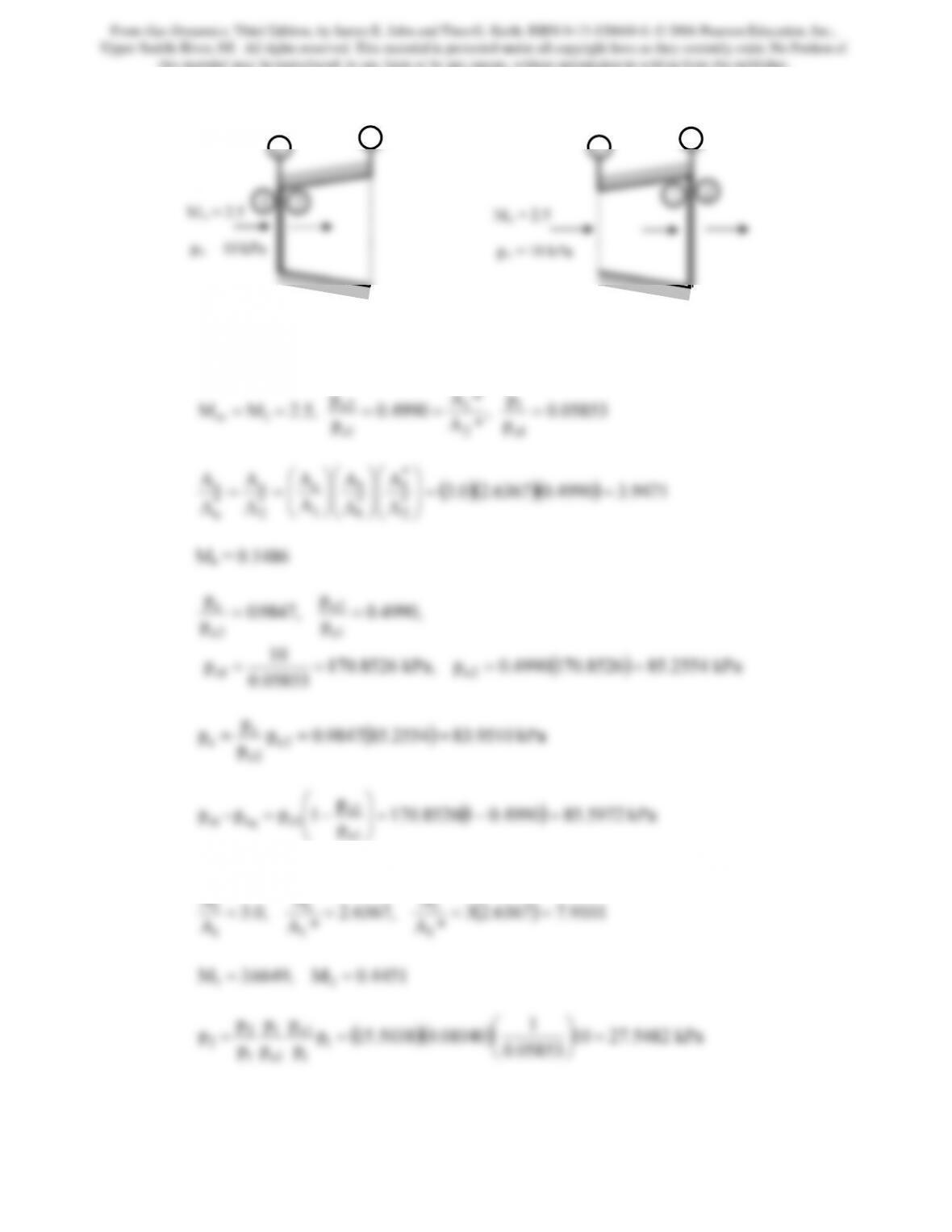
Problem 2. – A normal shock occurs at the inlet to a supersonic diffuser, as shown in
Figure P4.2. Ae/Ai is equal to 3.0. Find Me, pe, and the loss in stagnation pressure (poi –
poe). Repeat for a shock at the exit. Assume γ = 1.4.
From Gas Dynamics, Third Edition, by James E. John and Theo G. Keith. ISBN 0-13-120668-0. © 2006 Pearson Education, Inc.,
Upper Saddle River, NJ. All rights reserved. This material is protected under all copyright laws as they currently exist. No Portion of
this material may be reproduced, in any form or by any means, without permission in writing from the publisher.
e
e
From Gas Dynamics, Third Edition, by James E. John and Theo G. Keith. ISBN 0-13-120668-0. © 2006 Pearson Education, Inc.,
Upper Saddle River, NJ. All rights reserved. This material is protected under all copyright laws as they currently exist. No Portion of
this material may be reproduced, in any form or by any means, without permission in writing from the publisher.
()
kPa2961.1391847.018526.170
p
p
1ppp
o1
2o
oiboio =−=
⎟
⎟
⎠
⎞
⎜
⎜
⎝
⎛−=−
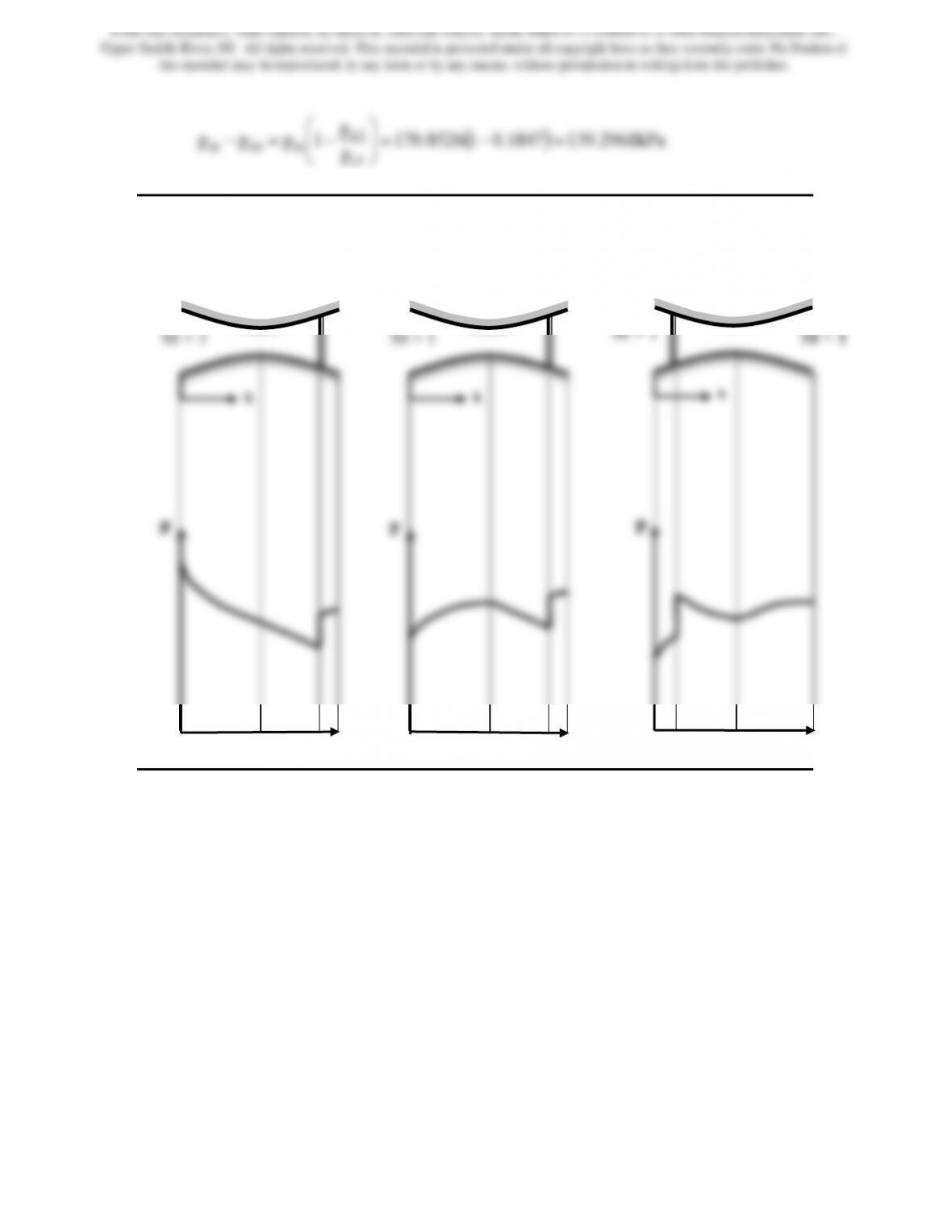
Problem 3. – Sketch p versus x for the three cases shown in Figure P4.3. Assume
isentropic flow except for flow across the normal shocks.
M > 1
From Gas Dynamics, Third Edition, by James E. John and Theo G. Keith. ISBN 0-13-120668-0. © 2006 Pearson Education, Inc.,
Upper Saddle River, NJ. All rights reserved. This material is protected under all copyright laws as they currently exist. No Portion of
this material may be reproduced, in any form or by any means, without permission in writing from the publisher.
59
Figure P4.4
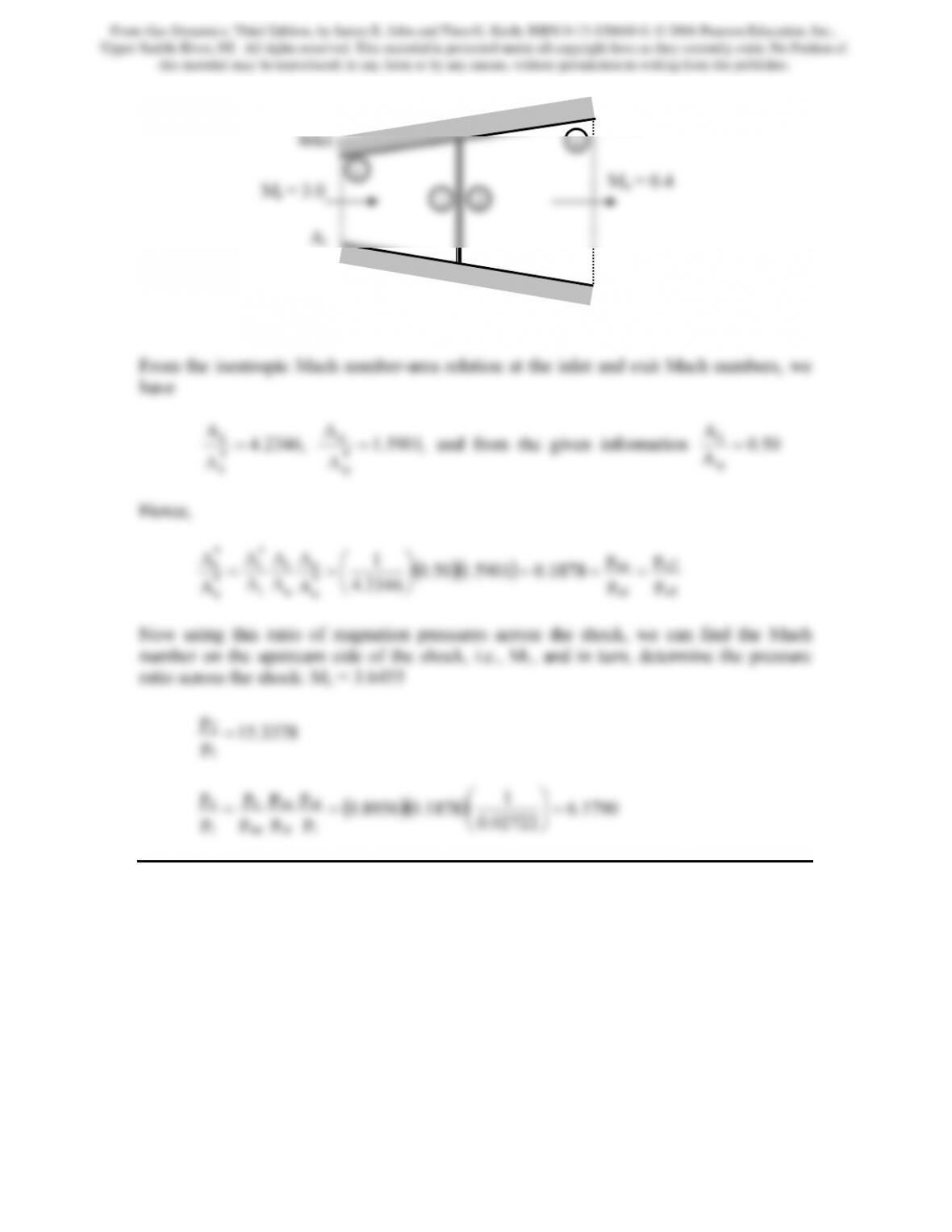
Problem 5. – A supersonic flow at Mach 3.0 and γ = 1.4 is to be slowed down via a
normal shock in a diverging channel. For the conditions shown in Figure P4.5, find p2/p1
and pe/pi.
To = 300 K
po = 200 kPa Athroat = 50 cm2
Aexit = 4 Athroat
Ashock = 2 Athroat
From Gas Dynamics, Third Edition, by James E. John and Theo G. Keith. ISBN 0-13-120668-0. © 2006 Pearson Education, Inc.,
Upper Saddle River, NJ. All rights reserved. This material is protected under all copyright laws as they currently exist. No Portion of
this material may be reproduced, in any form or by any means, without permission in writing from the publisher.
From Gas Dynamics, Third Edition, by James E. John and Theo G. Keith. ISBN 0-13-120668-0. © 2006 Pearson Education, Inc.,
Upper Saddle River, NJ. All rights reserved. This material is protected under all copyright laws as they currently exist. No Portion of
this material may be reproduced, in any form or by any means, without permission in writing from the publisher.
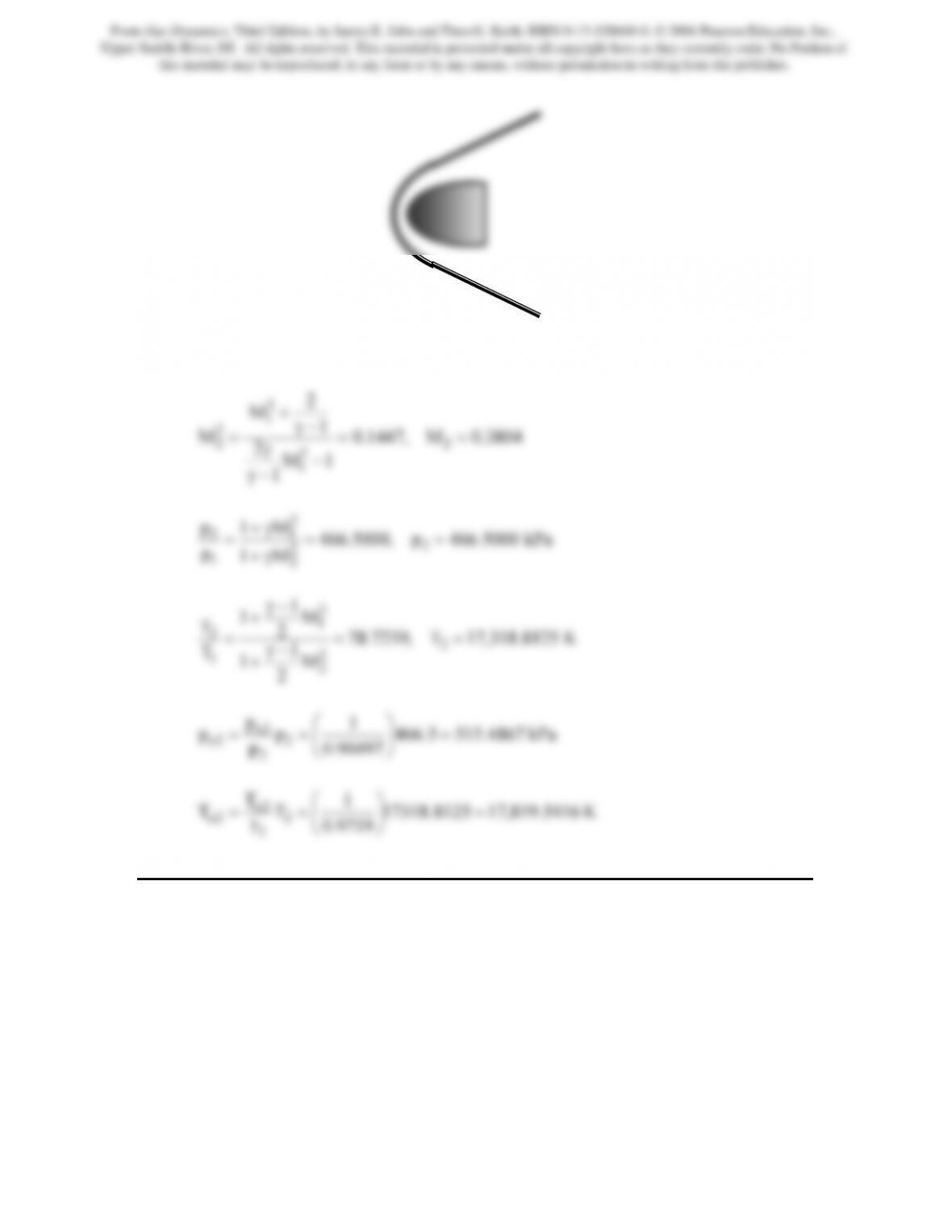
61
Figure P4.6
9719.0
T
2
2o =
⎠
⎝
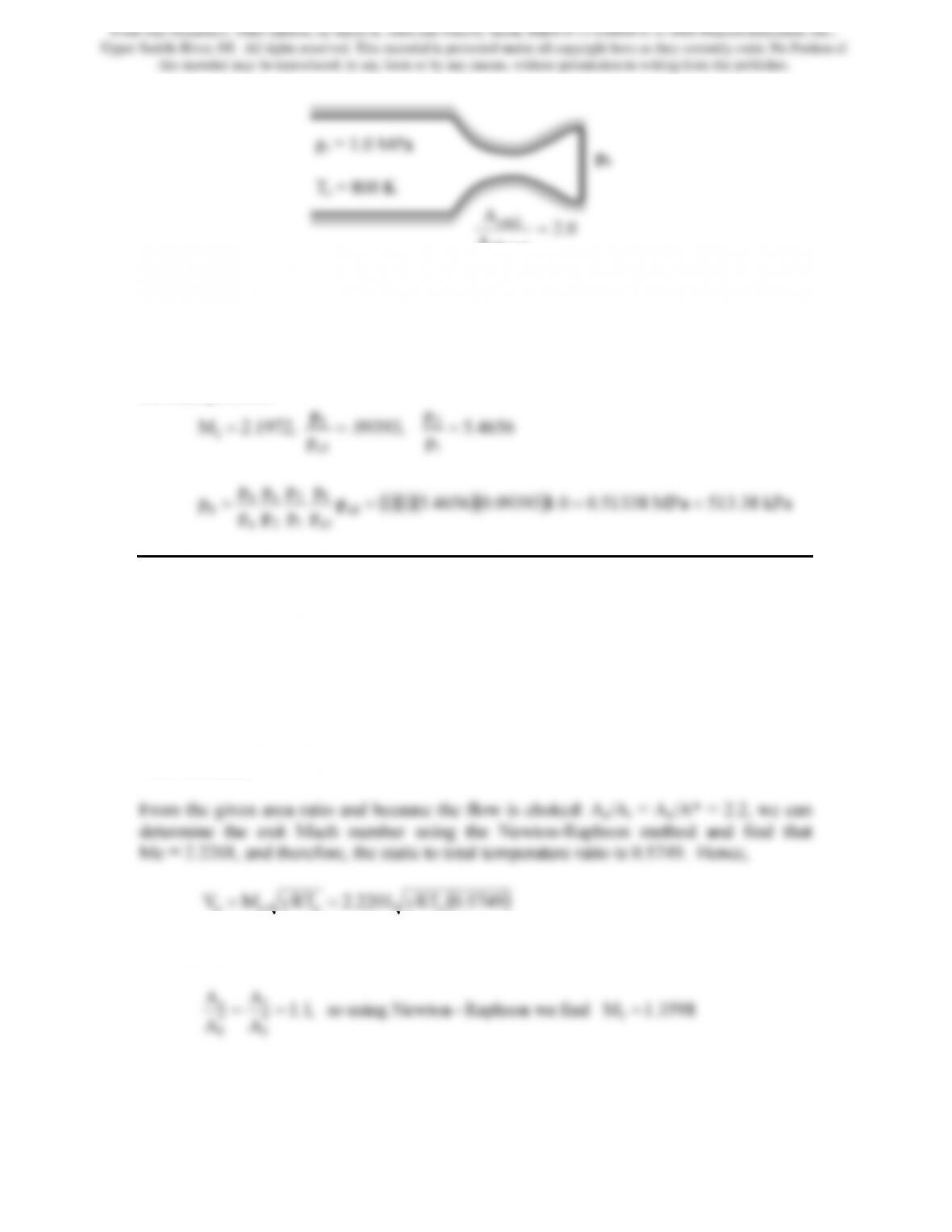
Problem 7. – Determine the back pressure necessary for a normal shock to appear at the
exit of a converging-diverging nozzle, as shown in Figure P4.7. Assume γ = 1.4.
From Gas Dynamics, Third Edition, by James E. John and Theo G. Keith. ISBN 0-13-120668-0. © 2006 Pearson Education, Inc.,
Upper Saddle River, NJ. All rights reserved. This material is protected under all copyright laws as they currently exist. No Portion of
this material may be reproduced, in any form or by any means, without permission in writing from the publisher.
From Gas Dynamics, Third Edition, by James E. John and Theo G. Keith. ISBN 0-13-120668-0. © 2006 Pearson Education, Inc.,
Upper Saddle River, NJ. All rights reserved. This material is protected under all copyright laws as they currently exist. No Portion of
this material may be reproduced, in any form or by any means, without permission in writing from the publisher.
A
p
*
1
2o ==
()()( )
1256.29662.012.2
A
A
A
A
*
2
*
1
t
*
2
From this area ratio we are able to extract the exit Mach number again using the
Newton-Raphson method, therefore, the static to total temperature ratio
decrease 82.9502%
6833.1
2870.0
1100
=
⎟
⎠
⎞
⎜
⎝
⎛−=
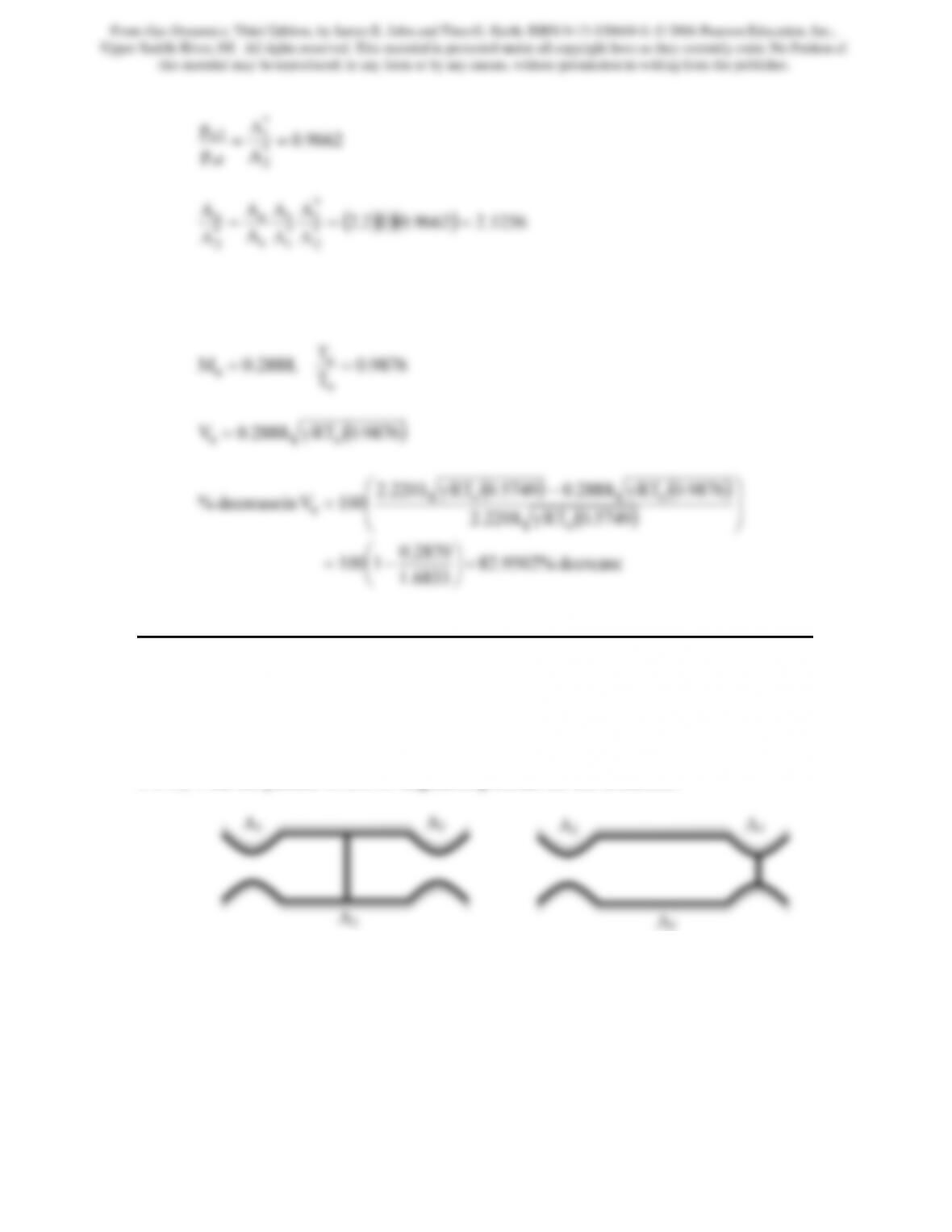
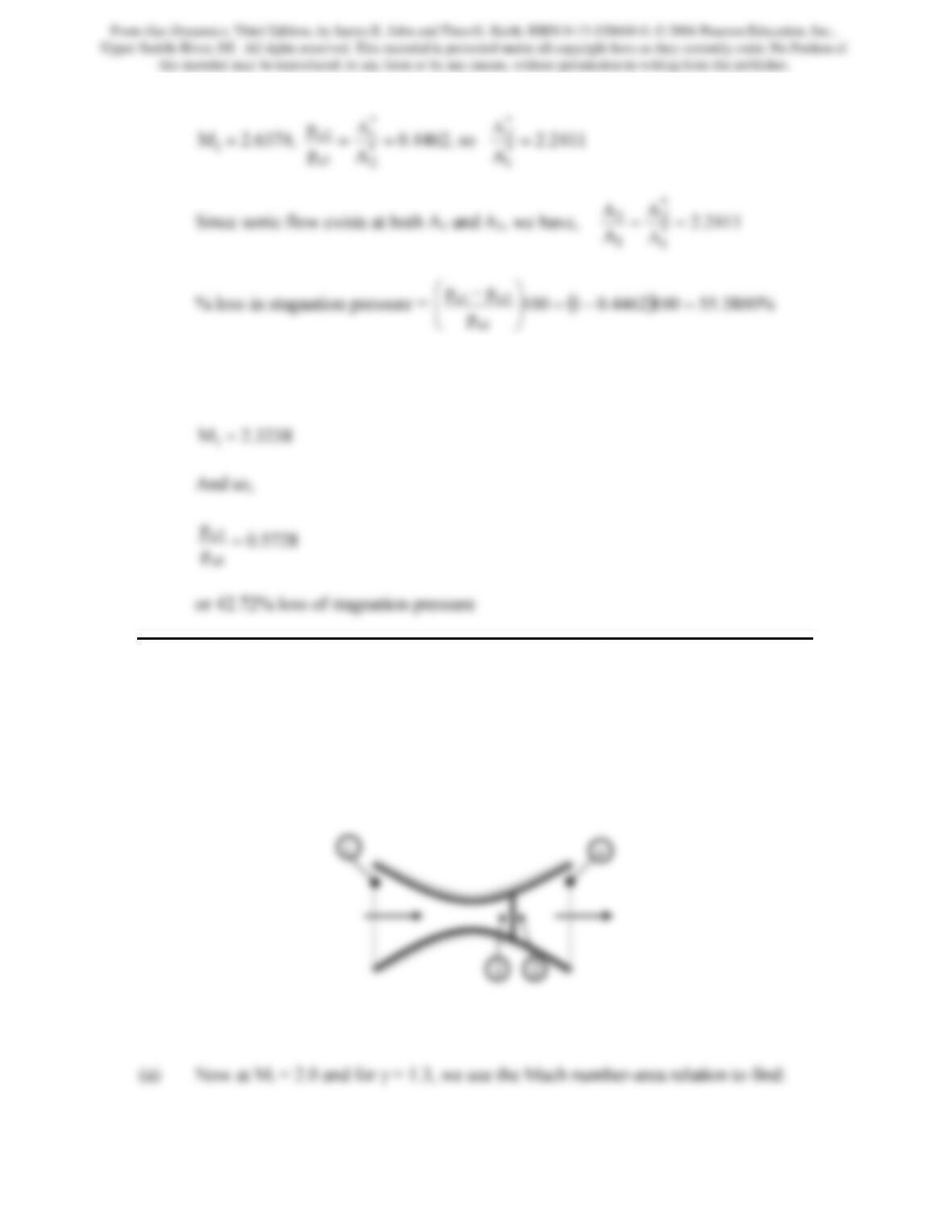
Problem 9. – A flow system consists of two converging-diverging nozzles in series (see
Figure P4.9a. If the area ratio (exit to throat) of each nozzle is 3.0 to 1, find the area ratio
A3/Al necessary to produce sonic flow at the second throat, with a shock at A2. Assume
isentropic flow except for the normal shock. Find the percent of loss in stagnation
pressure for this flow. At another operating condition, a shock appears at A3 (Figure
P4.9b). Find the percent of loss of stagnation pressure for this condition.
From Gas Dynamics, Third Edition, by James E. John and Theo G. Keith. ISBN 0-13-120668-0. © 2006 Pearson Education, Inc.,
Upper Saddle River, NJ. All rights reserved. This material is protected under all copyright laws as they currently exist. No Portion of
this material may be reproduced, in any form or by any means, without permission in writing from the publisher.
A
A
p
*
2
*
1
2o
% loss in stagnation pressure =
()
%3800.551004462.01100
p
1o
2o1o =−=
⎟
⎟
⎠
⎜
⎜
⎝
(b) For shock at A3, we have from part (a) A3/A1 = A3/A* = 2.411. Using this area
ratio, we can find the Mach number on the upstream side of the shock, i.e.,
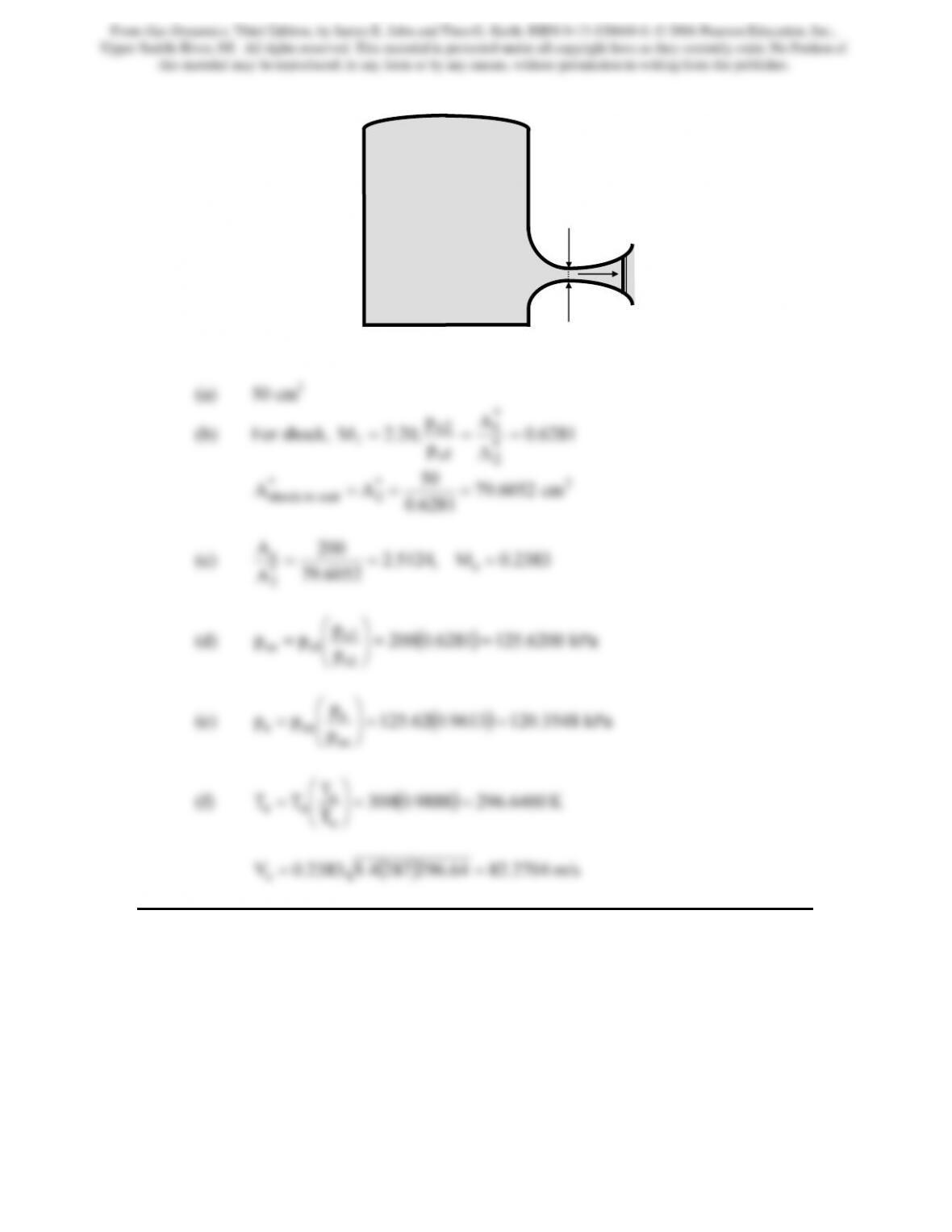
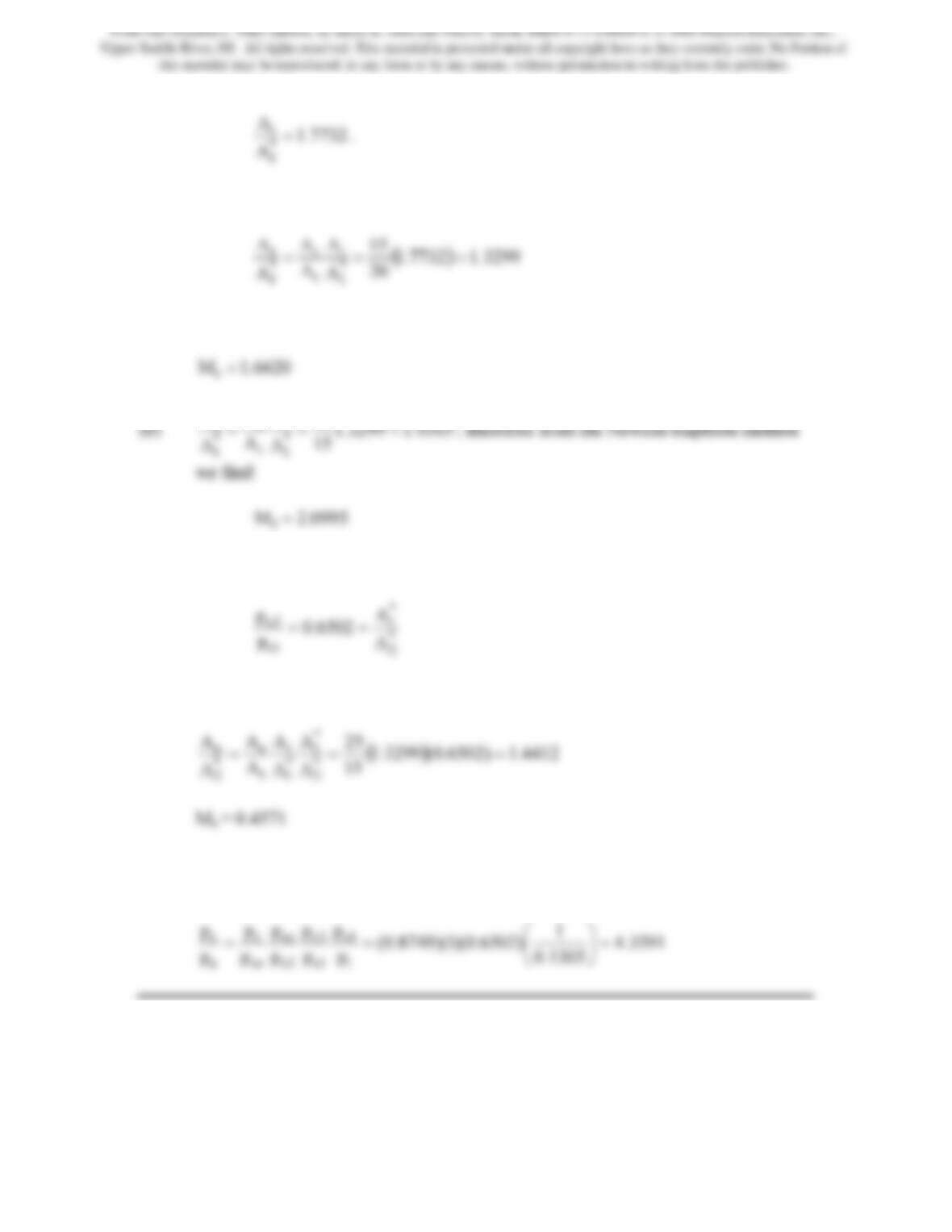
Problem 10. – For the system shown in Figure P4.10, Mi = 2.0, Ai = 20 cm2, throat area =
15 cm2, shock area = 22 cm2, and exit area = 25 cm2. With the working fluid behaving as
a perfect gas with constant γ = 1.3, find the following:
(a) Throat Mach number
(b) Exit Mach number
(c) Ratio of exit static pressure to static pressure at i
Figure P4.10
1 2
From Gas Dynamics, Third Edition, by James E. John and Theo G. Keith. ISBN 0-13-120668-0. © 2006 Pearson Education, Inc.,
Upper Saddle River, NJ. All rights reserved. This material is protected under all copyright laws as they currently exist. No Portion of
this material may be reproduced, in any form or by any means, without permission in writing from the publisher.
65
7732.1
A
A
*
1
i=.
Hence,
()
3299.17732.1
20
A
A
A
*
1
i
*
1
From which we determine the result of part (a),
22
A
A
A
t
s
s=== ; therefore from the Newton-Raphson method
At this Mach number we can compute the total pressure ratio across the shock
*
2
1
1o
2o
A
6502.0
p
Thus,
(c) From the various Mach numbers computed thus far, we may determine the
following pressure ratios and form the string,
1
p
p
p
p
p
1o
2o
oe
e
e=
⎞
⎛
Problem 11. – A jet plane uses a diverging passage as a diffuser (Figure P4.11). For a
flight Mach number of 1.8, determine the range of back pressures over which a normal
shock will appear in the diffuser. Ambient pressure and temperature are 25 kPa and
220 K. Find the mass flow range handled by the diffuser for the determined back pressure
From Gas Dynamics, Third Edition, by James E. John and Theo G. Keith. ISBN 0-13-120668-0. © 2006 Pearson Education, Inc.,
Upper Saddle River, NJ. All rights reserved. This material is protected under all copyright laws as they currently exist. No Portion of
this material may be reproduced, in any form or by any means, without permission in writing from the publisher.
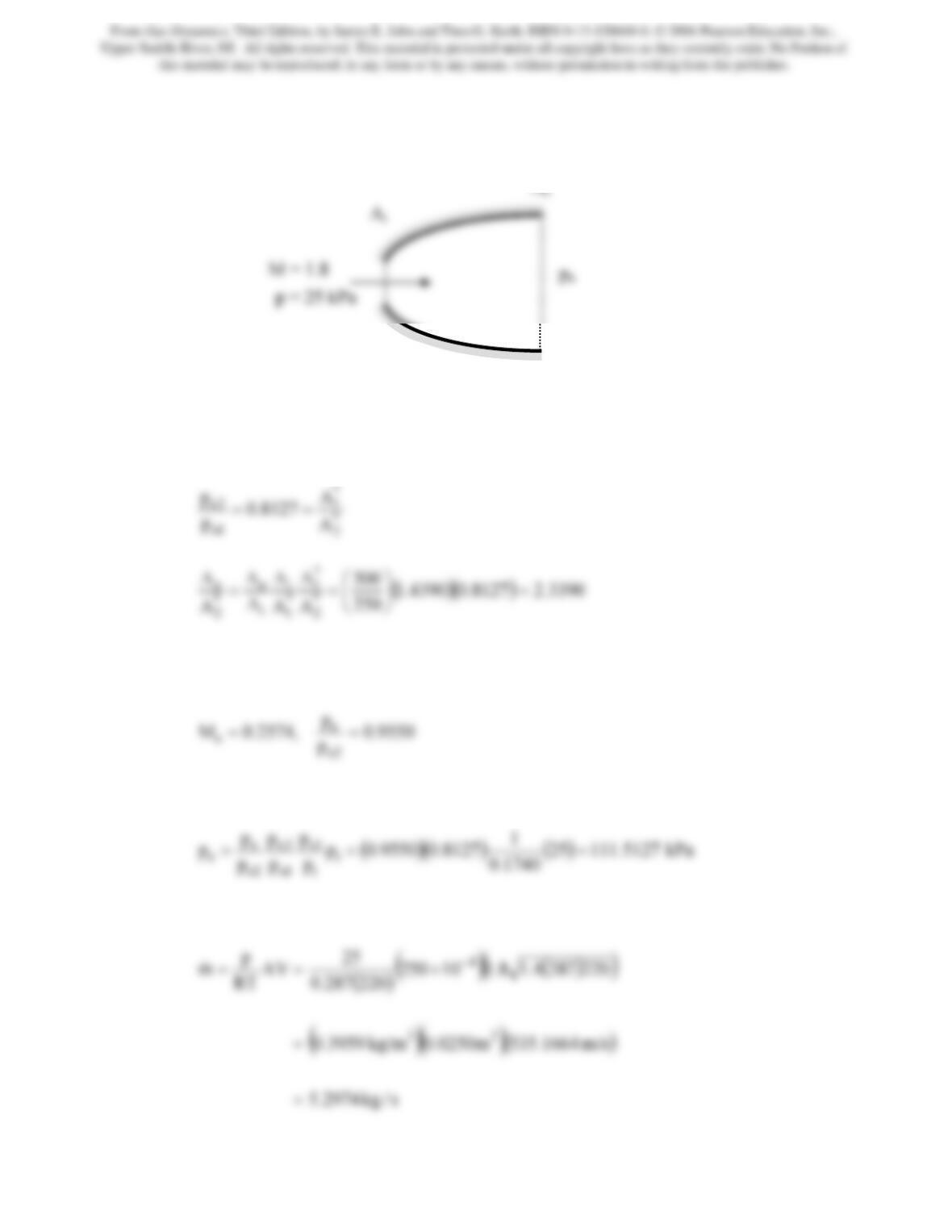
range. Also, the inlet and exit area are Ai = 250 cm2, Ae = 500 cm2. Assume isentropic
flow except for the shocks. Take γ = 1.4.
From Gas Dynamics, Third Edition, by James E. John and Theo G. Keith. ISBN 0-13-120668-0. © 2006 Pearson Education, Inc.,
Upper Saddle River, NJ. All rights reserved. This material is protected under all copyright laws as they currently exist. No Portion of
this material may be reproduced, in any form or by any means, without permission in writing from the publisher.
For a shock at the exit,
1740.0
p
p
p
1o
1
e=
⎠
⎝
∞
The diffuser is choked so it passes the same mass flow for the back pressure range,
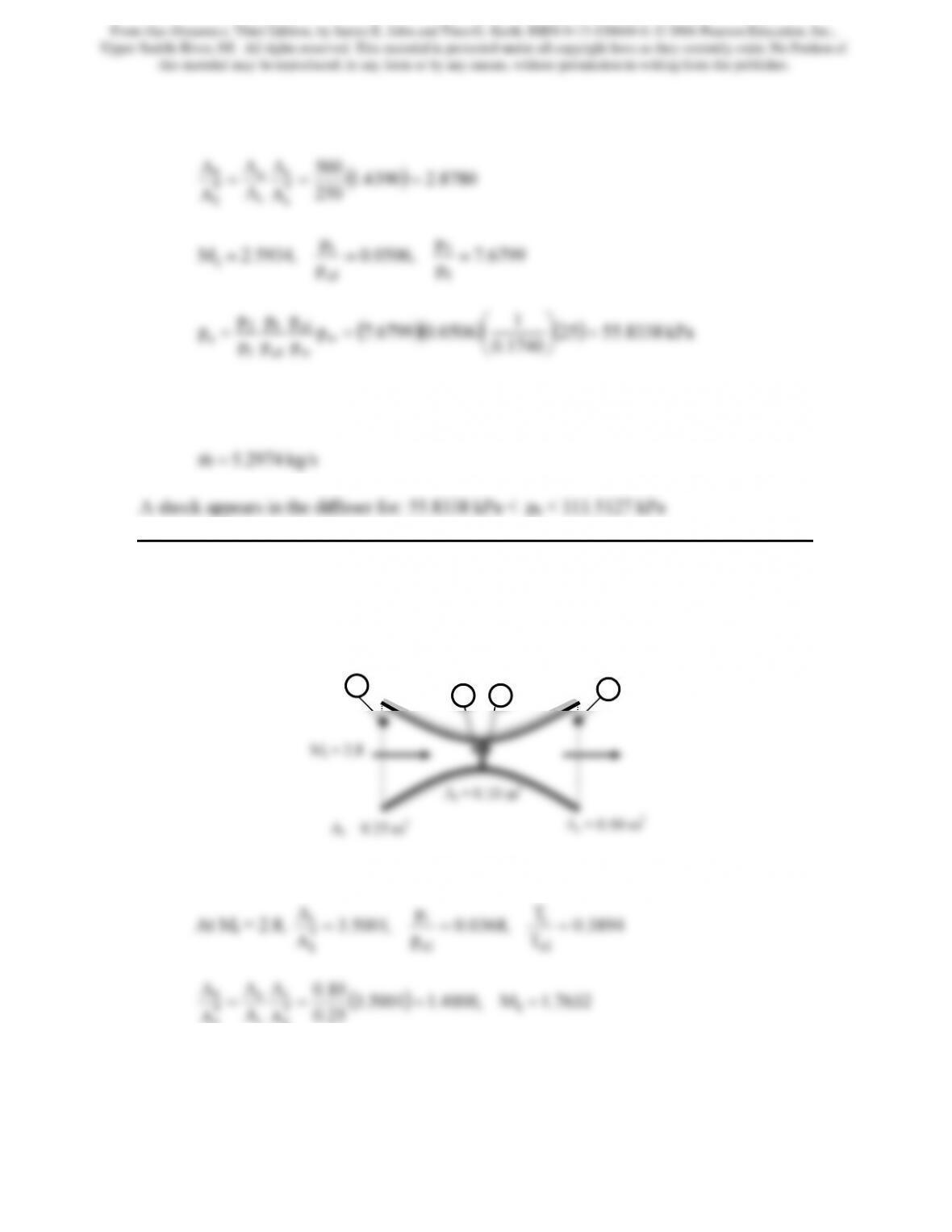
Problem 12. – Air (γ = 1.4) enters a converging-diverging diffuser with a Mach number
of 2.8, static pressure pi of 100 kPa, and a static temperature of 20°C. For the flow
situation shown in Figure P4.12, find the exit velocity, exit static pressure, and exit
stagnation pressure.
1 2 e
i
From Gas Dynamics, Third Edition, by James E. John and Theo G. Keith. ISBN 0-13-120668-0. © 2006 Pearson Education, Inc.,
Upper Saddle River, NJ. All rights reserved. This material is protected under all copyright laws as they currently exist. No Portion of
this material may be reproduced, in any form or by any means, without permission in writing from the publisher.
*
1
2o
A
p==
()()
8025.58289.05001.3
25.0
A
A
A
A
*
2
*
1
i
*
2
From this area ratio we can compute the exit Mach number
=
Problem 13. – Write a computer program that will yield values of p2/p1, ρ2/ρ1, T2/T1, and
po2/po1 for a fixed normal shock with a working fluid consisting of a perfect gas with
constant γ = 1.20. Use Mach number increments of 0.05 over the range M = 1.0 to M =
2.5.
1
−
γ
From Gas Dynamics, Third Edition, by James E. John and Theo G. Keith. ISBN 0-13-120668-0. © 2006 Pearson Education, Inc.,
Upper Saddle River, NJ. All rights reserved. This material is protected under all copyright laws as they currently exist. No Portion of
this material may be reproduced, in any form or by any means, without permission in writing from the publisher.