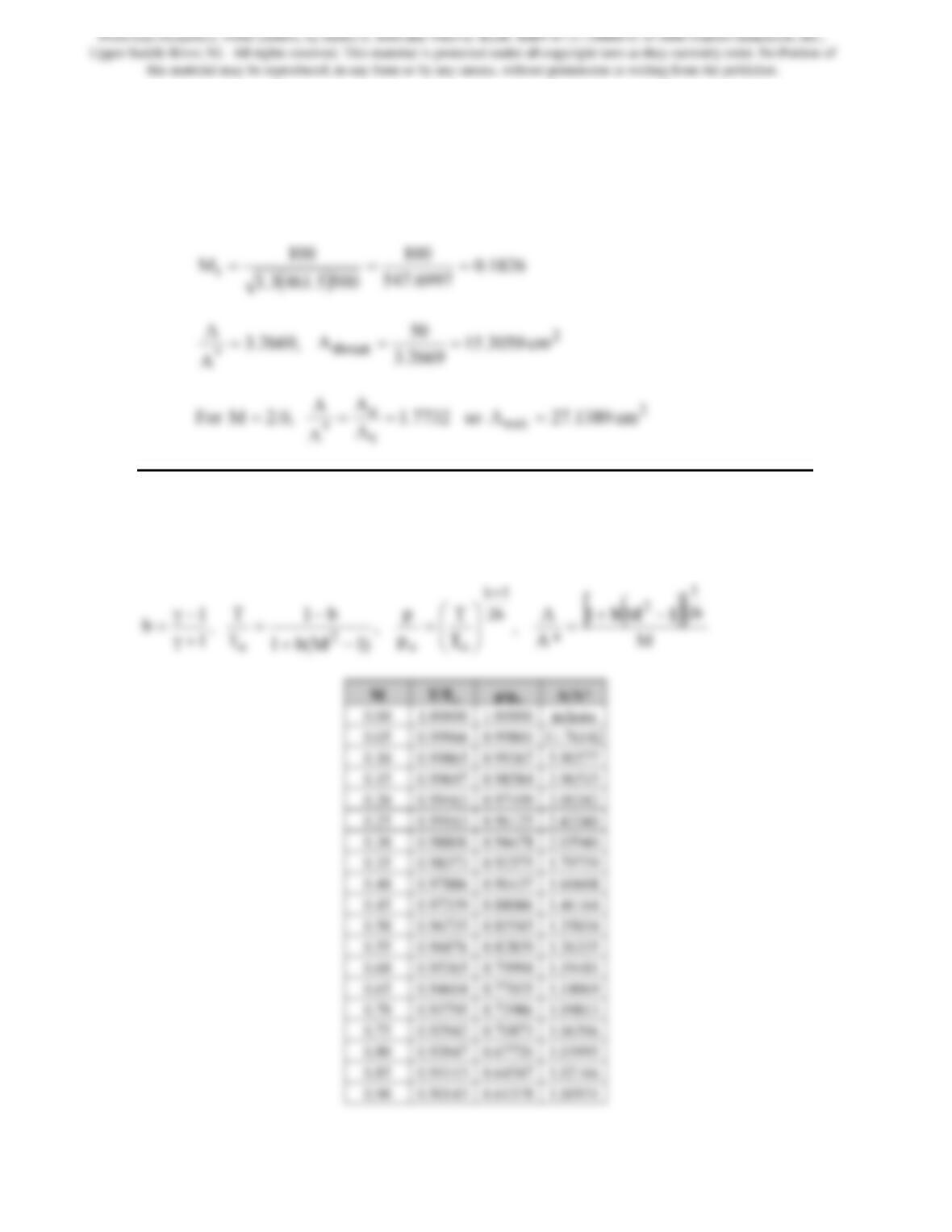
Problem 16. – Steam is to be expanded to Mach 2.0 in a converging-diverging nozzle
from an inlet velocity of 100 m/s. The inlet area is 50 cm2; inlet static temperature is 500
K. Assuming isentropic flow, determine the throat and exit areas required. Assume the
steam to behave as a perfect gas with constant γ = 1.3.
100
100
exit
t
*cm 1389.27A so7732.1
A
A
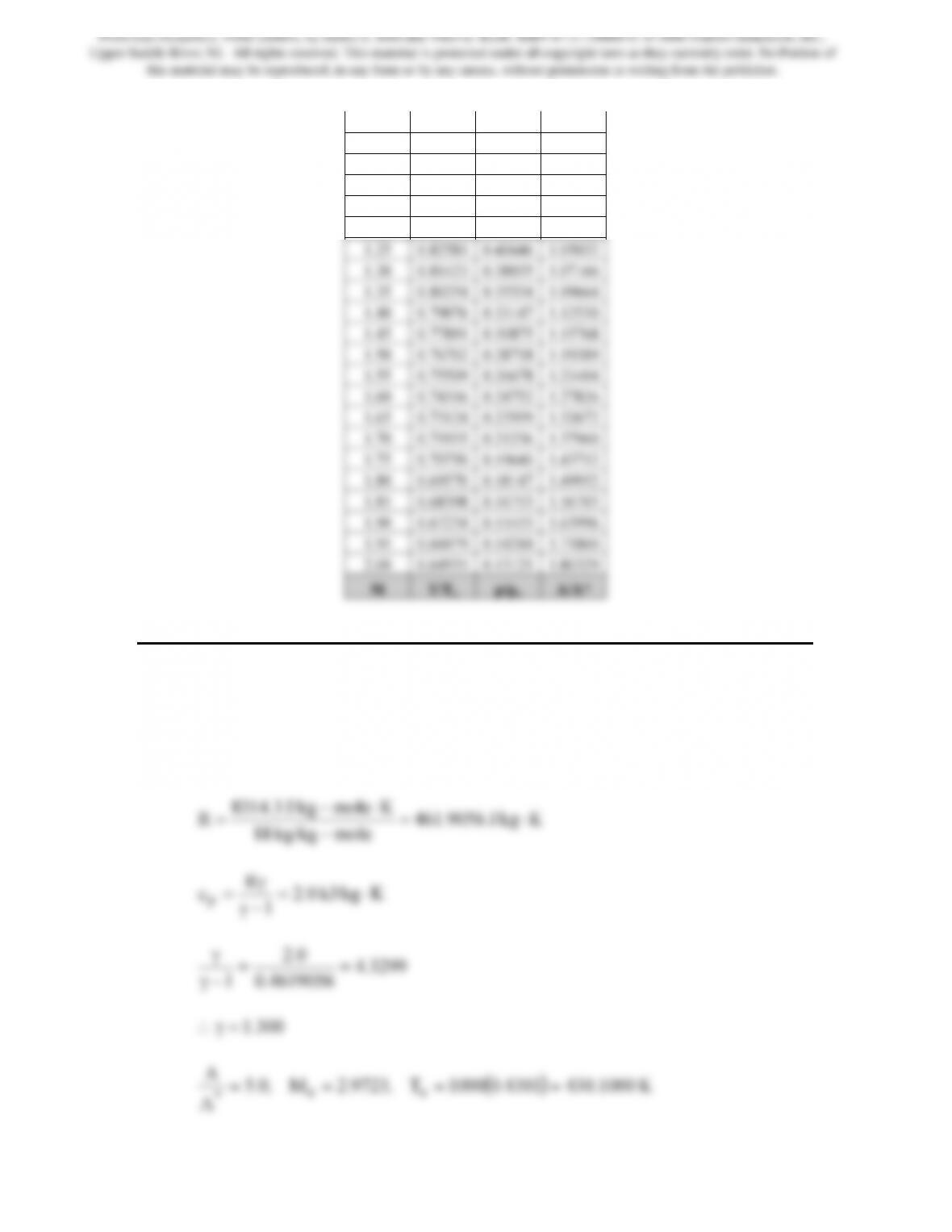
Problem 17. – Write a computer program that will yield values of T/To, p/po, and A/A*
for isentropic flow of a perfect gas with constant γ = 1.27. Use Mach number increments
of 0.05 over the range M = 0 to M = 2.0.
1
b+γ
−
γ
=,
b1
T
2
−
=, b2
1b
T
p
+
⎟
⎟
⎞
⎜
⎜
⎛
=,
()
[
]
1Mb1
Ab2
1
2−+
=
From Gas Dynamics, Third Edition, by James E. John and Theo G. Keith. ISBN 0-13-120668-0. © 2006 Pearson Education, Inc.,
Upper Saddle River, NJ. All rights reserved. This material is protected under all copyright laws as they currently exist. No Portion of
this material may be reproduced, in any form or by any means, without permission in writing from the publisher.
0.95 0.89139 0.58230 1.00226
1.00 0.88106 0.55121 1.00000
1.05 0.87045 0.52067 1.00215
1.10 0.85959 0.49081 1.00844
1.15 0.84851 0.46177 1.01864
1.20 0.83724 0.43362 1.03264
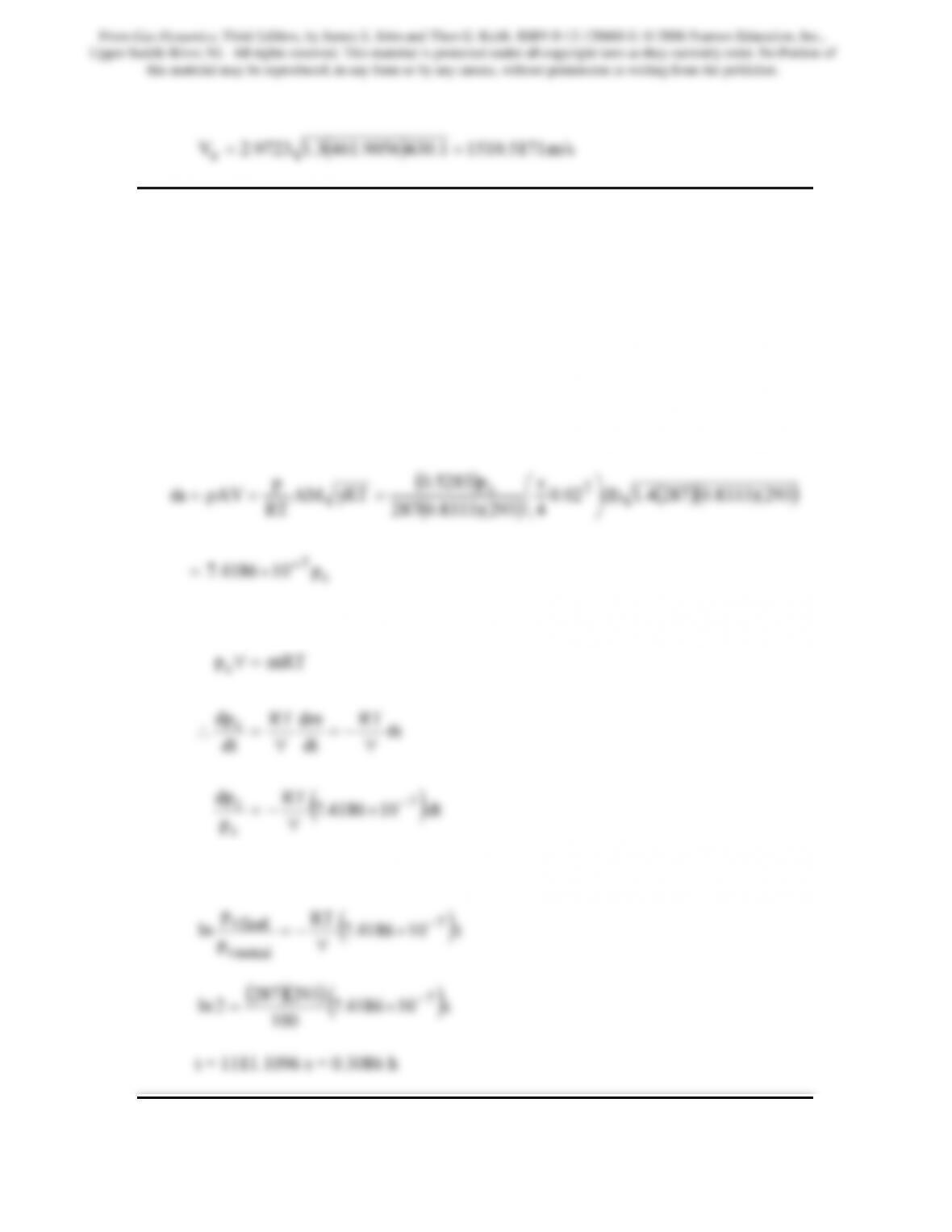
Problem 18. – A gas is known to have a molecular mass of 18, with cp = 2.0 kJ/kg · K.
The gas is expanded from negligible initial velocity through a converging-diverging
nozzle with an area ratio of 5.0. Assuming an isentropic expansion in the nozzle with
initial stagnation pressure and temperature 1 MPa and 1000 K, respectively, determine
the exit nozzle velocity.
From Gas Dynamics, Third Edition, by James E. John and Theo G. Keith. ISBN 0-13-120668-0. © 2006 Pearson Education, Inc.,
Upper Saddle River, NJ. All rights reserved. This material is protected under all copyright laws as they currently exist. No Portion of
this material may be reproduced, in any form or by any means, without permission in writing from the publisher.
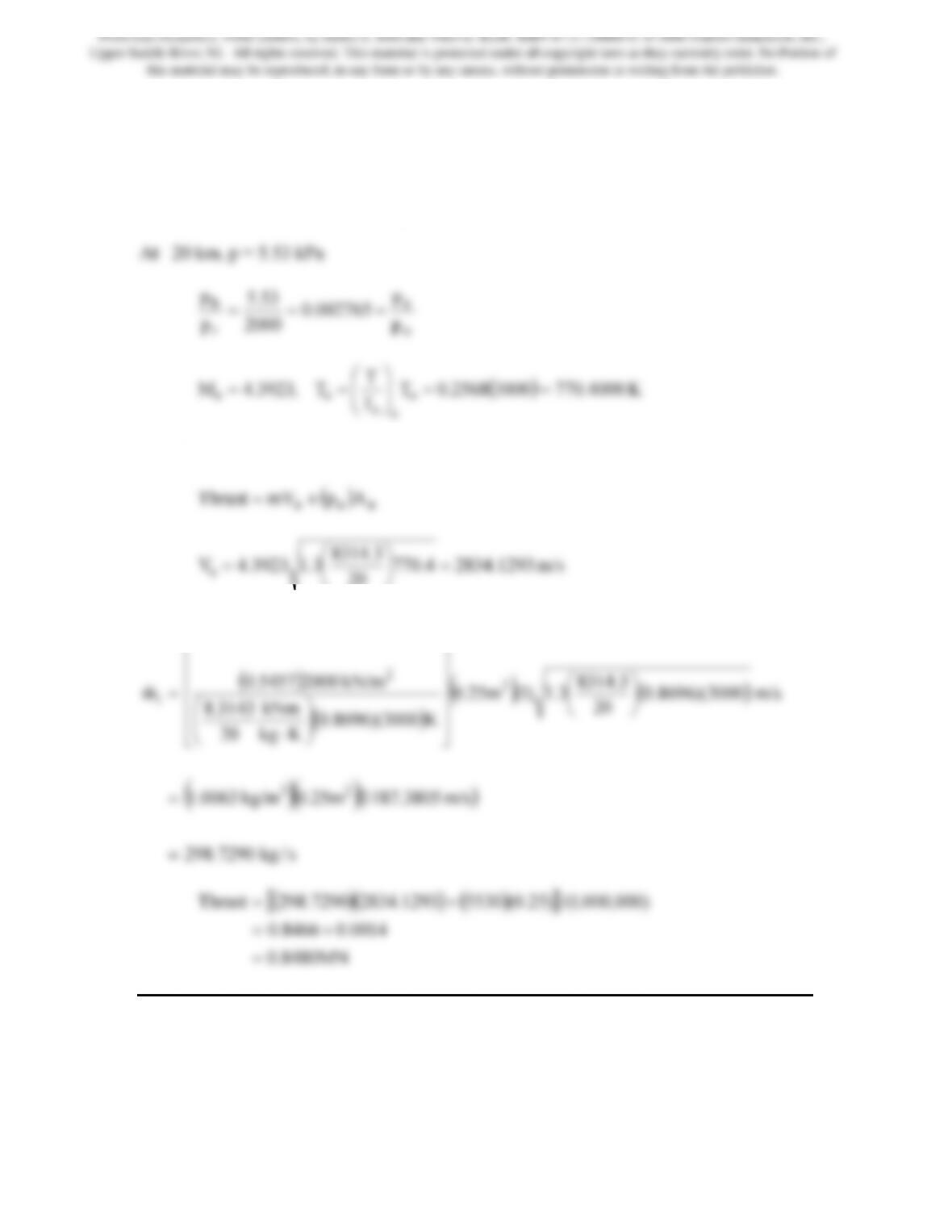
Problem 19. – A jet plane is flying at 10 km with a cabin pressure of 101 kPa and a cabin
temperature of 20°C. Suddenly a bullet is fired inside the cabin and pierces the fuselage;
the resultant hole is 2 cm in diameter. Assume that the temperature within the cabin
remains constant and that the flow through the hole behaves as that through a converging
nozzle with an exit diameter of 2.0 cm. Take the cabin volume to be 100 m3. Calculate
the time for the cabin pressure to decrease to one-half the initial value. At 10 km, p =
26.5 kPa and T = 223.3 K.
Because the back pressure to cabin pressure is 26.5/101 = 0.2624, which is less than
0.5283 the critical pressure ratio at γ = 1.4, the flow is choked and Me = 1. Hence, the
mass flow rate is
p104186.7
c
7
−
×=
In the cabin,
()
dt 104186.7
RT
p
dp
m
RT
dt
dmRT
dt
dp
mRTp
7
c
c
c
c
−
×
∀
−=
∀
−=
∀
=
∴
=∀
&
Integration produces,
RT
p
final
c−
From Gas Dynamics, Third Edition, by James E. John and Theo G. Keith. ISBN 0-13-120668-0. © 2006 Pearson Education, Inc.,
Upper Saddle River, NJ. All rights reserved. This material is protected under all copyright laws as they currently exist. No Portion of
this material may be reproduced, in any form or by any means, without permission in writing from the publisher.
47
Problem 20. – A rocket nozzle is designed to operate isentropically at 20 km with a
chamber pressure of 2.0 MPa and chamber temperature of 3000 K. If the products of
combustion are assumed to behave as a perfect gas with constant specific heats (γ = 1.3
and MM = 20), determine the design thrust for a nozzle throat area of 0.25 m2.
T
e
o
ee ==
⎟
⎠
⎜
⎝
At design
20
⎠
⎝
Now at the throat M t = 1, so (p/po)t = 0.5457 and (T/To)t = 0.8696.
2
⎥
⎤
⎢
⎡
0.8480MN
=
Problem 21. – A converging nozzle has a rectangular cross section of a constant width of
10 cm. For ease of manufacture, the sidewalls of the nozzle are straight, making an angle
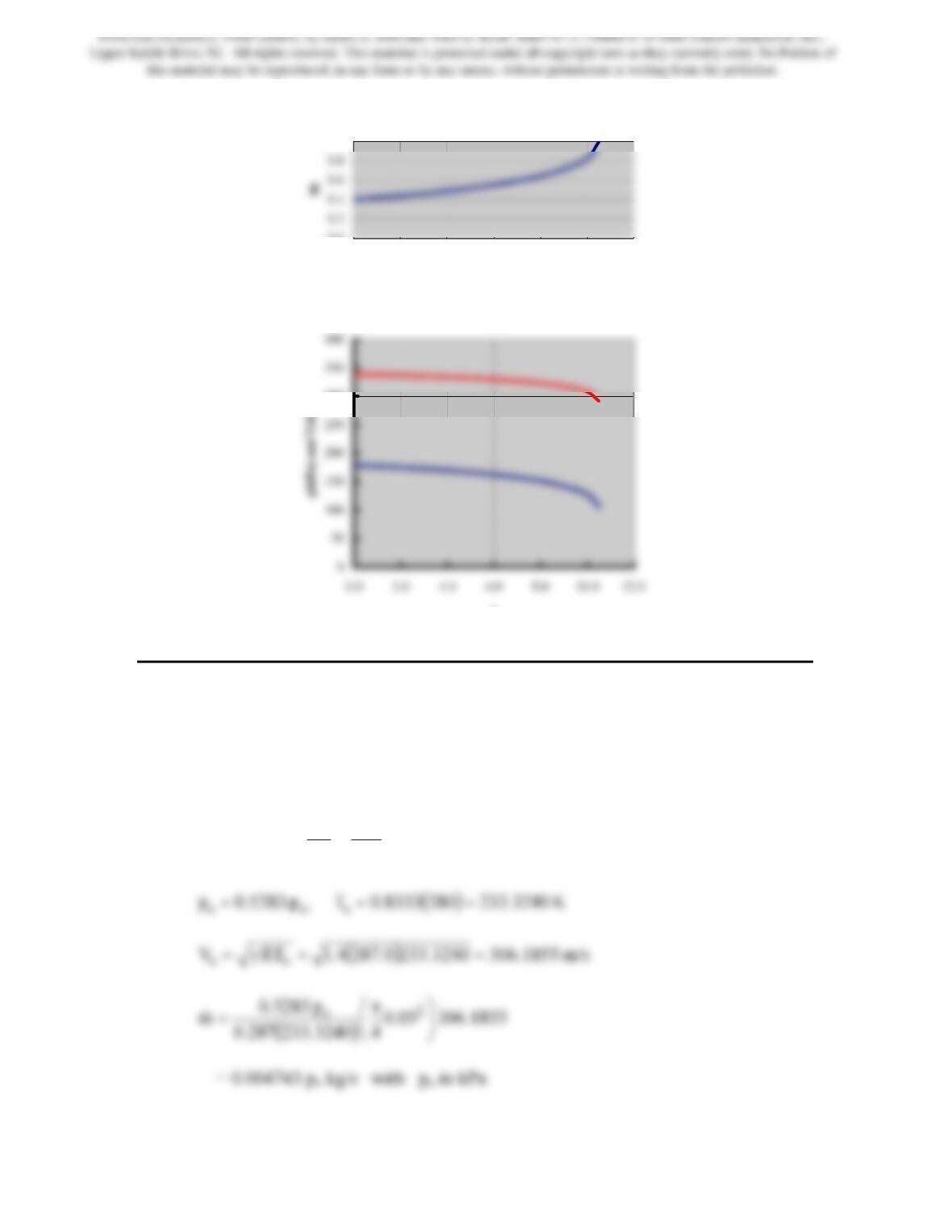
of 10° with the horizontal, as shown in Figure P3.21. Determine and plot the variation of
M, T, and p with x, taking M1 = 0.4, Po1 = 200 kPa, and To1 = 350 K. Assume the
From Gas Dynamics, Third Edition, by James E. John and Theo G. Keith. ISBN 0-13-120668-0. © 2006 Pearson Education, Inc.,
Upper Saddle River, NJ. All rights reserved. This material is protected under all copyright laws as they currently exist. No Portion of
this material may be reproduced, in any form or by any means, without permission in writing from the publisher.
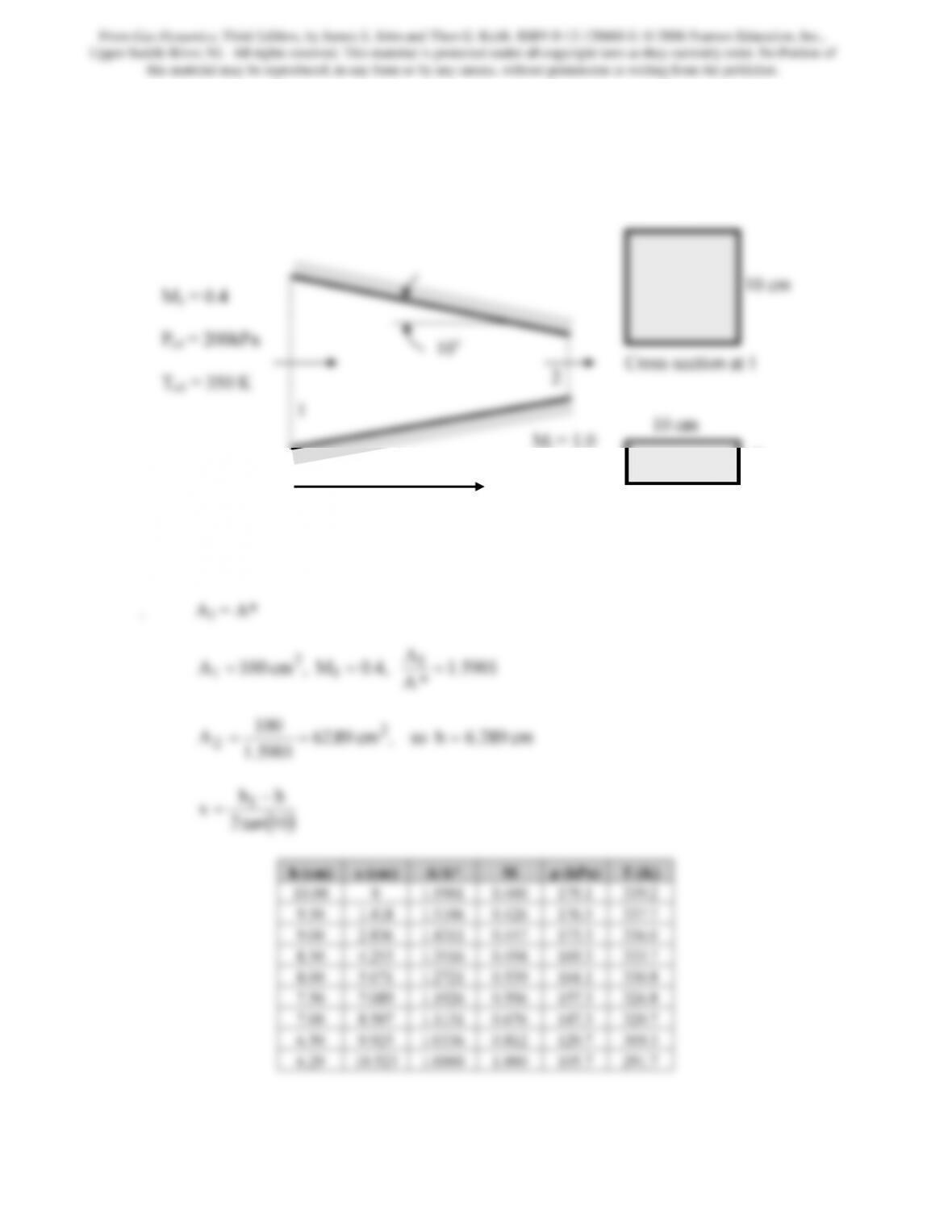
working fluid to be air, which behaves as a perfect gas with constant specific heats
(γ = 1.4), and that the flow is isentropic.
10 cm
From Gas Dynamics, Third Edition, by James E. John and Theo G. Keith. ISBN 0-13-120668-0. © 2006 Pearson Education, Inc.,
Upper Saddle River, NJ. All rights reserved. This material is protected under all copyright laws as they currently exist. No Portion of
this material may be reproduced, in any form or by any means, without permission in writing from the publisher.
0.0
0.2
0.4
0.6
0.8
1.0
0.0 2.0 4.0 6.0 8.0 10.0 12.0
x
400
x
Problem 22. – A spherical tank contains compressed air at 500 kPa; the volume of the
tank is 20 m3. A 5-cm burst diaphragm in the side of the tank ruptures, causing air to
escape from the tank. Find the time required for the tank pressure to drop to 200 kPa.
Assume the temperature of the air in the tank remains constant at 280 K, the ambient
pressure is 101 kPa and that the airflow through the opening can be treated as isentropic
flow through a converging nozzle with a 5-cm exit diameter.
For
()
so choked5283.0 505.0
200
101
p
p
,Pak 200p
o
b
tank <===
From Gas Dynamics, Third Edition, by James E. John and Theo G. Keith. ISBN 0-13-120668-0. © 2006 Pearson Education, Inc.,
Upper Saddle River, NJ. All rights reserved. This material is protected under all copyright laws as they currently exist. No Portion of
this material may be reproduced, in any form or by any means, without permission in writing from the publisher.
In the tank,
po∀= mRT
01838.0
−
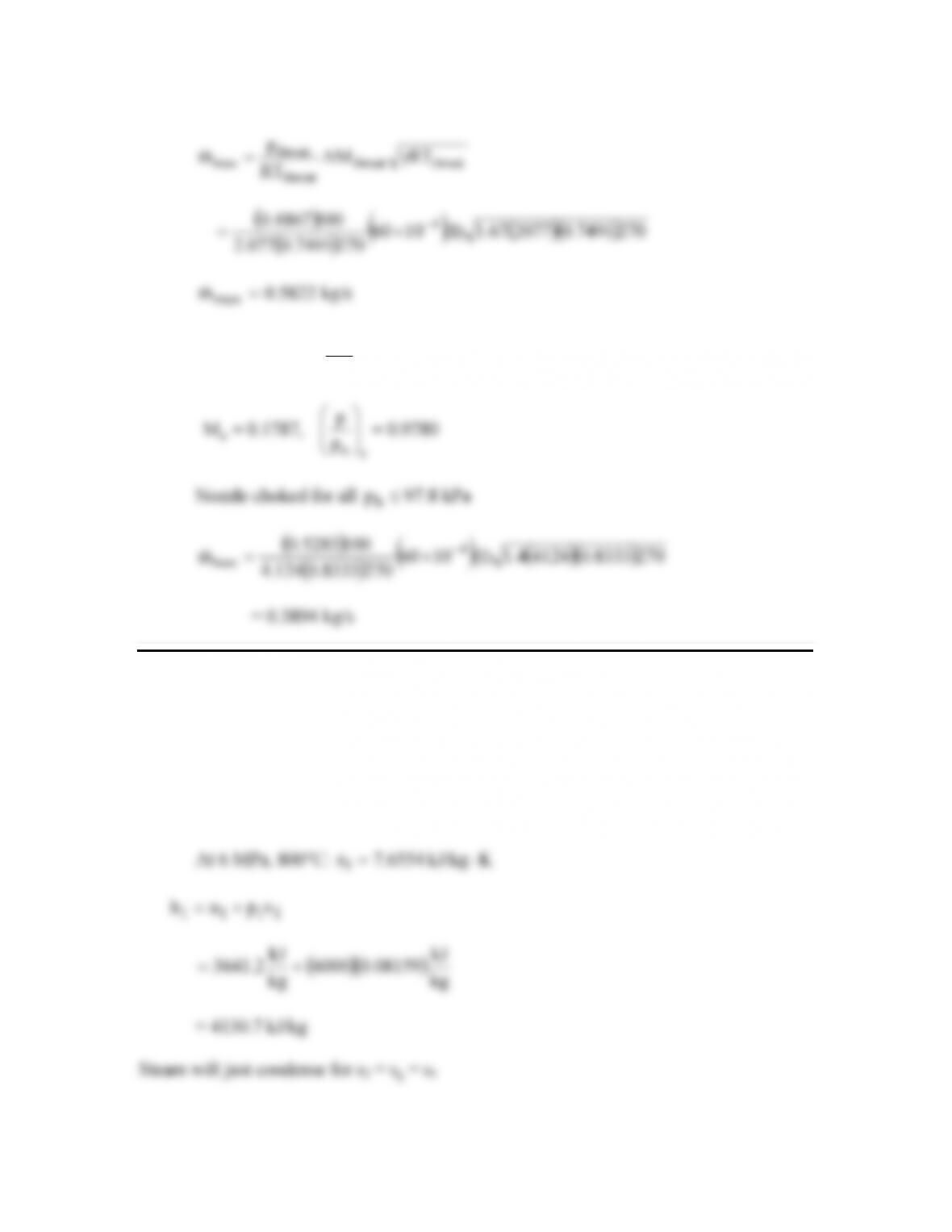
Problem 23. – A converging-diverging nozzle has an area ratio of 3.3 to 1. The nozzle is
supplied from a tank containing a gas at 100 kPa and 270 K (see Figure P3.23).
Determine the maximum mass flow possible through the nozzle and the range of back
pressures over which the mass flow can be attained assuming the gas is (a) helium (γ =
1.67, R = 2.077 kJ/kg·K) and (b) hydrogen (γ = 1.4, R = 4.124 kJ/kg·K).
Figure P3.23
(a) Helium: 3.3
*A
A
,67.1 e==γ
From Gas Dynamics, Third Edition, by James E. John and Theo G. Keith. ISBN 0-13-120668-0. © 2006 Pearson Education, Inc.,
Upper Saddle River, NJ. All rights reserved. This material is protected under all copyright laws as they currently exist. No Portion of
this material may be reproduced, in any form or by any means, without permission in writing from the publisher.
51
throat
p
mγ=
&
(b) Hydrogen: 3.3
*A
A
,40.1 e==γ
Problem 24. – Superheated steam is stored in a large tank at 6 MPa and 800°C. The
steam is exhausted isentropically through a converging-diverging nozzle. Determine the
velocity of the steam flow when the steam starts to condense, assuming the steam to
behave as a perfect gas with γ = 1.3.
Solution Using Steam Table Data
From Gas Dynamics, Third Edition, by James E. John and Theo G. Keith. ISBN 0-13-120668-0. © 2006 Pearson Education, Inc.,
Upper Saddle River, NJ. All rights reserved. This material is protected under all copyright laws as they currently exist. No Portion of
this material may be reproduced, in any form or by any means, without permission in writing from the publisher.
52
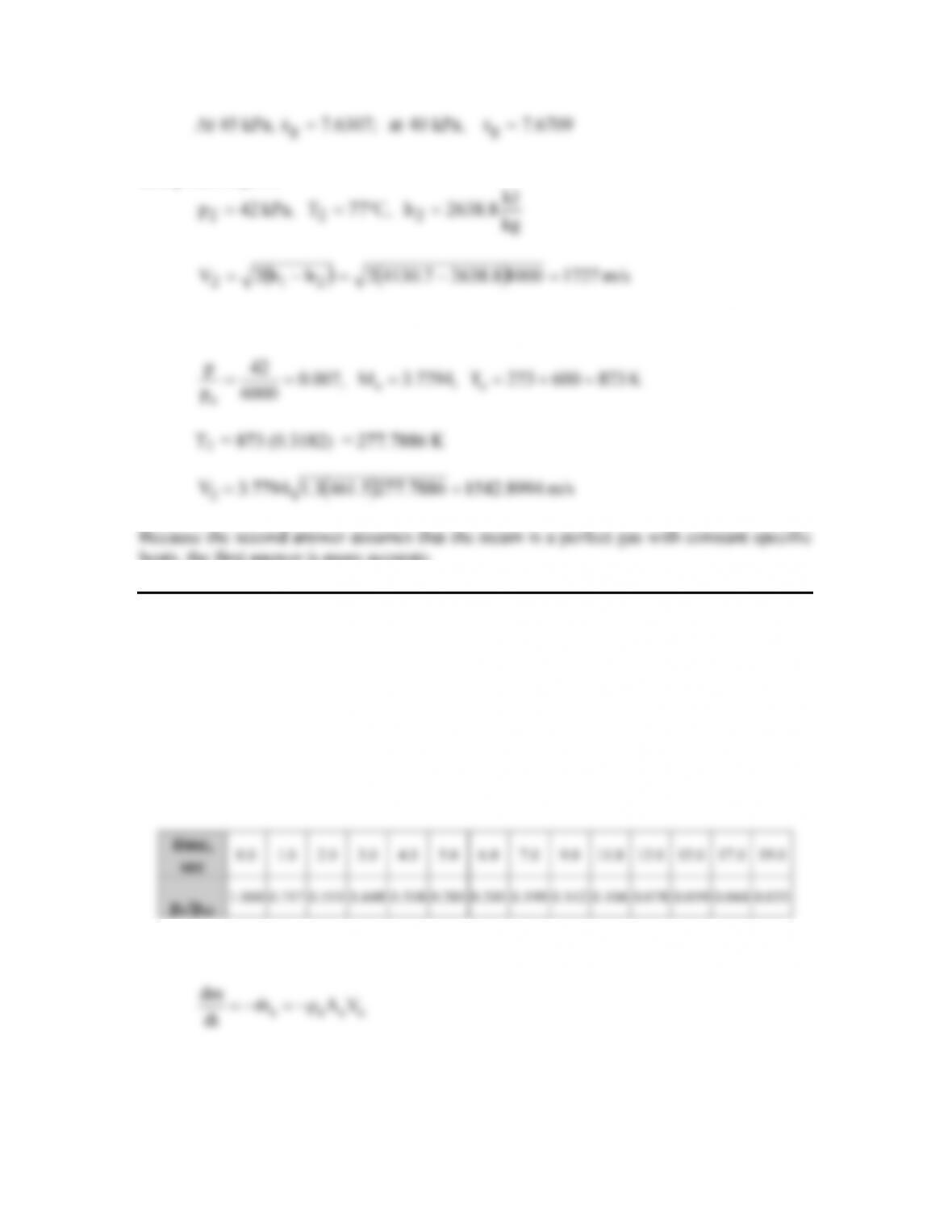
Interpolation gives
kJ
8.2638h ,C77T Pa,k 42p 222 =°==
Solution Assuming Steam is a Perfect Gas
42
p
heats, the first answer is more accurate.
Problem 25. – Air is stored in a tank 0.037661m3 in volume at an initial pressure of
5,760.6 kPa and a temperature of 321.4K. The gas is discharged through a converging
nozzle with an exit area of 3.167×10⁻⁵ m2. For a back-pressure of 101 kPa, assuming a
spatially lumped polytropic process in the tank, i.e., pvn = constant, and isentropic flow in
the nozzle, i.e., pvγ = constant, compare predicted tank pressures to the measured values
contained the following table. Try various values of the polytropic exponent, n, from 1.0
(isothermal) to 1.4 (isentropic). Perform only a Stage I analysis, i.e., the nozzle is
choked.
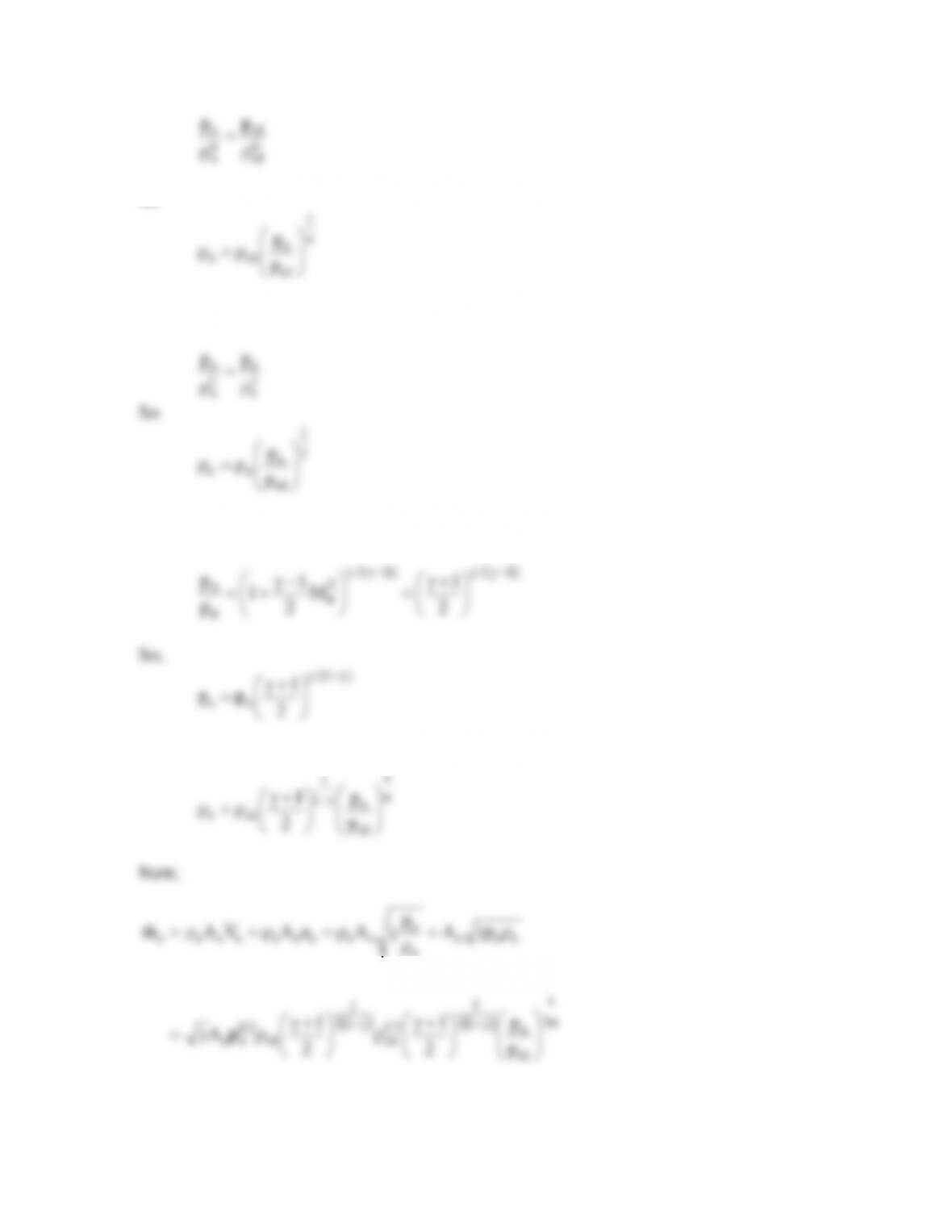
Now from the continuity equation
eeee VAm
dt
For polytropic expansion within the tank
From Gas Dynamics, Third Edition, by James E. John and Theo G. Keith. ISBN 0-13-120668-0. © 2006 Pearson Education, Inc.,
Upper Saddle River, NJ. All rights reserved. This material is protected under all copyright laws as they currently exist. No Portion of
this material may be reproduced, in any form or by any means, without permission in writing from the publisher.
53
1o
1o
o
opp
=
So
1
1o
1oo p
⎠
⎜
⎝
And for isentropic expansion in the nozzle
⎟
⎟
⎠
⎜
⎜
⎝
ρ=ρ
1o
o
oe p
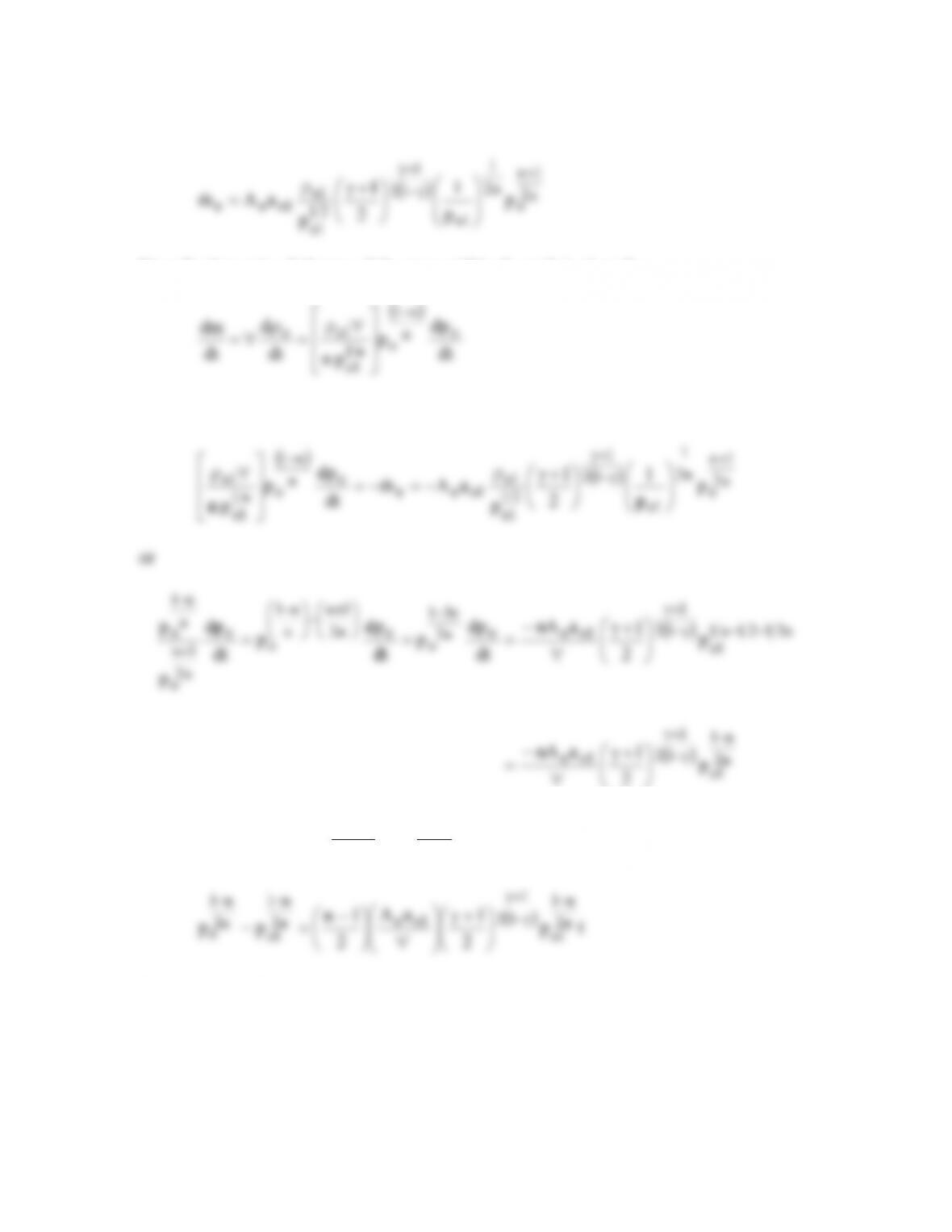
For a choked flow: Me = 1, Ve = ae = √γpe/ρe and
oe 2
⎠
⎝
Therefore,
1
1
() ()
n2
1
1o
o
12
1
21
1o
12
1o
21
oe
e
p
p
2
1
2
1
pA
⎟
⎟
⎠
⎞
⎜
⎜
⎝
⎛
⎟
⎠
⎞
⎜
⎝
⎛+γ
ρ
⎟
⎠
⎞
⎜
⎝
⎛+γ
ργ=
ρ
γ−γ−
γ
From Gas Dynamics, Third Edition, by James E. John and Theo G. Keith. ISBN 0-13-120668-0. © 2006 Pearson Education, Inc.,
Upper Saddle River, NJ. All rights reserved. This material is protected under all copyright laws as they currently exist. No Portion of
this material may be reproduced, in any form or by any means, without permission in writing from the publisher.
54
Using ao1 = √γpo1/ρ01 the mass flow rate at the exit can be written as
1n
1
1
+
+γ
Now the time rate of change of the mass within the tank is given by
(
)
dt
dp
p
pn
dt
d
dt
dm o
n
n1
o
n1
1o
1oo
−
⎥
⎥
⎦
⎤
⎢
⎢
⎣
⎡∀ρ
=
ρ
∀=
Equating this to the exiting flow rate gives
1o
2
⎠
⎝
∀
Integration yields, (note: n2
n1
1
n2
n31
−
=+
−)
n1
1
n1
n1
−
+γ
−−
Rearrangement brings
From Gas Dynamics, Third Edition, by James E. John and Theo G. Keith. ISBN 0-13-120668-0. © 2006 Pearson Education, Inc.,
Upper Saddle River, NJ. All rights reserved. This material is protected under all copyright laws as they currently exist. No Portion of
this material may be reproduced, in any form or by any means, without permission in writing from the publisher.
n1
n2
1
1o
2
2
p
+γ
⎥
⎥
⎦
⎤
⎢
⎢
⎣
⎡
⎠
⎝
⎟
⎠
⎜
⎝
∀
⎠
⎝
Note this is not valid for n =1, the isothermal case which must be treated separately. For
n = 1
o
1o
1oee
1o
2
p
dt
pdt
dt
⎠
⎝
Canceling, separating variables, integrating and rearranging yields,
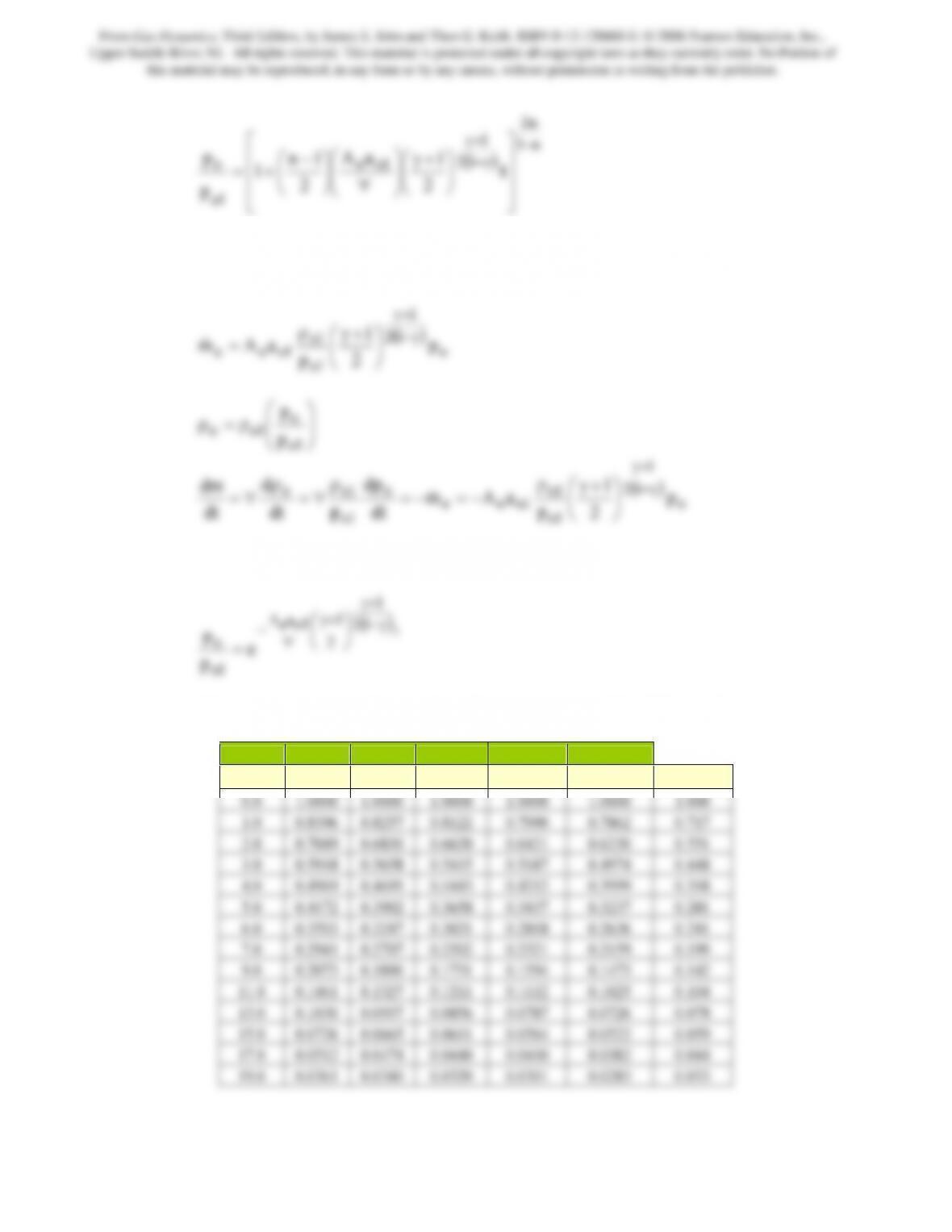
A spreadsheet program was written and run for various n. A table of the results is as
follows
n = 1.0 1.1 1.2 1.3 1.4
t po/po1 po/po1 po/po1 po/po1 po/po1 po/po1 (exp)
From Gas Dynamics, Third Edition, by James E. John and Theo G. Keith. ISBN 0-13-120668-0. © 2006 Pearson Education, Inc.,
Upper Saddle River, NJ. All rights reserved. This material is protected under all copyright laws as they currently exist. No Portion of
this material may be reproduced, in any form or by any means, without permission in writing from the publisher.