32
C
Ch
ha
ap
pt
te
er
r
T
Th
hr
re
ee
e
I
IS
SE
EN
NT
TR
RO
OP
PI
IC
C
F
FL
LO
OW
W
O
OF
F
A
A
P
PE
ER
RF
FE
EC
CT
T
G
GA
AS
S
Problem 1. – Air flows at Mach 0.25 through a circular duct with a diameter of 60 cm.
The stagnation pressure of the flow is 500 kPa; the stagnation temperature is 175°C.
Calculate the mass flow rate through the channel, assuming γ = 1.4 and that the air
behaves as a perfect gas with constant specific heats.
p
⎞
⎛
Problem 2. – Helium flows at Mach 0.50 in a channel with cross-sectional area of 0.16
m2. The stagnation pressure of the flow is 1 MPa, and stagnation temperature is 1000 K.
Calculate the mass flow rate through the channel, with γ = 5/3.
p
⎞
⎛
T
o
⎟
⎠
⎜
⎝
From Gas Dynamics, Third Edition, by James E. John and Theo G. Keith. ISBN 0-13-120668-0. © 2006 Pearson Education, Inc.,
Upper Saddle River, NJ. All rights reserved. This material is protected under all copyright laws as they currently exist. No Portion of
this material may be reproduced, in any form or by any means, without permission in writing from the publisher.
33
Problem 3. – In Problem 2, the cross-sectional area is reduced to 0.12 m2. Calculate the
Mach number and flow velocity at the reduced area. What percent of further reduction in
area would be required to reach Mach 1 in the channel?
12.0
A
A
A
1
2
2=
⎞
⎛
Problem 4. – (a) For small Mach numbers, determine an expression for the density ratio
ρ /ρo. (b) Using Eqs. (3.15) and (3.17), prove that
oo
o
o
a
T
p
⎠
⎜
⎝
=
⎟
⎠
⎜
⎝
=
⎟
⎟
⎠
⎜
⎜
⎝
ρ
⎟
⎟
⎠
⎜
⎜
⎝
(a)
From Gas Dynamics, Third Edition, by James E. John and Theo G. Keith. ISBN 0-13-120668-0. © 2006 Pearson Education, Inc.,
Upper Saddle River, NJ. All rights reserved. This material is protected under all copyright laws as they currently exist. No Portion of
this material may be reproduced, in any form or by any means, without permission in writing from the publisher.
34
⎟
⎠
⎜
⎝
−γ
⎠
⎝
⎠
⎝
ρ
−
2
1
2
2
2
1
o
2
o
2
2
oo
a
a
Ra
Ra
T
T
⎟
⎠
⎞
⎜
⎝
⎛
=
γ
γ
==
Problem 5. – An airflow at Mach 0.6 passes through a channel with a cross-sectional area
of 50 cm2. The static pressure in the airstream is 50 kPa; static temperature is 298 K.
(a) Calculate the mass flow rate through the channel.
(b) What percent of reduction in area would be necessary to increase the flow
Mach number to 0.8? to 1.0?
(c) What would happen if the area were reduced more than necessary to reach
Mach 1?
(a)
()
3
kg/m 5846.0
K 298Km/kgkN 287.0
kPa50
RT
p=
⋅⋅
==ρ
(b) For 0382.1*A/A,8.0M ==
1882.1
(c) Flow would be reduced.
Problem 6. – A converging nozzle with an exit area of 1.0 cm2 is supplied from an
oxygen reservoir in which the pressure is 500 kPa and the temperature is 1200 K.
Calculate the mass flow rate of oxygen for back pressures of 0, 100, 200, 300, and 400
kPa. Assume that γ = 1.3.
From Gas Dynamics, Third Edition, by James E. John and Theo G. Keith. ISBN 0-13-120668-0. © 2006 Pearson Education, Inc.,
Upper Saddle River, NJ. All rights reserved. This material is protected under all copyright laws as they currently exist. No Portion of
this material may be reproduced, in any form or by any means, without permission in writing from the publisher.
For γ = 1.3, the critical pressure ratio is: 5457.0
p
*p
o
=. So, the back pressure is
p
o
b==
⎟
⎠
⎜
⎝
Thus, the nozzle is choked for back-pressures below 272.85 kPa, i.e., for 0, 100, and 200
kPa. For these back pressures, pe = 272.8 kPa and
For pb = pe =300 kPa; thus, ,6.0
500
300
p
p
o
e== from which we find 9133.0Me
=
For pb = pe = 400 kPa, 5935.0M ,8.0
p
p
e
o
e==
From Gas Dynamics, Third Edition, by James E. John and Theo G. Keith. ISBN 0-13-120668-0. © 2006 Pearson Education, Inc.,
Upper Saddle River, NJ. All rights reserved. This material is protected under all copyright laws as they currently exist. No Portion of
this material may be reproduced, in any form or by any means, without permission in writing from the publisher.
400
⎞
⎛
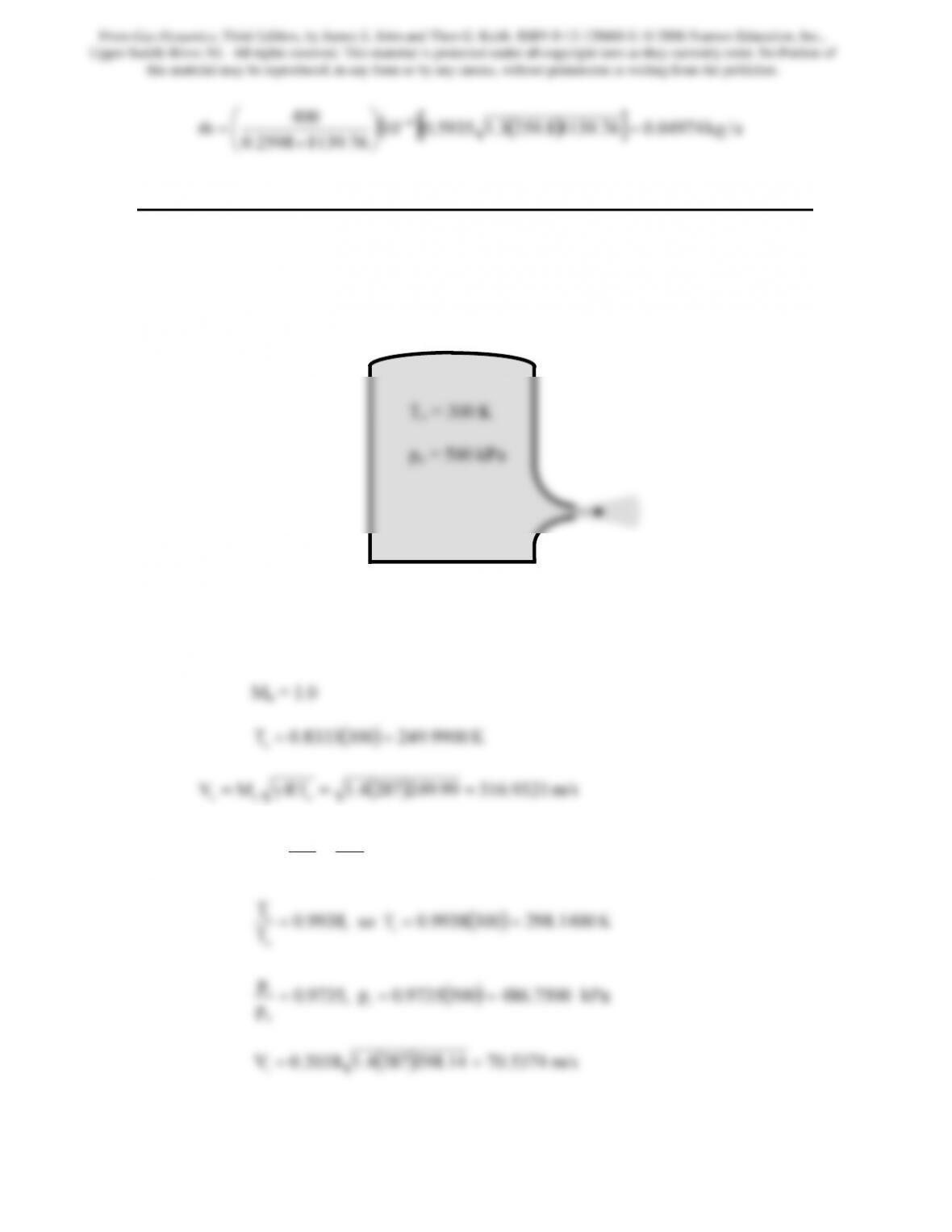
Problem 7. – Compressed air is discharged through the converging nozzle as shown in
Figure P3.7. The tank pressure is 500 kPa, and local atmospheric pressure is 101 kPa.
The inlet area of the nozzle is 100 cm2; the exit area is 34 cm2. Find the force of the air on
the nozzle, assuming the air to behave as a perfect gas with constant γ = 1.4. Take the
temperature in the tank to be 300 K.
Figure P3.7
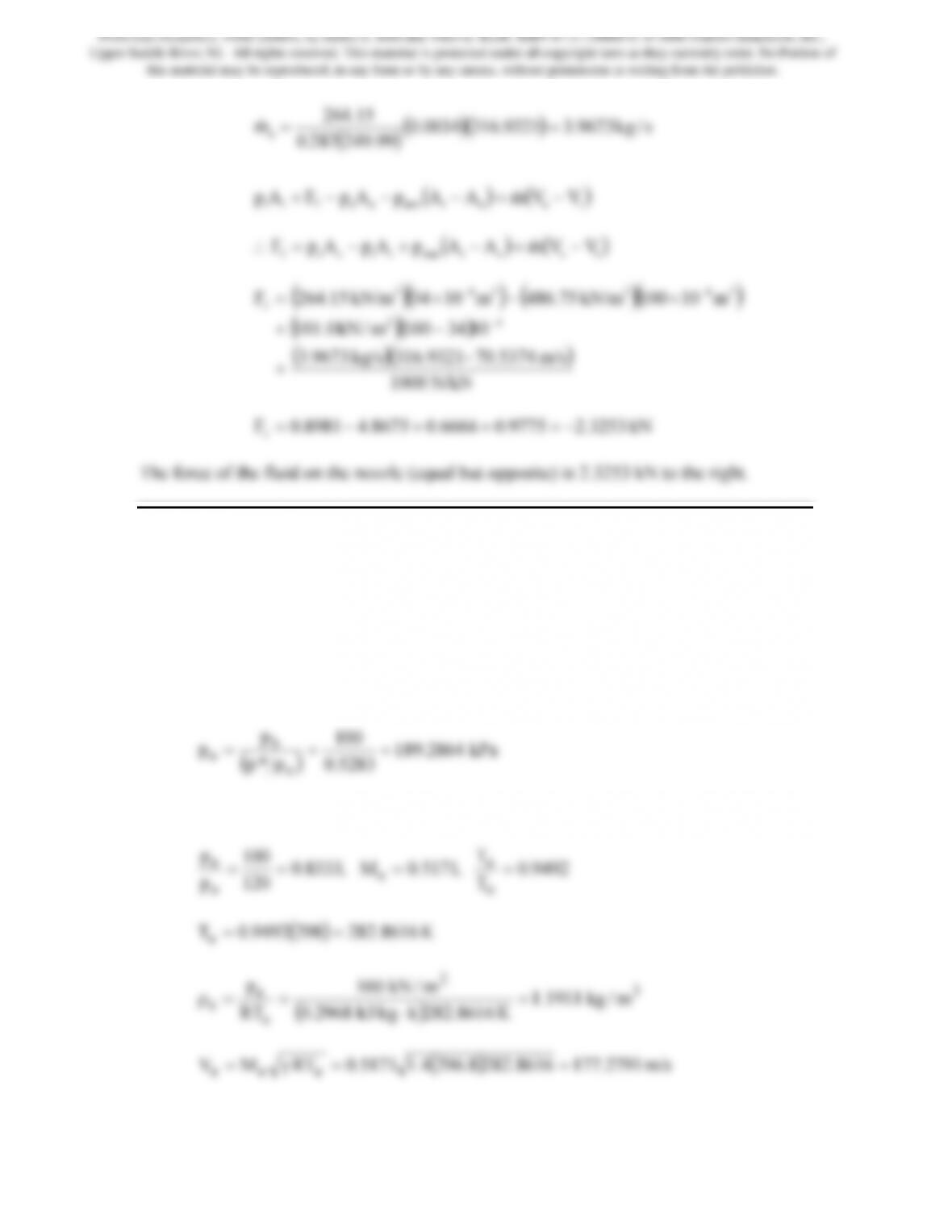
Assume the nozzle is choked. Accordingly, pe = 0.5283 (500 kPa) = 264.15 kPa. Since
this pressure exceeds the back pressure, the assumption is valid.
At the nozzle inlet, 2038.0M findwewhich, from9412.2
34
100
*A
A
i
i===
From Gas Dynamics, Third Edition, by James E. John and Theo G. Keith. ISBN 0-13-120668-0. © 2006 Pearson Education, Inc.,
Upper Saddle River, NJ. All rights reserved. This material is protected under all copyright laws as they currently exist. No Portion of
this material may be reproduced, in any form or by any means, without permission in writing from the publisher.
()( )
s/kg9673.39321.3160034.0
15.264
me==
&
Problem 8. – A converging nozzle has an exit area of 56 cm. Nitrogen stored in a
reservoir is to be discharged through the nozzle to an ambient pressure of 100 kPa.
Determine the flow rate through the nozzle for reservoir pressures of 120 kPa, 140 kPa,
200 kPa, and 1 MPa. Assume isentropic nozzle flow. In each case, determine the increase
in mass flow to be gained by reducing the back pressure from 100 to 0 kPa. Reservoir
temperature is 298 K.
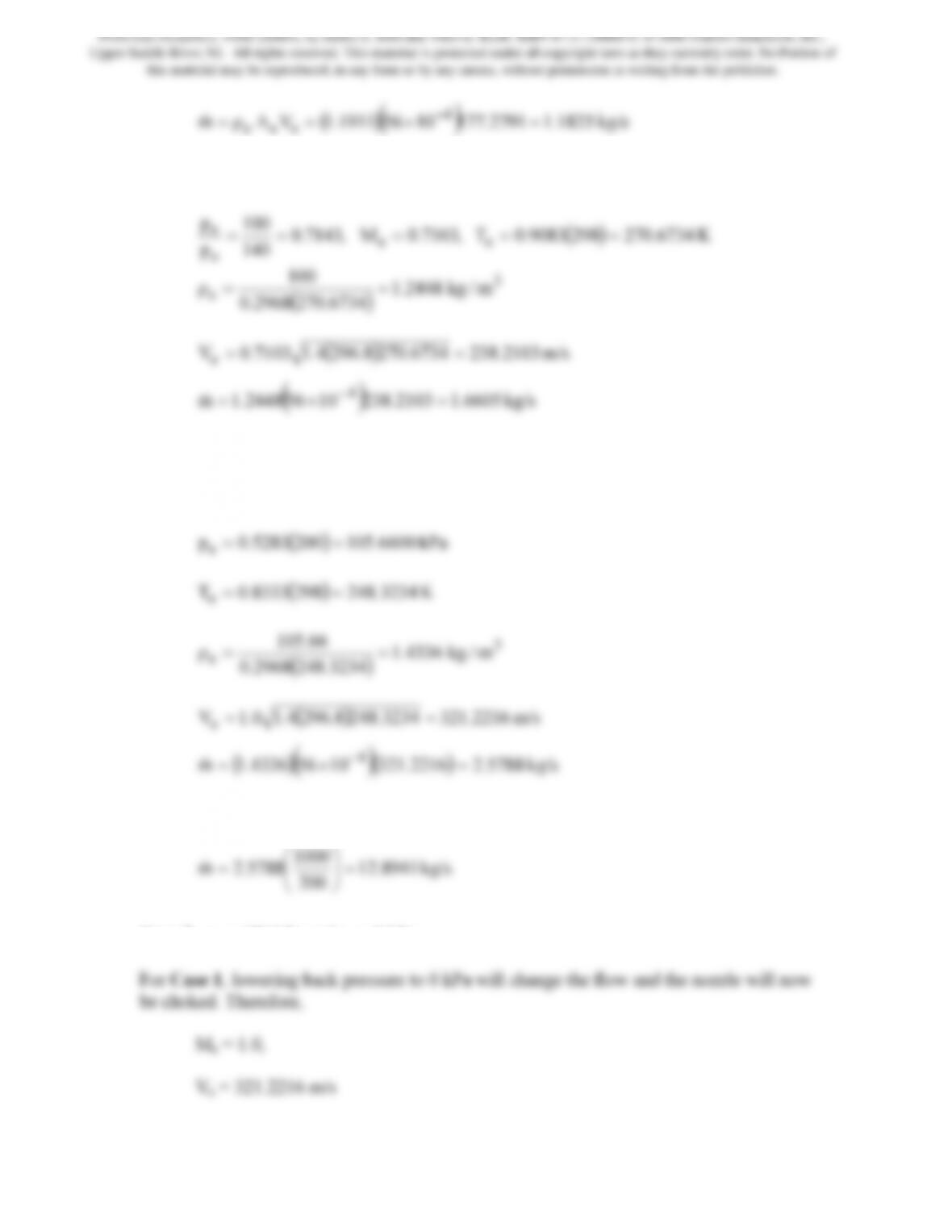
For N2, γ = 1.40. The nozzle is choked for
()
5283.0
100
p*p
p
o
b
Case 1. po = 120 kPa and pb = 100 kPa
From Gas Dynamics, Third Edition, by James E. John and Theo G. Keith. ISBN 0-13-120668-0. © 2006 Pearson Education, Inc.,
Upper Saddle River, NJ. All rights reserved. This material is protected under all copyright laws as they currently exist. No Portion of
this material may be reproduced, in any form or by any means, without permission in writing from the publisher.
eee =×=ρ= −
Case 2. po = 140 kPa and pb = 100 kPa
100
p
e=====
Case 3. po = 200 kPa and pb = 100 kPa
Since po is above the critical reservoir pressure the nozzle is choked, therefore Me = 1.0
Case 4. po = 1 MPa = 1000 kPa and pb = 100 kPa
1000
⎞
⎛
Case 5. po = 120 kPa and pb = 0 kPa
From Gas Dynamics, Third Edition, by James E. John and Theo G. Keith. ISBN 0-13-120668-0. © 2006 Pearson Education, Inc.,
Upper Saddle River, NJ. All rights reserved. This material is protected under all copyright laws as they currently exist. No Portion of
this material may be reproduced, in any form or by any means, without permission in writing from the publisher.
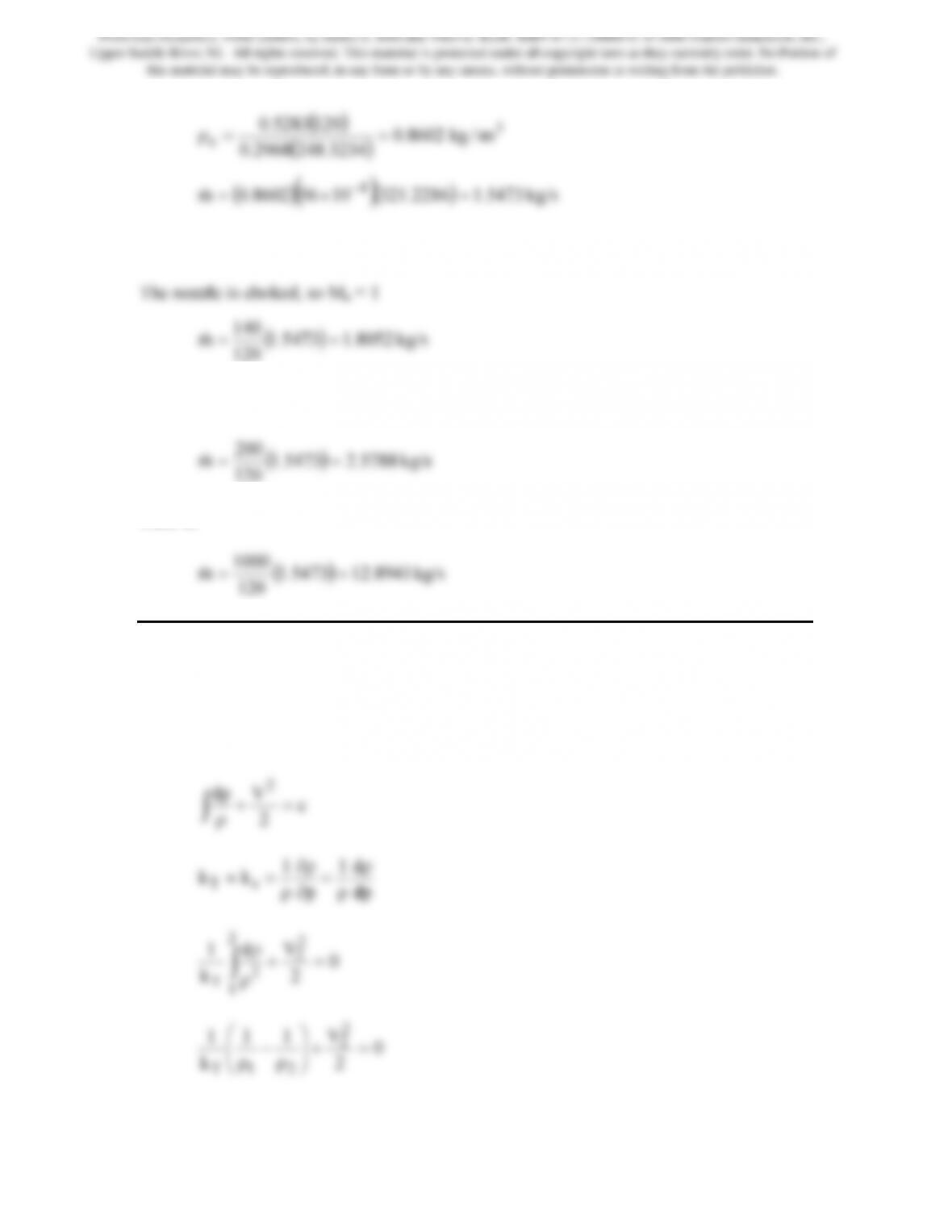
Case 6. po = 140 kPa and pb = 0 kPa
120
Case 7.
120
Case 8.
120
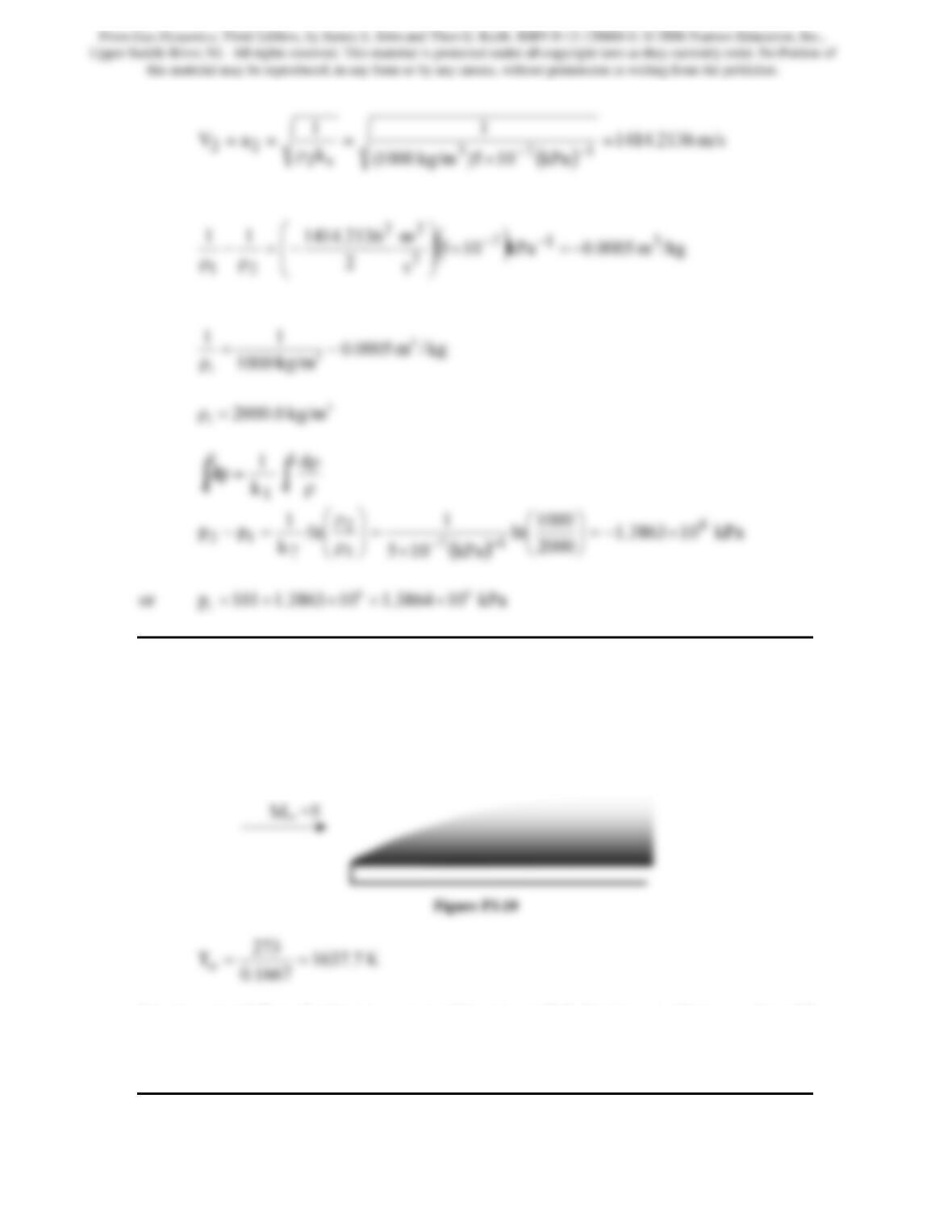
Problem 9. – Pressurized liquid water flows from a large reservoir through a converging
nozzle. Assuming isentropic nozzle flow with a negligible inlet velocity and a back
pressure of 101 kPa, calculate the reservoir pressure necessary to choke the nozzle.
Assume that the isothermal compressibility of water is constant at 5 × 10⁻⁷ (kPa)-l and
equal to the isentropic compressibility. Exit density of the water is 1000 kg/m3.
From Gas Dynamics, Third Edition, by James E. John and Theo G. Keith. ISBN 0-13-120668-0. © 2006 Pearson Education, Inc.,
Upper Saddle River, NJ. All rights reserved. This material is protected under all copyright laws as they currently exist. No Portion of
this material may be reproduced, in any form or by any means, without permission in writing from the publisher.
1
1
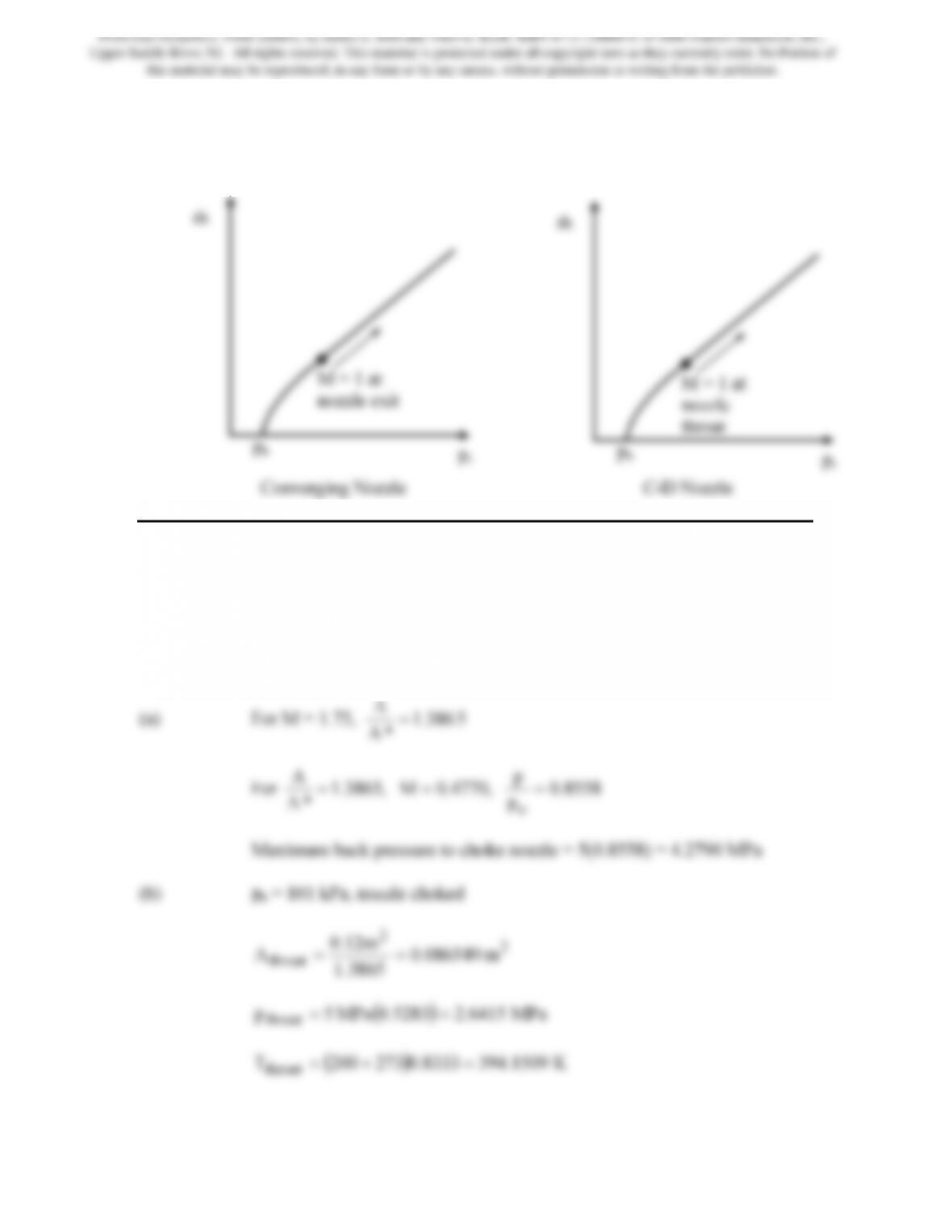
Problem 10. – Calculate the stagnation temperature in an airstream traveling at Mach 5
with a static temperature of 273 K (see Figure P3.10). An insulated flat plate is inserted
into this flow, aligned parallel with the flow direction, with a boundary layer building up
along the plate. Since the absolute velocity at the plate surface is zero, would you expect
the plate temperature to reach the free stream stagnation temperature? Explain.
From Gas Dynamics, Third Edition, by James E. John and Theo G. Keith. ISBN 0-13-120668-0. © 2006 Pearson Education, Inc.,
Upper Saddle River, NJ. All rights reserved. This material is protected under all copyright laws as they currently exist. No Portion of
this material may be reproduced, in any form or by any means, without permission in writing from the publisher.
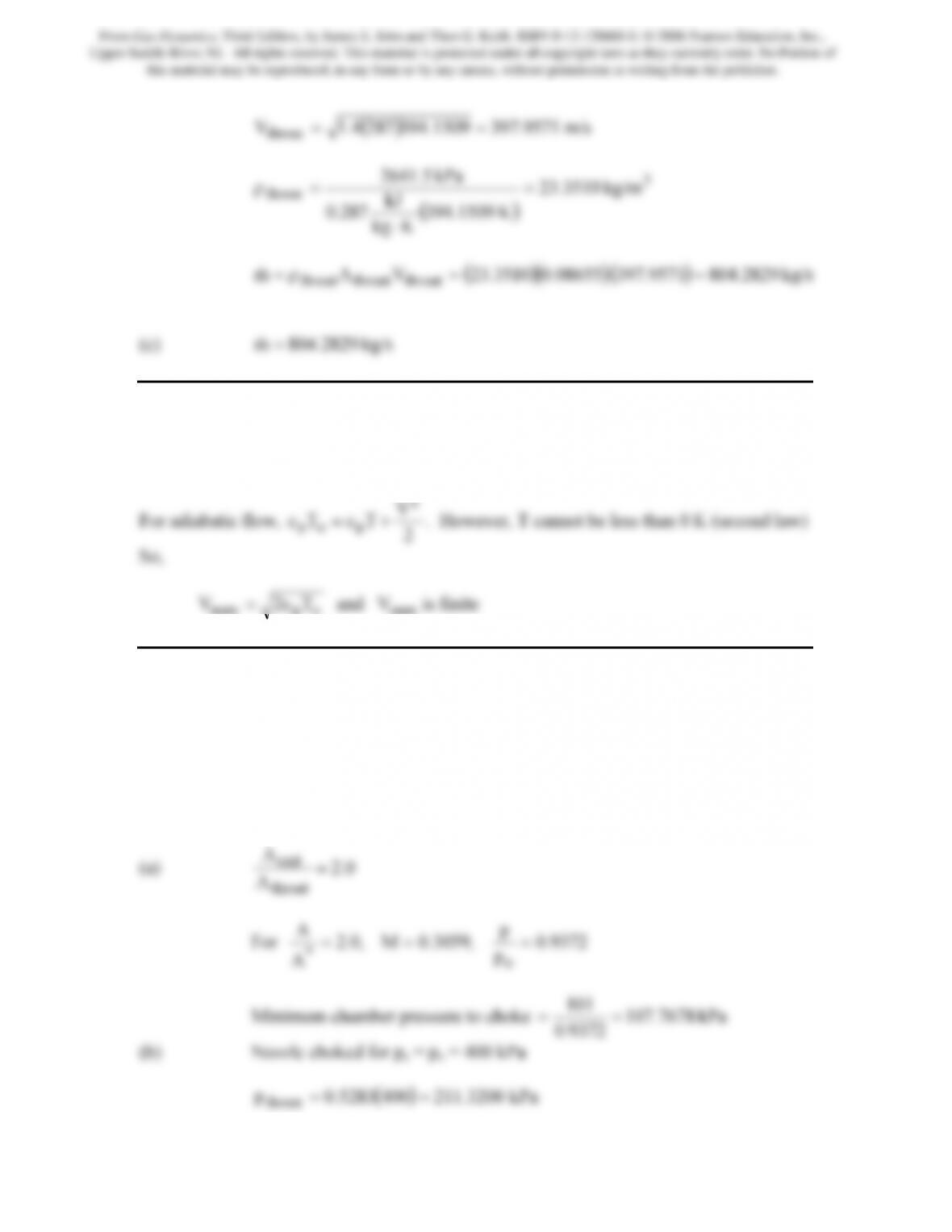
Problem 11. – A gas stored in a large reservoir is discharged through a converging
nozzle. For a constant back pressure, sketch a plot of mass flow rate versus reservoir
pressure. Repeat for a converging-diverging nozzle.
Problem 12. – A converging-diverging nozzle is designed to operate isentropically with
air at an exit Mach number of 1.75. For a constant chamber pressure and temperature of 5
MPa and 200°C, respectively, calculate the following:
(a) Maximum back pressure to choke nozzle
(b) Flow rate in kilograms per second for a back pressure of 101 kPa
(c) Flow rate for a back pressure of 1 MPa Nozzle exit area is 0.12 m2.
A=5
From Gas Dynamics, Third Edition, by James E. John and Theo G. Keith. ISBN 0-13-120668-0. © 2006 Pearson Education, Inc.,
Upper Saddle River, NJ. All rights reserved. This material is protected under all copyright laws as they currently exist. No Portion of
this material may be reproduced, in any form or by any means, without permission in writing from the publisher.
Problem 13. – A supersonic flow is allowed to expand indefinitely in a diverging
channel. Does the flow velocity approach a finite limit, or does it continue to increase
indefinitely? Assume a perfect gas with constant specific heats.
V
2
Problem 14. – A converging-diverging frictionless nozzle is used to accelerate an
airstream emanating from a large chamber. The nozzle has an exit area of 30 cm2 and a
throat area of 15 cm2. If the ambient pressure surrounding the nozzle is 101 kPa and the
chamber temperature is 500 K, calculate the following:
(a) Minimum chamber pressure to choke the nozzle
(b) Mass flow rate for a chamber pressure of 400 kPa
(c) Mass flow rate for a chamber pressure of 200 kPa
A
exit =
From Gas Dynamics, Third Edition, by James E. John and Theo G. Keith. ISBN 0-13-120668-0. © 2006 Pearson Education, Inc.,
Upper Saddle River, NJ. All rights reserved. This material is protected under all copyright laws as they currently exist. No Portion of
this material may be reproduced, in any form or by any means, without permission in writing from the publisher.
400
⎠
⎝
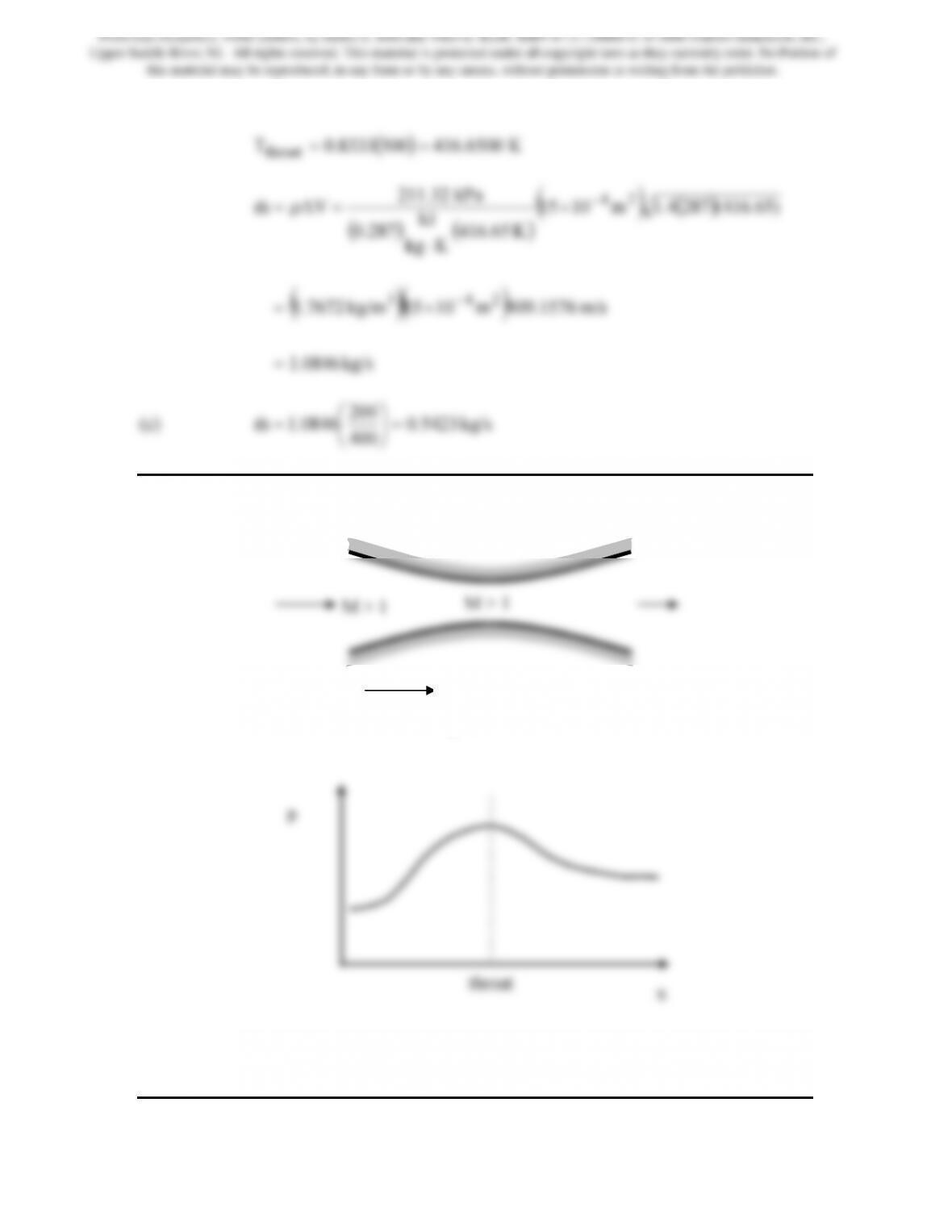
Problem 15. – Sketch p versus x for the case shown in Figure P3.15.
Figure P3.15
x
From Gas Dynamics, Third Edition, by James E. John and Theo G. Keith. ISBN 0-13-120668-0. © 2006 Pearson Education, Inc.,
Upper Saddle River, NJ. All rights reserved. This material is protected under all copyright laws as they currently exist. No Portion of
this material may be reproduced, in any form or by any means, without permission in writing from the publisher.