C
Ch
ha
ap
pt
te
er
r
T
Tw
wo
o
W
WA
AV
VE
E
P
PR
RO
OP
PA
AG
GA
AT
TI
IO
ON
N
I
IN
N
C
CO
OM
MP
PR
RE
ES
SS
SI
IL
LB
BE
E
M
ME
ED
DI
IA
A
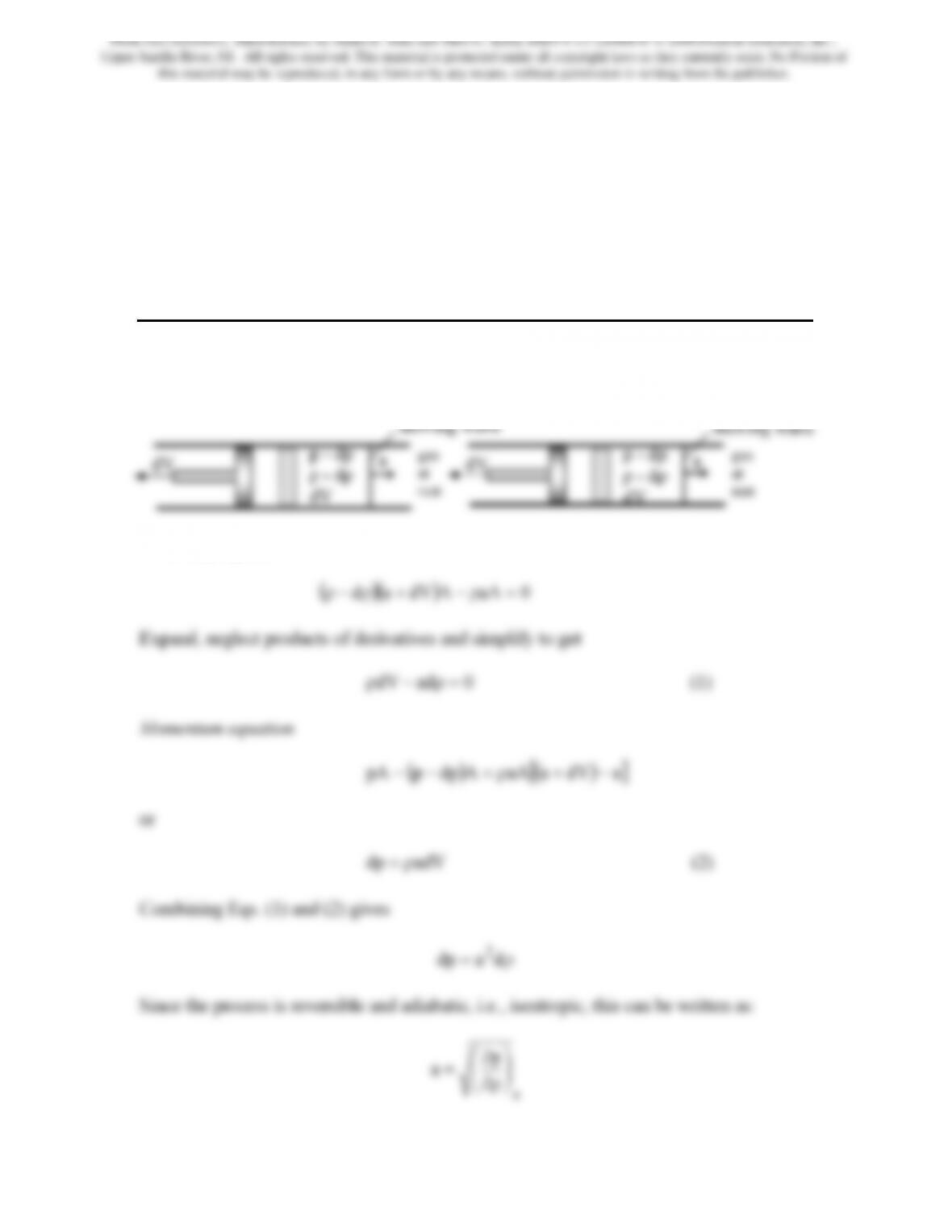
Problem 1. – Using the expansion wave and control volume depicted in Figs. 2.8 and 2.9
along with the continuity and momentum equations, rederive Eq. (2.4).
Continuity equation
moving wave
moving wave
From Gas Dynamics, Third Edition, by James E. John and Theo G. Keith. ISBN 0-13-120668-0. © 2006 Pearson Education, Inc.,
Upper Saddle River, NJ. All rights reserved. This material is protected under all copyright laws as they currently exist. No Portion of
this material may be reproduced, in any form or by any means, without permission in writing from the publisher.
18
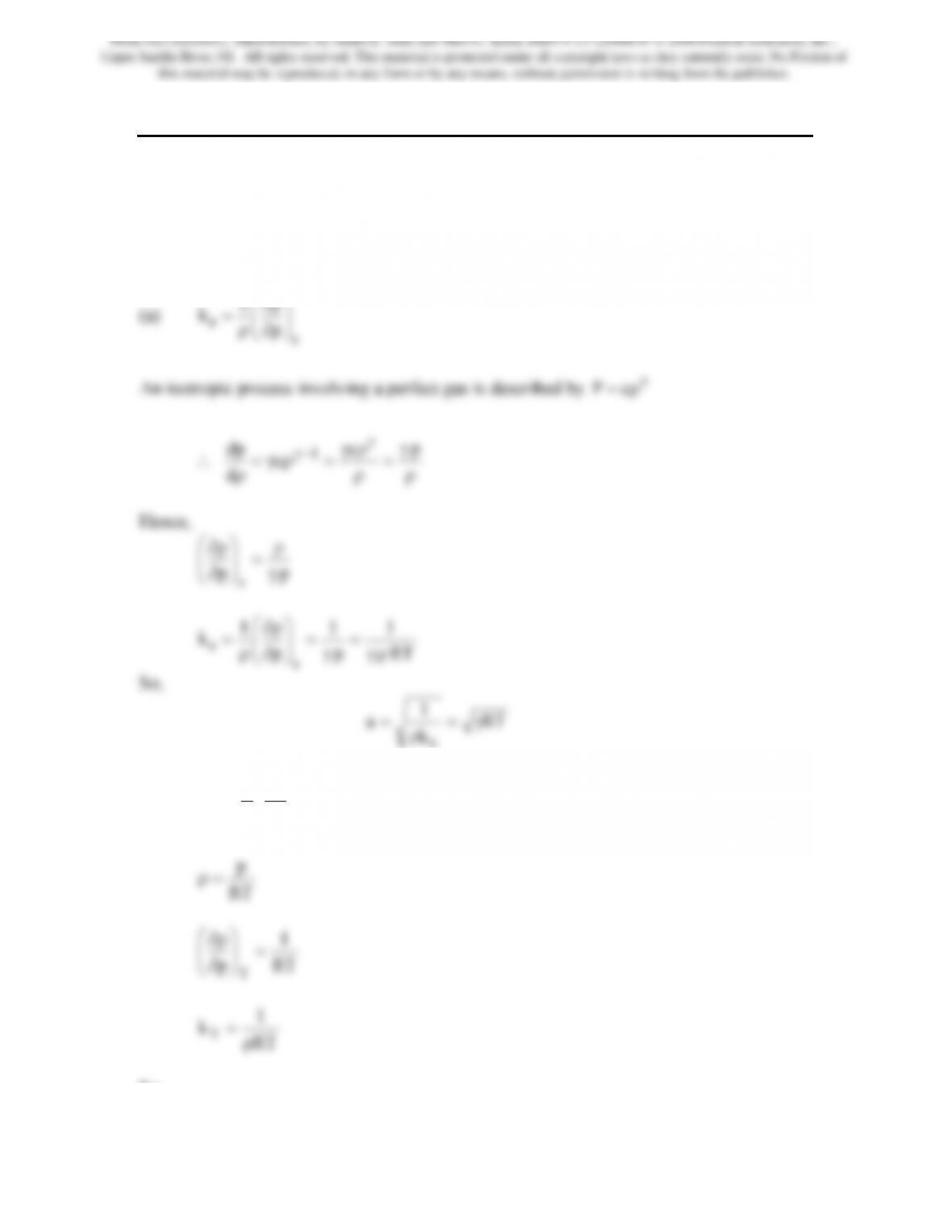
Problem 2. – (a) Derive an expression for ks, for a perfect gas, substitute the result into
Eq. (2.10), and thereby demonstrate Eq. (2.7); (b) Derive an expression for kT, for a
perfect gas, substitute the result into Eq. (2.11), and thereby demonstrate Eq. (2.7) and
finally; (c) Derive an expression for βs, for a perfect gas, substitute your result into Eq.
(2.14), and thereby demonstrate Eq. (2.7).
1
⎞
⎛
ρ∂
k
s
ρ
(b)
T
Tp
1
k⎟
⎟
⎠
⎞
⎜
⎜
⎝
⎛
∂
ρ∂
ρ
=
p
=ρ
So,
From Gas Dynamics, Third Edition, by James E. John and Theo G. Keith. ISBN 0-13-120668-0. © 2006 Pearson Education, Inc.,
Upper Saddle River, NJ. All rights reserved. This material is protected under all copyright laws as they currently exist. No Portion of
this material may be reproduced, in any form or by any means, without permission in writing from the publisher.
19
γ
ρ
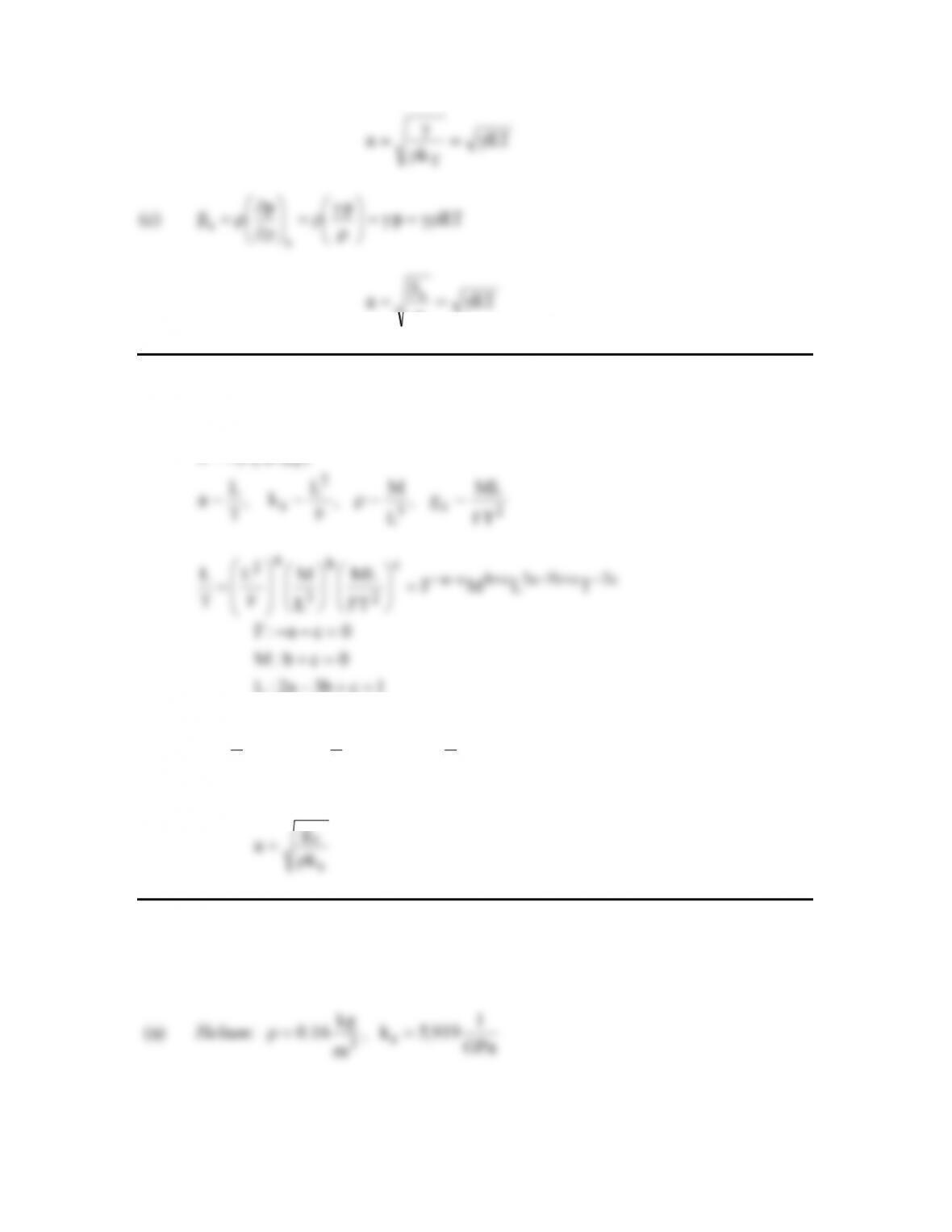
Problem 3. – Use dimensional analysis to develop an expression for the speed of sound in
terms of the isentropic compressibility, the density and gc.
()
2
3
FT
L
F
T
⎟
⎠
⎜
⎝
⎟
⎠
⎜
⎝
⎟
⎠
⎜
⎝
1c2:T
1cb3a2:L
0ca:F
=−
=+−
=−−
Hence, 2
1
b
2
1
a
2
1
c−=−==
So,
s
c
k
g
aρ
=
Problem 4. – Using the data provided in Tables 2-1, 2-2 and 2-3, i.e., the density, and the
isentropic compressibility or the bulk modulus, calculate the velocity of sound at 20°C
and one atmosphere pressure in (a) helium, (b) turpentine, and (c) lead.
m
From Gas Dynamics, Third Edition, by James E. John and Theo G. Keith. ISBN 0-13-120668-0. © 2006 Pearson Education, Inc.,
Upper Saddle River, NJ. All rights reserved. This material is protected under all copyright laws as they currently exist. No Portion of
this material may be reproduced, in any form or by any means, without permission in writing from the publisher.
20
10
1
a
9
=
=s/m 6.1027
=
300,11
ρ
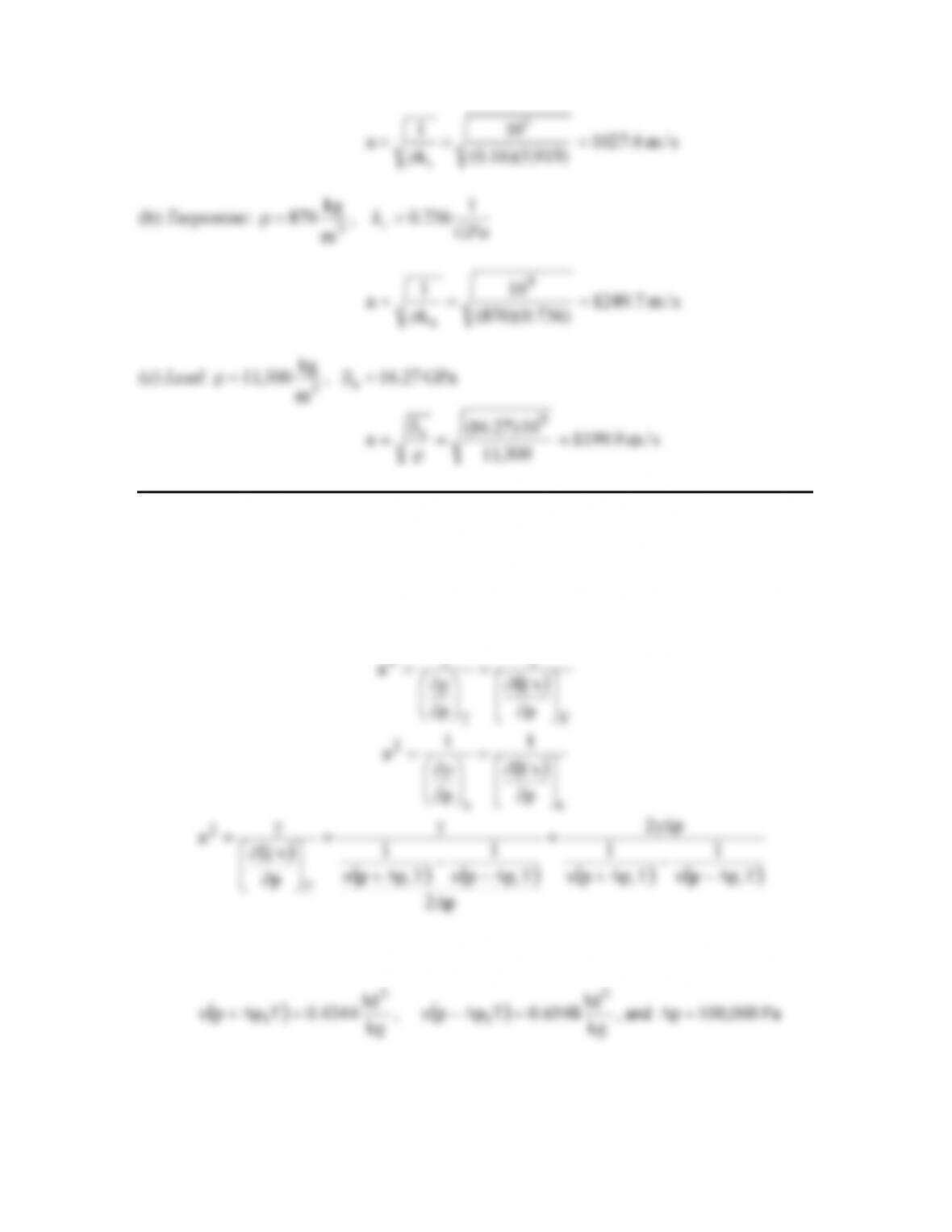
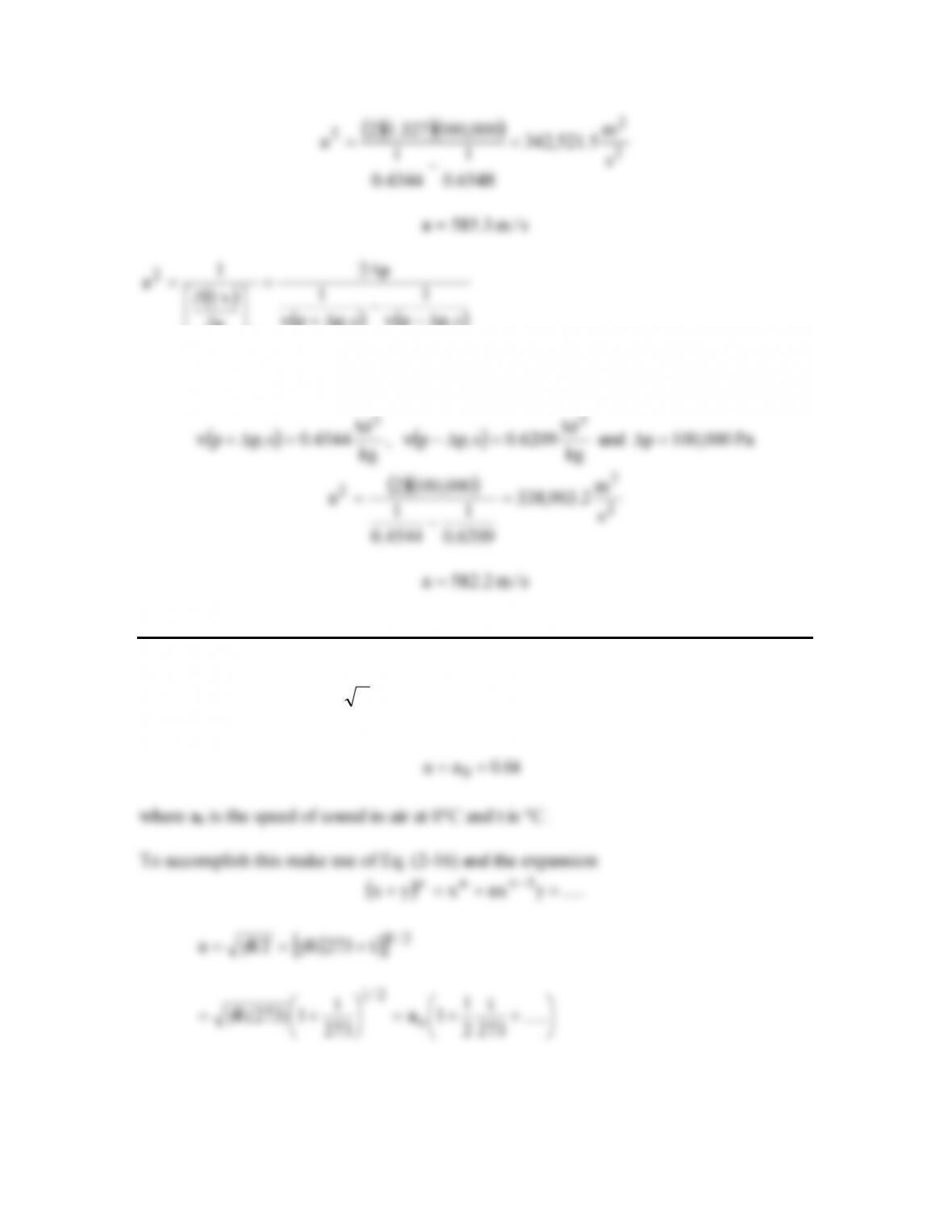
Problem 5. – In Example Problem 2.3 the speed of sound of superheated steam was
determined by using a finite difference representation of the compressibility and steam
table data (Table 2-4). Using the same steam table data, determine the speed of sound of
superheated steam for the same pressure and temperature, i.e., at p = 500 kPa and T =
300˚C. However, use the following finite differences to obtain two estimates for the
speed of sound:
2
γ
γ
T,ppv
T,ppv
p2
T,ppv
T,ppv
p
T
∆−
∆+
∆
∆−
∆+
⎥
⎦
⎢
⎣
∂
From Example 2.3
M
3
M
3
From Gas Dynamics, Third Edition, by James E. John and Theo G. Keith. ISBN 0-13-120668-0. © 2006 Pearson Education, Inc.,
Upper Saddle River, NJ. All rights reserved. This material is protected under all copyright laws as they currently exist. No Portion of
this material may be reproduced, in any form or by any means, without permission in writing from the publisher.
=
21
2
s,ppv
s,ppv
p
s
∆−
∆+
⎦
⎣
∂
From Example 2.3
M
3
M
3
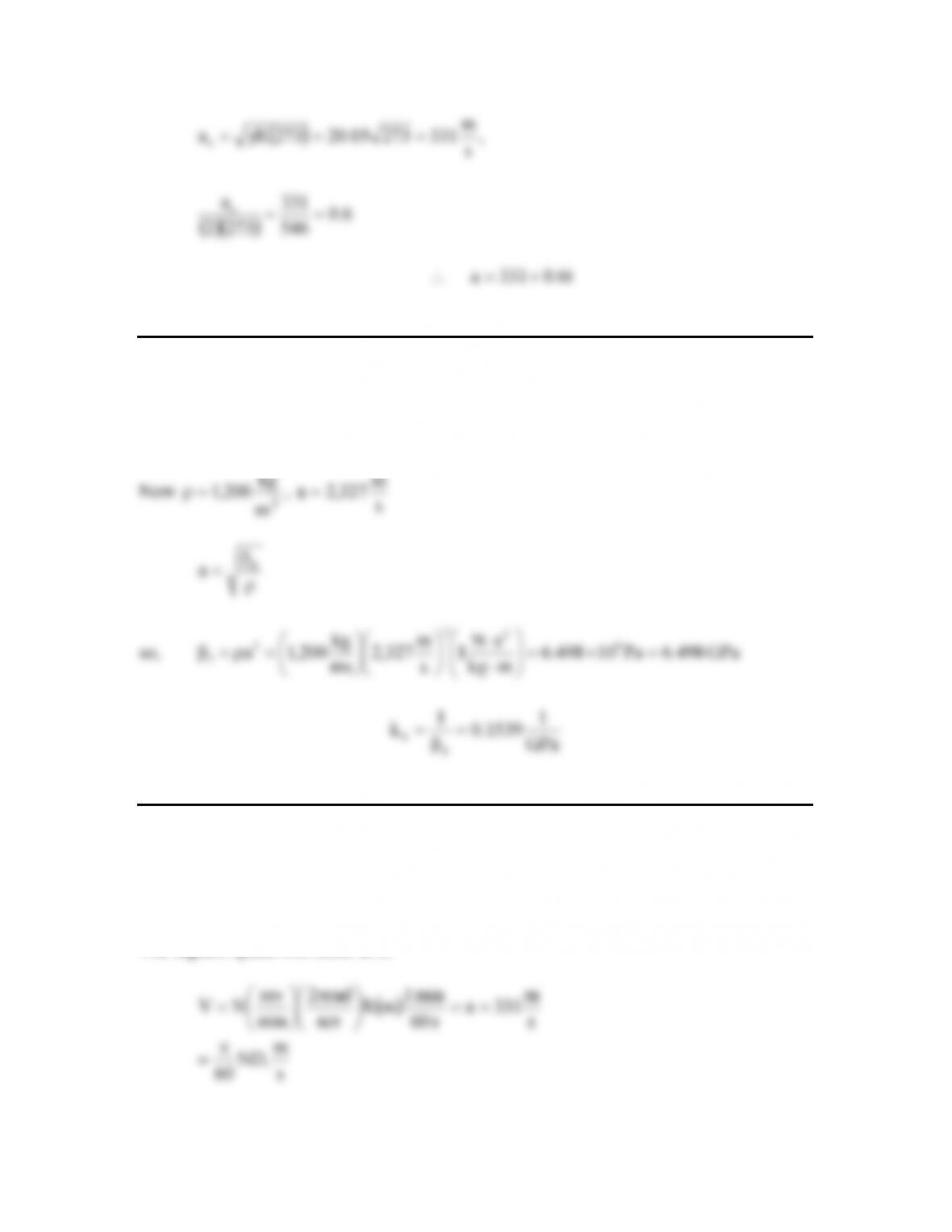
Problem 6. – Equation (2.16) provides a convenient expression for calculating the speed
of sound in air: a = 20.05 T, where T is the absolute temperature in degrees Kelvin.
Derive the following linear equation for the speed of sound in air:
+
=
From Gas Dynamics, Third Edition, by James E. John and Theo G. Keith. ISBN 0-13-120668-0. © 2006 Pearson Education, Inc.,
Upper Saddle River, NJ. All rights reserved. This material is protected under all copyright laws as they currently exist. No Portion of
this material may be reproduced, in any form or by any means, without permission in writing from the publisher.
22
m
Problem 7. – Rather than measure the bulk modulus directly it may be easier to measure
the speed of sound as it propagates though a material and then use it to compute the bulk
modulus. For a Lucite plastic of density 1,200 kg/m3, the speed of sound is measured as
2,327 m/s. Determine the bulk modulus. What is the corresponding isentropic
compressibility?
kg
m
GPa
s
s=
β
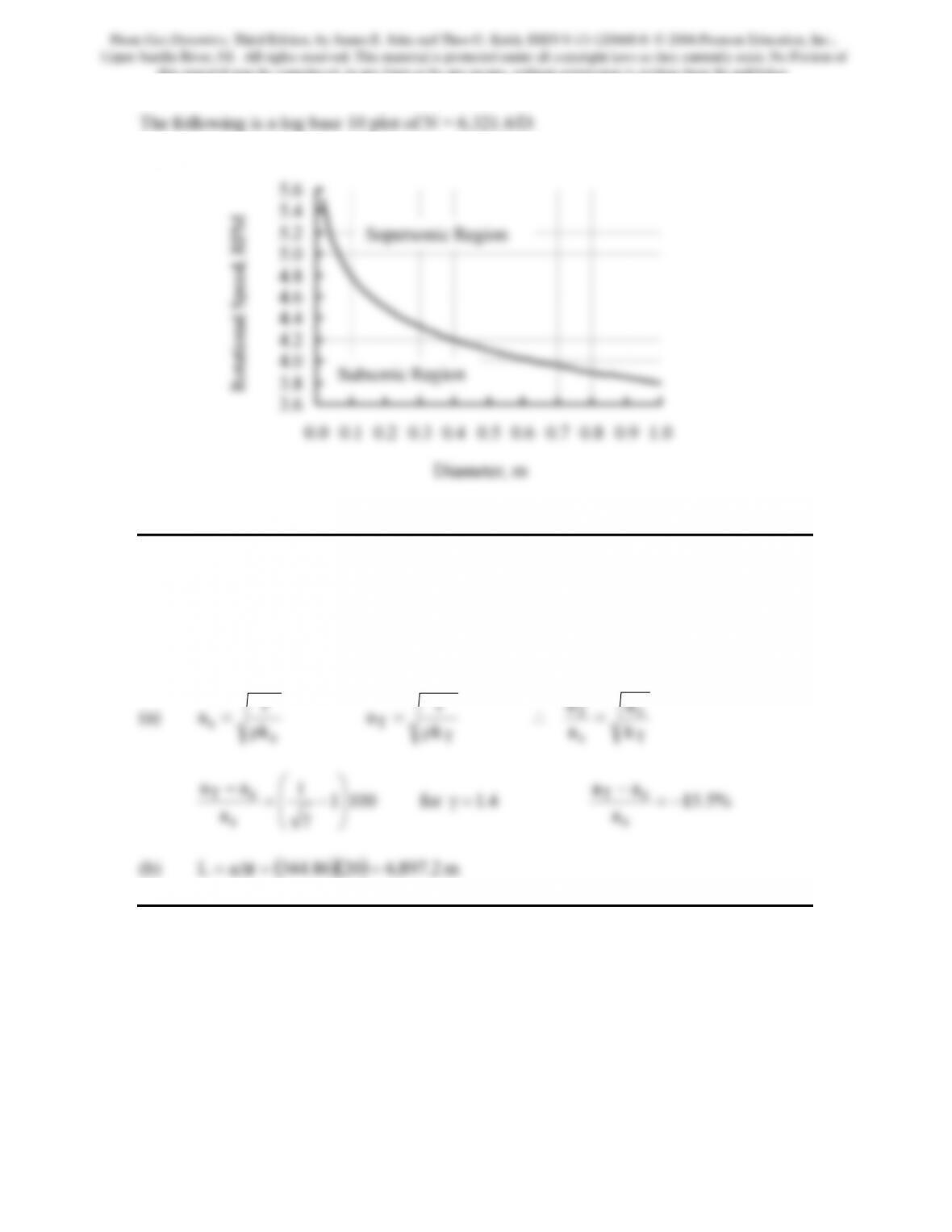
Problem 8. – An object of diameter d (m) is rotated in air at a speed of N revolutions per
minute. Draw a plot of the rotational speed required for the velocity at the outer edge of
the object to just reach sonic velocity for a given diameter. Take the speed of sound of
the air to be 331m/s.
The highest speed will occur at R.
From Gas Dynamics, Third Edition, by James E. John and Theo G. Keith. ISBN 0-13-120668-0. © 2006 Pearson Education, Inc.,
Upper Saddle River, NJ. All rights reserved. This material is protected under all copyright laws as they currently exist. No Portion of
this material may be reproduced, in any form or by any means, without permission in writing from the publisher.
5.4
5.6
From Gas Dynamics, Third Edition, by James E. John and Theo G. Keith. ISBN 0-13-120668-0. © 2006 Pearson Education, Inc.,
Upper Saddle River, NJ. All rights reserved. This material is protected under all copyright laws as they currently exist. No Portion of
this material may be reproduced, in any form or by any means, without permission in writing from the publisher.
(a) ρa
p∆
V=∆ , Pa 100∆p=
air:
()
3
m
kg
1615.1
303
97.28
8314
000,101
ρ=
⎟
⎠
⎞
⎜
⎝
⎛
=
m/s 0.34930305.20a ==
Therefore,
()()
m/s 247.0
0.3491615.1
100
V==∆
(b) ρa∆V∆p=, m/s 1.0V =∆
hydrogen:
()
3
m
kg
0808.0
300
016.2
8314
000,100
RT
p
ρ=
⎟
⎠
⎞
⎜
⎝
⎛
==
() ()
m/s 8.1320300
016.1
8314
41.1a =
⎟
⎠
⎞
⎜
⎝
⎛
=
Therefore,
()()
(
)
Pa 68.101.08.13200808.0p
=
=∆
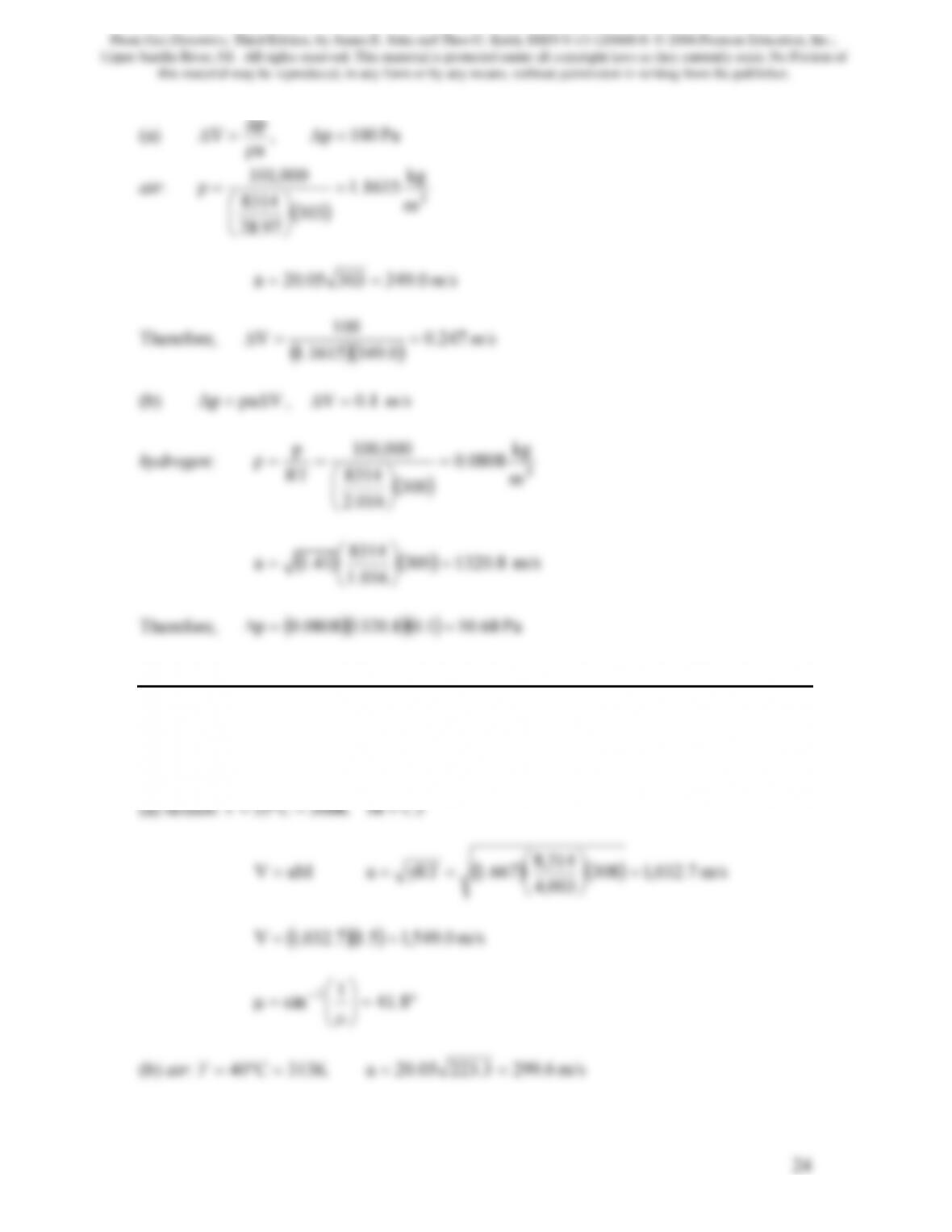
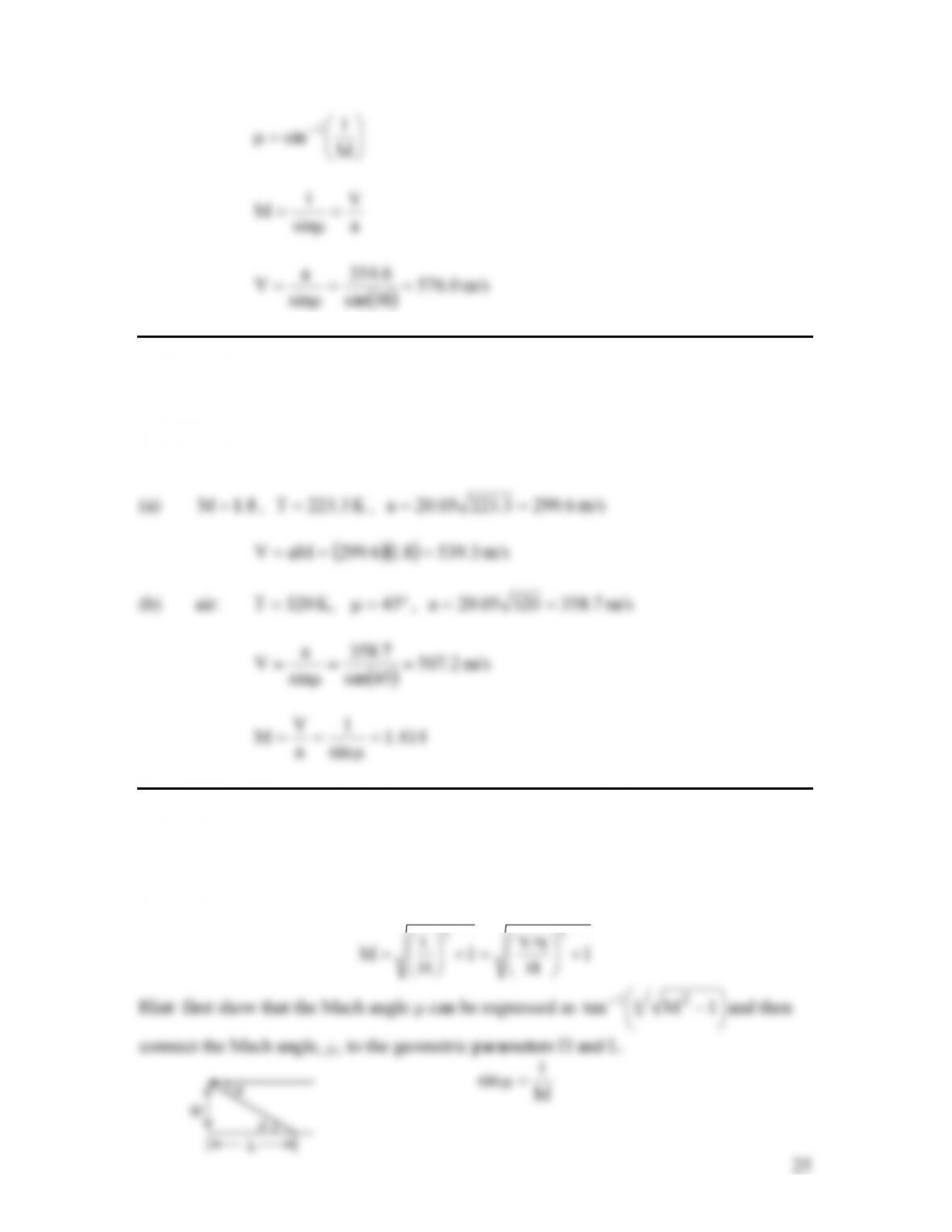
Problem 11. – (a) Helium at 35°C is flowing at a Mach number of 1.5. Find the velocity
and determine the local Mach angle. (b) Determine the velocity of air at 40°C to produce
a Mach angle of 38°
From Gas Dynamics, Third Edition, by James E. John and Theo G. Keith. ISBN 0-13-120668-0. © 2006 Pearson Education, Inc.,
Upper Saddle River, NJ. All rights reserved. This material is protected under all copyright laws as they currently exist. No Portion of
this material may be reproduced, in any form or by any means, without permission in writing from the publisher.
25
⎟
⎠
⎞
⎜
⎝
⎛
=µ −
M
1
ins 1
a
V
ins
1
M=
µ
=
()
m/s 0.576
38ins
6.354
ins
a
V==
µ
=
Problem 12. – (a) A jet plane is traveling at Mach 1.8 at an altitude of 10 km where the
temperature is 223.3K. Determine the speed of the plane. (b) Air at 320 K flows in a
supersonic wind tunnel over a 2-D wedge. From a photograph the Mach angle is
measured to be 45°. Determine the flow velocity, the local speed of sound and the Mach
number of the tunnel.
sin
a
µ
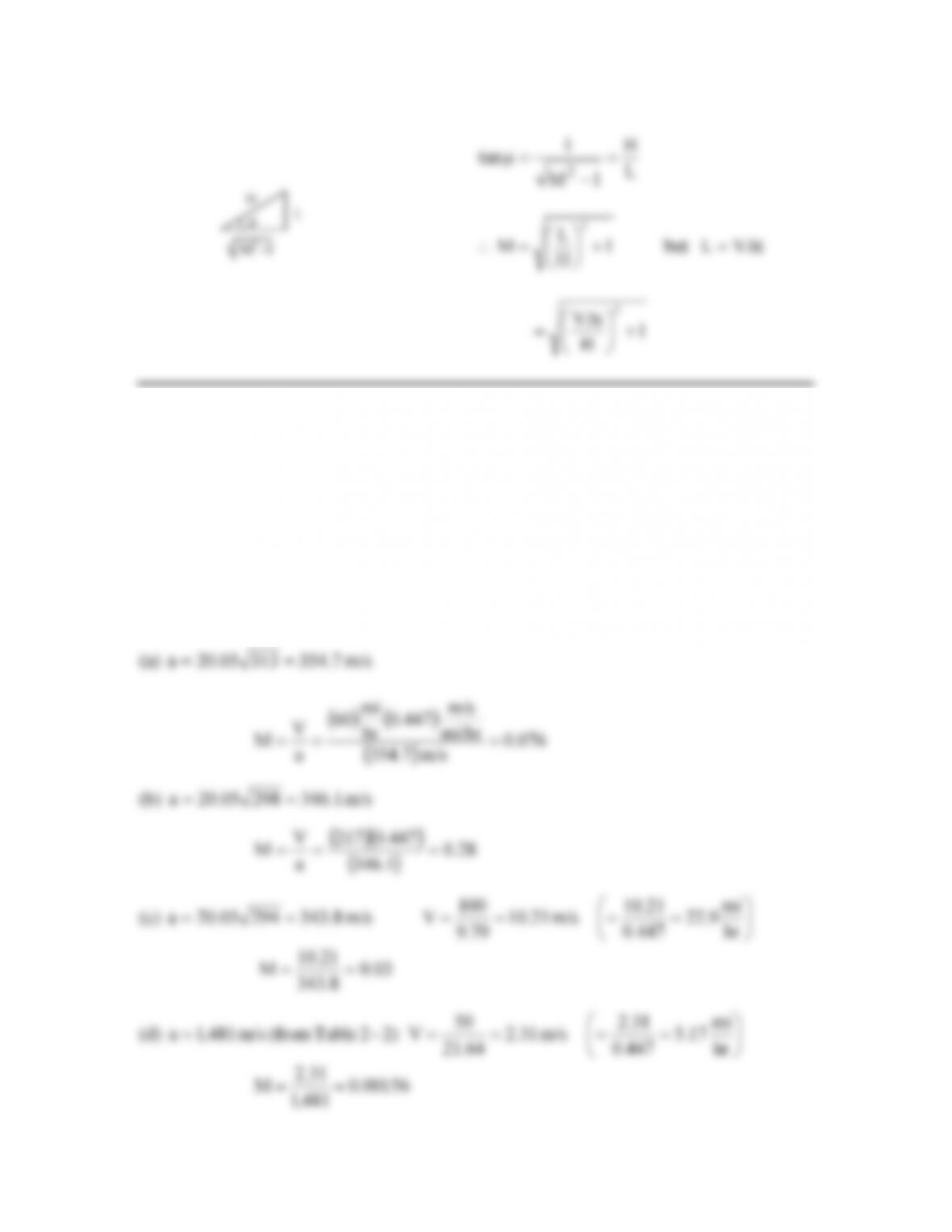
Problem 13. – A supersonic aircraft, flying horizontally a distance H above the earth,
passes overhead. ∆t later the sound wave from the aircraft is heard. In this time
increment, the plane has traveled a distance L. Show that the Mach number of the
aircraft can be computed from:
tV
L
22
⎞
⎛∆
⎞
⎛
H
L
µ
From Gas Dynamics, Third Edition, by James E. John and Theo G. Keith. ISBN 0-13-120668-0. © 2006 Pearson Education, Inc.,
Upper Saddle River, NJ. All rights reserved. This material is protected under all copyright laws as they currently exist. No Portion of
this material may be reproduced, in any form or by any means, without permission in writing from the publisher.
26
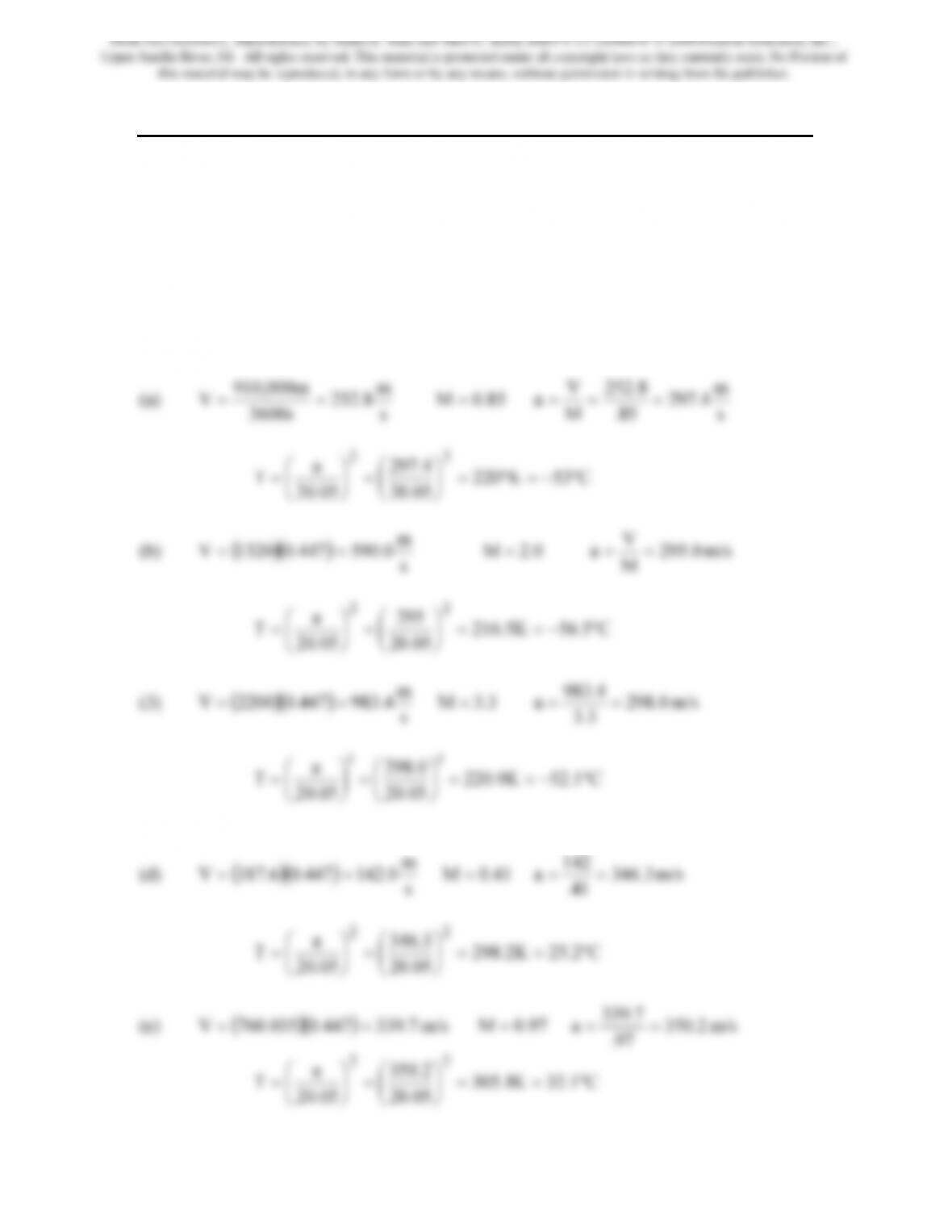
Problem 14. – Given speeds and temperatures, determine the corresponding Mach
numbers of the following (note: 1 mile = 5,280 ft = 1,609.3 m; 1 mi/hr = 1.6093 km/hr =
0.447 m/s):
(a) A cheetah running at top speed of 60 mi/hr; the local temperature is 40°C
(b) A Peregrine falcon in a dive at 217 mi/hr; local temperature of 25°C
(c) In June 1999 in Athens Greece, Maurice Greene became the world’s fastest human
by running 100 m in 9.79 s; the temperature was 21°C
(d) In June 1999, Alexander Popov became the world’s fastest swimmer by swimming
50 m in 21.64s; the temperature of the water was 20°C
(a) m/s 7.35431305.20a ==
() ()
()
076.0
m/s 7.354
mi/hr
m/s
447.0
hr
mi
60
a
V
M===
(b) m/s 1.34629805.20a ==
()( )
()
28.0
1.346
447.0217
a
V
M===
(c) m/s 8.34329405.20a == m/s 21.10
97.9
100
V== ⎟
⎠
⎞
⎜
⎝
⎛== hr
mi
9.22
447.0
21.10
03.0
8.343
21.10
M==
(d) 2)–2 Table (from m/s 481,1a = m/s 31.2
21.64
50
V== ⎟
⎠
⎞
⎜
⎝
⎛== hr
mi
17.5
447.0
31.2
00156.0
481,1
31.2
M==
From Gas Dynamics, Third Edition, by James E. John and Theo G. Keith. ISBN 0-13-120668-0. © 2006 Pearson Education, Inc.,
Upper Saddle River, NJ. All rights reserved. This material is protected under all copyright laws as they currently exist. No Portion of
this material may be reproduced, in any form or by any means, without permission in writing from the publisher.
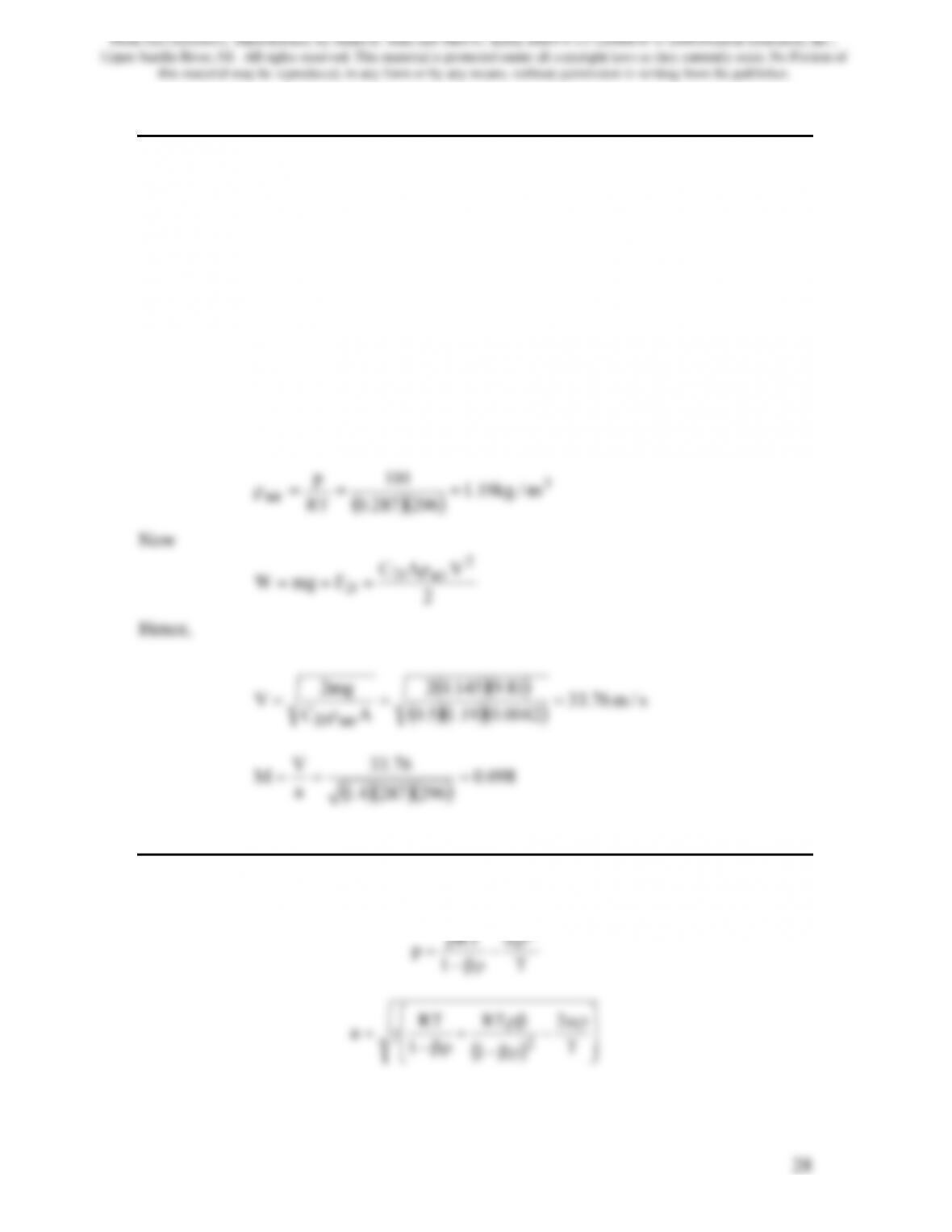
Problem 15. – Given speeds and Mach numbers, assuming air is a perfect gas, determine
the corresponding local temperature (note: 1 mi/hr = 0.447 m/s) for the following:
(a) A Boeing 747-400 at a cruise speed of 910 km/hr; M = 0.85.
(b) Concorde at a cruise speed of 1,320 mi/hr; M = 2.0
(c) The fastest airplane, the Lockheed SR-71 Blackbird, flying at 2,200 mi/hr; M =
3.3
(d) The fastest boat, the Spirit of Australia, that averaged 317.6 mi/hr; M = 0.41
(e) The fastest car, the ThrustSSC, averaged 760.035 mi/hr; M = 0.97
m
m000,910
m
8.252
V
05.20
05.20
⎠
⎝
⎠
⎝
m
142
From Gas Dynamics, Third Edition, by James E. John and Theo G. Keith. ISBN 0-13-120668-0. © 2006 Pearson Education, Inc.,
Upper Saddle River, NJ. All rights reserved. This material is protected under all copyright laws as they currently exist. No Portion of
this material may be reproduced, in any form or by any means, without permission in writing from the publisher.
Problem 16. – A baseball, which has a mass of 145 grams and a diameter of 3.66 cm,
when dropped from a very tall building reaches high speeds. If the building is tall
enough the speed will be controlled by the drag, as the baseball will reach terminal speed.
At this state
D
FW
=
Where W (weight) = mg, g (acceleration of gravity) = 9.81 m/s2, FD (drag force) =
CDρairAV2/2, CD (drag coefficient) = 0.5 and A (projected area of sphere) = πR2. Find the
terminal speed of the baseball and determine the corresponding Mach number if the
ambient air temperature is 23°C and the ambient air pressure is 101 kPa..
The density of the air is first determined:
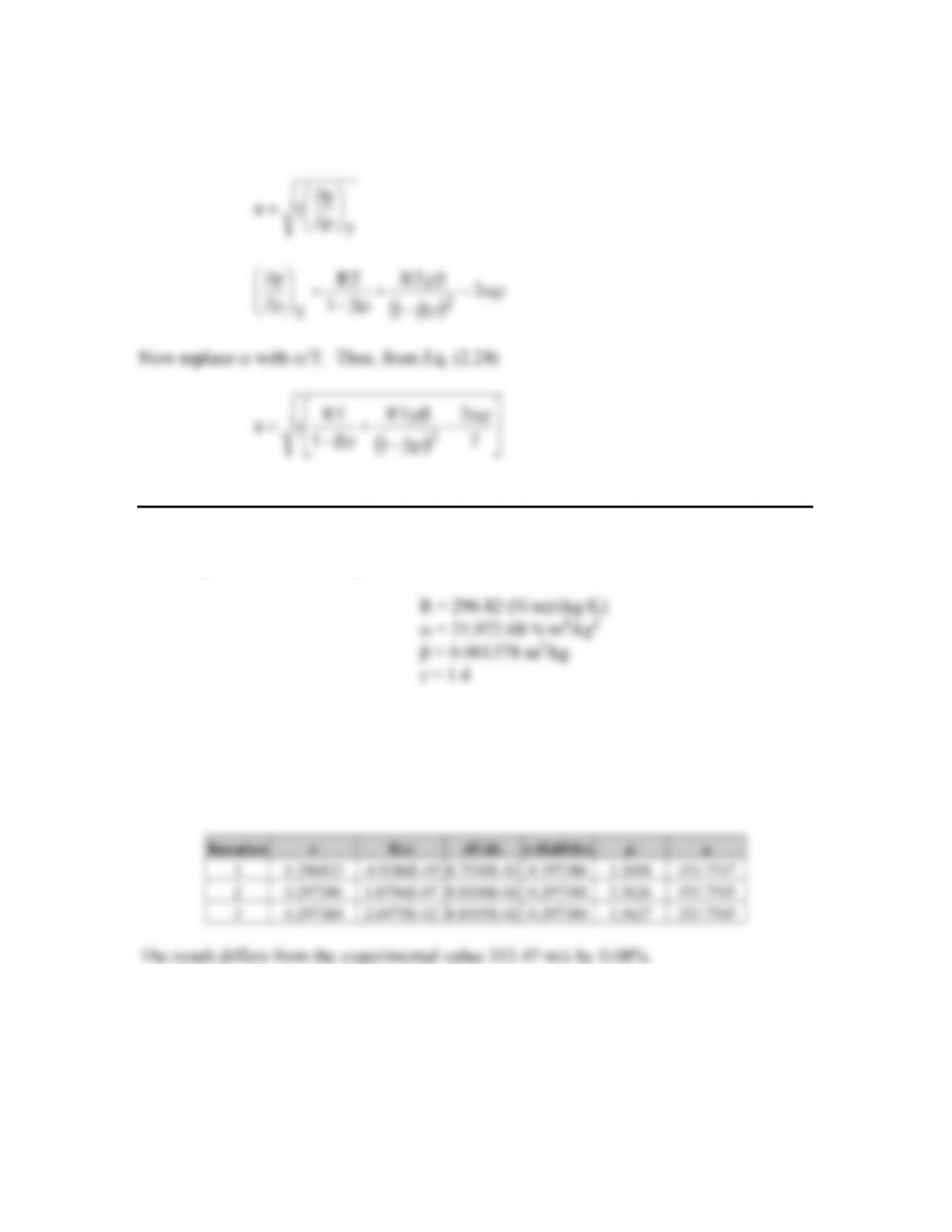
Problem 17. – Derive the following equation for the speed of sound of a real gas from
Berthelot’s equation of state:
2
From Gas Dynamics, Third Edition, by James E. John and Theo G. Keith. ISBN 0-13-120668-0. © 2006 Pearson Education, Inc.,
Upper Saddle River, NJ. All rights reserved. This material is protected under all copyright laws as they currently exist. No Portion of
this material may be reproduced, in any form or by any means, without permission in writing from the publisher.
29
Since T is treated as a constant, we may simply use information from Section 2.6 where
()
⎥
⎦
⎢
⎣
βρ−
βρ−
1
1
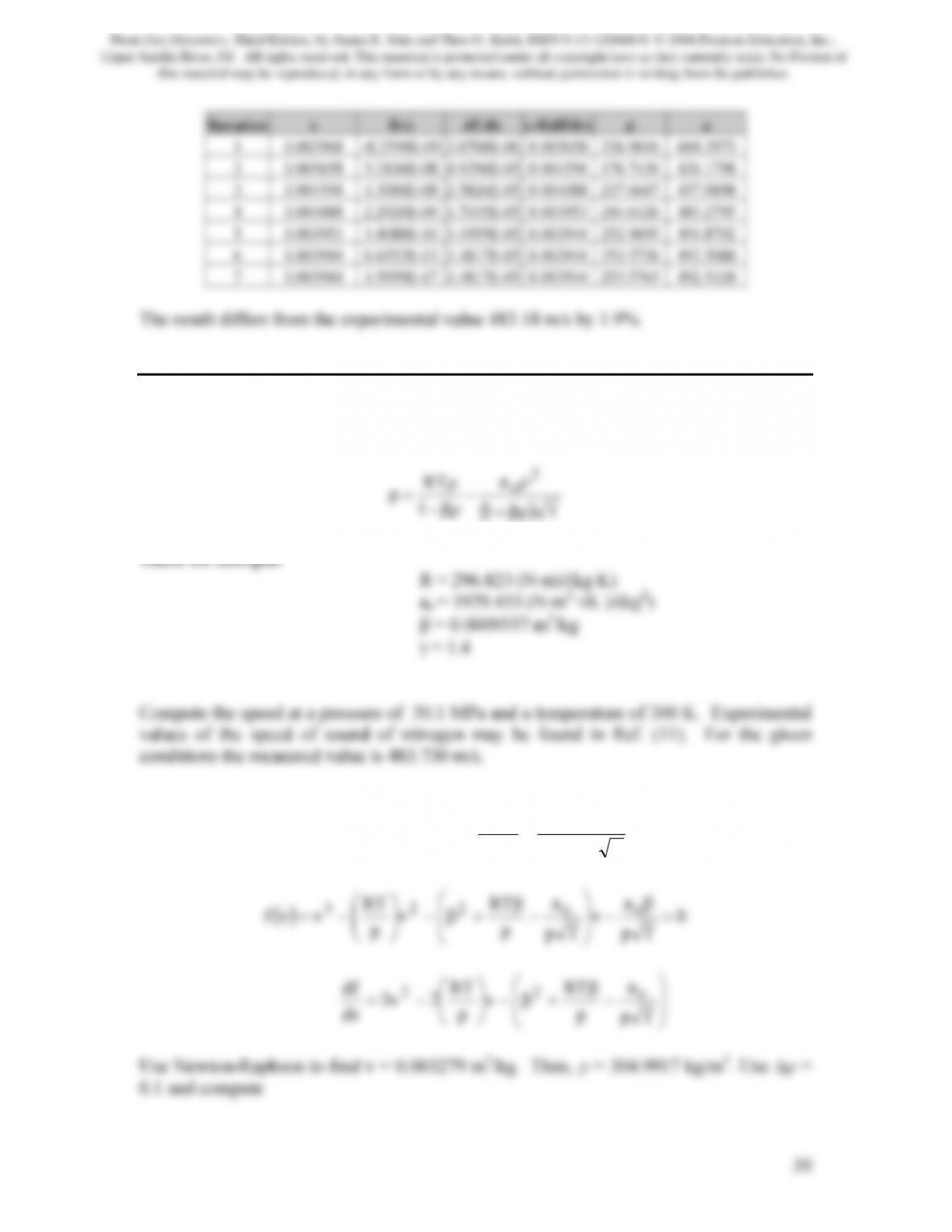
Problem 18. – Using the speed of sound expression from the previous problem and the
following constants for nitrogen
determine the speed of sound for the two cases described in Example 2.4.
Case (1) p 0.3 MPa and T = 300K
Case (2): p 30.0 MPa and T = 300K
From Gas Dynamics, Third Edition, by James E. John and Theo G. Keith. ISBN 0-13-120668-0. © 2006 Pearson Education, Inc.,
Upper Saddle River, NJ. All rights reserved. This material is protected under all copyright laws as they currently exist. No Portion of
this material may be reproduced, in any form or by any means, without permission in writing from the publisher.
Iteration v f(v) df /dv v-f/(df/dv) ρ a
1 0.002968 -8.2594E-09 3.0708E-06 0.005658 336.9016 604.3973
2 0.005658 5.2436E-08 4.9296E-05 0.004594 176.7430 426.1798
3 0.004594 1.3084E-08 2.5826E-05 0.004088 217.6647 457.9898
4 0.004088 2.2920E-09 1.7035E-05 0.003953 244.6426 483.2795
5 0.003953 1.4088E-10 1.4959E-05 0.003944 252.9695 491.8702
6 0.003944 6.6552E-13 1.4817E-05 0.003944 253.5736 492.5088
7 0.003944 1.5099E-17 1.4817E-05 0.003944 253.5765 492.5118
The result differs from the experimental value 483.18 m/s by 1.9%.
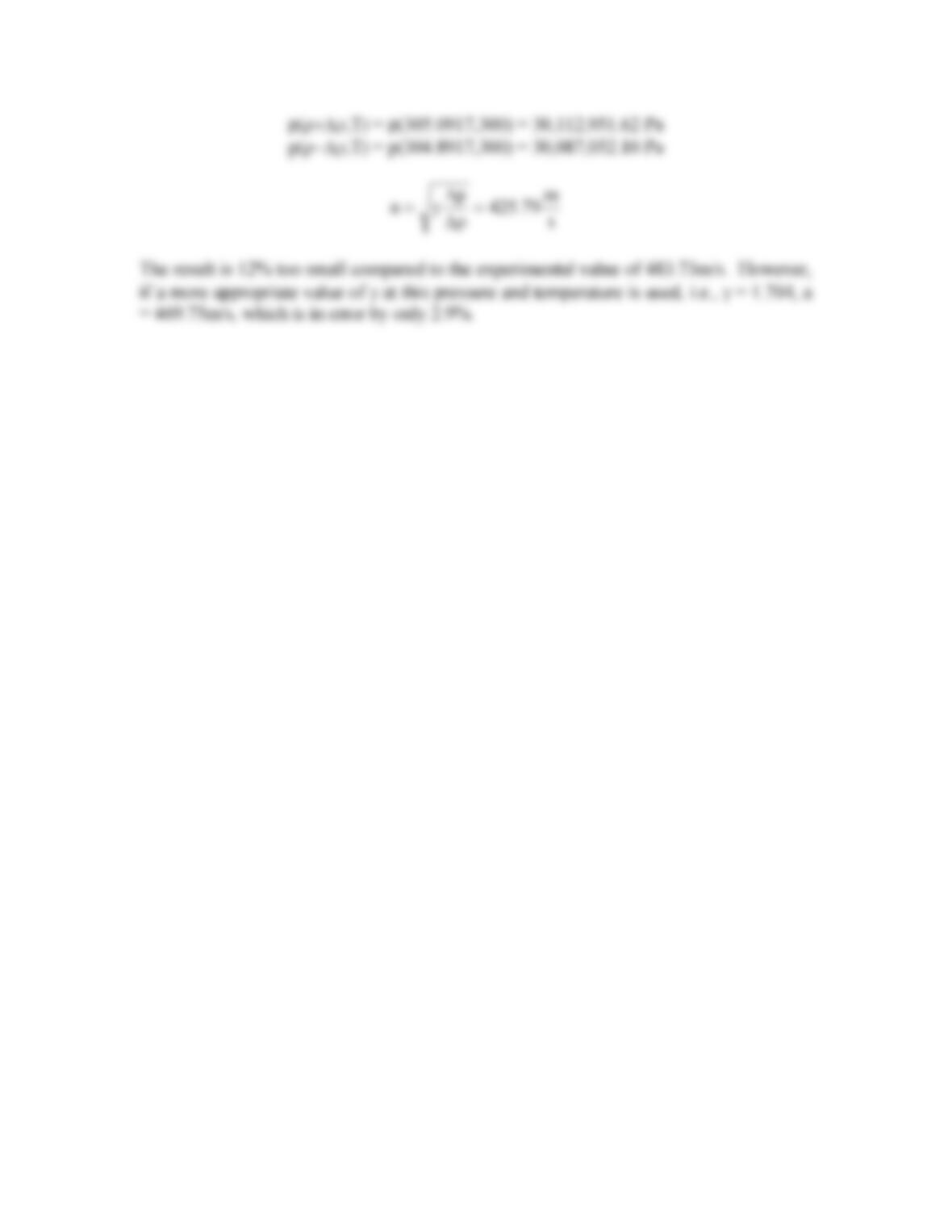
Problem 19. –Employ the finite difference method of Example 2.5 to determine the
speed of sound in nitrogen using the Redlich-Kwong equation of state
()
T1
1
βρ+
βρ−
The Redlich-Kwong equation of state is:
()
Tvv
a
v
RT
po
β+
−
β−
=. Rearrange to obtain:
From Gas Dynamics, Third Edition, by James E. John and Theo G. Keith. ISBN 0-13-120668-0. © 2006 Pearson Education, Inc.,
Upper Saddle River, NJ. All rights reserved. This material is protected under all copyright laws as they currently exist. No Portion of
this material may be reproduced, in any form or by any means, without permission in writing from the publisher.
31
From Gas Dynamics, Third Edition, by James E. John and Theo G. Keith. ISBN 0-13-120668-0. © 2006 Pearson Education, Inc.,
Upper Saddle River, NJ. All rights reserved. This material is protected under all copyright laws as they currently exist. No Portion of
this material may be reproduced, in any form or by any means, without permission in writing from the publisher.