290
Chapter Fourteen
C
CH
HA
AR
RA
AC
CT
TE
ER
RI
IS
ST
TI
IC
CS
S
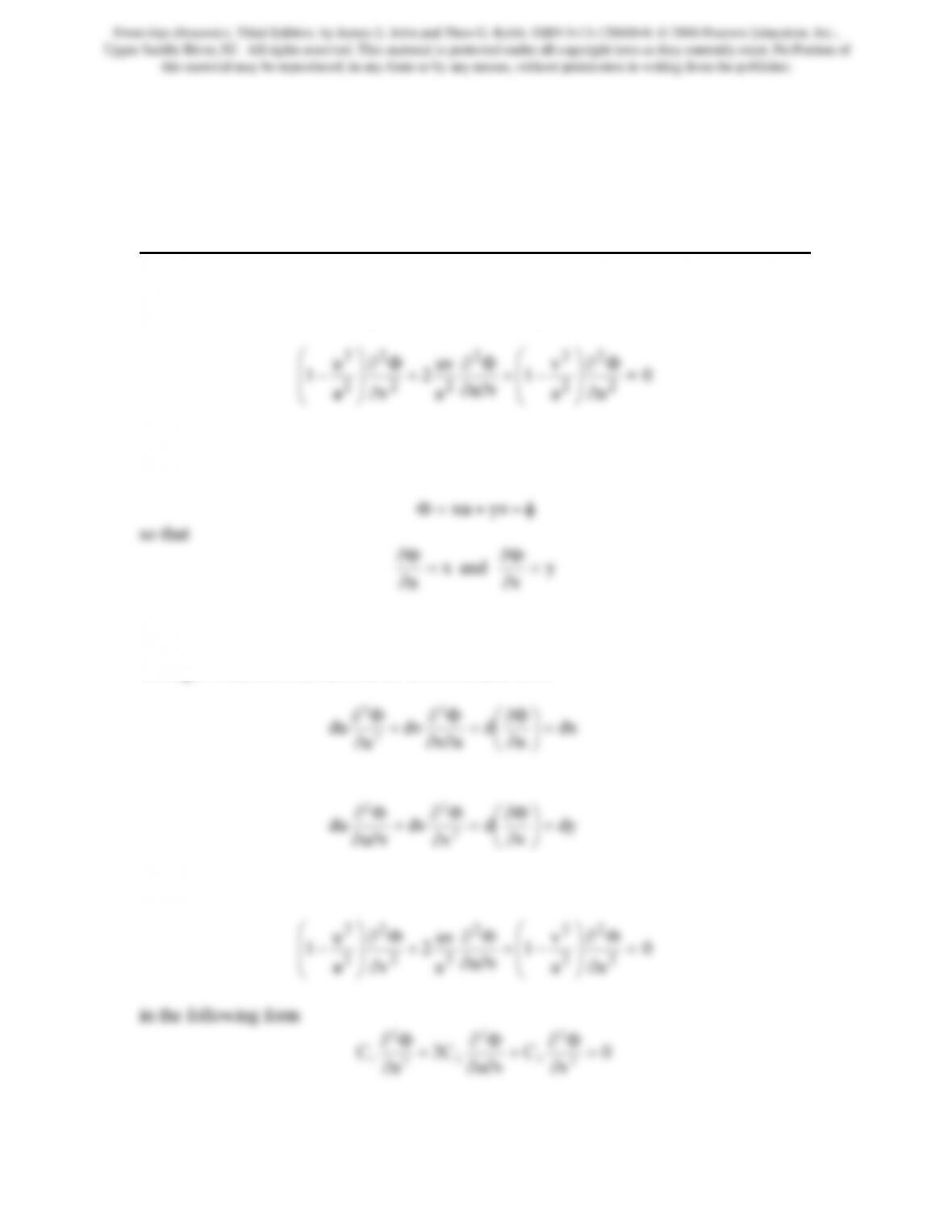
Problem 1. – Use the Method of Indeterminate Derivatives to obtain equations of the
characteristics for the following equation in the hodograph plane,
0
ua
v
1
vu
a
uv
2
va
u
12
2
22
2
∂
Φ∂
⎟
⎟
⎠
⎜
⎜
⎝
∂∂
Φ∂
+
∂
Φ∂
⎟
⎟
⎠
⎜
⎜
⎝
where the function, Φ(u,v), in the hodograph plane is related to the velocity potential,
φ(x,y), by
u=
∂
v=
∂
(see Problem 10 in Chapter 12).
To begin write the total derivatives of ∂Φ/∂u and ∂Φ/∂v
dy
v
d
v
dv
vu
du 2
=
⎟
⎠
⎜
⎝
∂
=
∂
+
∂∂
Next rewrite
0
v
C
vu
C2
u
C2
3
2
2
1=
∂
+
∂∂
+
∂
From Gas Dynamics, Third Edition, by James E. John and Theo G. Keith. ISBN 0-13-120668-0. © 2006 Pearson Education, Inc.,
Upper Saddle River, NJ. All rights reserved. This material is protected under all copyright laws as they currently exist. No Portion of
this material may be reproduced, in any form or by any means, without permission in writing from the publisher.
291
Note two of the terms have changed places and the coefficients are
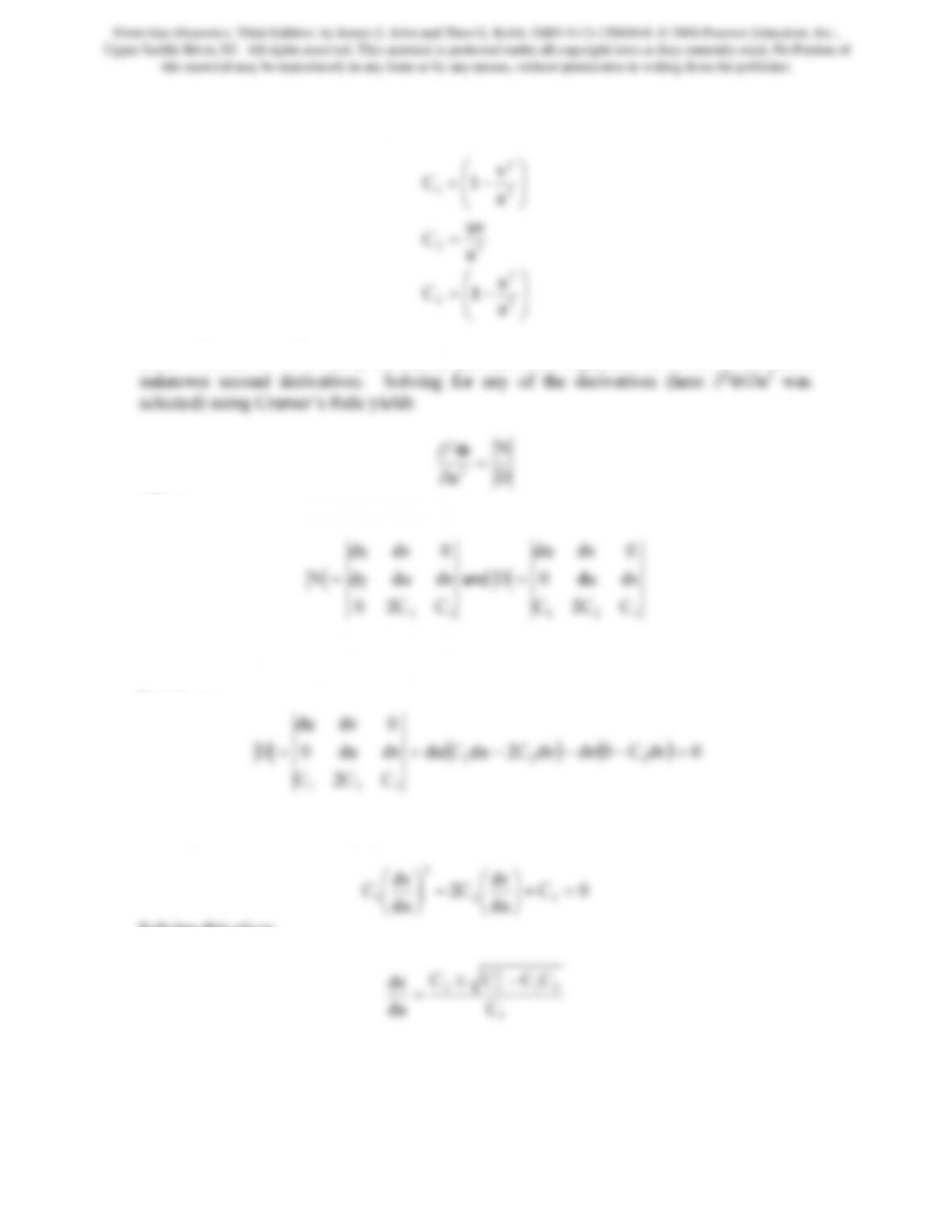
Since ∂2Φ/∂u∂v = ∂2Φ/∂v∂u, the above provide three equations in terms of the three
D
u2
=
∂
where
32132 CC2C
CC20
Setting the determinant D to zero gives the equation of the characteristic in the hodograph
plane, i.e.,
CC2C
321
which produces the following quadratic
0C
du
C2
du
C32
1=+
⎟
⎠
⎜
⎝
−
⎟
⎠
⎜
⎝
Solving this gives
1
C
du
Substitution brings Eq.(14.21)
From Gas Dynamics, Third Edition, by James E. John and Theo G. Keith. ISBN 0-13-120668-0. © 2006 Pearson Education, Inc.,
Upper Saddle River, NJ. All rights reserved. This material is protected under all copyright laws as they currently exist. No Portion of
this material may be reproduced, in any form or by any means, without permission in writing from the publisher.
(
)
22
4222
va
avuauv
du
dv
−
−+±
=
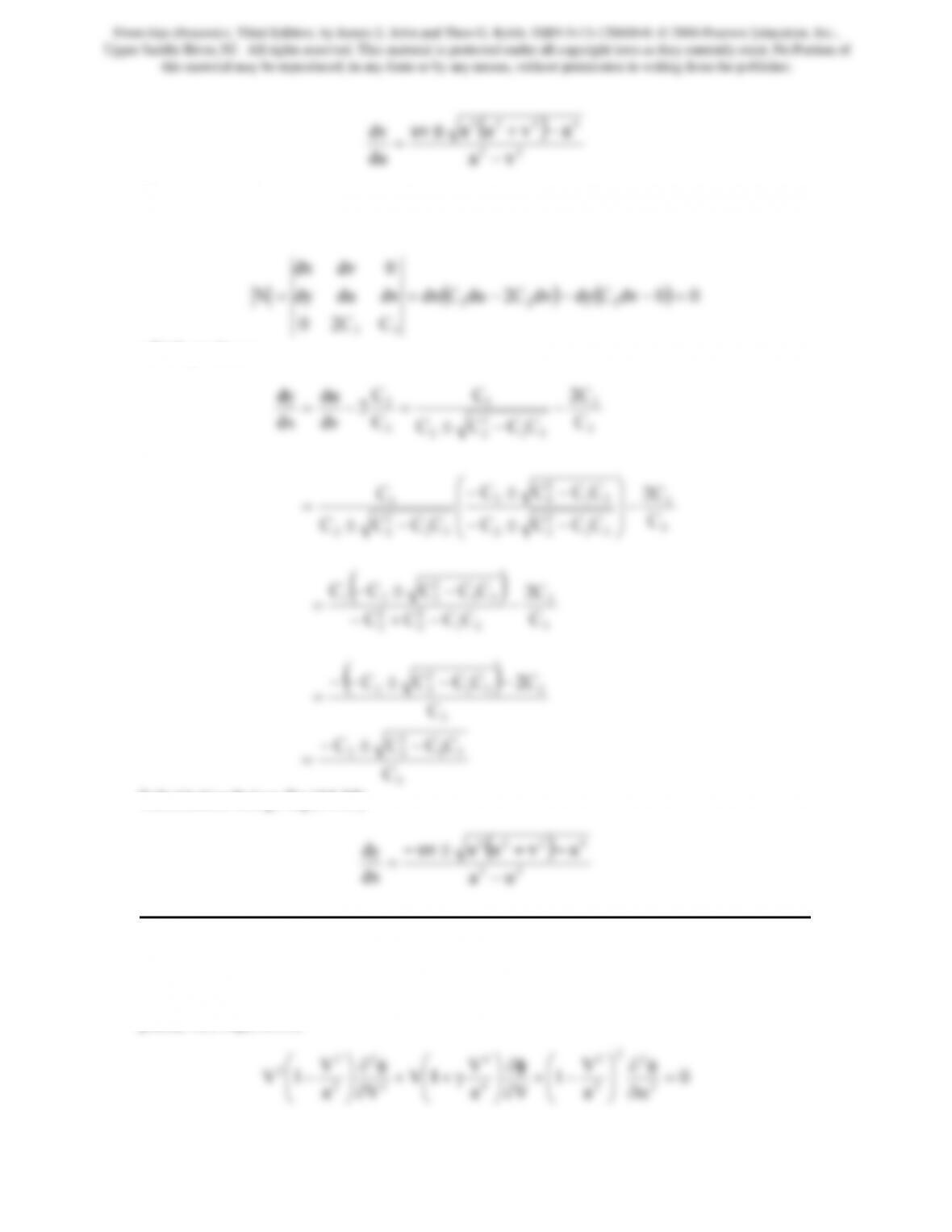
The equation for the information that is carried on the characteristics is obtained by
equating the determinant N to zero, i.e.,
CC20
32
which produces
()
()
3
31
2
22
3
231
2
22
3
2
31
2
2
2
2
31
221
C
CCCC
C
C2CCCC
C
C2
CCCC
CCCCC
−±−
=
−−±−−
=
−
−+−
−±−
=
Substitution brings Eq.(14.15)
22
ua
dx
−
Problem 2. – Use the Method of Indeterminate Derivatives to obtain the equation for the
slope of the characteristics in the hodograph plane in terms of the flow speed V and the
flow angle α. Develop the equation starting with the potential equation in the hodograph
plane, i.e., Eq.(12.55)
From Gas Dynamics, Third Edition, by James E. John and Theo G. Keith. ISBN 0-13-120668-0. © 2006 Pearson Education, Inc.,
Upper Saddle River, NJ. All rights reserved. This material is protected under all copyright laws as they currently exist. No Portion of
this material may be reproduced, in any form or by any means, without permission in writing from the publisher.
293
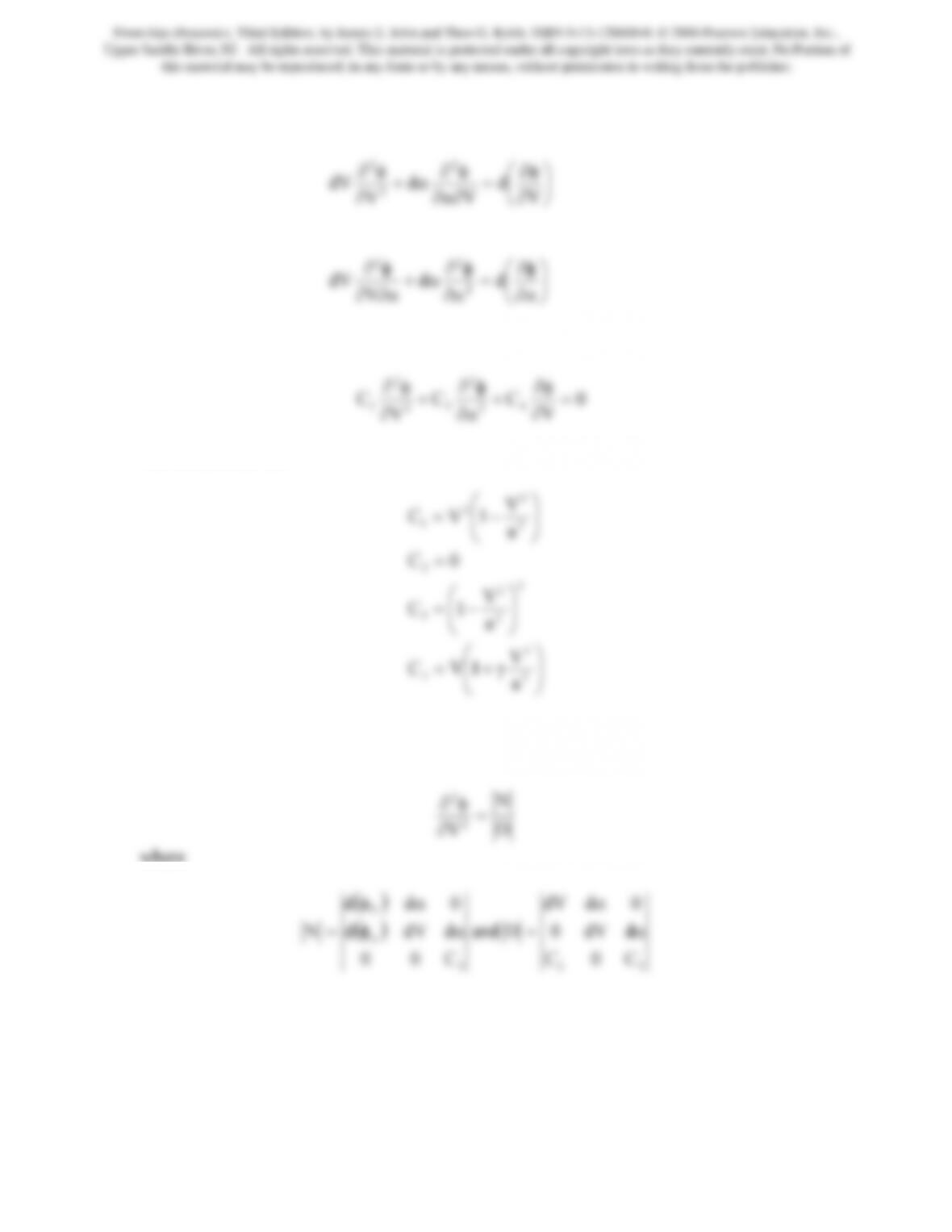
Write the total derivatives of ∂φ/∂V and ∂φ/∂α
⎞
⎛
φ∂
φ∂
φ∂
2
2
⎠
⎝
α∂
α∂
α∂∂
V
Next rewrite the potential equation as
0
V
CC
V
C4
2
3
2
1=
∂
+
α
∂
+
∂
The coefficients are
The above provide three equations in terms of the three unknown second derivatives.
Solving for any of the derivatives (here ∂2φ/∂V2 was selected) using Cramer’s Rule yields
D
V2
=
∂
where
313
C0C
C00
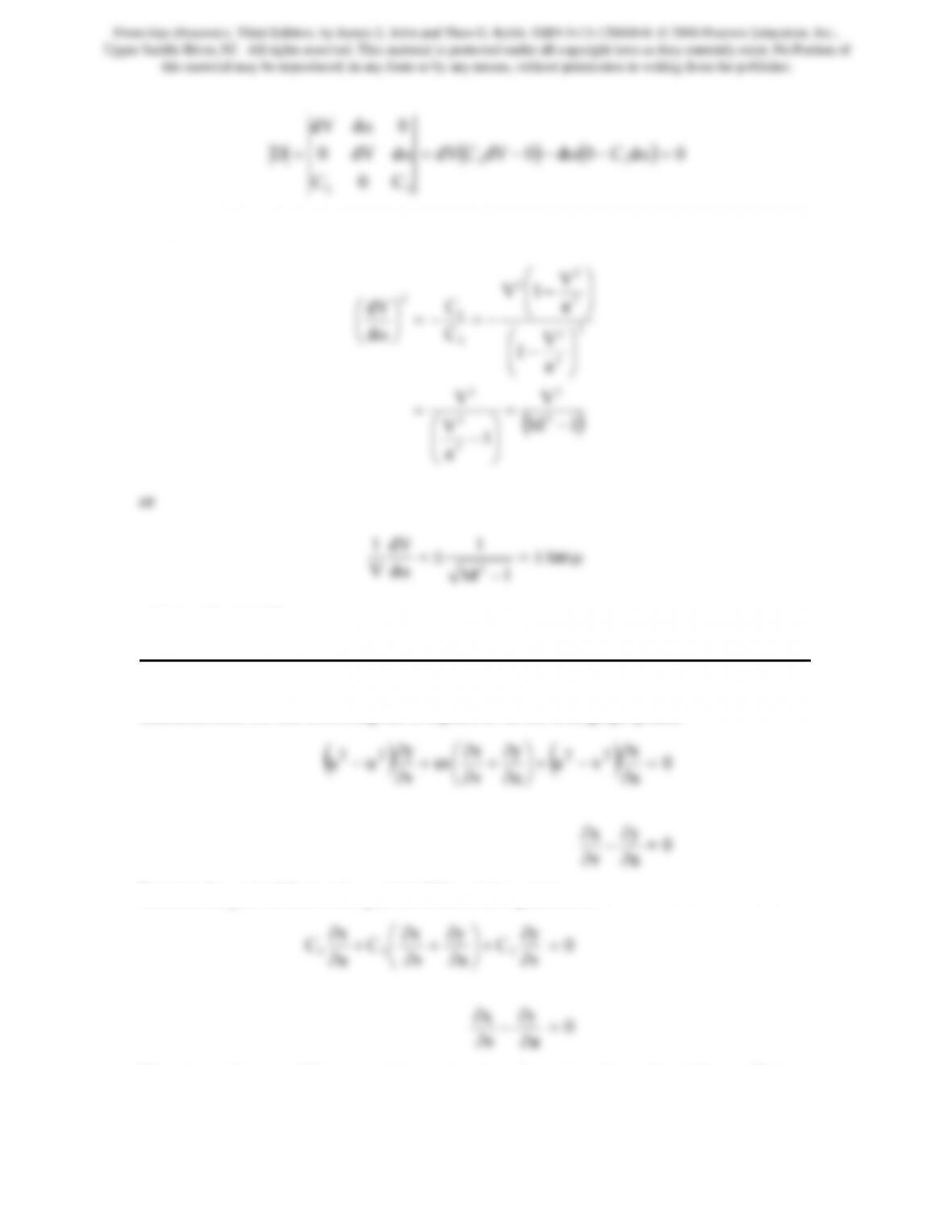
Setting the determinant D to zero gives the desired equation of the characteristic in the
hodograph plane, i.e.,
From Gas Dynamics, Third Edition, by James E. John and Theo G. Keith. ISBN 0-13-120668-0. © 2006 Pearson Education, Inc.,
Upper Saddle River, NJ. All rights reserved. This material is protected under all copyright laws as they currently exist. No Portion of
this material may be reproduced, in any form or by any means, without permission in writing from the publisher.
294
C0C
0ddV
31
α
which produces the following
which is Eq.(14.52).
Problem 3. – Use the Method of Linear Combination to obtain equations of the
characteristics for the following set of equations in the hodograph plane,
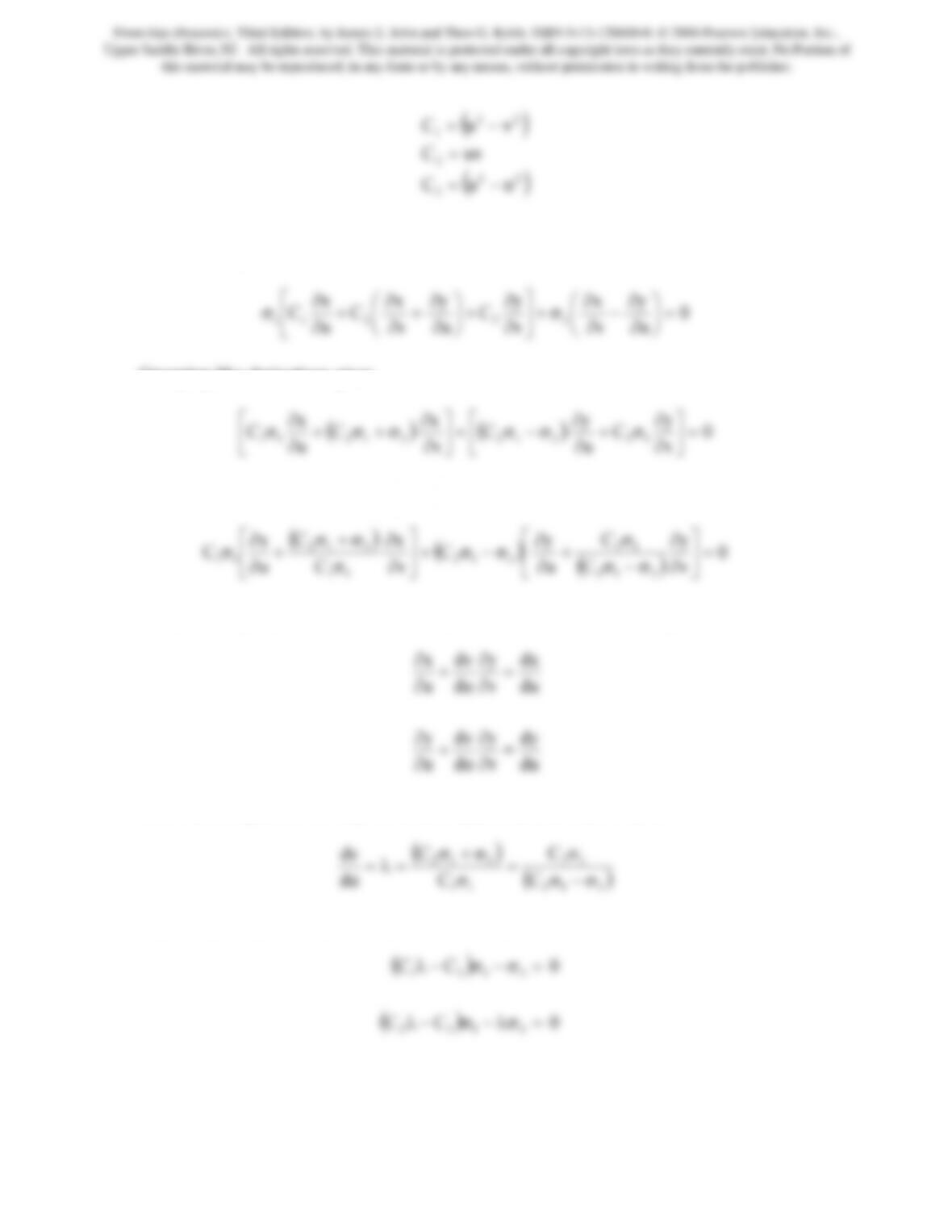
Rewrite the pair of first-order partial differential equations as
Note the end terms of the potential equation have been interchanged and the coefficients
are
From Gas Dynamics, Third Edition, by James E. John and Theo G. Keith. ISBN 0-13-120668-0. © 2006 Pearson Education, Inc.,
Upper Saddle River, NJ. All rights reserved. This material is protected under all copyright laws as they currently exist. No Portion of
this material may be reproduced, in any form or by any means, without permission in writing from the publisher.
295
(
)
()
22
3
2
22
1
uaC
uvC
vaC
−=
=
−=
Now multiply the first equation by an unknown parameter σ1, the second by σ2 and add
the results to get
Grouping like derivatives gives
v
u
v
u
⎥
⎦
⎢
⎣
∂
∂
⎥
⎦
⎢
⎣
∂
∂
Or
()
()
v
y
C
C
u
y
v
x
C
C
u
x
212
13
212
11
212
11 =
⎥
⎦
⎤
⎢
⎣
⎡
∂
∂
σ−σ
σ
∂
∂
⎥
⎦
⎤
⎢
⎣
⎡
∂
∂
σ
σ+σ
∂
∂
Compare the group of terms within the square brackets to the following total derivatives
du
dy
v
y
du
dv
u
y
=
∂
∂
+
∂
∂
From this comparison we may write the slope, dv/du, denoted as λ, as
212
11
C
C
du
σ−σ
σ
Expanding this pair of equations produces two equations for σ1 and σ2
()
0CC
2132
=λσ−σ−λ
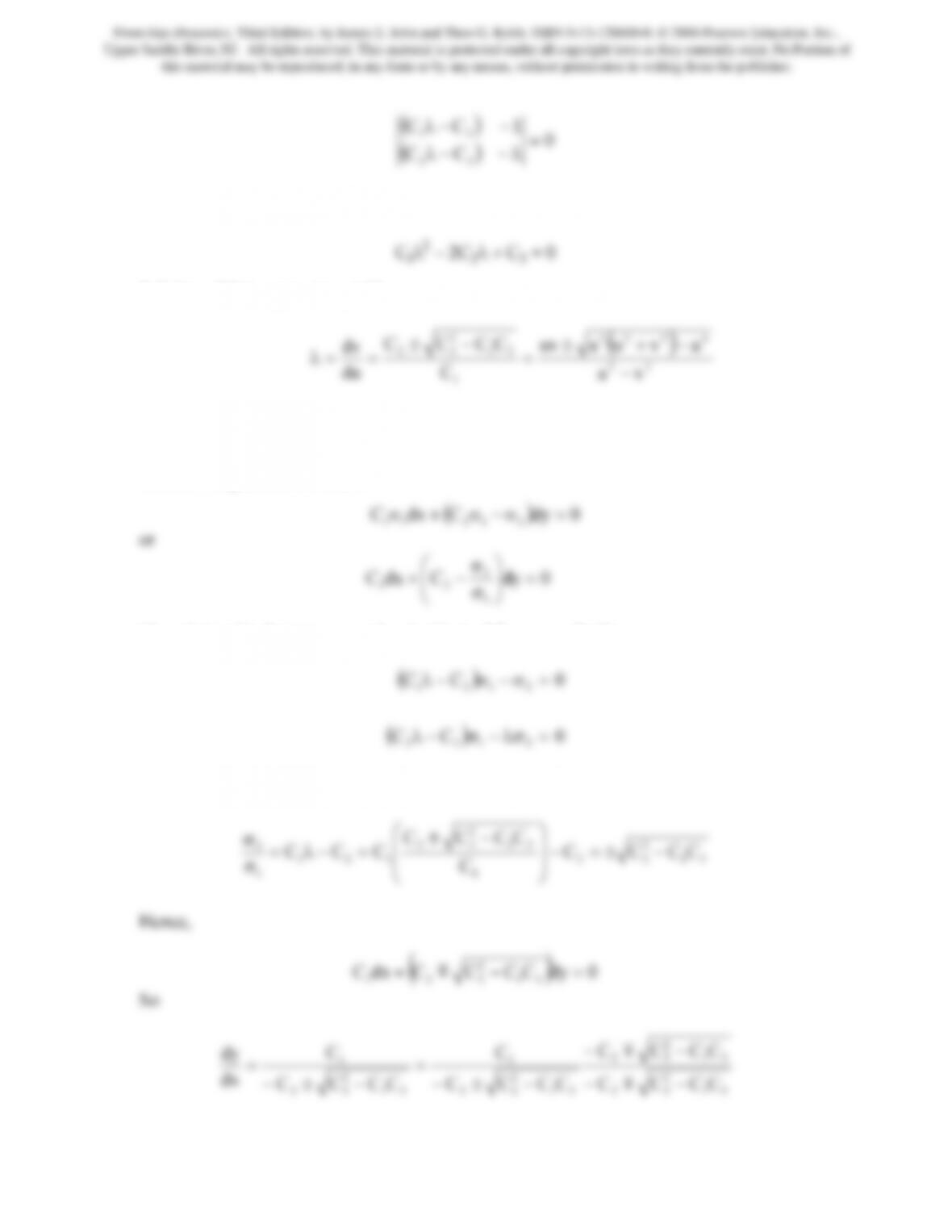
A unique solution for σ1 and σ2 will be obtained if and only if the determinant of the
coefficients vanishes, i.e.,
From Gas Dynamics, Third Edition, by James E. John and Theo G. Keith. ISBN 0-13-120668-0. © 2006 Pearson Education, Inc.,
Upper Saddle River, NJ. All rights reserved. This material is protected under all copyright laws as they currently exist. No Portion of
this material may be reproduced, in any form or by any means, without permission in writing from the publisher.
(
)
()
0
CC
1CC
32
21 =
λ−−λ
−−λ
Expanding and rearranging the result produces the quadratic equation,
Solution of this expression yields
22
1
va
C
du
−
which was previously obtained as Eq.(14.21).
To derive the compatibility equation, incorporate the total derivative equations into the
combined equation and obtain
The relationship between σ1 and σ2 is obtained from use of either
(
)
()
0CC
0CC
2132
2121
=λσ−σ−λ
=
σ
−
σ
−
λ
Using the first of these and the expression for λ produces
From Gas Dynamics, Third Edition, by James E. John and Theo G. Keith. ISBN 0-13-120668-0. © 2006 Pearson Education, Inc.,
Upper Saddle River, NJ. All rights reserved. This material is protected under all copyright laws as they currently exist. No Portion of
this material may be reproduced, in any form or by any means, without permission in writing from the publisher.
297
(
)
()
3
31
2
22
31
2
2
2
2
31
2
221
C
CCCC
CCCC
CCCCC
dx
dy −−
=
−−
−−
=mm
Substitution brings Eq.(14.15)
22
ua
dx
−
Problem 4. – Resolve problem 3 using Eigenanalysis
The pair of equations
0
u
y
v
x
=
∂
∂
−
∂
∂
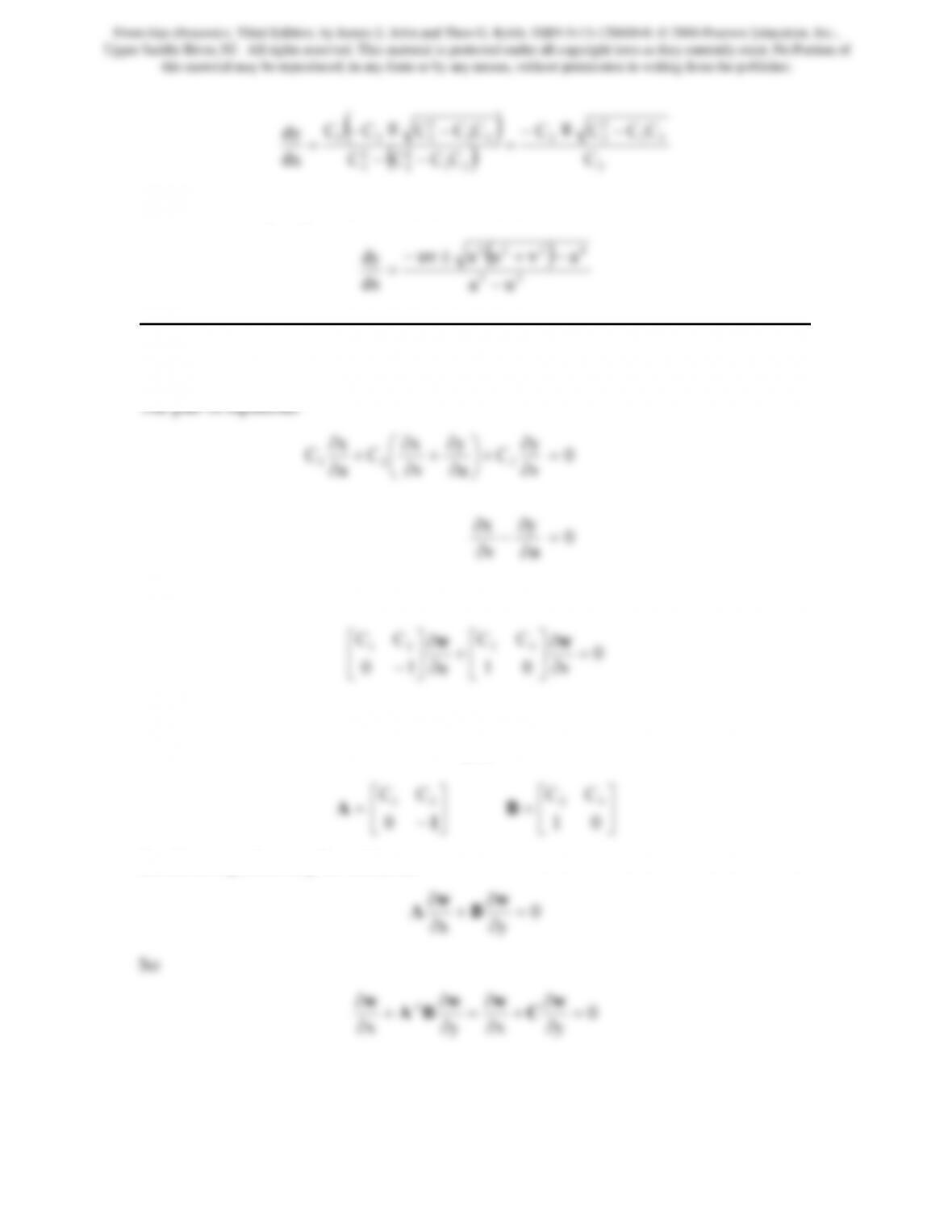
can be written in vector matrix form as
0
v
01
u
10
∂
⎥
⎦
⎢
⎣
+
∂
⎥
⎦
⎢
⎣
−
where the dependent column vector is w = ⎥
⎦
⎤
⎢
⎣
⎡
y
x. Defining the coefficient matrices as
the above equation may be written as
0
yxyx =
∂
+
∂
=
∂
+
∂
C
BA
From Gas Dynamics, Third Edition, by James E. John and Theo G. Keith. ISBN 0-13-120668-0. © 2006 Pearson Education, Inc.,
Upper Saddle River, NJ. All rights reserved. This material is protected under all copyright laws as they currently exist. No Portion of
this material may be reproduced, in any form or by any means, without permission in writing from the publisher.
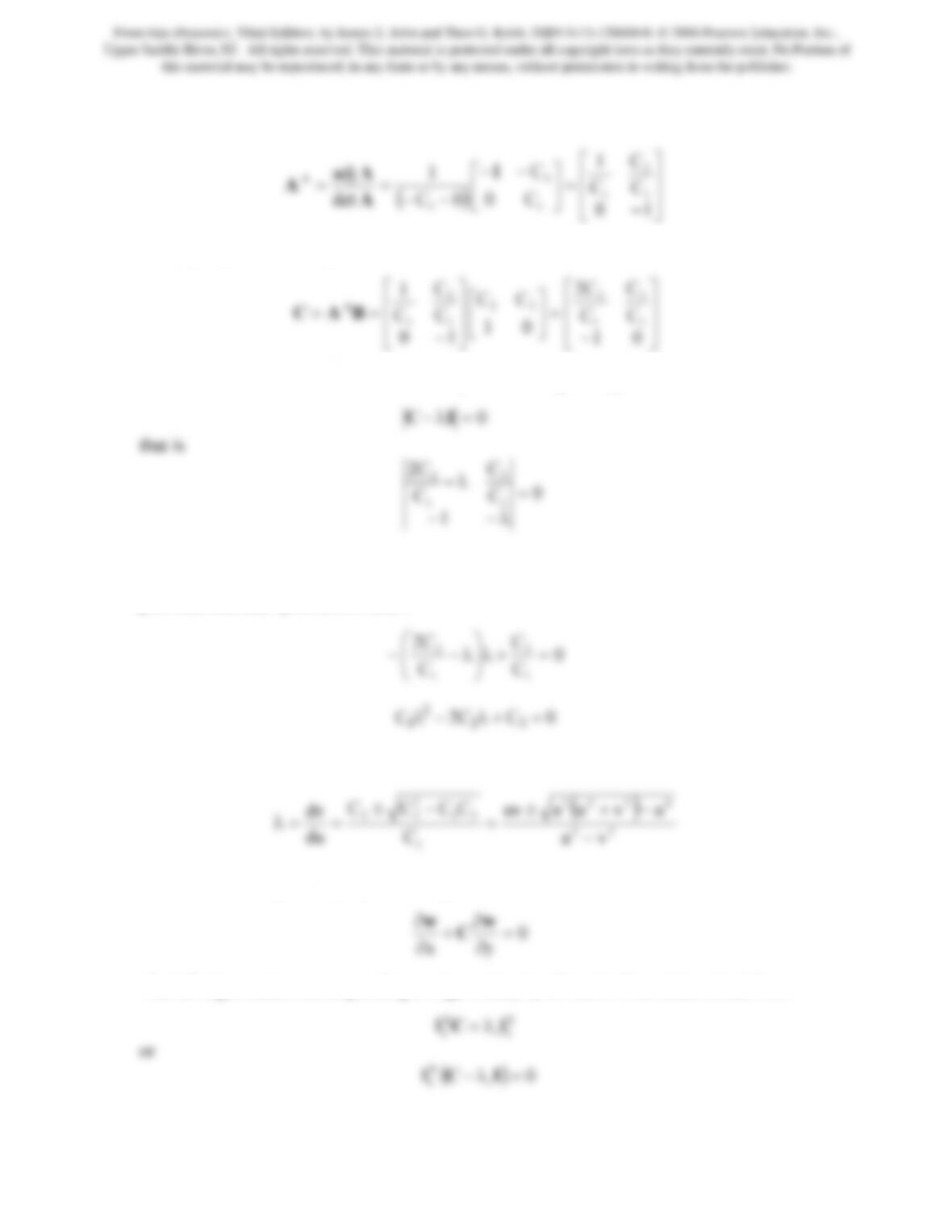
The inverse matrix of A is
()
10
C0
0C
det
1
1
1
1⎥
⎦
⎢
⎣
−
⎥
⎦
⎢
⎣
−−
Multiplying A-1 times B gives C
⎥
⎦
⎢
⎣
−
⎥
⎦
⎢
⎣
⎥
⎦
⎢
⎣
−
01
01
10
1
1
1
1
The characteristic directions are obtained by determining the eigenvalues of matrix C,
0
1
C
C
1
1
λ−−
Expanding the determinant yields the same quadratic expression as obtained by the two
previous methods problems 3 and 4
Solution of this brings
22
1
va
C
du
−
To derive the compatibility equation, begin with
The left eigenvectors corresponding to eigenvalue, λi, of matrix C are determined from
From Gas Dynamics, Third Edition, by James E. John and Theo G. Keith. ISBN 0-13-120668-0. © 2006 Pearson Education, Inc.,
Upper Saddle River, NJ. All rights reserved. This material is protected under all copyright laws as they currently exist. No Portion of
this material may be reproduced, in any form or by any means, without permission in writing from the publisher.
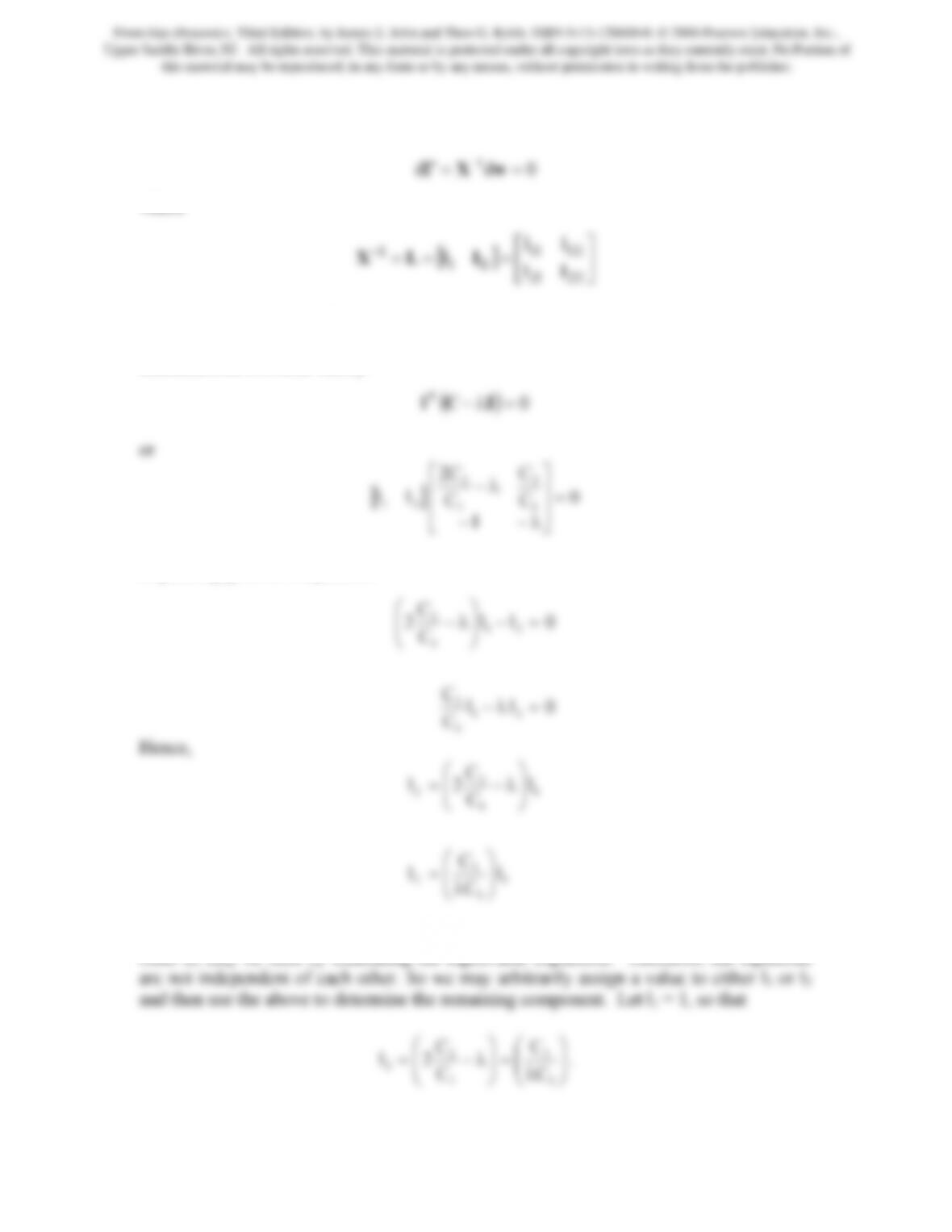
The characteristic variables are defined by
where
⎥
⎦
⎢
⎣
2ΙΙ2Ι
ΙΙΙ
ll
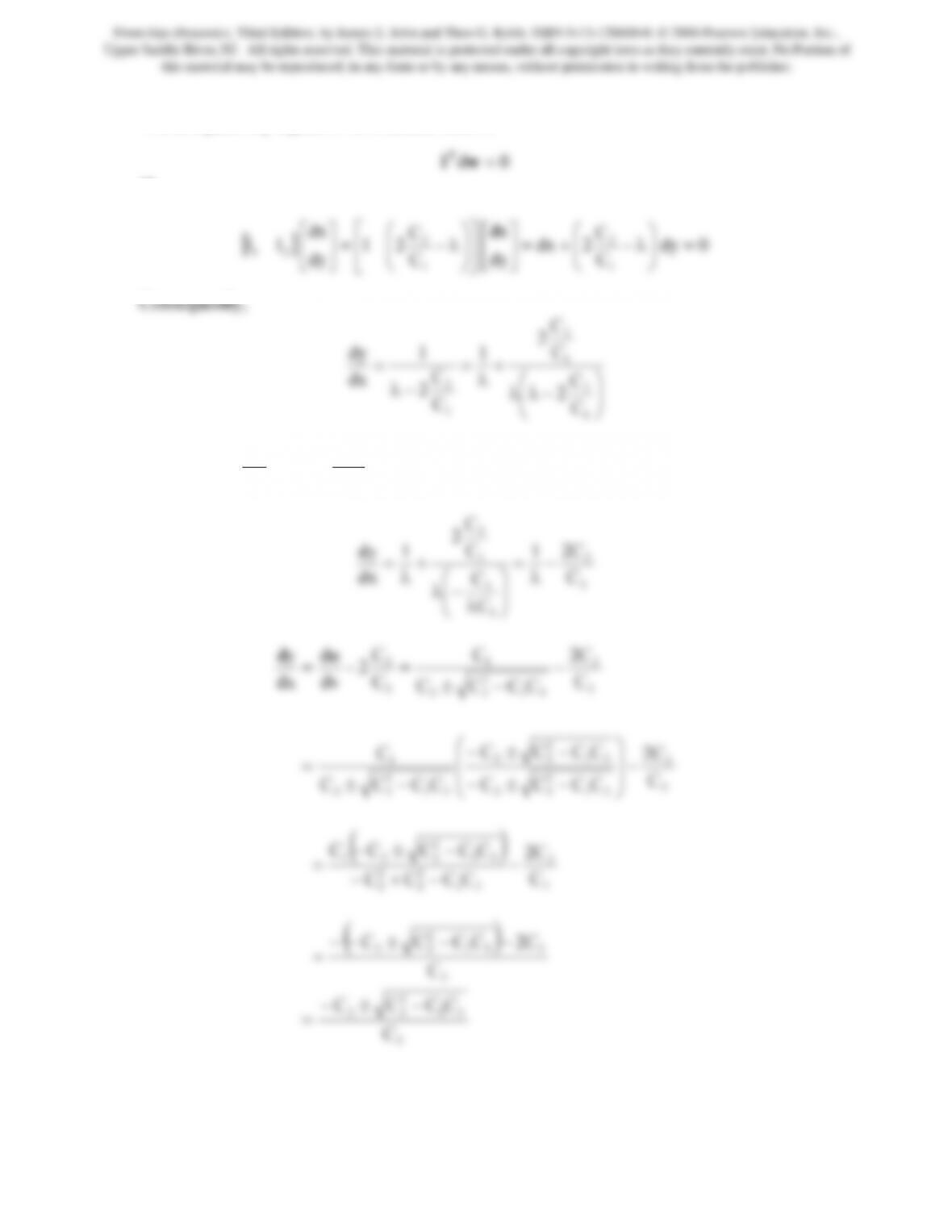
To derive the compatibility equation, the left eigenvectors must first be determined.
Rather than obtaining results for each characteristic (I and II), the following applies to
characteristics of either family
[]
0
1
C
C
ll 1
1
21 =
⎥
⎥
⎦
⎢
⎢
⎣
λ−−
Expanding gives two equations
1
1
3
2
l
C
C
l
⎟
⎟
⎠
⎞
⎜
⎜
⎝
⎛
λ
=
The group of coefficients on the right side of the above two equations are equal to each
other as may be seen by examining the eigenvalue expansion. Therefore, the equations
From Gas Dynamics, Third Edition, by James E. John and Theo G. Keith. ISBN 0-13-120668-0. © 2006 Pearson Education, Inc.,
Upper Saddle River, NJ. All rights reserved. This material is protected under all copyright laws as they currently exist. No Portion of
this material may be reproduced, in any form or by any means, without permission in writing from the publisher.
300
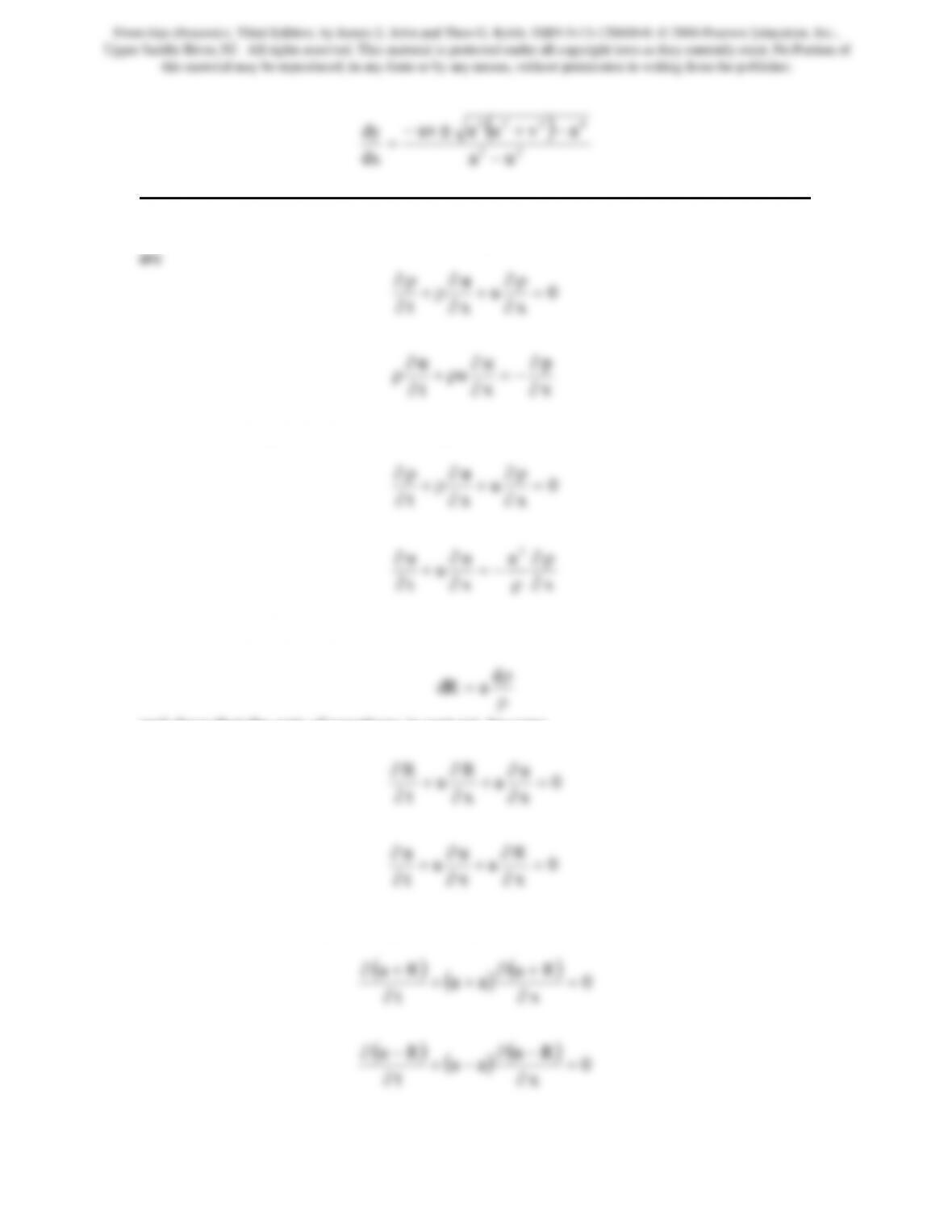
The compatibility equation for characteristics is
or
⎟
⎟
⎠
⎞
⎜
⎜
⎝
⎛−λλ
+
λ
=
−λ
=
1
2
1
1
2
C
C
2
C
C
2
dx
And since ⎟
⎟
⎠
⎞
⎜
⎜
⎝
⎛
λ
=
⎟
⎟
⎠
⎞
⎜
⎜
⎝
⎛λ−
1
3
1
2
C
C
C
C
2 the above becomes
()
()
3
31
2
22
3
231
2
22
3
2
31
2
2
2
2
31
221
C
CCCC
C
C2CCCC
C
C2
CCCC
CCCCC
−±−
=
−−±−−
=
−
−+−
−±−
=
Substitution brings
From Gas Dynamics, Third Edition, by James E. John and Theo G. Keith. ISBN 0-13-120668-0. © 2006 Pearson Education, Inc.,
Upper Saddle River, NJ. All rights reserved. This material is protected under all copyright laws as they currently exist. No Portion of
this material may be reproduced, in any form or by any means, without permission in writing from the publisher.
301
(
)
22
4222
ua
avuauv
dx
dy
−
−+±−
=
Problem 5. –The continuity and momentum equations for one-dimensional unsteady flow
x
p
x
u
u
t
u
∂
∂
−=
∂
∂
ρ+
∂
∂
ρ
(a) For an isentropic flow show that this pair can be written as
x
a
x
u
u
t
u
2
∂
ρ∂
ρ
−=
∂
∂
+
∂
∂
(b) Define the Riemann variable, R, as
ρ
and show that the pair of equations in part (a) become
0
x
R
a
x
u
u
t
u
=
∂
∂
+
∂
∂
+
∂
∂
(c) Add and subtract the pair of equations in part (b) to obtain
()
()
()
0
x
Ru
au
t
Ru
=
∂
−∂
−+
∂
−∂
From Gas Dynamics, Third Edition, by James E. John and Theo G. Keith. ISBN 0-13-120668-0. © 2006 Pearson Education, Inc.,
Upper Saddle River, NJ. All rights reserved. This material is protected under all copyright laws as they currently exist. No Portion of
this material may be reproduced, in any form or by any means, without permission in writing from the publisher.
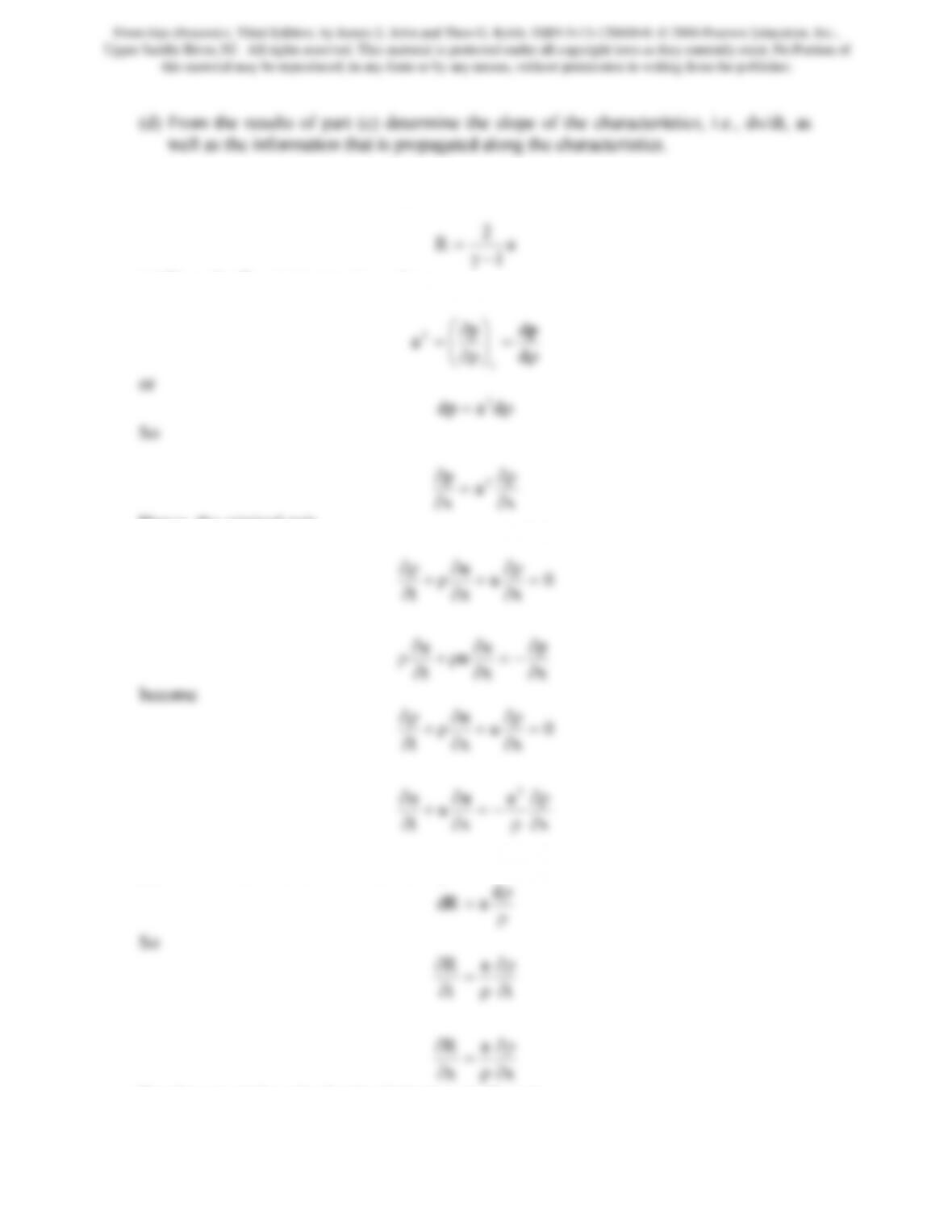
302
(e) For isentropic flow of a perfect gas, show that if R(0) = a(0) = 0, then
1
(a) Since the flow is isentropic we have
ρ
∂
∂
x
x
∂
∂
Hence, the original pair
ρ
∂
∂
ρ
∂
ρ
∂
∂
ρ
∂
x
a
x
u
u
t
u
2
∂
ρ∂
ρ
−=
∂
∂
+
∂
∂
(b) The Riemann variable R is defined by
ρ
=d
adR
x
a
x
R
∂
ρ∂
ρ
=
∂
∂
Use these to replace the density derivatives in the pair
From Gas Dynamics, Third Edition, by James E. John and Theo G. Keith. ISBN 0-13-120668-0. © 2006 Pearson Education, Inc.,
Upper Saddle River, NJ. All rights reserved. This material is protected under all copyright laws as they currently exist. No Portion of
this material may be reproduced, in any form or by any means, without permission in writing from the publisher.
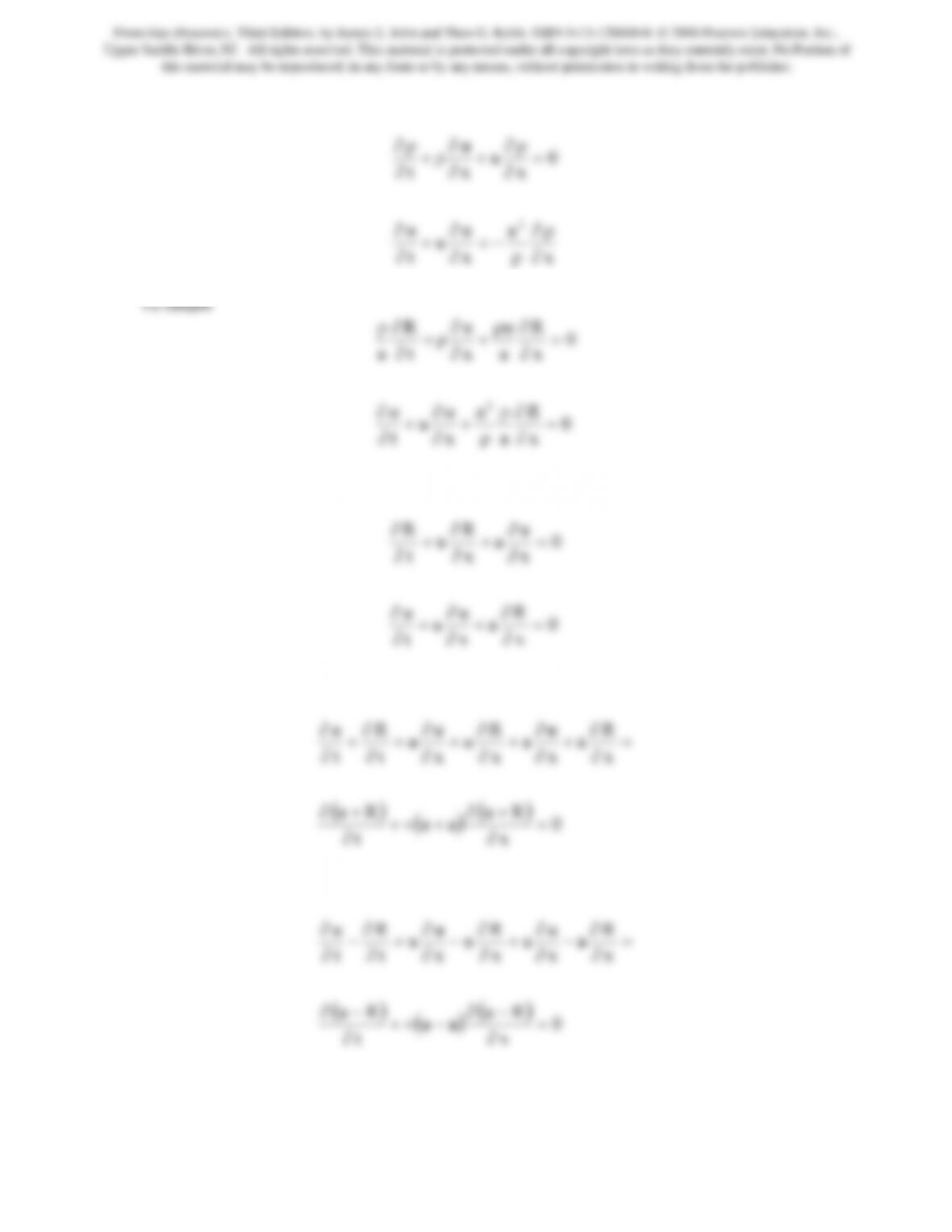
303
x
a
x
u
u
t
u
2
∂
ρ∂
ρ
−=
∂
∂
+
∂
∂
0
x
R
a
a
x
u
u
t
u
2
=
∂
∂
ρ
ρ
+
∂
∂
+
∂
∂
Performing the cancellation of terms gives
0
x
R
a
x
u
u
t
u
=
∂
∂
+
∂
∂
+
∂
∂
(c) Add the pair in (b) to get
()
()
()
0
x
Ru
au
t
Ru
=
∂
+∂
+++
∂
+∂
Subtraction produces
()
()
()
0
x
Ru
au
t
Ru
=
∂
−∂
−++
∂
−∂
(d) The pair of pde in (c) can be rewritten collectively as
From Gas Dynamics, Third Edition, by James E. John and Theo G. Keith. ISBN 0-13-120668-0. © 2006 Pearson Education, Inc.,
Upper Saddle River, NJ. All rights reserved. This material is protected under all copyright laws as they currently exist. No Portion of
this material may be reproduced, in any form or by any means, without permission in writing from the publisher.
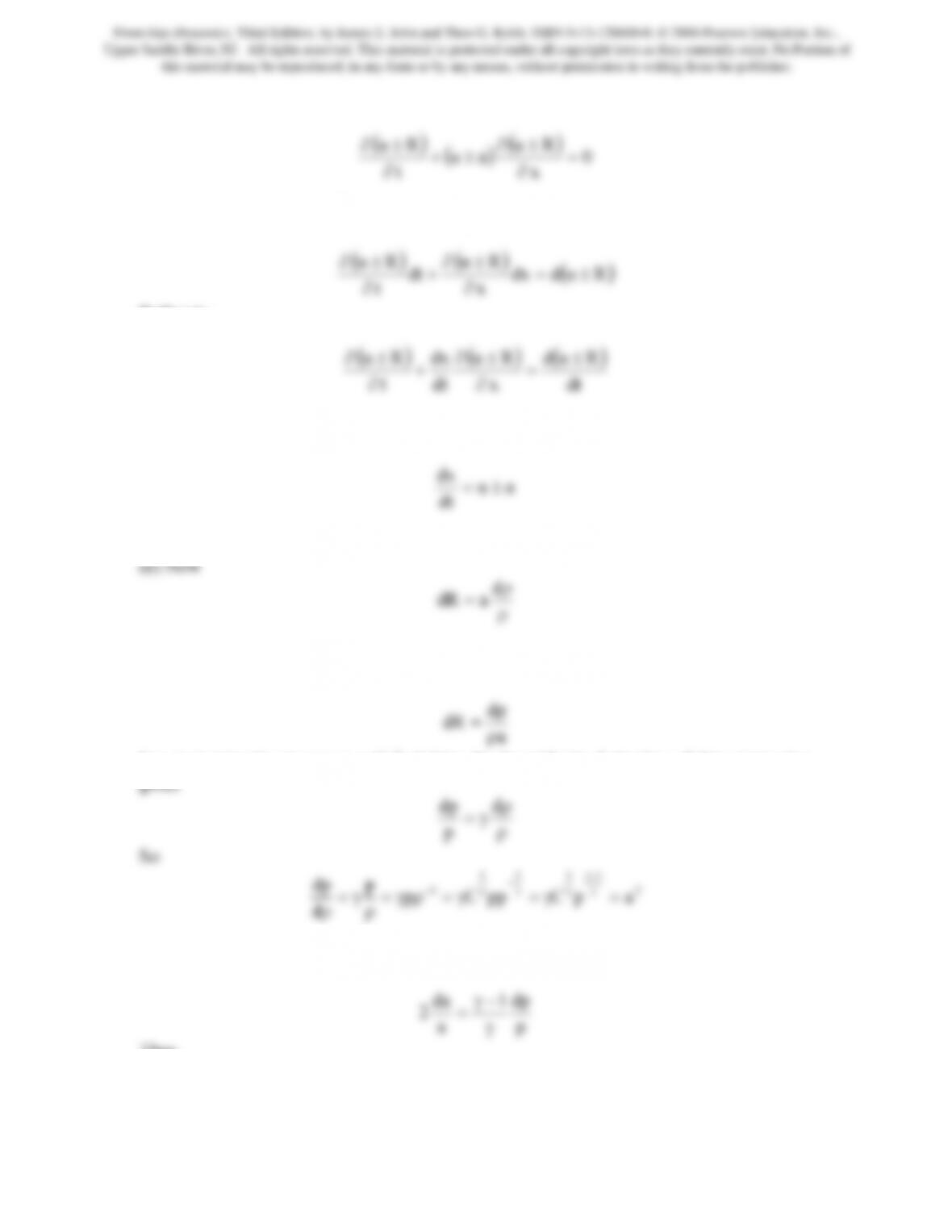
304
()
0
x
au
t
∂
±+
∂
Contrast this to the total derivative of u ± R, i.e.,
Ruddx
x
dt
t
∂
+
∂
Rather to
dt
x
dt
t
=
∂
+
∂
And we observe that the quantity u ± R remains constant along a line whose slope is
au
dt
ρ
But for isentropic flow we have: ρ=dadp 2, therefore
a
For an isentropic process p = Cργ. Taking the logarithmic derivative of this expression
d
ρ
γ=
ρ
Taking the logarithmic derivative of this expression brings
p
a
Thus,
From Gas Dynamics, Third Edition, by James E. John and Theo G. Keith. ISBN 0-13-120668-0. © 2006 Pearson Education, Inc.,
Upper Saddle River, NJ. All rights reserved. This material is protected under all copyright laws as they currently exist. No Portion of
this material may be reproduced, in any form or by any means, without permission in writing from the publisher.
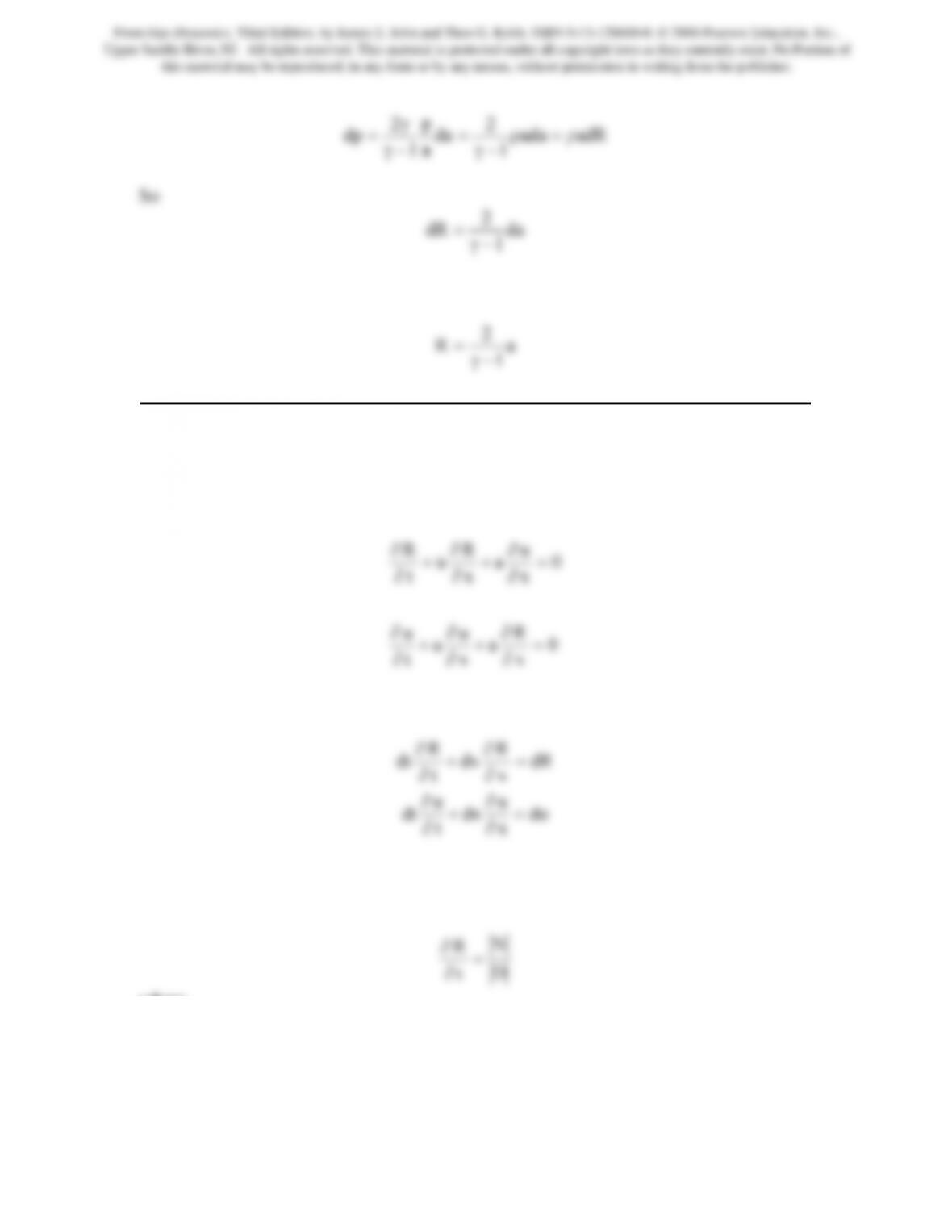
305
2
p
2
γ
1
Integration using the given initial conditions produces
1
Problem 6. – Obtain the characteristic equations of the pair of pde in part (b) of problem
5 by using the Method of Indeterminate Derivatives.
In addition to the given set of equations
0
x
R
a
x
u
u
t
u
0
x
u
a
x
R
u
t
R
=
∂
∂
+
∂
∂
+
∂
∂
=
∂
∂
+
∂
∂
+
∂
∂
we have the total derivatives of R and u
∂
∂
∂
∂
x
t
∂
∂
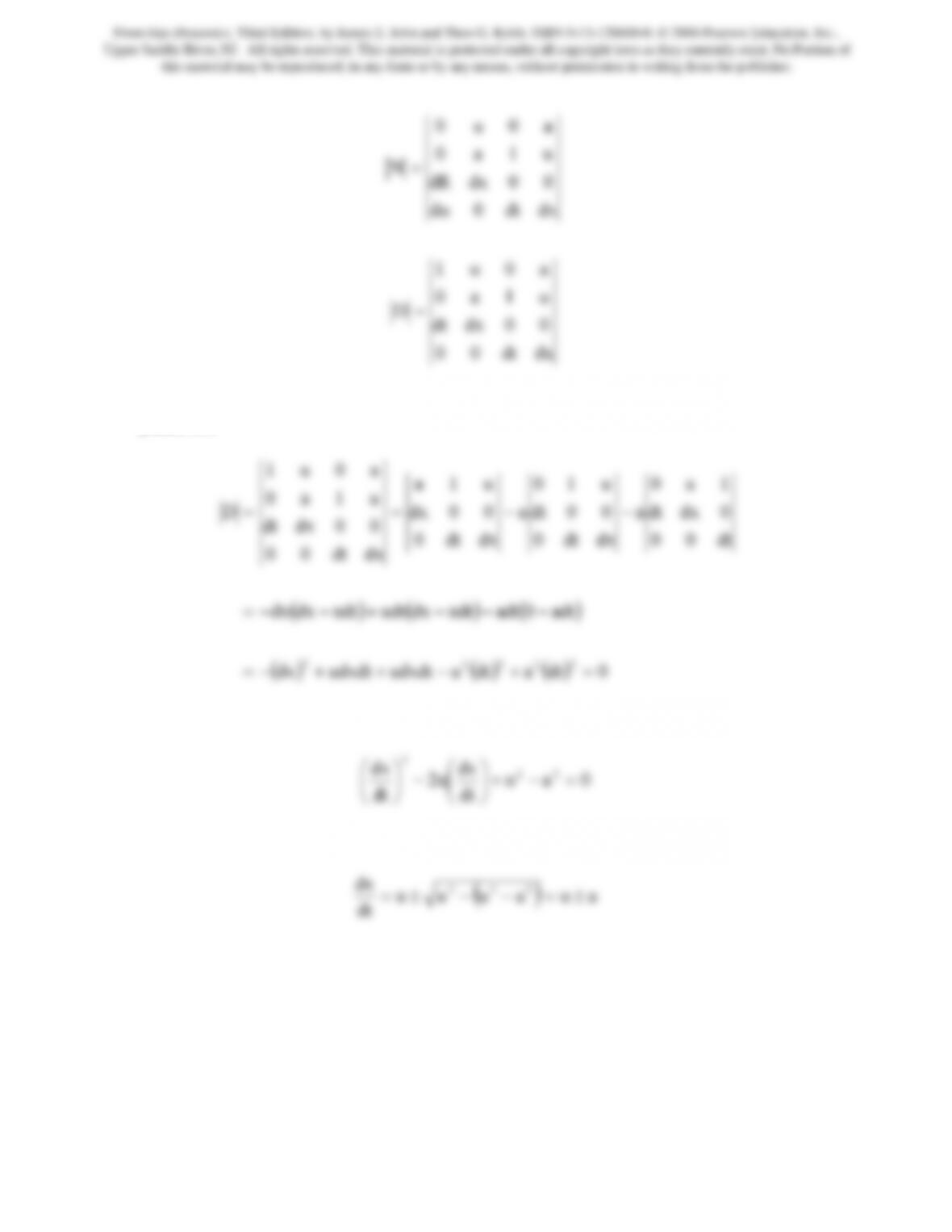
The above provide four equations in terms of the four unknown derivatives. Solving for
any of the derivatives (here ∂R/∂t was selected) using Cramer’s Rule yields
D
t
∂
where
From Gas Dynamics, Third Edition, by James E. John and Theo G. Keith. ISBN 0-13-120668-0. © 2006 Pearson Education, Inc.,
Upper Saddle River, NJ. All rights reserved. This material is protected under all copyright laws as they currently exist. No Portion of
this material may be reproduced, in any form or by any means, without permission in writing from the publisher.
306
dxdt00
00dxdt
u1a0
a0u1
D
dxdt0du
00dxdR
u1a0
a0u0
N
=
=
Setting the determinant D to zero gives the equation of the characteristic in the x − t
plane, i.e.,
( ) () ()
0dtadtuudxdtudxdtdx
2
2
2
2
2=+−++−=
which produces the following quadratic
0au
dt
u2
dt
=−+
⎟
⎠
⎜
⎝
−
⎟
⎠
⎜
⎝
Solving this gives
(
)
auauuu
dt
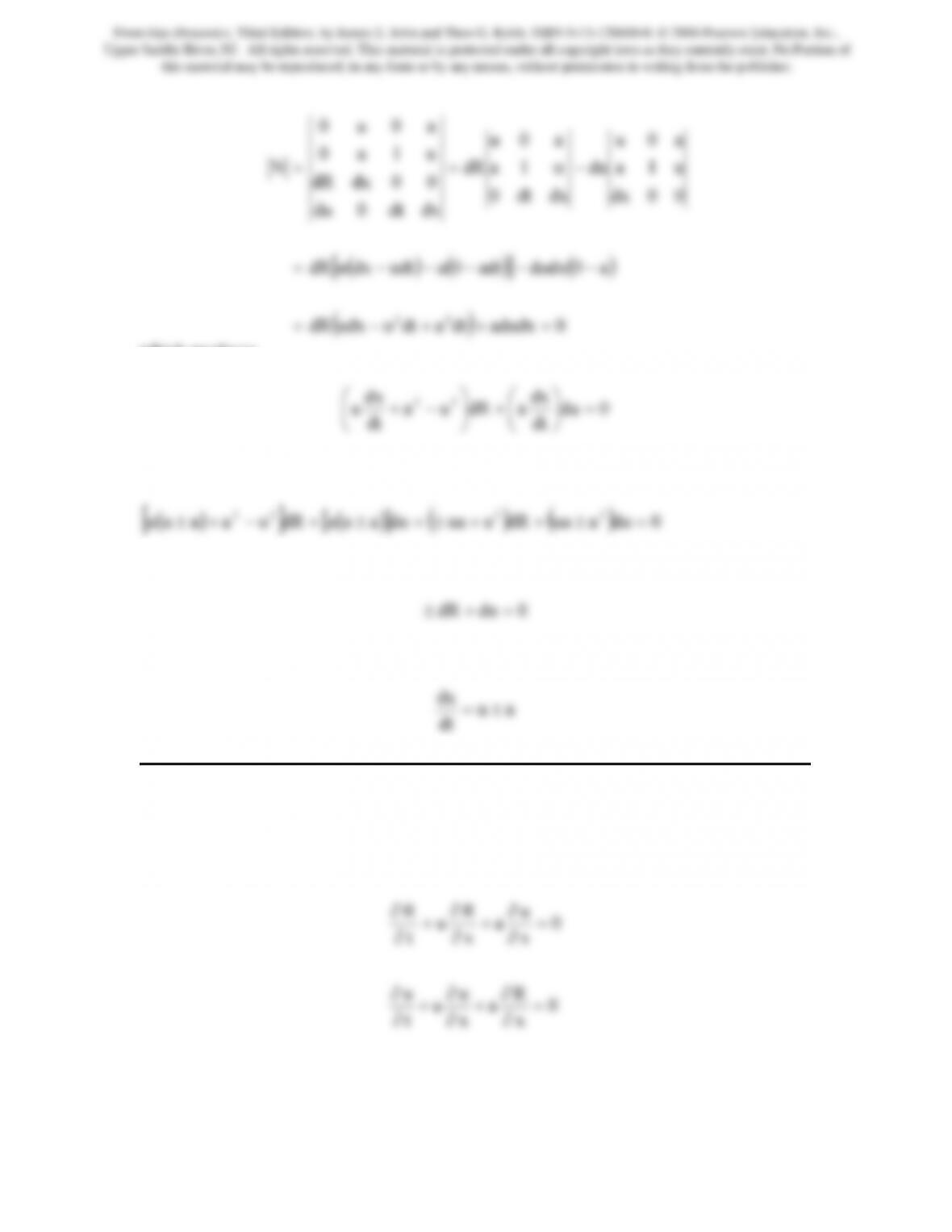
The compatibility equation is obtained by equating the determinant N to zero, i.e.,
From Gas Dynamics, Third Edition, by James E. John and Theo G. Keith. ISBN 0-13-120668-0. © 2006 Pearson Education, Inc.,
Upper Saddle River, NJ. All rights reserved. This material is protected under all copyright laws as they currently exist. No Portion of
this material may be reproduced, in any form or by any means, without permission in writing from the publisher.
307
()
0adudxdtadtuudxdR
00dx
u1a
a0u
du
dxdt0
u1a
a0u
dR
dxdt0du
00dxdR
u1a0
a0u0
N
22 =++−=
−==
which produces
0du
dt
adRua
dt
u22 =
⎟
⎠
⎜
⎝
+
⎟
⎠
⎜
⎝
Replace dx/dt with u ± a yields
which reduces to
along lines with slopes
au
dt
dx ±=
Problem 7. – Obtain the characteristic equations of the pair of pde in part (b) of problem
5 by using the Method of Linear Combination.
Multiply the given equations
0
x
R
a
x
u
u
t
u
=
∂
∂
+
∂
∂
+
∂
∂
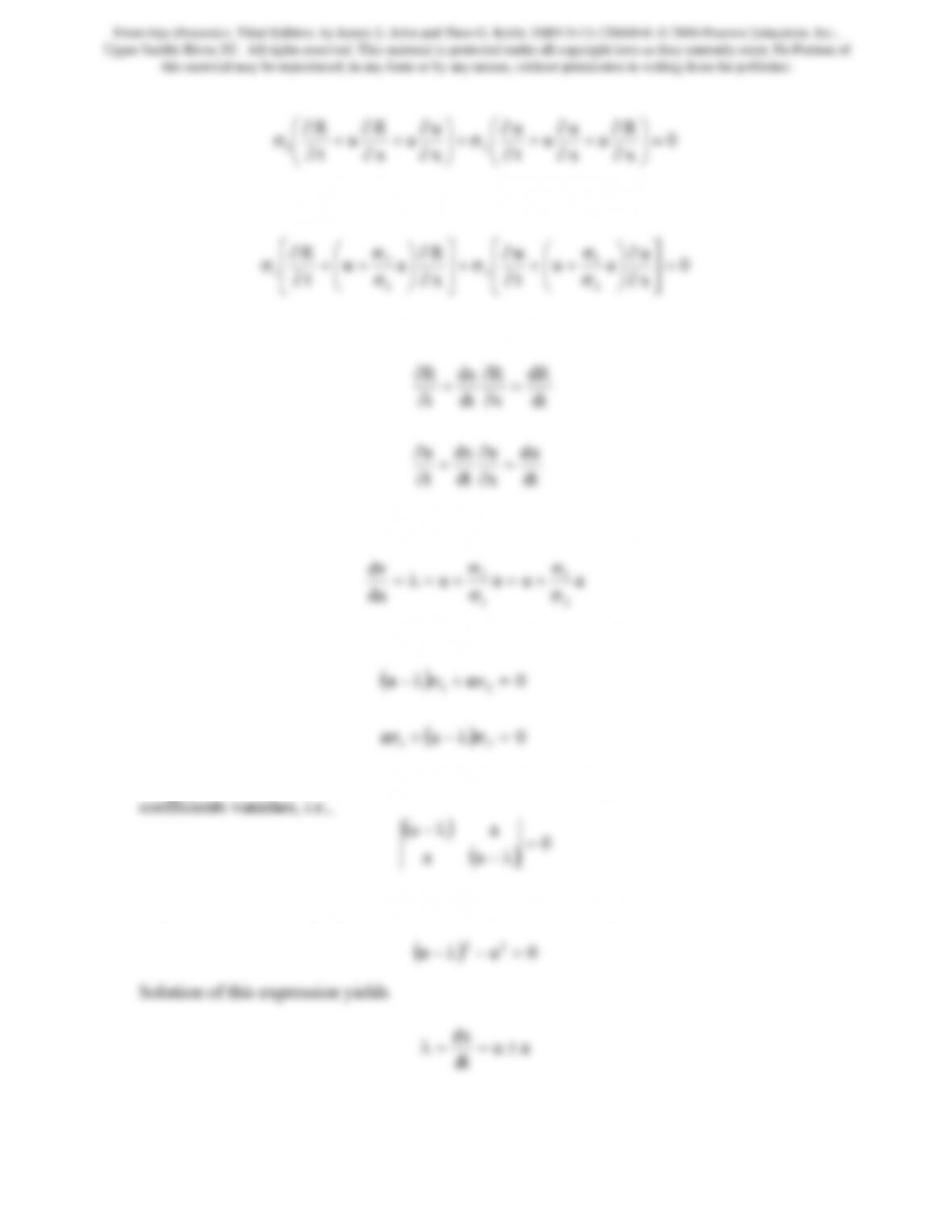
by σ1 and σ2, respectively, and add to get
From Gas Dynamics, Third Edition, by James E. John and Theo G. Keith. ISBN 0-13-120668-0. © 2006 Pearson Education, Inc.,
Upper Saddle River, NJ. All rights reserved. This material is protected under all copyright laws as they currently exist. No Portion of
this material may be reproduced, in any form or by any means, without permission in writing from the publisher.
308
x
R
x
u
t
u
x
u
x
R
t
R
21 =
⎟
⎠
⎞
⎜
⎝
⎛
∂
∂
∂
∂
∂
∂
⎟
⎠
⎞
⎜
⎝
⎛
∂
∂
∂
∂
∂
∂
Rearrangement brings
x
t
x
t
2
2
1
1=
⎦
⎣
∂
⎟
⎠
⎜
⎝
σ
∂
⎦
⎣
∂
⎟
⎠
⎜
⎝
σ
∂
Compare the group of terms within the square brackets to the following total derivatives
dt
du
x
u
dt
dx
t
u
=
∂
∂
+
∂
∂
From this comparison we may write the slope, dx/dt, denoted as λ, as
du
dv
2
1
1
2
σ
σ
σ
σ
Expanding this pair of equations produces two equations for σ1 and σ2
()
0ua
21
=σλ−+σ
A unique solution for σ1 and σ2 will be obtained if and only if the determinant of the
0
ua
λ−
Expanding and rearranging the result produces the quadratic equation,
au
dt
From Gas Dynamics, Third Edition, by James E. John and Theo G. Keith. ISBN 0-13-120668-0. © 2006 Pearson Education, Inc.,
Upper Saddle River, NJ. All rights reserved. This material is protected under all copyright laws as they currently exist. No Portion of
this material may be reproduced, in any form or by any means, without permission in writing from the publisher.
309
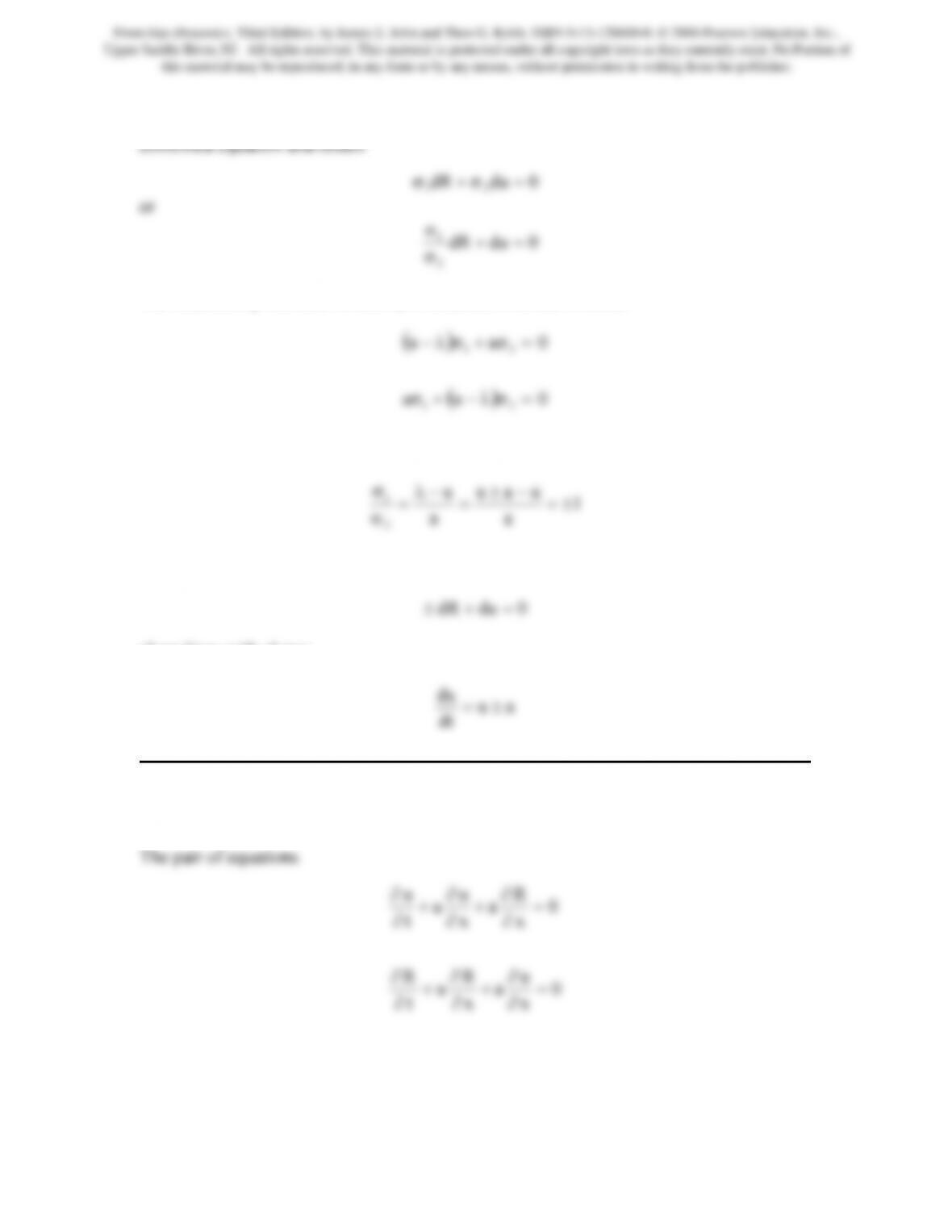
To derive the compatibility equation, incorporate the total derivative equations into the
0dudR
2
1=+
σ
The relationship between σ1 and σ2 is obtained from use of either
()
0ua
21
=σλ−+σ
Using either of these and the expression for λ produces
1
a
a
2
1±=
=
=
σ
Hence,
along lines with slopes
au
dt
Problem 8. – Obtain the characteristic equations of the pair of pde in part (b) of problem
5 by using Eigenanalysis.
0
x
u
a
x
R
u
t
R
=
∂
∂
+
∂
∂
+
∂
∂
can be written in vector matrix form as
From Gas Dynamics, Third Edition, by James E. John and Theo G. Keith. ISBN 0-13-120668-0. © 2006 Pearson Education, Inc.,
Upper Saddle River, NJ. All rights reserved. This material is protected under all copyright laws as they currently exist. No Portion of
this material may be reproduced, in any form or by any means, without permission in writing from the publisher.