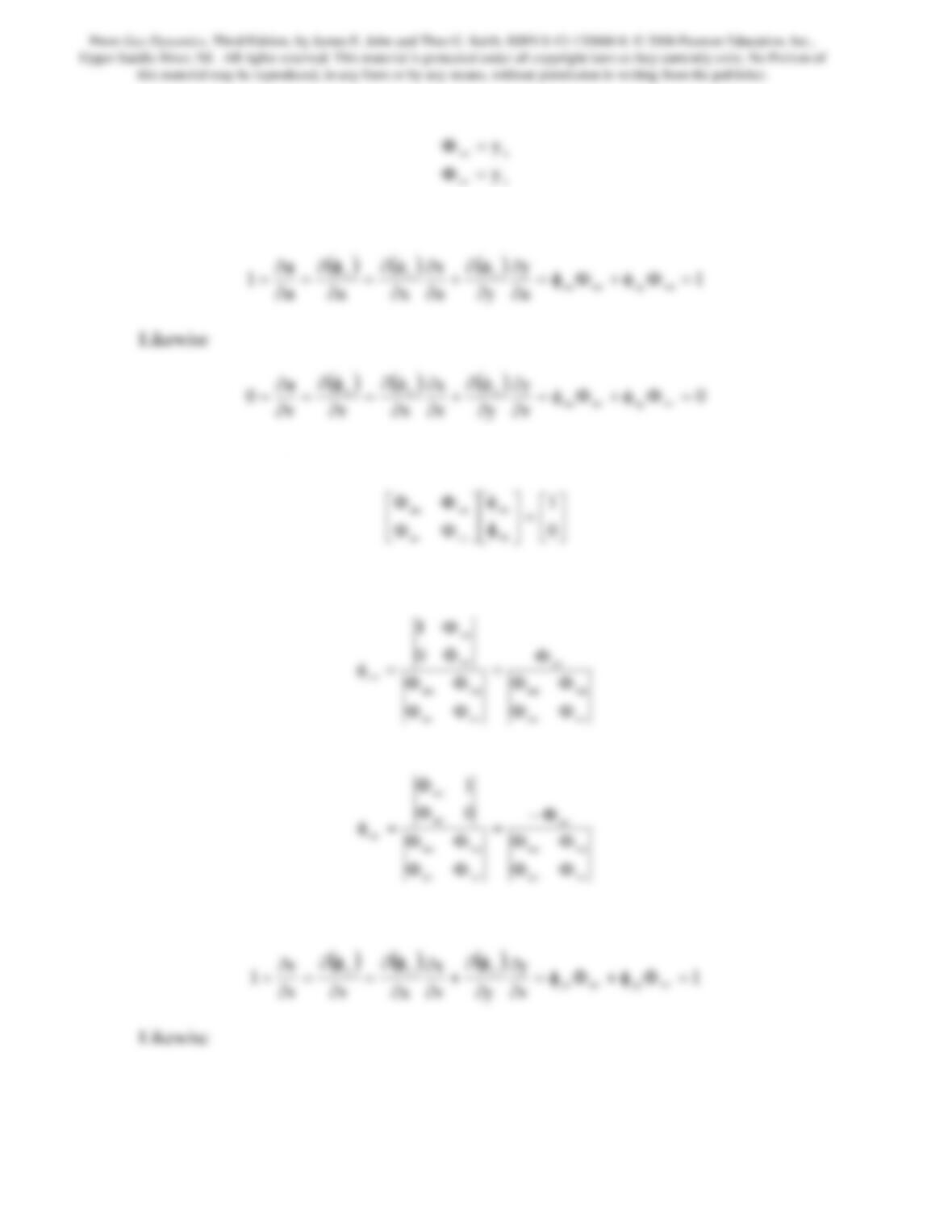
vvv
y
=Φ
Now use the chain rule and write
v
yv
xvv
∂
∂
∂
∂
∂
∂
The above pair may be written in matrix-vector form as
⎥
⎦
⎢
⎣
=
⎥
⎦
⎢
⎣
φ
⎥
⎦
⎢
⎣
ΦΦ
0
xy
vvuv
Solving this for φxx and φxy yields
vuuu
vv
vuuu
vv
vu
xx
0
1
ΦΦ
ΦΦ
Φ
=
ΦΦ
ΦΦ
Φ
Φ
=φ
vvuv
vuuu
vvuv
vuuu
xy
ΦΦ
ΦΦ
ΦΦ
ΦΦ
Following the same procedure
From Gas Dynamics, Third Edition, by James E. John and Theo G. Keith. ISBN 0-13-120668-0. © 2006 Pearson Education, Inc.,
Upper Saddle River, NJ. All rights reserved. This material is protected under all copyright laws as they currently exist. No Portion of
this material may be reproduced, in any form or by any means, without permission in writing from the publisher.
262
u
yu
xuu
∂
∂
∂
∂
∂
∂
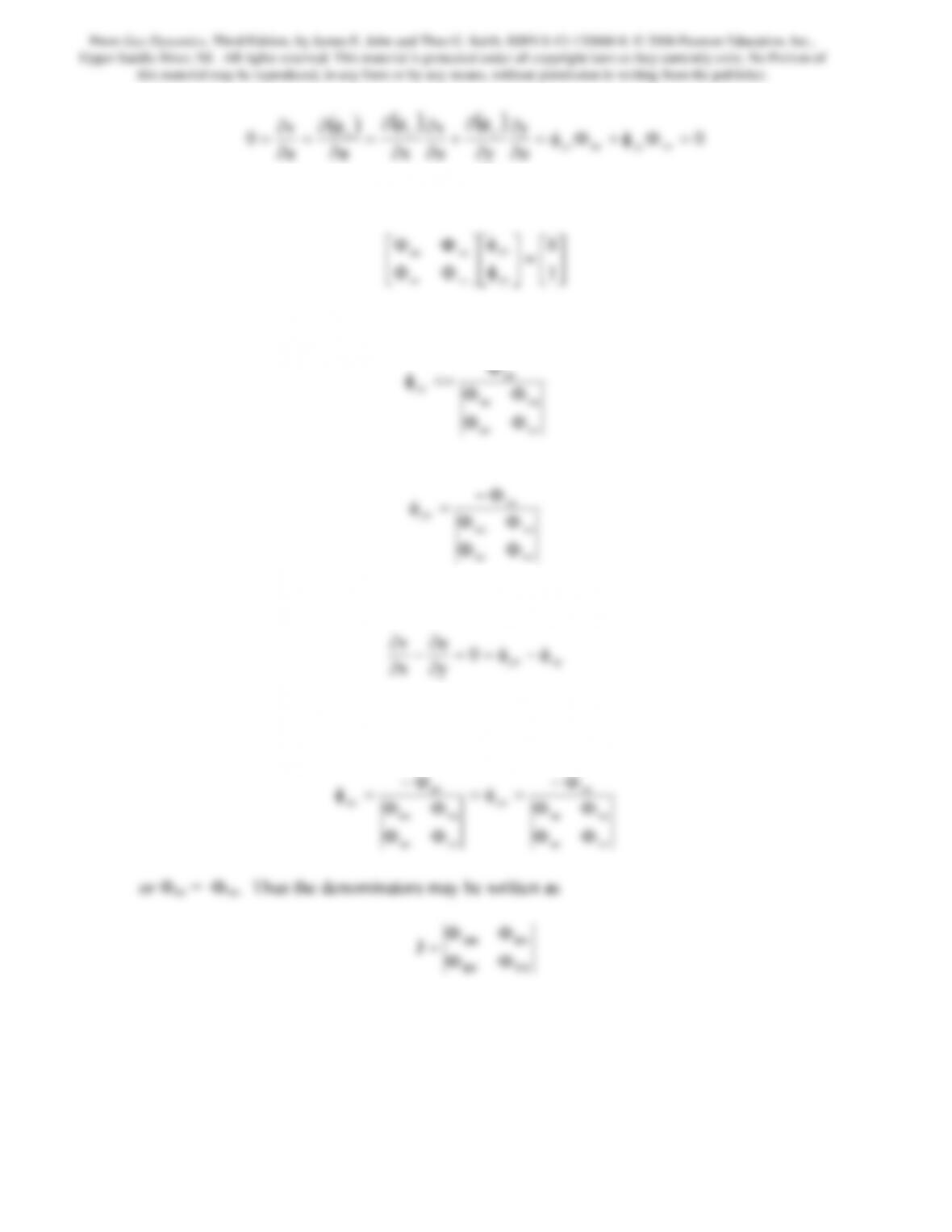
The above pair may be written in matrix-vector form as
⎥
⎦
⎢
⎣
=
⎥
⎦
⎢
⎣
φ
⎥
⎦
⎢
⎣
ΦΦ
1
yy
vvuv
Solving this for φyx and φyy yields
vuuu
uu
yy
ΦΦ
ΦΦ
Φ
==φ
vvuv
vuuu
yx
ΦΦ
ΦΦ
Because of irrotationality
xyyx
0
y
u
x
vφ−φ==
∂
∂
−
∂
∂
So φxy = φyx. Accordingly, from the above we see that
vuuu
vu
yx
vuuu
uv
xy
ΦΦ
ΦΦ
Φ−
=φ=
ΦΦ
ΦΦ
Φ−
=φ
vvuv
Finally then we obtain the expressions requested i.e.,
From Gas Dynamics, Third Edition, by James E. John and Theo G. Keith. ISBN 0-13-120668-0. © 2006 Pearson Education, Inc.,
Upper Saddle River, NJ. All rights reserved. This material is protected under all copyright laws as they currently exist. No Portion of
this material may be reproduced, in any form or by any means, without permission in writing from the publisher.
263
2
2
2
2
22
2
2
2
2
u
J
1
y
vuJ
1
yx
v
J
1
x
∂
Φ∂
=
∂
φ∂
∂∂
Φ∂
∂∂
φ∂
∂
Φ∂
=
∂
φ∂
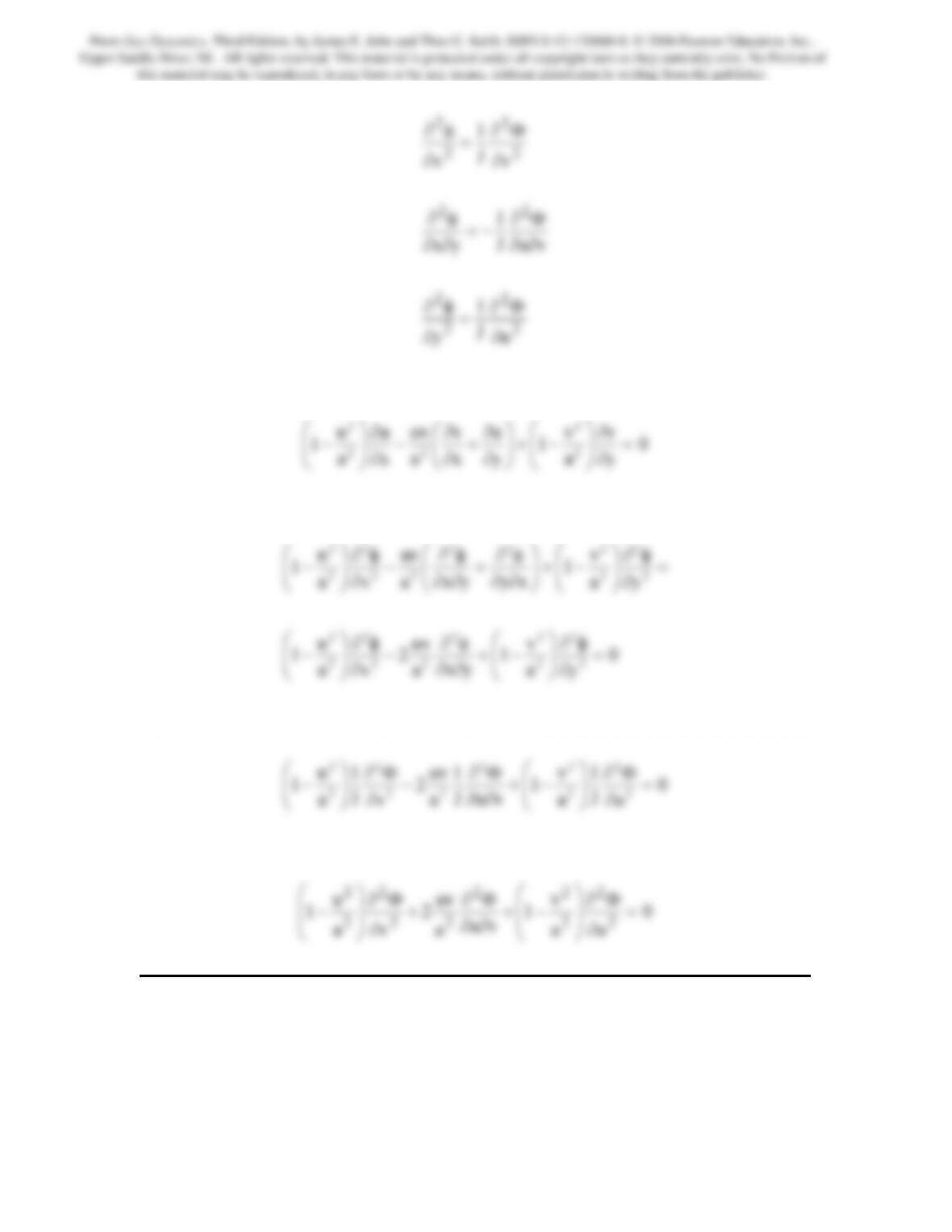
(c) Equation (12.27)
0
y
v
a
v
1
y
u
x
v
a
uv
x
u
a
u
12
2
22
2
=
∂
∂
⎟
⎟
⎠
⎞
⎜
⎜
⎝
⎛−+
⎟
⎟
⎠
⎞
⎜
⎜
⎝
⎛
∂
∂
+
∂
∂
−
∂
∂
⎟
⎟
⎠
⎞
⎜
⎜
⎝
⎛−
may be written as
0
ya
v
1
yx
a
uv
2
xa
u
1
ya
v
1
xyyx
a
uv
xa
u
1
2
2
2
22
22
2
2
2
2
2
2
222
22
2
2
2
=
∂
φ∂
⎟
⎟
⎠
⎞
⎜
⎜
⎝
⎛−+
∂∂
φ∂
−
∂
φ∂
⎟
⎟
⎠
⎞
⎜
⎜
⎝
⎛−
=
∂
φ∂
⎟
⎟
⎠
⎞
⎜
⎜
⎝
⎛−+
⎟
⎟
⎠
⎞
⎜
⎜
⎝
⎛
∂∂
φ∂
+
∂∂
φ∂
−
∂
φ∂
⎟
⎟
⎠
⎞
⎜
⎜
⎝
⎛−
The derivatives of the potential may be replaced by using the expressions from part (b)
0
u
J
1
a
v
1
vuJ
1
a
uv
2
v
J
1
a
u
12
2
2
22
22
2
2
2
=
∂
Φ∂
⎟
⎟
⎠
⎞
⎜
⎜
⎝
⎛−+
∂∂
Φ∂
−
∂
Φ∂
⎟
⎟
⎠
⎞
⎜
⎜
⎝
⎛−
Assuming that J ≠ 0 this becomes
0
ua
v
1
vu
a
uv
2
va
u
12
2
2
22
22
2
2
2=
∂
Φ∂
⎟
⎟
⎠
⎞
⎜
⎜
⎝
⎛−+
∂∂
Φ∂
+
∂
Φ∂
⎟
⎟
⎠
⎞
⎜
⎜
⎝
⎛−
Problem 11. – Prove Eq.(12.49).
Start with Eq.(12.48)
From Gas Dynamics, Third Edition, by James E. John and Theo G. Keith. ISBN 0-13-120668-0. © 2006 Pearson Education, Inc.,
Upper Saddle River, NJ. All rights reserved. This material is protected under all copyright laws as they currently exist. No Portion of
this material may be reproduced, in any form or by any means, without permission in writing from the publisher.
264
1
2
o
o
a
2
1−γ
−
⎟
⎟
⎠
⎜
⎜
⎝
−=
ρ
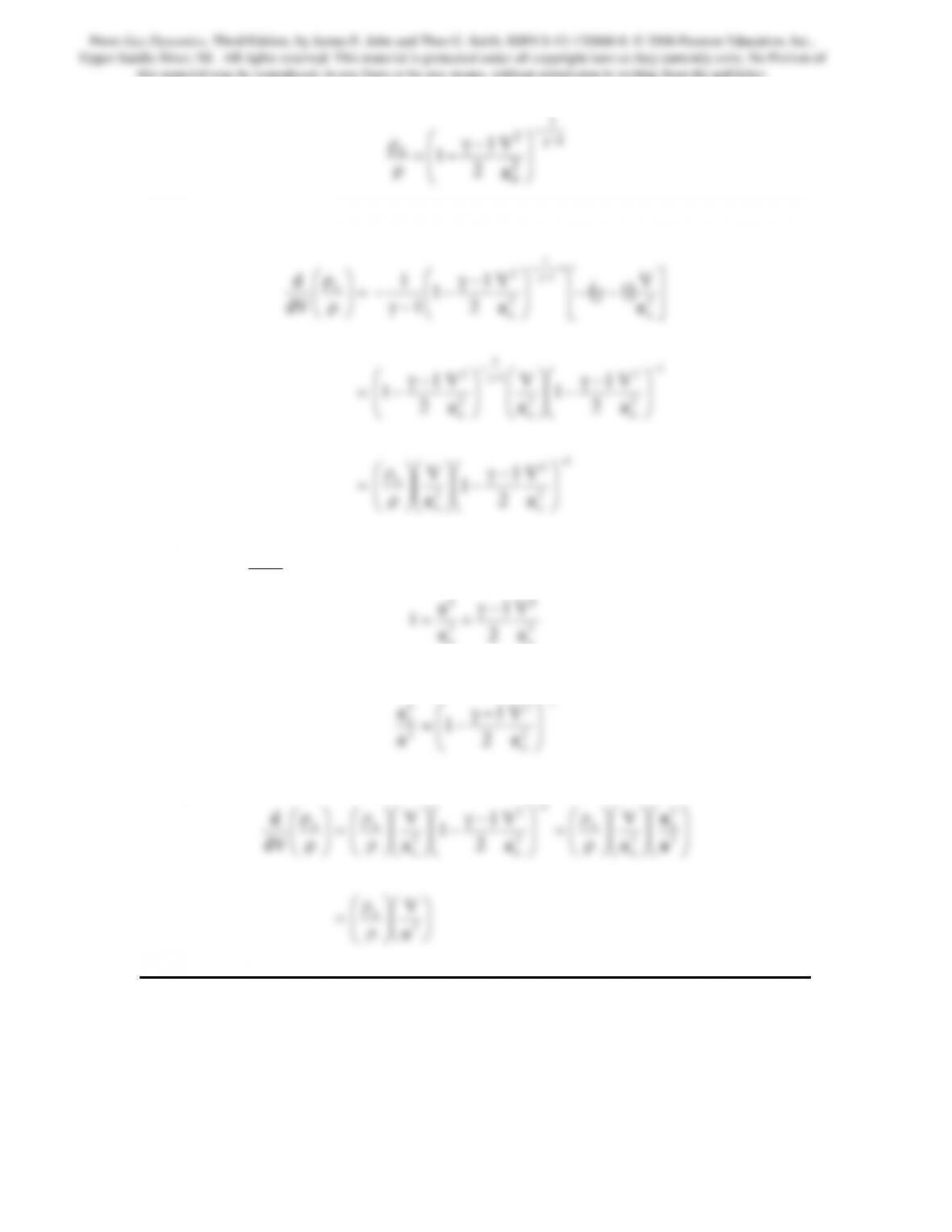
Differentiate this with respect to V, i.e.,
1
2
o
2
2
o
o
o
o
o
1
1
1
2
o
a
V
2
1
1
a
V
a
2
a
a
2
V
V
1
1
d
−
−
−γ
−
⎟
⎟
⎠
⎞
⎜
⎜
⎝
⎛−γ
−
⎟
⎟
⎠
⎞
⎜
⎜
⎝
⎛
⎟
⎟
⎠
⎞
⎜
⎜
⎝
⎛
ρ
ρ
=
⎠
⎝
⎠
⎝
⎠
⎝
⎤
⎡−γ−
⎞
⎛−γ
⎞
⎛
ρ
But 222
oV
2
1
aa −
γ
+= or
o
o
a
2
a
Hence,
1
2
o
2
2
2
o
a
V
2
1
1
a
a−
⎟
⎟
⎠
⎞
⎜
⎜
⎝
⎛−γ
−=
Finally then
⎟
⎠
⎞
⎜
⎝
⎛
⎟
⎟
⎠
⎞
⎜
⎜
⎝
⎛
ρ
ρ
=
⎟
⎟
⎠
⎞
⎜
⎜
⎝
⎛
⎟
⎟
⎠
⎞
⎜
⎜
⎝
⎛
⎟
⎟
⎠
⎞
⎜
⎜
⎝
⎛
ρ
ρ
=
⎟
⎟
⎠
⎞
⎜
⎜
⎝
⎛−γ
−
⎟
⎟
⎠
⎞
⎜
⎜
⎝
⎛
⎟
⎟
⎠
⎞
⎜
⎜
⎝
⎛
ρ
ρ
=
⎟
⎟
⎠
⎞
⎜
⎜
⎝
⎛
ρ
ρ−
2
o
2
2
o
2
o
o
1
2
o
2
2
o
oo
a
V
a
a
a
V
a
V
2
1
1
a
V
dV
d
Problem 12. – In the solution of problems using the hodograph equations, the resulting
expressions often contain the following two parameters: τ = (V/Vmax)2 and β = 1/(γ – 1).
Show that
From Gas Dynamics, Third Edition, by James E. John and Theo G. Keith. ISBN 0-13-120668-0. © 2006 Pearson Education, Inc.,
Upper Saddle River, NJ. All rights reserved. This material is protected under all copyright laws as they currently exist. No Portion of
this material may be reproduced, in any form or by any means, without permission in writing from the publisher.
265
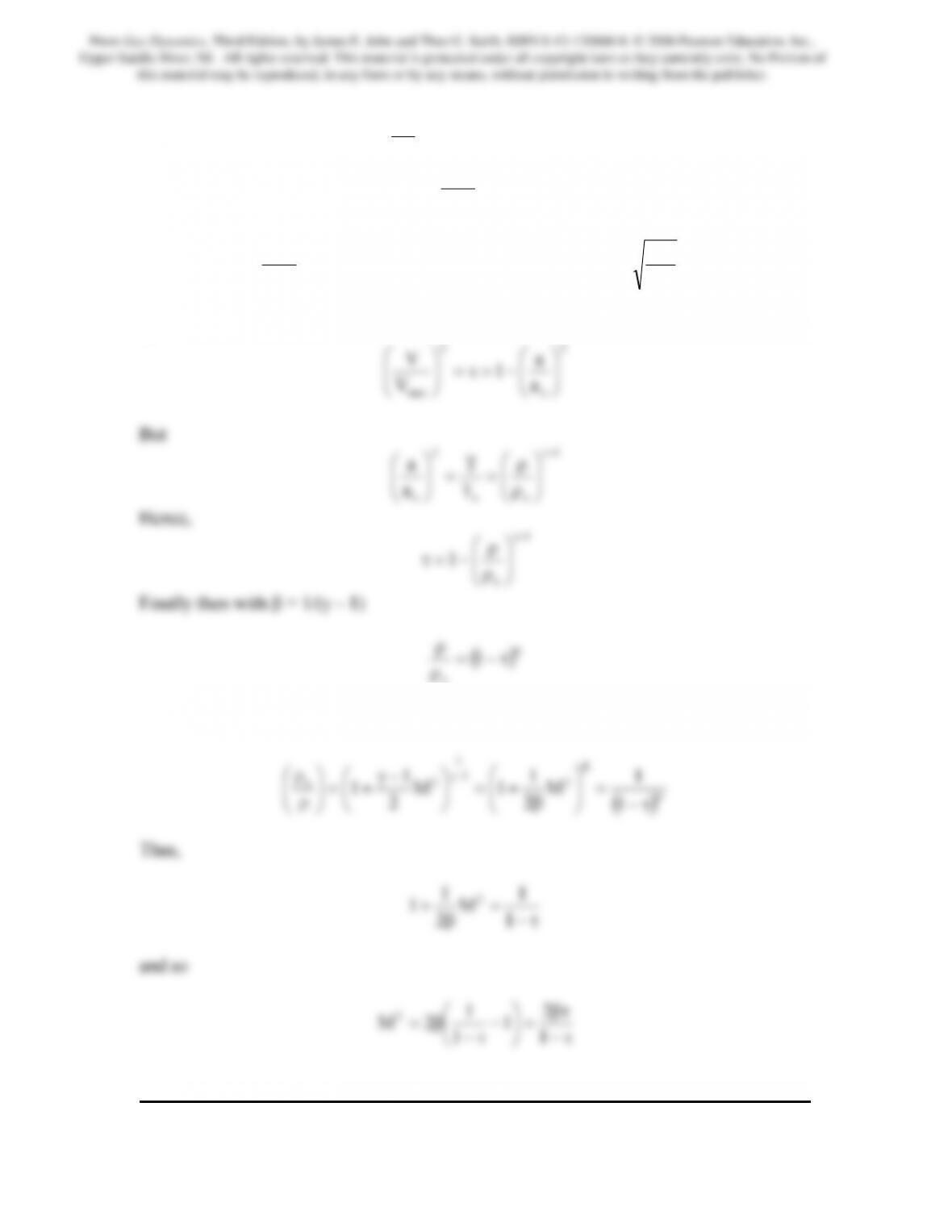
(a)
()
β
τ−=
ρ
ρ
1
o
(b)
τ
−
β
τ
=1
2
M2.
From 222
oV
2
1
aa −
γ
+= when a = 0, V = Vmax; therefore omax a
1–
2
V ⎟
⎟
⎠
⎞
⎜
⎜
⎝
⎛
γ
=.
(a) So
ρ
o
(b) From static to total density relation and the result of part (a), we have
From Gas Dynamics, Third Edition, by James E. John and Theo G. Keith. ISBN 0-13-120668-0. © 2006 Pearson Education, Inc.,
Upper Saddle River, NJ. All rights reserved. This material is protected under all copyright laws as they currently exist. No Portion of
this material may be reproduced, in any form or by any means, without permission in writing from the publisher.
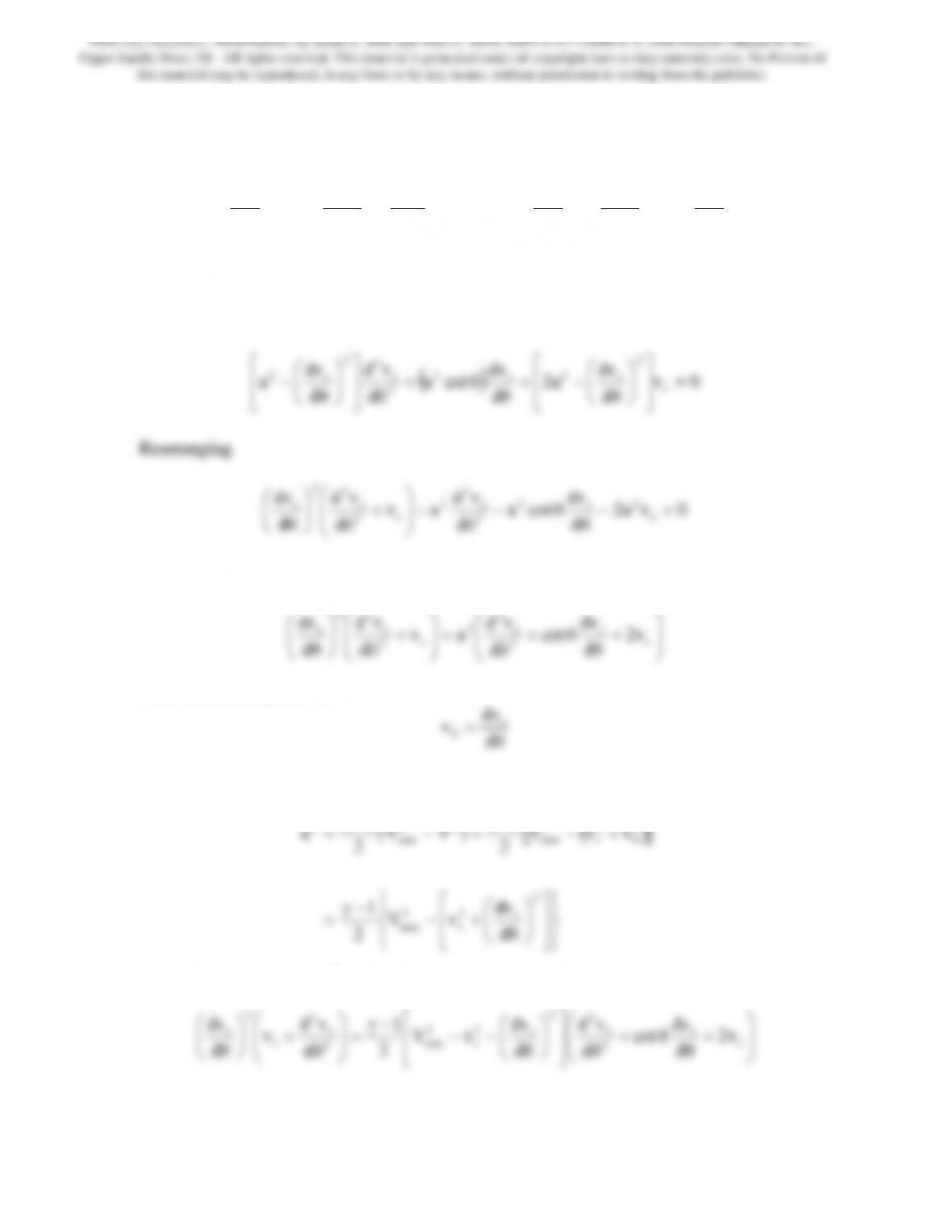
Problem 13. – Using Eq. (12.79), show that Eq.(12.77) can be written as
⎟
⎟
⎠
⎞
⎜
⎜
⎝
⎛+
θ
θ+
θ
⎥
⎥
⎦
⎤
⎢
⎢
⎣
⎡⎟
⎠
⎞
⎜
⎝
⎛
θ
−−
−γ
=
⎟
⎟
⎠
⎞
⎜
⎜
⎝
⎛
θ
+
⎟
⎠
⎞
⎜
⎝
⎛
θr
r
2
r
2
2
r
2
r
2
max
2
r
2
r
2
rv2
d
dv
cot
d
vd
d
dv
vV
2
1
d
vd
v
d
dv
Verify that this is identically satisfied by a uniform stream given by vr = Vcosθ.
Equation (12.77), the Taylor-Maccoll equation is
or
⎟
⎟
⎠
⎞
⎜
⎜
⎝
⎛+
θ
θ+
θ
=
⎟
⎟
⎠
⎞
⎜
⎜
⎝
⎛+
θ
⎟
⎠
⎞
⎜
⎝
⎛
θr
r
2
r
2
2
r
2
r
2
2
rv2
d
dv
cot
d
vd
av
d
vd
d
dv
Next combine Eq.(12.78)
θ
=
θ
d
dv
vr
and Eq.(12.79)
−
γ
−
γ
22
2
22
2
1
1
Using this to replace the a2 in the above gives the desired expression
⎟
⎞
⎜
⎛+
θ+
⎥
⎤
⎢
⎡⎟
⎞
⎜
⎛
−−
−γ
=
⎟
⎞
⎜
⎛
+
⎟
⎞
⎜
⎛
r
r
2
2
r
2
2
r
2
2
rv2
dv
cot
vd
dv
vV
1
vd
v
dv
From Gas Dynamics, Third Edition, by James E. John and Theo G. Keith. ISBN 0-13-120668-0. © 2006 Pearson Education, Inc.,
Upper Saddle River, NJ. All rights reserved. This material is protected under all copyright laws as they currently exist. No Portion of
this material may be reproduced, in any form or by any means, without permission in writing from the publisher.
267
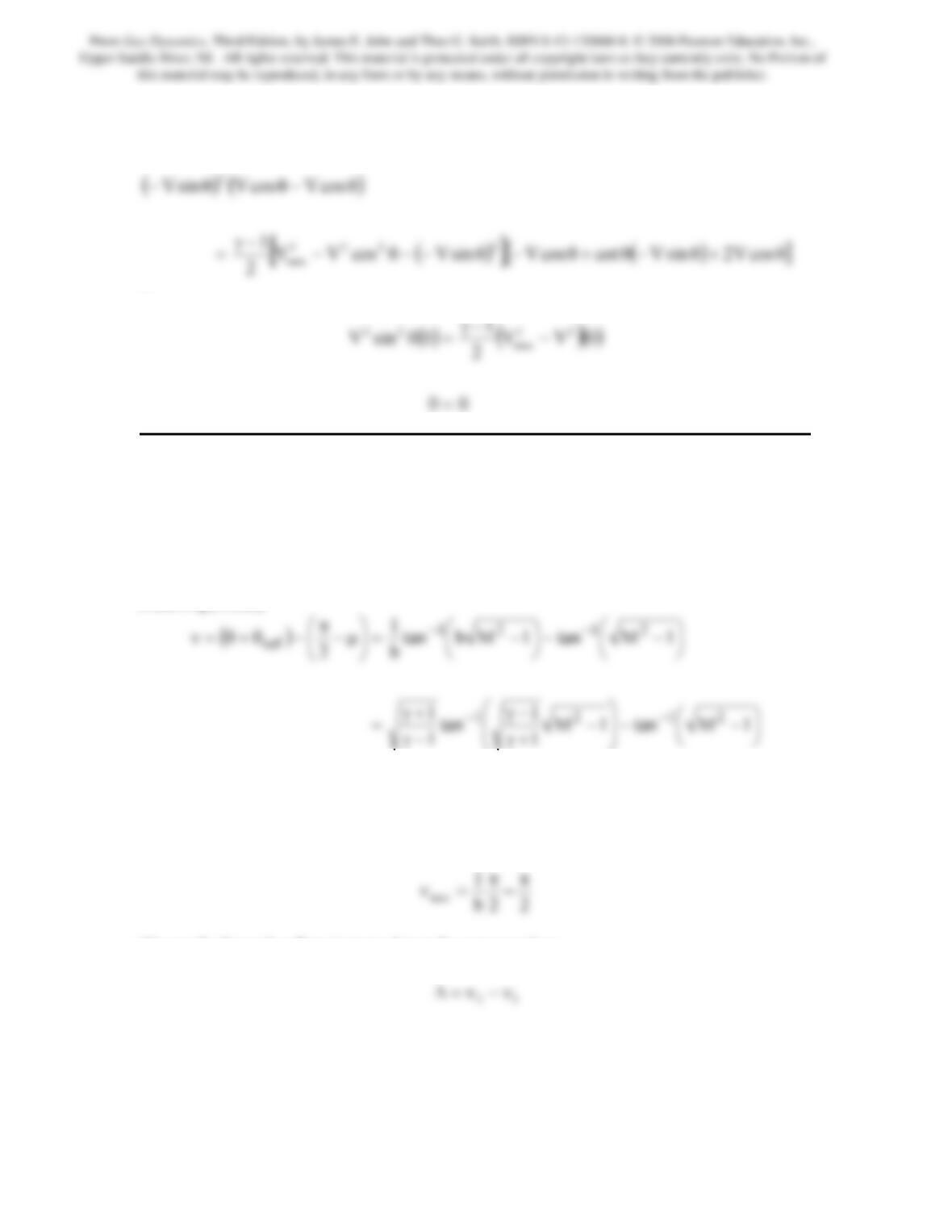
Now suppose vr = Vcosθ. So dvr/dθ = −Vsinθ and d2vr/dθ2 = −Vcosθ . Substitution into
the above brings
2
or
00
1
22
=
−
γ
Problem 14. – A steady, two-dimensional, supersonic flow, uniformly streams along a
horizontal wall that is aligned with the x-axis. The stream encounters a sharp corner
located at x = 0. Show that the maximum angle through which the flow may turn is given
by π/2b – π/2, where b2 = (γ – 1)/(γ + 1). Also show that the maximum angle can only
occur if the original flow is sonic.
From Eq.(12.66)
⎟
⎠
⎜
⎝
⎟
⎠
⎜
⎝
+γ
−γ
⎞
⎛−−
⎞
⎛−=
⎞
⎛µ−
π
−−
1
1
1
2121
The maximum value of ν will occur at M → ∞. As Mach number goes to infinity the
argument of the inverse tangent becomes infinite, i.e., tan-1(∞) = π/2. Therefore, the
above becomes
1
max
π
−
π
=ν
The angle through a flow is turned may be expressed as
12
ν
−
ν
=
∆
The maximum turning angle will occur when ν2 =νmax and ν1 = 0. As shown above νmax
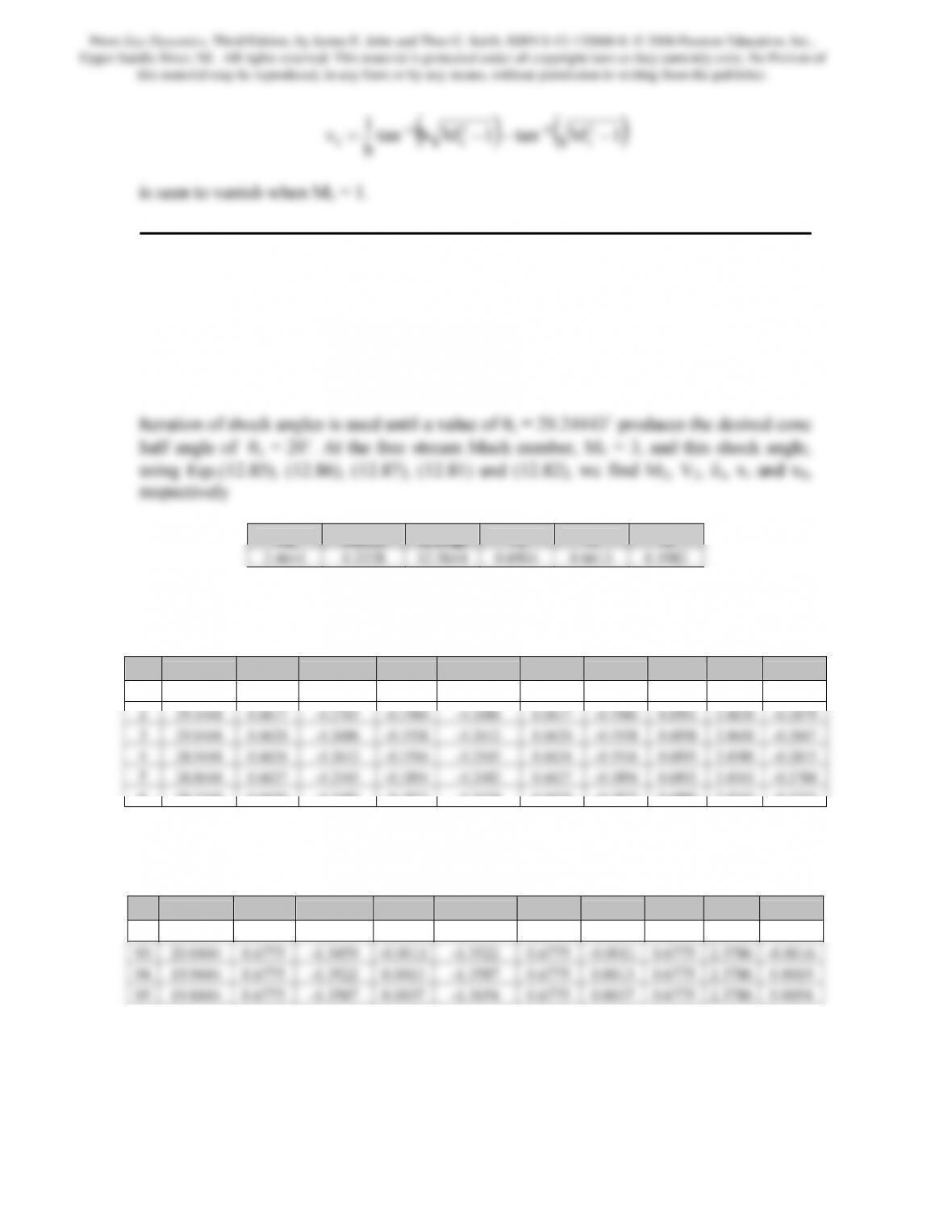
occurs when M2 → ∞; The upstream Prandtl-Meyer function, ν1, i.e.,
From Gas Dynamics, Third Edition, by James E. John and Theo G. Keith. ISBN 0-13-120668-0. © 2006 Pearson Education, Inc.,
Upper Saddle River, NJ. All rights reserved. This material is protected under all copyright laws as they currently exist. No Portion of
this material may be reproduced, in any form or by any means, without permission in writing from the publisher.
268
(
)
(
)
1Mtan1Mbtan
b
12
1
12
1
1
1−−−=ν −−
is seen to vanish when M1 = 1.
Problem 15. – Uniform supersonic flow at Mach 3.0 and p = 20 kPa passes over a cone
of semi-vertex angle of 20° aligned parallel to the flow direction. Determine the shock
wave angle, the Mach number of the flow along the cone surface, and the surface
pressure. Take γ = 1.3.
Except for the ratio of specific heats this is identical to Example 12.8.
M2 tan(δs) δs (deg) V2 vr vθ
Spreadsheet calculation results for the first five increments of ∆θ = 0.1˚ for
θs = 29.24443˚, M1 = 3 and γ = 1.3 are as follows
No. θ (deg) (vr)p F[(vr)i,(vθ)i] (vθ)p F[(vr)p,(vθ)p](vr) i+1 (vθ) i+1 V M δ (rad)
1 29.2444 0.6613 -0.1982 0.6613 -0.1982 0.6904 2.4641 -0.2912
6 28.7444 0.6630 -1.2482 -0.1872 -1.2424 0.6630 -0.1872 0.6889 2.4542 -0.2752
Spreadsheet calculation results near the cone surface for ∆θ = 0.1˚, θs = 29.24443˚,
M1 = 3 and γ = 1.3 are contained in the following table
No. θ (deg) (vr)p F[(vr)i,(vθ)i] (vθ)p F[(vr)p,(vθ)p](vr) i+1 (vθ) i+1 V M δ (rad)
92 20.1444 0.6775 -1.3397 -0.0034 -1.3459 0.6775 -0.0034 0.6775 2.3786 -0.0050
Since the velocity at the surface is equal to the radial velocity component, we may readily
compute the Mach number from Eq.(12.84) and the static pressure on the surface.
From Gas Dynamics, Third Edition, by James E. John and Theo G. Keith. ISBN 0-13-120668-0. © 2006 Pearson Education, Inc.,
Upper Saddle River, NJ. All rights reserved. This material is protected under all copyright laws as they currently exist. No Portion of
this material may be reproduced, in any form or by any means, without permission in writing from the publisher.
269
Problem 16. – Uniform supersonic flow at Mach 4.0 and p = 20 kPa passes over a cone
of semi-vertex angle of 20° aligned parallel to the flow direction. Determine the shock
wave angle, the Mach number of the flow along the cone surface, and the surface
pressure. Take γ = 1.4.
Except for the upstream Mach number this is identical to Example 12.8.
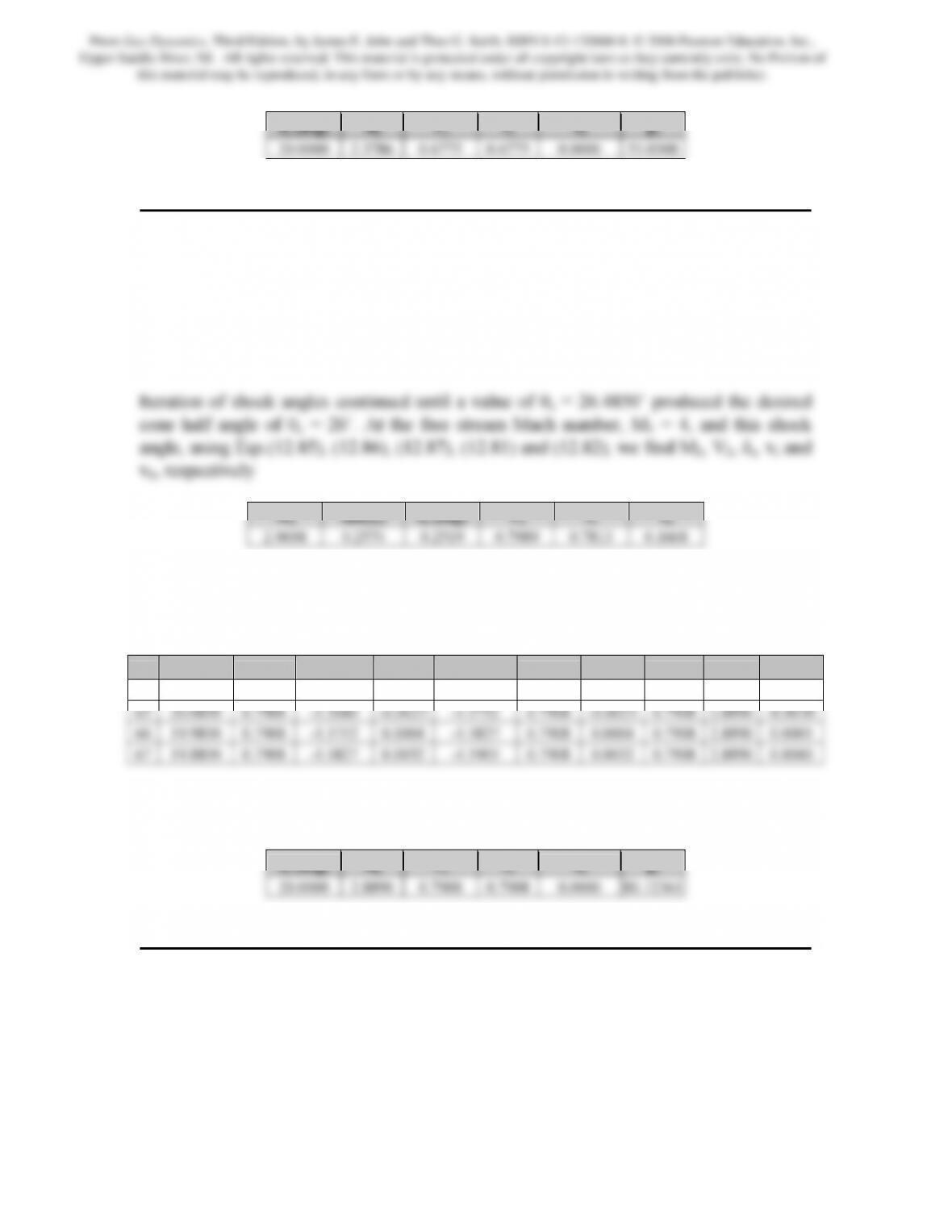
Calculation results near the cone surface for ∆θ = 0.1˚, θs = 26.4850˚, M1 = 4 and γ = 1.4.
No. θ (deg) (vr)p F[(vr)i,(vθ)i] (vθ)p F[(vr)p,(vθ)p](vr) i+1 (vθ) i+1 V M δ (rad)
64 20.1850 0.7908 -1.5610 -0.0051 -1.5680 0.7908 -0.0051 0.7908 2.8891 -0.0064
Since the velocity at the surface is equal to the radial velocity component, we may readily
compute the Mach number on the surface from Eq.(12.84).
θc (deg) Mc Vc vr vθ ps
Problem 17. – Uniform supersonic flow at Mach 3.0 and p = 20 kPa passes over a cone
of semi-vertex angle of 30° aligned parallel to the flow direction. Determine the shock
wave angle, the Mach number of the flow along the cone surface, and the surface
pressure. Take γ = 1.4.
Except for the cone angle this is identical to Example 12.8.
From Gas Dynamics, Third Edition, by James E. John and Theo G. Keith. ISBN 0-13-120668-0. © 2006 Pearson Education, Inc.,
Upper Saddle River, NJ. All rights reserved. This material is protected under all copyright laws as they currently exist. No Portion of
this material may be reproduced, in any form or by any means, without permission in writing from the publisher.
270
M2 tan(δs) δs (deg) V2 vr vθ
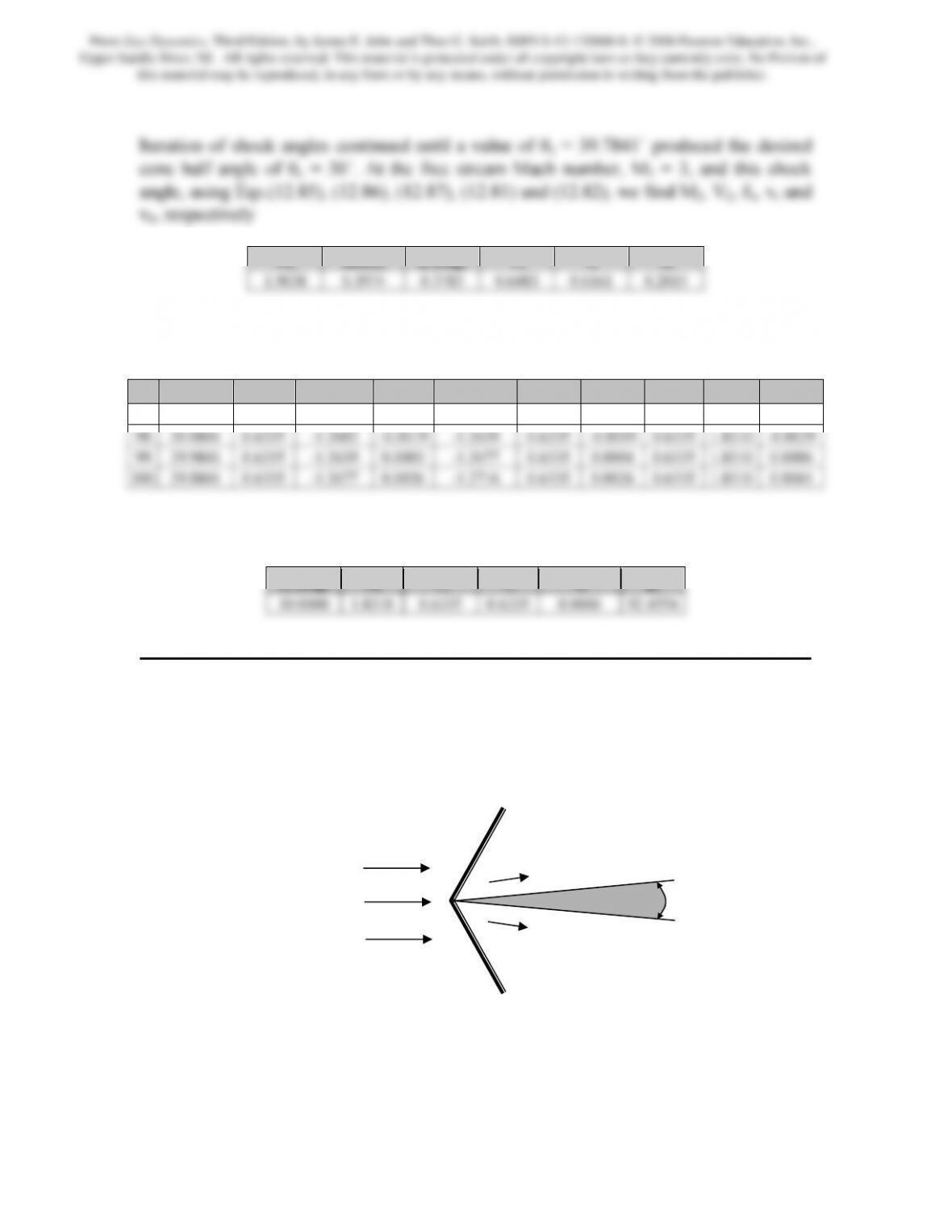
Calculation results near the cone surface for ∆θ = 0.1˚ for θs = 39.7841˚, M1 = 3 and
γ = 1.4 are as follows
No. θ (deg) (vr)p F[(vr)i,(vθ)i] (vθ)p F[(vr)p,(vθ)p](vr) i+1 (vθ) i+1 V M δ (rad)
97 30.1841 0.6335 -1.2566 -0.0041 -1.2602 0.6335 -0.0041 0.6336 1.8310 -0.0064
Since the velocity at the surface is equal to the radial velocity component, we may readily
compute the Mach number on the surface from Eq.(12.84).
θc (deg) Mc Vc vr vθ ps
Problem 18. – A supersonic diffuser contains a conical spike of semi-vertex angle 5°; the
spike is aligned with the flow (Figure P12.18). Determine the Mach number of the flow
along the cone surface and the static pressure at the surface of the cone. Altitude = 5 km
and γ = 1.4.
F
Fi
ig
gu
ur
re
e
P
P1
12
2.
.1
18
8
At an altitude of 5 km the local static pressure is 54.05 kPa.
5º
M∞ = 3.0
From Gas Dynamics, Third Edition, by James E. John and Theo G. Keith. ISBN 0-13-120668-0. © 2006 Pearson Education, Inc.,
Upper Saddle River, NJ. All rights reserved. This material is protected under all copyright laws as they currently exist. No Portion of
this material may be reproduced, in any form or by any means, without permission in writing from the publisher.
271
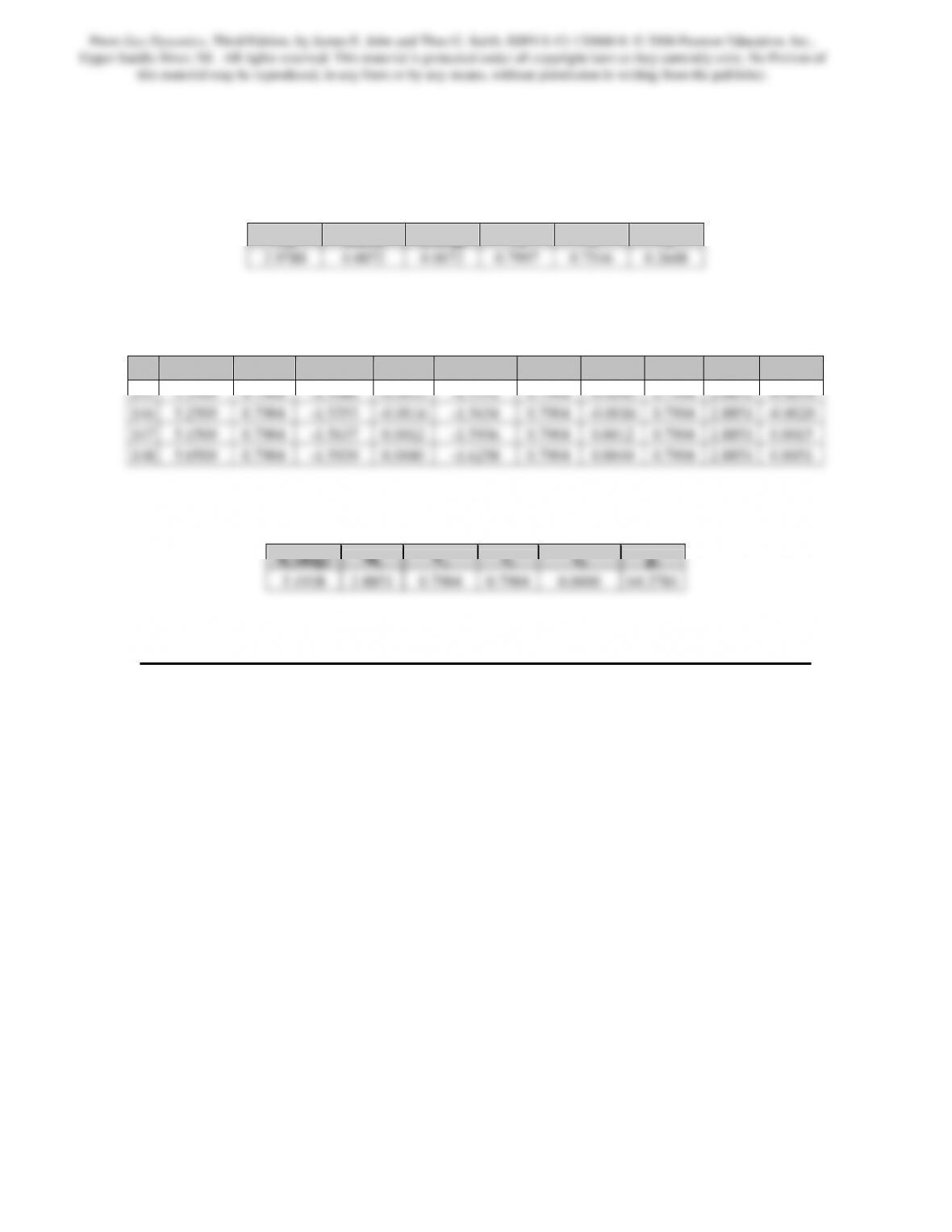
Iteration of shock angles continued until a value of θs = 19.75086˚ produced the desired
cone half angle of θc = 5˚. At the free stream Mach number, M1 = 3, and this shock angle,
using Eqs.(12.85), (12.86), (12.87), (12.81) and (12.82), we find M2, V2, δs, vr and vθ,
respectively
M2 tan(δs) δs (deg) V2 vr vθ
Calculation results near the cone surface for ∆θ = 0.1˚ for θs = 19.75086˚, M1 = 3 and
γ = 1.4 are as follows
No. θ (deg) (vr)p F[(vr)i,(vθ)i] (vθ)p F[(vr)p,(vθ)p](vr) i+1 (vθ) i+1 V M δ (rad)
Since the velocity at the surface is equal to the radial velocity component, we may readily
compute the Mach number on the surface from Eq.(12.84).
From Gas Dynamics, Third Edition, by James E. John and Theo G. Keith. ISBN 0-13-120668-0. © 2006 Pearson Education, Inc.,
Upper Saddle River, NJ. All rights reserved. This material is protected under all copyright laws as they currently exist. No Portion of
this material may be reproduced, in any form or by any means, without permission in writing from the publisher.