Chapter Eleven
E
EQ
QU
UA
AT
TI
IO
ON
NS
S
O
OF
F
M
MO
OT
TI
IO
ON
N
F
FO
OR
R
M
MU
UL
LT
TI
ID
DI
IM
ME
EN
NS
SI
IO
ON
NA
AL
L
F
FL
LO
OW
W
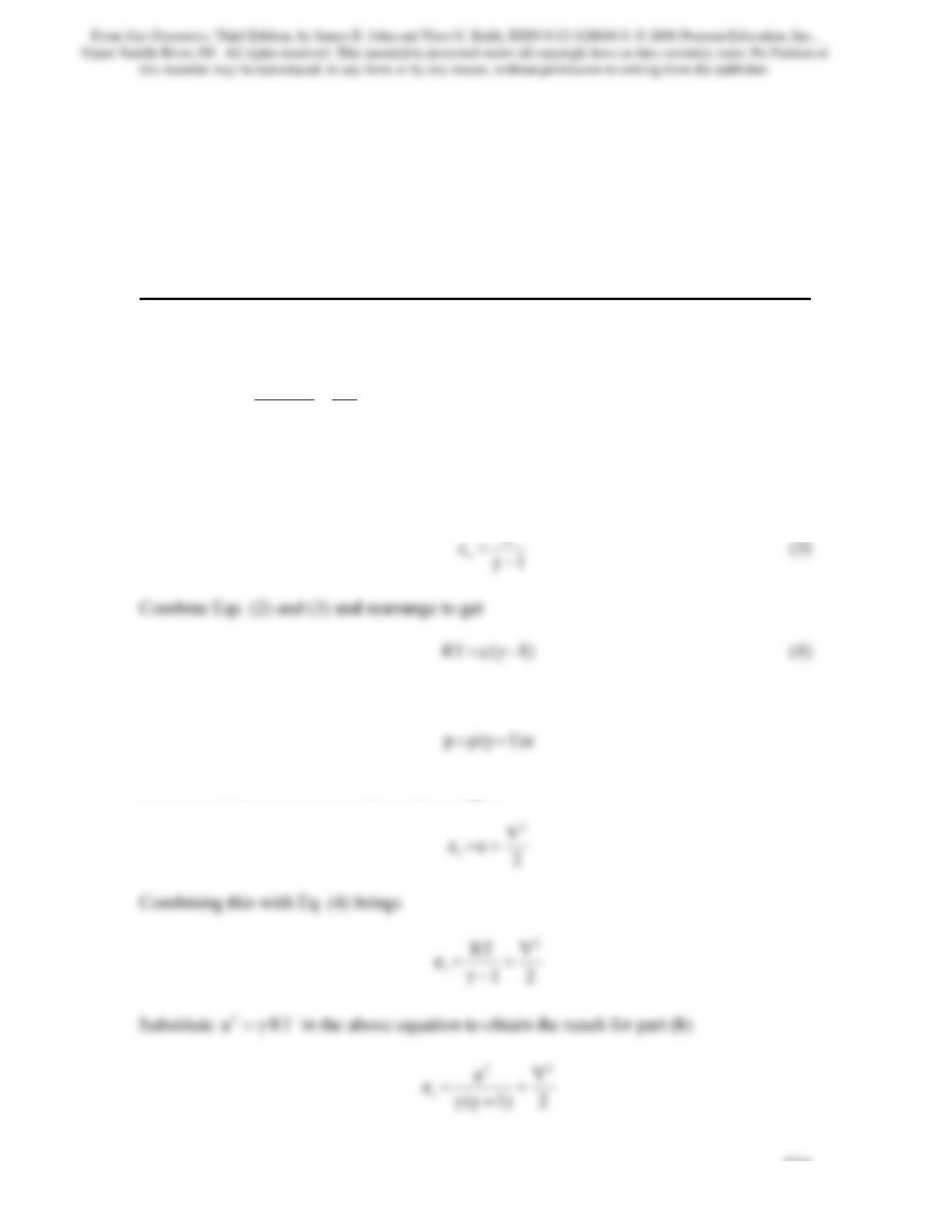
Problem 1. – Prove that for a perfect gas
(a) e1)(γρp−=
(b) 2
V
1)(γγ
a
e
22
t+
+
=
(a) For a perfect gas
RTρp
=
(1)
Tce v
=
(2)
R
Substitute Eq. (4) into Eq. (1) to the result for part (a)
(b) The definition of the total (internal) energy is
From Gas Dynamics, Third Edition, by James E. John and Theo G. Keith. ISBN 0-13-120668-0. © 2006 Pearson Education, Inc.,
Upper Saddle River, NJ. All rights reserved. This material is protected under all copyright laws as they currently exist. No Portion of
this material may be reproduced, in any form or by any means, without permission in writing from the publisher.
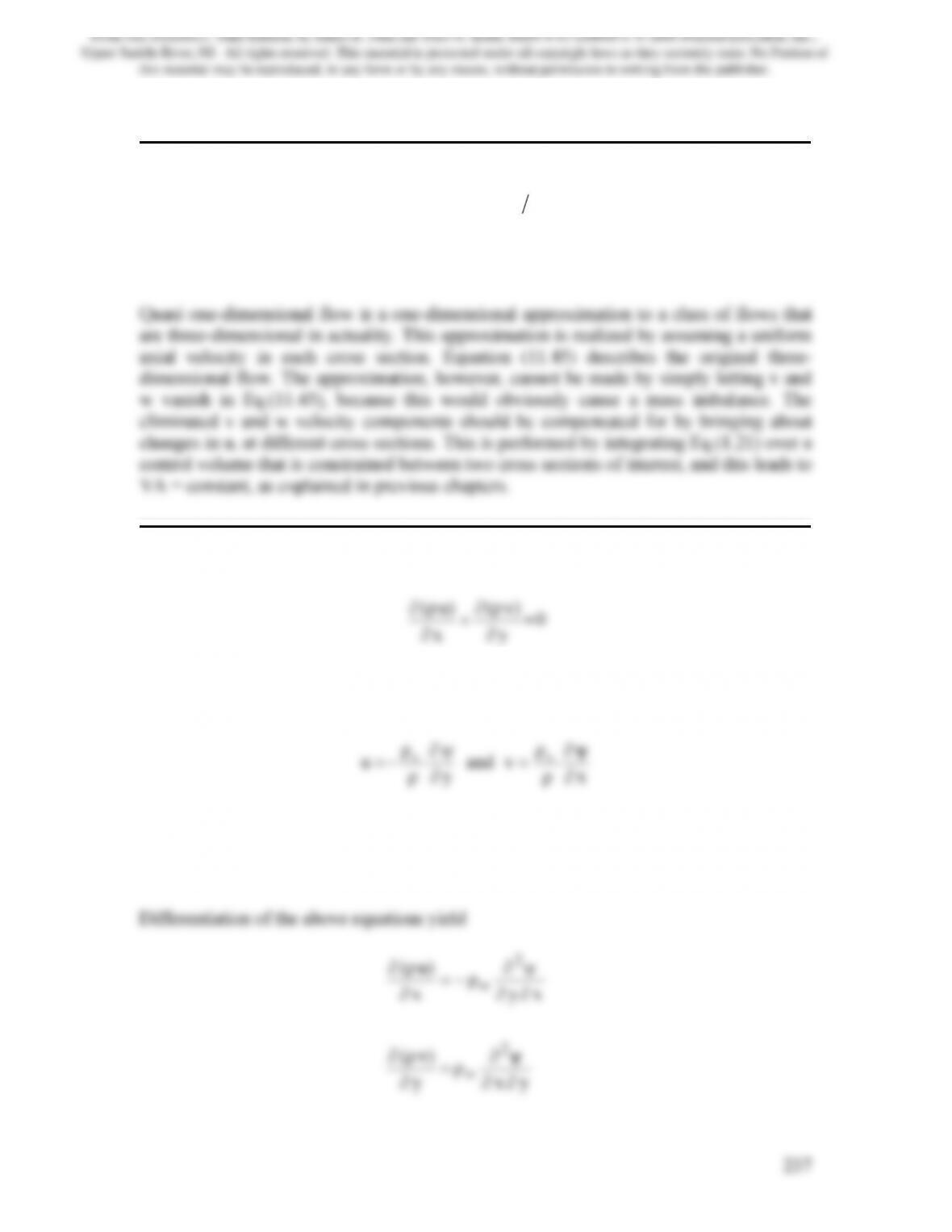
Problem 2. – According to the generalized continuity equation given by Eq. (11.1), for
steady, incompressible, one-dimensional flow, 0xu
=
∂
∂
, or, in other words, u is equal
to a constant. Previously, for incompressible flow, however, it has been customary to
assume that, for steady, one-dimensional flow, the product of velocity and cross-sectional
area (AV) is a constant. Explain this seeming contradiction.
Problem 3. – The continuity equation for steady two-dimensional flow is
y
x
∂
∂
A function ψ (the compressible stream function) may be defined so that this equation is
automatically satisfied. Show that the following accomplish this
y
ψ
ρ
ρ
∂
ψ
ρ
ρ
∂
where ∞
ρ is a constant that is inserted so that the stream function has the same units as
the incompressible flow stream function. What are the units of the stream function? What
are the units of the velocity potential,
φ
?
From Gas Dynamics, Third Edition, by James E. John and Theo G. Keith. ISBN 0-13-120668-0. © 2006 Pearson Education, Inc.,
Upper Saddle River, NJ. All rights reserved. This material is protected under all copyright laws as they currently exist. No Portion of
this material may be reproduced, in any form or by any means, without permission in writing from the publisher.
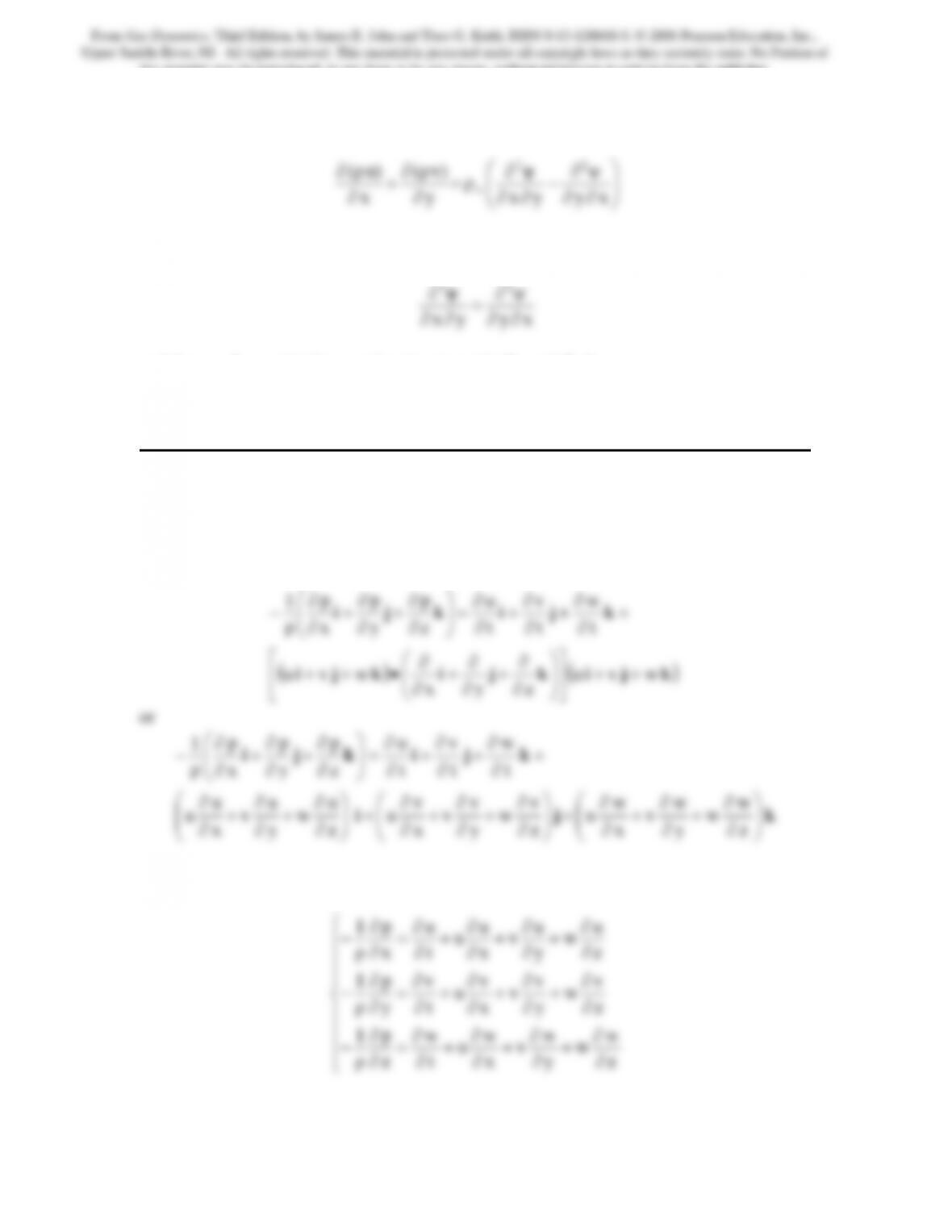
Therefore
⎟
⎟
⎠
⎞
⎜
⎜
⎝
⎛
∂∂
∂
−
∂∂
∂
=
∂
∂
+
∂
∂
∞xy
ψ
yx
ψ
ρ
y
v)(ρ
x
u)(ρ22
But for a continuous stream function with continuous derivatives
ψ
ψ22
∂
=
∂
and, hence, the continuity equation is automatically satisfied.
The dimensions of both the stream function and velocity potential are: L2T-1.
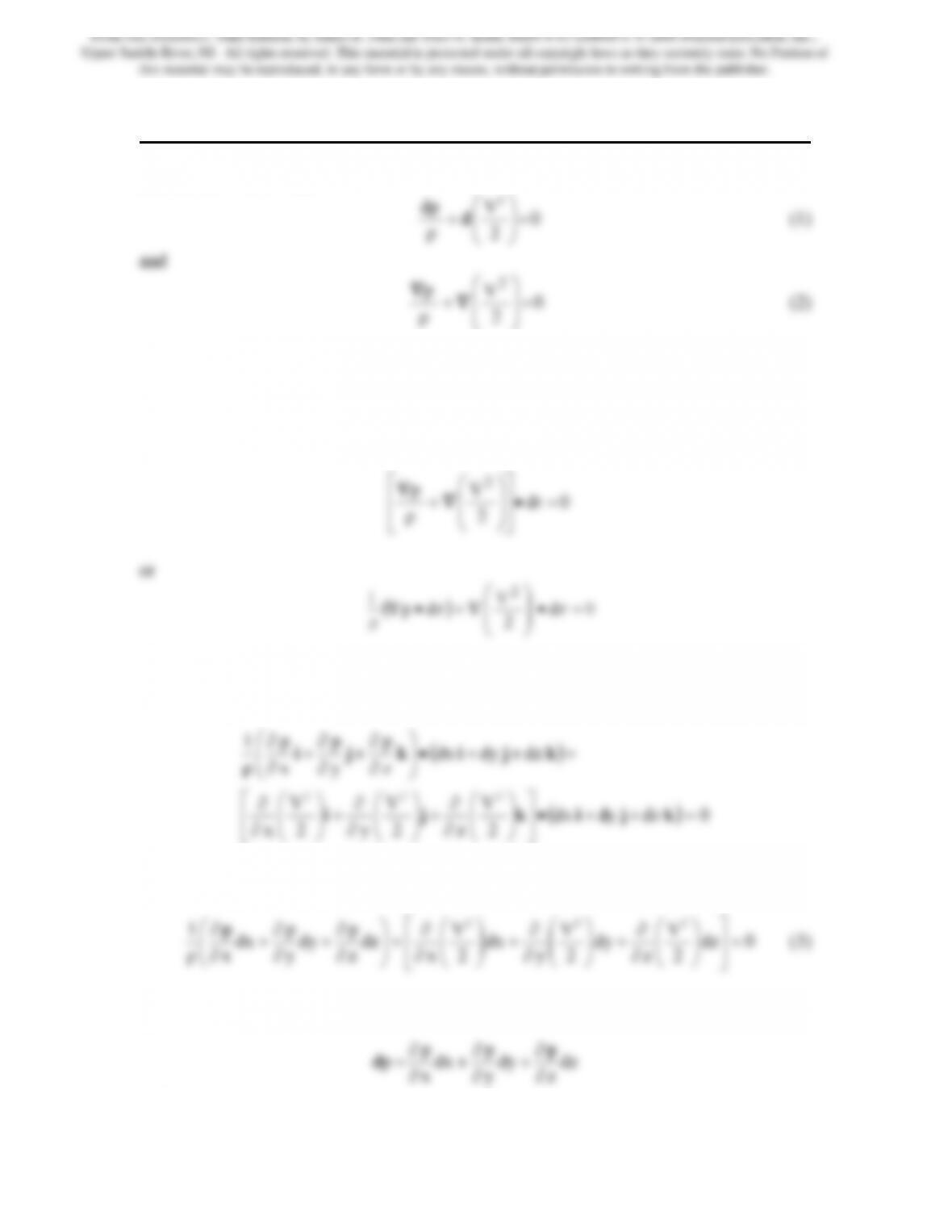
Problem 4. – Expand Eq.(11.10) into the three component equations, and show that
Eqs.( 11.7), (11.8), and (11.9) result.
Equation (11.10) can be written as
kjikji
t
w
t
v
t
u
z
p
y
p
x
p
ρ
1
⎤
⎡⎟
⎞
⎛
∂
∂
∂
+
∂
∂
+
∂
∂
+
∂
∂
=
⎟
⎟
⎠
⎞
⎜
⎜
⎝
⎛
∂
∂
+
∂
∂
+
∂
∂
−
kji
⎟
⎟
⎠
⎞
⎜
⎜
⎝
⎛
∂
∂
+
∂
∂
+
∂
∂
+
⎟
⎟
⎠
⎞
⎜
⎜
⎝
⎛
∂
∂
+
∂
∂
+
∂
∂
+
⎟
⎟
⎠
⎞
⎜
⎜
⎝
⎛
∂
∂
+
∂
∂
+
∂
∂
z
w
w
y
w
v
x
w
u
z
v
w
y
v
v
x
v
u
z
u
w
y
u
v
x
u
u
This implies that
⎪
⎪
⎪
⎪
⎪
⎨
⎧
∂
∂
∂
∂
∂
∂
∂
+
∂
∂
+
∂
∂
+
∂
∂
=
∂
∂
−
∂
∂
+
∂
∂
+
∂
∂
+
∂
∂
=
∂
∂
−
w
w
w
w
p
1
z
v
w
y
v
v
x
v
u
t
v
y
p
ρ
1
z
u
w
y
u
v
x
u
u
t
u
x
p
ρ
1
From Gas Dynamics, Third Edition, by James E. John and Theo G. Keith. ISBN 0-13-120668-0. © 2006 Pearson Education, Inc.,
Upper Saddle River, NJ. All rights reserved. This material is protected under all copyright laws as they currently exist. No Portion of
this material may be reproduced, in any form or by any means, without permission in writing from the publisher.
Problem 5. – Show that
V
dp 2
⎞
⎛
0
2
ρ
⎟
⎠
⎜
⎝
+∇
are equivalent.
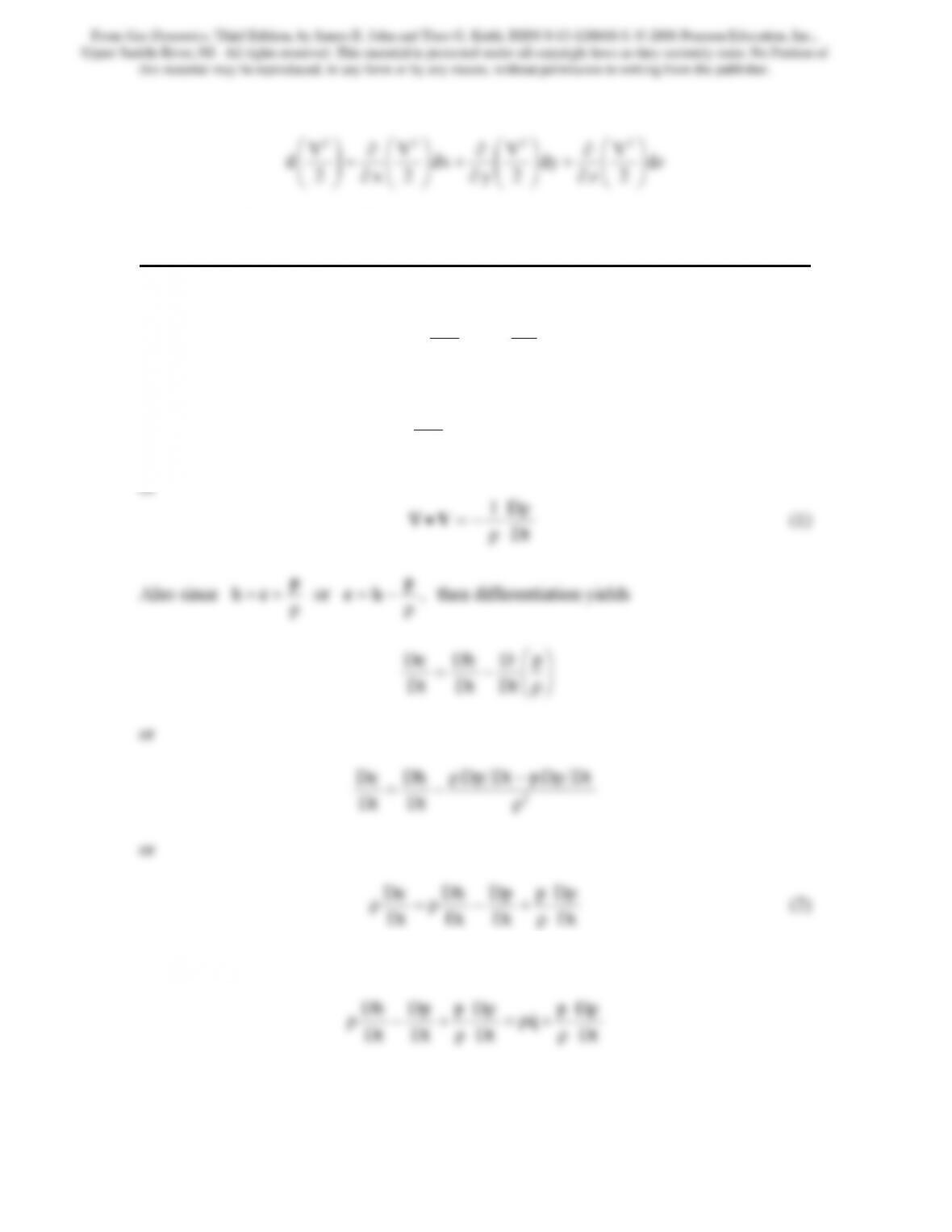
Take the dot product of Eq. (2) with the differential displacement vector,
kjir dzdydxd ++= to get
V
p2=•
⎤
⎡
⎟
⎞
⎜
⎛
∇
V
12=•
From Gas Dynamics, Third Edition, by James E. John and Theo G. Keith. ISBN 0-13-120668-0. © 2006 Pearson Education, Inc.,
Upper Saddle River, NJ. All rights reserved. This material is protected under all copyright laws as they currently exist. No Portion of
this material may be reproduced, in any form or by any means, without permission in writing from the publisher.
240
Substitution of these into Eq.(3) produces Eq. (1).
Problem 6. – Derive Eq.(11.8), i.e., prove that
Dt
Dp
qρ
Dt
Dh
ρ+= &
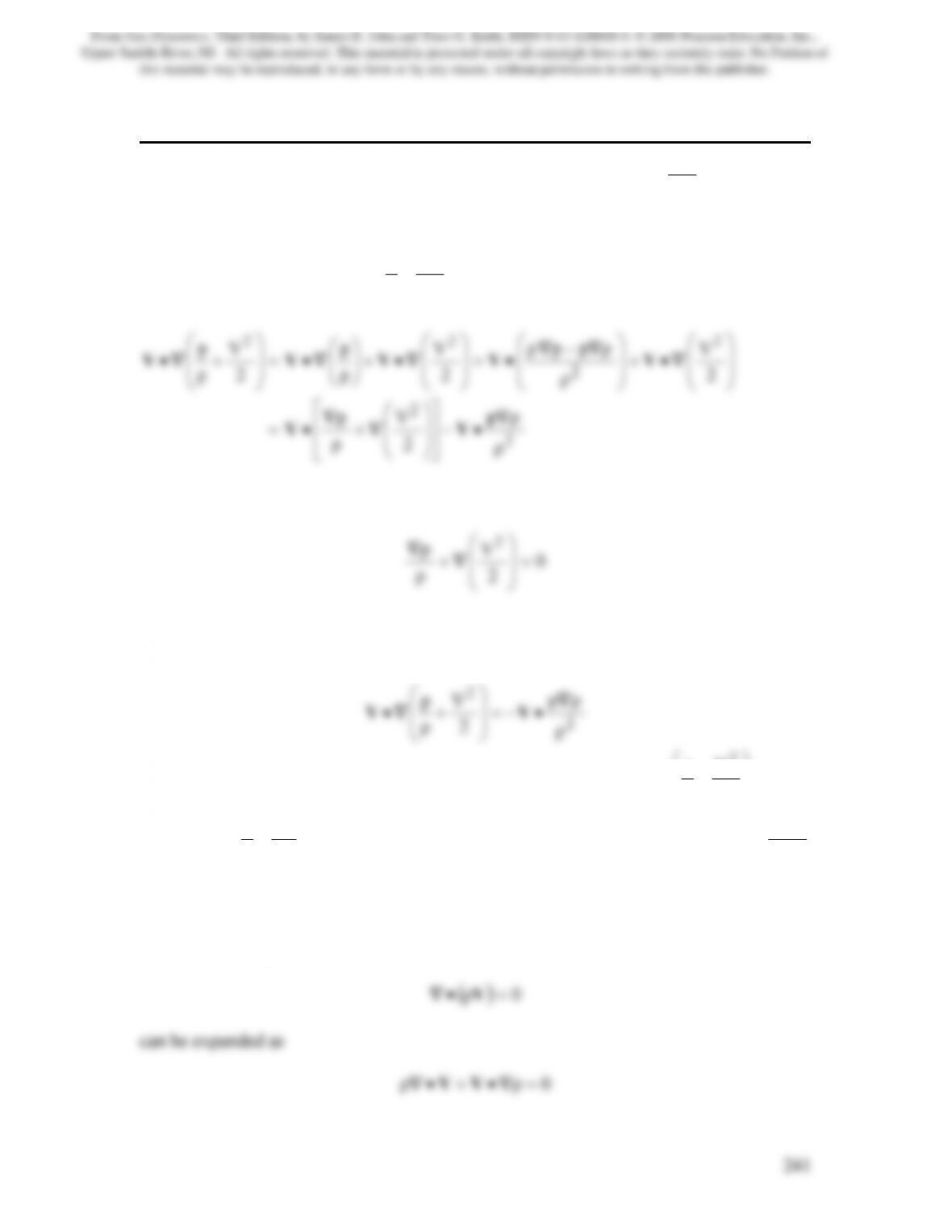
Consider the continuity equation
0ρ
D
t
Dρ=•+ V∇
or
Dρ
1
−=• V∇ (1)
Dt
ρ
Dt
Dt
Dt
Substitution of Eqs.(1) and (2) in Eq.(11.17), then leads to
Dt
ρ
Dt
ρ
Dt
Dt
which simplifies to give Eq.(11.18).
From Gas Dynamics, Third Edition, by James E. John and Theo G. Keith. ISBN 0-13-120668-0. © 2006 Pearson Education, Inc.,
Upper Saddle River, NJ. All rights reserved. This material is protected under all copyright laws as they currently exist. No Portion of
this material may be reproduced, in any form or by any means, without permission in writing from the publisher.
Problem 7. – Under what conditions can it be assumed that 2
V
ρp
2
+ is equal to a
constant?
Consider the dot product ⎟
⎟
⎠
⎞
⎜
⎜
⎝
⎛+• 2
V
ρ
p2
∇V. It can be expanded as follows
2
2
ρ
ρp
2
V
ρ
p
∇
∇
∇
•−
⎥
⎥
⎦
⎤
⎢
⎢
⎣
⎡
⎟
⎟
⎠
⎞
⎜
⎜
⎝
⎛
+•=
VV
But using the vector form of Eq.(11.34)
0
2
ρ
⎟
⎟
⎠
⎜
⎜
⎝
+∇
for irrotational, steady, frictionless flow with no external forces except pressure.
Therefore the dot product introduced above becomes
2
2
ρ
ρp
2
V
ρ
p∇
∇•−=
⎟
⎟
⎠
⎞
⎜
⎜
⎝
⎛+• VV
This means that, if the right hand side term is zero for a flow, then V⊥
⎟
⎟
⎠
⎞
⎜
⎜
⎝
⎛+2
V
ρ
p2
∇, in
other words, Constant
2
V
ρ
p2
=+ along a streamline. Now, in order for the term 2
ρ
ρp
∇
•V
to vanish, we must have either 0ρ
=
∇ or V
⊥
ρ
∇
. The former is a constant density flow
(for our steady assumption), and we can show that the latter also leads to a constant
density flow:
The continuity equation
=
•
+
•
∇
∇
From Gas Dynamics, Third Edition, by James E. John and Theo G. Keith. ISBN 0-13-120668-0. © 2006 Pearson Education, Inc.,
Upper Saddle River, NJ. All rights reserved. This material is protected under all copyright laws as they currently exist. No Portion of
this material may be reproduced, in any form or by any means, without permission in writing from the publisher.
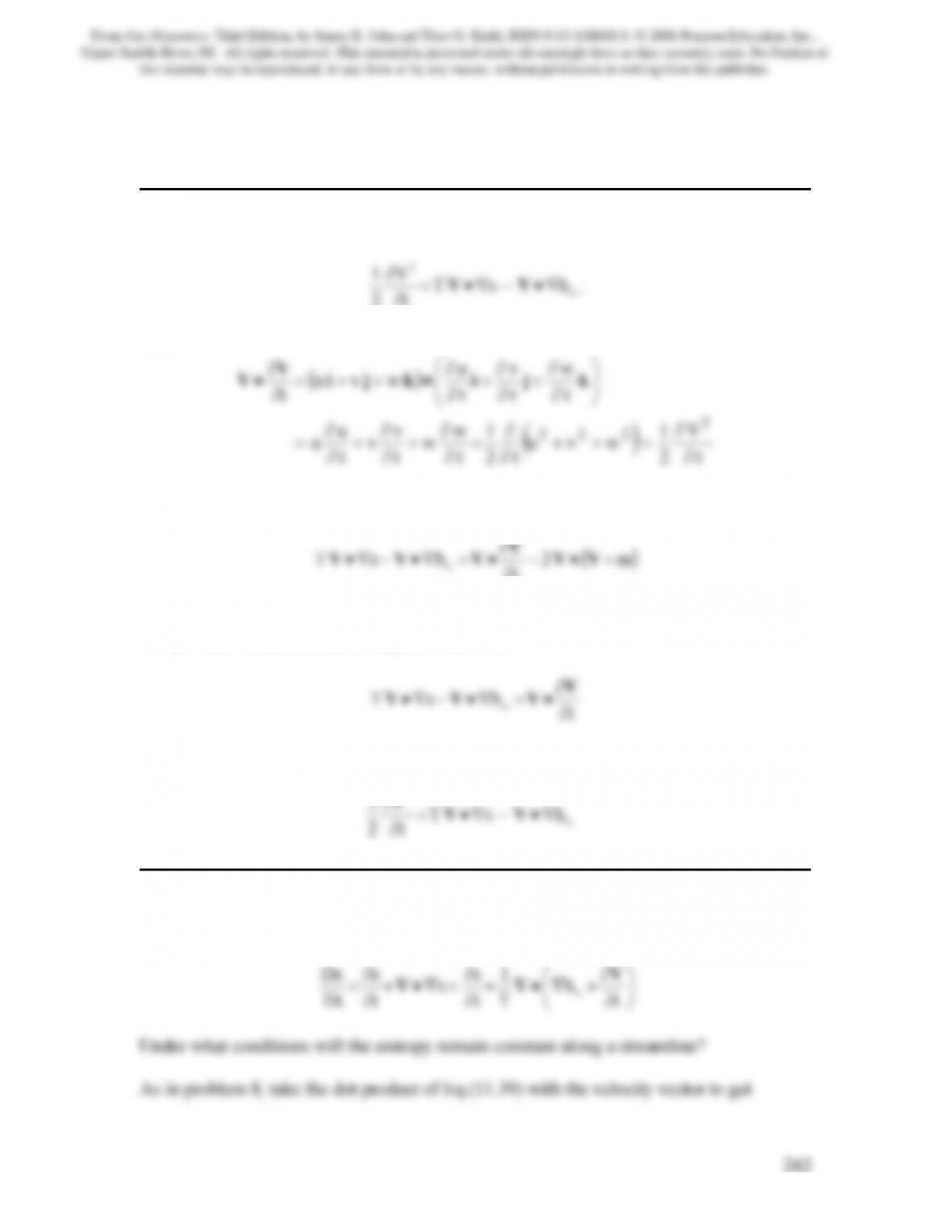
Using this, the assumption V⊥ρ∇, which implies 0ρ
=
•
∇
V, leads to 0=• V∇. This
is again the continuity description of a constant density flow.
Problem 8. – Show that Crocco’s equation along a streamline can be written as
o
t
2
∂
Now
()
t
V
2
1
wvu
t2
1
t
w
w
t
v
v
t
u
u
w
v
u
2
222
∂
∂
=++
∂
∂
=
∂
∂
+
∂
∂
+
∂
∂
=
⎞
⎛
∂
∂
∂
∂
V
Take the dot product of Eq.(11.39) with the velocity vector to get
V
∂
∂
t
By definition, the product ωV× is perpendicular to both vectors V and ω. Therefore,
()
0=ו ωVV , and the above equation becomes
Combining the two previous expressions produces
2
hsT
t
V
2
1∇•−∇•=
∂
∂VV
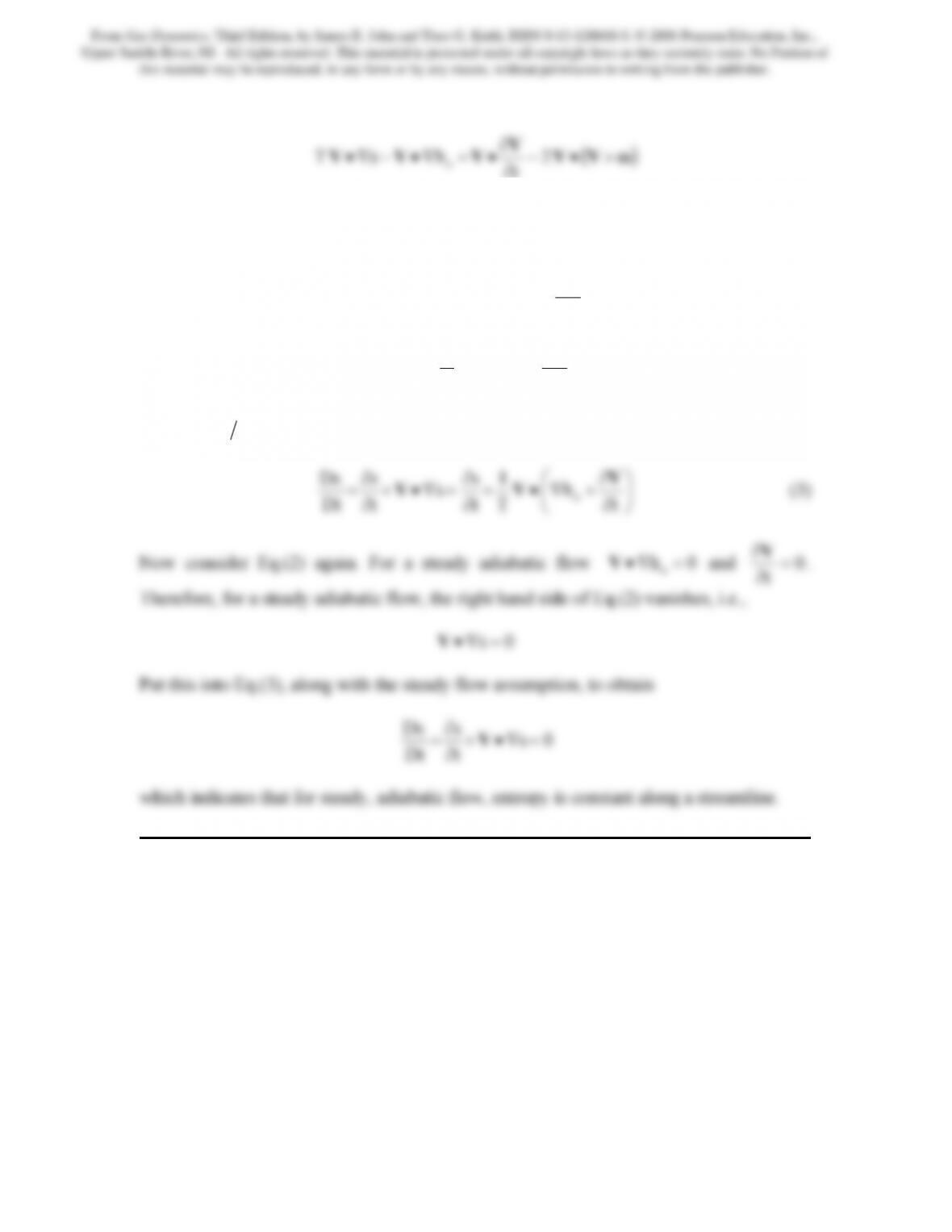
Problem 9. – Using the substantial derivative operator within Crocco’s equation,
Eq.(11.39), develop the following equation for the entropy
⎞
⎛
∂
∂
∂
1
s
s
Ds
V
From Gas Dynamics, Third Edition, by James E. John and Theo G. Keith. ISBN 0-13-120668-0. © 2006 Pearson Education, Inc.,
Upper Saddle River, NJ. All rights reserved. This material is protected under all copyright laws as they currently exist. No Portion of
this material may be reproduced, in any form or by any means, without permission in writing from the publisher.
From Gas Dynamics, Third Edition, by James E. John and Theo G. Keith. ISBN 0-13-120668-0. © 2006 Pearson Education, Inc.,
Upper Saddle River, NJ. All rights reserved. This material is protected under all copyright laws as they currently exist. No Portion of
this material may be reproduced, in any form or by any means, without permission in writing from the publisher.
244
f
f
f
f
f
f
z
f
y
f
x
f
zyx
f
222222 =
⎟
⎞
⎜
⎛
∂
∂
⎟
⎞
⎜
⎛
∂
∂
⎟
⎞
⎜
⎛
∂
∂
∂
∂
∂
∂
∂
∂
∂
∂
∂
∂
∂
∂
=
kji
∇×∇
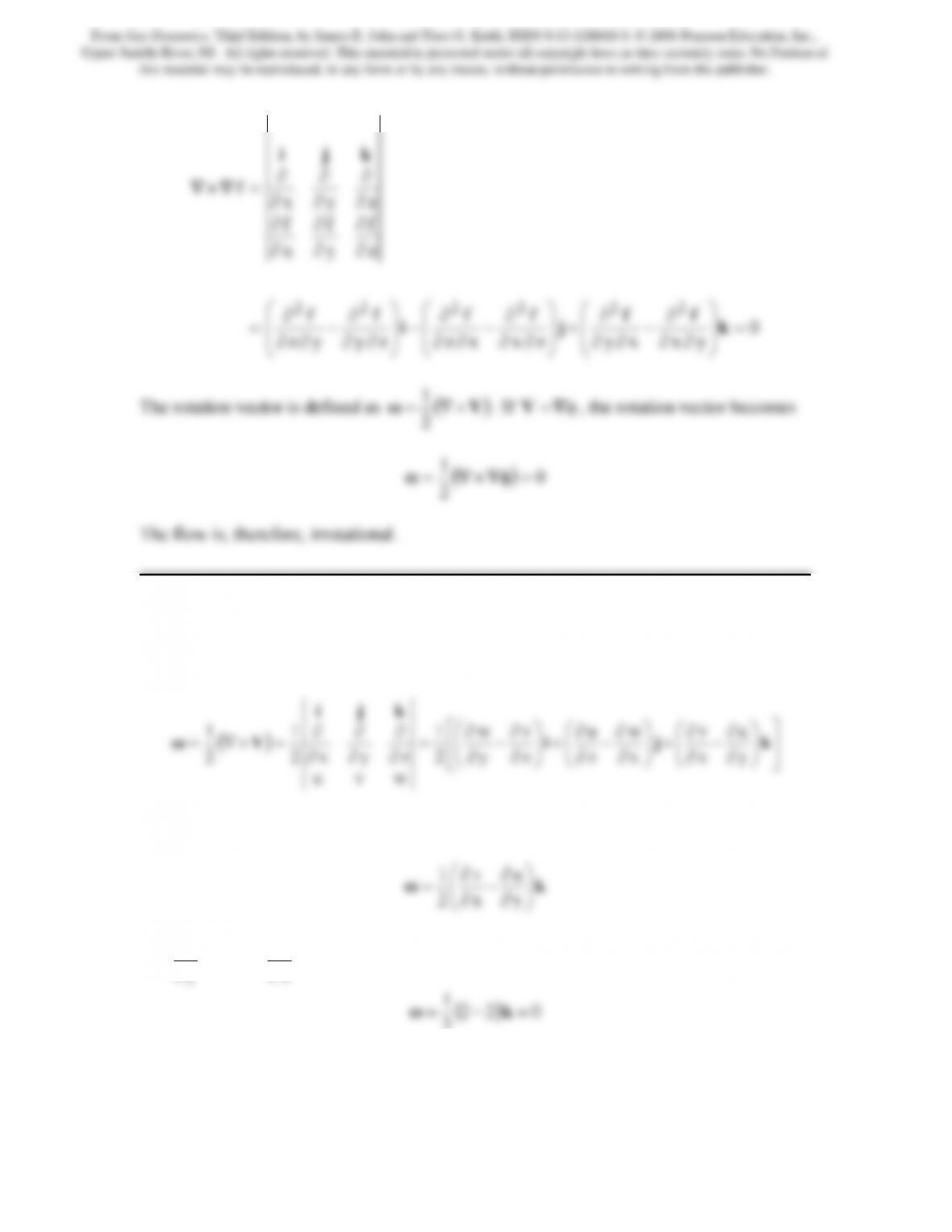
Problem 11. – The velocity components for a possible flow field are given by
y2x3u 2+−= and y2x2v += . Is the flow irrotational? If so, determine the velocity
potential.
()
⎥
⎦
⎤
⎢
⎣
⎡⎟
⎟
⎠
⎞
⎜
⎜
⎝
⎛
∂
∂
−
∂
∂
+
⎟
⎟
⎠
⎞
⎜
⎜
⎝
⎛
∂
∂
−
∂
∂
+
⎟
⎟
⎠
⎞
⎜
⎜
⎝
⎛
∂
∂
−
∂
∂
=
∂
∂
∂
∂
∂
∂
=×∇= kji
kji
Vω
y
u
x
v
x
w
z
u
z
v
y
w
2
1
wvu
zyx2
1
2
1
Since the flow if two-dimensional, the above relation simplifies to
kω⎟
⎟
⎠
⎞
⎜
⎜
⎝
⎛
∂
∂
−
∂
∂
=y
u
x
v
2
1
But 2
y
u=
∂
∂ and 2
x
v=
∂
∂. The rotation vector then becomes
2
Therefore, the flow is irrotational.
From Gas Dynamics, Third Edition, by James E. John and Theo G. Keith. ISBN 0-13-120668-0. © 2006 Pearson Education, Inc.,
Upper Saddle River, NJ. All rights reserved. This material is protected under all copyright laws as they currently exist. No Portion of
this material may be reproduced, in any form or by any means, without permission in writing from the publisher.
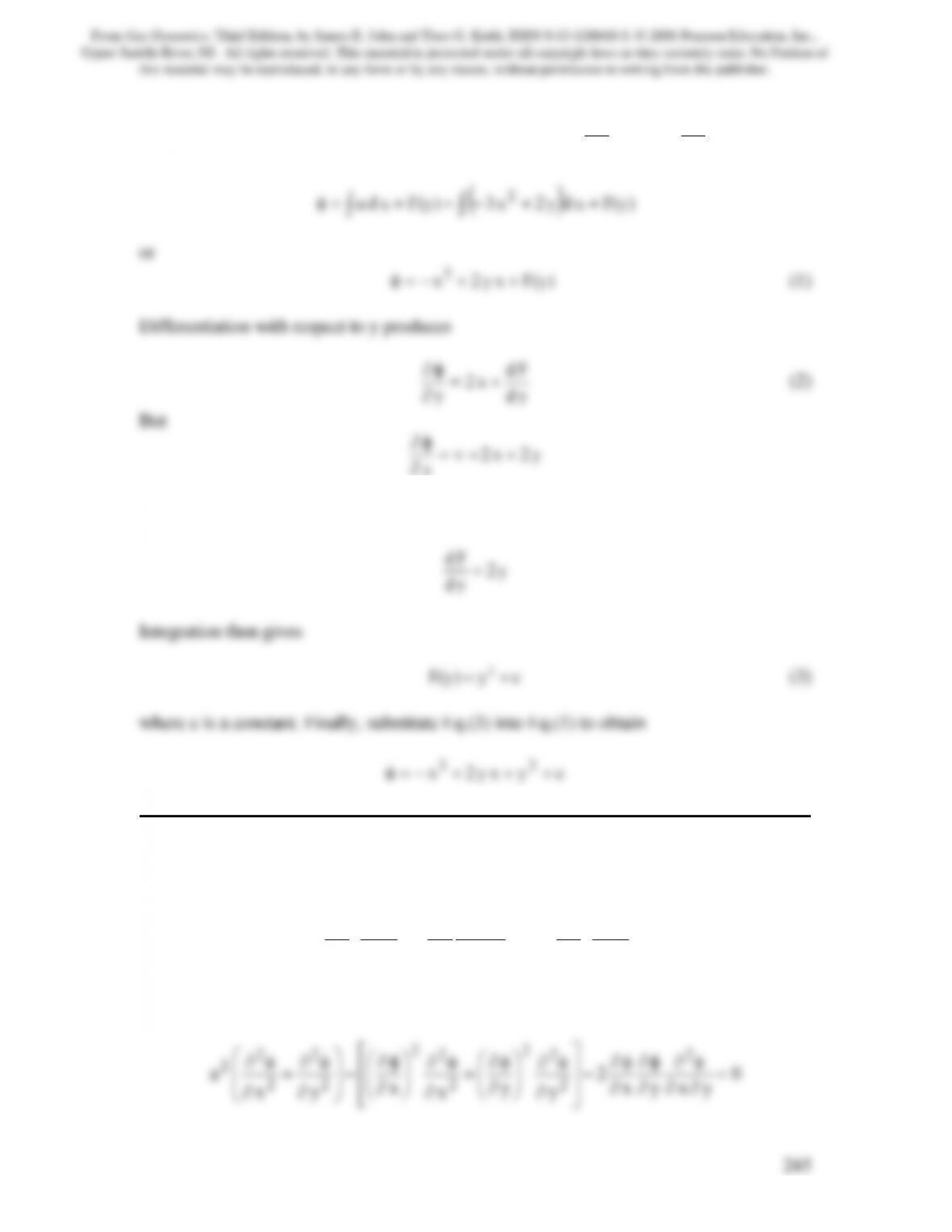
Based on definition of the velocity potential, Eq.(11.4), x
u∂
φ
∂
= and y
v∂
φ∂
=. Therefore,
y+==
∂
Substitute this into Eq.(2) to get
Problem 12. – Show that the velocity potential equation, Eq.(11.47) can be written in
two-dimensional form as
0
ya
v
1
yx
a
vu
2
xa
u
12
2
2
22
22
2
2
2=
∂
φ∂
⎟
⎟
⎠
⎞
⎜
⎜
⎝
⎛−+
∂∂
φ∂
−
∂
φ∂
⎟
⎟
⎠
⎞
⎜
⎜
⎝
⎛−
Equation (11.47), in two dimensions, can be written as
2
2
2
2
2
2
2
2=
φ∂
φ∂
φ∂
⎤
⎡
φ∂
⎞
⎛
φ∂
φ∂
⎞
⎛
φ∂
⎟
⎞
⎜
⎛
φ∂
φ∂
From Gas Dynamics, Third Edition, by James E. John and Theo G. Keith. ISBN 0-13-120668-0. © 2006 Pearson Education, Inc.,
Upper Saddle River, NJ. All rights reserved. This material is protected under all copyright laws as they currently exist. No Portion of
this material may be reproduced, in any form or by any means, without permission in writing from the publisher.
246
ya
yx
a
xa
2
22
2
∂
⎟
⎠
⎜
⎝
∂∂
∂
⎟
⎠
⎜
⎝
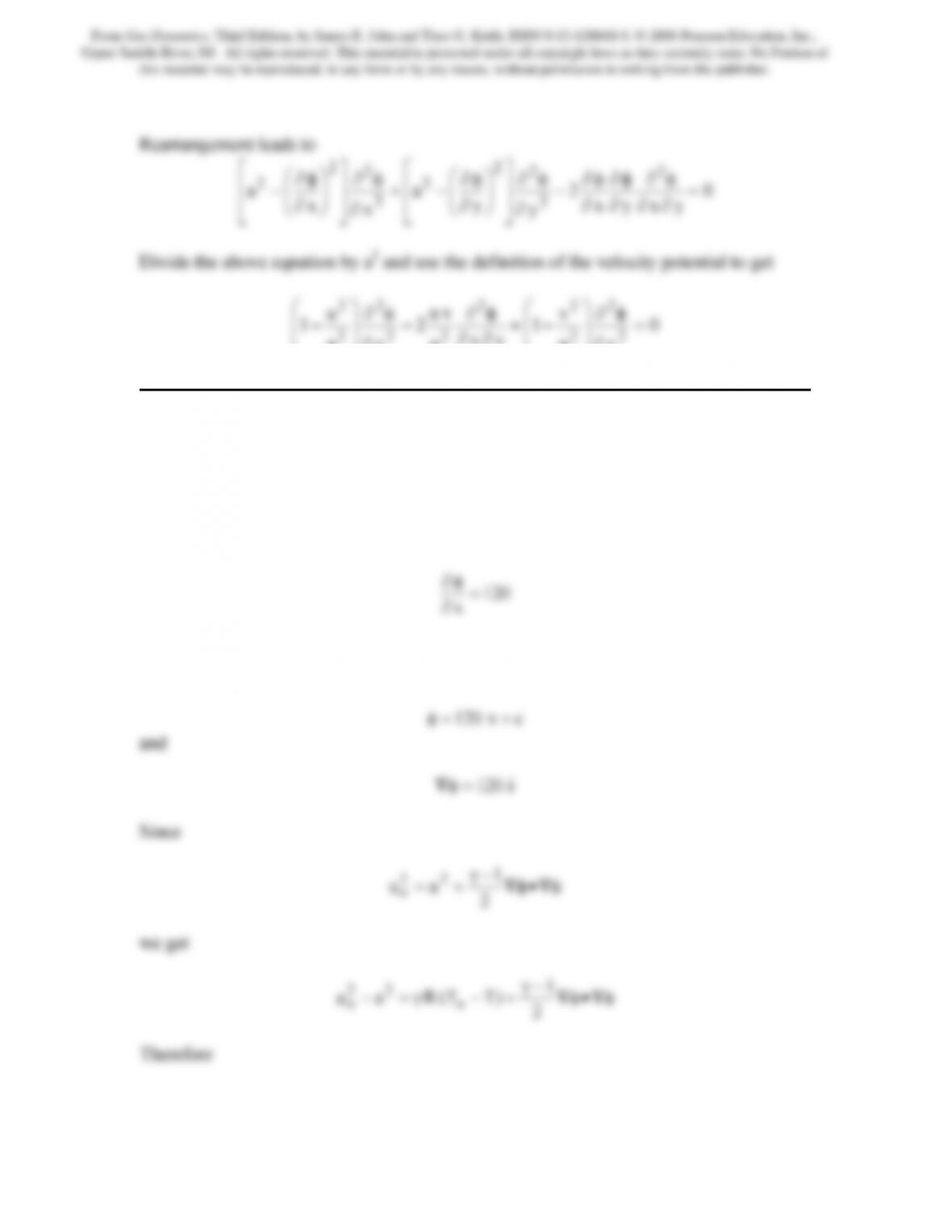
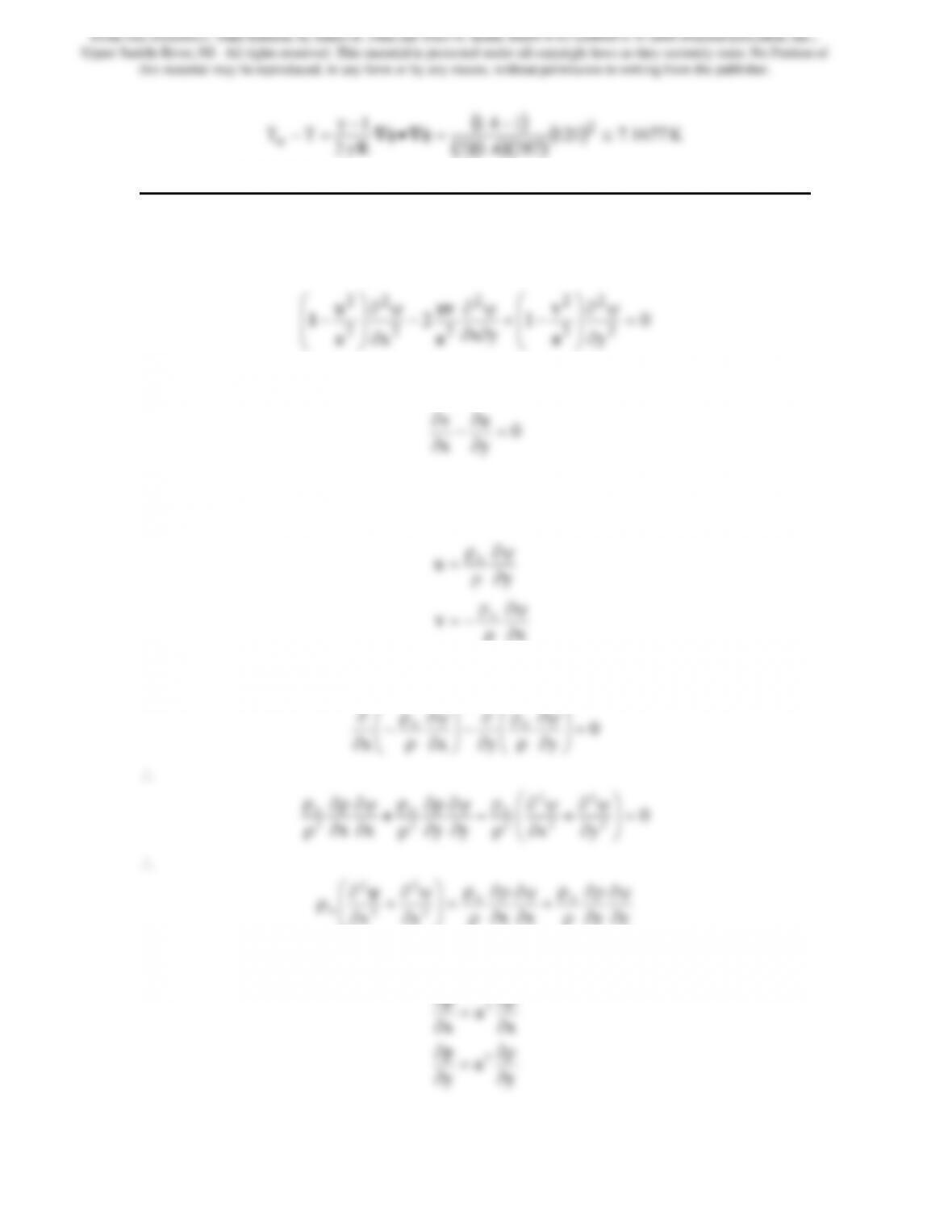
Problem 13. – Consider a steady, uniform flow of air (
γ
= 1.4, R = 0.287 kJ/kg.K) with
velocity components u = 120 m/s and v = w = 0. Determine the velocity potential,
substitute into Eq.(11.48), and find the resultant difference between static and stagnation
temperature.
Using the definition of the velocity potential and the above velocity components, we get
x=
∂
Since the other velocity components are zero, the velocity potential is a function of x
only. Therefore
From Gas Dynamics, Third Edition, by James E. John and Theo G. Keith. ISBN 0-13-120668-0. © 2006 Pearson Education, Inc.,
Upper Saddle River, NJ. All rights reserved. This material is protected under all copyright laws as they currently exist. No Portion of
this material may be reproduced, in any form or by any means, without permission in writing from the publisher.
(
)
()( )( )
()
K7.1677120
2871.42
11.4
Rγ2
1γ
TT 2
o≅
−
=φ•φ
−
=− ∇∇
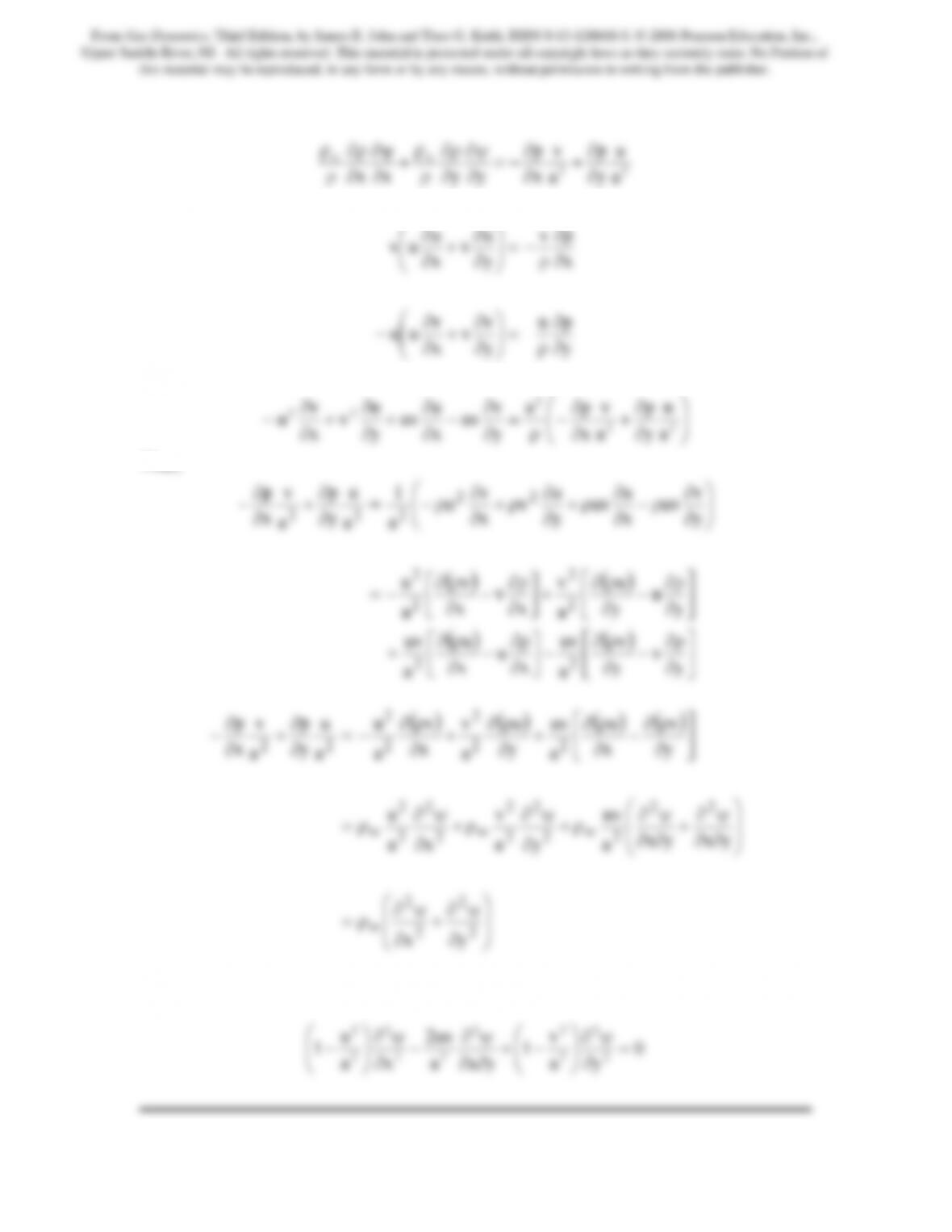
Problem 14. – Using the stream function, as defined in Problem 11.3, develop the
following expression for steady, two-dimensional, irrotational flow
0
ya
v
1
yx
a
uv
2
xa
u
12
2
2
22
22
2
2
2=
∂
ψ∂
⎟
⎟
⎠
⎞
⎜
⎜
⎝
⎛−+
∂∂
ψ∂
−
∂
ψ∂
⎟
⎟
⎠
⎞
⎜
⎜
⎝
⎛−
From irrotational flow
y
u
x
v=
∂
∂
∂
∂
and from the definition of the stream function
u∂
ψ∂
ρ
=∞
ρ
Hence,
⎞
⎛
ψ∂
ρ
∂
⎞
⎛
ψ∂
ρ
∂∞∞
yyxx
yx 2
∂
∂
ρ
∂
∂
ρ
⎠
⎝
∂
∂
Now for isentropic flow
a
p2
ρ
∂
=
∂
From Gas Dynamics, Third Edition, by James E. John and Theo G. Keith. ISBN 0-13-120668-0. © 2006 Pearson Education, Inc.,
Upper Saddle River, NJ. All rights reserved. This material is protected under all copyright laws as they currently exist. No Portion of
this material may be reproduced, in any form or by any means, without permission in writing from the publisher.
22 a
y
a
x
yyxx ∂
+
∂
−=
∂
∂
ρ
+
∂
∂
ρ
From Euler’s equations
y
pu
y
v
v
x
v
uu
x
pv
y
u
v
x
u
uv
∂
∂
ρ
=
⎟
⎟
⎠
⎞
⎜
⎜
⎝
⎛
∂
∂
+
∂
∂
−
∂
∂
ρ
−=
⎟
⎟
⎠
⎞
⎜
⎜
⎝
⎛
∂
∂
+
∂
∂
So
⎟
⎟
⎠
⎞
⎜
⎜
⎝
⎛
∂
∂
+
∂
∂
−
ρ
=
∂
∂
−
∂
∂
+
∂
∂
+
∂
∂
−22
2
22
a
u
y
p
a
v
x
pa
y
v
uv
x
u
uv
y
u
v
x
v
u
Thus,
⎟
⎟
⎠
⎞
⎜
⎜
⎝
⎛
∂
∂
ρ−
∂
∂
ρ+
∂
∂
ρ+
∂
∂
ρ−=
∂
∂
+
∂
∂
−
y
v
uv
x
u
uv
y
u
v
x
v
u
a
1
a
u
y
p
a
v
x
p
2
2
22
222
⎟
⎟
⎠
⎞
⎜
⎜
⎝
⎛
∂
ψ∂
+
∂
ψ∂
ρ=
⎟
⎠
⎜
⎝
∂∂
∂∂
∂
∂
∞
∞∞∞
2
2
2
2
22
2
2
2
yx
yxyx
a
ya
xa
Rearranging produces the result
v
uv2
u
2
22
2
2
ψ∂
⎞
⎛−+
ψ∂
ψ∂
⎞
⎛−
From Gas Dynamics, Third Edition, by James E. John and Theo G. Keith. ISBN 0-13-120668-0. © 2006 Pearson Education, Inc.,
Upper Saddle River, NJ. All rights reserved. This material is protected under all copyright laws as they currently exist. No Portion of
this material may be reproduced, in any form or by any means, without permission in writing from the publisher.
249
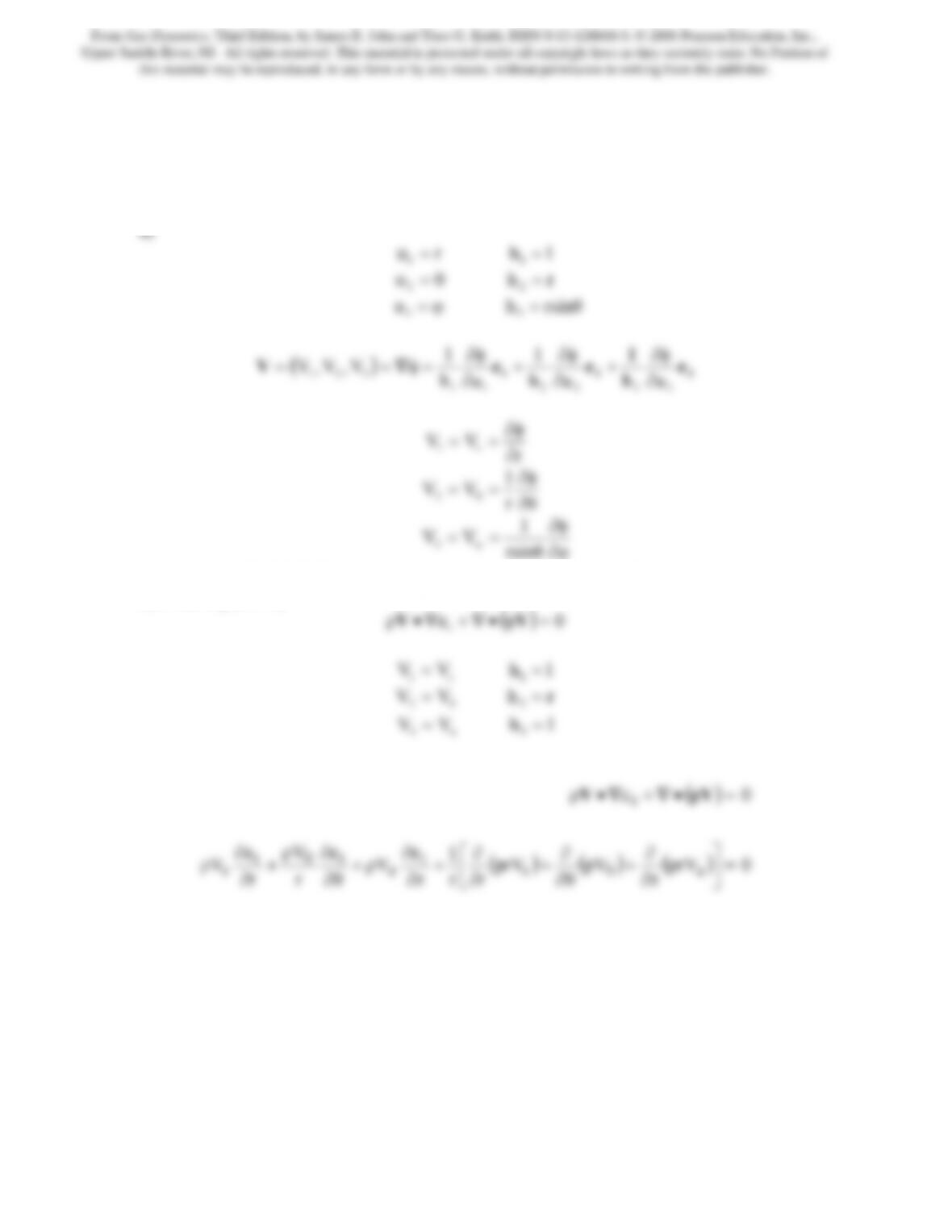
Problem 15. – Use the technique presented in Example 11.4 to write (a) the velocity
components in terms of the velocity potential in spherical coordinates and (b) the steady
energy equation for three-dimensional, adiabatic flow in cylindrical coordinates.
ϕ∂
b) From Eq.(11.14)
(
)
0pet
=
•
+
•
ρ
VV
∇
∇
r1 VV
=
1h1
=
θ
=
VV2 rh 2
=
z3 VV
=
1h3
=
()
() () ()
0prV
z
pVprV
rr
1
z
e
V
e
r
V
r
e
V
0pe
zr
t
z
tt
r
t
=
⎥
⎦
⎤
⎢
⎣
⎡
∂
∂
+
θ∂
∂
+
∂
∂
+
∂
∂
ρ+
θ∂
∂ρ
+
∂
∂
ρ
=•
+
•
ρ
θ
θ
VV
∇
∇
From Gas Dynamics, Third Edition, by James E. John and Theo G. Keith. ISBN 0-13-120668-0. © 2006 Pearson Education, Inc.,
Upper Saddle River, NJ. All rights reserved. This material is protected under all copyright laws as they currently exist. No Portion of
this material may be reproduced, in any form or by any means, without permission in writing from the publisher.
=
=
φ
∂
φ
∂
φ
∂
φ
∂
φ
∂
φ
∂