C
Ch
ha
ap
pt
te
er
r
O
On
ne
e
B
BA
AS
SI
IC
C
E
EQ
QU
UA
AT
TI
IO
ON
NS
S
O
OF
F
C
CO
OM
MP
PR
RE
ES
SS
SI
IB
BL
LE
E
F
FL
LO
OW
W
Problem 1. – Air is stored in a pressurized tank at a pressure of 120 kPa (gage) and a temperature
of 27°C. The tank volume is 1 m3. Atmospheric pressure is 101 kPa and the local acceleration
of gravity is 9.81 m/s2. (a) Determine the density and weight of the air in the tank, and (b)
determine the density and weight of the air if the tank was located on the Moon where the
acceleration of gravity is one sixth that on the Earth.
kpa 122101120PPP
atmgageabs
=+=+=
From Gas Dynamics, Third Edition, by James E. John and Theo G. Keith. ISBN 0-13-120668-0. © 2006 Pearson Education, Inc.,
Upper Saddle River, NJ. All rights reserved. This material is protected under all copyright laws as they currently exist. No Portion of
this material may be reproduced, in any form or by any means, without permission in writing from the publisher.
32
m
kg
,
m
N
p
⎟
⎟
⎠
⎞
⎜
⎜
⎝
⎛≈ρ
⎟
⎟
⎠
⎞
⎜
⎜
⎝
⎛≈
c
g1000
1
factor
=
∴
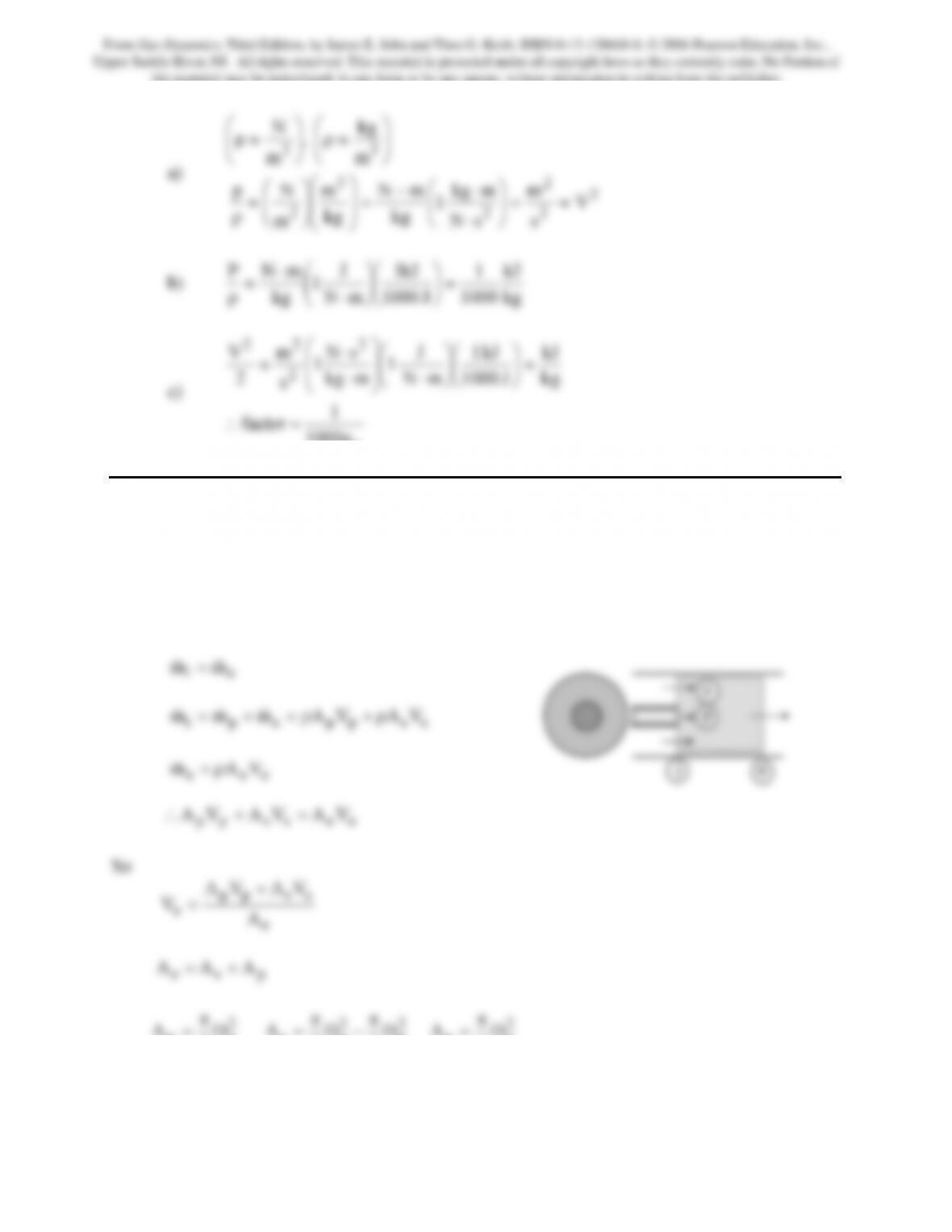
Problem 3. – Air flows steadily through a circular jet ejector, refer to Figure 1.15. The primary
jet flows through a 10 cm diameter tube with a velocity of 20 m/s. The secondary flow is through
the annular region that surrounds the primary jet. The outer diameter of the annular duct is 30
cm and the velocity entering the annulus is 5 m/s. If the flows at both the inlet and exit are
uniform, determine the exit velocity. Assume the air speeds are small enough so that the flow
may be treated as an incompressible flow, i.e., one in which the density is constant.
From Gas Dynamics, Third Edition, by James E. John and Theo G. Keith. ISBN 0-13-120668-0. © 2006 Pearson Education, Inc.,
Upper Saddle River, NJ. All rights reserved. This material is protected under all copyright laws as they currently exist. No Portion of
this material may be reproduced, in any form or by any means, without permission in writing from the publisher.
(
)
()
sp
2
o
2
p
s
2
o
s
2
p
2
op
2
p
e
sspp
eVV
D
D
V
D
VDDVD
A
VAVA
V−+=
−+
=
+
=
()
s/m6667.6520
30
10
52
2=−+=
Problem 4. – A slow leak develops in a storage bottle and oxygen slowly leaks out. The volume
of the bottle is 0.1 m3 and the diameter of the hole is 0.1 mm. The initial pressure is 10 MPa and
the temperature is 20˚C. The oxygen escapes through the hole according to the relation
ee A
T
p
04248.0m =
&
where p is the tank pressure and T is the tank temperature. The constant 0.04248 is based on the
gas constant and the ratio of specific heats of oxygen. The units are: pressure N/m2, temperature
K, area m2 and mass flow rate kg/s. Assuming that the temperature of the oxygen in the bottle
does not change with time, determine the time it takes to reduce the pressure to one half of its
initial value.
From Gas Dynamics, Third Edition, by James E. John and Theo G. Keith. ISBN 0-13-120668-0. © 2006 Pearson Education, Inc.,
Upper Saddle River, NJ. All rights reserved. This material is protected under all copyright laws as they currently exist. No Portion of
this material may be reproduced, in any form or by any means, without permission in writing from the publisher.
ATR 80424.0
p
2⎟
⎞
⎛
hrs 5979.12sec4076.713,46
2
293)8219.259(
mm 0100
m
mm 1.0
4
)04248.0(
2
==
⎠
⎝
⎟
⎠
⎞
⎜
⎝
⎛
⎟
⎠
⎞
⎜
⎝
⎛π
Problem 5. – A normal shock wave occurs in a nozzle in which air is steadily flowing. Because
the shock has a very small thickness, changes in flow variables across the shock may be assumed
to occur without change of cross-sectional area. The velocity just upstream of the shock is 500
m/s, the static pressure is 50 kPa and the static temperature is 250 K. On the downstream side of
the shock the pressure is 137 kPa and the temperature is 343.3 K. Determine the velocity of the
air just downstream of the shock.
s/m 050V
1= ?V2
=
From Gas Dynamics, Third Edition, by James E. John and Theo G. Keith. ISBN 0-13-120668-0. © 2006 Pearson Education, Inc.,
Upper Saddle River, NJ. All rights reserved. This material is protected under all copyright laws as they currently exist. No Portion of
this material may be reproduced, in any form or by any means, without permission in writing from the publisher.
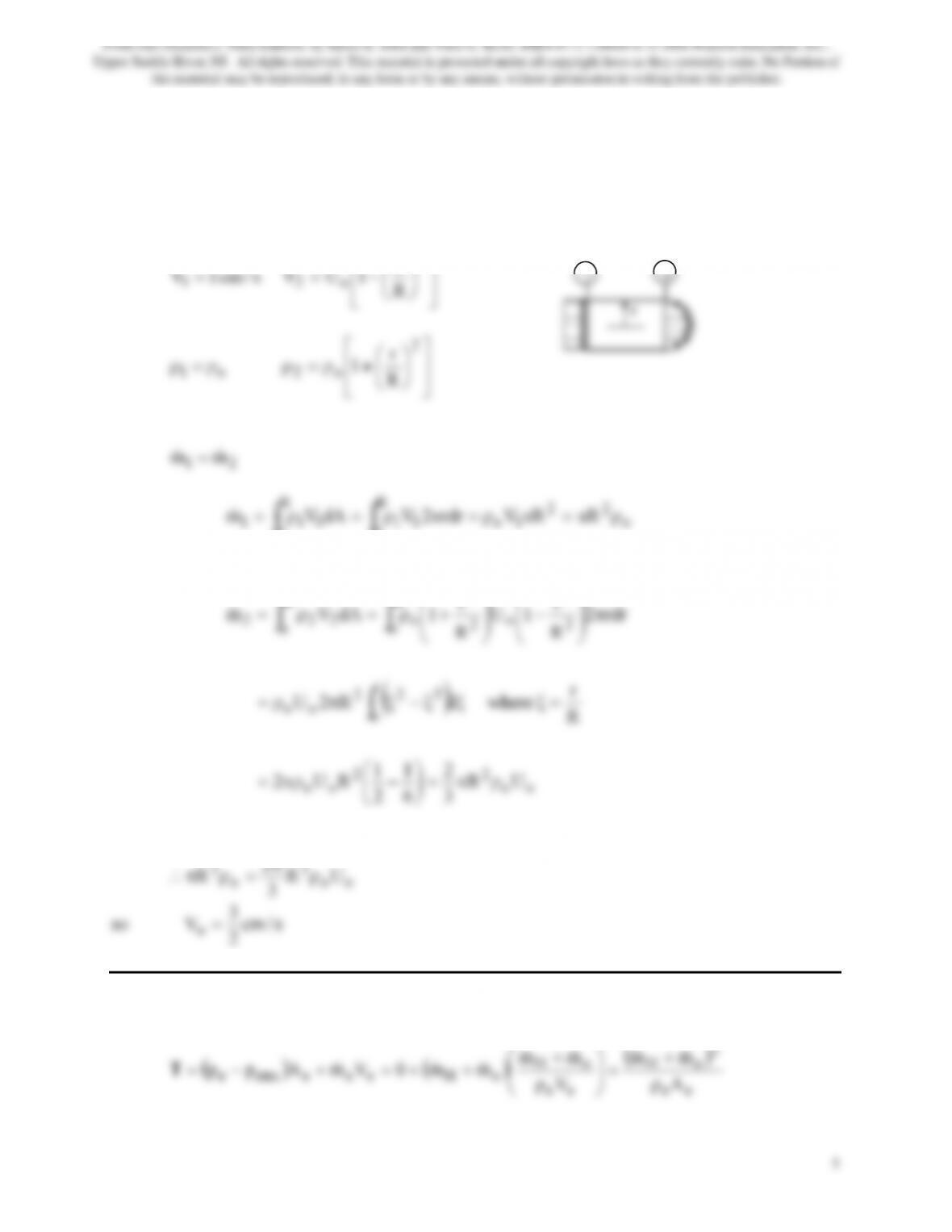
Problem 6. – A gas flows steadily in a 2.0 cm diameter circular tube with a uniform velocity of
1.0 cm/s and a density ρo. At a cross section farther down the tube, the velocity distribution is
given by V = Uo[1-( r/R)2], with r in centimeters. Find Uo, assuming the gas density to be
ρo[1+( r/R)2].
⎤
⎡⎟
⎞
⎛
2
r
o
22
1o
o111
o11 RRVrdr2VdAVm ρπ=πρ=πρ=ρ= ∫∫
()
oo
22
oo
1
o
522
oo
2
2
R
R
UR
3
2
6
1
2
1
RU2
R
r
wheredR2U
rdr2
r
1U
r
1dAVm
ρπ=
⎟
⎠
⎞
⎜
⎝
⎛−πρ=
=ξξξ−ξπρ=
π
⎟
⎞
⎜
⎛−
⎟
⎞
⎜
⎛+ρ=ρ=
∫
&
2
2UR
2
π
2
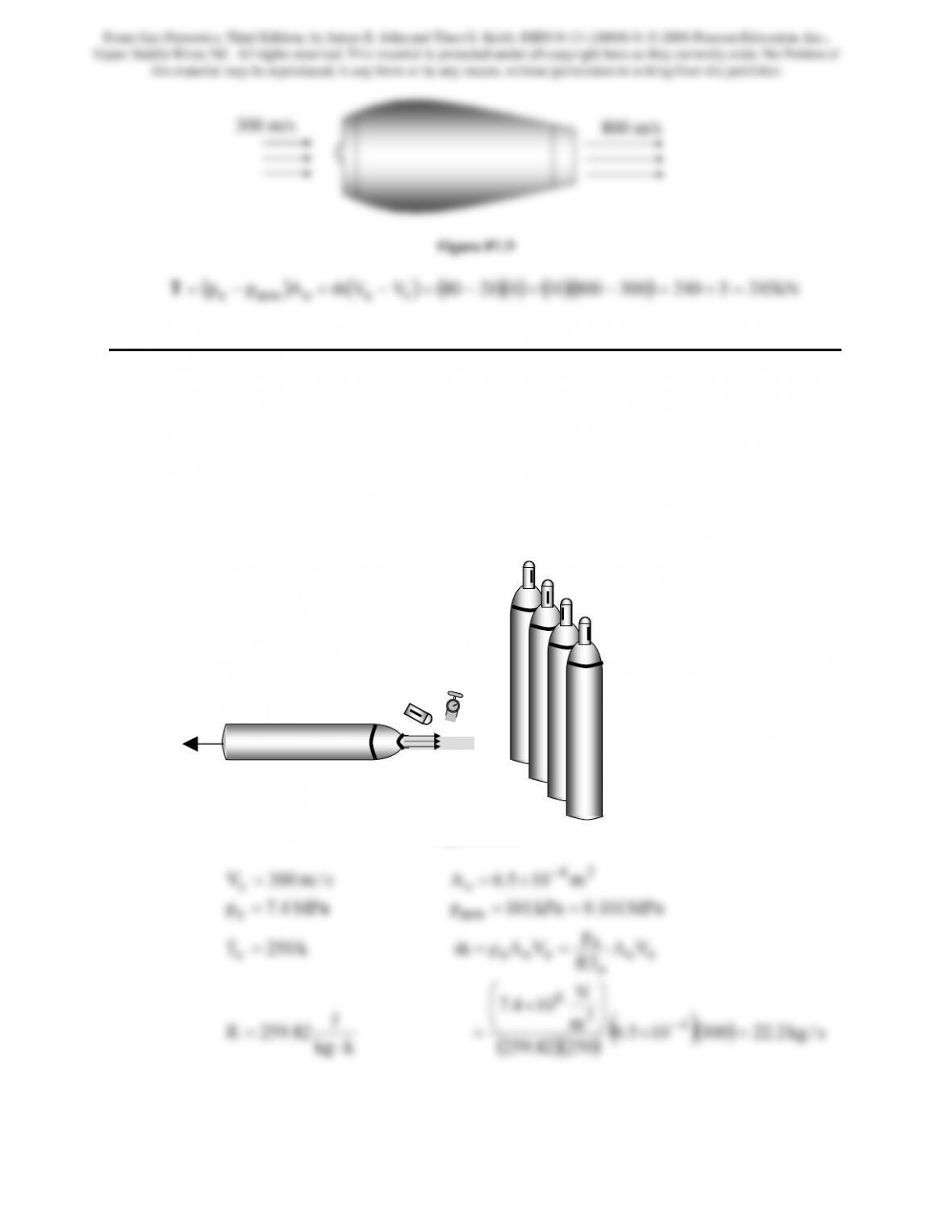
Problem 7. – For the rocket shown in Figure 1.6, determine the thrust. Assume that exit plane
pressure is equal to ambient pressure.
(
)
2
oH
oH
mm
mm
+
⎞
⎛
+
From Gas Dynamics, Third Edition, by James E. John and Theo G. Keith. ISBN 0-13-120668-0. © 2006 Pearson Education, Inc.,
Upper Saddle River, NJ. All rights reserved. This material is protected under all copyright laws as they currently exist. No Portion of
this material may be reproduced, in any form or by any means, without permission in writing from the publisher.
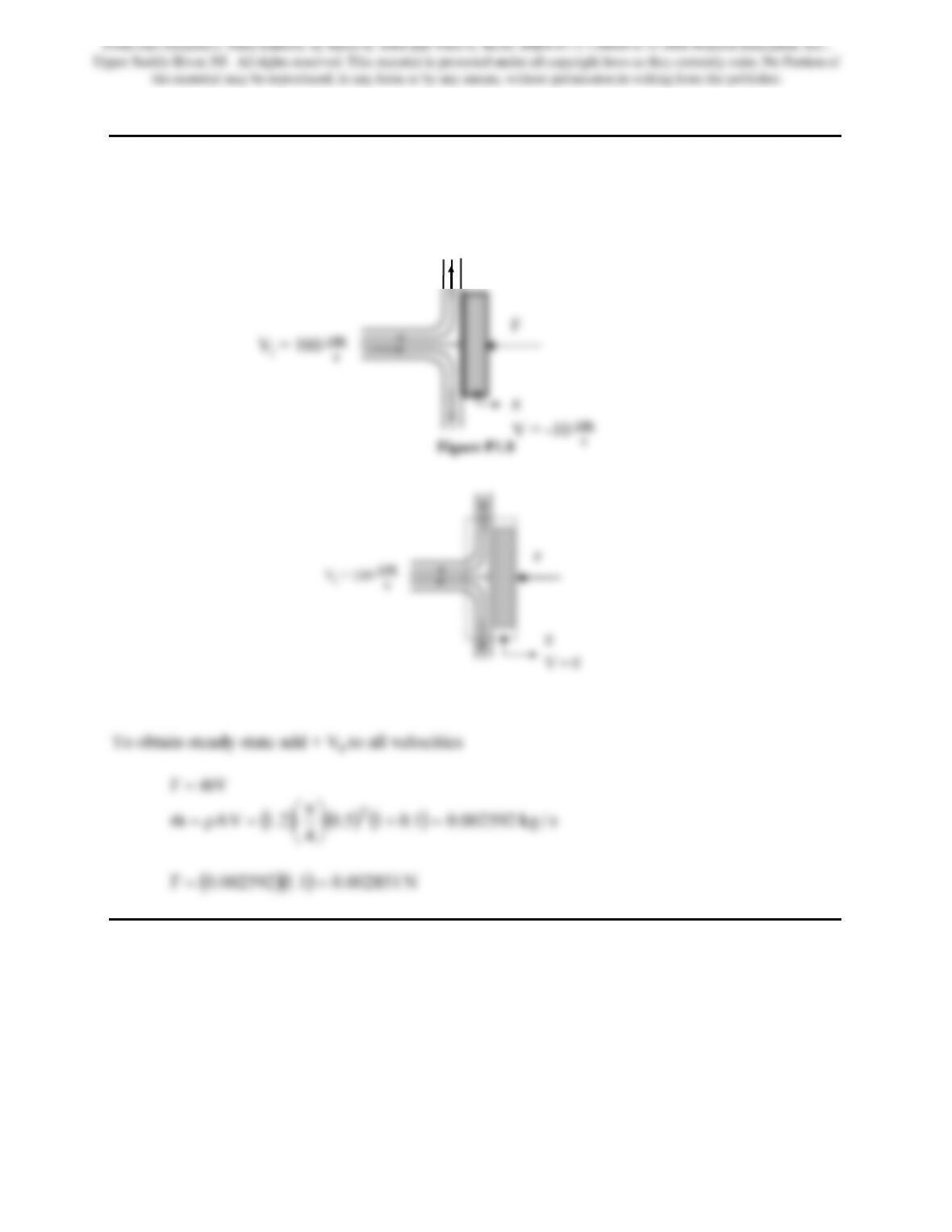
Problem 8. – Determine the force F required to push the flat plate of Figure Pl.8 against the
round air jet with a velocity of 10 cm/s. The air jet velocity is 100 cm/s, with a jet diameter of 5.0
cm. Air density is 1.2 kg/m3.
From Gas Dynamics, Third Edition, by James E. John and Theo G. Keith. ISBN 0-13-120668-0. © 2006 Pearson Education, Inc.,
Upper Saddle River, NJ. All rights reserved. This material is protected under all copyright laws as they currently exist. No Portion of
this material may be reproduced, in any form or by any means, without permission in writing from the publisher.
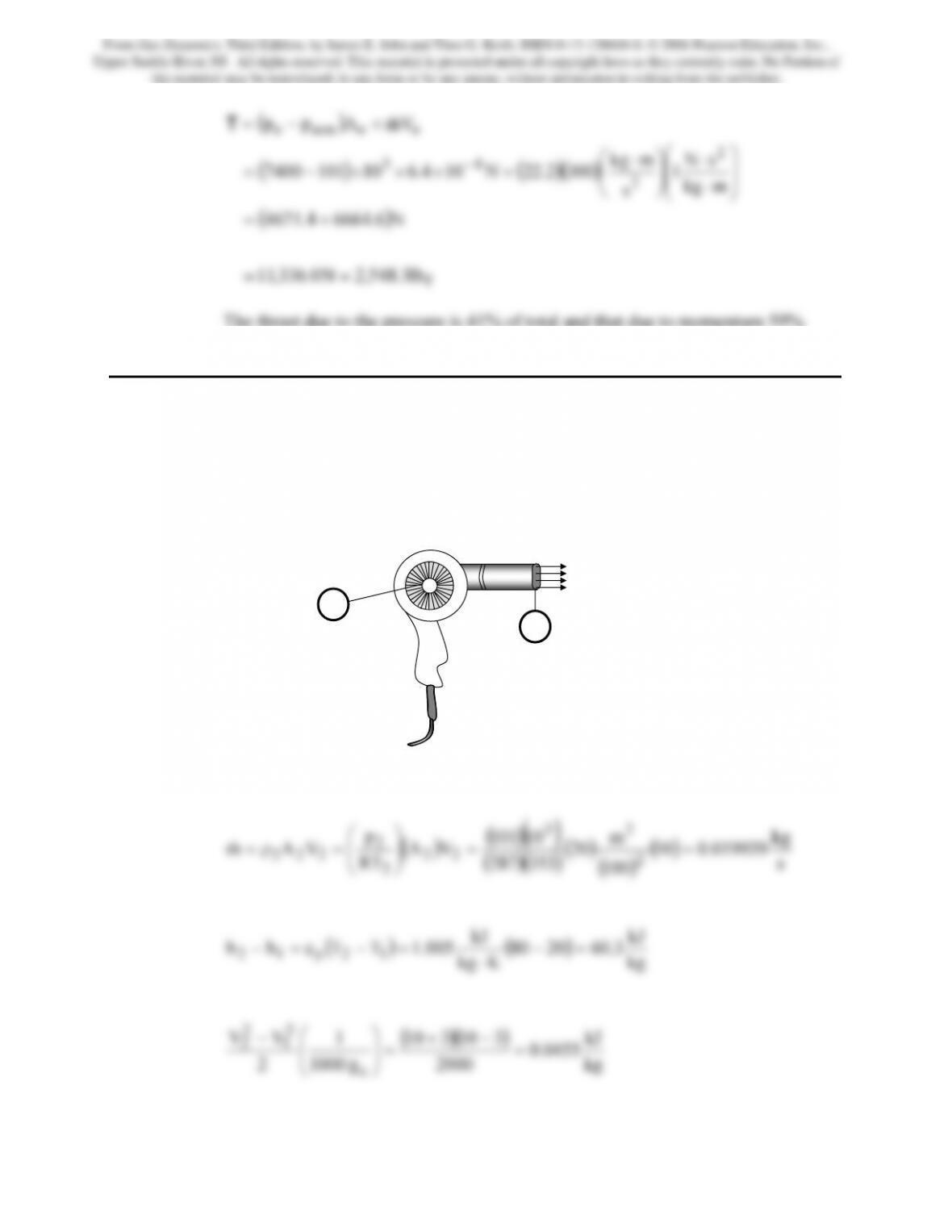
Problem 10. – A high-pressure oxygen cylinder, typically found in most welding shops,
accidentally is knocked over and the valve on top of the cylinder breaks off. This creates a hole
with a cross-sectional area of 6.5 x 10⁻⁴ m
2. Prior to the accident, the internal pressure of the
oxygen is 14 MPa and the temperature is 27˚C. Based on critical flow calculations, the velocity
of the oxygen exiting the cylinder is estimated to be 300 m/s, the exit pressure 7.4 MPa and the
exit temperature 250 K. How much thrust does the oxygen being expelled from the cylinder
generate? What percentage is due to the pressure difference? What percentage due to the exiting
momentum? Atmospheric pressure is 101 kPa. Also note that 0.2248 lbf = 1 N.
Figure P1.10
From Gas Dynamics, Third Edition, by James E. John and Theo G. Keith. ISBN 0-13-120668-0. © 2006 Pearson Education, Inc.,
Upper Saddle River, NJ. All rights reserved. This material is protected under all copyright laws as they currently exist. No Portion of
this material may be reproduced, in any form or by any means, without permission in writing from the publisher.
8
The thrust due to the pressure is 41% of total and that due to momentum 59%.
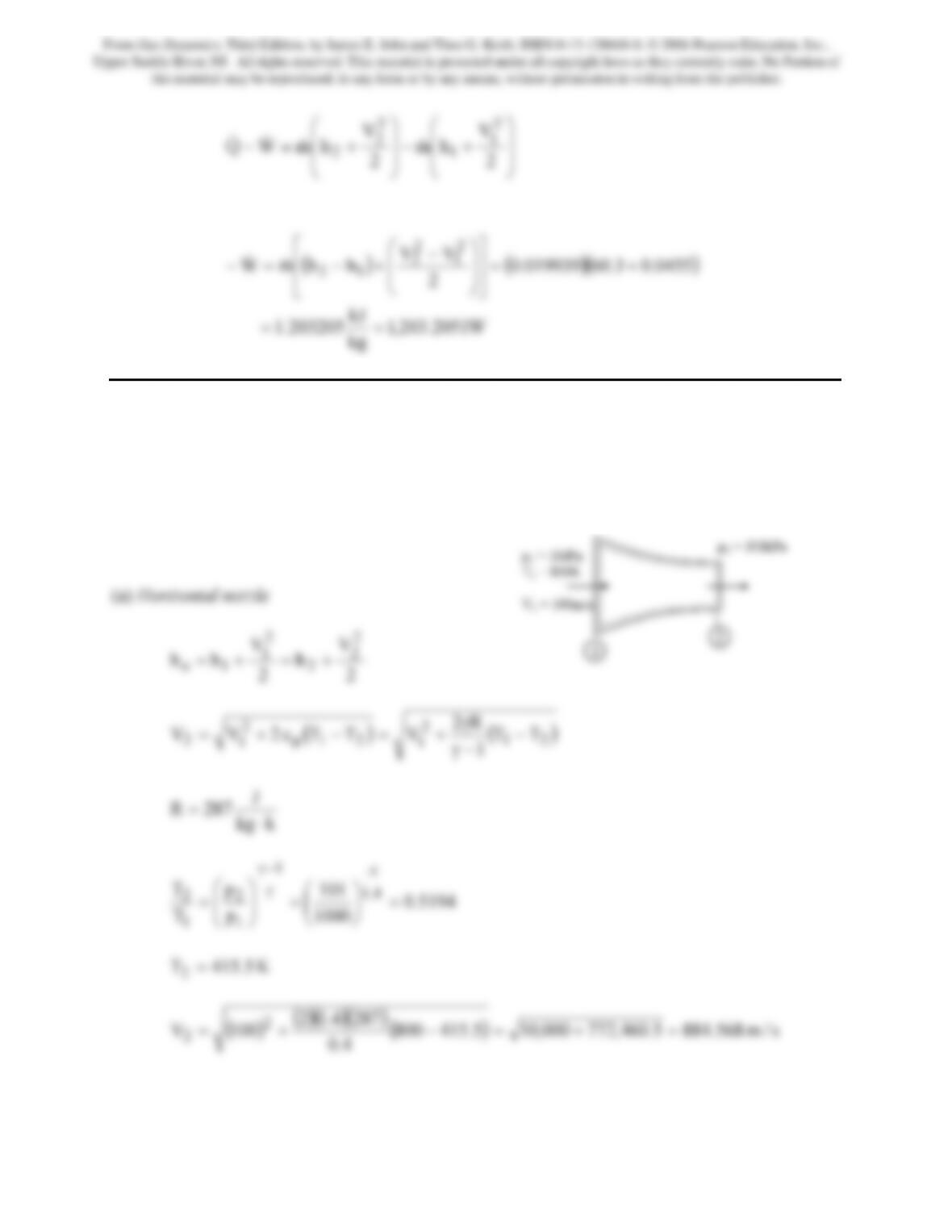
Problem 11. – Air enters a hand held hair dryer with a velocity of 3 m/s at a temperature of 20°C
and a pressure of 101 kPa. Internal resistance heaters warm the air and it exits through an area of
20 cm2 with a velocity of 10 m/s at a temperature of 80°C. Assume that internal obstructions do
not appreciably affect the pressure between inlet and exit and that heat transfer to the
surroundings are negligible. Determine the power in kW needed to operate the hair dryer at
steady state.
i
e
From Gas Dynamics, Third Edition, by James E. John and Theo G. Keith. ISBN 0-13-120668-0. © 2006 Pearson Education, Inc.,
Upper Saddle River, NJ. All rights reserved. This material is protected under all copyright laws as they currently exist. No Portion of
this material may be reproduced, in any form or by any means, without permission in writing from the publisher.
⎟
⎞
⎜
⎛+−
⎟
⎞
⎜
⎛+=− 2
V
hm
V
hmWQ
2
1
1
2
2
2&&
&
&
() ()( )
W2051.203,1
kg
kJ
203205.1
0455.03.60019939.0
2
hhmW
12
==
+=
⎥
⎥
⎦
⎢
⎢
⎣
⎟
⎠
⎜
⎝
+−=− &
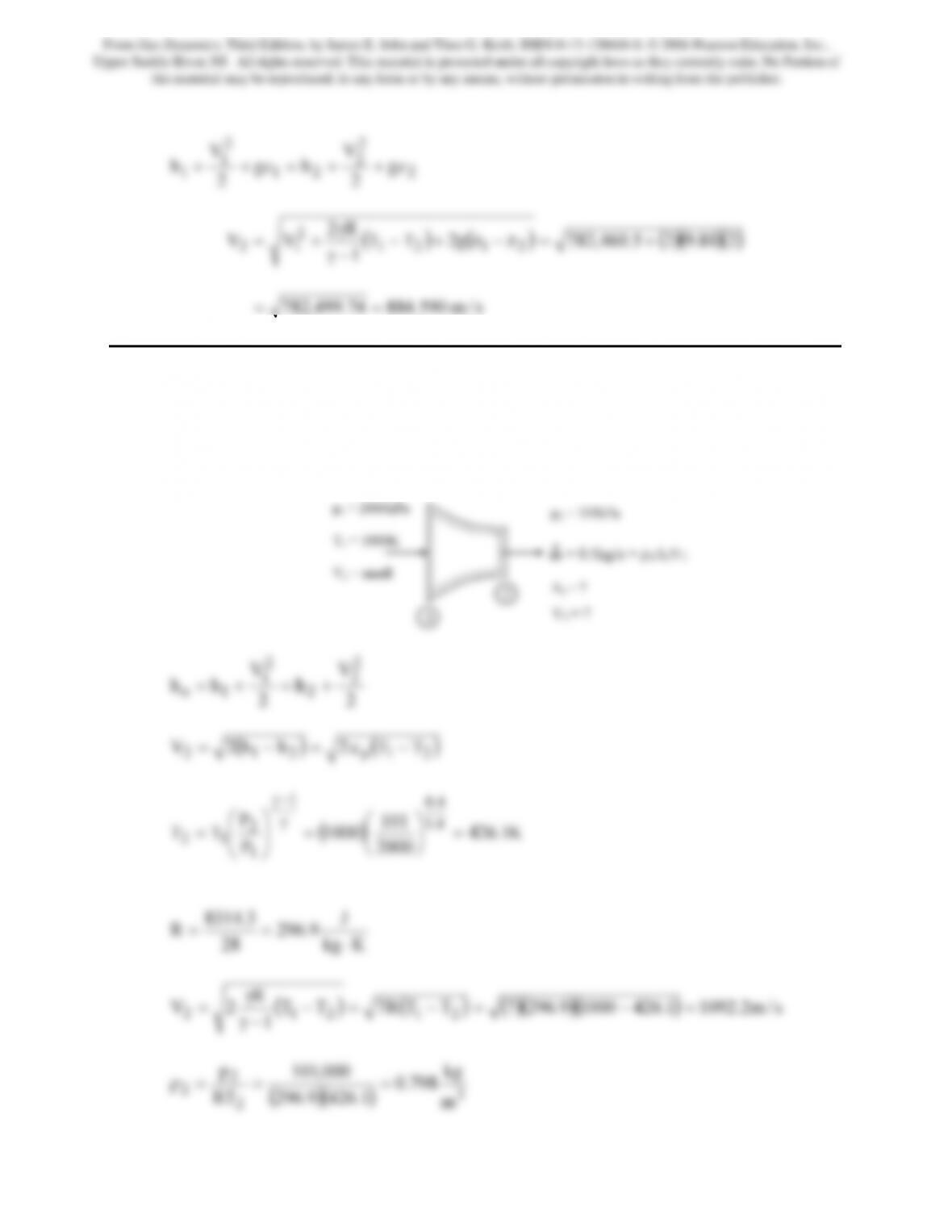
Problem 12. – Air is expanded isentropically in a horizontal nozzle from an initial pressure of
1.0 MPa, of a temperature of 800 K, to an exhaust pressure of 101 kPa. If the air enters the
nozzle with a velocity of 100 m/s, determine the air exhaust velocity. Assume the air behaves as
a perfect gas, with R = 0.287 kJ/kg · K and γ = 1.4. Repeat for a vertical nozzle with exhaust
plane 2.0 m above the intake plane.
From Gas Dynamics, Third Edition, by James E. John and Theo G. Keith. ISBN 0-13-120668-0. © 2006 Pearson Education, Inc.,
Upper Saddle River, NJ. All rights reserved. This material is protected under all copyright laws as they currently exist. No Portion of
this material may be reproduced, in any form or by any means, without permission in writing from the publisher.
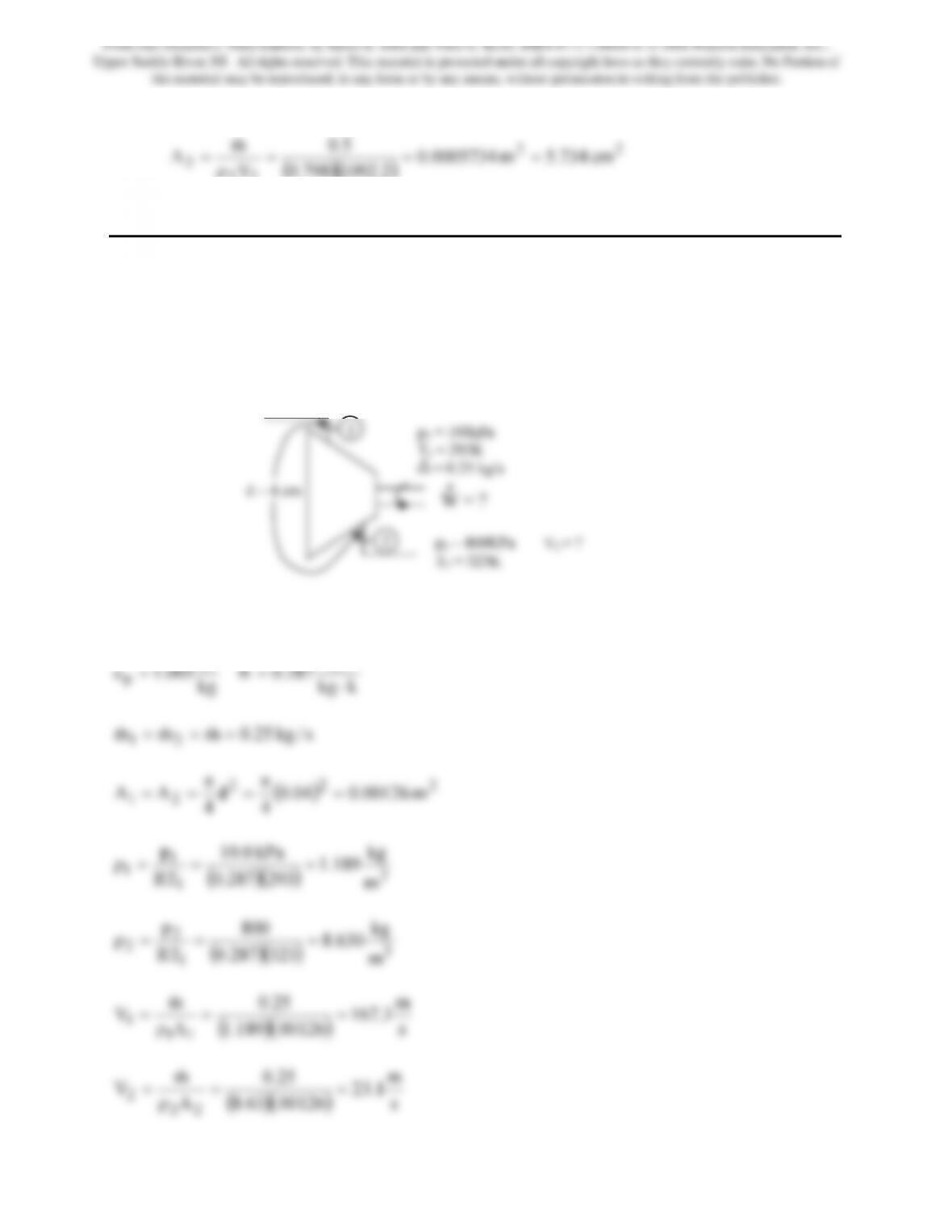
Problem 13. – Nitrogen is expanded isentropically in a nozzle from a pressure of 2000 kPa, at a
temperature of 1000 K, to a pressure of 101 kPa. If the velocity of the nitrogen entering the
nozzle is negligible, determine the exit nozzle area required for a nitrogen flow of 0.5 kg/s.
Assume the nitrogen to behave as a perfect gas with constant specific heats, mean molecular
mass of 28.0, and γ = 1.4.
p1 = 2000kPa
From Gas Dynamics, Third Edition, by James E. John and Theo G. Keith. ISBN 0-13-120668-0. © 2006 Pearson Education, Inc.,
Upper Saddle River, NJ. All rights reserved. This material is protected under all copyright laws as they currently exist. No Portion of
this material may be reproduced, in any form or by any means, without permission in writing from the publisher.
()( )
22
2.1092798.0
V
ρ
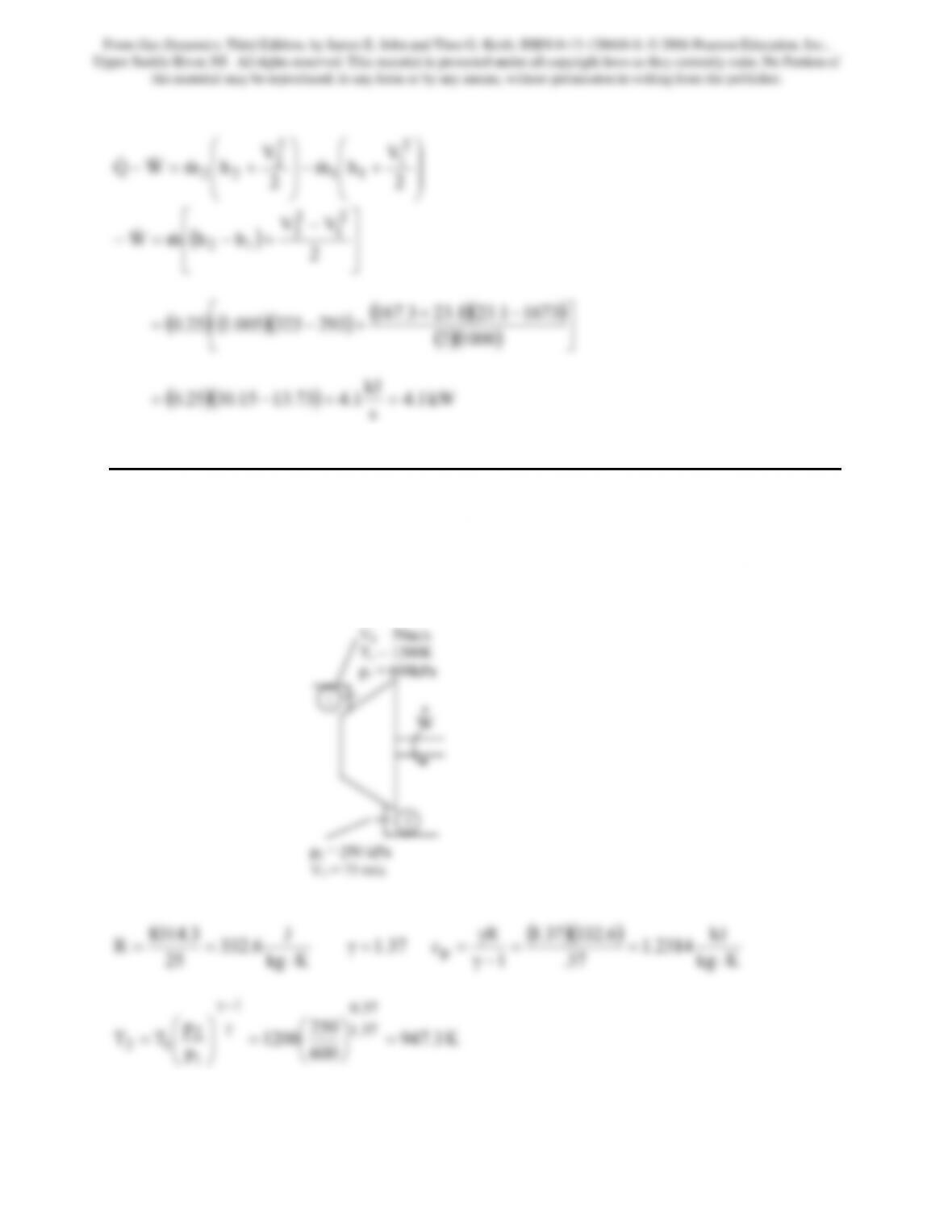
Problem 14. – Air enters a compressor with a pressure of 100 kPa and a temperature 20°C; the
mass flow rate is 0.25 kg/s. Compressed air is discharged from the compressor at 800 kPa and
50°C. Inlet and exit pipe diameters are 4.0 cm. Determine the exit velocity of the air at the
compressor outlet and the compressor power required. Assume an adiabatic, steady, flow and
that the air behaves as a perfect gas with constant specific heats; cp = 1.005 kJ/kg · K and
R = 0.287kJ/kg·K.
kJ
kJ
From Gas Dynamics, Third Edition, by James E. John and Theo G. Keith. ISBN 0-13-120668-0. © 2006 Pearson Education, Inc.,
Upper Saddle River, NJ. All rights reserved. This material is protected under all copyright laws as they currently exist. No Portion of
this material may be reproduced, in any form or by any means, without permission in writing from the publisher.
s
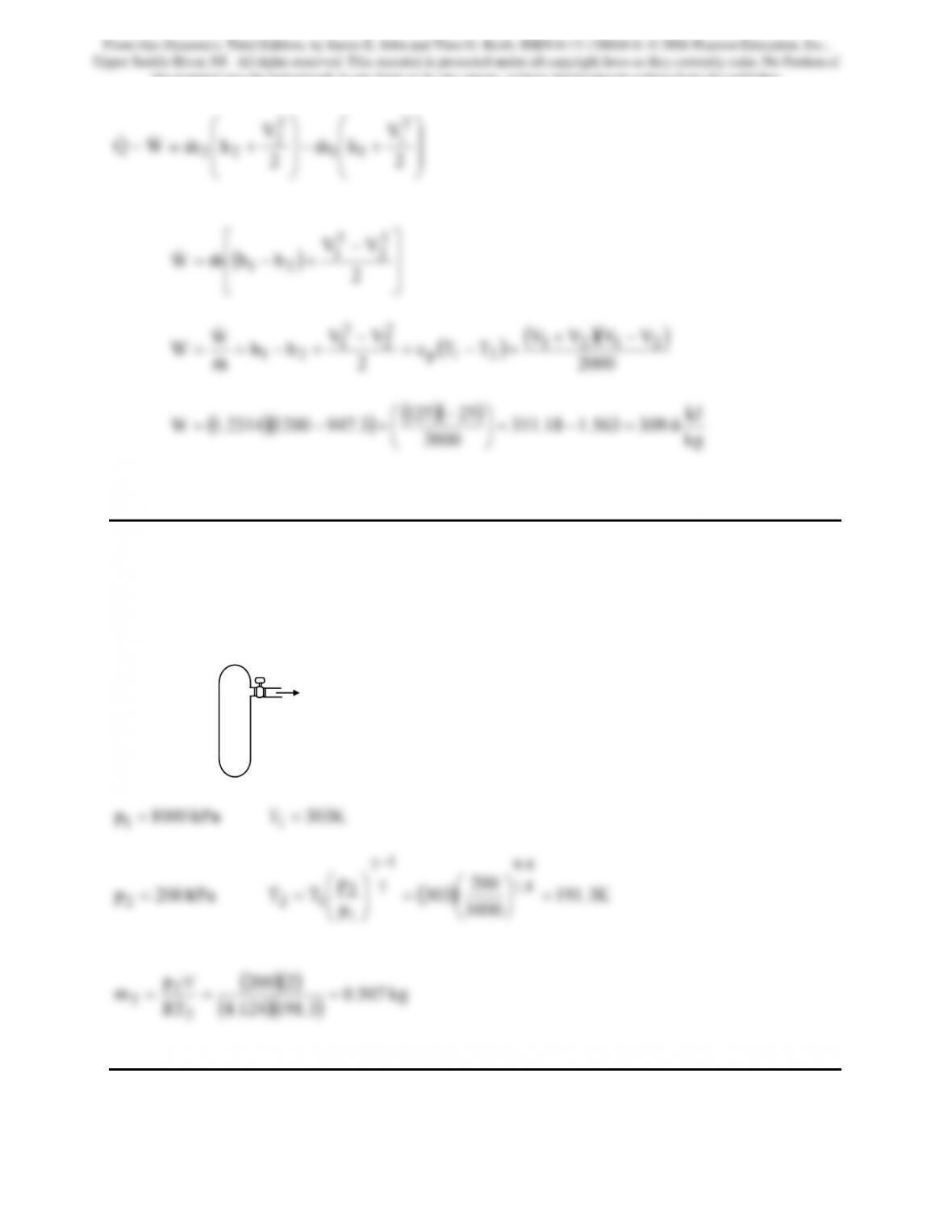
Problem 15. – Hot gases enter a jet engine turbine with a velocity of 50 m/s, a temperature of
1200 K, and a pressure of 600 kPa. The gases exit the turbine at a pressure of 250 kPa and a
velocity of 75 m/s. Assume isentropic steady flow and that the hot gases behave as a perfect gas
with constant specific heats (mean molecular mass 25, γ = 1.37). Find the turbine power output
in kJ/(kg of mass flowing through the turbine).
From Gas Dynamics, Third Edition, by James E. John and Theo G. Keith. ISBN 0-13-120668-0. © 2006 Pearson Education, Inc.,
Upper Saddle River, NJ. All rights reserved. This material is protected under all copyright laws as they currently exist. No Portion of
this material may be reproduced, in any form or by any means, without permission in writing from the publisher.
13
⎟
⎞
⎜
⎛+−
⎟
⎞
⎜
⎛+=− 2
V
hm
V
hmWQ
2
1
11
2
2
22 &&
&
&
kg
2000
⎠
⎝
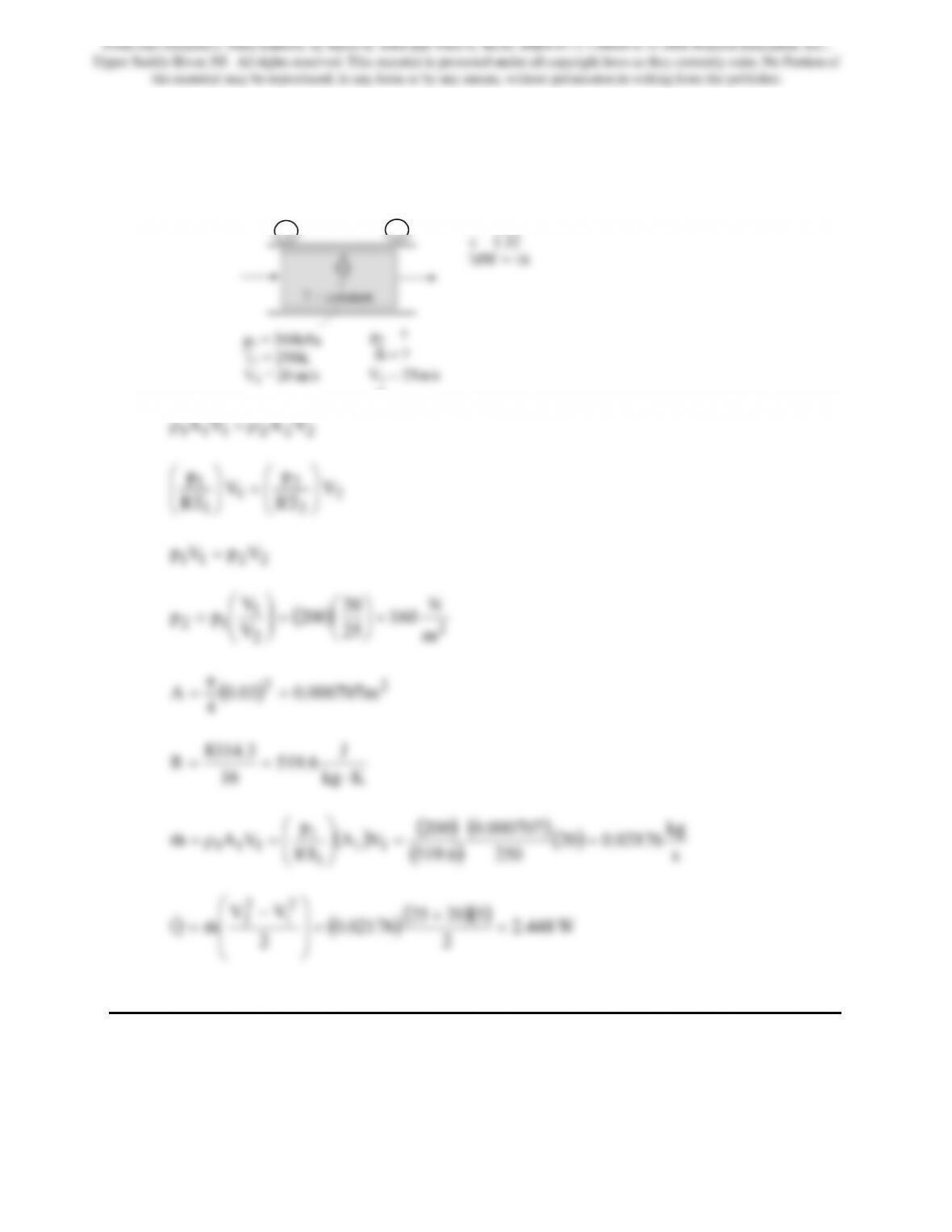
Problem 16. – Hydrogen is stored in a tank at 1000 kPa and 30°C. A valve is opened, which
vents the hydrogen and allows the pressure in the tank to fall to 200 kPa. Assuming that the
hydrogen that remains in the tank has undergone an isentropic process, determine the amount of
hydrogen left in the tank. Assume hydrogen is a perfect gas with constant specific heats; the ratio
of specific heats is 1.4, and the gas constant is 4.124 kJ/kg · K. The tank volume is 2.0m3.
From Gas Dynamics, Third Edition, by James E. John and Theo G. Keith. ISBN 0-13-120668-0. © 2006 Pearson Education, Inc.,
Upper Saddle River, NJ. All rights reserved. This material is protected under all copyright laws as they currently exist. No Portion of
this material may be reproduced, in any form or by any means, without permission in writing from the publisher.
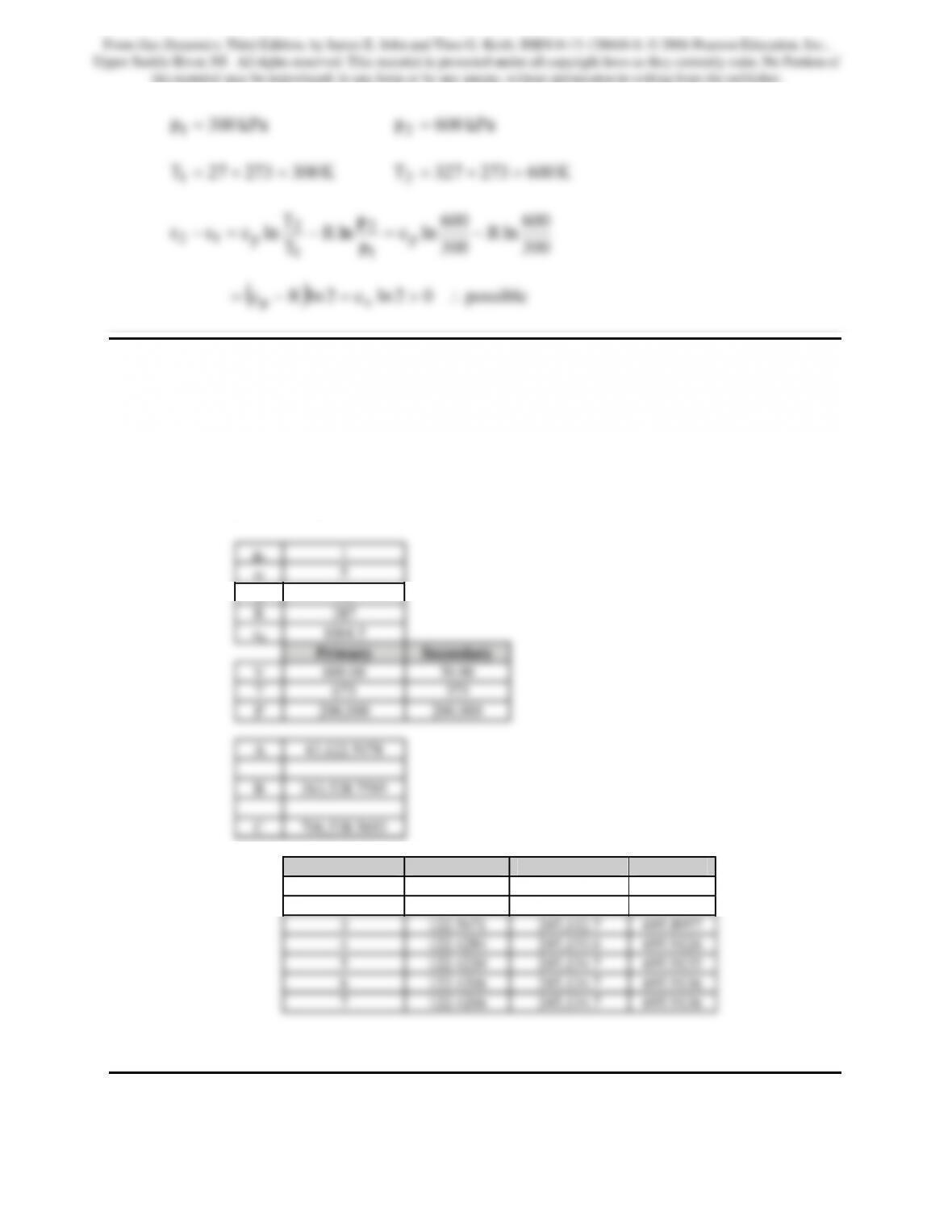
Problem 17. – Methane enters a constant-diameter, 3 cm duct at a pressure of 200 kPa, a
temperature of 250 K, and a velocity of 20 m/s. At the duct exit, the velocity reaches 25 m/s. For
isothermal steady flow in the duct, determine the exit pressure, mass flow rate, and rate at which
heat is added to the methane. Assume methane behaves as a perfect gas; the ratio of specific
heats is 1.32 (constant) and the mean molecular mass is 16.0.
d = 3cm
From Gas Dynamics, Third Edition, by James E. John and Theo G. Keith. ISBN 0-13-120668-0. © 2006 Pearson Education, Inc.,
Upper Saddle River, NJ. All rights reserved. This material is protected under all copyright laws as they currently exist. No Portion of
this material may be reproduced, in any form or by any means, without permission in writing from the publisher.
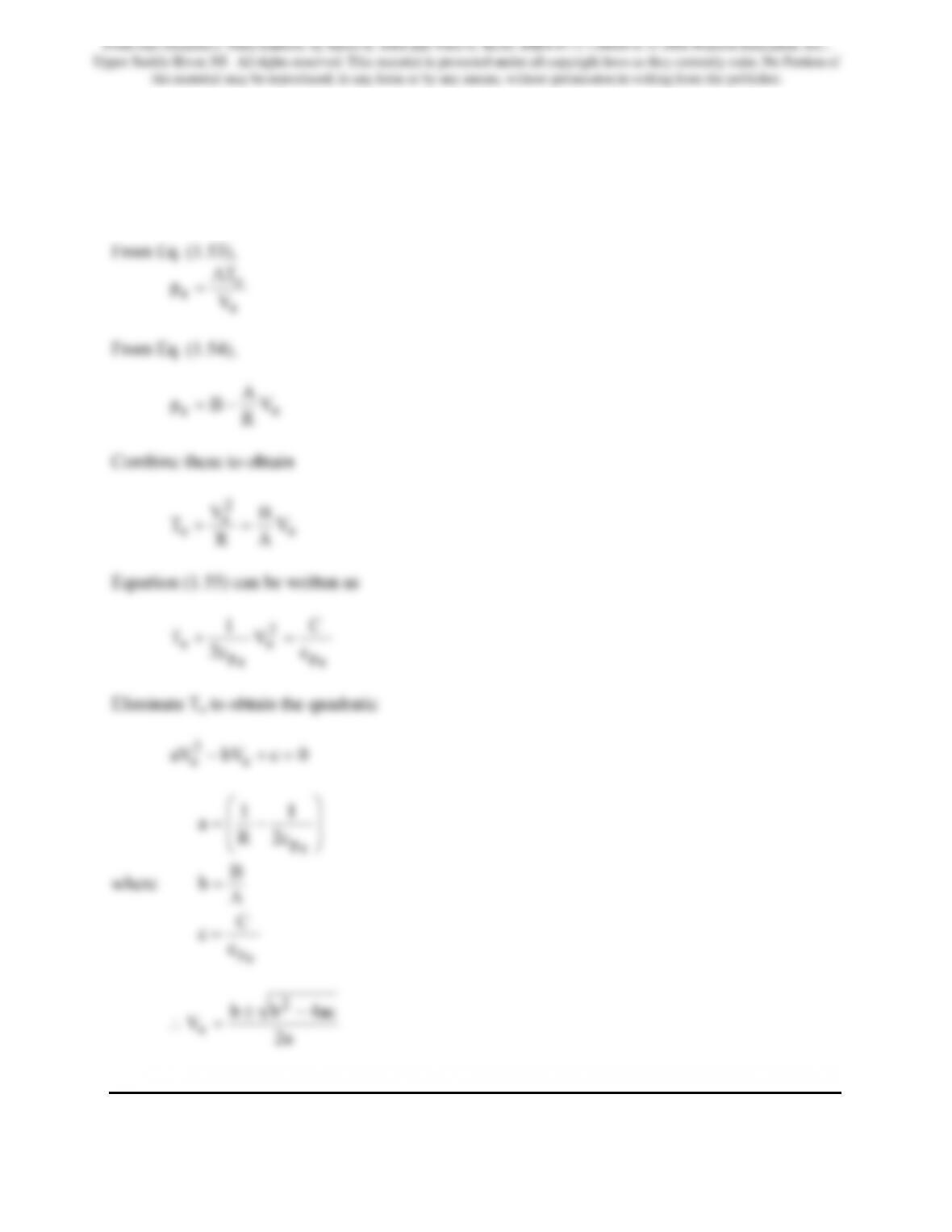
Problem 19. – Two streams of air mix in a constant-area mixing tube of a jet ejector. The
primary jet enters the tube with a speed of 600 m/s, a pressure of 200 kPa and a temperature of
400˚C. The secondary stream enters with a velocity of 30 m/s, a pressure of 200 kPa and a
temperature of 100˚C. The ratio of the area of the secondary flow to the primary jet is 5:1. The
air behaves as a perfect gas with constant specific heats, cp = 1.0045 kJ/kg· K. Using the iterative
numerical procedure described in Example 1.9 determine the velocity, pressure and temperature
of the air leaving the mixing tube.
γ 1.4
n Ve (m/s) Pe (Pa) Te (K)
1 0.0000 101,000.0 293.1500
2 125.1620 244,722.8 695.5757
From Gas Dynamics, Third Edition, by James E. John and Theo G. Keith. ISBN 0-13-120668-0. © 2006 Pearson Education, Inc.,
Upper Saddle River, NJ. All rights reserved. This material is protected under all copyright laws as they currently exist. No Portion of
this material may be reproduced, in any form or by any means, without permission in writing from the publisher.
16
Problem 20. – The flow exiting a jet ejector was determined by utilizing an iterative numerical
procedure. A more direct approach is possible however. Eliminate pressure Pe between Eqs.
(1.53) and (1.54). Solve for the temperature Te in the resulting expression, and equate it to Eq.
(1.55). This produces a quadratic equation for the velocity Ve. Solve the quadratic to determine
Vm for the same set of conditions given in Example 1.9.
From Gas Dynamics, Third Edition, by James E. John and Theo G. Keith. ISBN 0-13-120668-0. © 2006 Pearson Education, Inc.,
Upper Saddle River, NJ. All rights reserved. This material is protected under all copyright laws as they currently exist. No Portion of
this material may be reproduced, in any form or by any means, without permission in writing from the publisher.