Solution Manual Chapter 16: Bioengineering
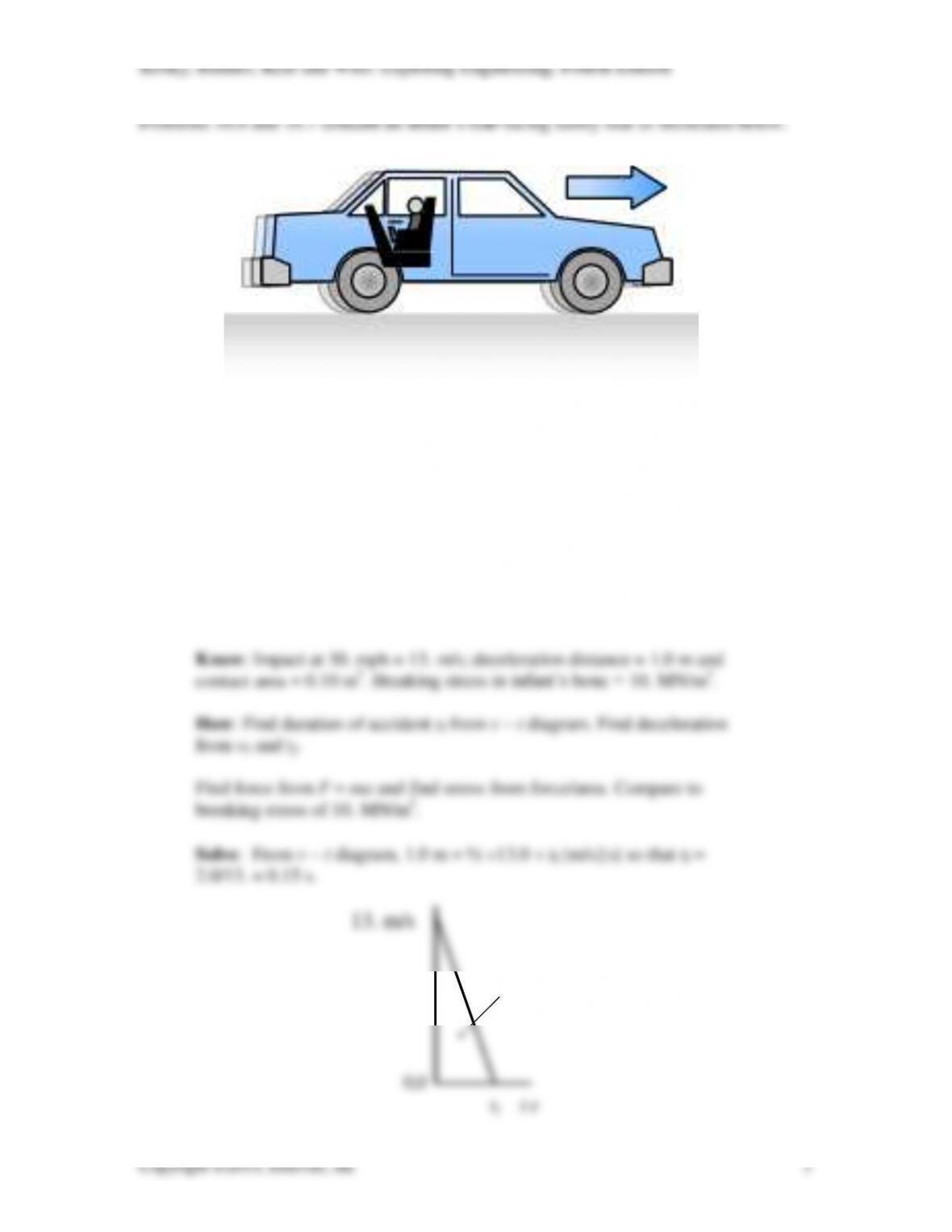
Problems 1 and 2 concern the following situation: A car is traveling 30. mph hits a wall.
The car has a crumple zone of zero and the passenger is not wearing a seat belt. The
passenger’s head hits the windshield, and is stopped in the distance of 0.10 m. The skull
mass is 5.0 kg. The area of contact of the head and the windshield is 0.010 m2. Assume
direct contact (that is, ignore whiplash) and ignore the time it takes the passenger to reach
the windshield.
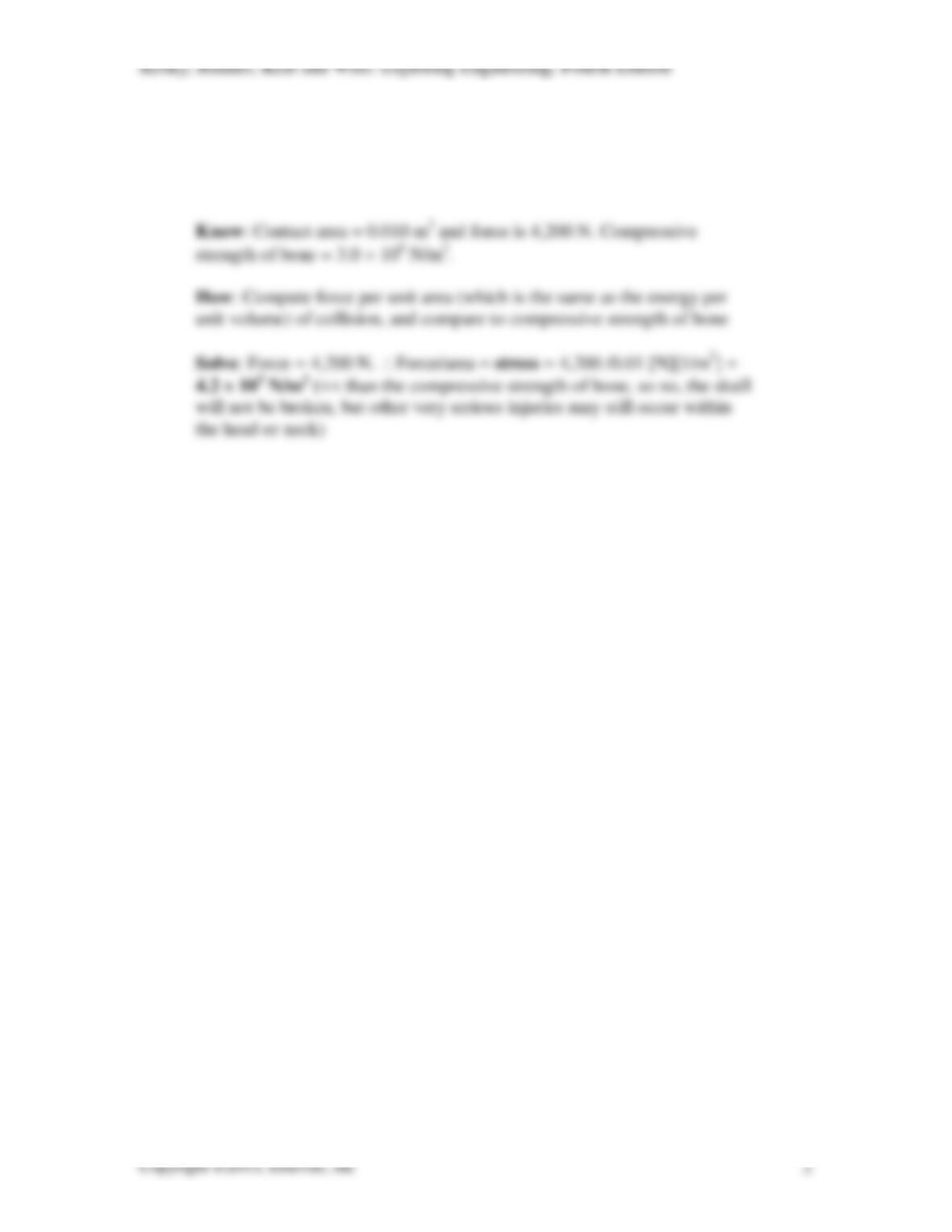
16-1) Provide a graph of v – t graph of the collision of the skull and the windshield, and
then graph the force experienced by the skull as a function of time.
Need: v – t graph of the collision and F = _____ N (as fn. of time)
Know: v = 30. mph = 13. m/s; Ds = 0.10 m and A(contact) = 0.010 m2.
Skull mass = 5.0 kg.
16-2) If the compressive strength of bone is 3.0 106 N/m2, will the collision in the
previous exercise break the skull?
Need: Max allowable stress on skull exceeded = _____ (yes/no)
Copyright ©2015, Elsevier, Inc
3
Problems 3 and 4 concern an experiment in the 1950s when Air Force Colonel John
Paul Stapp volunteered to ride a rocket sled to test the resistance of the human body to “g
forces”. The sled accelerated from 0 to 625 miles per hour in 5.0 seconds. Then the sled
hit a water brake and decelerated in 3.0 seconds to a standstill. Assume that Stapp was
rigidly strapped into the sled, and he had a mass of 75 kg.
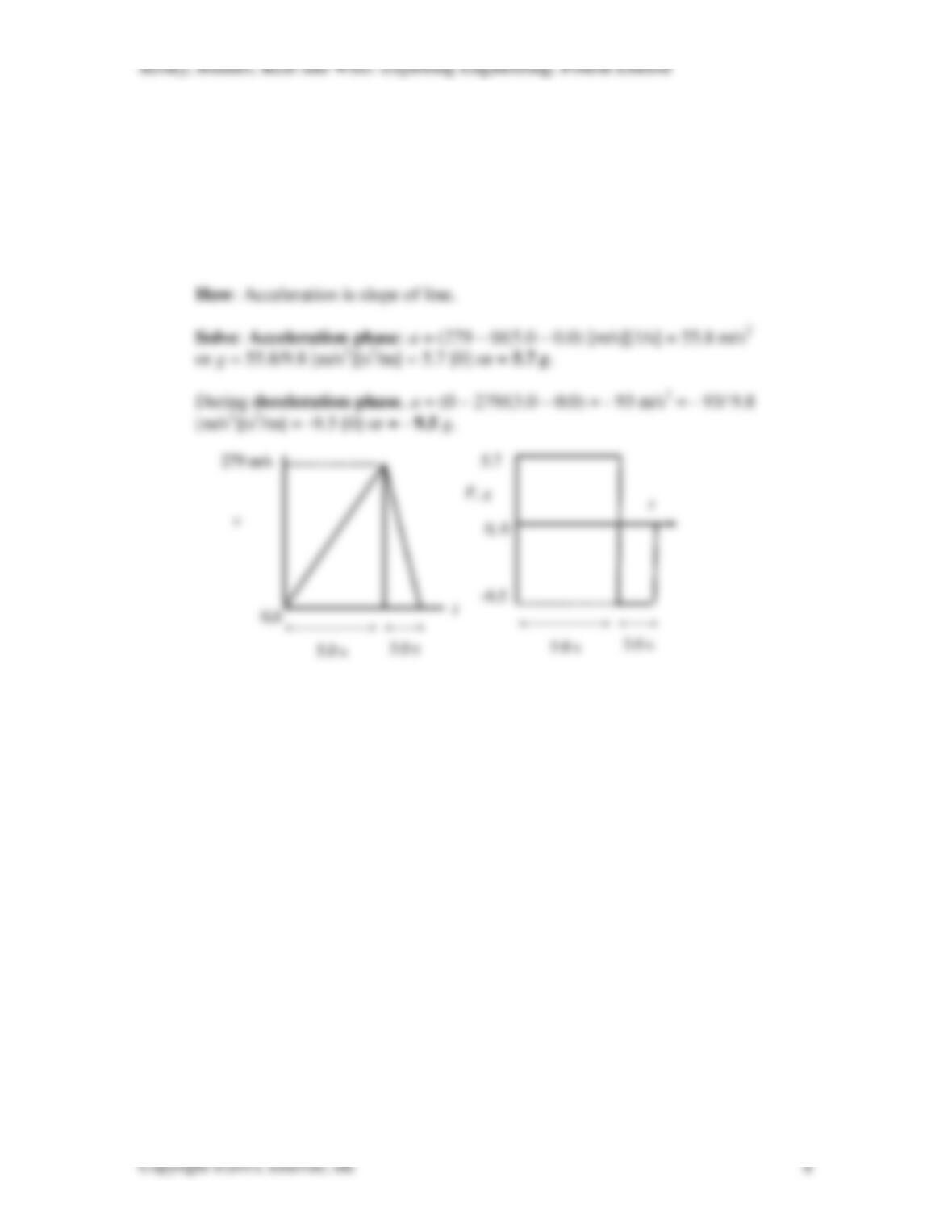
16-3) Prepare v – vs.- t and F – vs.- t graphs of Stapp’s trip, and compute the “g forces”
he experienced in the course of acceleration and deceleration.
Need: v – vs.- t and F – vs.- t graphs and g = ____ [0].
Know: vmax = 625 mph = 279 m/s. Constant acceleration for 5.0 s and
constant deceleration for 3.0 s.
Kosky, Balmer, Keat and Wise: Exploring Engineering, Fourth Edition
16-4) Using the force vs. time graph (Figure 16.6) for human resistance to “g forces”,
predict whether Stapp suffered serious injury in the course of his record-breaking trip in
the worse case.
Need: Was Stapp’s maximum g force that was experienced for a duration
of 3.0 second in the “serious injury or death” region = ______ yes/no?)
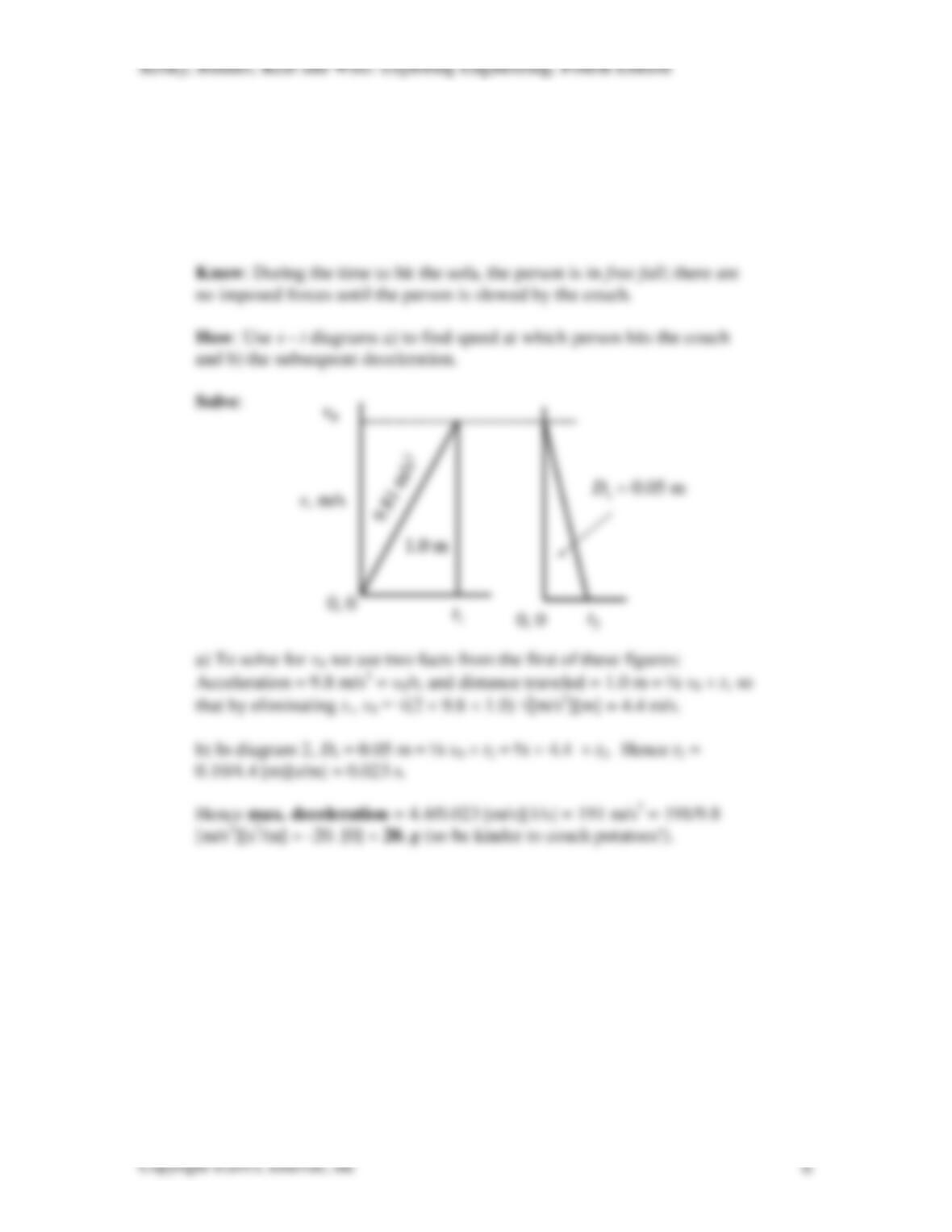
16-5) A tall person sits down onto a sofa to watch TV. Assume that the center of gravity
of the person falls 1.0 m with constant gravitational acceleration in the course of sitting
down. The sofa compresses by 0 .05 m. Assume constant deceleration. Determine the g
forces experienced by the person in the course of this sitting down.
Need: g forces on a tall couch potato = ____ g
Copyright ©2015, Elsevier, Inc
7
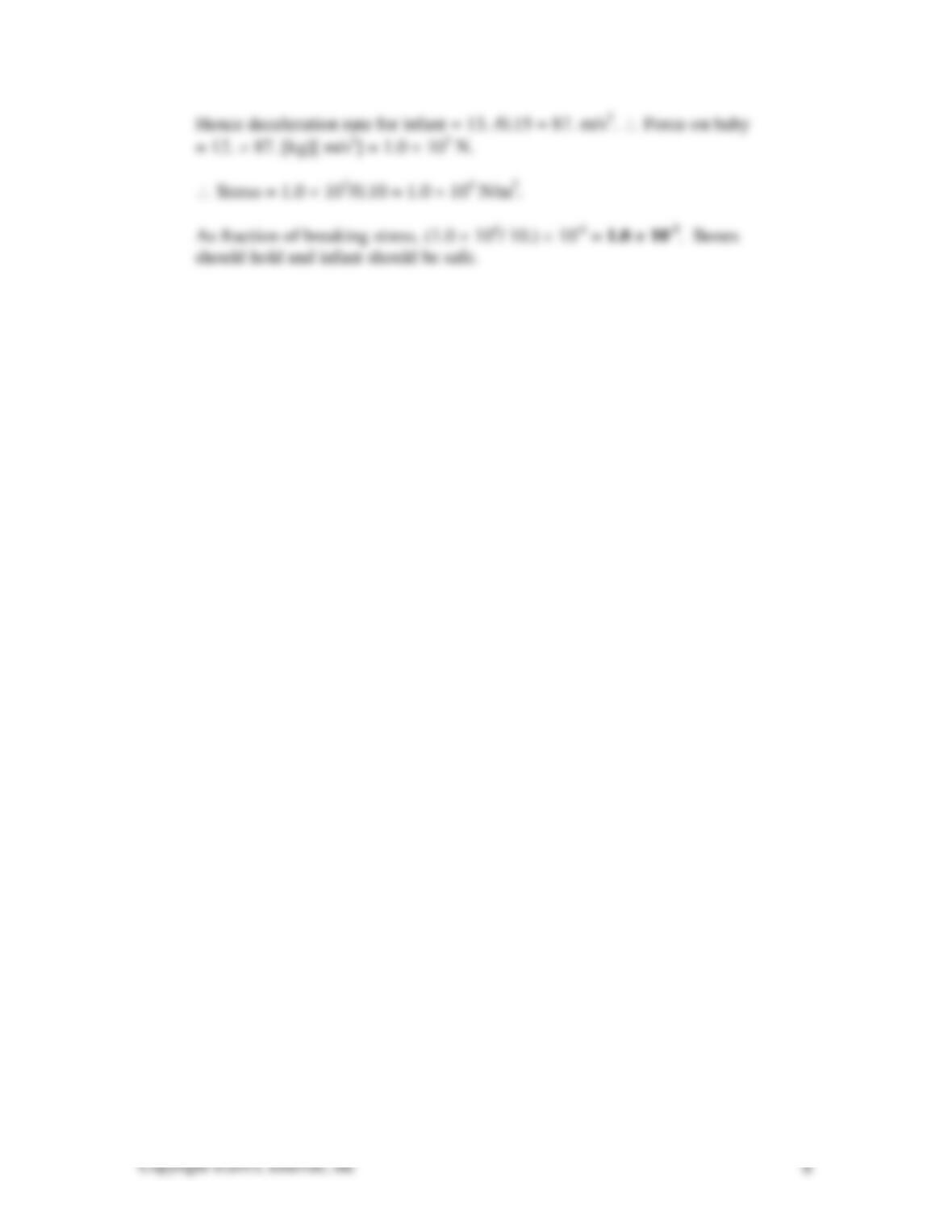
Problems 16.6 and 16.7 concern an infant’s rear–facing safety seat as illustrated below.
16-6) A ear facing child safety seat holds a child of mass 12. kg rigidly within the interior
of a car. The area of contact between the seat and the child is 0.10 m2. The car undergoes
a 30. mph collision. The car’s crumple zone causes the distance traveled by the rigid
interior to be 1.0 m. Give the stress experienced by the child’s body in terms of a fraction
of the breaking strength of bone assuming an infant’s bone breaks at a stress of 10.
MN/m2.
Need: Stress experienced by child’s body = ____ compared to breaking
stress of bone.
0,0
v
tft s
1.0 m
0,0
v
tft s
1.0 m
Kosky, Balmer, Keat and Wise: Exploring Engineering, Fourth Edition
Copyright ©2015, Elsevier, Inc
8
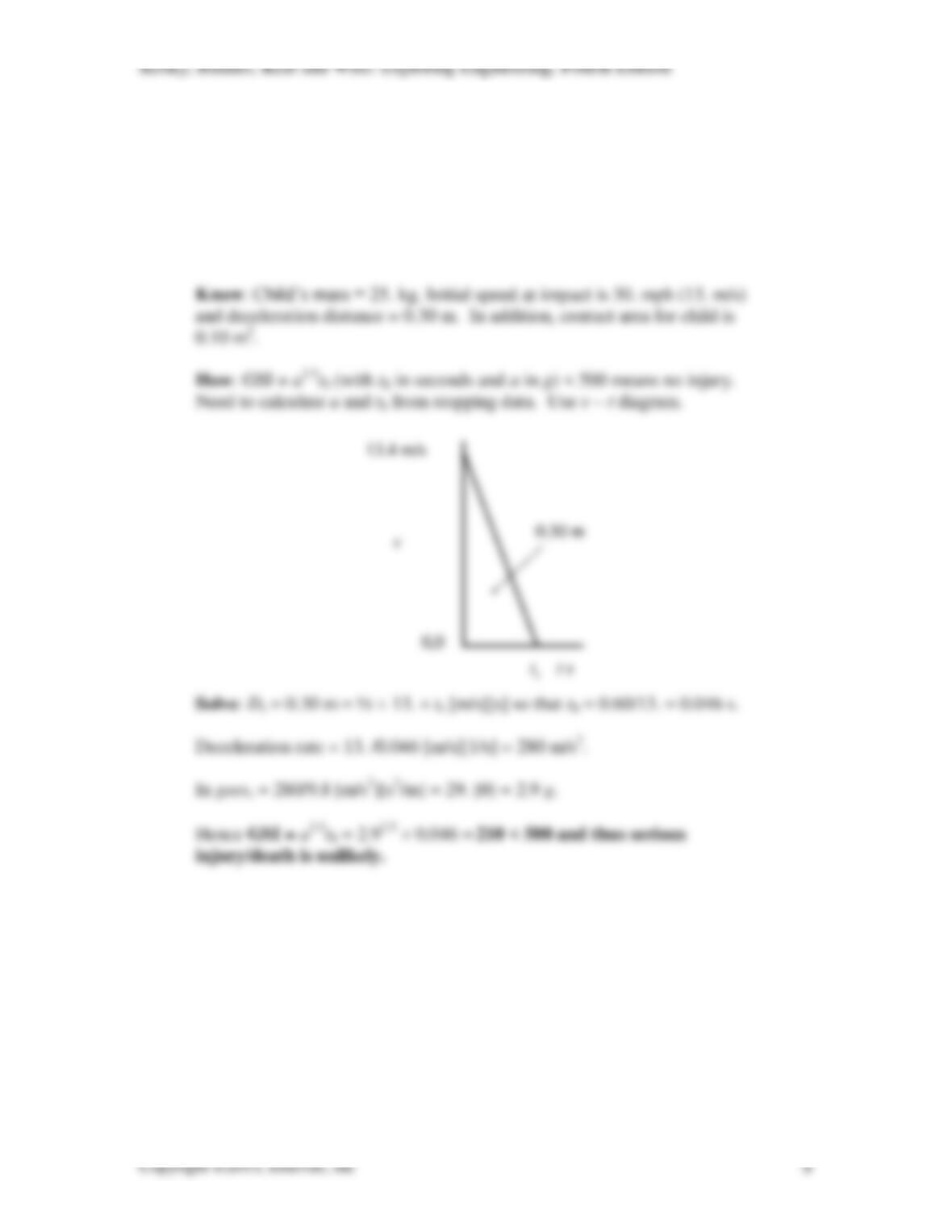
16-7) A rear facing child safety seat holds a child of mass 25. kg rigidly within the rigid
interior of a car. The area of contact between the seat and the child is 0.10 m2. The car
undergoes a 30. mph collision. The car has no crumple zone, but a harness attached to the
car seat stops it uniformly within a distance of 0.30 m. According to the Gadd severity
index, will the child sustain serious injury or death?
Need: Child ___ (will/will not) suffer serious injury or death.
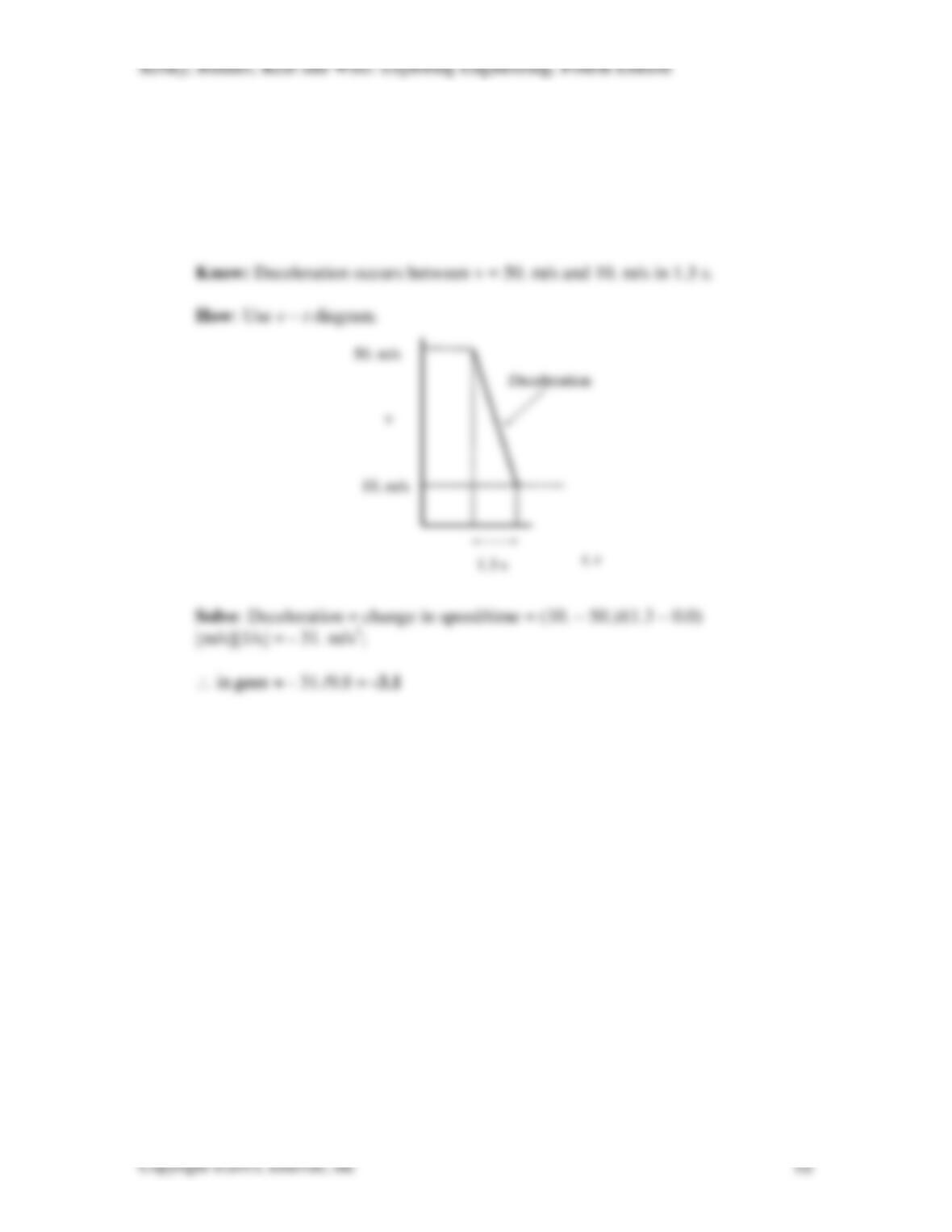
16-8) Consider a parachute as a safety device. When parachute opens the previously
freely falling person has typically reached a speed of about 50. m/s. The parachute slows
to a terminal speed of about 10. m/s in 1.3 s. Approximating this set of motions by a
constant deceleration, what is the maximum g experienced by the parachutist?
Need: maximum acceleration = ___ g
16-9) In the previous problem, the force exerted by the parachute is spread by a harness
in contact with 0.50 m2 of the parachutist, and the parachutist has a mass of 75. kg, what
is the force per unit area (stress) experienced by the person during the deceleration?
Need: Stress = ____ N/m2
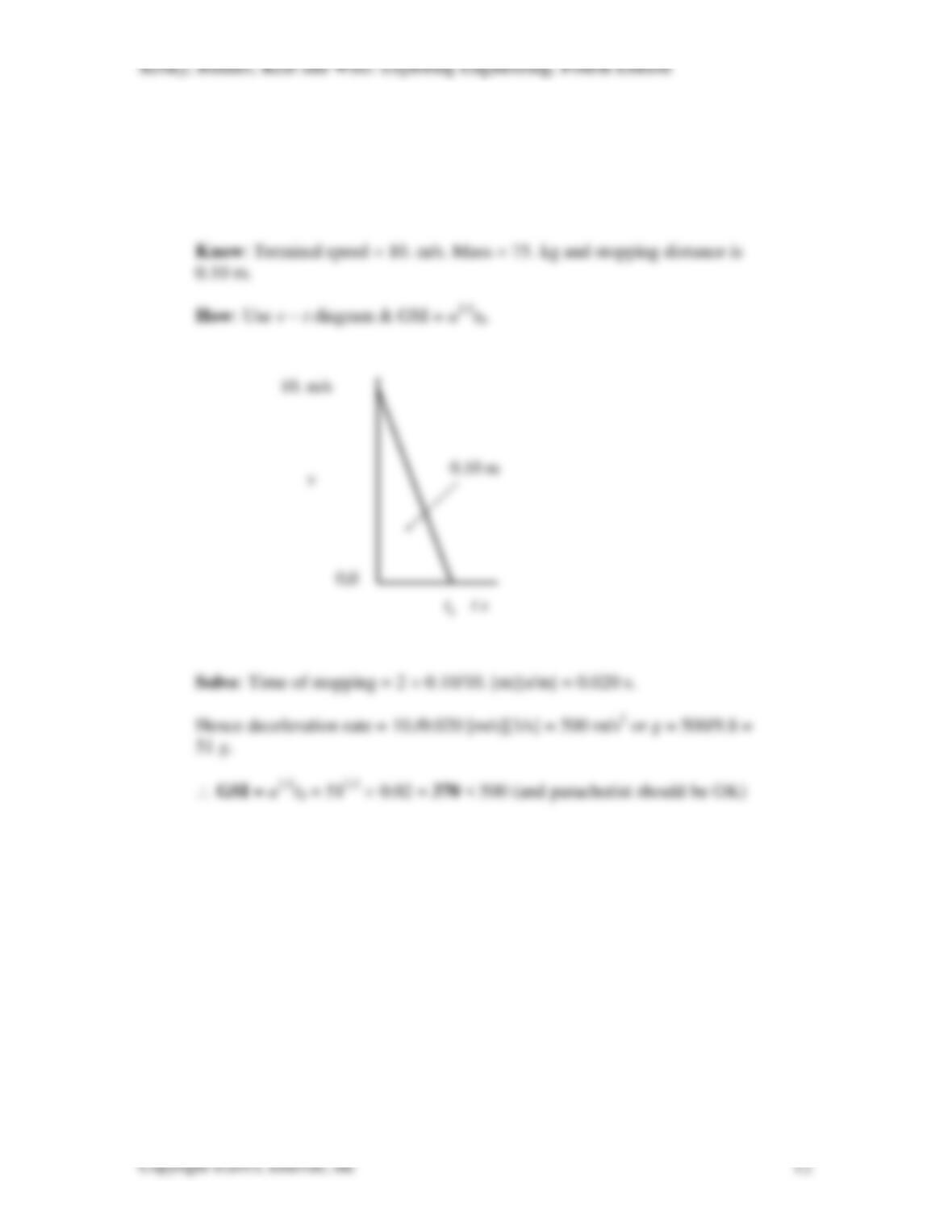
16-10) The parachutist in the previous two exercises hits the ground (still wearing the
parachute!) and is stopped in a distance of 0.10 m. If this final deceleration is constant,
calculate the Gadd Severity Impact of the landing.
Need: GSI = ____ (a number)
Copyright ©2015, Elsevier, Inc
13
16-11) A 75. kg person jumping from a 1.00 103 m cliff will reach a terminal speed of
50. m/s and uses a 1.00 102 m bungee cord to slow the descent. The bungee cord exerts
a force F proportional to its extension, where F (in newtons) = (5.0 N/m) (extension in
m) and is designed to extend by 5.00 101 m in the course of bringing the user to a stop
just above the ground. Is the maximum deceleration in g experienced by the falling
person more or less than the maximum deceleration experienced by a parachutist
undertaking the same leap (excluding landing forces)?
Need: Maximum deceleration for bungee is ____ (greater/equal/less) than
for parachute.
from 50. to 10. m/s (Exercise 16-10). The parachutist’s maximum g = 3.1
Kosky, Balmer, Keat and Wise: Exploring Engineering, Fourth Edition
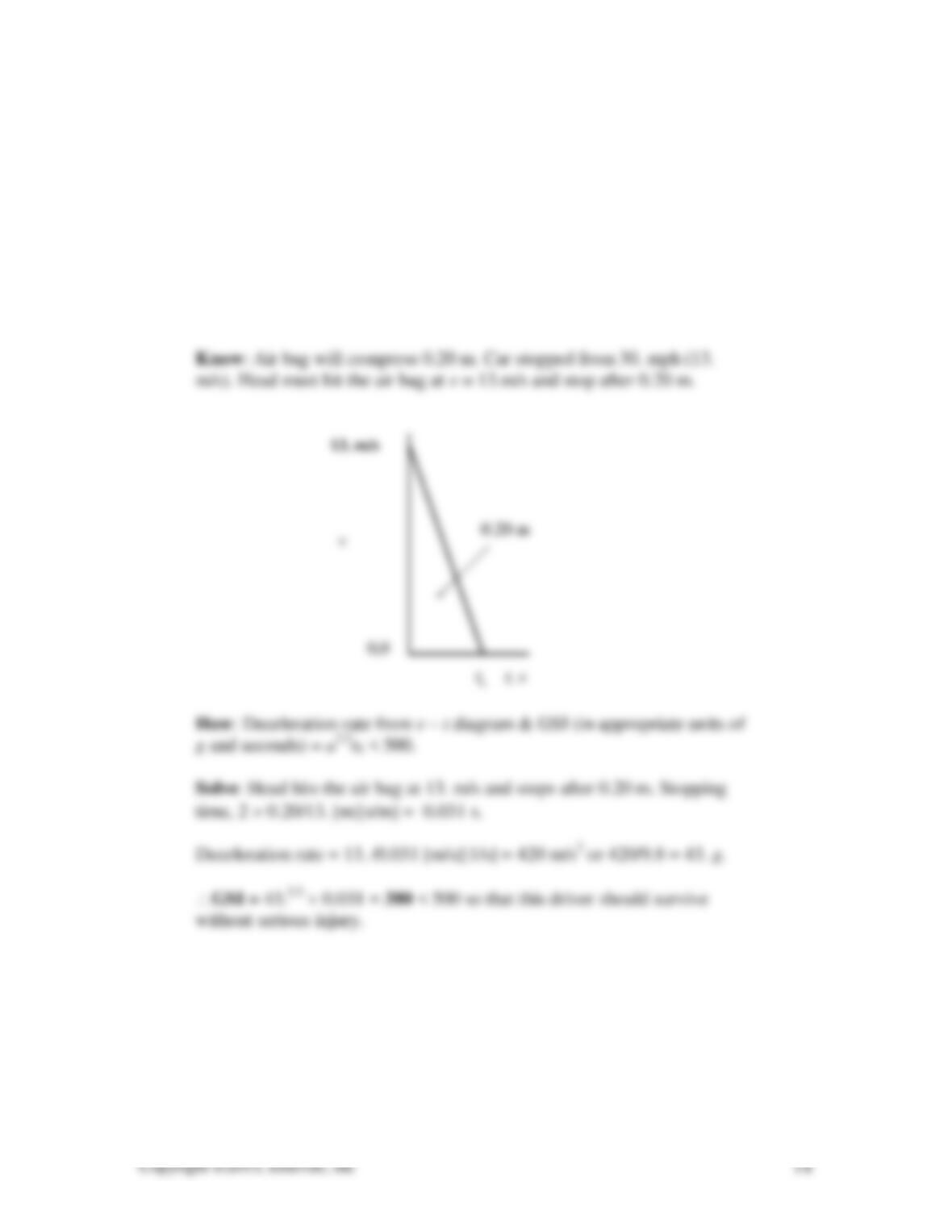
16-12) An airbag is designed to inflate very quickly and to subsequently yield if the
driver hits it. A collision uniformly stops a car from 30. mph to 0.0 and then triggers the
air bag. The driver is not seat belted and so hits the inflated airbag. This acts as a local
“crumple zone” and consequently compresses by 0.20 meters as his head is brought to
rest.
According to the Gadd Severity Index, will the driver suffer serious injury? Assume
constant deceleration of the driver’s head after hitting the air bag.
Need: Driver ____ (will/will not) suffer serious injury.