CHAPTER 8.
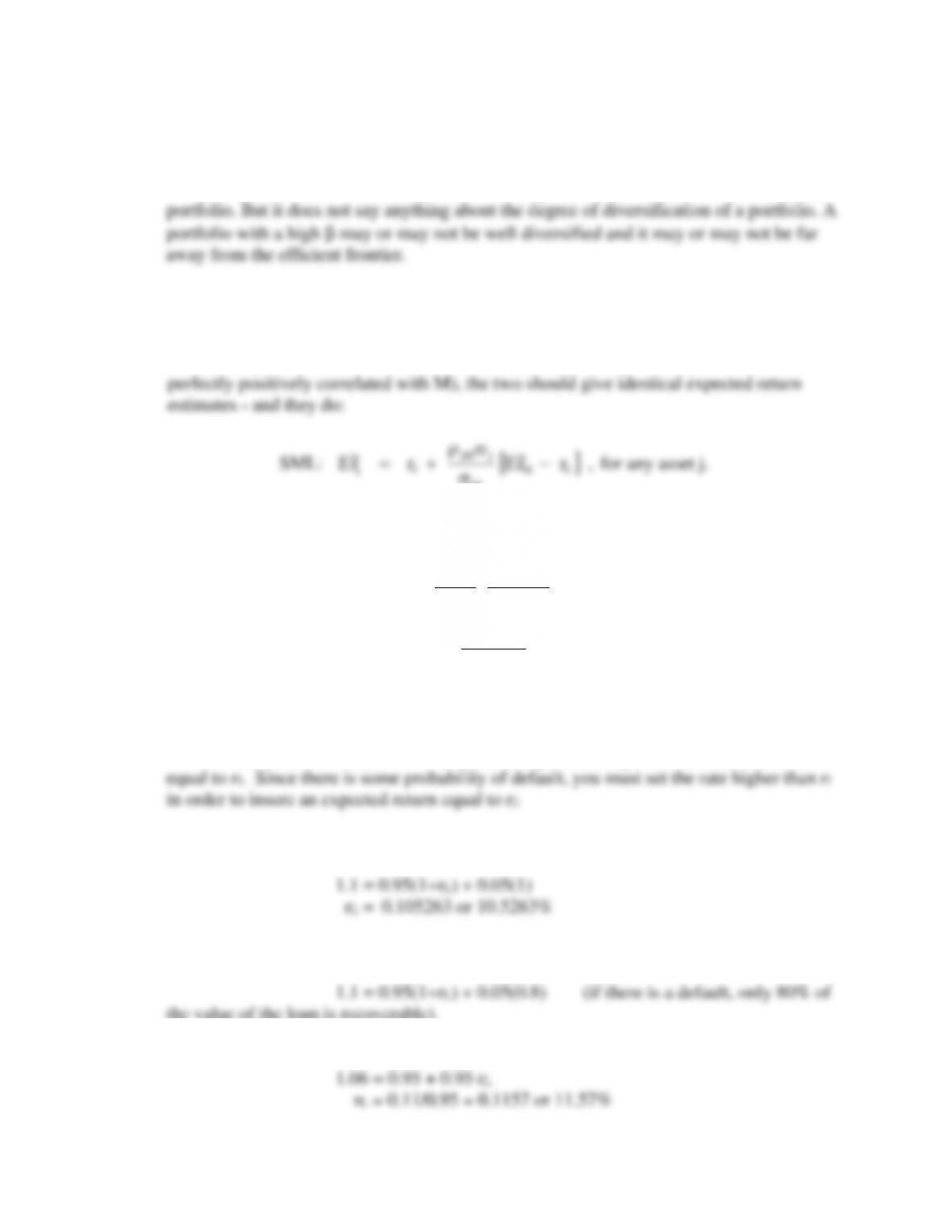
8.1 A high does not say anything about the level of diversification. The speaks about the
co-variations between the returns on an asset or a portfolio and the returns on the market
8.2 The CML describes the risk/return tradeoff for efficient portfolios, while the SML
describes the same tradeoff for arbitrary assets (that are in “M”).
For arbitrary assets that have the same statistical characteristics as M (i.e. that are
M
fj
If “j” is perfectly positively correlated with M,
j
r
~
E
= rf +
Mf
Mj
MM
Er r
= rf +
M
fM
j
rEr
, which is the equation of the capital
market line for an efficient portfolio “j”.
8.3 a. No! It is incorrect. The CAPM tells you to equate the expected return on the loan
b. Let rL = rate on the loans. You want
c. Again, let rL = the rate on the loans:
the value of the loan is recoverable).
1.1 = 0.95(1+rL) + 0.04

8.4. Write the SML equation to make the market risk premium appear, then multiply by
M
M
,
2
M
MjM
M
fM
f
2
M
jM
fMfjfMfj
rrE
r
rrErrrErrE
.
Rewrite the last term
jMj
2
M
MjMMj
2
M
MjM
.
Then we get
jMj
M
fM
fj
rrE
rrE
and the conclusion follows since
10 jM
.
8.5. Intuitively, the CML in the ‘more risk averse economy’ should be steeper, in view of its
risk/return trade-off interpretation. This is true in particular because one would expect the risk
free rate to be lower, as the demand for the risk free asset should be higher, and the return on the
optimal risky portfolio to be higher, as the more risk averse investors require a higher
8.6 The frontier of the economy where asset returns are more correlated and where diversification
opportunities are thus lower is contained inside the efficient frontier of the economy where assets
are less correlated. If the risk free rate was constant, this would guarantee that the slope of the
8.7 If investors hold homogeneous expectations concerning asset returns, mean returns on risky
assets -per dollar invested- will be the same. Otherwise they would face different efficient
8.8. Using standard notations and applying the formulas, we get
A = 3.77, B = 5.87, C = 5.85, D = 1.31
471.0
059.0
529.1
g
382.0
235.0
618.0
h
42.1rE MVP
072.0
275.0
652.0
wMVP
3
ZCP
E r 1.3028
028.0
248.0
725.0
w3
ZCP
8.9 a. The agent’s problem is (agent i):
j j j
i
jf
i
j
i
0i
)x,…,x,x( )r
~
1(x)r1)(xY(UEmax i
J
i
2
i
1
)r
~
,Y
~
cov(
)Y
~
(UE
)Y
~
(UE
)rr
~
(E ji
i
‘
i
i
‘‘
i
fj
)Y
~
(UE
i
‘‘
i
R
1
A
fj
i
)r
~
,Y
~
cov()rr
~
(E
R
1
jifj
Ai
,
J
1j jMj
I
1i A
MO
J
1j fjj r
~
,r
~
covw
R
1
Y
)rr
~
(Ew
i
.
It follows that
J
1j jjM
I
1i A
MO
J
1j fjj r
~
w,r
~
cov
R
1
Y
rr
~
wE
i
By construction,
M
J
1j jj r
~
r
~
w
.
Then
MM
I
1i A
MO
fM r
~
,r
~
cov
R
1
Y
rr
~
E
i
M
I
1i A
MO
fM r
~
var
R
1
Y
rr
~
E
i
. (5)
f. (4) states that
jM
I
1i A
MO
fj r
~
,r
~
cov
R
1
Y
)rr
~
(E
i
i
MO Mf
IM
i1 A
YE(r r )
var(r )
1
R
%
%
)rr
~
(E
)r
~
var(
r
~
,r
~
cov
)rr
~
(E fM
M
jM
fj
, the traditional CAPM.
8.10. A ray in
2
R
is defined by
)xx(nyy 11
. Rewrite this in the following way
11 y)xx(ny
and apply it to the problem:
fP
P
fP
Pr0
rrE
rE
.
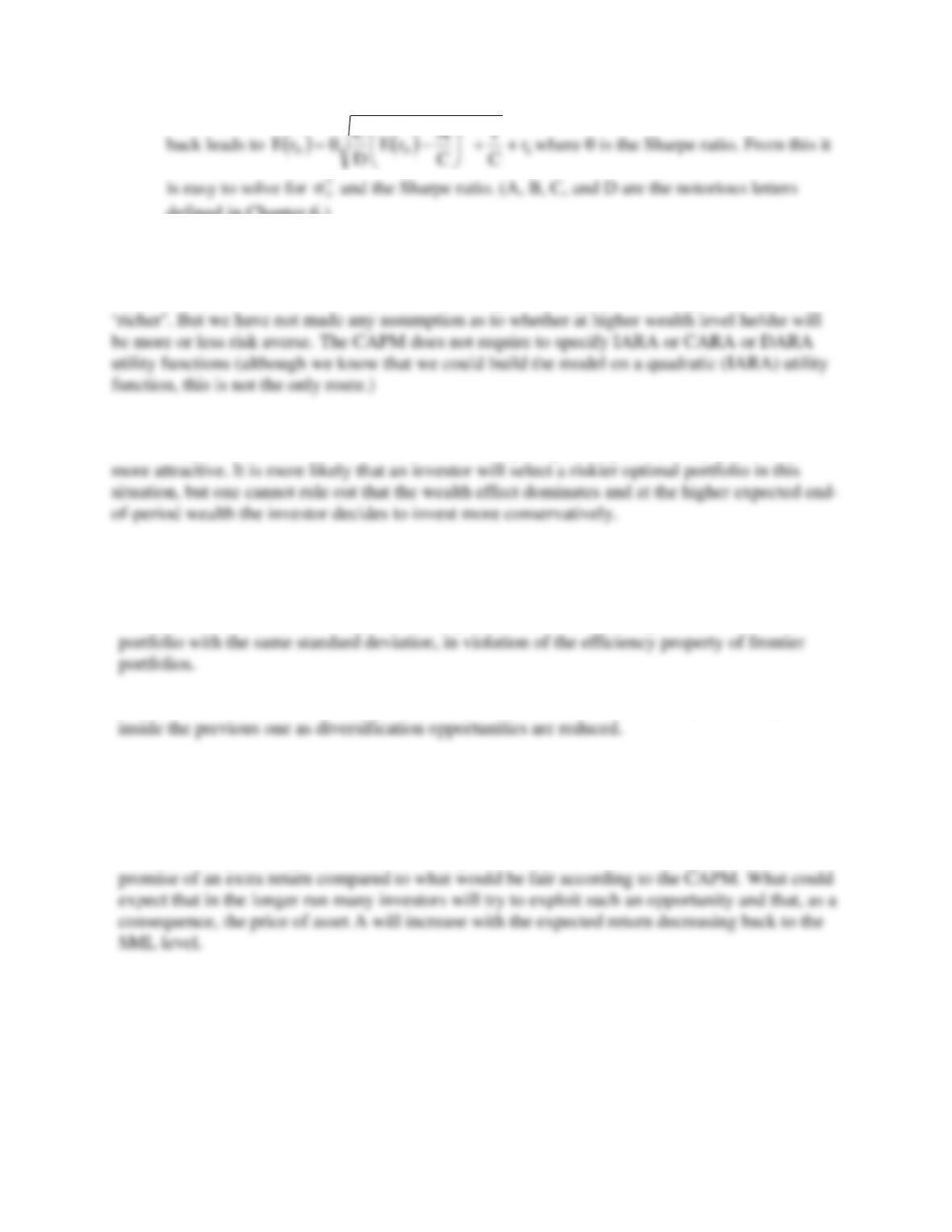
This can be maximized with respect to the Sharpe ratio. Of course, we get
0
P
; i.e. the
C
1
C
A
D
C
2
PP
2
1
A
C
P
defined in Chapter 6.)
8.11 1) Not possible to say without further knowledge of preferences. The reason is that with both
risk-free and risky returns higher, there is what is called a ‘wealth effect’: with given amount of
initial wealth to invest, the end-of-period is unambiguously expected to be higher: the investor is
2) Here it is even more complicated; the efficient frontier is higher: there is a wealth effect, but it
is also steeper: there is also a substitution effect. Everything else equal, the risky portfolio is
8.12. Questions about the Markowitz model and the CAPM.
a) If it were not, one could build a portfolio composed of two efficient portfolios that would not
be itself efficient. Yet, the new portfolio’s expected return would be higher than the frontier
b) With a lower number of risky assets, one expects that the new frontier will be contained
c) The efficient frontier is made of three parts, including a portion of the frontier. Note that
borrowers and lenders do not take positions in the same ”market portfolio”.
d) Asset A is a good buy: it pays on average a return that exceeds the average return justified by
its beta. If the past is a good indication of the pattern of future returns, buying asset A offers the
8.13. ”If” part has been shown in Chapter VI.
”Only if” : start with Vw=ae+b1; premultiply by V-1

C
V
bC
A
eV
aAbVeaVw11
11
P
where
A
eV 1
, and
C
V1
are frontier portfolios
with means
A
B
, and
C
A
respectively. Since aA+bC=1 (Why?) the result follows.
8.14 We build a portfolio with P and the MVP, with minimum variance. Then, the weights a and (1-a)
must satisfy the condition
2
2
22 1,cov12min MVPMVPPP
a
arraaa
.
The FOC is
012,cov2122 22 MVPMVPPP arraa
.
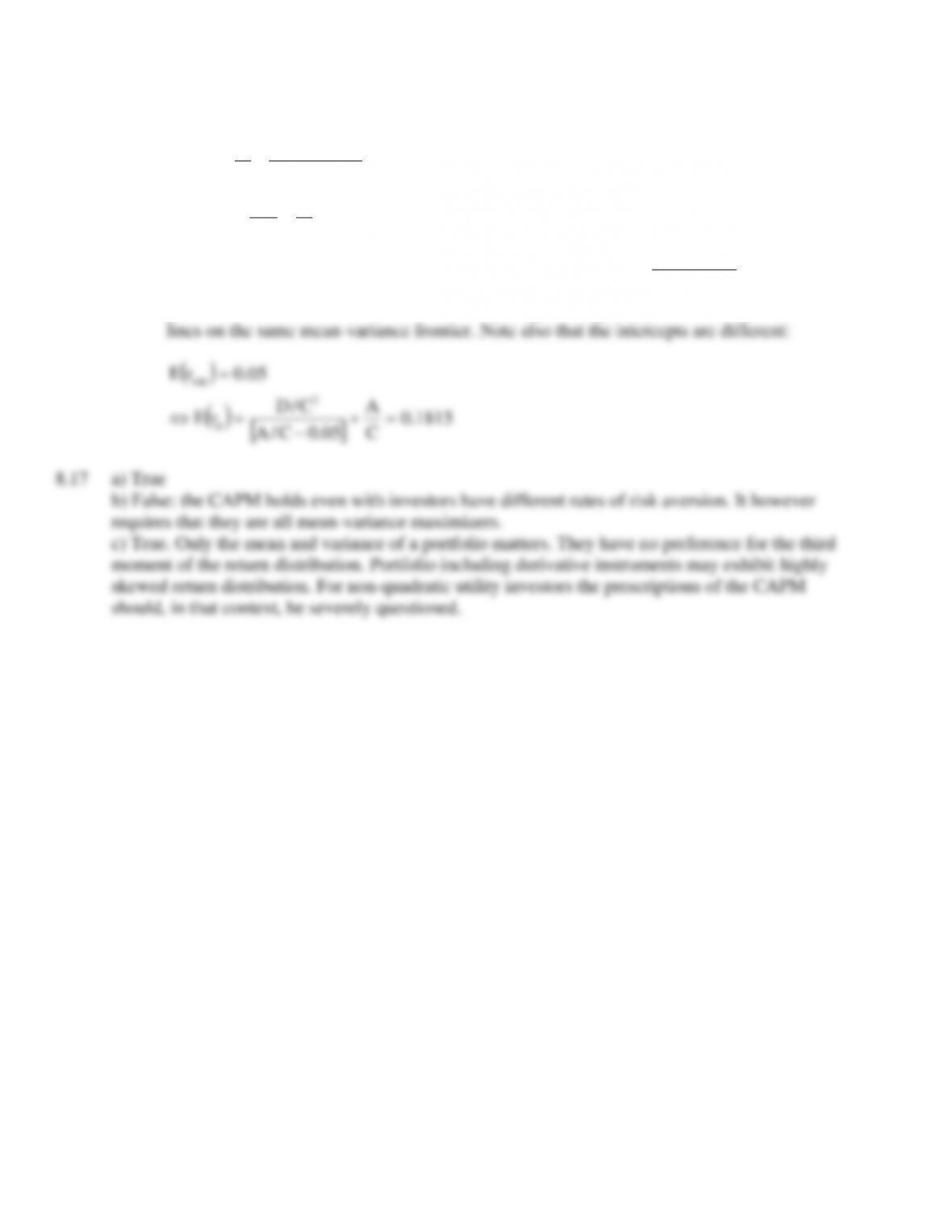
1733.0
C
A
CA
D
rE
0
C/ArE
C/D
C
A
rE
p
p
2
zcp
b) We need to compare the weights of the portfolio p with
CrA
reV
w
f
f
1
T
. The two
portfolios should differ because we are comparing the tangency points of two different