
9-13
o Lower back pain
o Arthritis
o Sinus trouble or allergies (most prevalent factor)
• Methods to resolve presenteeism involves:
o Management becoming aware (recognition and acceptance) of the existence and
consequences of presenteeism.
o Counseling employees to manage their ailments through better diagnosis and medical
treatment.
o Managers being empathetic and yet assertive enough to encourage employees to stay
away from work on occasion when necessary.
• The overall lesson is to have a reasonable goal for absenteeism rates, but not to push it to
impossibly low levels.
Theft
• Theft is the unauthorized use or removal of company resources.
o Acts of theft include such things as:
o Using company services without authorization
o Fraud
• Although employee theft has many causes, some employees may steal because they feel
exploited, overworked, or frustrated by the impersonal treatment they receive from their
organization.
o Employees may justify this unethical behavior as a way of reestablishing a perception
of lost equity or even gaining revenge for what they considered ill treatment at the
hands of a supervisor.
• Tighter organizational controls or incentive systems do not always solve theft problems.
o They are directed at the symptoms rather than the underlying causes, such as severe
dissatisfaction.
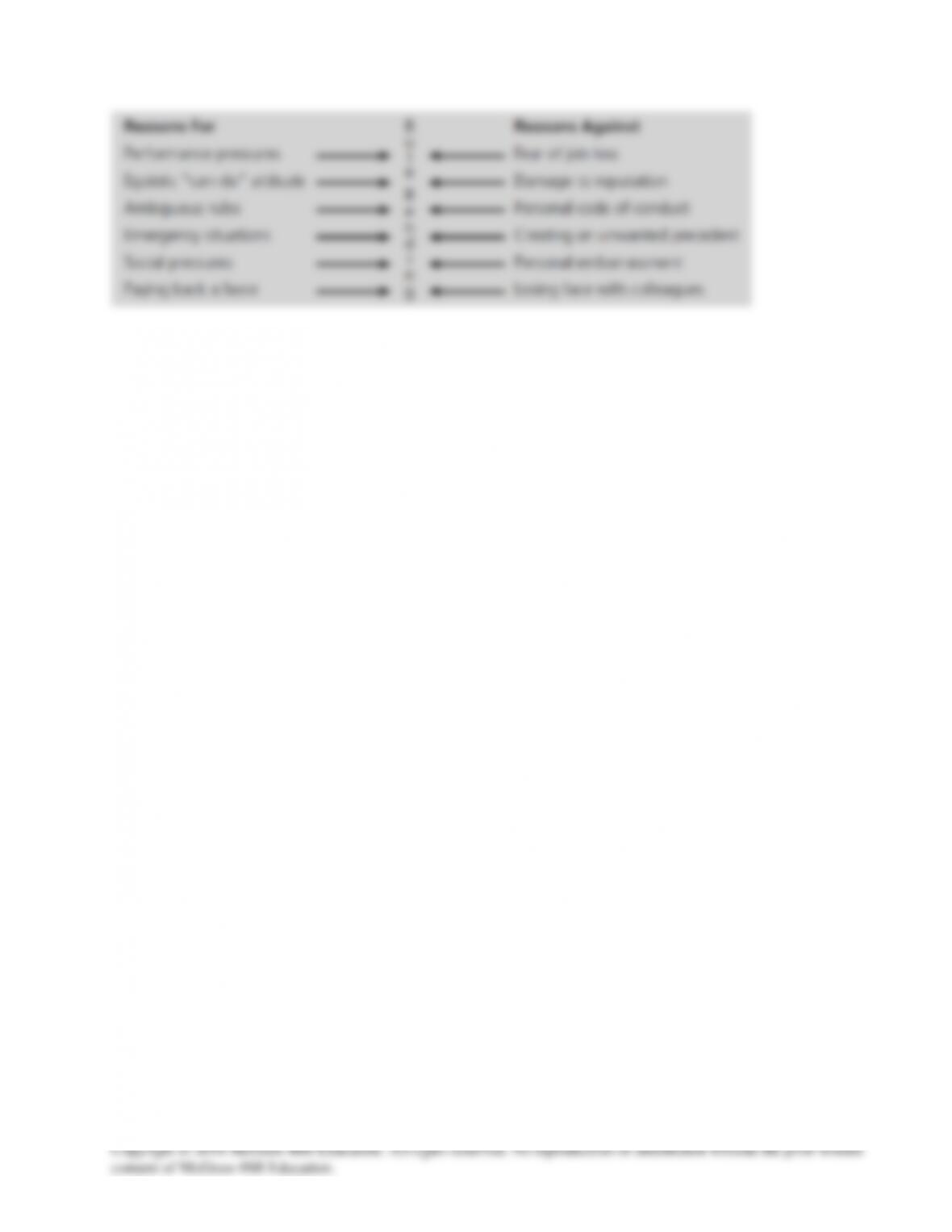
• Employee theft is part of a much broader ethical problem in organizations that involves rule-
bending.
o Employees who intentionally twist organizational policies to obtain personal gain argue
that it is necessary to achieve their demanding performance goals, or that the rules
themselves are faulty, or society condones it (Figure 9.7).
9-14
Copyright © 2014 McGraw-Hill Education. All rights reserved. No reproduction or distribution without the prior written
consent of McGraw-Hill Education.
Violence
• Violence—various forms of verbal or physical aggression at work—is one of the most
extreme (an unfortunate) consequences of employee dissatisfaction.
o The source of violence can include co-workers, customers, and strangers.
o Millions of workers are victims of workplace violence annually.
o Many more live under the direct or perceived threat of harm.
o The cost to U.S. businesses is an estimated $36 billion per year.
o Work stress can be both a cause of violence and the aftermath of it.
• Managers must increasingly be on the lookout for signs that employee dissatisfaction might
turn into verbal or physical harm at work, and they must take appropriate and immediate
preventive actions.
Other Effects
• Low productivity, turnover, absenteeism, tardiness, theft, and violence are all typically
negative behaviors, for they harm the organization and sometimes its members.
• Many employees hold positive attitudes toward their job and organization, and these pay off
in both obvious and subtle ways.
o Both individual employees and groups sometimes demonstrate organizational
citizenship behaviors, which are discretionary and helpful actions above and beyond
the call of duty that promote the organization’s success.
• Organizational citizenship (also called prosocial behavior) is often marked by its
spontaneity, its voluntary nature, its constructive impact on results, and its unexpected
helpfulness or cooperativeness to others.
o Research suggests that these “good soldiers engage in action for any of these three
reasons:
▪ Their personality traits (e.g., conscientiousness, optimism, or extroversion)
dispose them to do so.
▪ They hope that by doing so they will receive special recognition or rewards.
▪ They are attempting to engage in image-enhancement through managing the
impressions that others form of them.
• Emotional Contagion
9-15
o Emotional contagion refers to the automatic and often unconscious spread of attitudes
and feelings from one person to another.
o Employees perceive the statements, facial expressions, gestures, postures, and moods
of others and often absorb them as their own; an emotional convergence develops. Two
principles stand out in this regard:
▪ Negative attitudes are more “catchy” than positive ones.
▪ Strongly expressed attitudes (either positive or negative) are more contagious
than others. Apparently, feelings expressed with high energy and emotion are
more easily believed and embraced.
o The significance of emotional contagion lies in the fact that employee attitudes are not
just spread within a work group or organization, but they are potentially conveyed to
outsiders—and most importantly to clients and customers.
o Since customer satisfaction is a strong predictor of return business, managers are vitally
interested in the effort (emotional labor) that employees expend to project positive
emotions to those groups.
Studying Job Satisfaction
• Management needs information on employee job satisfaction in order to make sound decisions,
in both preventing and solving employee problems.
o A typical method is a job satisfaction survey also known as a morale, opinion, or attitude
survey.
▪ A job satisfaction survey is a procedure by which employees report their feelings
toward their jobs and work environment. Individual responses are then combined
and analyzed.
• Monitoring Attitudes
o Benefit of attitude studies include:
▪ Gives management an indication of general levels of satisfaction
▪ Indicates specific areas of satisfaction and dissatisfaction
▪ Identifies specific groups of dissatisfied employees
▪ Identifies departments that are particularly affected
▪ Indicates which parts of the jobs are generating dissatisfaction
o The survey is potentially a powerful diagnostic instrument for assessing both broad
9-16
employee problems and positive attitudes.
• Additional Benefits
o Other benefits of a job satisfaction survey include the following:
▪ The flow of communication in all directions is improved as people plan the
survey, take it, and discuss its results.
▪ They can serve as a safety valve, or emotional release for people to get things off
their chests (vent) and later feel better about them.
▪ Training needs can be identified, as employees can report how well they feel
their supervisor performs certain parts of the job.
▪ They help managers plan and monitor new programs, by getting feedback on
proposed changes in advance and then conducting a follow-up survey to evaluate
the actual response.
Use of Existing Job Satisfaction Information
• Before conducting a formal job satisfaction survey, managers might fruitfully examine two
other methods for learning about current employee feelings—daily contacts and existing
data.
o These approaches recognize that formal job satisfaction surveys are similar to an
annual accounting audit in the sense that both are merely periodic activities; yet there is
a day-to-day need to monitor job satisfaction just as there is a regular need to keep up
with the financial accounts.
• Management stays in touch with the level of employee satisfaction primarily through face-to–
face contact and communication.
o This is a practical, timely, and proven method of determining the job satisfaction level
of individuals, but a number of other satisfaction indicators are already available in an
organization.
• Direct behavioral indicators of job satisfaction include:
o Turnover, absenteeism, tardiness, and grievances
• Indirect clues include:
o Medical and training records, exit interviews, waste and scrap reports, and the level of
employee activity in suggestion programs
• Carefully interpreted, the data can provide a rich portrait of the satisfaction of workers in an
Critical Issues
• Job satisfaction survey procedures are more complicated than they appear to be at the first
9-17
glance.
o Careless errors in survey design can seriously limit the usefulness of a survey.
• Reliability and validity serve as the backbone of any effective survey.
o Reliability is the capacity of a survey instrument to produce consistent results,
regardless of who administers it or when someone responded to it.
o Validity is the capacity to measure what the survey claims to measure.
Using Survey Information
• Gathering survey information is chiefly a matter of technique.
o Analysis and use of the resulting data requires skilled management judgment.
o It is the final important step in a job satisfaction survey.
o When appropriate action is taken, results can be excellent.
• Communicating the Results
o The first step in using job satisfaction information is to communicate results to all
managers, so that they can understand it and prepare to use it.
o The document is also known as a survey report.
o Recommendations of job satisfaction specialists are helpful, but managers (with the
participative input from employees) must make the final decisions.
• Comparative Data
o In larger organizations, comparisons among departments are an effective way to
encourage managers to sit up and take note of satisfaction data.
o Managers whose departments show low satisfaction will be spurred to improve their
employees’ attitudes before the next survey.
o This type of comparison must be handled skillfully, so lower performers do not feel
• Committee Work Follow-up
o One way to get managers to introduce change in their departments following a survey
is to set up working committees (task forces) who are responsible for reviewing the
survey data and developing plans for corrective action.
o The long-run approach to using job satisfaction information is important.
▪ Too many employers make the mistake of giving a survey immense publicity and
interest for a few weeks and then forgetting about it until another survey is run.
• Feedback to Employees
o Details of what was learned and what action was taken should be shared with
employees as soon as possible.
▪ Only in this way will the people who participated feel management listened to

9-18
them and took action on the basis of their ideas.
▪ Providing feedback assures employees that their ideas really were wanted—and
are wanted still.
o If a job satisfaction survey is made, management should be prepared to take action on
the results.
▪ Employees feel that if they cooperate in stating their feelings, management
should either make some of the improvements they suggest or at least explain
why the changes are not feasible.
▪ A sure way to close off future expressions of employee opinion is to fail to take
action on opinions already given.
Using the Company Intranet
• Intranet is an in-house version of the internet, private computer networks, accessible only by
employees of the organization.
• Intranets are used for the following purposes:
o For internal communications
o To transmit secure documents
o To facilitate collaboration among persons and teams with mutual interests
• Intranet has been found to be a useful tool for transmitting attitude surveys and results as its
widespread internal visibility provides a powerful incentive for managers to implement
changes quickly.
o Response rates are often improved over traditional paper-and-pencil formats, and the
computer technology is typically Welcomed by younger members of the workforce.
o Problems with multiple responses can be easily detected and controlled
o Longer (richer) comments to open-end questions are often provided
Changing Employee Attitudes
• Inducing attitude shifts is not always easy, but the potential gains can make it worthwhile to
try.
• To change employee attitudes in a favorable direction, management should follow these
guidelines:
o Closely tie rewards to individual or team performance
o Set challenging goals
o Define clear expectations
9-19
o Show appreciation for appropriate effort and citizenship behaviors
Suggested Answers to Discussion Questions
1. Explain, in your own words, why you feel employee attitudes are important. Do you
think today’s managers overemphasize or underemphasize attitudes? Why?
Students’ answers may vary. Employee attitudes are important because if they are poor
2. Assume that a survey of the 20 employees in your department found that 90 percent of
them were basically satisfied with their jobs. What are the implications for you as a
manager?
3. “A happy employee is a productive employee.” Discuss this statement.
Students’ answers may vary. The textbook points out that this is not necessarily true. A
satisfied employee will produce to the point where he or she is satisfied, and there can be a
4. Think of a job you have held. List the areas of your job in which you were most satisfied
and those which satisfied you least. Note in each case the degree to which management
had some control over the item mentioned. What could the managers have done to
9-20
improve your satisfaction?
Students’ answers may vary. Students will probably discover that the areas that satisfied them
5. Assume that job satisfaction, job involvement, organizational commitment, and work
mood are independent of one another such that any one may be present without the
others. Describe a situation in which an employee might be committed but not satisfied or
involved. What would you do with such an employee?
Students’ responses to this question will vary according to personal opinion. One situation
might be where a person who has been with a company for many years and has reached the top
6. How would you begin to assess whether presenteeism is a problem in your organization?
If it is, what could you do to discourage employees from coming to work when they
shouldn’t?
Students’ answers may vary. Presenteeism is far harder to assess than absenteeism. It is driven
by employees trying to do what is right by coming to work even when they don’t feel like
7. Select an industry (e.g., financial institutions or hospitals), and contact three
organizations within that industry to learn of their absenteeism and turnover rates. What
9-21
have they done to reduce them?
Students’ answers may vary. Turnover and absenteeism rates vary greatly from industry to
8. Construct a short questionnaire using objective questions, and survey the members of a
small work team about their job satisfaction. Tabulate and analyze your results; include
a list of recommendations for change.
Students’ answers may vary. There is no correct answer for this exercise, but students should
9. Prepare the outline of a plan for using the data from a job satisfaction survey in an
insurance office to provide feedback to managers and employees.
Students’ answers may vary. Individual plans will vary according to student or group, but each
should contain the following aspects:
9-22
Copyright © 2014 McGraw-Hill Education. All rights reserved. No reproduction or distribution without the prior written
consent of McGraw-Hill Education.
and devise plans for change.
• Most importantly, the results of the surveys and any changes made must be relayed to the
employees to assure them that their opinions are valuable to management.
10. Contact a local fast-food restaurant, and ask the manager to estimate the proportion of
turnover that can be attributed to effective employees leaving of their own choice. What
suggestions could you make to reduce this voluntary turnover problem?
Student answers to this question will vary. Some possible solutions might be to offer ways for
Assess Your Own Skills
Students should honestly circle the number on the response scale that most closely reflects the
degree to which each statement accurately describes them when empowering employees. This
section will help them understand how well they exhibit good employee attitude-management skills.
Incident
Barry Niland
Niland apparently believes that his sales representative is strongly conditioned by the social system
to want opportunity, since all of Niland’s points stress opportunity. He also appears to believe that
satisfaction will result from the many opportunities for goal achievement in sales work. In other
words, achievement of the goal leads to satisfaction, rather than the other way around. This is the
more modern view of satisfaction described in the first part of the chapter.

9-23
Experiential Exercise
Attitudes in the Classroom
The discussion of attitudes presented in this chapter can also be related to the college classroom. For
this exercise, the students are asked to work individually, and rate, on a scale from 1 to 10 (1 = low,
10 = high) their overall satisfaction with the course, feeling of involvement in the educational
process, commitment to the college. Once the survey has been completed the instructor should
predict the average ratings of the class on each of the three items. Next, students are asked to work in
groups of four or five persons, discuss the reasons for the overall level of satisfaction, involvement,
and commitment in the class.
Generating OB Insights
Students’ responses will vary for this exercise. They should however, highlight several of the major
topics discussed in the chapter such as the nature of attitudes and job satisfaction, the relationship
between performance and satisfaction, job involvement and organizational commitment, etc.