
9-1
Chapter 9
Employee Attitudes and Their Effects
Chapter Overview
This chapter provides an understanding of employee attitudes toward their jobs; ways to obtain
information about those attitudes; and how to use this information toward employees’ work, their
organization, and their careers. Included here are the topics of job satisfaction and its importance,
level of job satisfaction, and source of satisfaction. Also, job involvement and organizational
commitment are presented. Next, effects of employee attitudes are explored. The next major section
is devoted to a detailed discussion on studying job satisfaction. The final part of the chapter deals
with job satisfaction survey design and follow-up, and changing employee attitudes.
Chapter Learning Objectives
After reading this chapter, students should understand:
1. The nature of attitudes and job satisfaction
2. The relationship between performance and satisfaction
3. Job involvement and organizational commitment
4. Some positive and negative effects of employee attitudes
5. Organizational citizenship behaviors
6. Benefits of studying employee attitudes
7. Design and use of job satisfaction surveys
Discussion and Project Ideas
• Have the students conduct a small job satisfaction survey and report it to class. Appoint a
group of five to plan and administer the survey to a small work group of ten to twenty-five
persons, such as the college bookstore, an office, or wherever students have contacts. To keep
the assignment within limits, have them survey only one or two subject areas, such as
relationships with fellow workers, satisfaction with working conditions, or supervisory
relations. The students should then report their analysis and experiences to the class. Their
report should include a proposal for data feedback and action planning based on the survey
results.
• Before discussing the levels of general job satisfaction in class, take a poll by a show of hands
and ask how many people in class believe that ___________ of the people in this country are
generally satisfied with their jobs.
o more than 75 percent

9-2
o more than 50 percent
o more than 25 percent
o less than 25 percent.
Past experience indicates that most students vote for the 25 percent or 50 percent levels,
believing job satisfaction is far lower than the data indicate. Discuss the reasons for their
estimates emphasizing:
o The differences between their needs and the needs of workers “in general”
o Possible selective perception by both themselves and the media
o The nature of survey techniques used to generate the date, i.e., are workers reporting
general satisfaction “really satisfied”?
• An effective written assignment for advanced classes is to have each person develop a detailed
plan for a complete job satisfaction survey of a designated small company. This plan should
include:
o A sample survey questionnaire or interview;
o Details of how the questionnaire or interviews will be administered
o Examples of how the data will be tabulated and analyzed
o Plans for feedback to management and employees
o A description of methods to facilitate the use of the data for constructive action planning.
• How many students in the class have a used an intranet? What information was included on the
site? Do employees find it useful? Does management ever use it for surveys and
communicating idea or results to employees?
Lecture Outline
Introduction
• Negative attitudes among employees are:
o A symptom of underlying problems
o A contributing cause of forthcoming difficulties
• Declining attitudes may result in strikes, work slowdowns, absences, and employee turnovers.
• The organizational costs associated with poor employee attitudes may severely reduce an
organization’s competitiveness.
• Employee satisfaction, along with high productivity, is a hallmark of a well-managed
organization.
• A key challenge is dealing with employees who increasingly expect to have concern shown for
their attitudes and feelings as well as to receive rewards and recognition.
• Some employees even develop an attitude of entitlement—a belief that they deserve things
because society owes it to them.

9-3
The Nature of Employee Attitudes
• Attitudes are the feelings and beliefs that largely determine how employees will:
o Perceive their environment
o Commit themselves to intended actions
o Ultimately behave
• Managers are vitally interested in the nature of the attitudes of their employees toward:
o Their jobs
o Their careers
o The organization itself
• Attitudes affect perceptions, and perceptions affect attitudes
• People differ in their personal dispositions as they enter organizations.
o People with positive affectivity are optimistic, upbeat, cheerful, and courteous.
o People with negative affectivity are pessimistic, downbeat, irritable, and even abrasive.
• Even though happiness may predispose some employees to also have positive attitudes on the job,
it is important to explore the nature and effects of job satisfaction.
Job Satisfaction
• Elements
o Job satisfaction is a set of favorable or unfavorable feelings and emotions, with which
employees view their work.
o Job satisfaction is an affective attitude—a feeling of relative like or dislike toward
something.
o These job-related feelings of satisfaction are very different from the two other elements
of employee attitudes.
o An employee may have an intellectual response to her work, stating an objective
thought (belief).
▪ On other occasions employees may voice her behavioral intentions to a co-
worker.
o Attitudes, then, consist of feelings, thoughts, and intentions to act
• Individual Focus
o Job satisfaction typically refers to the attitudes of a single employee.
▪ The general term used for overall group satisfaction is morale.
o Group morale is especially important to monitor since individuals often take their
social cues from their work associates.
▪ They adapt their own attitudes to conform to those of the group.
• Overall or Multidimensional?
o Job satisfaction can be viewed as an overall attitude, or it can apply to the various parts
of an individual’s job.
▪ If it is viewed only as an overall attitude, managers may miss seeing some key

9-4
hidden exceptions as they assess an employee’s overall satisfaction.
▪ For example, a worker may be very satisfied with his promotion but unhappy
with the vacation schedule for the year.
▪ Job-related attitudes predispose an employee to behave in certain ways.
o Important aspects of job satisfaction include:
▪ Pay
▪ One’s supervisor
▪ The nature of the tasks performed
▪ An employee’s coworkers or team
▪ The immediate working conditions
o Because job satisfaction is multidimensional, managers are cautioned not to allow an
employee’s high satisfaction on one element offset high dissatisfaction on another by
arithmetically blending both feelings into an average rating.
▪ The studies may divide their attention between those elements that are directly
related to job content and those that are part of job context.
▪ Job content refers to the nature of the job, whereas, job context refers to the
supervisor, co-workers, and organization.
• Stability of Job Satisfaction
o Attitudes are generally acquired over a long period of time.
▪ Job satisfaction or dissatisfaction emerges as an employee gains more
information about the workplace.
o Job satisfaction is dynamic, for it can decline even more quickly than it develops.
▪ Managers cannot establish conditions leading to high satisfaction now and then
later neglect it, for employee needs and viewpoints may fluctuate suddenly.
• Environmental Impact
o The nature of a worker’s environment off the job indirectly influences his or her
feelings on the job.
▪ Similarly, since job is an important part of life for many workers, job satisfaction
influences general life satisfaction.
▪ The result is a spillover effect that occurs in both directions between job and life
satisfaction (Figure 9.1).

9-5
Copyright © 2014 McGraw-Hill Education. All rights reserved. No reproduction or distribution without the prior written
consent of McGraw-Hill Education.
• Importance
o Managers must be alert to subtle clues about employee satisfaction levels.
▪ It is important to apply knowledge of organizational behavior to build better
organizations; this way both individuals and society benefit.
o Additional perspectives on the issue revolves around several critical questions such as:
▪ Is there room for improvement?
▪ Which employees are currently the most dissatisfied?
▪ What other attitudes besides job satisfaction should be studied?
▪ What are the effects of negative employee attitudes?
▪ How can information about attitudes be gained?
▪ How can knowledge of employee attitudes be used constructively?
• Level of Job Satisfaction
o Job satisfaction has been historically high and stable in the United States.
▪ Although worker expectations have both increased and changed in their focus
over time, quality of management practices also has improved.
▪ However, only 50 percent of those currently in the workforce report they are
reasonably satisfied with their job.
▪ And, many who report satisfaction have simply resigned themselves to their work
situations, with the result that they are neither strongly satisfied, nor highly
dissatisfied.
o The level of job satisfaction across groups is not always the same, but is related to a
number of variables.
▪ Key variables revolve around age, occupational level, and organizational size.
o As workers grow older, they initially tend to be slightly more satisfied with their jobs.
9-6
o People with higher-level occupations tend to be more satisfied with their jobs.
▪ They are usually better paid, have better working conditions, and hold jobs that
make fuller use of their abilities.
o Evidence suggests that levels of job satisfaction are higher in smaller organizations.
▪ Larger organizations tend to overwhelm people, disrupt supportive processes, and
limit personal closeness, friendship, and small-group teamwork that are important
aspects of job satisfaction for many people.
Job Involvement
• Job involvement is the degree to which employees immerse themselves in their jobs, invest
time and energy in them, and view work as a central part of their overall lives.
o Holding meaningful jobs and performing them well are important aspects of their own
self-image.
▪ This helps explain the traumatic effects of job loss on their esteem needs when
they are laid off or fired.
Organizational Commitment
• Organizational commitment (employee loyalty) is the degree to which an employee
identifies with the organization and wants to continue actively participating in it.
o It is a measure of the employee’s willingness to remain with a firm in the future.
• Commitment is usually stronger among:
o Longer-term employees
o Those who have experienced personal success in the organization
o Those who have passed major hurdles to successful entry
o Those working within a committed group
• It is useful to distinguish between three forms of organizational commitment.
o Affective commitment is a positive emotional state in which employees want to exert
effort and choose to remain with the organization.
o Normative commitment is the choice to stay attached because of strong cultural or
familial ethics that drive them to do so.
9-7
• Organizationally committed employees will usually:
o Have good attendance records
o Demonstrate a willing adherence to company policies
o Have lower turnover rates
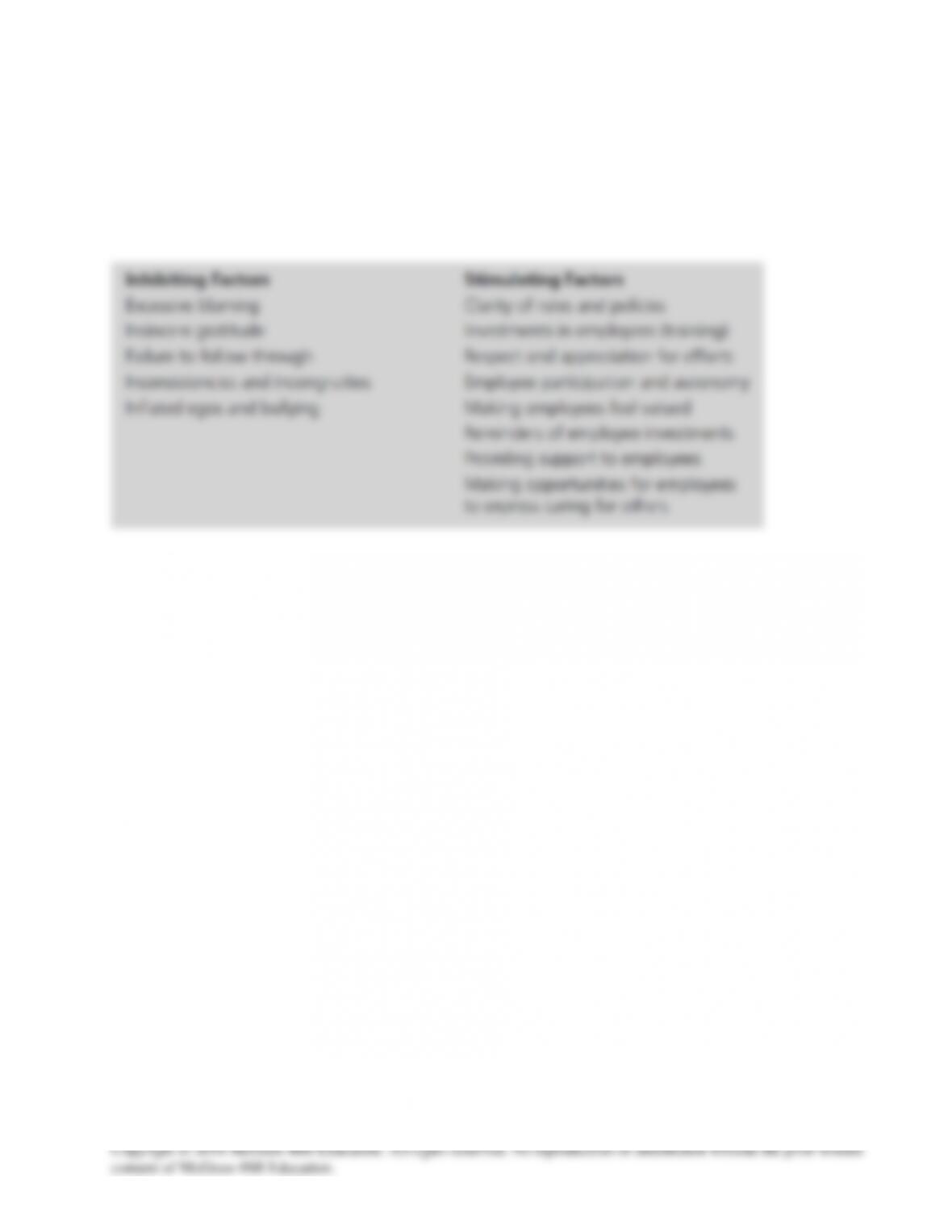
• Ways to increase and decrease commitment are presented in Figure 9.2.
Work Moods
• Attitudes are emotional states that are typically stable across time and focused on a particular
element of one’s job.
• Employees also have feelings about their job that are both diffused and highly dynamic; they
reflect overall views and can change within a day, hour, or minute.
o These variable attitudes that employees have toward their jobs are called work moods.
• An employee’s work mood can be described as ranging from negative to positive and from
weak to strong and intense.
o Positive moods produce energy, passion, vitality, and enthusiasm.
o This results in better customer service, lower absenteeism, greater creativity, and
interpersonal cooperation.
• Work moods are directly affected by managerial actions such as:
o Sharing praise
o Creating an atmosphere filled with occasional fun, humor, and levity
o Providing a workplace filled with pleasant surroundings
o Engaging in and encouraging a reasonable amount of social interaction
Employee Engagement
• Employee engagement is demonstrated substantially when some employees exhibit a high
degree of job satisfaction and involvement, are committed to their firm’s mission, and have
generally upbeat work moods.
o Such employees:
9-8
▪ Honestly care about the organization’s success
▪ Have a strong bond to their employer
▪ Voluntarily commit their energy, time, and effort to helping the organization
• Following are some methods that managers can use to stimulate and reinforce employee
engagement:
o Effective communication (frequent, candid, thorough, understandable)
o Clear job expectations
o Inspirational leadership, reflecting appropriate values
o Positive relationships with one’s supervisor
o Regular feedback and recognition
Effects of Employee Attitudes
• Attitudes are good predictors of behaviors as they provide clues to an employee’s behavioral
intentions or inclinations to act in a certain way.
o Positive attitudes help predict constructive behaviors.
o Negative attitudes help predict undesirable behaviors.
• Employees who are dissatisfied with their jobs, lack job involvement, are low in organizational
commitment, and have strongly negative moods.
o These results are especially likely if the feelings are both strong and persistent.
9-9
Copyright © 2014 McGraw-Hill Education. All rights reserved. No reproduction or distribution without the prior written
consent of McGraw-Hill Education.
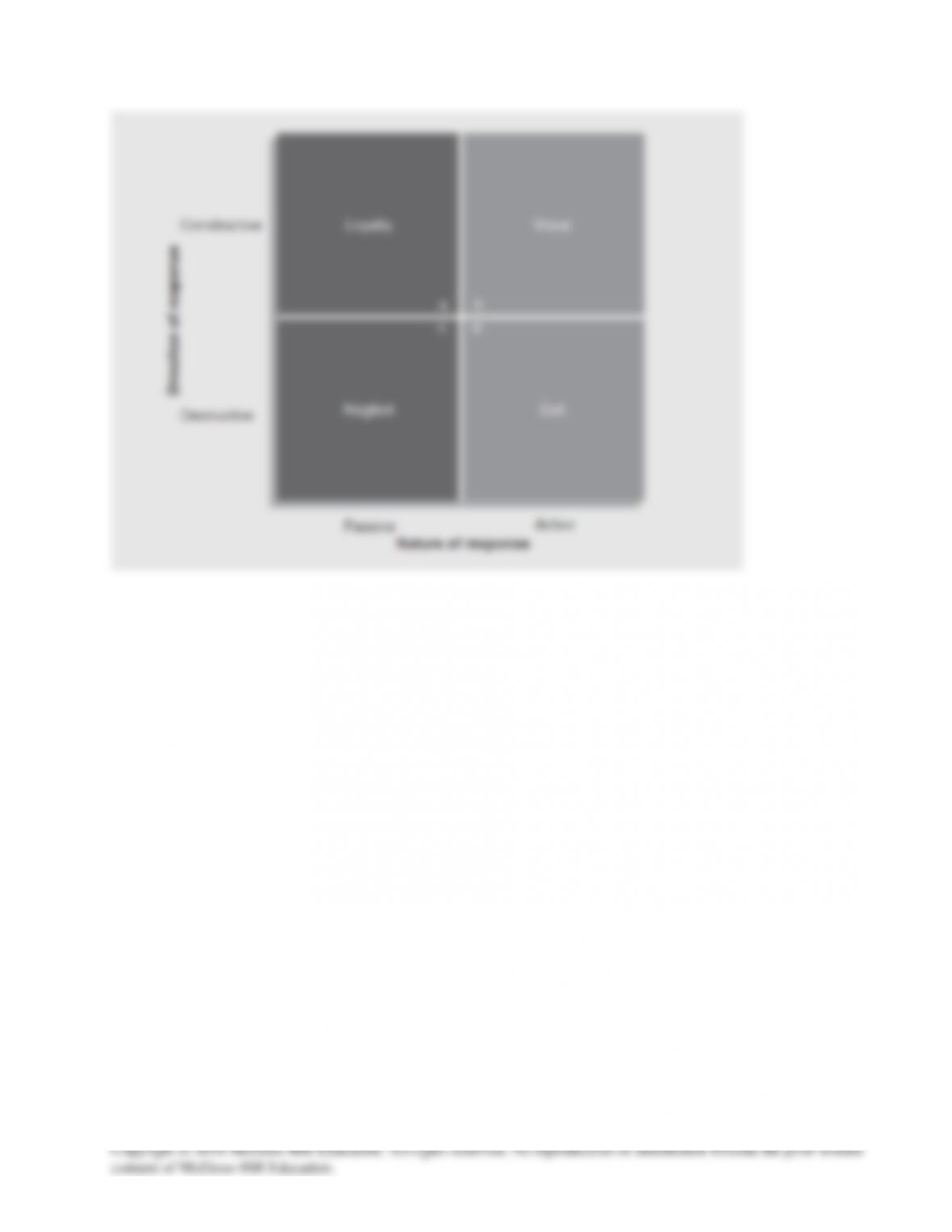
• At their extreme, employees may react in a constructive or destructive manner, and may also
do this either passively or actively.
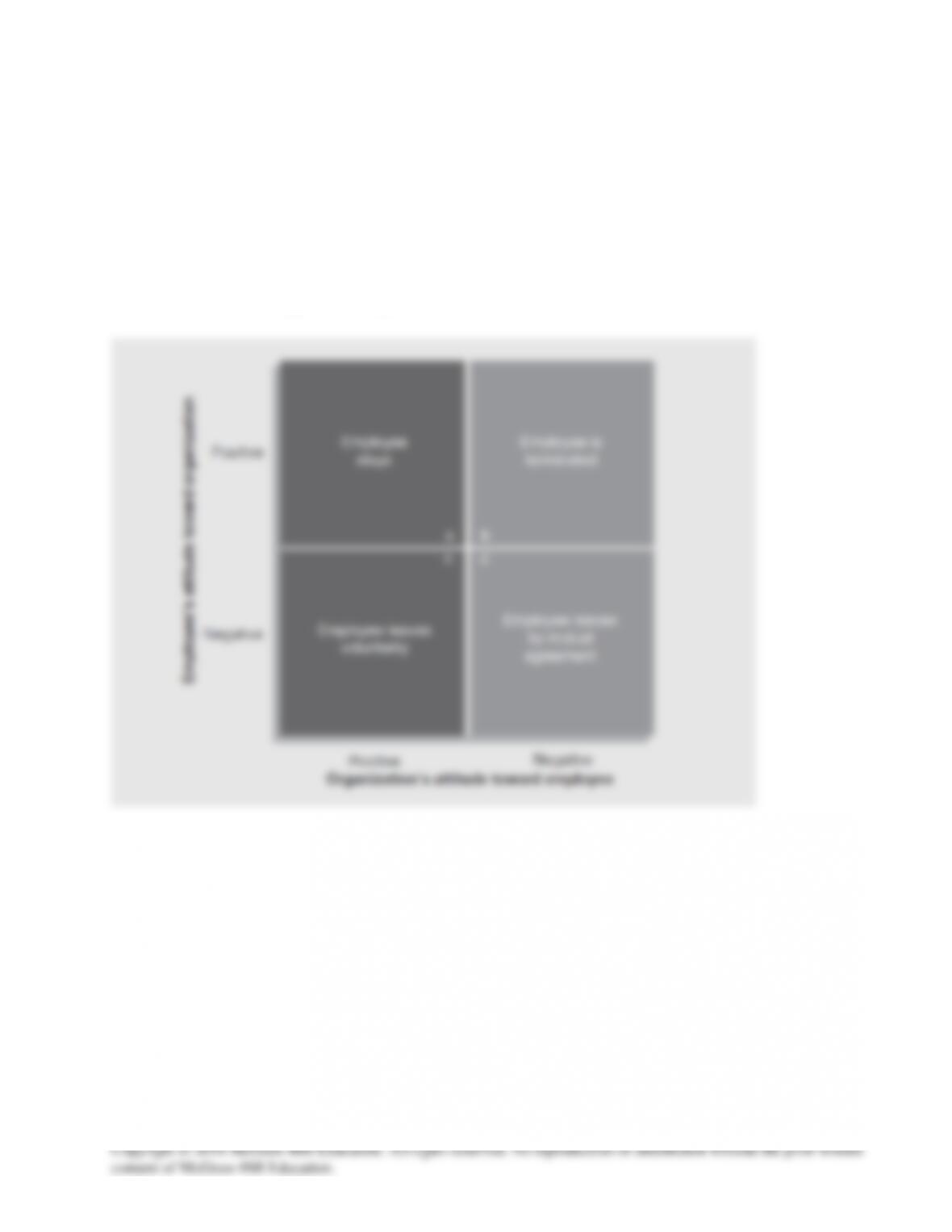
• Four simplified characterizations of employee responses are:
o Exit (voluntary departure)
o Voice (constructive criticism of disliked policies)
o Loyalty (remaining in the organization but not being verbal about problems)
o Neglect (being passively destructive).
• Satisfied employees are likely to
o Provide acts of customer service beyond the call of duty
o Have sparkling work records
o Actively pursue excellence in all areas of their jobs
Employee Performance
• Some managers cling to the myth that high satisfaction always leads to high employee
performance.
o This assumption is not correct.
• Satisfied workers actually may be high, average, or even low producers and they will tend to
continue the level of performance that previously brought them satisfaction (according to the
behavior modification model).
• A more accurate statement of the causal relationship is both counterintuitive and precisely the

9-10
reverse of the classic misbelieve.
o High performance contributes to high job satisfaction.
▪ As shown in figure 9.4, better performance typically leads to higher economic,
sociological, and psychological rewards.
o The level of satisfaction leads to either greater or lesser commitment, which then
affects effort and eventually (and perhaps indirectly) affects performance; the result is a
continuously operating performance-satisfaction-effort loop.
o Management should devote its efforts to aiding and facilitating employee performance,
which can produce satisfaction and commitment as a by-product.
• If performance is low employees might not receive the rewards and recognition they were
hoping for, and dissatisfaction can result.
o Dissatisfaction among employees may lead to negative behaviors such as:
▪ Turnover
▪ Absenteeism and tardiness
▪ Theft
▪ Violence
▪ Poor organizational citizenship
Turnover
• Higher job satisfaction is associated with lower employee turnover.
• Turnover is the proportion of employees leaving an organization during a given time period
(usually one year).
• Satisfied employees are less likely to think about quitting or announce their intention to quit.
• Employees with lower satisfaction are more likely to:
o Have higher rates of turnover
o Lack self-fulfillment
o Receive little recognition on the job
o Not feel valued
o Experience continual conflicts with a supervisor or peer
o Have reached a personal plateau in their career
• Excessive employee turnover can have several negative effects on an organization; they
include:
o Separation costs (exit interview time, separation pay, unemployment tax increase)
o Training costs for new employees (both orientation and skill-development instruction;
both formal and informal learning experiences)
o Vacancy costs (temporary help or overtime pay; productivity loss and service
disruption)
o Replacement costs (attracting, screening, and relocating new hires)
o Morale effects (loss of friendships; concerns about personal job loss during
downsizings)
9-11
• Some benefits of turnover: are as follows
o More opportunities for internal promotion
o Welcomed removal of disruptive employees
o Infusion of expertise from newly hired employees
• Managers should look beyond overall turnover rates and examine instead the functionality of
each departure.
• This is an extremely critical analytical issue during downsizing (Figure 9.6).
o The best approach is a preventive one.
• Employers with lower turnover:
o Clarify job expectations
o Socialize employees about norms for their behavior
o Watch for early signs of dissatisfaction
o Provide opportunities for employees to excel and use their talents
o Offer recognition and praise regularly
o Make sure that each employee feels cared for as a person
Absences and Tardiness
• Employees with low job satisfaction tend to be absent more often.
• The connection is not always sharp, for a couple of reasons.
9-12
o Some (involuntary) absences are caused by legitimate medical (sickness or injury) or
personal (jury duty or sick children) reasons; therefore a satisfied employee may have a
valid absence.
o Dissatisfied employees do not necessarily plan to be absent, but they seem to find it
easier to respond to the opportunities to do so on a spontaneous basis.
• Voluntary (attitudinal) absences occur more often among a certain cluster of employees and
usually happen on Mondays or Fridays.
o Whereas involuntary (medically related) absenteeism can sometimes be predicted (e.g.,
for surgery) and often be reduced through the use of more thorough preemployment
physical exams and work-history record checks.
▪ Different approaches are needed for absences caused by poor attitudes.
• The connection between satisfaction and absences/tardiness is not always sharp.
o Absences may also be caused by legitimate reasons.
o Dissatisfied employees do not necessarily plan to be absent; they just find it easier to
• Employees can also exhibit their dissatisfaction with job conditions through tardiness.
o Tardiness is a type of short-period absenteeism that can range from a few minutes to
several hours for each event, and it is another way in which employees physically
withdraw from active involvement in the organization.
o It may impede timely completion of work and disrupt productive relationships with co–
workers.
o Although there may be legitimate reasons for an occasional tardy arrival, a pattern of
tardiness is often a symptom of negative attitudes requiring managerial attention.
• Presenteeism occurs when employees come to work despite troublesome (and often
recurring) physical and emotional health conditions that substantially affect their work
performance.
o Presenteeism is a unique but rather widespread phenomenon—it is far harder to assess
than absenteeism and it can reduce a worker’s productivity by 33 percent or more.
o It is caused by management placing too much emphasis on lowering absenteeism rates.