
8-1
Chapter 8
Empowerment and Participation
Chapter Overview
This chapter discusses what empowerment and participation are, management programs that foster
them, their benefits, and their limitations. The chapter begins with discussions on the nature of
empowerment and the nature of participation. The next section is devoted to discussing how
participation works as a process. Prerequisites for participation as well as its benefits are presented.
The final section of the chapter describes and reviews several types of participation programs.
Chapter Objectives
After reading this chapter, students should be able to understand:
1. The nature of empowerment and its prerequisites
2. The participative process
3. Benefits of participation
4. Types of participative programs
5. Limitations of participation
6. Servant leadership
Discussion and Project Ideas
Of all the ideas in organizational behavior, participation is among those with major potential.
Participation historically was absent from the employment environment. People were told what to
do, and that was all. Even now, as more participative activities are brought into work, some
managers look upon participation as merely a device to manipulate their personnel. The objective of
this chapter is to explain that participation is something more than manipulation and to present a
general discussion of participation. The following exercises and assignments should help to
demonstrate and achieve these objectives.
• After seeking consent from your students, have each student submit his or her name and
whether or not the course is a requirement or an elective. Check the correlation between
voluntary participation and students’ grades after the first exam. Discuss the reasons for the
correlation. Also discuss variables which may reduce the size of the correlation between
voluntary participation and grades.
• Ask students to research the dynamics of the student protests in U.S. colleges and universities
during the 1960s and 1970s with regard to the students’ demand for more voice in curriculum

8-2
and other administrative decisions. What level of participation was sought by the protesters?
What programs exist on campus today as a result? Which programs discussed in the text could
be instituted today, if they have not been? Are there any reasons that today’s students may not
be as desirous as their predecessors of such participation?
• Invite a representative from an organization in the community which has developed a program
or policies that encourage participation. Have this individual explain the results of the program
and its relative advantages and disadvantages.
Lecture Outline
Introduction
• An employee orientation and a participative style are often important for effective leadership.
o Participation has excellent potential for developing employees and building teamwork, but
it is a difficult practice and can fail if it is poorly applied or if executives do not truly
believe in its value.
o Used effectively, two of the best results are acceptance of change and a strong
commitment to goals that encourage better performance.
The Nature of Empowerment and Participation
What is Empowerment?
• Many employees believe that they are dependent on others and that their efforts will have
little impact on performance.
o This powerlessness contributes to the frustrating experience of low self-efficacy—the
conviction among people that they cannot successfully perform their jobs or make
meaningful contributions.
▪ Problems with self-efficacy are often caused by major organizational changes that
are beyond the employees’ control (such as mergers).
o Problems may also stem from having to work:
▪ Under an authoritarian leader

8-3
▪ Within a reward system that fails to reinforce competence or innovation
▪ In a job that lacks variety, discretion, or role clarity
• Feelings of low self-efficacy are similar to the imposter phenomenon in which individuals
at all levels and in all industries fail to acknowledge properly their own expertise and
accomplishments.
o They feel like a fake and erroneously attribute their success to luck, charm, personal
contacts, or timing, instead of talent, competence, or perseverance.
• Individual perceptions of low levels of self-efficacy can be raised by empowering employees.
o Empowerment is any process that provides greater autonomy to employees through
the sharing of relevant information and the provision of control over factors affecting
job performance.
o Empowerment helps remove the conditions that cause powerlessness while enhancing
employee feelings of self-efficacy.
o Empowerment authorizes employees to cope with situations and enables them to take
control of problems as they arise.
• Five broad approaches to empowerment:
o Helping employees achieve job mastery
o Allowing more control
o Providing successful role models.
o Using social reinforcement and persuasion
o Giving emotional support
• When managers use the empowerment approaches, employees believe that:
o They are competent and valued
o They truly have some autonomy
o Their jobs have meaning and impact
o They have opportunities to use their talents
• When employees have been legitimately empowered, their efforts are more likely to result in
personal satisfaction and the kind of results that the organization values.
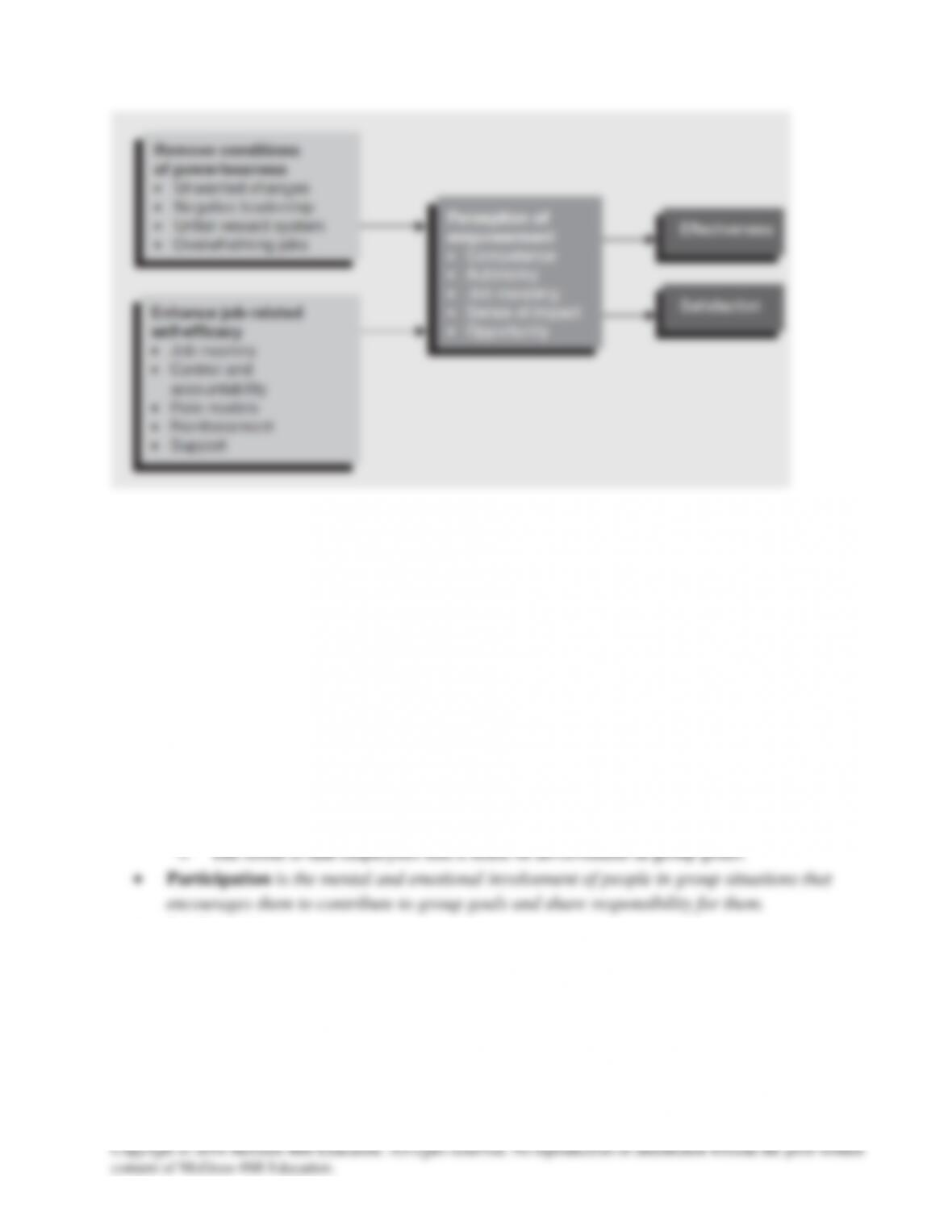
• Figure 8.1 shows In the process of empowerment, powerlessness is diminished and self-
efficacy enhanced.
8-4
Copyright © 2014 McGraw-Hill Education. All rights reserved. No reproduction or distribution without the prior written
consent of McGraw-Hill Education.
• Managers use behavioral tools to attack the powerlessness problem, such as:
o Mutual goal setting
o Job feedback
o Modeling
o Contingent reward systems
o Participative management
What is Participation?
• Participative managers consult with their employees, bringing them in on problems and
decisions so they work together as a team.
• Participative managers are not autocrats, but neither are they managers who abandon their
management responsibilities.
o They have learned to share operating responsibility with those performing the work.
• Involvement
o Participation means meaningful involvement rather than mere muscular activity.
▪ A person who participates is ego-involved instead of merely task-involved.
o Some managers mistake task involvement for true participation which often leads to
empty managerial actions that constitutes pseudoparticipation (fake involvement, or
merely a façade).
▪ As a result of employees fail to become ego-involved.
• Motivation to Contribute
8-5
Copyright © 2014 McGraw-Hill Education. All rights reserved. No reproduction or distribution without the prior written
consent of McGraw-Hill Education.
o Participation stimulates people to contribute.
o Participation is what motivates people to release their resources of initiative and
creativity toward the objectives of the organization.
o Participation differs dramatically from consent.
▪ Consent uses only the creativity of the manager; consenters merely acquiesce and
passively approve ideas.
▪ Participation is more than getting consent for something that has already been
decided; its great value is that it taps the creativity of all employees.
o Participation especially improves motivation by helping employees understand and
clarify their paths toward goals.
▪ According to the path-goal model of leadership, improved understanding of path-
goal relationships produces a heightened sense of responsibility for goal
attainment; therefore resulting in improved motivation.
• Acceptance of Responsibility
o Participation encourages people to accept responsibility in their group’s activities.
▪ It is a social process by which people become self-involved in an organization,
committed to it, and want to see it work successfully.
o Participation helps employees become good organizational citizens who take
ownership for results rather than nonresponsible, machinelike performers.
o As individuals begin to accept responsibility for group activities, they see in it a way to
accomplish a job for which they feel responsible.
▪ This idea of getting the group to want teamwork is a key step to developing a
successful work unit.
▪ Under these conditions, employees see managers as supportive contributors to the
team.
o Employees are likely ready to work actively with managers rather than reactively
against them.
• Global market competition is causing keen interest in any managerial practice that offers to
aid in the attraction or retention of qualified employees, increase productivity, or to speed the

8-6
introduction of products to market.
o Participative practices expedite these goals by placing more responsibility at lower
levels of the organization and speeding up the approval process.
o Participative practices may also provide power opportunities earlier to minority
workers in an increasingly diverse workforce, since such workers need not wait until
reaching higher organizational levels before being allowed to contribute meaningfully.
• Participation helps satisfy the awakening employee need for meaning and fulfillment at work.
o The search for spirit or harmony among all facets of life as guided by a higher
(religious) power has challenged organizations to search for ways to restore a “soul” to
their workplaces.
▪ These organizations have found that employees are searching for a sense of
significance, the opportunity to use their minds, and a chance to devote their
efforts to a higher purpose in their work.
• Other reasons for the popular use of participative practices are noteworthy.
o The education level of the workforce often provides workers with unique capacities
that can be applied creatively to work problems.
▪ These employees also acquire a greater desire for influencing work-related
decisions.
▪ They have a strong expectation that they will be allowed to participate in these
decisions.
• A strong argument can be made that participation is an ethical imperative for managers.
o This view rests on the conclusion that highly nonparticipative jobs cause both
psychological and physical harm to employees in the long run.
o A participative approach is the ‘right’ thing to do if a manager cares about employee
welfare.
o Managers need to create participative conditions that will allow interested employees to
experience feelings of empowerment in their work.
8-7
Copyright © 2014 McGraw-Hill Education. All rights reserved. No reproduction or distribution without the prior written
consent of McGraw-Hill Education.
How Participation Works
The Participative Process
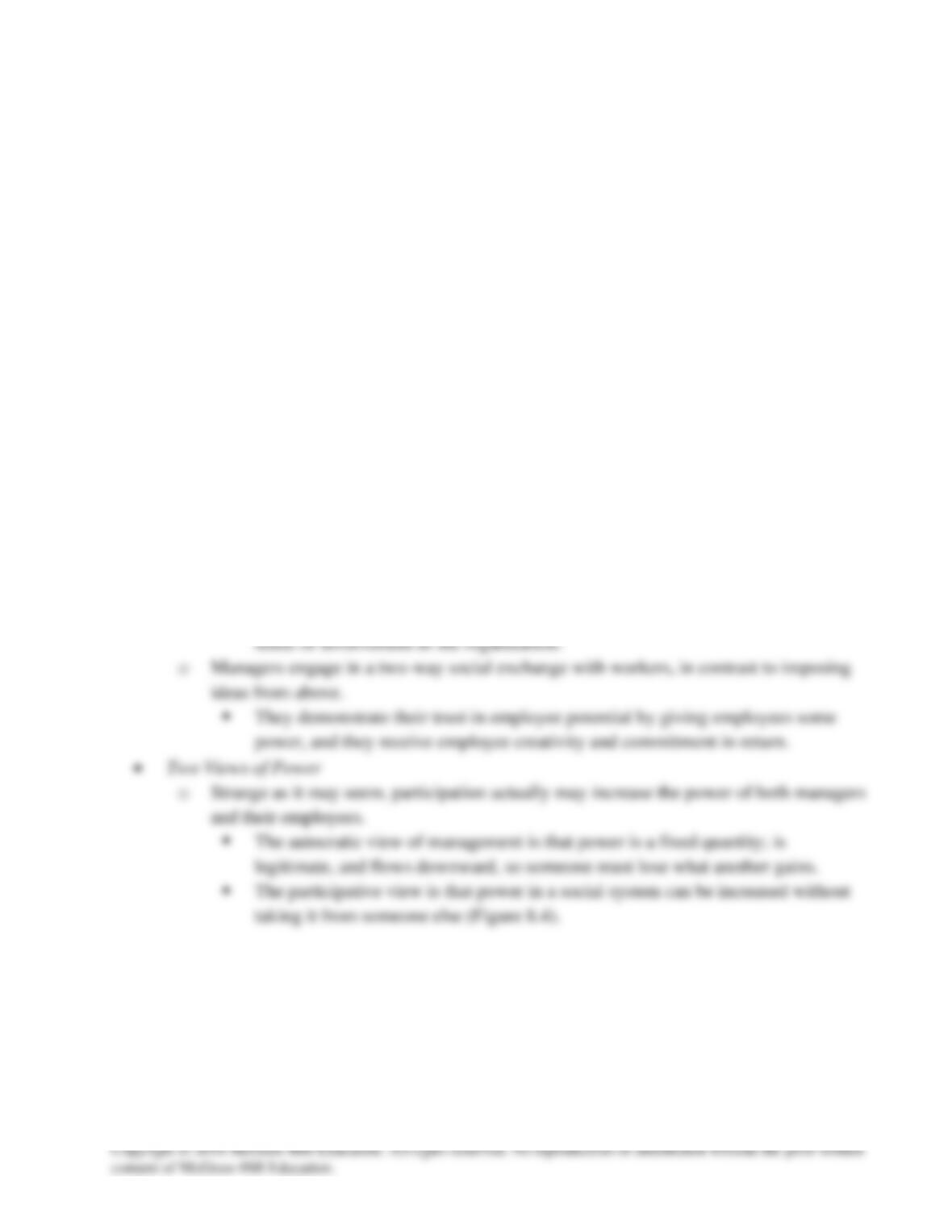
• A simple model of the participative process is shown in Figure 8.3.
• Participative programs often result in mental and emotional involvement that produces
generally favorable outcomes for both the employees and the organization.
o Participating employees are generally more satisfied with their work and their
8-8
supervisor, their stress from working under an authoritarian manager diminishes, and
their self-efficacy rises as a result of newfound empowerment.
The Impact on Managerial Power
• Leader-Member Exchange
o Participation is a sharing process between managers and employees.
o Participation is built upon the leader-member exchange model of leadership.
o This model suggests that leaders and their followers develop a unique reciprocal
relationship with the leaders selectively delegating, informing, consulting, mentoring,
praising, or rewarding each employee.
▪ In exchange, subordinates contribute various degrees of task performance,
loyalty, and respect to the manager.
▪ The quality of the relationship varies, depending on the balance of exchanges
made with some employees attaining favored status (the in-group); others
perceiving unfairness in their treatment (the out-group).
o If a manager believes that an employee has high ability and that a high-quality
exchange relationship exists, the manager is more likely to allow a greater degree of
influence in decisions.
▪ Some managers feel that allowing participation will reduce their authority
however this is not true as participative managers often still retain final authority.
▪ All they do is share the use of authority so employees will experience a greater

8-9
Copyright © 2014 McGraw-Hill Education. All rights reserved. No reproduction or distribution without the prior written
consent of McGraw-Hill Education.
o Managerial power depends partly on:
▪ Employee trust in management
▪ A feeling of teamwork
▪ A sense of responsibility
o Participation improves the managerial power conditions through the application of
socialized power.
▪ Since employees feel more cooperative and responsible, they are likely to be
more responsive to managerial attempts to influence them.
▪ Employees feel supported, enabled, and more capable.
Prerequisites for Participation
• The success of participation is directly related to how well certain prerequisite conditions are
met.
o Some of these conditions occur in the participants; others exist in their environment.
• Major prerequisites include:
o Adequate time to participate
o Potential benefits greater than costs
o Relevance to employee interests
o Adequate employee abilities to deal with the subject
o Mutual ability to communicate
o No feeling of threat to either party
o Restriction to the area of job freedom
▪ The area of job freedom for any department is its area of discretion after all
restraints have been applied.
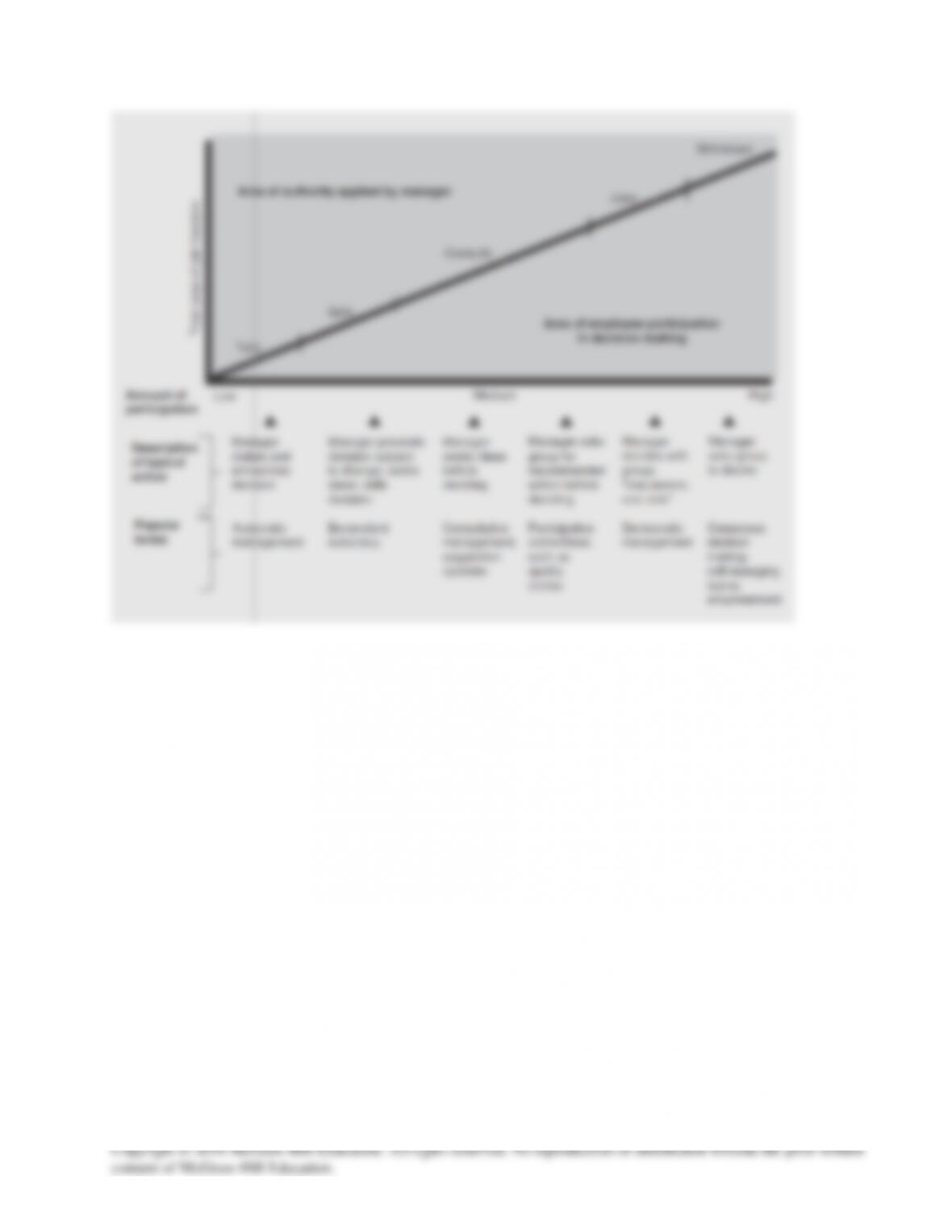
• Within the area of job freedom, participation exists along a continuum (Figure 8.6).
o Over time, a manager will practice participation at various points along the continuum,
sometimes moving up and down on the diagonal line.
o Each manager gradually becomes identified with a general style of participation as a
usual practice.
8-10
Copyright © 2014 McGraw-Hill Education. All rights reserved. No reproduction or distribution without the prior written
consent of McGraw-Hill Education.
Contingency Factors
• Several contingency factors influence the success of participative programs. They may be
found in the:
o Environment
o Organization
o Leadership
o Nature of the tasks performed
o Employees
• Emotional Intelligence
o Emotional intelligence is the combination of two personal abilities—self awareness
and self-management—and two social competencies—social awareness and
relationship management.
o Emotional intelligence means being aware of and understanding one’s own feelings,
realizing why one feels that way, and managing one’s own feelings effectively.
o A parallel set of skills deals with a leader’s ability to assess and manage the emotions
of employees by using:
▪ Empathy
▪ Compassion
▪ Optimism
8-11
▪ Humor
▪ Integrity
▪ Caring
▪ Persuasiveness
o Emotional intelligent leaders build the kind of relationship with employees that assures
them that their talents and inputs will be used effectively for the benefit of all.
• Differing Employee Needs for Participation
o Some employees desire more participation than others.
o Educated and higher-level workers often seek more participation, because they feel
more prepared to make useful contributions.
▪ When they are not allowed to contribute, they tend to have lower performance,
less satisfaction, lower self-esteem, and more stress.
o Other employees desire only minimum participation and are not upset if they are not
actively involved.
o The difference between an employee’s desired and actual participation gives a measure
of the potential effectiveness of participation, assuming that the employee has the
ability to contribute.
▪ When employees want more participation than they have, they are
“participatively deprived” and there is under-participation.
▪ When they have more participation than they want, they are “participatively
saturated” and there is over-participation.
o Under-participation or over-participation causes people to be less satisfied than those
who participate in a degree that closely matches their needs. This relationship is shown
in Figure 8.7.
o Participation is not something that should be applied equally to everyone.
• Responsibilities of Employees and Managers
o The success of any participative program depends on the degree to which all employees
recognize that the opportunities provided are accompanied by a set of responsibilities.
o Ideally, all employees would agree to:
▪ Be fully responsible for their actions and their consequences
▪ Operate within the relevant organizational policies
▪ Be contributing team members
▪ Respect and seek to use the perspectives of others
▪ Be dependable and ethical