
7-13
what needs to be done (goal) and how to do it (path).
o Leaders must decide which style to use with each employee; the path-goal model
identifies four alternatives:
▪ Directive leadership—the leader focuses on clear task assignments, standards of
successful performance, and work schedules.
▪ Supportive leadership—the leader demonstrates concern for employees’ well-
being and needs, while trying to create a pleasant work environment.
▪ Achievement-oriented leadership—the leader sets high expectations for
employees, communicates confidence in their ability to achieve challenging
goals, and enthusiastically models the desired behavior.
▪ Participative leadership—the leader invites employees to provide input to
decisions, and seriously seeks to use their suggestions as final decisions are
made.
• Contingency Factors
o Two major factors must be analyzed—the general work environment and the specific
characteristics of the employee.
o In the work environment, a leader must identify:
▪ Whether the employee’s task is already structured or not.
▪ Whether the formal authority system is most compatible with a directive or
participative approach.
▪ Whether the existing work group already provides for satisfaction of employee
social and esteem needs.
o The leader must assess three significant variables of each employee.
▪ Locus of control—alternative beliefs about whether an employee’s achievements
are the product of his or her own effort (an internal locus, which is more
compatible with a participative style) or the result of outside forces (an external
locus, which is more receptive to a directive approach).
▪ Willingness to accept the influence of others—if this variable is high, a
directive approach will be more successful; if it is low, a participative style is
more appropriate.
▪ Self-perceived task ability—employees who have high confidence in their
potential will react most favorably to a supportive leader; alternatively,
employees lacking a perception of their own task ability will more likely embrace
an achievement-oriented leader.
o Stereotypically, Generation Y employees have a stronger internal locus of control, an
unwillingness to accept the influence of superiors, and a strong image of their own task
competence, capacity to learn, and ability to act independently.
o The path-goal model has made a contribution by identifying additional contingency
variables, as well as broadening the range of leader behaviors to choose from.
▪ It is also pragmatic since it explicitly relates leadership style to an underlying

7-14
motivational model.
o Existing research indicates that use of the model does correlate with employee
satisfaction with leadership, but its impact on performance is not yet fully documented.
Vroom’s Decision-Making Model
• A useful decision-making model for selecting among various degrees of leadership style
(autocratic to participative) was developed by V. H. Vroom and others.
o They recognized that problem-solving situations differ, so they developed a structured
approach for managers to examine the nature of those differences and to respond
appropriately.
• Problem Attributes
o This model helps managers assess a current decision situation along five-point scales
according to its problem attributes:
▪ How important is technical quality with regard to the decision being made?
▪ How important is subordinate commitment to the decision (employee
acceptance)?
▪ Do you already have sufficient information to make a high-quality decision?
▪ Is the problem well structured?
▪ If you made the decision, would the subordinates be likely to accept it?
▪ Do subordinates share the goals to be attained in solving the problem?
▪ Is there likely to be conflict among subordinates over alternative solutions?
▪ Do subordinates have sufficient information to allow them to reach a high-quality
solution?
o Decision-quality dimensions include cost considerations, the availability of information
and whether or not the problem is structured.
o Employee-acceptance dimensions include:
▪ The need for their commitment.
▪ Their prior approval.
▪ Congruence of employee’s goals with that of the organization.
▪ The likelihood of conflict among employees.
• Leadership Options
o After the type of problem being faced is determined, guidelines are then offered to help
managers select one of five approaches to use.
o These considerations all have an impact on the choice of whether to use a more
autocratic or a more consultative approach from among the five described below:
▪ Autocratic I—leader individually solves the problem using information already
available.
▪ Autocratic II—leader obtains data from subordinates and then decides.
▪ Consultative I—leader explains problem to individual subordinates and obtains
ideas from each before deciding.
7-15
▪ Consultative II—leader meets with group of subordinates to share the problem
and obtain inputs, and then decides.
▪ Group II—leader shares problem with group, facilitates a discussion of
alternatives, and then reaches group agreement on a solution.
• The usefulness of Vroom’s model rests on several key assumptions:
o Managers can accurately classify problems according to the criteria offered.
o Managers are willing and able to adapt their leadership style to fit the contingency
Alternative Perspectives on Leadership
• Despite the seemingly substantial differences among the leadership models, they are
remarkably consistent in some way.
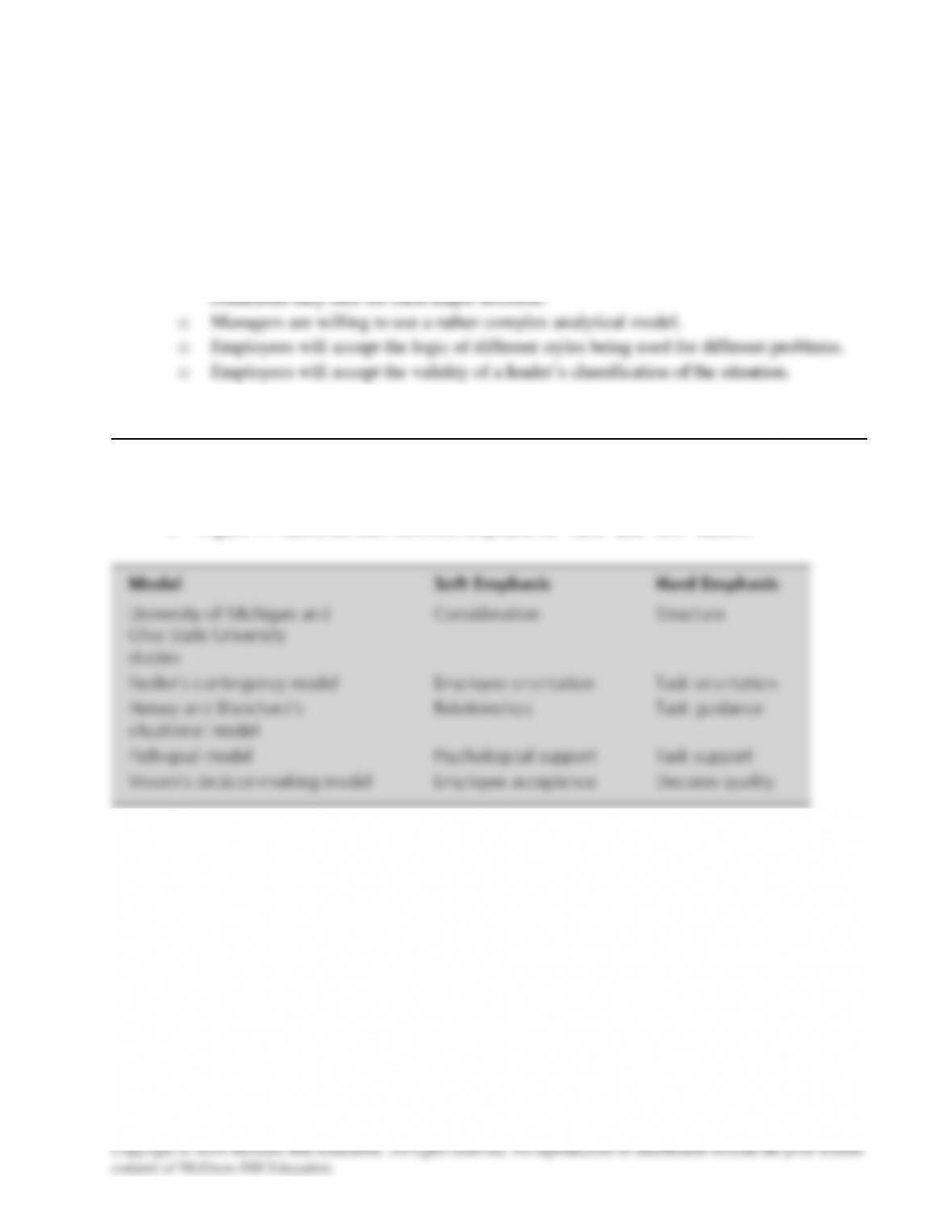
o Figure 7.7 identifies their common emphasis on “hard” and “soft” factors.
Neutralizers, Substitutes, and Enhancers for Leadership
• Previous leadership models suggests that a formal leader is necessary to provide task
direction, structure, and rewards, plus the consideration and social support that employees
require.
o Unfortunately, these leadership roles may create an unhealthy dependency on leaders
that stifles the growth and autonomy of subordinates.
o A leader may also lack the necessary traits, knowledge, and skills needed to fulfill the
roles, or they may not be able to be present at all times.
• Neutralizers can also intervene—these are attributes of subordinates, tasks, and
organizations that actually interfere with or diminish the leader’s attempts to influence the
employees.
7-16
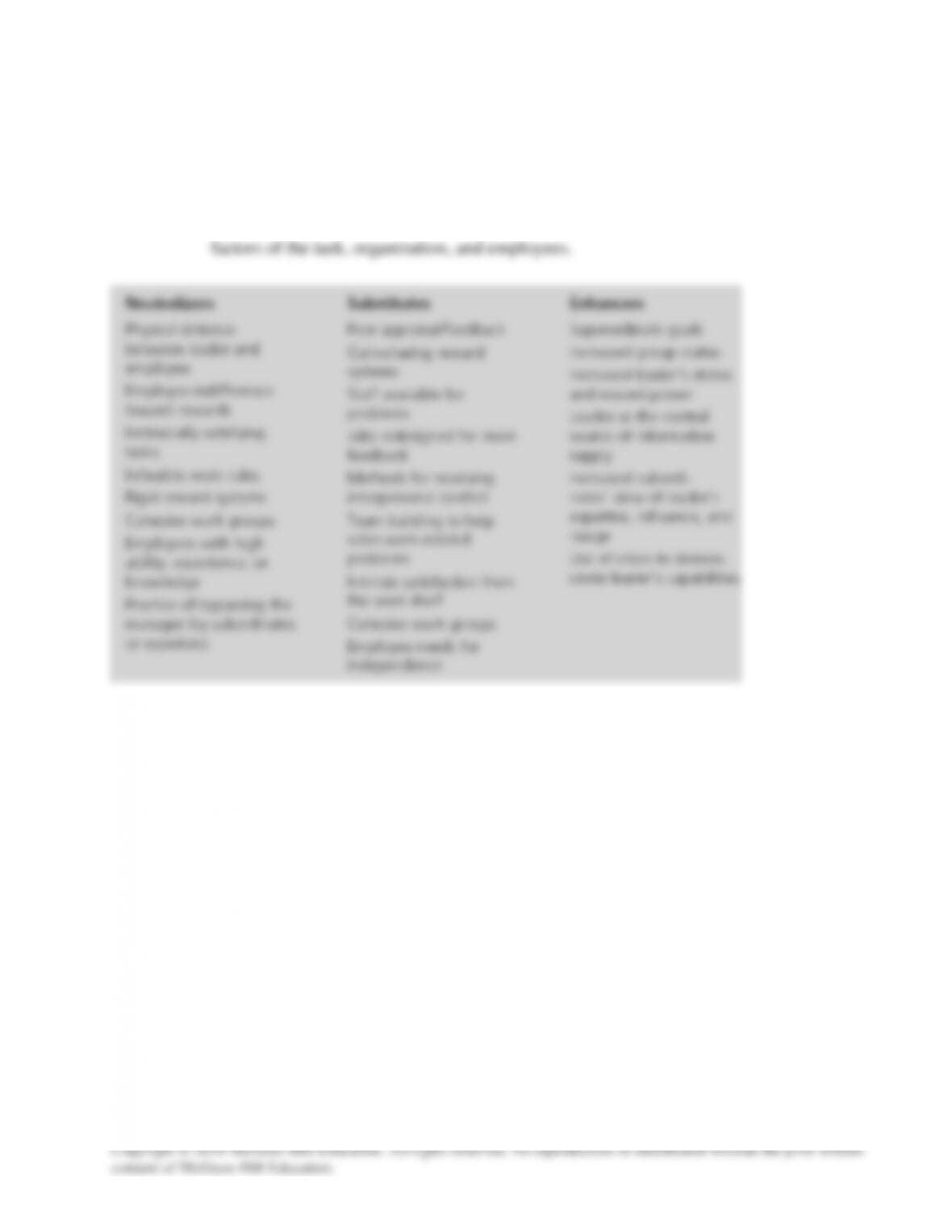
o Neutralizers include physical distance, rigid reward systems, and a practice of
bypassing the managers by either subordinates or superiors.
• Substitutes for leadership are factors that make leadership roles unnecessary through
replacing them with other sources.
o Examples of such factors are listed in Figure 7.8; they are found in the contingency
• If the situation or leader cannot be readily changed, there may be substitutes or even
enhancers for leadership.
o Substitutes for leadership are factors that make leadership roles unnecessary through
replacing them with other sources.
▪ Presence of such substitutes as strong subordinate experience, clear rules, or a
cohesive work group helps decrease the need for a leader’s traditional task
orientation.
▪ Other factors, such as intrinsically satisfying tasks, professional orientations by
employees, or an employee’s high need for independence, may diminish the need
for a leader’s consideration-oriented behavior.
o Enhancers for leadership are elements that amplify a leader’s impact on the
employees.
▪ A directive orientation may be improved by an increase in the leader’s status or
reward power or when that leadership style is used in jobs with frequent crises.
• A supportive leadership style may be enhanced by encouraging more team-based work
activities or by increasing employee participation in decision making.

7-17
• The important contribution of the neutralizers/substitutes/enhancers approach is that it gives
organizations an alternative remedy where it is not feasible to replace or train the leader or to
find a better match between leader and job.
Coaching
• Coach is a rapidly-emerging metaphor for the leader.
• Coaching means that the leader prepares, guides, and directs a “player” but does not play the
game.
o These leaders recognize they are on the sidelines, not on the playing field.
o Their role is to select the right players, to teach and develop subordinates, to be
available for problem-oriented consultation; to review resource needs, to ask questions,
and to listen to inputs from employees.
• Coaches see themselves as cheerleaders and facilitators.
o They recognize the occasional need to be tough and demanding
o They focus on enhanced performance supported by high expectations and timely
feedback
• One role of any executive—and managerial coaches in particular—is that of sensemaking.
• According to psychologist Karl Weick, sensemaking is similar to cartography (map making).
o It is the process of finding order in complex or ambiguous situations requiring situation
awareness, data gathering from multiple sources, the two-way act of fitting data into a
mental model and/or adapting a mental framework to fit the data, and checking with
others on an ongoing basis to gain from their perspectives.
o The product—making sense of the world around oneself—is never-ending and often
requires other persons (coaches and collaborators) for assistance.
• Good coaching focuses mostly on enhanced performance as supported by high expectations
and timely feedback while building on the tools of trust, mutual respect, integrity, openness,
and common purpose.
• The specific areas in which most managers need coaching are as follows:
o Improving their interaction style
o Dealing more effectively with change
o Developing listening and speaking skills
• Prerequisites to successful coaching are as follows:
o Willingness to change
o Capability of changing
o Opportunity to practice new behaviors
An Integrative Model of Leadership Behaviors
• Gary Yukl and his colleagues developed a proposed taxonomy of leadership behaviors.
o This taxonomy identifies four major categories and fifteen component behaviors, as

7-18
follows:
▪ Task-oriented (accomplishing objectives by clarifying, planning, and monitoring
operations; problem solving)
▪ Relations-oriented (improving human capital by supporting, developing,
recognizing, and empowering people)
▪ Change-oriented (stimulating creativity, mutual learning, and environmental
adaptation by envisioning, advocating, and encouraging change)
▪ External-oriented (acquiring resources for the organization and promoting the unit
to its stakeholders by networking, external monitoring, and engaging in
representational behaviors)
Other Approaches
• Two other perspectives on leadership are visionary leadership and the reciprocal nature of
influence.
o Visionary leaders can paint a portrait of what the organization needs to become and
then use their communication skills to motivate others to achieve the vision.
▪ This is especially important during times of transition
o A second approach looks at the reciprocal nature of influence between managers and
their employees and studies the exchanges that take place between them.
▪ This approach serves as the basis for participative management in which both
parties give and gain something.
Suggested Answers to Discussion Questions
1. Explain the difference between management and leadership. Discuss why conceptual
leadership skills become more important, and technical skills less important, at higher
organizational levels.
Students’ answers may vary. Leadership is but a part of management. Management includes the
2. A manager once told a subordinate, “To be a good leader, you must first become a good
7-19
follower.” Discuss what it means to be a good follower, whether you agree with the statement,
and why or why not.
Students’ answers may vary. Being a good follower teaches the follower to listen, learn and
understand what it takes to be a successful leader. Being a good follower can also be considered
3. Think of the best leader you have ever worked with on a job, in sports, or in any other
activity. Then think of the worst leader. Discuss the contrasting styles and skills used by the
two. How did you respond to each? What could they have done differently?
Students’ answer may vary. Most of the students would probably report that the good leader
4. Explain how Theory X and Theory Y relate to leadership styles, especially the contingency
approaches and superleadership. Comment on the statement “management philosophy
controls practice.”
McGregor’s Theory X and Theory Y deal with assumptions held by managers. In reviewing the
leadership styles discussed in the textbook, one can conclude that the positive, participative,
7-20
Copyright © 2014 McGraw-Hill Education. All rights reserved. No reproduction or distribution without the prior written
consent of McGraw-Hill Education.
philosophy controls practice” will vary according to personal opinion. Students should realize,
however, that management’s philosophy regarding operations, decision making, personnel
practices, and even the organization’s design will affect how these areas are handled.
5. Think of situations in which you were a leader. What leadership style did you use? Using
hindsight and the material in this chapter, what would you have done differently?
Students’ answers may vary. There are numerous styles of leadership and students will be likely to
6. The contingency models are all more complex than the earlier trait or “one best way”
approaches. Discuss the likelihood that practicing managers will understand, accept, and use
each of the contingency models.
Students’ answers may vary. Many managers, it is true, try to avoid complexity if at all possible.
commonsense appeal to many managers.
7. Consider the various substitutes for leadership and enhancers. Identify the three that you
think have the greatest potential for positive impact, and explain why.
Students’ answers may vary. Presence of such substitutes as strong subordinate experience, clear
8. Vroom’s decision-making model assumes that managers have the flexibility to shift from one
style to another, whereas Fiedler’s model does not. Debate the feasibility of these models.
7-21
Students’ answers may vary. Students may have difficulty accepting the applicability of the Vroom
9. Why would a typical manager attempt to create independent-thinking employees? Would
this competition between manager and employees eventually result in the loss of the
manager’s job if the attempt were fully successful? Why or why not?
10. Review the idea of the leader as a coach. Which of the leadership models relates more closely
with coaching? Explain.
Students’ answers may vary. A rapidly emerging metaphor for the leader is that of a coach.
Assess Your Own Skills
Students should honestly circle the number on the response scale that most closely reflects the
degree to which each statement accurately describes them as leaders. This section will help them
understand how well they exhibit good leadership traits.
Incident

7-22
The Work Assignment
Pardini is definitely a supervisor in the middle. She receives pressures from management to complete
assignments, but also she receives pressures from employees, such as Prosser, who do not want to do the
work assigned. In this instance, a specific act by Prosser has characteristics of insubordination, and it is
involving other employees, because they are observing what is happening. This kind of challenge to
Pardini cannot be ignored.
From a perspective of power, Pardini needs to regain control of the workplace. She could try to direct
power play by verbally reprimanding Sonia or threatening to fire her. However, as noted in the book,
these are very risky strategies. Sonia may not accept the reprimand and could turn the discipline into a
heated argument. She might also protest any threat or action to fire her through a grievance procedure
and win. Thus, Pardini could lose rather than gain power. A more effective strategy, it would seem,
would be for her to tell Sonia that she would like to meet with her. Then, after selecting a private place
away from the other employees, she should listen to Sonia’s side of the story. If Sonia’s arguments have
merit and appear justified, Pardini should attempt to “mend fences” by allowing Sonia a more preferred
activity at a later time. If Sonia’s grievances are not warranted, that also needs to be pointed out and
consequences for continued insubordination should be outlined. However, Pardini should still allow
Sonia some way of “saving face” with the other employees.
Using Fiedler’s contingency model, it can be argued that this situation falls into Octant VIII. Leader–
member relations are poor with Sonia, the task appears somewhat unstructured, and leader position
power does not appear to be strong. (If it were strong, Sonia would hardly take the risk she is taking.)
These conditions define Octant VIII, which calls for task-oriented leadership that firmly instructs Sonia
to do her work. This approach can, of course, be done in a considerate way in the privacy of Pardini’s
office. Task performance needs to be restored, but consideration will be helpful in handling the situation
and getting to the root of the larger problem, for its long-run solution.
It should be noted that the above approaches are not necessarily in conflict with each other and that,
depending upon what Pardini finds out in her conversation with Sonia, her final strategy may reflect and
integrate all three approaches outlined above.
7-23
Experiential Exercise
Application of Leadership Models
This exercise will help create an interesting group discussion for students to discuss their
understanding of the concepts of leadership and its various models. This provides an opportunity to
actually apply what they learnt from the chapter.
Generating OB Insights
Students’ responses will vary for this exercise. They should however, highlight several of the major
topics discussed in the chapter such as the nature of leadership and followership, the difference
between traits and behaviors, different leadership styles, early approaches to leadership, etc.