
6-1
Chapter 6
Appraising and Rewarding Performance
Chapter Overview
This chapter focuses on money as a means of rewarding employees, motivational models applied to
pay, cost-reward breakeven analysis, and behavioral considerations in performance appraisal. The
first part of the chapter addresses the use of money as a means of rewarding employees.
Organizational behavior as it relates to the performance appraisal process is considered in the next
section, which is followed by economic incentive systems and wage incentives. Finally, profit and
gain sharing programs are discussed.
Chapter Learning Objectives
After reading this chapter, students should understand:
1. Total reward systems
2. Money as an economic and social medium of exchange
3. The role of money in motivational models
4. Behavioral considerations in performance appraisal
5. The characteristics of good feedback programs
6. The process of attribution
7. How and why to link pay with performance
8. Uses of profit-sharing, gain-sharing and skill-based pay programs
Discussion and Project Ideas
Although money will not buy happiness, it still is the principal medium of exchange for satisfying
certain types of employee wants. Therefore, organizational behavior becomes quite involved in the
pay systems of an organization. It is the objective of this chapter to discuss at some length the human
implications of job evaluation, performance appraisal, and pay plans.
This chapter offers an excellent opportunity for class recitation. For example, have individual
students discuss some of their personal experiences with performance appraisal, job evaluation, and
pay plans. Specific exercises and assignments emphasizing key points are described below.
Select two students to assume the roles described below and to act out a performance appraisal.
Have the other students serve as observers. If available, record and play back the appraisal. At the
conclusion of the appraisal, develop a list of good points and ways to improve the appraisal process
6-2
consent of McGraw-Hill Education.
through class discussion.
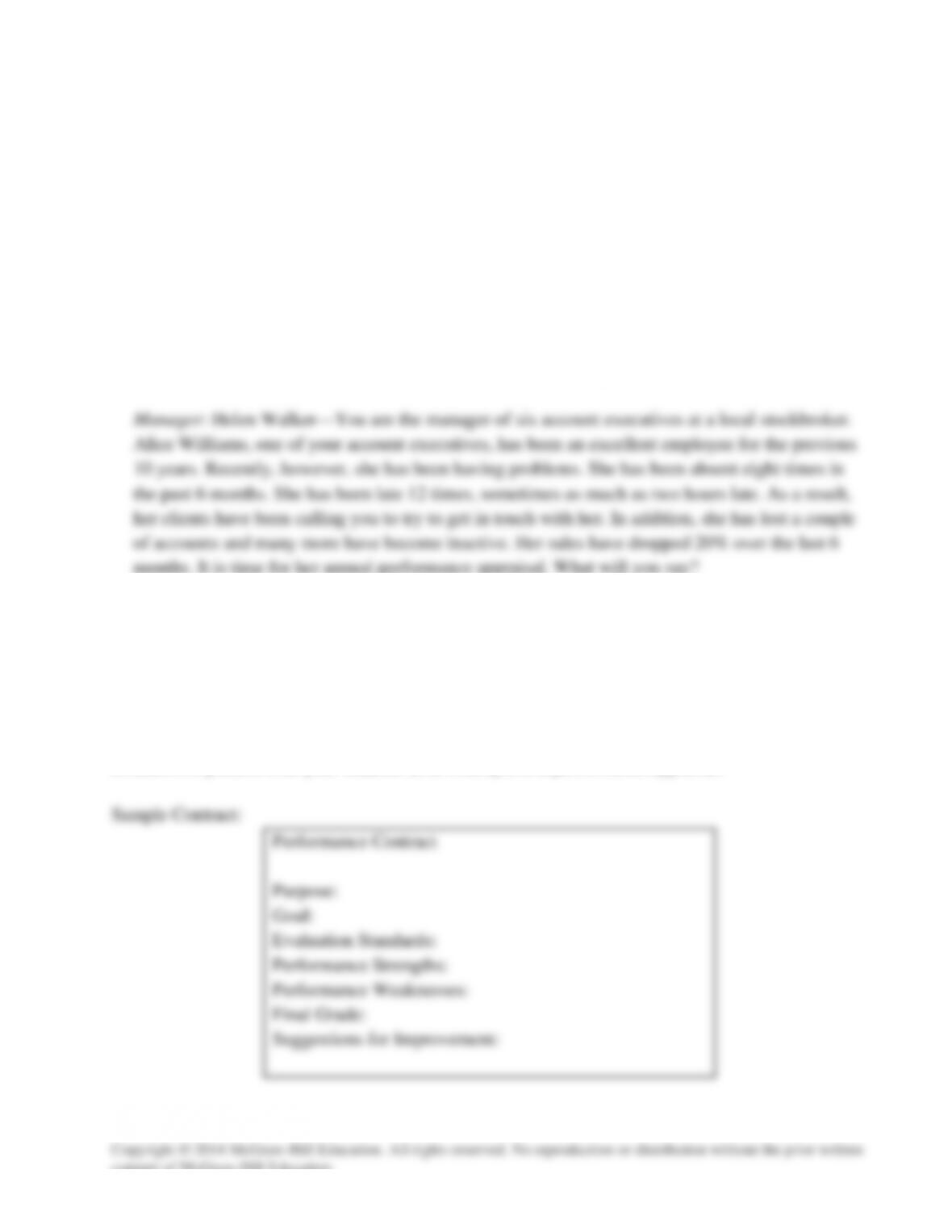
Employee: Alice Williams—You have been an account executive for a local stockbroker for the
past 10 years. In prior years, your performance has been excellent. Lately, however, your
performance has slipped. You have been late for work several times and also have been absent a
number of times. On a couple of occasions, clients have called your boss because they could not
reach you. Part of your problem has to do with your recent divorce. You spend a lot more time
partying now because you feel better when you are out with people rather than sitting at home.
You feel this is fairly normal behavior considering the hard times you have had lately. You feel
this is a stage you’re going through and are confident things will eventually improve. You feel no
particular need to reveal your personal problems to your manager.
months. It is time for her annual performance appraisal. What will you say?
If class size and time permit, negotiate individual contracts for student projects at the beginning of
the year. Look through the instructor’s manual and develop a list of projects from which students can
select. Then, set up each individual performance contract on a mini-performance appraisal system. A
sample contract follows. When this chapter is covered, conduct a mini-appraisal with each student
and assign a project grade.
Discuss this process with your students as an example of a performance appraisal.

6-3
Ask one or several students who have worked under piece rate incentive systems to prepare short
reports describing the systems and the ways in which employees reacted to the systems. Are there
any systematic differences in employees’ reactions to the systems that can be accounted for by the
designs of the systems?
Select several jobs in the surrounding area for which students will be able to have relatively free
access to information regarding pay and fringe benefits. Have the students prepare, organize, and
present this information according to the pay pyramid diagrammed in Figure 6.1. Discuss the
differences in the pay and incentives for the various jobs. What is the relative attractiveness of these
various jobs for young people, older people, males, females, married people, single individuals, etc.?
Many organizations provide the opportunity for their employees to select their means of
compensation through cafeteria benefit programs. Other companies have very individualized and
unique systems for employee compensation. Have one or several students prepare a comprehensive
report on these programs and present it to the class.
Invite to class an insurance salesperson who handles group policies for organizations. This
individual should be well qualified to describe the variety of compensation options available, such as
tax deferred annuities, disability plans, hospitalization plans, mutual investment funds, etc. Have the
individual relate the plans described to the pay pyramid diagrammed in Figure 6.1. A person from
the personnel department of a progressive organization might also be qualified to do a similar
presentation.
Lecture Outline
Introduction
• Economic rewards are powerfully important to employees and pay relationships carry
immense social value.
• Researchers have showed that economic rewards operated through the attitudes of workers in
the social system to produce an indirect incentive.
• This chapter focuses on how incentives are combined with other parts of wage administration
to build a complete reward system.
A Complete Program

6-4
• Many types of pay are required for a complete economic reward system.
o Job analysis and wage surveys rate jobs, comparing one job with another to determine
base pay (according to levels of responsibility and market pressure).
o Performance appraisal and incentives rate employees on their performance and reward
their contributions.
o Profit sharing rates the organization in terms of its general economic performance and
rewards employees as partners in it.
o These three systems systems—base pay, performance rewards, and profit sharing—are
the incentive foundation of a complete pay program.
• Base pay and skill-based pay motivates employees to progress to jobs of higher skills and
responsibility.
o Performance pay is an incentive to improve performance on the job.
o Profit sharing motivates workers toward teamwork to improve an organization’s
performance.
• Other payments, primarily non-incentive in nature are added to the incentive foundation.
o Seniority pay adjustments are made to reward workers for extended service and to
encourage them to remain with their employer.
o If an employer asks workers to sacrifice by working overtime, working on their day off,
or working undesirable hours, the workers may be paid extra for inconvenience.
o Other payments are given for periods when an employee does not work, such as
vacations, holidays, etc.
• The additions to the foundation of the reward pyramid have little direct incentive value
because they do not increase according to improved job performance.
o However, some of these additions may result in indirect incentive through better
attitudes.
o Other additions, such as seniority pay, actually may decrease worker incentive since they
are not tied to performance outcomes.
o Some of these factors are related less to incentive than they are to things such as security,
equity, and social justice.
o An effective program of economic rewards is a balance of most of these factors.
Money as a Means of Rewarding Employees
6-5
• Money is important to employees for a number of reasons.
o It is valuable because of the goods and services it will purchase.
o It also is a social medium of exchange.
o It represents to employees what their employer thinks of them.
o It is also an indication of one employee’s status relative to that of other employees.
• Money has about as many values as it has possessors.
Application of the Motivational Models
• Drives
o Achievement-oriented employees maintain a symbolic scorecard in their minds by
monitoring their total pay and comparing it with that of others.
o Their pay is a measure of their accomplishments.
o Money also relates to other drives, since people can use it to buy their way into
expensive clubs (affiliation) and give them the capacity (power) to influence others,
such as through political contributions.
• Expectancy
o Expectancy theory states that Valence × Expectancy × Instrumentality = Motivation
o This means that if money is to act as a strong motivator, an employee must:
▪ Want more of it (valence)
▪ Believe that will be successful in producing desired performance (expectancy)
▪ Trust that the monetary reward will follow better performance
o Valance of money is not easily influenced by management.
▪ It is contingent upon an employee’s personal values, experiences, and needs, as
well as the macromotivational environment.
▪ Since money has many social meanings to people, employees may seek it for its
social value even when its economic value has low valence.
o This dual role means that most employees do respond to money as a reward.
o With regard to instrumentality, many employees are not sure that additional
performance will lead to additional pay.
▪ They often believe that promotions are based more on seniority or personal
relationships than on performance.
o Instrumentality is an area where management has much opportunity for building trust
and taking positive action, because it can change substantially the connection between
increased performance and reward.

6-6
• Behavior Modification
o The two desired conditions for applying contingent rewards under behavior
modification principles are shown in Figure 6.2 as situations 1 and 4.
o In each case, employees can see that there is a direct connection between performance
and reward (instrumentality is high).
o The undesirable states are situations 2 and 3, where rewards are withheld from high
performers or given to low performers (instrumentality is low).
o When these conditions are allowed to occur, many employees will at least be confused
about how to perform and may even be highly dissatisfied with the reward system.
• Equity
o There is no simple answer for employers in their attempts to create workable systems
of economic rewards for increased productivity, but they must at least attempt to
understand the employee’s perspective.
o The employee’s approach to this complex problem is to make a rough type of cost–
reward comparison, similar to the break-even analysis that is used in financial
assessments.
o The employee identifies and compares personal costs and rewards to determine the
point at which they are approximately equal (Figure 6.3).
o Employees consider all the costs of higher performance, such as effort, time,
acquisition of knowledge and new skills, and mental energy that must be devoted to
innovation and problem solving.
o Then, they compare those costs with all possible rewards, both economic (pay, benefits,
and holidays) and non-economic (status, esteem, and autonomy, although the value of
these may be more difficult to assess).
o The break-even point is the point at which cost and rewards are equal for a certain level
of expected performance.
o Employee performance tends to be near the break-even point, but general below it, for
two reasons:
▪ The employee typically cannot be so precise as to pinpoint the exact break-even
point.
▪ The employee tries to maintain a personally satisfactory relationship in which

6-7
rewards are relatively favorable in relation to costs.
Additional Considerations in the Use of Money
• Extrinsic and Intrinsic Rewards
o Money is essentially an extrinsic reward rather than an intrinsic one, so it is easily
administered in behavior modification programs.
o However, it also has all the limitations of extrinsic benefits.
▪ No matter how closely management attaches pay to performance, pay is still
something that originates outside the job and is useful only away from the job.
▪ Money tends to be less immediately satisfying than intrinsic job rewards.
o An important task for management is integrating extrinsic and intrinsic rewards
successfully.
▪ One problem is that employees differ in the amount of intrinsic and extrinsic
rewards that they want, and jobs and organizational conditions also differ.
▪ Another problem occurs when employers begin paying employees for work they
previously found satisfying, since some evidence indicates that payment of an
extrinsic reward decreases the intrinsic satisfaction received.
▪ In addition, it is difficult for managers to administer intrinsic rewards on a
systematic basis.
o These conditions suggest that what is needed is a contingency approach to rewards that
considers needs of workers, type of job, organizational environment, and different
rewards.
• Compliance with the Law
o In addition to the complexities involved in applying various motivational models and
building on both extrinsic and intrinsic factors, compensation management is also
complicated by the need to comply with a wide range of federal and state laws.
o The most significant one is the federal Equal Pay Act of 1963, which affects
employers who are engaged in interstate commerce and most employees of federal,
state, and local governments.
o Another problem called comparable worth, also seeks to guarantee equal pay for
equal work.
▪ This approach demands that reward systems be designed so people in different
but comparable jobs—those of equal value to the employer—receive similar
levels of pay.
▪ This program also has the intent of to ending historical patterns of

6-8
discrimination against those people who hold sex-stereotyped jobs.
• Other Factors
o Many other elements confound the compensation process.
▪ In contrast to legal and psychological pressure for equity, some individuals
advocate equality.
❖ They would prefer that all employees receive the same rewards, regardless
of their unique skills or level of performance.
▪ Secrecy in pay programs is sometimes subject to debate.
▪ Control can also be an issue.
▪ The level of flexibility has been subject to debate.
Organizational Behavior and Performance Appraisal
• Many firms use some form of results-oriented planning and control systems.
• Management by objectives (MBO) is a cyclical process that often consists of four-steps as a
way to attain desired performance:
o Objective setting—joint determination by manager and employee of appropriate levels of
future employee performance for the employee, within the context of overall unit goals
and resources.
▪ These objectives are often set for the next calendar or fiscal year.
o Action planning—participative or even independent planning by the employee as to how
to reach those objectives.
▪ Providing some autonomy to employees is invaluable.
o Periodic reviews—joint assessment of progress toward objectives by manager and
employee, performed informally and sometimes spontaneously.
o Annual evaluation—more formal assessment of success in achieving the employee’s
annual objectives coupled with a renewal of the planning cycle.
• Performance appraisal plays a key role in reward systems.
o It is the process of evaluating the performance of employees, sharing that information
with them, and searching for ways to improve their performance.
o Appraisal is necessary in order to:
▪ Allocate scarce resources in a dynamic environment
▪ Motivate and reward employees
▪ Give employees feedback about their work
▪ Maintain fair relationships within groups
▪ Coach and develop employees
▪ Comply with regulations
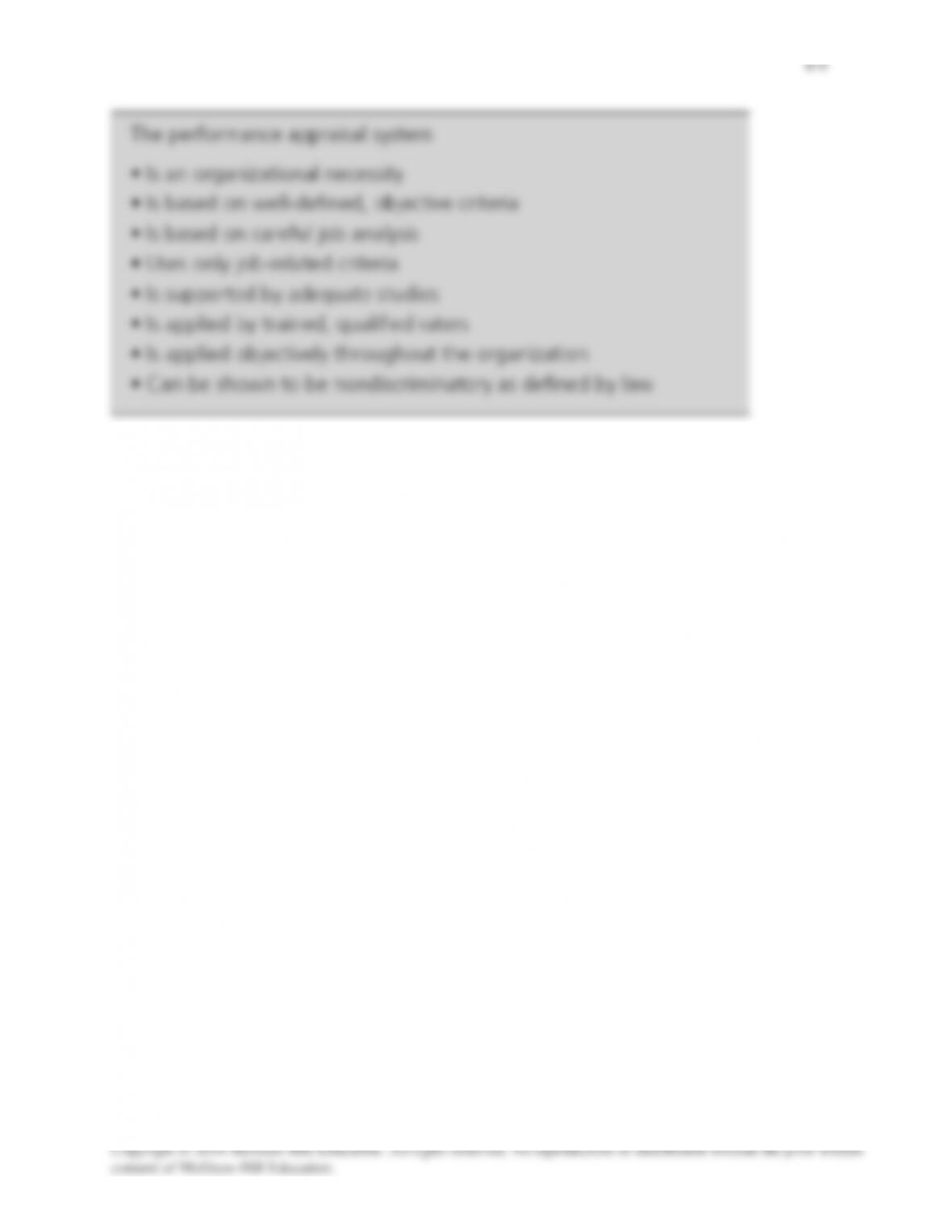
o Criteria for compliance with equal employment opportunity laws are stringent (Figure
6.4).
Copyright © 2014 McGraw-Hill Education. All rights reserved. No reproduction or distribution without the prior written
consent of McGraw-Hill Education.
Appraisal Philosophy
• A few decades ago, appraisal programs tended to emphasize employee traits, deficiencies,
and abilities, but modern appraisal philosophy emphasizes present performance and future
goals.
• Modern philosophy also stresses employee participation in mutually setting goals with the
supervisor and knowledge of results.
• The hallmarks of modern appraisal philosophy are as follows:
o Performance orientation—it is not enough for employees to put forth effort; that effort
must result in the attainment of desired outcomes.
o Focus on goals or objectives—employees need to have a clear idea of what they are
supposed to be doing and the priorities among their tasks.
o Mutual goal setting between supervisor and employee—this is the belief that people
will work harder for goals or objectives that they have participated in setting.
o Clarification of behavioral expectations—this is often done via a behaviorally
anchored rating scale (BARS), which provides the employee and managers with
concrete examples of various levels of behaviors.
▪ BARS help reduce a managers’ tendency to focus on attitudes, personality, and
quirks of employees and shift the emphasis toward productive behaviors.
o Extensive feedback systems—employees can fine-tune their performance if they know
how they are doing in the eyes of the organization, and receive this information
regularly and candidly.
The Appraisal Interview
• Most organizational appraisal systems require supervisors to assess employees on various
aspects of their productivity (results) and work-related behaviors.
• Many appraisal systems also point toward both historical performance and the individual’s
potential for growth and advancement.

6-10
• Some organizations (and the military) ask supervisors to write essays describing the
employee’s performance.
o Others recommend that they accumulate a record of critical incidents (both positive
and negative).
o Many firms use various types of graphic rating scales that grade employees on A-B-C-
D-E or 1-2-3-4-5 systems.
• Regardless of the system used, the assessment is then communicated to the employee in an
appraisal interview.
o This is a situation in which the supervisor:
▪ Provides feedback to the employee on past performance
▪ Discusses any problems that have arisen
▪ Invites a response
o In some organizations, the employee is informed about her or his future salary.
▪ In others, the pay issue is delayed until several months later.
o The appraisal interview also provides a rich opportunity to motivate the employees.
• Suggested Approaches
o Appraisal interviews are most likely to be successful when the appraiser:
▪ Is knowledgeable about the employee’s job
▪ Has previously set measurable performance standards
▪ Has gathered specific evidence about performance
• Some organizations in both the private and public sectors, include as a formal part of the
process, self-appraisal.
o This is an opportunity for employees to be introspective and to offer a personal
assessment of his or her accomplishments, strengths, and weaknesses.
o This approach allows differences of opinion to be discussed openly and resolved.
• However, problems can arise in self-appraisals.
o Some poor performers tend to diminish their level of difficulties and attribute their
problems to situational factors around them.
o A few rate themselves too leniently or try to impress their manager by stretching the
truth.
• However, the limitations are offset by the fact that most employees are quite candid when
asked to identify their strengths and weaknesses, and are able to accurately compare their
performance with previous expectations.
o In addition, self-assessments are much is less threatening to one’s self-esteem than

6-11
those received from others.
Performance Feedback
• All appraisal systems build on the assumption that employees need feedback about their
performance.
• Generally, performance feedback leads to both improved performance and improved
attitudes—if handled by the proper manager.
• Feedback has the greatest chance for inducing a behavioral change if:
o It is desired genuinely desired by the employee
o It is connected to job tasks
o The receiver is allowed to choose a new behavior from alternative recommendations
offered
• A more contemporary approach to appraisals is to combine the features of electronic
monitoring of performance with electronic feedback.
o These software systems allow data collection that is detailed, unobtrusive, and
continuous, while also accumulating information from a variety of sources in real time.
• In spite of the importance of performance feedback, many managers fail to provide enough of
it on an ongoing basis.
o They may feel too busy.
o They may assume that employees are already aware of their performance level.
o They may be reluctant to share bad news because of the negative reaction they expect it
to generate.
• Another possible reason for poor feedback—not having enough valid information to create a
substantive conclusion—can be overcome by the use of 360-degree feedback.
o This is the process of systematically gathering data on a person’s skills, abilities, and
behaviors from a variety of sources—the manager, peers, subordinates, and even
customers or clients.
o The results can be compared across time to see if improvements have been made or
compared with organizational norms to see if a person is better or worse than others.
o The 360-degree feedback system works best if individuals match the data gathered with
their own self-assessments, for this approach encourages candid confrontation of one’s
o However, 360-degree feedback programs can be time-consuming, intimidating to
recipients, and expensive (development and administration of rating forms and training
in how to use them).
• Praise is the provision of approval or admiration for an employee’s positive qualities or

6-12
worthwhile achievements.
o Many workers have a strong desire to be valued and have their contributions be
acknowledged, and therefore they crave praise.
o Timely, meaningful and personalized praise communicates a strong message to both
the recipient and the entire organization, adds to feelings of self-esteem and self-
efficacy, and builds stronger employee commitment.
• Appraisal Problems
o The need to perform the multiple functions in the appraisal process makes the appraisal
interview difficult and even threatening for managers.
o In addition, several behavioral problems are inherent in the process.
▪ It can be confrontational, because each party is trying to convince the other that
her or his view is more accurate.
▪ It is typically emotional since the manager’s role calls for a critical perspective,
while the employee’s desire to save face easily leads to defensiveness.
▪ It is judgmental, because the manager must evaluate the employee’s behavior and
results, and this aspect places the employee in a subordinate position.
▪ It is a complex task for managers, requiring job understanding, careful
observation of performance, and sensitivity to the needs of employees.
o Managers sometimes fail to conduct effective appraisal interviews because they lack
vital skills.
▪ Perhaps they failed to gather data systematically.
▪ Maybe they weren’t specific on the expected performance improvements in the
previous appraisal.
the ratings and feedback given.
o All these factors can place powerful limits on the usefulness of the appraisal interview,
unless it is conducted properly or modified through the use of other inputs.
• Nature of Attributions
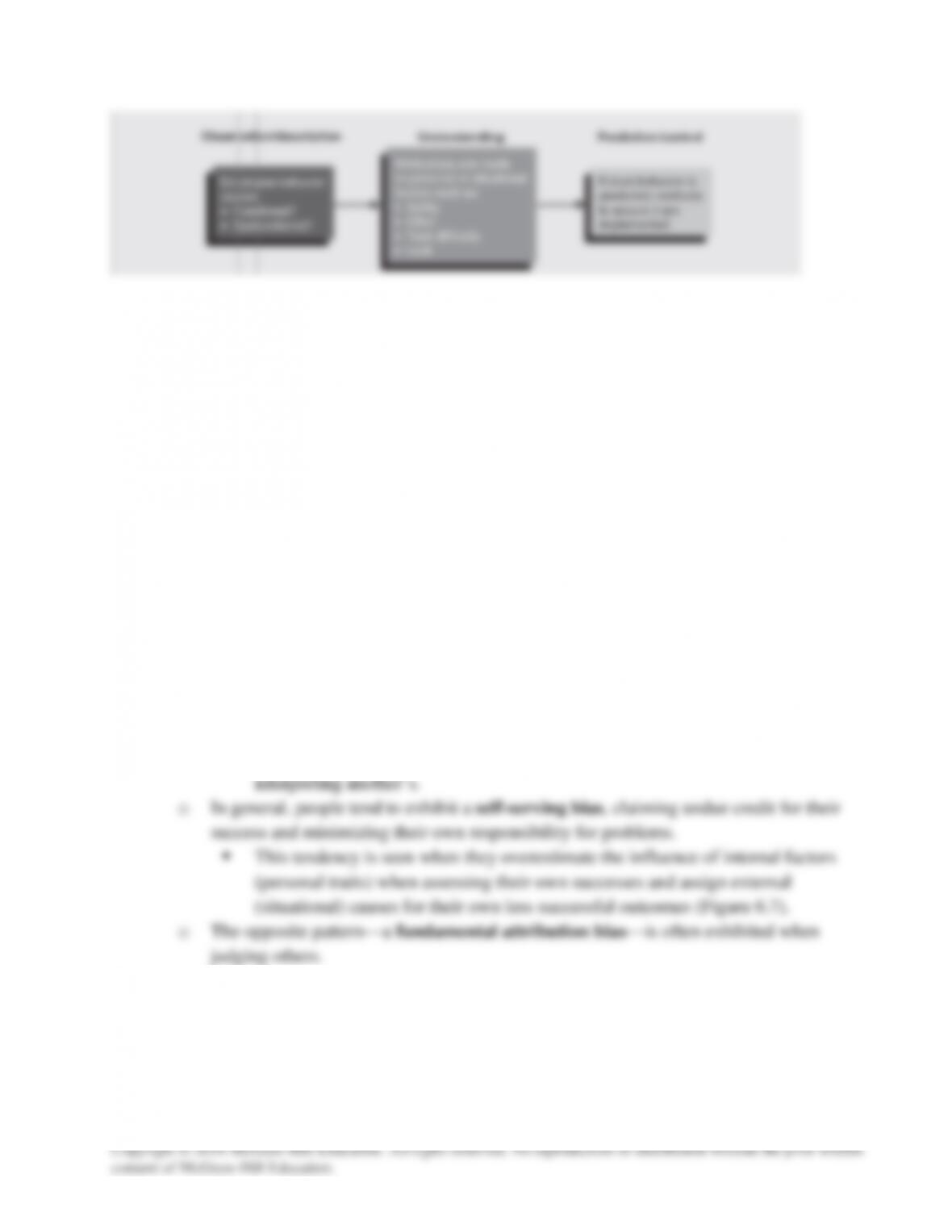
o Attribution is the process by which people interpret and assign causes for their own
and others’ behavior (Figure 6.6).
6-13
Copyright © 2014 McGraw-Hill Education. All rights reserved. No reproduction or distribution without the prior written
consent of McGraw-Hill Education.
o The attribution process closely parallels the four basic goals of organizational behavior.
▪ A manager observes some employee’s behavior or its consequences and often
describes it as functional or dysfunctional for the work unit.
▪ Seeking to understand and diagnose the behavior, the manager makes a casual
attribution for it.
▪ Then, the manager tries to predict and control future employee behaviors as a
product of that attribution.
o The assessment of functionality results in several potential explanations for an
employee’s performance on a task.
▪ It could be high or low ability, to greater or lesser effort, to a difficult or easy
task, or to good or poor luck.
o Ability and effort are personal attributions.
▪ They tend to be given as explanations when there is a judgment of high
consistency, low distinctiveness, and low consensus.
o Task difficulty and luck are situational attributions.
▪ They tend to be used as explanations when the behavior stands out as distinctive
and different from that of peers, while also being inconsistent.
o Attributions are subjective assessments.
▪ One important factor is whether we are evaluating our own behavior or
▪ The interpersonal comparison process is at work, with each party trying to
improve his or her own relative self-image by manipulating assessments and
attributions.
o Attributional tendencies accent the existing role differences between managers and
employees, and these biases emerge during managerial appraisals of employees.
• Related Ideas