Solutions Manual Orbital Mechanics for Engineering Students Third Edition Chapter 5
Howard D. Curtis 224 Copyright © 2013, Elsevier, Inc.
global mu
deg = pi/180;
mu = 398600;
Re = 6378;
f = 1/298.26;
%...Data declaration for Problem 5.25:
H = 0.5;
phi = 60*deg;
t = [ 0 300 600];
ra = [157.783 159.221 160.526]*deg;
dec = [24.2403 27.2993 29.8982]*deg;
theta = [ 150 151.253 152.507]*deg;
%…
%...Equations 5.56, 5.57:
fac1 = Re/sqrt(1-(2*f – f*f)*sin(phi)^2);
fac2 = (Re*(1-f)^2/sqrt(1-(2*f – f*f)*sin(phi)^2) + H)*sin(phi);
for i = 1:3
R(i,1) = (fac1 + H)*cos(phi)*cos(theta(i));
R(i,2) = (fac1 + H)*cos(phi)*sin(theta(i));
R(i,3) = fac2;
rho(i,1) = cos(dec(i))*cos(ra(i));
rho(i,2) = cos(dec(i))*sin(ra(i));
rho(i,3) = sin(dec(i));
end
%...Algorithms 5.5 and 5.6:
[r, v, r_old, v_old] = gauss(rho(1,:), rho(2,:), rho(3,:), ...
R(1,:), R(2,:), R(3,:), ...
t(1), t(2), t(3));
%...Echo the input data and output the solution to
% the command window:
fprintf(‘–——–—–——––—–—–—–——–—–——–—–——––—––—–‘)
fprintf(‘\n Problems 5.25 and 5.26: Orbit determination‘)
fprintf(‘\n by the Gauss method\n’)
fprintf(‘\n Radius of earth (km) = %g‘, Re)
fprintf(‘\n Flattening factor = %g‘, f)
fprintf(‘\n Gravitational parameter (km^3/s^2) = %g‘, mu)
fprintf(‘\n\n Input data:\n‘);
fprintf(‘\n Latitude (deg) of tracking site = %g‘, phi/deg);
fprintf(‘\n Altitude (km) above sea level = %g‘, H);
fprintf(‘\n\n Observations:‘)
fprintf(‘\n Right‘)
fprintf(‘ Local’)
fprintf(‘\n Time (s) Ascension (deg) Declination (deg)’)
fprintf(‘ Sidereal time (deg)‘)
for i = 1:3
fprintf(‘\n %9.4g %11.4f %19.4f %20.4f‘, ...
t(i), ra(i)/deg, dec(i)/deg, theta(i)/deg)
end
fprintf(‘\n\n Solution:\n’)
fprintf(‘\n Without iterative improvement (Problem 5.25)...\n’)
fprintf(‘\n r (km) = [%g, %g, %g]’, r_old(1), r_old(2), r_old(3))
fprintf(‘\n v (km/s) = [%g, %g, %g]’, v_old(1), v_old(2), v_old(3))
fprintf(‘\n’);
Solutions Manual Orbital Mechanics for Engineering Students Third Edition Chapter 5
Howard D. Curtis 225 Copyright © 2013, Elsevier, Inc.
fprintf(‘\n\n With iterative improvement (Problem 5.26)...\n’)
fprintf(‘\n r (km) = [%g, %g, %g]’, r(1), r(2), r(3))
fprintf(‘\n v (km/s) = [%g, %g, %g]’, v(1), v(2), v(3))
fprintf(‘\n-—–—–——––—–—–—–——–—–——–—–——––—–—–—-\n’
–—–—–—–——–—–——–—–——–––—––—–——–—–——–
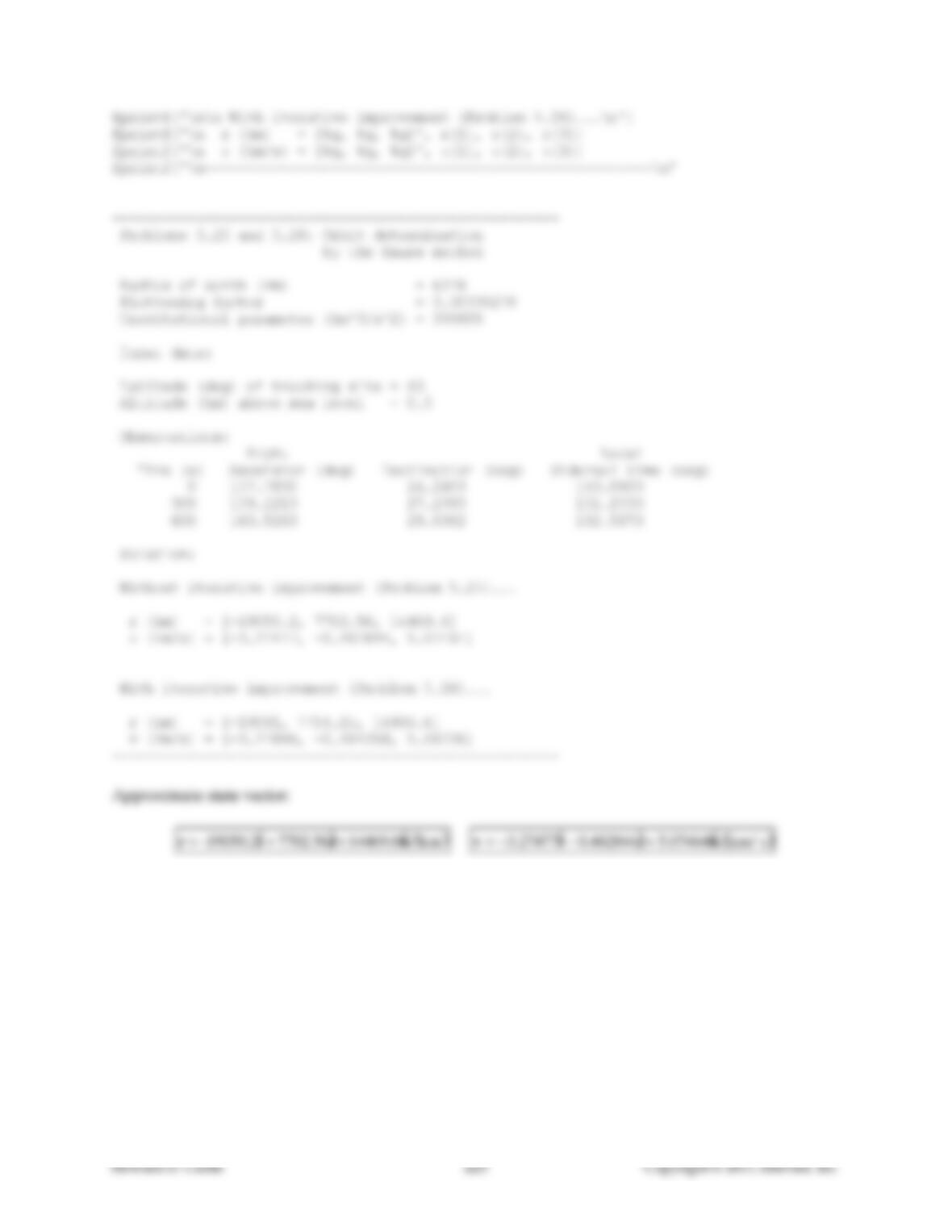
Problems 5.25 and 5.26: Orbit determination
by the Gauss method
Radius of earth (km) = 6378
Flattening factor = 0.00335278
Gravitational parameter (km^3/s^2) = 398600
Input data:
Latitude (deg) of tracking site = 60
Altitude (km) above sea level = 0.5
Observations:
Right Local
Time (s) Ascension (deg) Declination (deg) Sidereal time (deg)
0 157.7830 24.2403 150.0000
300 159.2210 27.2993 151.2530
600 160.5260 29.8982 152.5070
Solution:
Without iterative improvement (Problem 5.25)...
r (km) = [-19050.2, 7702.56, 14469.6]
v (km/s) = [-3.27477, –0.482844, 5.07464]
With iterative improvement (Problem 5.26)...
r (km) = [-19081, 7714.25, 14486.6]
v (km/s) = [-3.27846, –0.484358, 5.08206]
–—–—–—–——–—–——–—–——–––—––—––——–—–——
Approximate state vector:
r–19050.2ˆ
I7702.56ˆ
J14469.6 ˆ
K km
v 3.27477ˆ
I0.482844ˆ
J5.07464 ˆ
K km/ s
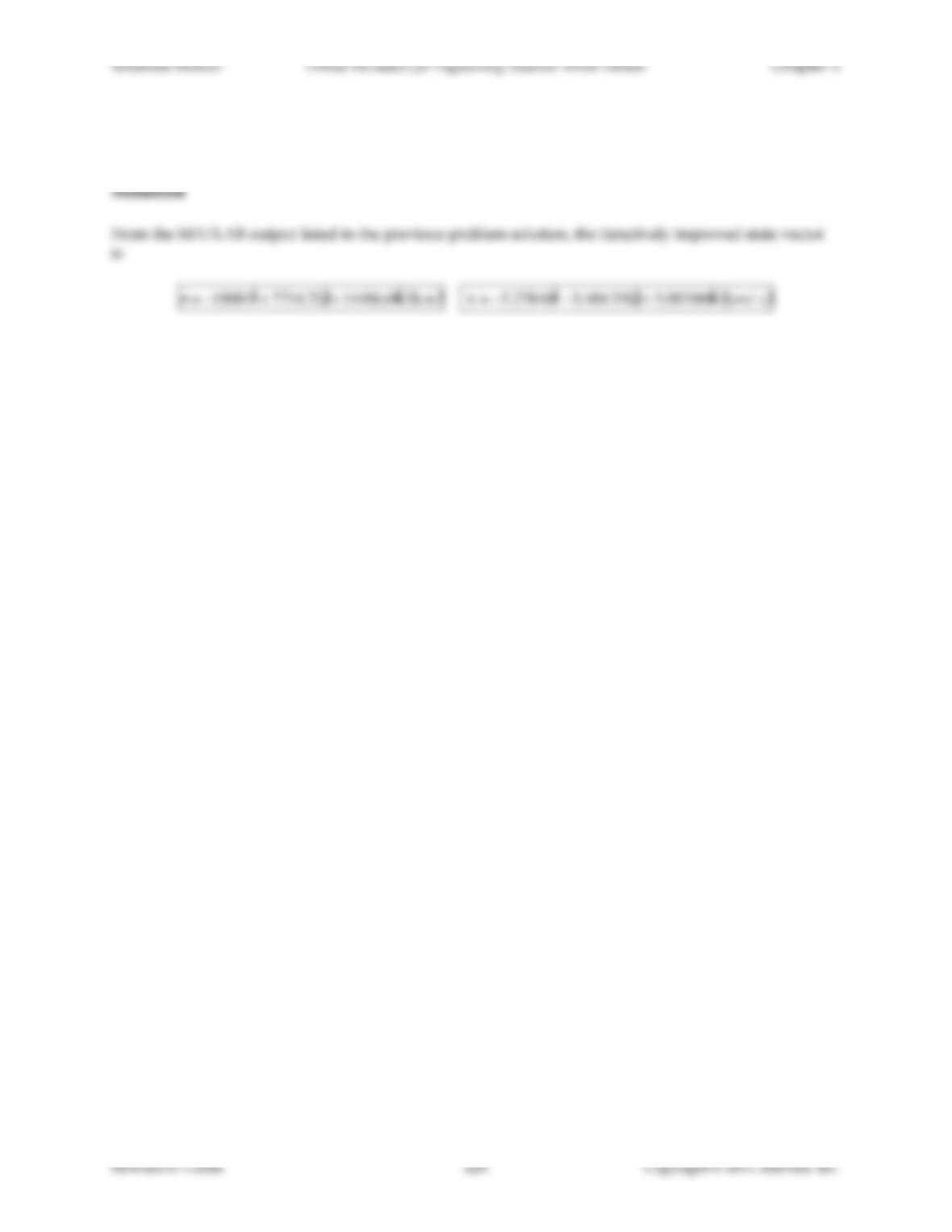
Problem 5.26 Refine the estimate in the previous problem using iterative improvement.
r 19081ˆ
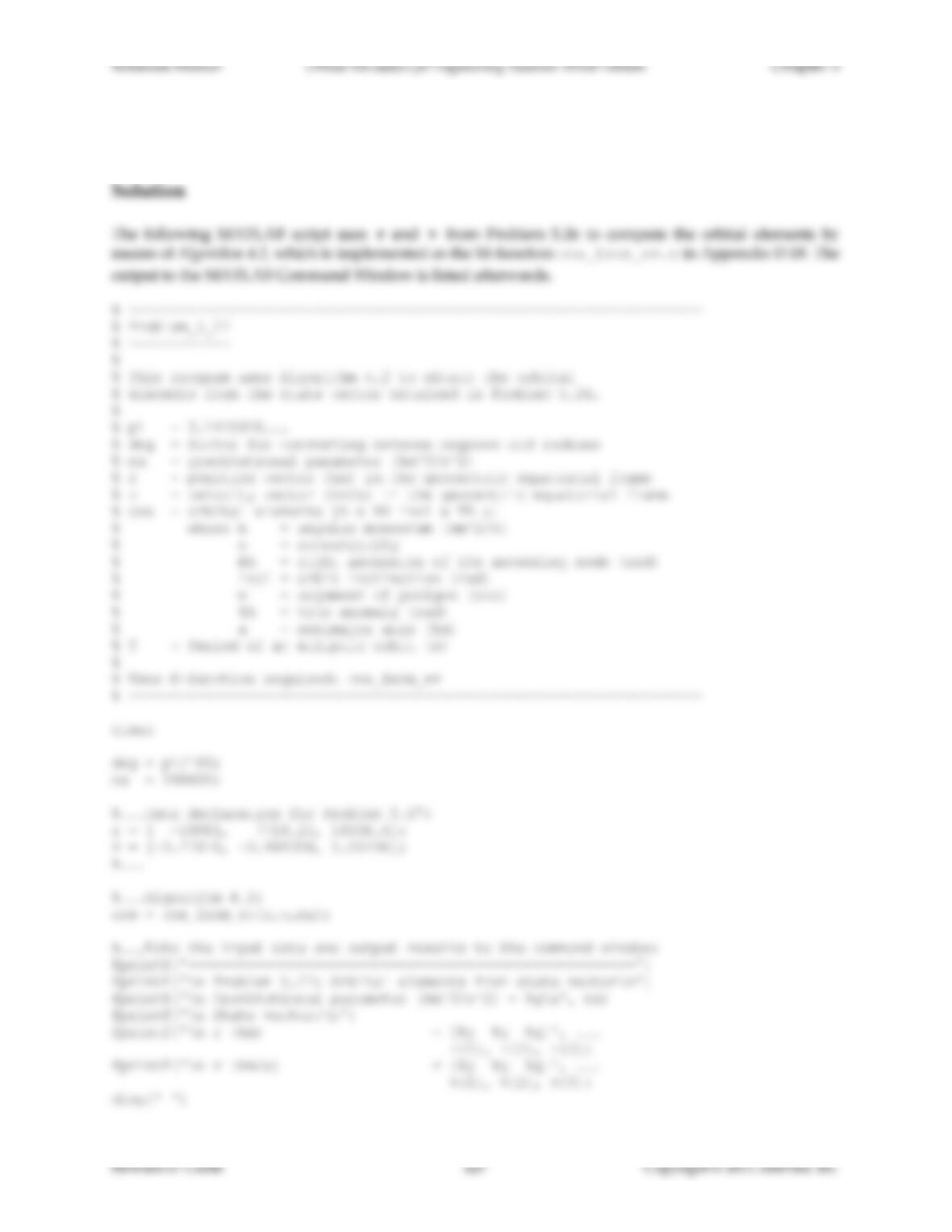
Problem 5.27 Calculate the orbital elements from the state vector obtained in the previous problem.
Solutions Manual Orbital Mechanics for Engineering Students Third Edition Chapter 5
Howard D. Curtis 228 Copyright © 2013, Elsevier, Inc.
fprintf(‘\n Angular momentum (km^2/s) = %g’, coe(1))
fprintf(‘\n Eccentricity = %g’, coe(2))
fprintf(‘\n Right ascension (deg) = %g‘, coe(3)/deg)
fprintf(‘\n Inclination (deg) = %g’, coe(4)/deg)
fprintf(‘\n Argument of perigee (deg) = %g’, coe(5)/deg)
fprintf(‘\n True anomaly (deg) = %g’, coe(6)/deg)
fprintf(‘\n Semimajor axis (km): = %g’, coe(7))
%...if the orbit is an ellipse, output its period (Equation 2.73):
if coe(2)<1
T = 2*pi/sqrt(mu)*coe(7)^1.5;
fprintf(‘\n Period:‘)
fprintf(‘\n Seconds = %g’, T)
fprintf(‘\n Minutes = %g’, T/60)
fprintf(‘\n Hours = %g’, T/3600)
fprintf(‘\n Days = %g’, T/24/3600)
end
fprintf(‘\n-—–—–——––—–—–—–——–—–——–—–——––—–—–—-\n’)
–—–—–—–——–—–——–—–——–––—––—––——–—–——
Problem 5.27: Orbital elements from state vector
Gravitational parameter (km^3/s^2) = 398600
State vector:
r (km) = [–19081 7714.25 14486.6]
v (km/s) = [–3.27846 –0.484358 5.08206]
Angular momentum (km^2/s) = 76005.8
Eccentricity = 1.08937
Right ascension (deg) = 136.949
Inclination (deg) = 62.9772
Argument of perigee (deg) = 287.335
True anomaly (deg) = 112.915
Semimajor axis (km): = –77612.3
–—–—–—–——–—–——–——–—–——–—–—–——–—–—–
Orbital elements:
h76 005.8 km 2s
e1.08937
136.949
i62.9772
287.335
112.915
Problem 5.28 The position vector
R
of a tracking station and the direction cosine vector
ˆ
of a sat-
ellite relative to the tracking station at three times are as follows:
t10 min
R15582.84ˆ
I3073.90 ˆ
K (km )
ˆ
10.846 428ˆ
I0.532 504 ˆ
K
t25 min
R25581.50ˆ
I122.122ˆ
J3073.90 ˆ
K (km)
ˆ
20.749 290ˆ
I0.463023ˆ
J0.473 470 ˆ
K
t310 min
R35577.50ˆ
I244.186ˆ
J3073.90 ˆ
K (km)
ˆ
30.529 447ˆ
I0.777163ˆ
J0.340152 ˆ
K
Use the Gauss method without iterative improvement to estimate the state vector of the satellite.
Solutions Manual Orbital Mechanics for Engineering Students Third Edition Chapter 5
Howard D. Curtis 230 Copyright © 2013, Elsevier, Inc.
%...Data declaration for Problem 5.28:
t = [ 0 300 600];
R = [ 5582.84 0 3073.90
5581.50 122.122 3073.90
5577.50 244.186 3073.90];
rho = [ 0.846428, 0, 0.532504
0.749290, 0.463023, 0.473470
0.529447, 0.777163, 0.340152];
%…
%...Algorithms 5.5 and 5.6:
[r, v, r_old, v_old] = gauss(rho(1,:), rho(2,:), rho(3,:), ...
R(1,:), R(2,:), R(3,:), ...
t(1), t(2), t(3));
%...Echo the input data and output the solution to
% the command window:
fprintf(‘–——–—–——––—–—–—–——–—–——–—–——––—––—–‘)
fprintf(‘\n Problems 5.28 and 5.29: Orbit determination’)
fprintf(‘\n by the Gauss method\n’)
fprintf(‘\n Gravitational parameter (km^3/s^2) = %g‘, mu)
fprintf(‘\n\n Input data:\n‘);
fprintf(‘\n Site position vector (R) and space object‘)
fprintf(‘\n direction cosine vector (rho) at three times:\n‘)
for i = 1:3
fprintf(‘\n t = %g s:\n‘,t(i))
fprintf(‘\n R = [%g %g %g]‘, R(i,1), R(i,2), R(i,3))
fprintf(‘\n rho = [%g %g %g]‘, rho(i,1), rho(i,2), rho(i,3))
disp(‘ ‘)
end
fprintf(‘\n\n Solution:\n’)
fprintf(‘\n Without iterative improvement (Problem 5.28)...\n’)
fprintf(‘\n r (km) = [%g, %g, %g]’, r_old(1), r_old(2), r_old(3))
fprintf(‘\n v (km/s) = [%g, %g, %g]’, v_old(1), v_old(2), v_old(3))
fprintf(‘\n’);
fprintf(‘\n\n With iterative improvement (Problem 5.29)...\n’)
fprintf(‘\n r (km) = [%g, %g, %g]’, r(1), r(2), r(3))
fprintf(‘\n v (km/s) = [%g, %g, %g]’, v(1), v(2), v(3))
fprintf(‘\n-—–—–——––—–—–—–——–—–——–—–——––—–—–—-\n’)
–—–—–—–——–—–——–—–——–––—––—––———–——–
Problems 5.28 and 5.29: Orbit determination
by the Gauss method
Gravitational parameter (km^3/s^2) = 398600
Input data:
Site position vector (R) and space object
direction cosine vector (rho) at three times:
t = 0 s:
R = [5582.84 0 3073.9]
rho = [0.846428 0 0.532504]
Solutions Manual Orbital Mechanics for Engineering Students Third Edition Chapter 5
Howard D. Curtis 231 Copyright © 2013, Elsevier, Inc.
t = 300 s:
R = [5581.5 122.122 3073.9]
rho = [0.74929 0.463023 0.47347]
t = 600 s:
R = [5577.5 244.186 3073.9]
rho = [0.529447 0.777163 0.340152]
Solution:
Without iterative improvement (Problem 5.28)...
r (km) = [8282.6, 1791.26, 4780.7]
v (km/s) = [-1.07108, 5.89508, -0.618321]
With iterative improvement (Problem 5.29)...
r (km) = [8306.27, 1805.89, 4795.66]
v (km/s) = [-1.07872, 5.94219, –0.622807]
–—–—–—–——–—–——–—–——–––—––—––——–—–——
Approximate state vector:
r8282.6ˆ
I1791.26ˆ
J4780.7 ˆ
Kkm
v 1.07108ˆ
I5.89508ˆ
J0.618 321 ˆ
Kkm/ s
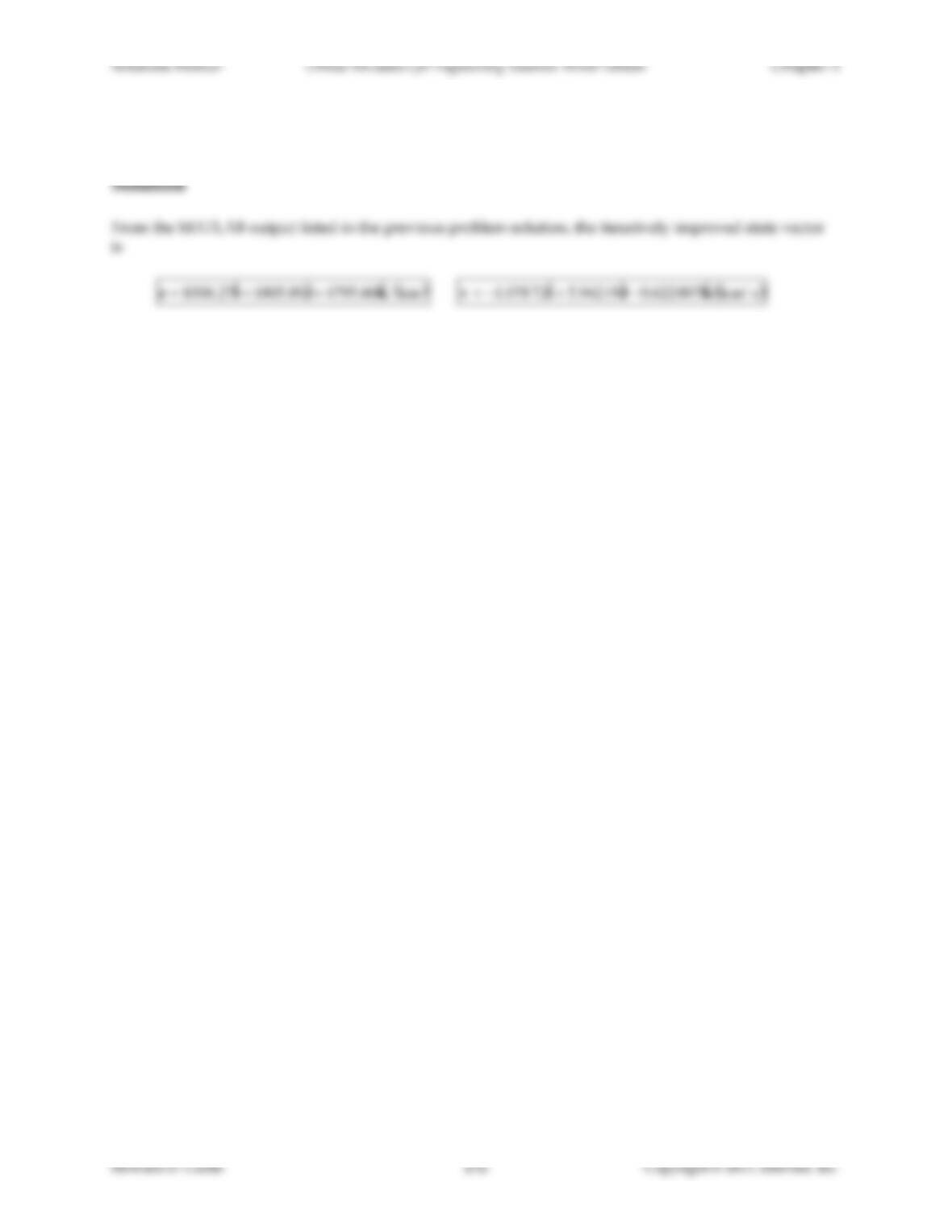
Problem 5.29 Refine the estimate in the previous problem using iterative improvement.
r8306.27ˆ
Problem 5.30 Calculate the orbital elements from the state vector obtained in the previous problem.
Solutions Manual Orbital Mechanics for Engineering Students Third Edition Chapter 5
Howard D. Curtis 234 Copyright © 2013, Elsevier, Inc.
fprintf(‘\n Eccentricity = %g’, coe(2))
fprintf(‘\n Right ascension (deg) = %g’, coe(3)/deg)
fprintf(‘\n Inclination (deg) = %g’, coe(4)/deg)
fprintf(‘\n Argument of perigee (deg) = %g’, coe(5)/deg)
fprintf(‘\n True anomaly (deg) = %g‘, coe(6)/deg)
fprintf(‘\n Semimajor axis (km): = %g’, coe(7))
%...if the orbit is an ellipse, output its period (Equation 2.73):
if coe(2)<1
T = 2*pi/sqrt(mu)*coe(7)^1.5;
fprintf(‘\n Period:‘)
fprintf(‘\n Seconds = %g‘, T)
fprintf(‘\n Minutes = %g’, T/60)
fprintf(‘\n Hours = %g’, T/3600)
fprintf(‘\n Days = %g’, T/24/3600)
end
fprintf(‘\n-—–—–——––—–—–—–——–—–——–—–—–—–—–——–\n‘)
–—–—–—–——–—–——–—–——–––—––—––——–—–——
Problem 5.30: Orbital elements from state vector
Gravitational parameter (km^3/s^2) = 398600
State vector:
r (km) = [8306.27 1805.89 4795.66]
v (km/s) = [-1.07872 5.94219 –0.622807]
Angular momentum (km^2/s) = 59242.6
Eccentricity = 0.0995646
Right ascension (deg) = 270
Inclination (deg) = 30.0002
Argument of perigee (deg) = 269.945
True anomaly (deg) = 190.718
Semimajor axis (km): = 8893.18
Period:
Seconds = 8346.36
Minutes = 139.106
Hours = 2.31843
Days = 0.0966014
–—–—–—–——–—–——–—–——–––—––—––———–——–
Orbital elements:
h59 242.6 km 2s
e0.0995646
270
i30.0002
269.945
190.718