
5-1
Chapter 5
Motivation
Chapter Overview
The chapter explains and describes the underlying dynamics of the motivation process. First, a
model of motivation is presented. The model depicts the role of needs in the motivational process.
Next, a comprehensive description and discussion of Maslow’s hierarchy of needs is presented,
which is followed by a discussion of Herzberg’s two factor theory and Alderfer’s E-R-G model. The
final part provides a description of the basic principles of behavior modification, types of
reinforcement schedules, and goal setting.
Chapter Learning Objectives
After reading this chapter, students should understand:
1. The motivational process
2. Motivational drives
3. Need category systems
4. Behavior modification and reinforcement
5. Goal setting and its effects
6. The expectancy model of motivation
7. Equity comparisons
Discussion and Project Ideas
The following exercises should help deliver the concepts discussed in this chapter to the students.
• Describe a person sitting in a local restaurant eating a large steak. Ask the class what need this
person is fulfilling. Most will say hunger. Needs for status, affiliation, and power, however, are
also possible. Use this example to lead a discussion on the difficulty of inferring needs from
behavior and the complex interaction of needs which determine behavior.
• Have students bring to class one-half page descriptions of behaviors they would like to change
in an individual or a group. Form groups of four or five. Have the students trade their
descriptions and select one person’s problem to work on as a group. Ask the groups to go
through the following four-step process and present its problems and strategies for behavior
change to the class:
o Pinpoint the behavior they wish to change.
o Identify environmental consequences presently reinforcing and/or punishing the
5-2
behavior.
o Suggest additional reinforcers or punishment which might influence the frequency of the
behavior.
o Design a strategy to change behavior by adding additional reinforcers to desirable
behavior and eliminating anything which is punishing the desired behavior. Also suggest
strategies for eliminating anything which may be reinforcing undesired behavior.
• Divide the class in two and conduct a debate with one side taking the position that proper
management of behavioral contingencies would lead to an optimally positive and productive
environment. The other side should take the position that behavior modification denies free
will, infringes on people’s basic rights, and is untenable as a strategy for motivating complex
organisms.
• Negotiate a trade with a professor from the social sciences who specializes in behavior
modification applications. The arrangement would be that you would explain behavior
modification applications in the business area of his or her class if he or she will go over some
of the finer points of developing, structuring, and implementing a behavior modification
intervention with your class.
• Have the class bring in pictures of status symbols in an organization. How many symbols are
representing executive, managerial, and staff positions?
Lecture Outline
Introduction
• Motivation takes place within a culture, reflects an organizational behavior model, and
requires excellent communication skills.
• The four major indicators of employee motivation that are commonly monitored by employers
• Work Motivation is the result of a set of internal and external forces that cause an employee to
choose an appropriate course of action and engage in certain behaviors.
• Work motivation is a complex combination of psychological forces within each person, and
employers are vitally interest in three elements of it:
o Direction and focus of the behavior
o Level of the effort
o Persistence of the behavior
5-3
• Motivation requires discovering and understanding employee drives and needs, since it
originated within an individual.
o Positive acts performed for the organization need to be reinforced.
o Employees will be more motivated when they have clear goals to achieve.
• It is equally important to uncover the factors at work that act to demotivate employees and
diminish their enthusiasm for high performance.
• Common managerial behaviors that detract from motivation include:
o Tolerating poor performance by incompetent or lazy coworkers
o Leveling undue criticism at employees
o Failing to provide clear expectations
o Making false promises of incentives available
o Unfair distribution of rewards (favoritism)
o Hours spent in unproductive meetings
A Model of Motivation
• Although a few spontaneous human activities occur without motivation, nearly all conscious
behavior is motivated or caused.
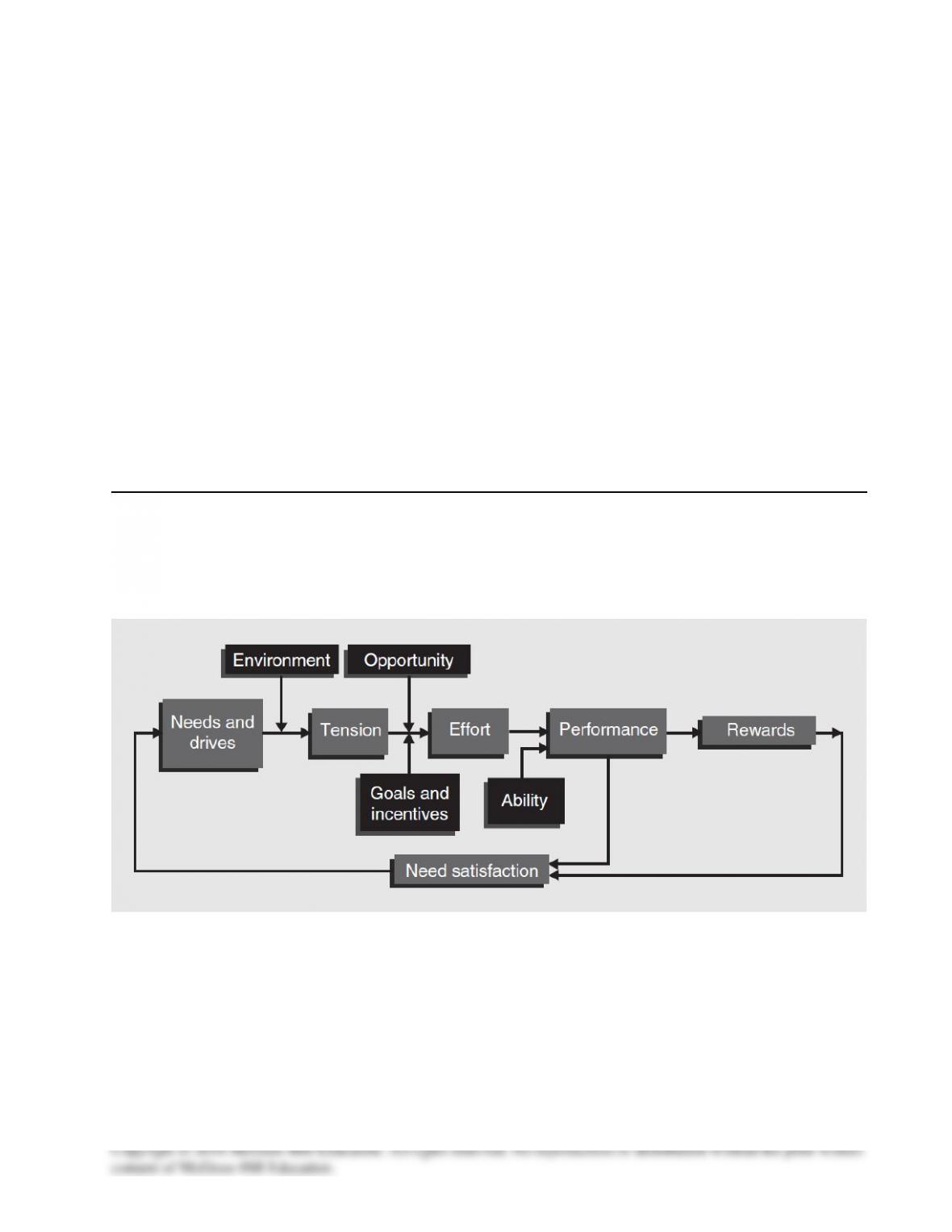
• The role of motivation in performance is summarized in Figure 5.1.
• Internal needs and drives create tensions that are affected by one’s environment.
• Potential performance (PP) is a product of ability (A) and motivation (M).
o Results occur when motivated employees have the opportunity to perform and the
resources to do so.
o The presence of goals and the awareness of incentives to satisfy one’s needs are also
powerful motivational factors leading to the release of effort (motivation).
o The amount of effort that employees expend is also directly affected by whether they are

5-4
energized or fatigued.
o High-energy workers are alert, spirited, and enthusiastic; they feel vitalized and are
eager to act.
o Fatigued workers act tired, sluggish, and feel emotionally depleted.
• Personal strategies for energy management fall into three categories:
o Learning (acquiring new information or skills; setting new goals; identifying sources of
joy at work).
o Relationship development (helping colleagues; demonstrating gratitude to others; seeking
and acting on feedback)
o Finding meaning at work (reflecting on one’s significance and impact at work)
• When an employee is productive and the organization takes note of it, rewards will be
distributed.
o If those rewards are appropriate in nature, timing, and distribution, the employee’s
original needs and drives are satisfied.
Motivational Drives
• People tend to develop certain motivational drives (strong desires for something) as a product
of the cultural environment in which they live.
o These acquired drives affect how people view their jobs and approach their lives.
o Much of the interest in these patterns of motivation was generated by David C.
McClelland of Harvard University.
• McClelland’s research focused on the drives for achievement, affiliation, and power.
• In most nations, one or two of the motivational patterns tend to be strong among workers
because they have grown up with similar backgrounds.
Achievement Motivation
• Achievement motivation is a drive some people have to pursue and attain challenging goals.
o Accomplishment is seen as important primarily for its own sake, not just the rewards
that accompany it.
• Achievement-oriented employees work harder when:
o They perceive that they will receive personal credit for effort
o The risk of failure is only moderate
o They receive specific feedback about past performance
• People with a high drive for achievement:
o Take responsibility for their actions and results
o Desire to control their destiny
o Seek regular feedback
o Enjoy being part of a winning achievement through individual or collective effort
• Achievement-oriented managers tend to expect that their employees will also be oriented

5-5
toward achievement.
o These high expectations sometimes make it difficult for achievement-oriented
managers to delegate effectively and for ‘average’ employees to satisfy manager’s high
demands.
Affiliation Motivation
• Affiliation motivation is a drive to relate to people on a social basis—to work with
compatible people and experience a sense of community.
• People with affiliation motives:
o Work better when they are complimented for their favorable attitudes and cooperation
o Tend to surround themselves with friends and likable people
• Managers with strong needs for affiliation may have difficulty being effective managers.
o Although a high concern for positive social relationships usually results in a
cooperative work environment where employees genuinely enjoy working together,
managerial overemphasis on the social dimension may interfere with the vital process
of getting things done.
o Affiliation-oriented managers may have difficulty assigning challenging tasks,
directing work activities, and monitoring work effectiveness.
Power Motivation
• Power motivation is a drive to influence people, take control, and change situations.
• Power-motivated people wish to create an impact on their organizations and are willing to
take risks to do so.
o Once the power is obtained, it may be used either constructively or destructively.
• Power-motivated people make excellent managers if their drives are for institutional power
instead of personal power.
• Institutional power is the need to influence others’ behavior for the good of the whole
organization.
o However, if an employee’s drives are toward personal power, that person tends to lose
the trust and respect of employees and colleagues and be an unsuccessful
organizational leader.
Managerial Application of the Drives
• Knowledge of the differences among the three motivational drives requires managers to think
contingently and understand the unique work attitudes of each employee.
o They can deal with employees differently based on the strongest motivational drive that
they identify in each employee.
Human Needs
5-6
• Like a machine, an employee who malfunctions does so because of definite causes that may be
related to needs
o If managers treated workers as well as they do expensive machines, they would have
more productive, and hence more satisfied workers.
Types of Needs
• Needs may be classified in various ways. A simple classification is:
o Basic physical needs called primary needs.
▪ The physical needs include food, water, sex, sleep, air, etc.
▪ These needs arise from the basic requirements of life and are important for
survival of the human race.
o Social and psychological needs called secondary needs.
▪ These needs are more vague because they represent needs of the mind and spirit.
▪ Many of these needs are acquired and developed as people mature.
▪ Examples are needs that pertain to self-esteem, sense of duty, competitiveness,
giving and receiving affection, self-assertion, etc.
• The secondary needs are those that complicate the motivational efforts of managers.
o Managerial planning should consider the effect of proposed actions on secondary needs
of employees.
• The following are the key conclusions about secondary needs:
o They are strongly conditioned by experience.
o They vary in type and intensity.
o They are subject to change across time within any individual.
o They cannot usually be isolated, but rather work in combination and influence one
• The theories of Maslow, Herzberg, and Alderfer build on the distinction between primary and
secondary needs.
Maslow’s Hierarchy of Needs
• According to A. H. Maslow, human needs are not of equal strength, and they emerge in a
predictable but rather fluid sequence.
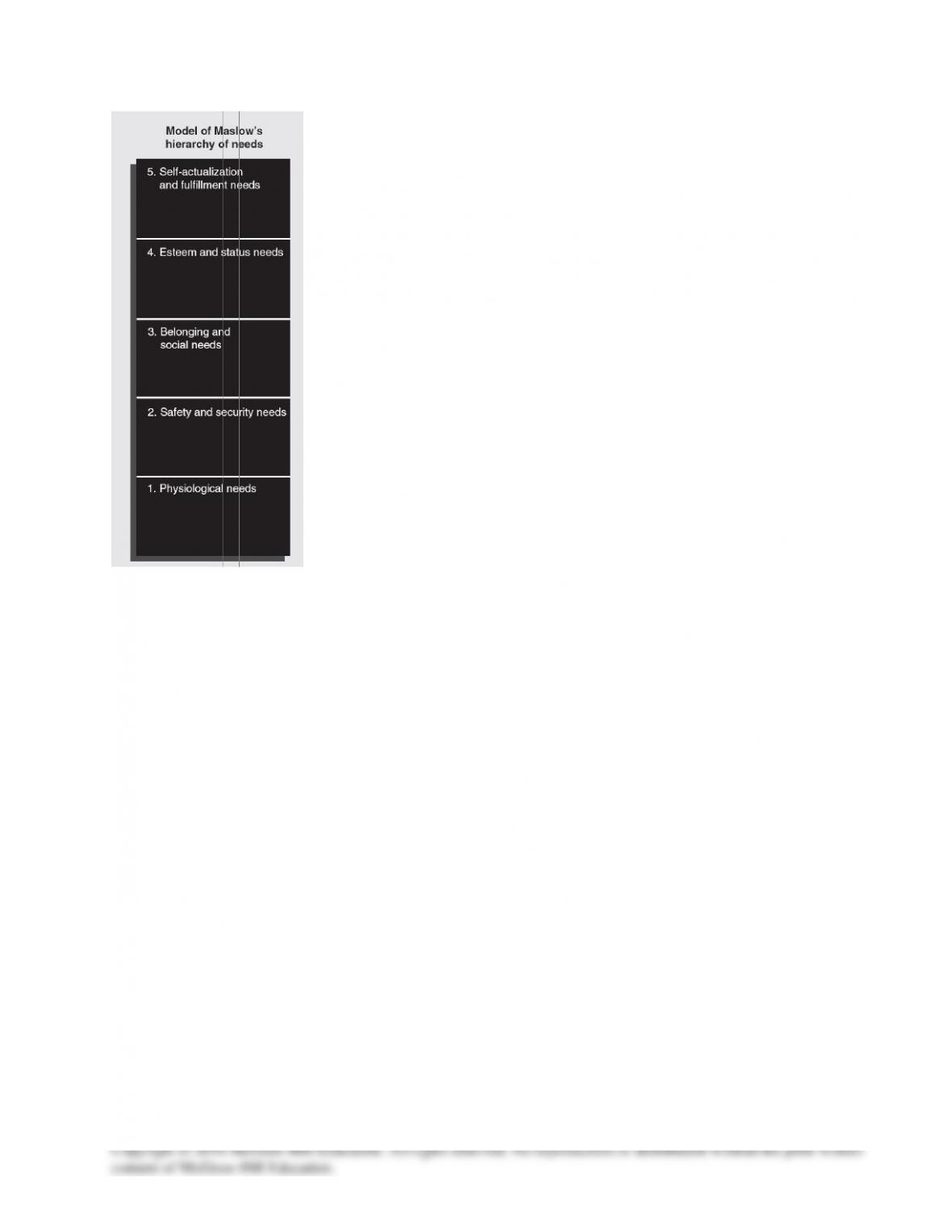
• Maslow’s hierarchy of needs identifies and focuses attention on five levels (Figure 5.3).
5-7
• Lower-Order Needs
o First-level needs involve basic survival and include physiological needs for food, air,
water, and sleep.
o The second need level that tends to dominate is bodily safety and economic security.
o These two need levels together are typically called lower-order needs, and they are
similar to the primary needs.
• Higher-Order Needs
o Three levels of higher-order needs exist:
▪ The third level concerns love, belonging, and social involvement at work.
▪ The needs at the fourth level encompass those for esteem and status, including
one’s feelings of self-worth and competence.
▪ The fifth level need is self-actualization, which is an ongoing process of
becoming all that one is capable of becoming, using one’s skills to the fullest,
having a rich combination of values and purpose, and stretching talents to the
maximum.
• Interpreting the Hierarchy of Needs
o Maslow’s need-hierarchy essentially says that people have a variety of needs they wish
to satisfy, multiple needs operate simultaneously, all need levels are often partially
satisfied, and that gratified needs are not as strongly motivating as unmet needs.
o Employees are more enthusiastically motivated by what they are currently seeking than
by receiving more of what they already have.
5-8
o Today’s managers need to:
▪ Identify and accept employee needs
▪ Recognize that needs differ among employees
▪ Offer satisfaction for the particular needs currently unmet
▪ Realize that giving more of the same reward may have diminishing impact on
motivation
• The Maslow model also has many limitations, and it has been sharply criticized.
o As a philosophical framework, it has been difficult to study and has not been fully
verified.
o From a practical perspective, it is not easy to provide opportunities for self-
actualization to all employees.
o Research has not supported the presence of all five need levels as unique, nor has the
five-step progression from lowest to highest need levels been established.
• There is some evidence that unless the two lower-order needs (physiological and security) are
basically satisfied, employees will not be greatly concerned with higher-order needs.
Herzberg’s Two-Factor Model
• On the basis of research with a group of engineers and accountants, Frederick Herzberg
developed a two-factor model of motivation.

5-9
o He asked the group members to think of a time when they felt especially good about
their jobs and a time when they felt especially bad about their jobs.
• Herzberg found that employees named different types of conditions that produced good and
bad feelings.
o If a feeling of achievement led to a good feeling, the lack of achievement was rarely
given as cause for bad feelings.
o Instead, some other factor, such as company policy, was the more frequently given
cause for bad feelings
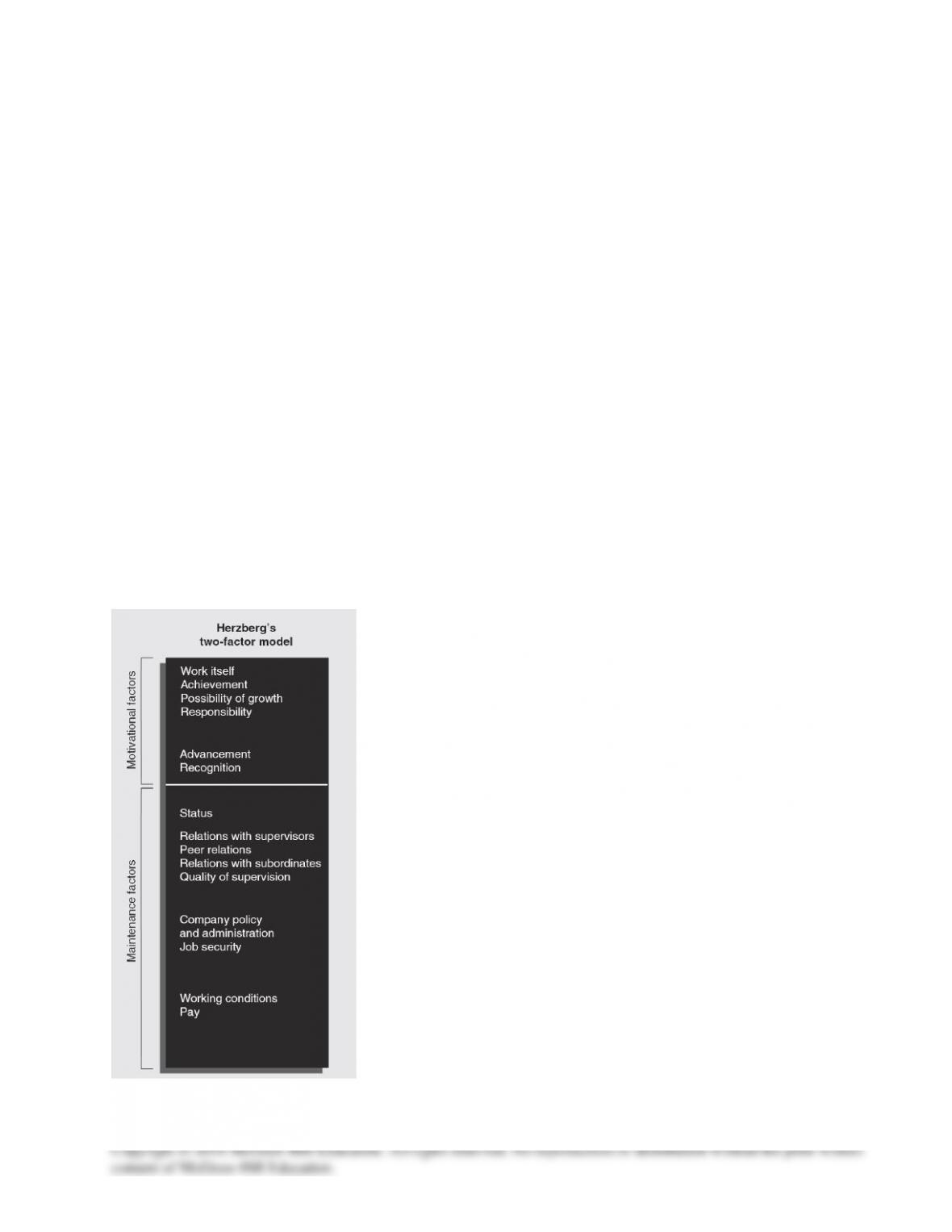
• Maintenance and Motivational Factors
o Herzberg concluded that two separate sets of factors influenced motivation.
▪ Prior to that time, people had assumed that motivation and lack of motivation
were merely opposites of one factor on a continuum.
o Herzberg upset the traditional view by stating that certain job factors dissatisfy
employees primarily when the conditions are absent.
▪ However, the presence of these factors generally brings employees only to a
neutral state.
▪ These potent dissatisfiers are called hygiene factors, or maintenance factors,
because they must not be ignored.
o Other job conditions operate primarily to build this motivation, but their absence rarely
is strongly dissatisfying.
▪ These conditions are known as motivational factors, motivators, or satisfiers.
• Job Content and Context
o Motivational factors, such as achievement and responsibility, are related, for the most
part, directly to the job itself, the employee’s performance, and the personal recognition
and growth that the employee experiences.
o Motivators mostly are job-centered, and relate to job content.
o Maintenance factors are mainly related to job context; because they are more related to
the environment surrounding the job.
o The difference between job content and job context is a significant one.
▪ It shows that employees are motivated primarily by what they do for themselves.
▪ When employees take responsibility or gain recognition through their own
behavior, they are strongly motivated.
• Intrinsic and Extrinsic Motivators
o Intrinsic motivators are internal rewards that a person feels when performing a job, so
there is a direct and often immediate connection between work and rewards.
▪ An employee in this situation is self-motivated.
o Extrinsic motivators are external rewards that occur apart from the nature of work,
providing no direct satisfaction at the time the work is performed.
▪ Examples are retirement plans, health insurance, and vacations.
▪ Although employees value these items, they are not effective motivators.

5-10
• Interpreting the Two-Factor Model
o Herzberg’s model provides a useful distinction between maintenance factors, which are
necessary but not sufficient, and motivational factors, which have greater potential for
improving employee effort.
▪ It broadened managers’ perspectives by showing the potentially powerful role of
intrinsic rewards that evolve from the work itself.
▪ This conclusion ties in with a number of other important behavioral
developments, such as job enrichment, empowerment, self-leadership, and
quality of work life.
o Managers cannot neglect a wide range of maintenance factors that create at least a
neutral work environment.
▪ Unless these hygiene factors are reasonably well addressed, their absence will
serve as significant distractions to workers.
o The Herzberg model has been widely examined and criticized, as well as defended.
▪ It is not universally applicable, because it was based on and applies best to
managerial, professional, and upper white-collar employees.
▪ The model also appears to reduce the motivational importance of pay, status, and
relations with others since these are maintenance factors.
❖ This aspect of the model is counterintuitive to many managers and difficult
for them to accept.
▪ Since there is no absolute and clear distinction between the effects of the two
major factors, the model outlines only general tendencies; maintenance factors
may be motivators to some people, and motivators may be maintenance factors to
others.
▪ The model also seems to be method-bound, meaning that only Herzberg’s
approach produces the two-factor model.
Alderfer’s E-R-G Model
• Building upon earlier need models (primarily Maslow’s) and seeking to overcome some of
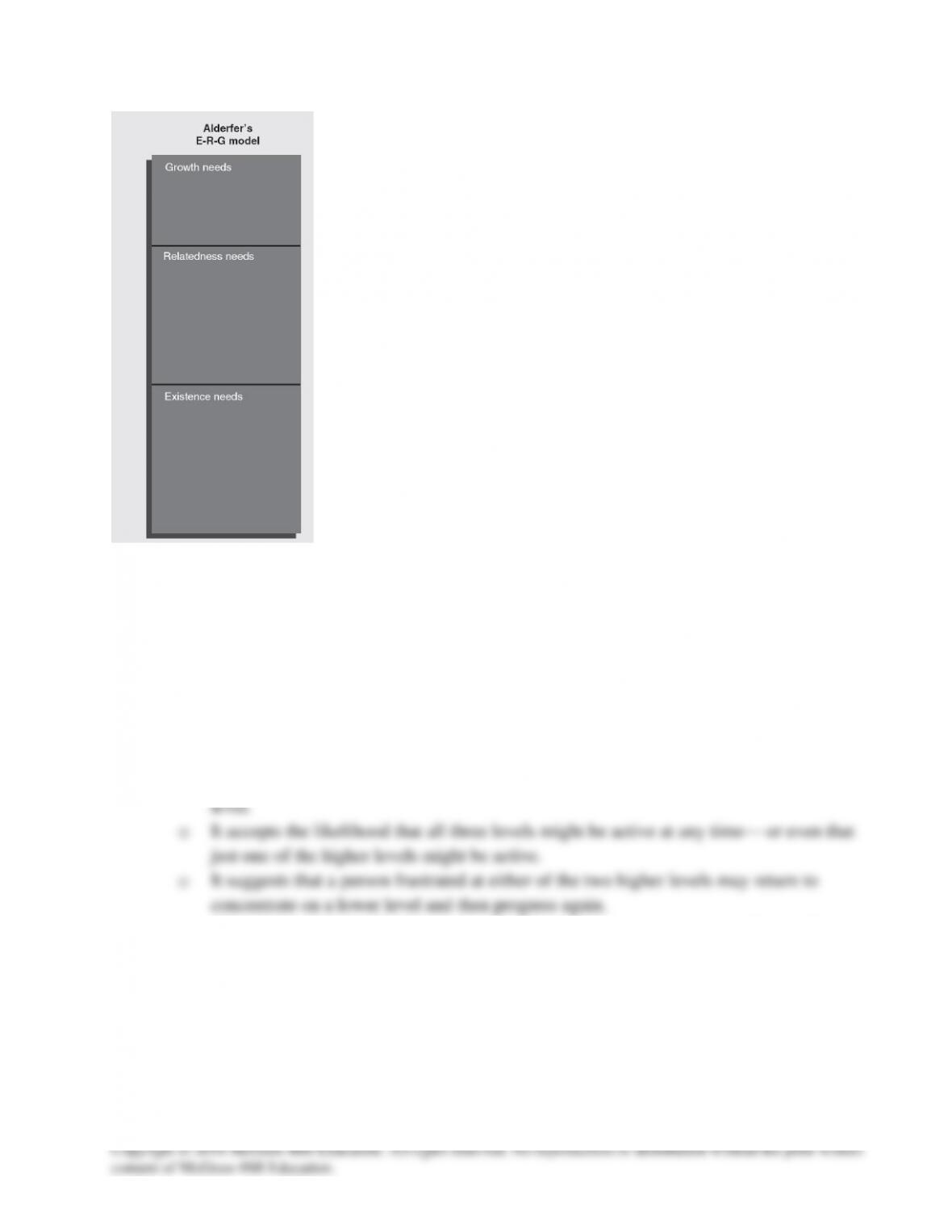
their weaknesses, Clayton Alderfer proposed a modified need hierarchy—the E-R-G
model—with just three levels.
5-11
o Existence needs—combine physiological and security factors.
▪ Pay, physical working conditions, job security, and fringe benefits can all address
these needs.
o Relatedness needs—these social factors involve being understood and accepted by
people above, below, and around the employee at work and away from it.
o Growth needs—involve the desire for both self-esteem and self-actualization.
• In addition to condensing Maslow’s five need levels into three that are more consistent with
research, the E-R-G model differs in other ways.
o For example, the E-R-G model does not assume a distinct progression from level to
o Whereas the first two levels are somewhat limited in their requirements for satisfaction,
the growth needs not only are unlimited but are actually further awakened each time
some satisfaction is attained.
Comparison of the Maslow, Herzberg, and Alderfer Models
• The similarities among the three models of human needs are shown in Figure 5.3, but there
are important contrasts, too.
o Maslow and Alderfer focus on the internal needs of the employee, whereas Herzberg

5-12
also identifies and differentiates the conditions (job content or job context) that could
be provided for need satisfaction.
o Popular interpretations of the Maslow and Herzberg models suggest that in modern
societies many workers have already satisfied their lower-order and maintenance needs,
so they are now motivated mainly by higher-order needs and motivators.
o Alderfer suggests that the failure to satisfy relatedness or growth needs will cause
renewed interest in existence needs.
• All three models indicate that before a manager tries to administer a reward, he or she would
find it useful to discover which need or needs dominate a particular employee at the time.
Behavior Modification
• The models of motivation that have been discussed up to this point are known as content
theories of motivation because they focus on the content (nature) of items that may motivate a
person.
o They relate to the person’s inner self and how that person’s internal state of needs
determines behavior.
• The major difficulty with content models of motivation is that the needs people have are
subject to observation by managers or to precise measurement for monitoring purposes.
o As a result, there has been considerable interest in motivational models that rely more
heavily on intended results, careful measurement, and systematic application of
incentives.
• Organizational behavior modification, or OB Mod is the application in organizations of the
principles of behavior modification, which evolved from the work of B. F. Skinner.
o OB Mod and the next several models are process theories of motivation, since they
provide perspectives on the dynamics by which employees can be motivated.
Law of Effect
• OB Mod relies heavily on the law of effect, which states that a person tends to repeat
behavior that is accompanied by favorable consequences (reinforcement) and tends not to
repeat behavior that is accompanied by unfavorable (or lack of) consequences.
• Two conditions are required for successful application of OB Mod:
o The manager must be able to identify some powerful consequences (as perceived by the
employee).
o The manager must be able to control or administer them in such a way that the
employee will see the connection between the behavior to be affected and the
consequences.
• The law of effect comes from learning theory, which suggests that we learn best under
pleasant surroundings.
o Whereas content theories argue that internal needs lead to behavior, OB Mod states
5-13
that external consequences tend to determine behavior.
• The advantage of OB Mod is that it places a greater degree of control, and responsibility, in
the hands of the manager.
• A special type of learning theory is social learning, also known as vicarious learning.
o This suggests that employees do not always have to learn directly from their own
experiences.
o Instead, they may—and even are likely to—learn by observing the actions of others,
understanding the consequences that others are experiencing, and using that new
information to modify their own behavior.
• Employees who acquire the skills of social learning can often become much more effective in
less time than they would have if they had to experience everything independently.
Alternative Consequences
• OB Mod places great emphasis on the use of rewards and alternative consequences to sustain
behavior.
o Before using OB Mod, managers must decide whether they wish to increase the
probability of a person’s continued behavior or to decrease it.
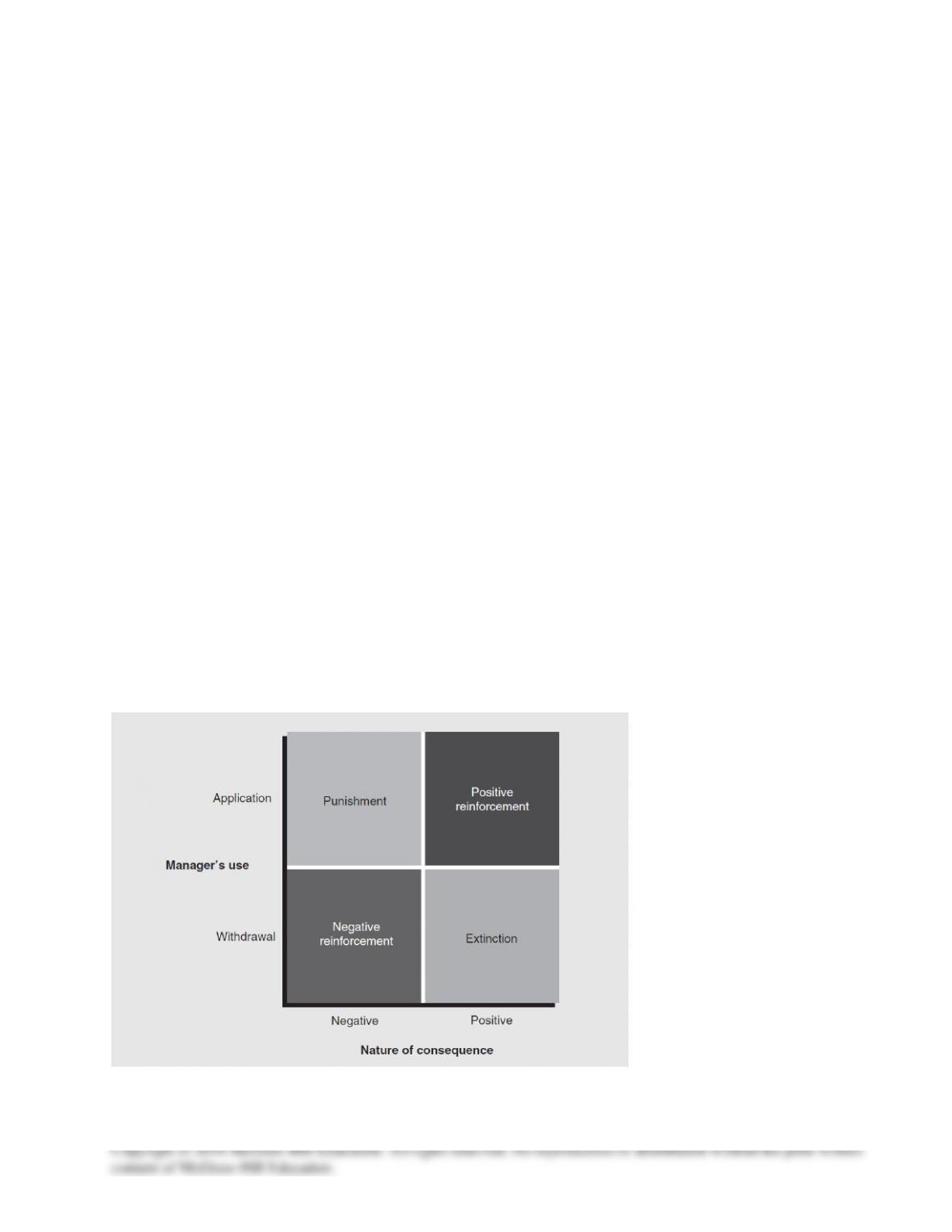
• Once managers have decided on their objective, they have two further choices to make which
determine the type of consequence to be applied:
o Should they use a positive or a negative consequence?
o Should they apply it or withhold it?
• The answers to these two questions result in four unique alternative consequences (Figure
5.5)—positive reinforcement, negative reinforcement, punishment, and extinction.
• Positive reinforcement provides a favorable consequence that encourages repetition of a