
4-1
Chapter 4
Social Systems and Organizational Culture
Chapter Overview
The key purpose of this chapter is to provide an understanding of the nature, operation, and
impact of social systems within organizations. First an overview of the organization as a social
system is presented, followed by a discussion of cultural change and cultural evolution. Particular
attention is devoted to the origins of the work ethic, to current trends in that area, and to the
notion of social responsibility. Next, role related concepts including role perceptions, mentors,
role conflict, and role ambiguity and the role and importance of status relationships in
organizations are described. The final section is devoted to a detailed discussion of
organizational culture.
Chapter Learning Objectives
After reading this chapter, students should understand:
1. The operation of a social system
2. The psychological contract
3. Social cultures and their impact
4. The value of cultural diversity
5. Role and role conflict in organizations
6. Status and status symbols
7. Organizational culture and its effects
8. Fun workplaces
Discussion and Project Ideas
All organizational behavior takes place within a system of interdependent variables—this is the
social system. It is important early in the course for students to conceive of human behavior
within a system because this helps them to see the subject as a whole rather than a series of
disconnected ideas. Systems concepts give totality and completeness to a subject and help us
perceive order within a society that is so complex that it appears disorderly. Further, the social
system has a major influence on the values that people hold and their behavior. The following
exercises should help deliver these concepts to students.
• Ask each student to write down on a blank sheet of paper a description of a typical day 10
years from now. Have the students small groups and read each other’s descriptions.
4-2
Discuss the descriptions in terms of the work ethic. Is work a central part of their
description? Are there implicit goals, objectives, and deadlines in the descriptions they
provide?
• Ask the students to form small groups and list all of the status symbols present in the
classroom and university setting. Have a spokesperson for each group present the list to the
remainder of the group. The symbols should include examples of both high and low status,
differences in dress, differences in office locations, equipment, etc.
• If you have a lot of determination, you might like to try this one. Come to class in a pair of
cut-off jeans and sandals and sit in the back of the room. When class begins, refuse to lead
the class, telling students that they are adults and have responsibility for their own learning.
After about 10 minutes of discussion, some possible complaining, and confusion, assume
your normal role. Lead a discussion on the need for roles, role ambiguity, need for status,
Lecture Outline
Introduction
• Companies like Google, Boston Consulting Group, etc. are often recognized for being
some of the best companies to work for.
o The organizational cultures at these firms are well-established, and often reflect the
beliefs and values of the companies’ founders as well as those of the current staff.
o Cultures provide both direct and indirect cues telling workers how to succeed:
▪ Direct cues include orientation training, policy statements, and advice from
supervisors and peers.
▪ Indirect cues are more subtle, including inferences made from promotions and
apparent patterns of acceptable dress.
Understanding a Social System
• A social system is a complex set of human relationships interacting in many ways.
o Possible interactions are limitless.
o Each small group is a subsystem within larger groups that are subsystems of even
larger groups, and so on, until all the world’s population is included.

4-3
• Two points stand out in the complex interactions among people in a social system.
o The behavior of any one member can have an impact, directly or indirectly, on the
behavior of any other.
o Any social system engages in exchanges with its environment, receiving input from it
and providing output to it (which then becomes input for its adjacent systems).
• Social systems are open systems that interact with their surroundings.
o Consequently, members of a system should be aware of the nature of the nature of
their environments and their impact on other members both within and outside their
own social system.
Social Equilibrium
• A system is said to be in social equilibrium when its interdependent parts are in dynamic
working balance.
• Equilibrium is a dynamic concept, not a static one.
• A single event change or a series of rapid changes may throw an organization out of
balance, seriously reducing its forward progress until it can reach a new equilibrium.
o In a sense, when it is in disequilibrium, some of its parts are working against one
another instead of in harmony.
Functional and Dysfunctional Effects
• A change has a functional effect when it is favorable for the system.
• When an action or a change creates unfavorable effects for the system it has a
dysfunctional effect.
• A major management task is to appraise both actual and proposed changes in the social
system to determine their possible functional or dysfunctional effects, so that appropriate
responses can be anticipated and made.
o Managers also need to predict both short-term and long-term effects, measure “hard”
(e.g., productivity) and “soft” (e.g., satisfaction and commitment) criteria, and
consider the probable effects on various stakeholder groups, such as employees,
customers, and stockholders.
• Employees can also have functional or dysfunctional effects on the organization.
o They can be creative, productive, and enthusiastic and actively seek to improve the
quality of the organization’s product or service.
o On the other hand, they can be tardy, absent frequently, unwilling to use their talents,
and resistant to organizational changes.
• For employees to exhibit functional behaviors, they need to receive clear expectations and
promises of reward.
Psychological and Economic Contracts
• When employees join an organization, they make an unwritten psychological contract
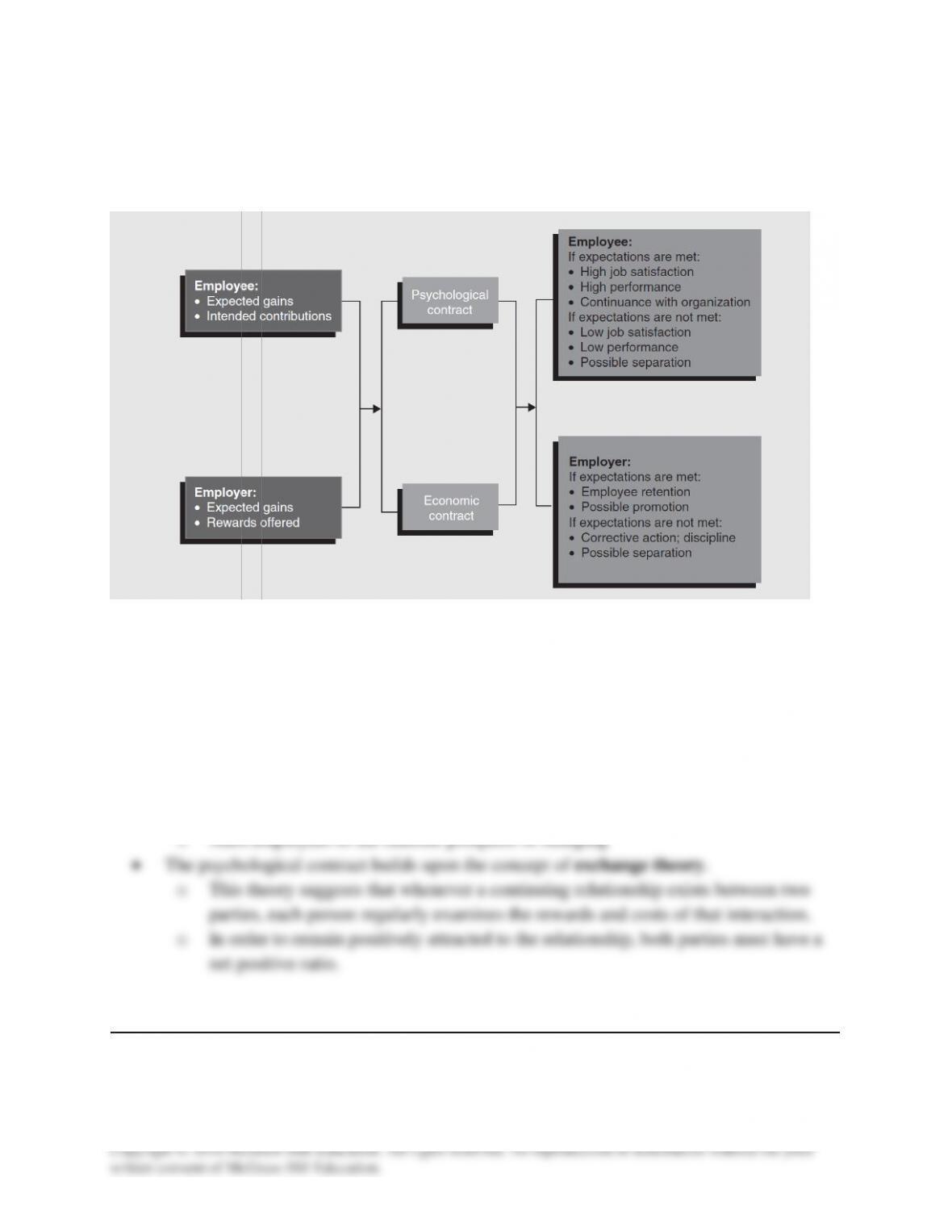
4-4
with it, although often they are not conscious of doing so.
• This contract is in addition to the economic contract where time, talent, and energy are
exchanged for wages, hours, and reasonable working conditions (Figure 4.1).
• If the organization honors only the economic contract and not the psychological contract,
employees tend to have lower satisfaction because not all their expectations are being
met.
• To prevent breakdowns of the psychological contract, employers are urged to:
o Help employees clarify their expectations and perceptions
o Initiate explicit discussions of mutual obligations
o Exercise caution when conveying promises
o Provide candid explanations for broken promises
o Alert employees to the realistic prospects of reneging
Social Culture
• Whenever people act in accordance with the expectations of others, their behavior is social.
• Social culture is an individual’s environment of human-created beliefs, customs,
4-5
knowledge, and practices.
• Social cultures are often portrayed as consistent within a nation, thereby producing a
national culture.
o Knowledge of social cultures is especially important because managers need to
understand, appreciate, and respond to the backgrounds and beliefs of all members of
their work unit.
• People learn to depend on their culture.
o However, this one-culture dependency may place intellectual blinders on employees,
preventing them from gaining the benefits of exposure to people from other cultural
backgrounds.
o Employees need to lean to adapt to others in order to capitalize on the distinctive
backgrounds, traits, and opportunities they present, while avoiding possible negative
consequences.
Cultural Diversity
• Employees in almost any organization are divided into subgroups of various kinds.
• Formation of groups is determined by two broad sets of conditions:
o Job-related (organizationally created) differences and similarities, such as type of
work, rank in the organization, and physical proximity to one another, sometimes
cause people to align themselves into groups.
o Non-job-related conditions (those related to culture, ethnicity, socioeconomics, sex,
and race) arise primarily from an individual’s personal background; these
• Problems may persist because of a key difference in this context between discrimination
and prejudice.
o Discrimination is generally exhibited as an action, whereas prejudice is an attitude.
o Either may exist without the other.
• The law focuses on an employer’s actions, not feelings.
o If actions lead to what is legally determined to be discriminatory results, such
actions are unlawful regardless of the employer’s alleged good intentions.
• A promising approach to overcoming discriminatory practices actually attempts to change
the underlying attitudes, values, and beliefs.
o Programs aimed at managing and valuing diversity build from a key premise—
prejudicial stereotypes develop from unfounded assumptions about other and from
their overlooked qualities.
4-6
o Differences need to be recognized, acknowledged, appreciated and used to
collective advantage.
o All participants will need to explore their differences, learn from others, respect the
value that others contribute, and use that information to build a strong organization.
o This requires inclusion (an active desire to use diverse talents and strengths) and
cultural competency (the skill to do so).
Social Culture Values
• The Work Ethic
o For many years, the culture of much of the Western world has emphasized work as
a desirable and fulfilling activity.
o The result of this cultural emphasis is a work ethic for many people, meaning they
view work as very important, morally correct, and as desirable goal in life.
o They tend to like work and derive satisfaction from it.
o They usually have a stronger commitment to the organization and its goals than do
other employees, and are more diligent in carrying out their responsibilities.
o In spite of its prevalence, the work ethic is a subject of continuing reflection,
discussion, and controversy.
o The available research indicates that two conclusions can be safely reached:
▪ The proportion of employees with a strong work ethic varies sharply among
sample groups.
❖ Differences depend on factors such as personal background, type of
work performed, and geographical location.
o Dramatic social changes have brought about the work ethic’s deterioration.
▪ Competing social values have emerged such as a leisure ethic, desire for
community and connectedness, and entitlement.
▪ In addition, changes in social policy and tax laws have reduced incentives to
work and occasionally even penalized hard work and success.
• Social Responsibility
o Every action that organizations take involves costs as well as benefits.
o Social responsibility is the recognition that organizations have significant influence
on the nation’s social system and that this influence must be properly considered
4-7
and balanced in all organizational actions.
o The presence of strong social values such as social responsibility has a powerful
impact on organizations and their actions.
▪ It leads them to take a broader view of their role within a social system and
accept their interdependence with it.
Role
• A role is the pattern of actions expected of a person in activities involving others.
o Role reflects a person’s position in the social system, with its accompanying rights
and obligations, power and responsibility.
• In order to be able to interact with one another, people need some way of anticipating
others’ behavior.
o Role performs this function in the social system.
• A person has roles both on the job and away from it (Figure 4.2).
o Each role calls for different types of behavior.
o Within the work environment alone, a worker may have more than one role.
Role Perceptions
• Activities of managers and workers alike are guided by role perceptions—that is how
they think they are supposed to act in their own roles and how others should act in their
roles.
• Since managers perform many different roles, they must be highly adaptive (exhibiting
role flexibility) in order to change from one role to another quickly.
• When a manager and employee interact, each one needs to understand four different role
perceptions (Figure 4.3).
Mentors
• A mentor is a role model who guides another employee (a protégé) by providing
historical perspectives and sharing valuable advice on roles to play and behaviors to
avoid.
• The advantages of successful mentoring programs include:
4-8
o Stronger employee loyalty
o Faster movement up learning curve
o Better succession planning through development of replacements
o Increased level of goal accomplishments
• Some organizations assign protégés to mentors, but this practice can create problems of
resentment, abuse of power, and unwillingness to serve.
• Tips for protégés working with mentors are provided in Figure 4.4(a); tips for mentors are
shown in Figure 4.4(b).
• Mentors are usually older, successful themselves, and respected by their peers
(influential).
o They must be:
▪ Willing to commit time and energy to help another person move up the
corporate ladder
▪ Able to communicate effectively and share ideas in a non-threatening manner
▪ Enjoy one-on-one development of others
• Mentors are often not the employee’s direct supervisor; therefore, they can provide
additional support to aid an employee’s career progress.
• Several problems can arise in mentoring programs:
o Some mentors are more effective role models than others.
o Some protégés are more aggressive in seeking out the prime candidates for a
mentor, leaving other protégés with less skilled mentors.
o A mentor might provide inappropriate advice or inaccurate information to a protégé
that actually hinders the employee’s development.
• For these and other reasons, common practice is to have more than one mentor for each
protégé, resulting in multiple relations from which the protégé can derive richer role
perceptions and broader career advice.
• Despite well-meaning attempts, efforts to establish mentoring relationships sometimes
fail.
• Reverse mentoring occurs when a person who has more general depth of experience
requires assistance in an area of special expertise, and a newer employee can provide it.
o It became popular largely due to the rapid expansion of various types of innovative
digital technologies, associated apps and social media, and e-commerce.

4-9
Role Conflict
• When others have different perceptions or expectations of a person’s role, that person
tends to experience role conflict.
o Such conflict makes it difficult to meet one set of expectations without rejecting
another.
• Role conflict at work is fairly common.
• Many employees experience role conflict from time to time and some feel role conflict is
a frequent and serious problem.
• Role conflict is most difficult for employees with many job contacts outside the
organization—that is, with boundary roles.
• Another type of role conflict arises between role expectations at work versus those from
non-work activities.
o When the demands from the non-work activities accumulate, there is often a
potential spillover effect on one’s work life and job performance.
o The work-family conflict that ensues can impact both domains and result in
diminished job satisfaction, work performance, life satisfaction, and emotional
exhaustion.
Role Ambiguity
• When roles are inadequately defined or are substantially unknown, role ambiguity exists,
because people are not sure how they should act in situations of this type.
• When role conflict and role ambiguity exist, job satisfaction and organizational
commitment will likely decline.
o On the other hand, employees tend to be more satisfied with their jobs when their
roles are clearly defined by job descriptions and statements of performance
expectations.
Status
• Status is the social rank of a person in a group.
o It is a mark of the amount of recognition, honor, esteem, and acceptance given to a
person.
• Individuals are bound together in status systems, or status hierarchies, which define their
rank relative to others in the group.
o If they become seriously upset over their status, they are said to feel status anxiety.
• Loss of status—sometimes called “losing face” or status deprivation—is a serious event
for most people.
• Since status is important to people, they will work hard to earn it.
o If it can be tied to actions that further the corporate goals, then employees are

4-10
strongly motivated to support their company.
Status Relationships
• High-status people within a group usually have more power and influence than those with
low status.
o They also receive more privileges from their group and tend to participate more in
group activities.
o They interact more with their peers than with those of lower rank.
• Basically, high status gives people an opportunity to play a more important role in an
organization.
o As a result, lower-status members tend to feel isolated from the mainstream and
show more stress symptoms than higher-ranked members.
• In a work organization, status provides a system by which people can relate to one
another as they work.
o Without it, they would tend to be confused and spend much of their time trying to
learn how to work together.
Status Symbols
• Status symbols are the visible, external things that attach to a person or workplace and
serve as evidence of social rank.
• There are a variety of symbols of status, depending on what employees feel is important
(Figure 4.5).
• When an employee gives unreasonable attention to status symbols, there is evidence of
status anxiety, and this situation requires management attention.
• Managers need to face the fact that status differences exist and must be managed
successfully.
Sources of Status
• The sources of status are numerous, but in a typical work situation several sources are
easily identified (Figure 4.6).
o Education, job level, a person’s abilities, job skills, and type of work are major
sources of status.
o Other sources of status are amount of pay, seniority, age, stock options, method of
pay (hourly versus salary), and working conditions.
Significance of Status
• Status is significant to organizational behavior in several ways:
o When employees are consumed by the desire for status, it often is the source of
employee problems and conflicts that management needs to solve.
o It influences the kinds of transfers that employees will take, because they don’t
4-11
want a low-status location or dead-end job assignment.
o It helps determine who will be an informal leader of a group.
o It serves to motivate those seeking to advance in the organization.
o Some people are status seekers, wanting a job of high status regardless of other
working conditions.
Organizational Culture
• Social (national) culture creates the wide-ranging context in which organizations operate.
o It provides the complex social system of laws, values, and customs in which
organizational behavior occurs.
• According to social psychologist Kurt Lewin, employee behavior (B) is a function of the
interaction between personal characteristics (P) and the environment (E) around the person.
o B = f (P,E)
• Organizational culture is the set of assumptions, beliefs, values, and norms shared by an
organization’s members.
o This culture may have been consciously created by its key members, or it may have
simply evolved over time.
• Organizational culture surrounds and affects everything that happens in an organization.
o Because it is a dynamic systems concept, culture is also affected by almost
everything that occurs within an organization.
• Organizational cultures are important to a firm’s success for several reasons:
o They give an organizational identity to employees—a defining vision of what the
organization represents.
o They are also an important source of stability and continuity to the organization,
which provides a sense of security to its members.
Characteristics of Cultures
• Each organization has its own history, patterns of communication, systems and
procedures, mission statements and visions, and stories and myths which, in their totality,
constitute its distinctive culture.
• Cultures are relatively stable in nature, usually changing only slowly over time.
o Exceptions to this condition may occur when a major crisis threatens a firm or when
two organizations merge with each other.
4-12
• Most organizational cultures have historically been implicit and unconscious rather than
explicit.
• Most cultures are seen as symbolic representations of underlying beliefs and values.
• Employees make inferences about organizational cultures from hearing stories about the
way things are done, from reading slogans that portray corporate ideals, from observing
key artifacts, or from watching ceremonies in which certain types of employees are
honored.
• Over time, an organization’s culture becomes perpetuated by its tendency to attract and
retain people who fit its values and beliefs.
• Several other dimensions of culture are important to note:
o There is no one best culture for all firms.
o Culture depends on the organization’s goals, industry, nature of competition, and
other factors in the environment.
o Cultures will be more easily recognized when their elements are generally
integrated and consistent with each other.
o Most members must at least accept, if not embrace, the assumptions and values of
the culture.
o Most cultures evolve directly from top management, who can have a powerful
influence on their employees by what they say.
▪ However, management’s actions are even more important to watchful
• The effect of organizational culture on employee behavior is difficult to establish.
o Some research indicates there is a positive relationship between certain
organizational cultures and performance.
Measuring Organizational Culture
• Systematic measurement and comparison of cultures is difficult at best.
o Most early attempts by researchers relied on examination of stories, symbols,
rituals, and ceremonies to obtain clues and construct a composite (but subjective)
portrait.
o Others have used interviews and open-ended questionnaires in an attempt to assess
employee values and beliefs.
o In other cases, examination of corporate philosophy statements has provided insight
into the espoused culture (the beliefs and values that the organization states

4-13
publicly).
o Another approach is to survey employees directly and seek their perceptions of the
organization’s culture.
o One of the more interesting methods is to become a member of the organization and
engage in participant observation.
• Any attempt to measure organizational culture can be only an imperfect assessment.
o Such measurements are comparable to capturing only a single snapshot of the
culture at a single point in time.
o Many organizational cultures are in the process of changing and need to be
monitored regularly and by a variety of methods to gain a truer picture.
Communicating and Changing Culture
• If organizations are to consciously create and manage their cultures, they must be able to
communicate them to employees, especially the newly hired ones.
• Examples of formal communication vehicles for transmitting organizational cultures
include:
o Executive visions of the firm’s future
o Corporate philosophy statements
o Codes of ethical conduct
• Informal means involve:
o Publicly recognizing heroes and heroines
o Retelling historical success stories
o Allowing myths to be exaggerated
• Elements of the organization’s culture are also unintentionally communicated to
employees in a variety of ways, such as when news of a manager’s error and an
executive’s forgiveness of it are accidentally leaked throughout the firm.
• Collectively, the cultural communication acts may be lumped under the umbrella of
organizational socialization, which is the continuous process of transmitting key
elements of an organization’s culture to its employees.
o Socialization consists of both formal methods and informal means.
• Viewed from the organization’s perspective, organizational socialization is like placing an
organization’s fingerprints on people or stamping its own genetic code on them.
• From the employee’s viewpoint, it is essential that they learn “the ropes” to survive and
prosper within the firm.
• Two powerful methods for communicating an organizational culture to new employees
involve:
o Signature experiences—clearly defined and dramatic devices that convey a key
element of the firm’s culture and vividly reinforce the values of the organization.
▪ The culture is clearly imprinted in the new employee’s mind.
▪ Example of signature experiences are demanding selection procedures for
4-14
new hires at Goldman Sachs.
o Storytelling—managers are also encouraged to engage in storytelling as a way to
forge a culture and build organizational identity.
▪ Good stories tap into emotions of an audience and have proven to be powerful
ways to create shared meaning and purpose.
▪ Stories convey a sense of tradition, explain how past problems have been
solved, convey personal frailty through tales of mistakes made and learned
from, and enhance cohesion around key values.
▪ The most memorable stories entertain as well as inform, and uplift as well as
and teach.
▪ The stories highlight purposeful plots and patterns that the organization
cherishes, they point out consequences of actions, and they provide valuable
lessons that carry forward the wisdom gained through previous years.
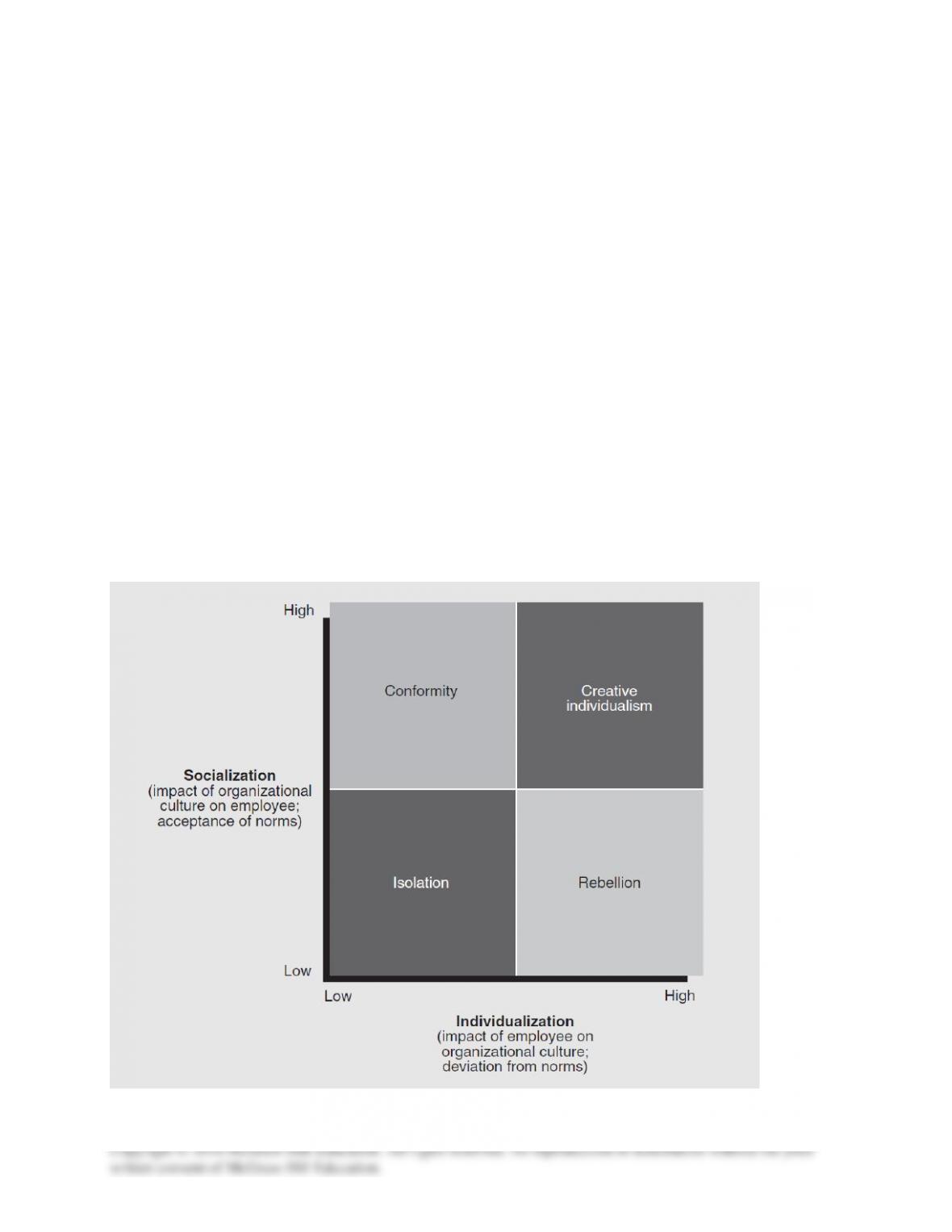
• Individualization occurs when employees successfully exert influence on the social
system around them at work by challenging the culture or deviating from it.
o The interaction between socialization and individualism is portrayed in Figure 4.8,
which shows the types of employees who accept or reject an organization’s norms
and values while exerting various degrees of influence.
4-15
o The two extremes—rebellion and total conformity—may prove dysfunctional for
the organization and the individual’s career in the long run.
o Isolation is seldom a productive course of action.
o Creative individuals can infuse new life and ideas for the organization’s benefit.
• Counterculture is a subgroup of individuals within the larger culture whose values,
norms, and behavior are substantially different.
o When this happens, a culture clash may arise, and the resultant conflict of values
can be highly disruptive.
Fun Workplaces
• A fun work environment is a unique and increasingly popular organizational culture in
which supervisors encourage, initiate, and support a variety of playful and humorous
activities.
• A fun workplace has several key features:
o It is easily recognized.
o It means different things to various people.
o It is relatively easy to create at work.
o It elicits a broad range of personal and organizational payoffs.
• Hundreds of approaches have been used to stimulate fun at work.
o Key categories include unique ways to provide recognition for personal milestones,
hosting of special social events, public celebrations of professional and departmental
achievements, games and friendly competitions, entertainment, etc.
• Specific tactics used in various organizations include dress up days, cartoons tailored to
employees, exaggerated job titles, distribution of the “joke for the day”, or the use of
modified board games and TV show formats to engage minds and stimulate creativity.
• Employees like to work in an environment that satisfies their economic and security needs,
makes them feel listened to, and recognizes their time, effort, and results.
Suggested Answers to Discussion Questions
1. What psychological contract do you feel is present in this course? Describe its key
4-16
features.
Students’ answers will vary according to personal reasons for being in the class, both in
2. Look around your classroom, dormitory, or student organization. In what ways does
it reflect cultural diversity? Suggest ways by which the resources represented in that
diversity could be used to great advantage for the benefit of all participants.
Students’ answers may vary. College campuses today abound with examples of cultural
diversity. Most have international student organizations, language houses, and more
3. A management specialist recently commented about the work ethic, saying, “You can
discover if you personally have a work ethic if you think more about the salary you
make than about the quality of the produce you make (or the service you provide).”
Comment.
4. What does social responsibility mean to you? Does it apply to people as well as
institutions? Describe three acts of social responsibility that you have seen, or
performed, in the last month.
Student’s answers will vary and may include helping to care for those who are unable to
care for themselves (food, shelter, clothing); keeping the environment clean and safe (water
4-17
Copyright © 2014 McGraw-Hill Education. All rights reserved. No reproduction or distribution without the prior
written consent of McGraw-Hill Education.
and air pollution), serving in the armed forces, voting, volunteering for community work,
or joining the fight against drugs in schools. These suggestions apply to people as well as
institutions, simply because people are institutions and vice versa. Social responsibility for
institutions means that organizations recognize that their actions have an impact on society
and this influence must be taken into consideration in their operations.
5. Describe a situation in which you experienced role conflict or role ambiguity. What
caused it? How are the two ideas related, and how are they different?
Students’ answers may vary. They should be challenged to see the difference between these
two concepts, so they can minimize them in their own management careers. Role conflict
6. Interview a manager to discover what that person believes to be the five most
important status symbols in the work situation. Identify whether the importance of
status symbols is increasing or decreasing there.
Students’ answers may vary. They may be surprised to learn of the non-tangible status
7. Describe the organizational culture that seems to exist in your class. What are some of
the implicit/explicit norms, values, and assumptions?
Students’ answers may vary according to personal backgrounds, experience, and attitudes.
4-18
8. Reflect back on your first days in college, or in a part-time or summer job. In what
ways were you socialized? How did you feel about what was happening to you? Was
there a signature experience you recall vividly?
Students’ answers may vary according to their experience. Examples of socialization into
9. Look at the reciprocal process of individualization. In what ways did you make an
impact on the college or on the job?
Students’ answers may vary. They may want to refer to Figure 4.8 in formulating a
10. The beneficial effects of having fun at work are relatively easy to see. What are some
of the possible dysfunctional effects of such a culture?
Students’ answers may vary. According to the text, possible dysfunctional effects of a fun
Assess Your Own Skills
Students should honestly circle the number on the response scale that most closely reflects the
degree to which each statement accurately describes them when they have played a role to
someone else as a mentor. This section will help them understand how well they exhibit good
mentoring skills.
Incident
4-19
Liberty Construction Company
This case involves many issues, such as the social system, equilibrium, the psychological
contract, equity theory, role, status, and status symbols. For example, Alvarez appeared to feel
that he had a psychological contract with the construction company that would give a regular
employee privileges not available to a temporary employee. On the other hand, the company
owner apparently felt that seniority should govern assignments of backhoes, regardless of one’s
temporary or regular position. The newness of a backhoe appears to be a status symbol, and
Alvarez felt that his status had been reduced. He felt unequal.
Since Alvarez has resigned, equilibrium probably is reasonably restored, but at the cost of an
employee’s (Alvarez) job. In the future situations of this type, the owner may wish to discuss the
issues with employees in order to understand employee feelings and try to reach consensus
before making a decision.
Experiential Exercise
The first part of this exercise provides an opportunity for students to discover for themselves the
complex perceptual interactions depicted in Figure 4.3. Students often find examining their
perception of another person’s role perception to be fascinating. Discussion often centers around
disagreement over how a person in a given role “sees” the tasks in that role; subordinates often
see “unnecessary” tasks being performed by managers, while the managers see those same tasks
as vital to the accomplishment of organizational goals.

4-20
Generating OB Insights
Students’ responses will vary for this exercise. They should however, highlight several of the
major topics discussed in the chapter such as the operation of a social system, the psychological
contract, the social cultures and their impact, the value of cultural diversity, the role and role
conflict in organizations etc.