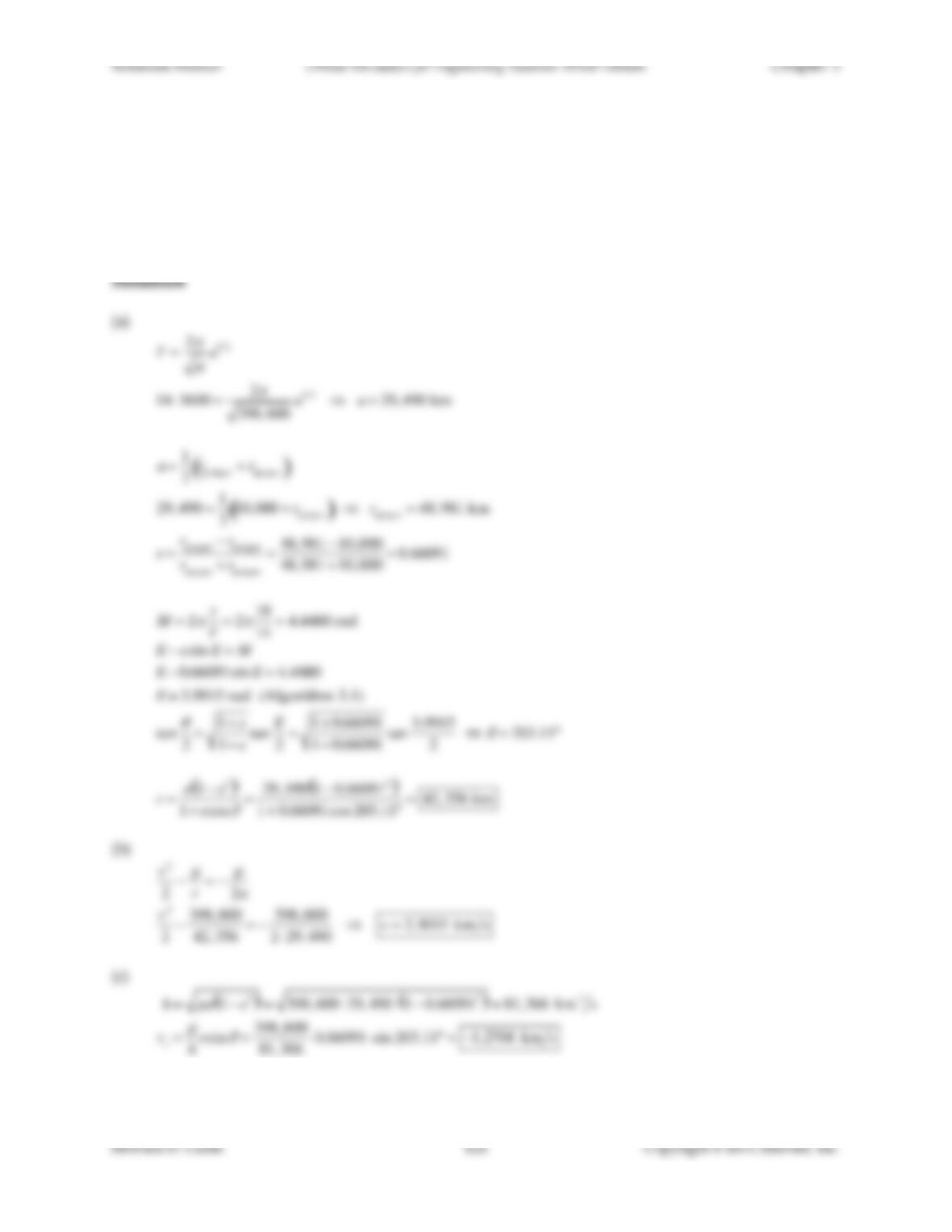
Problem 3.10 An earth-orbiting satellite has a period of 14 hours and a perigee radius of 10,000 km. At
time t = 10 hours after perigee passage, determine
(a) The radial position.
(b) The speed.
(c) The radial component of the velocity.
vr
hesin
398,600
81,366 0.66091sin 203.11 1.2708 km s
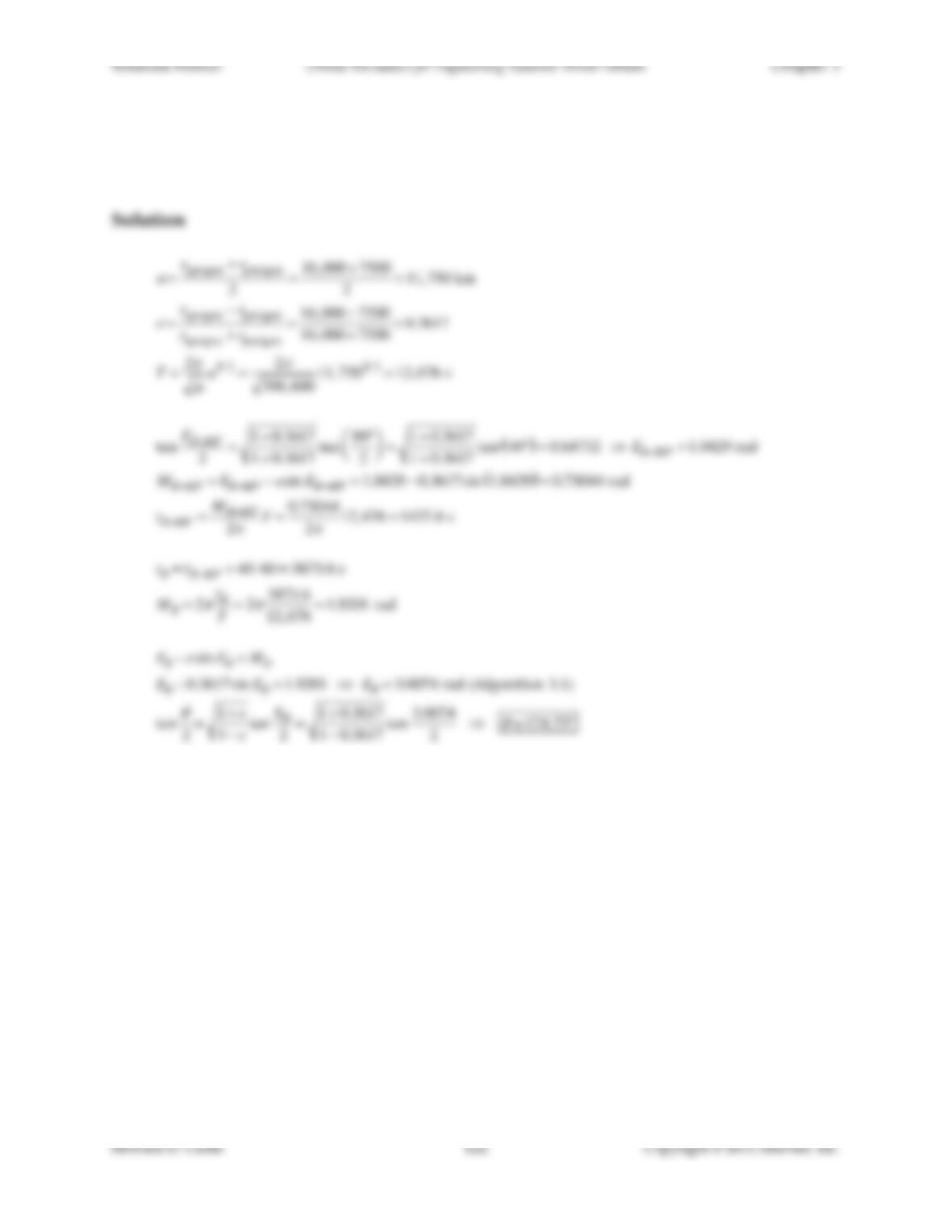
Problem 3.11 A satellite in earth orbit has perigee and apogee radii of
rp7500km
and
ra16,000km
, respectively. Find its true anomaly 40 minutes after passing true anomaly of 80°.
21e
1etan E
210.3617
10.3617 tan 3.0074
2
Solutions Manual Orbital Mechanics for Engineering Students Third Edition Chapter 3
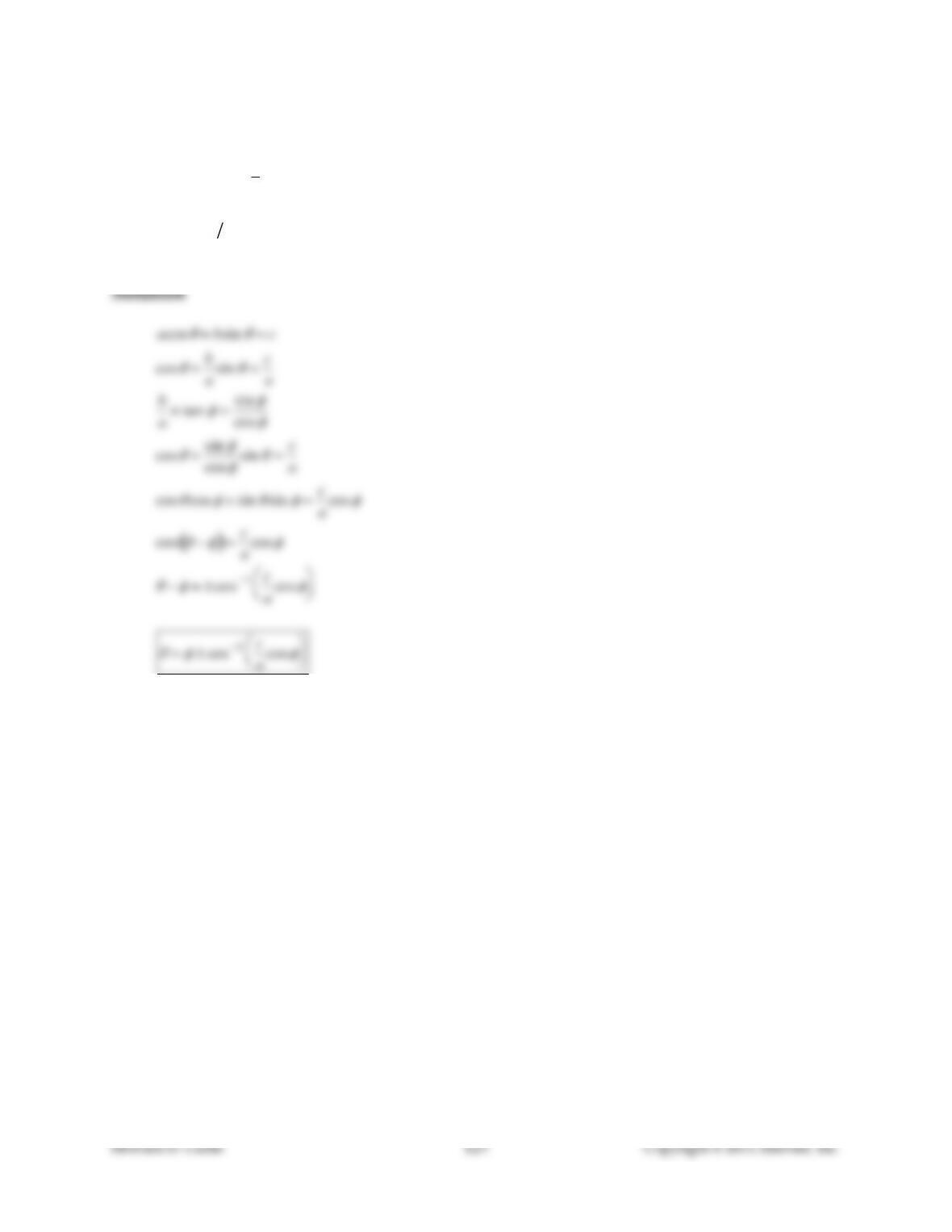
Problem 3.12 Show that the solution to
acos
bsin
c
, where a, b and c are given, is:
cos1c
acos
where
tan
b a
.
acos
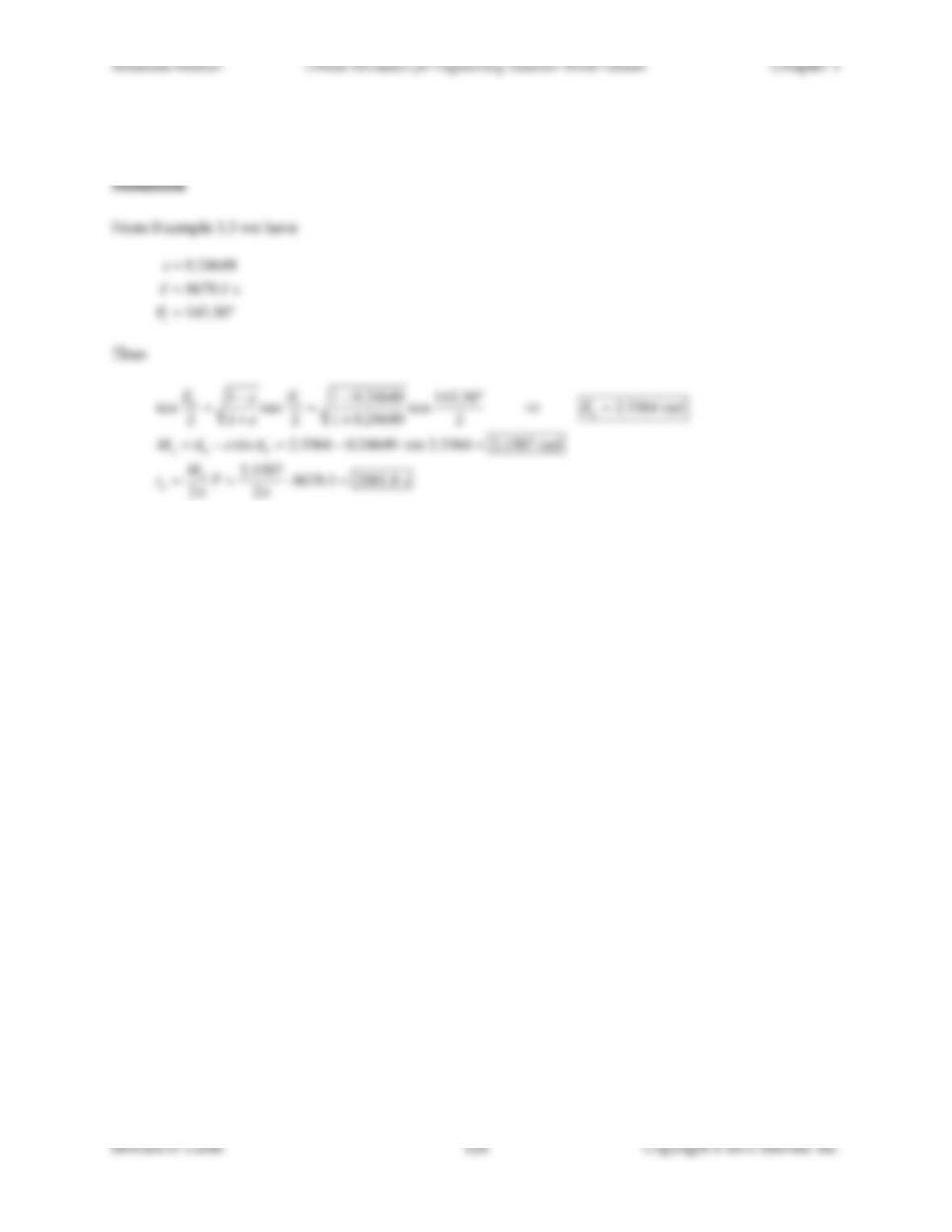
Problem 3.13 Verify the results of part (b) of Example 3.3.
2
2
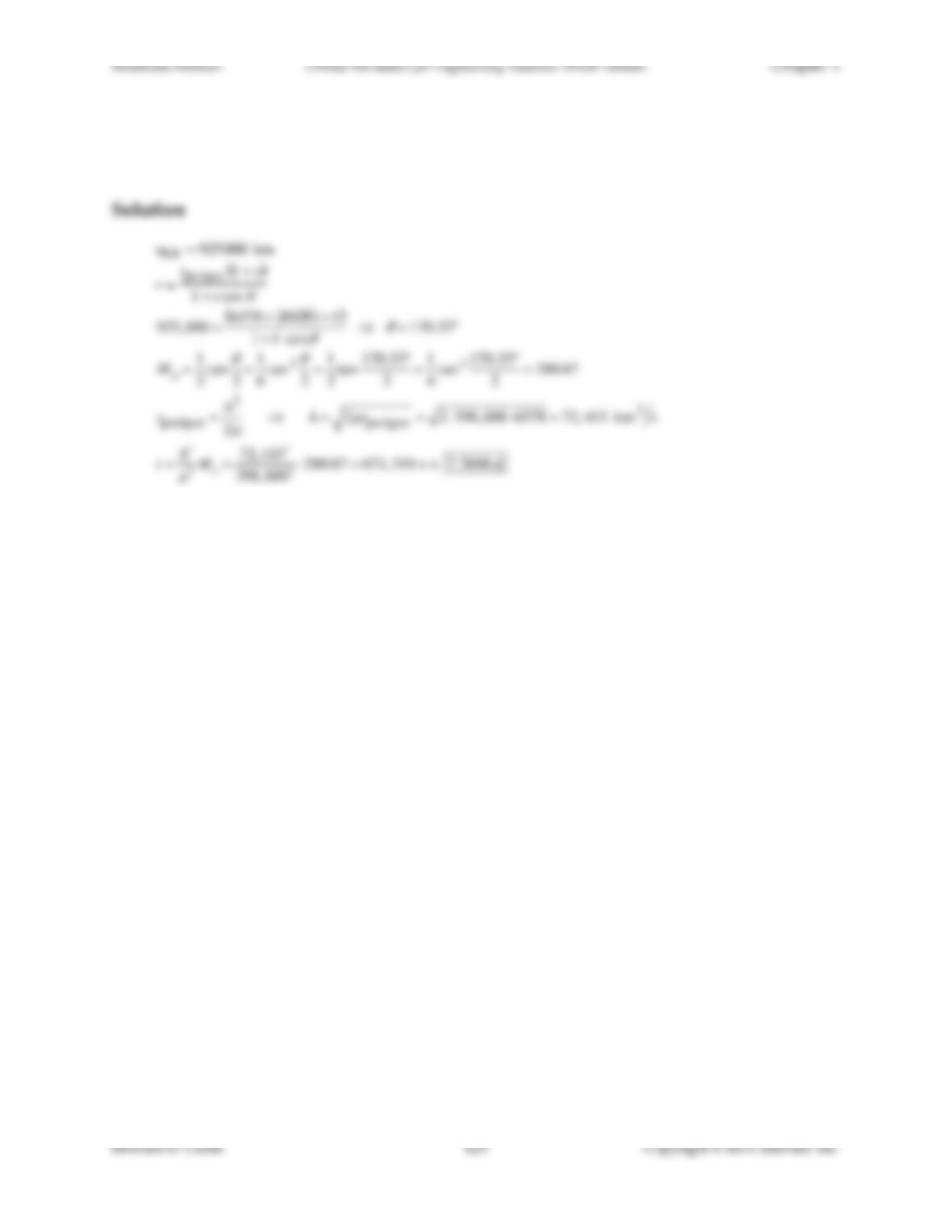
Problem 3.14 Calculate the time required for a spacecraft launched into a parabolic trajectory at a
perigee altitude of 200 km to leave the earth’s sphere of influence (see Table A.2).
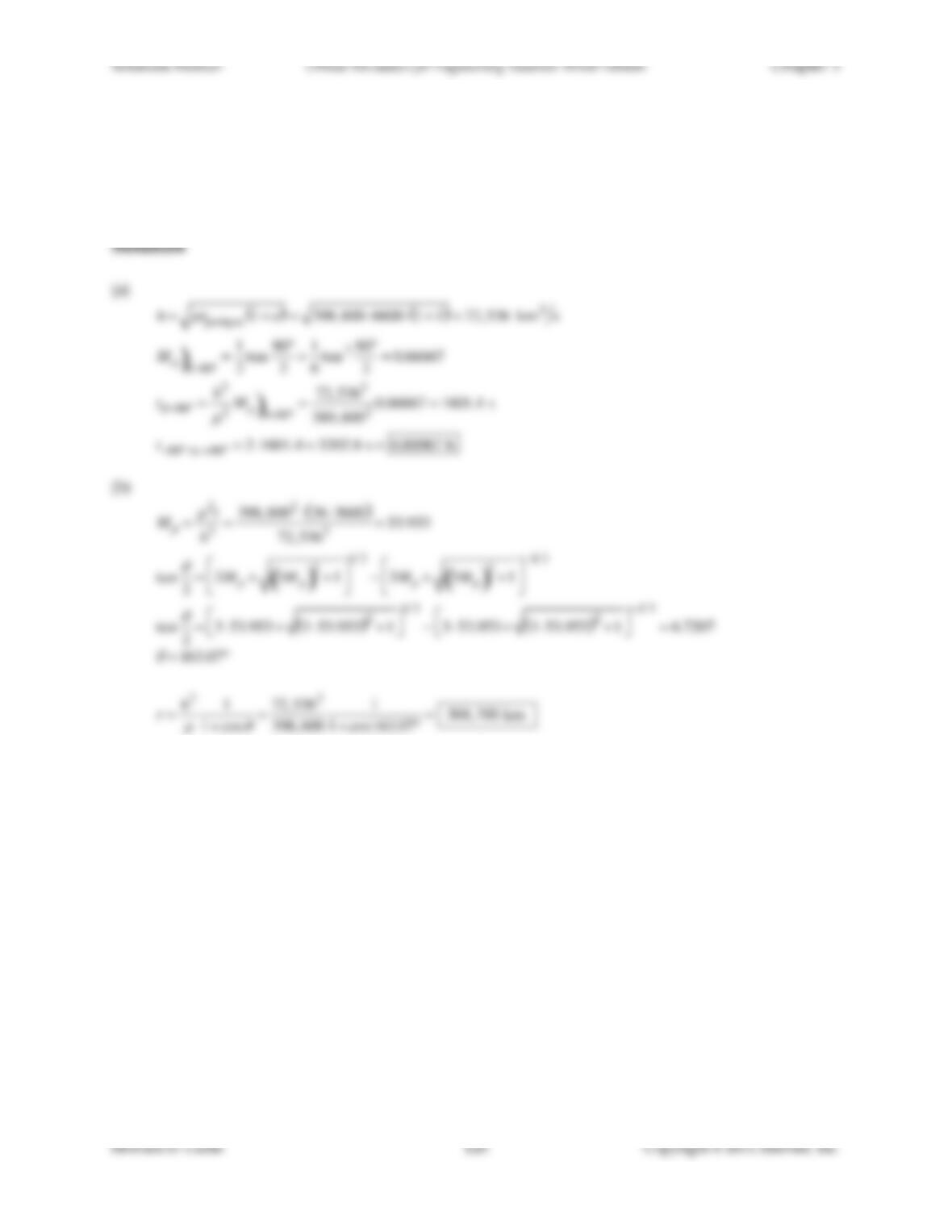
Problem 3.15 A spacecraft on a parabolic trajectory around the earth has a perigee radius of 6600 km.
(a) How long does it take to coast from
90 degrees
to
90 degrees
?
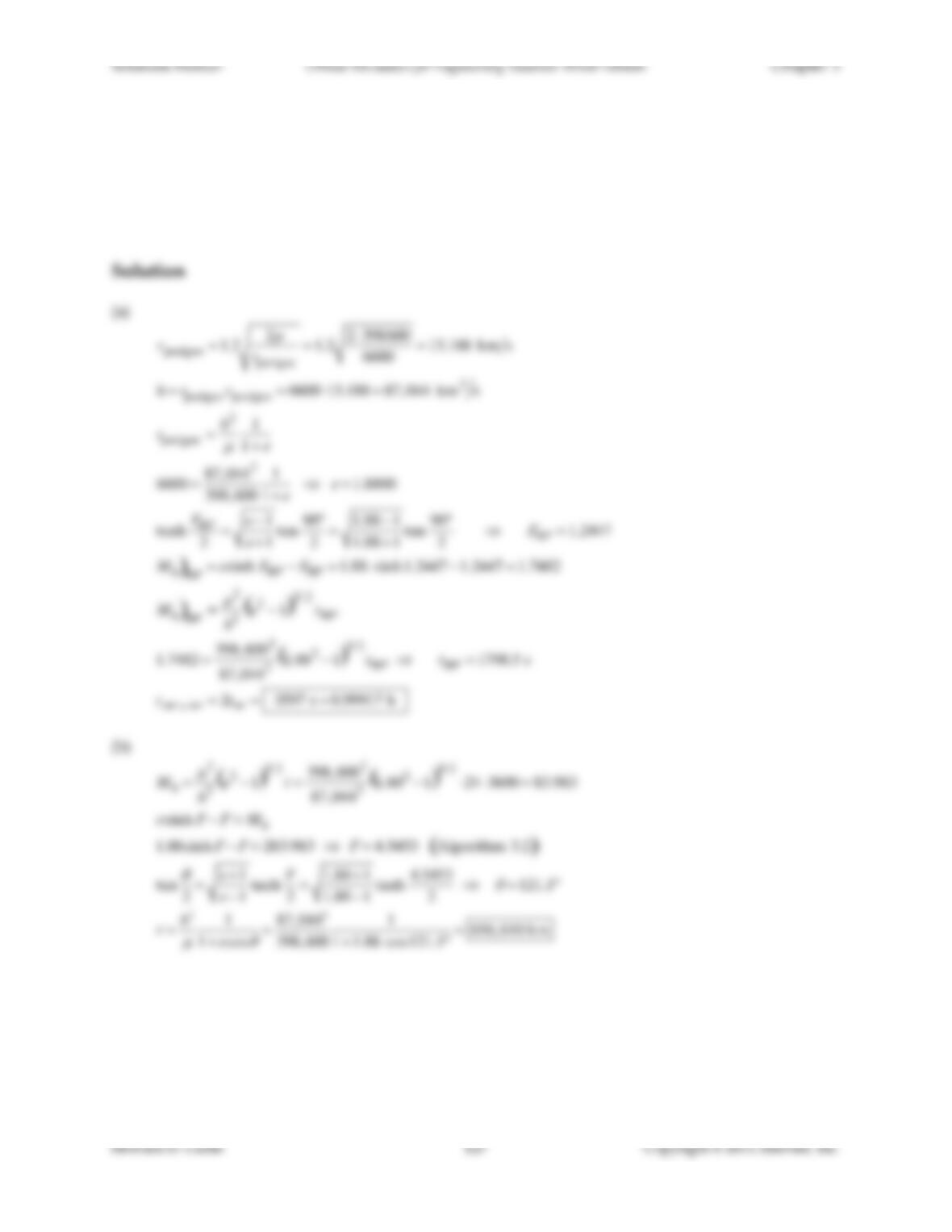
(b) How far is the spacecraft from the center of the earth 36 hours after passing through perigee?
1cos
398,600
1cos163.07304,700 km
Problem 3.16 A spacecraft on a hyperbolic trajectory around the earth has a perigee radius of 6600 km
and a perigee speed of
1.2vesc
.
(a) How long does it take to coast from
90 degrees
to
90 degrees
?
(b) How far is the spacecraft from the center of the earth 24 hours after passing through perigee?
Problem 3.17 A trajectory has a perigee velocity
1.1vesc
and a perigee altitude of 200 km. If at 10 AM
the satellite is traveling towards the earth with a speed of 8 km/s, how far will it be from the earth’s
surface at 5 PM the same day?
Solutions Manual Orbital Mechanics for Engineering Students Third Edition Chapter 3
z142,630 6378 136,250 km
Problem 3.18 An incoming object is sighted at an altitude of 100,000 km with a speed of 6 km/s and a
flight path angle of –80°. (a) Will it impact the earth or fly by? (b) What is the time either to impact or
closest approach?
0.5064 hours until perigee passage
Solutions Manual Orbital Mechanics for Engineering Students Third Edition Chapter 3
Problem 3.19 At a given instant the radial position of an earth-orbiting satellite is 7200 km, its radial
speed is 1 km/s. If the semimajor axis is 10 000 km, use Algorithm 3.3 to find the universal anomaly 60
minutes later. Check your result using Equation 3.58.
2
r
2a
Solutions Manual Orbital Mechanics for Engineering Students Third Edition Chapter 3
Howard D. Curtis 132 Copyright © 2013, Elsevier, Inc.
v2
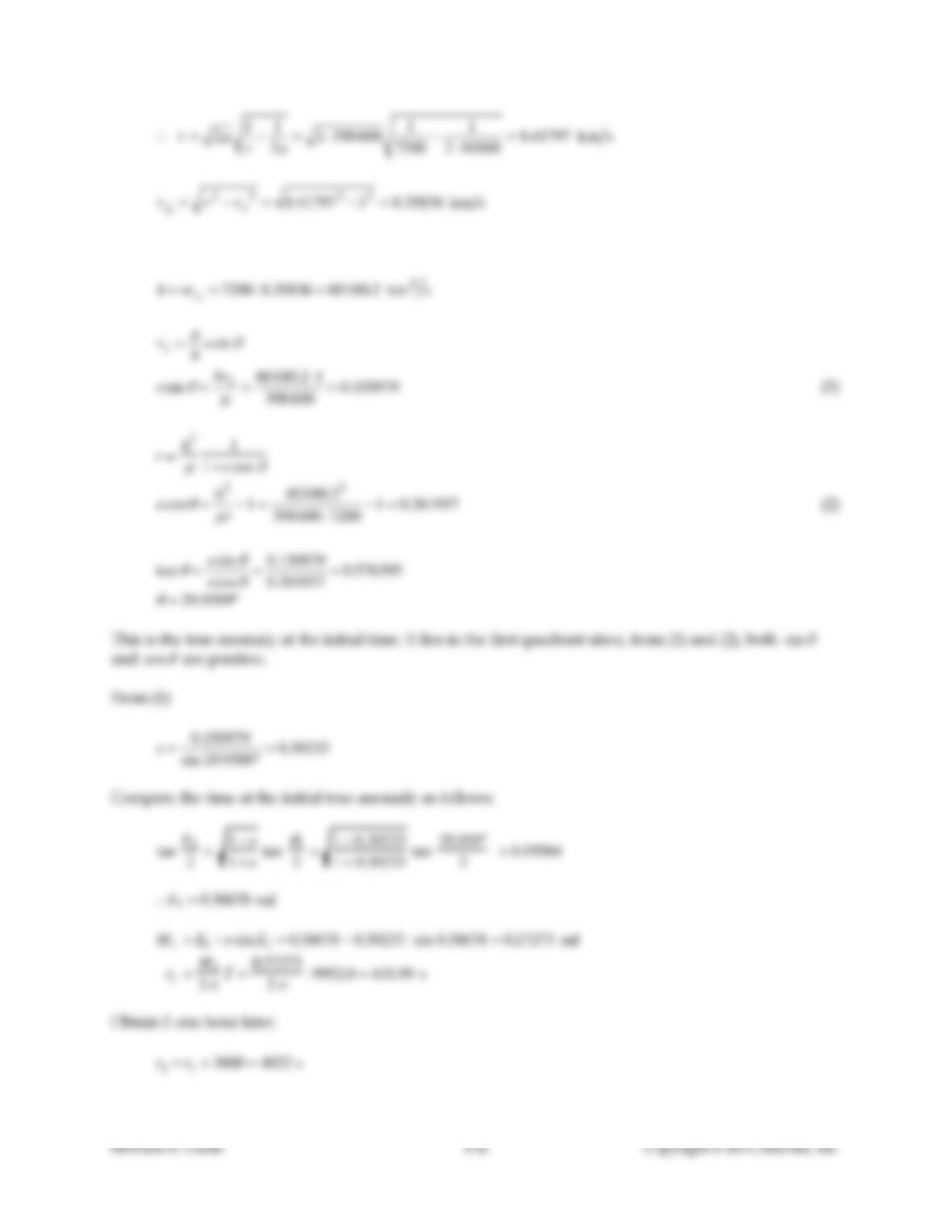
1
r1
2a2398 600 1
7200 1
210000 8.41797 km s
vv2vr
28.417972128.35836 km s
hrv7200 8.35836 60180.2 km2s
vr
hesin
esin
hvr
60180.2 1
398 600 0.150979
(1)
rh2
1
1ecos
ecos
h2
r160180.22
398 600 7200 10.261937
(2)
tan
esin
ecos
0.150979
0.261937 0.576395
29.9589
This is the true anomaly at the initial time. It lies in the first quadrant since, from (1) and (2), both
sin
and
cos
are positive.
From (1)
e0.150979
sin 29.95890.30233
Compute the time at the initial true anomaly as follows:
tan E1
21e
1etan
1
210.30233
10.30233 tan 29.959
2 0.19584
E10.38678 rad
M1E
1esin E10.38678 0.30233 sin 0.38678 0.27273 rad
t1M1
2
T0.27273
2
9952.0 431.99 s
Obtain E one hour later.
t2t13600 4032 s
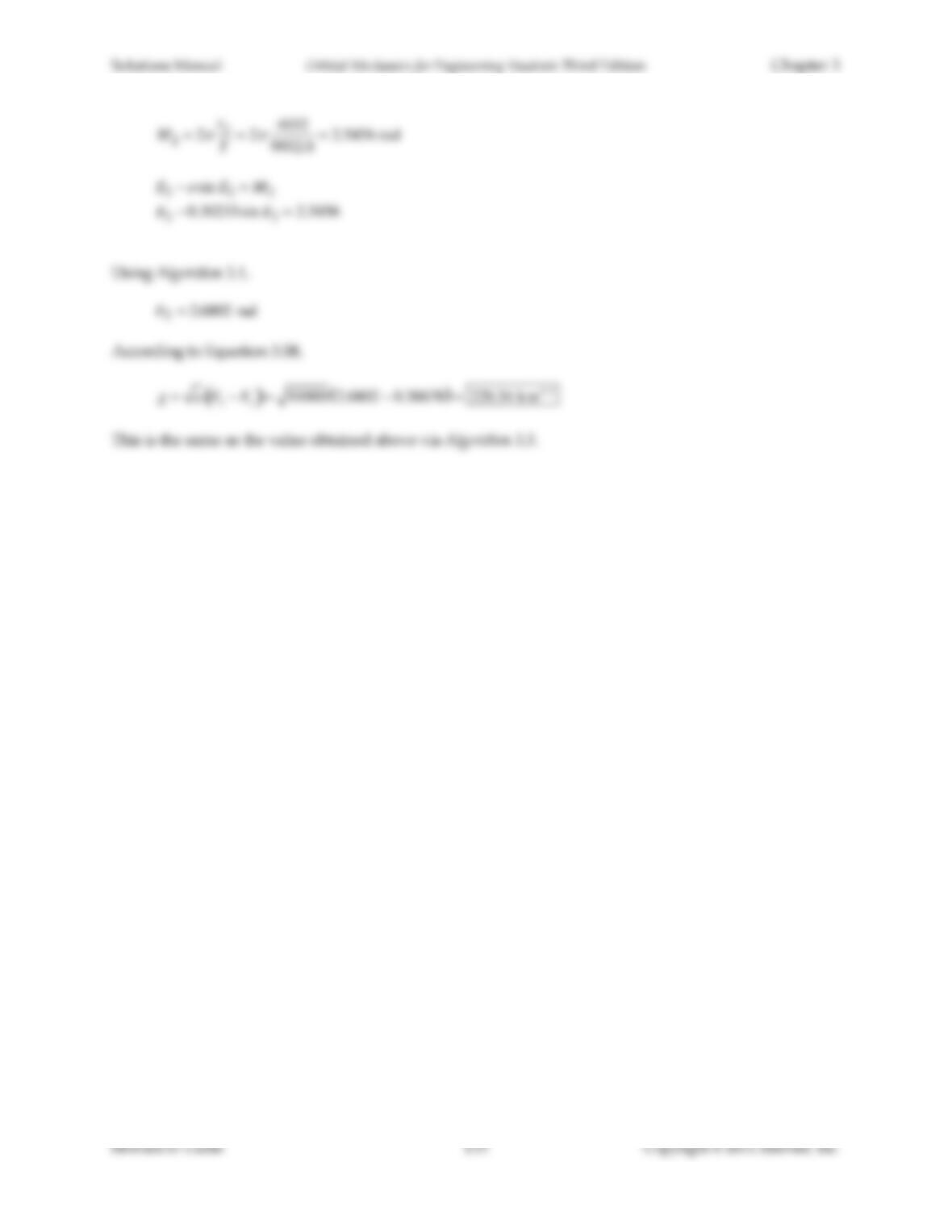
t2
4032
Problem 3.20 At a given instant a space object has the following position and velocity vectors relative
to an earth-centered inertial frame of reference:
r
020 000ˆ
i105 000ˆ
j19 000 ˆ
k km
v0=0.9000ˆ
i3.4000ˆ
j1.5000 ˆ
kkm s
Find
r
and
v
two hours later.