
3-14
problems or issues on the part of employees.
o Organizational silence is usually caused by two compelling factors:
▪ Fear of negative repercussions for speaking up
▪ An assumption that one’s voice would not be heard anyway
• There may be legitimate reasons for filtering the message.
o The total message may be very lengthy, technically overwhelming, or the
information may be speculative and require additional confirmation.
o In some cases, the supervisor may have previously requested the employee to pass
along only the highlights of a situation.
• Sometimes, in an effort to avoid filtering, people bypass their superior, which means that
they skip one or more steps in the communication hierarchy.
• Another problem revolves around an employee’s legitimate need for a response.
o Since employees initiate upward communication, they are now the senders, and
they have strong expectations that feedback will occur (and soon).
o If management provides a quick response, further upward messages will be
encouraged.
o Conversely, lack of immediate response suppresses future upward communications.
• A final communication difficulty concerns distortion.
o This is the willful modification of a message intended to achieve one’s personal
objectives.
o For example, some employees may exaggerate their achievements, hoping for more
recognition or larger salary increases.
o Any message distortion robs a manager of accurate information and the capacity to
make enlightened decisions.
o It represents unethical behavior that can destroy trust between two parties.
Upward Communication Practices
• A starting point for building better upward communications is to establish a general
policy stating what kinds of upward messages are desired.
o This could include areas where higher management is accountable, controversial
topics, matters requiring managerial advice, requests for exception to corporate
policy, or “bottom-up” recommendations for change.
• In addition to policy statements, various practices are needed to improve upward
communications.
• Questioning
o Managers can encourage upward communications by asking good questions.
o Questions can take several forms, but the most common types are:
▪ Open questions—introduce a broad topic and give others an opportunity to
respond in several ways.
▪ Closed questions—focus on a narrower topic and invite the receiver to
3-15
provide a specific response.
o No matter how well questions are asked, they are useless unless the questions are
accompanied by skillful listening and the responses are probed for their meaning.
• Listening
o Active listening is much more than hearing; it requires use of the ears and the mind.
▪ Effective listening works on two levels—it helps receivers understand both
the factual idea and the emotional message the sender intended.
• Employee Meetings
o One useful method of building upward communications is to meet with small
groups of employees
▪ In these “town hall” meetings employees are encouraged to talk about job
problems, resource needs, and management practices that both help and
interfere with job performance.
• An Open-Door Policy
o An open-door policy is a statement that encourages employees to come to their
supervisor or to higher management with any matter that concerns them.
▪ Usually, employees are encouraged to see their supervisor first.
▪ The goal is to remove blocks to upward communication (physical,
psychological, and social)
o Although the manager’s door is physically open, psychological and social barriers
exist that make employees reluctant to enter.
▪ Some employees do not want to admit that they lack information or have a
problem.
▪ Others are afraid they will incur their manager’s disfavor if they raise
disruptive issues.
• Participation In Social Groups
o Informal casual recreational events furnish superb opportunities for unplanned
upward communication.
o Information gained on a spontaneous basis reveals true conditions better than most
formal communications.

3-16
o Upward communication is not the primary purpose of these events, but it can be an
important by-product of them.
Other Forms of Communication
Lateral Communication
• Managers engage in a large amount of lateral communication, or cross-communication,
which is communication across chains of command.
o It is necessary for job coordination with people in other departments.
o It also is done because people prefer the informality of lateral communication rather
than the up-and-down process of the official chain of command.
o Lateral communication often is the dominant pattern within management.
• Employees who play a major role in lateral communication are referred to as boundary
spanners.
o Boundary-spanning employees have strong communication links within their
department, with people in other units, and often with the external community.
o These connections with other units allow boundary spanners to gather large
amounts of information, which they may filter or transfer to others.
o This gives them a source of status and potential power.
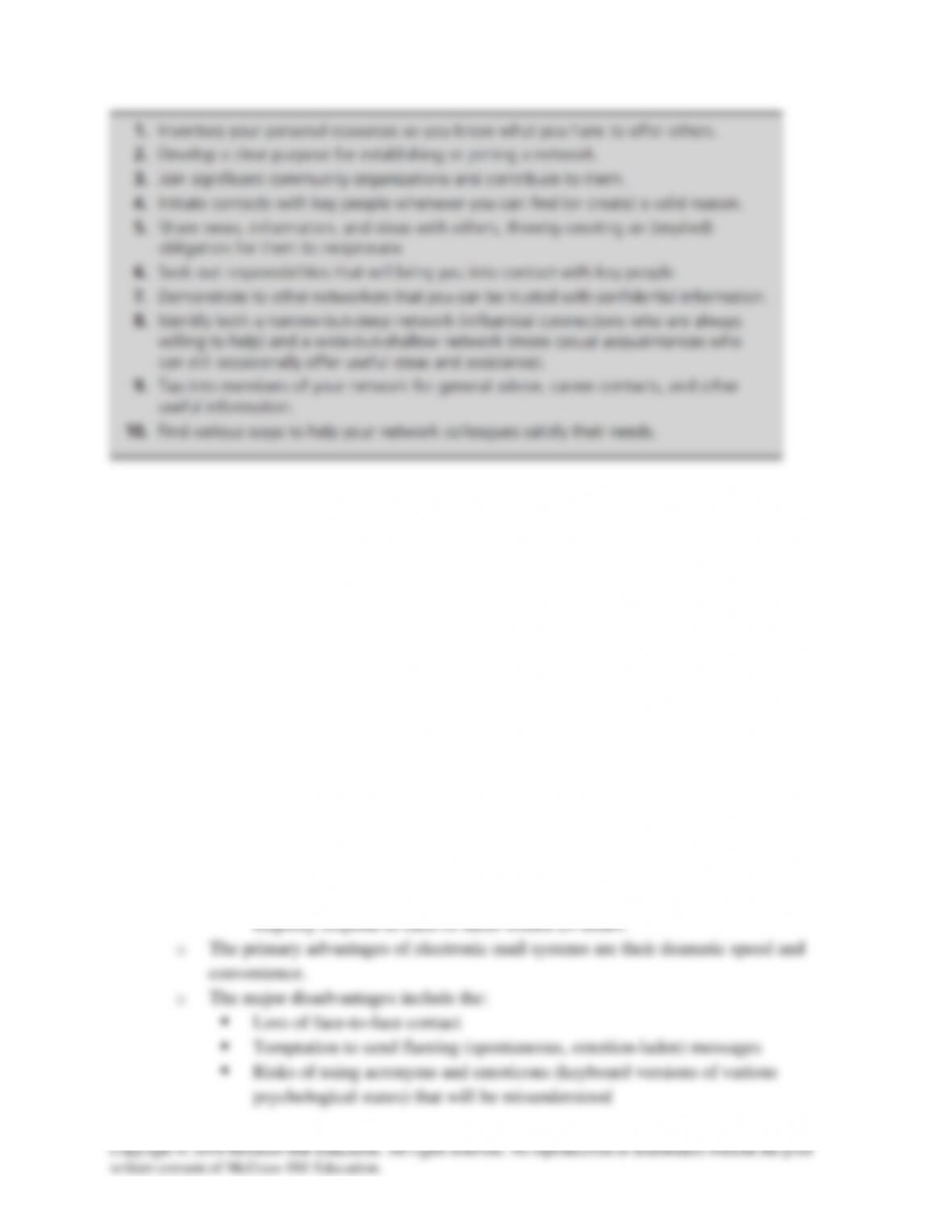
• Networks
o A network is a group of people who develop and maintain contact to exchange
information informally, usually about a shared interest.
o An employee who becomes active in such a group is said to be networking.
o Although networks can exist within as well as outside a company, usually they are
built around external interests.
o Networks help broaden the interests of employees, keep them more informed about
new technical developments, and make them more visible to others.
o Networks help employees learn who knows what and even who knows those who
3-17
Copyright © 2014 McGraw-Hill Education. All rights reserved. No reproduction or distribution without the prior
written consent of McGraw-Hill Education.
Social Networking and Electronic Communication
• Social networking technologies are Internet sites and software programs that allow
people to link together into some form of a virtual social community.
o YouTube, Facebook, and MySpace are accessed by millions of viewers, and used to
share personal information profiles and learn about others.
o Wikis are Web pages that enable their users to add or modify contents; the most
visible example of this is Wikipedia, which is a collaboratively created and
constantly updated collection of 4 million articles in the English language.
• Electronic Mail
o Electronic mail (e-mail) is a computer-based communication system that allows
people to send a message to someone—or to a hundred people—almost
instantaneously.
o Some electronic mail systems can send messages in various modes, and others can
translate the message into a foreign language.
o In surveys of employees, more than 80 percent of users report that the Internet has
made them more productive at work.
▪ Most users receive more than 20 work-related e-mails every day, and the vast
3-18
▪ Associated difficulty of accurately conveying and interpreting emotions and
subtleties in brief and somewhat sterile messages
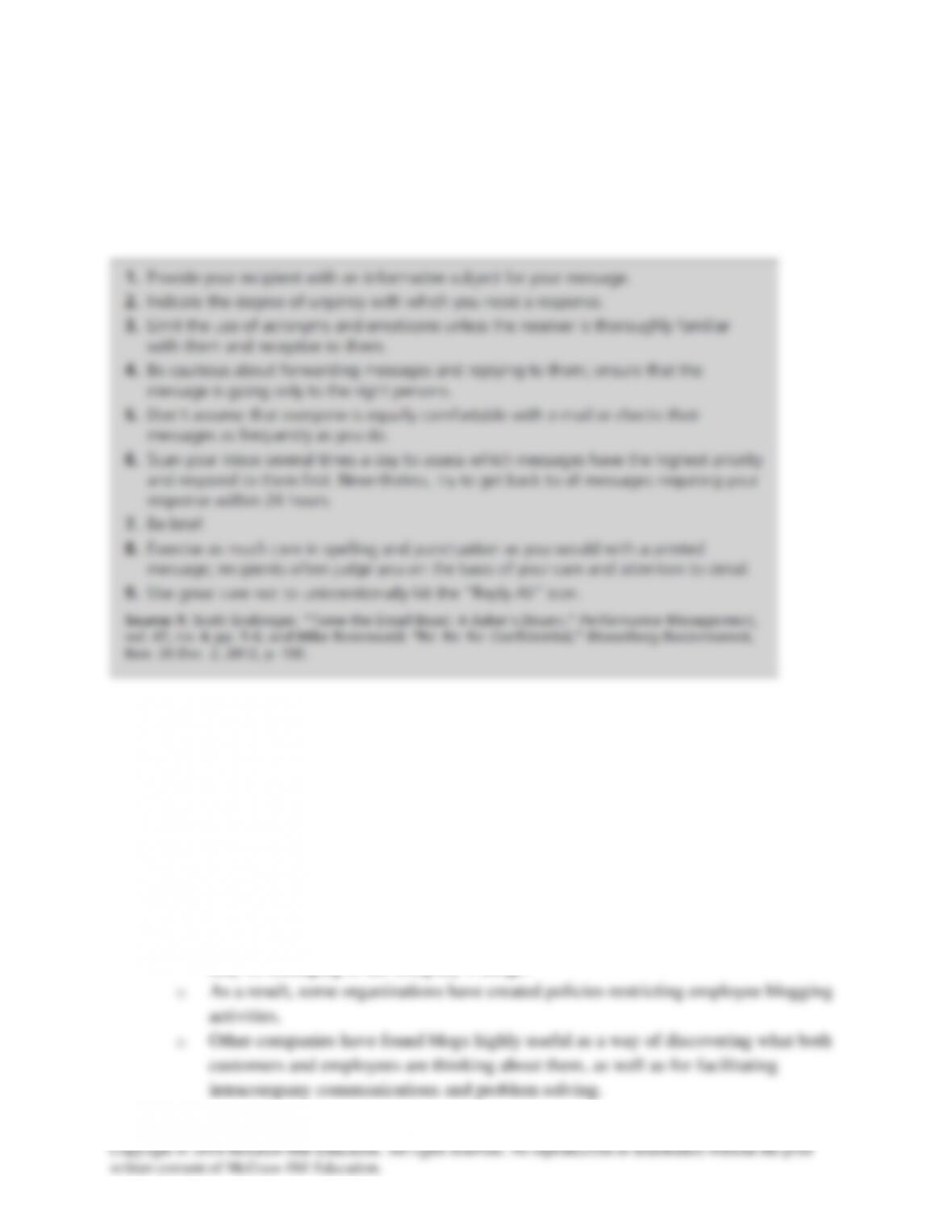
o The whole field of e-mail courtesy (“netiquette”) has sprung up, with a set of
guidelines (Figure 3.6) emerging to help managers decide how best to proceed via
e-mail.
• Blogs
o The past decade has produced rapidly increased interest in Web logs, or blogs.
o These are online diaries or journals created and updated frequently by individuals to
express their personal thoughts, musings, and commentaries on topics of interest to
them, although they can also be produced by organizations, CEOs, and professional
groups.
o Often informative and sometimes amusing, blogs can be time-consuming if
employees get “hooked” on reading them at work.
o Other problems arise when employees themselves engage in blogging about their
own companies, thus offering unofficial insider opinions about the organization that
may be damaging to the company’s image.

3-19
o A special form of microblogging has emerged at Twitter.com.
▪ Twittering involves expressing oneself in a brief (maximum of 140
characters) message (a “Tweet”) in real time to a self-selected network of
interested persons.
• Telecommuting
o Telecommuting allows telecommuters to accomplish all or part of their work at
home, or at a satellite location, through computer links to their office.
o Research suggests that the personal advantages of telecommuting include:
▪ Freedom from the distractions of the workplace
▪ A reduction in the time and money spent on commuting
▪ The opportunity to reduce expenditures for work-relevant clothing
▪ The opportunity to spend more time with family members or even to provide
for their care at home
o Corporate advantages include:
▪ Improved productivity (sometimes as much as 15 to 25 percent)
▪ Reduced space requirements
▪ The opportunity to hire key talent who will telecommute from a distant city
▪ Increased employee loyalty because the employer “went the extra mile” by
setting up the system
▪ The capacity to accommodate disabled or chronically ill employees
o It creates the following societal benefits too:
▪ Reduction in auto traffic and pollution
▪ Employment of people who are unable to work outside the home
o The growth of telecommuting practices depends largely on the ability of managers
to overcome their fear of a loss of direct control over employees they cannot
visually monitor.
o Other substantial problems include the:
▪ Possibility of being overlooked at promotion time through lesser daily
visibility
▪ Risk of getting burned out from the temptation to put in more hours daily
▪ Temptation to engage in household activities instead of working
▪ Social isolation that at-home employees may feel
• Virtual Offices
o Some companies have implemented virtual offices, in which physical office space
and individual desks are being replaced with an amazing array of portable

3-20
communication tools—electronic mail, cellular phones, voice mail systems, laptop
computers, fax machines, etc.
o Electronic communication tools allow employers to greatly reduce the office space
needed for each employee, sometimes enabling them to replace dozens of desks
with a single “productivity center” that employees can use for holding meetings,
responding to mail, and accomplishing other short-term tasks.
o One significant risk is the loss of an opportunity for social interaction; employees
still need to gather informally, exchange ideas and experiences face-to-face, and
develop a sense of teamwork.
Informal Communication
• The grapevine is an informal communication system.
o The term “grapevine” arose during the Civil War.
o Intelligence telegraph lines were strung loosely from tree to tree in the manner of a
grapevine, and wild grapevines grew over the lines in some areas.
o Since messages from the lines often were incorrect or confusing, any rumor was said
to be from the grapevine.
o Today, the term applies to all informal communication, including company
information that is communicated informally between employees and people in the
community.
• Although grapevine information tends to be sent orally, it may be written.
o Handwritten or typed notes sometimes are used, but in the modern electronic office
these messages typically are flashed on computer screens, creating an era of
electronic grapevine.
• Electronic grapevine will not replace the face-to-face grapevine for two reasons:
o Not every employee has access to a network of personal computers at work.
o Many workers enjoy the more personal social interaction gained through the
traditional grapevine.
Features of the Grapevine
• The pattern that grapevine information usually follows is called a cluster chain, because
each link in the chain tends to inform a cluster of other people instead of only one person.
• In addition, only a few people are active communicators on the grapevine for any specific
unit of information; these people are called liaison individuals.
3-21
Copyright © 2014 McGraw-Hill Education. All rights reserved. No reproduction or distribution without the prior
written consent of McGraw-Hill Education.
• Contrary to common perceptions, well over three-fourths of grapevine information is
accurate.
• The grapevine may be incomplete; it generally carries the truth but not the whole truth.
• The grapevine is fast, flexible, and personal.
o This speed makes it difficult for management to stop undesirable rumors or to
release significant news in time to prevent rumor formation.
• The grapevine is influential, both favorably and unfavorably.
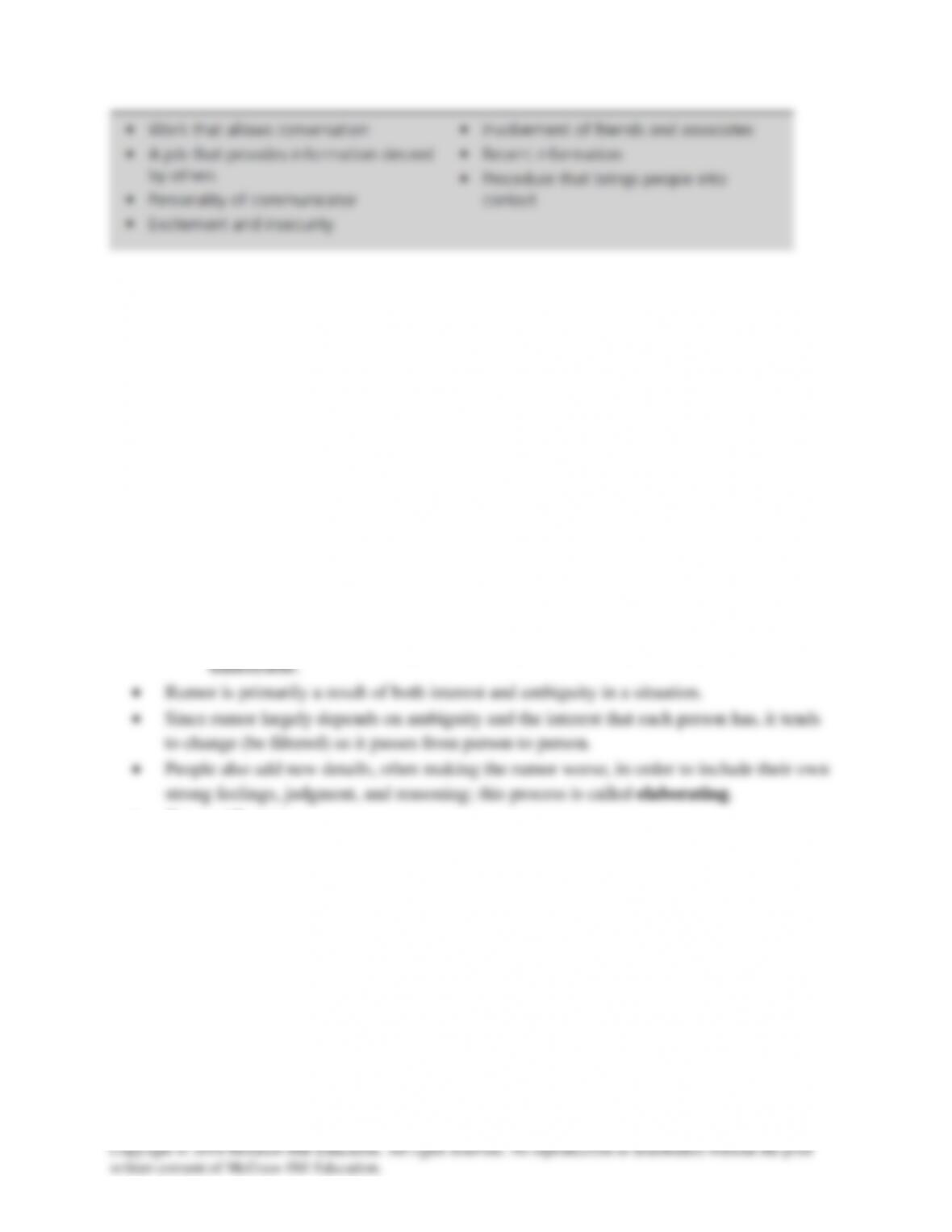
Rumor
• The major problem with the grapevine—and the one that gives the grapevine its poor
reputation—is rumor.
o It is grapevine information that is communicated without secure standards of
evidence being present.
o It is the unverified and untrue part of the grapevine.
o It could by chance be correct, but generally it is incorrect; thus it is presumed to be
• Types of Rumors
o There are different kinds of rumors.
▪ Some are historical and explanatory; they attempt to make meaning out of
incomplete prior events.
▪ Others are more spontaneous and action-oriented; they arise without much
forethought and represent attempts to change a current situation.
▪ Occasionally, rumors are negative, such as those that drive a wedge between
people or groups, destroy loyalties, and perpetuate hostilities.
▪ They may also be positive as when employees speculate about the beneficial
effects of a new product just released.
• Control of Rumor
o Rumor should be dealt with firmly and consistently, but how and what to attack
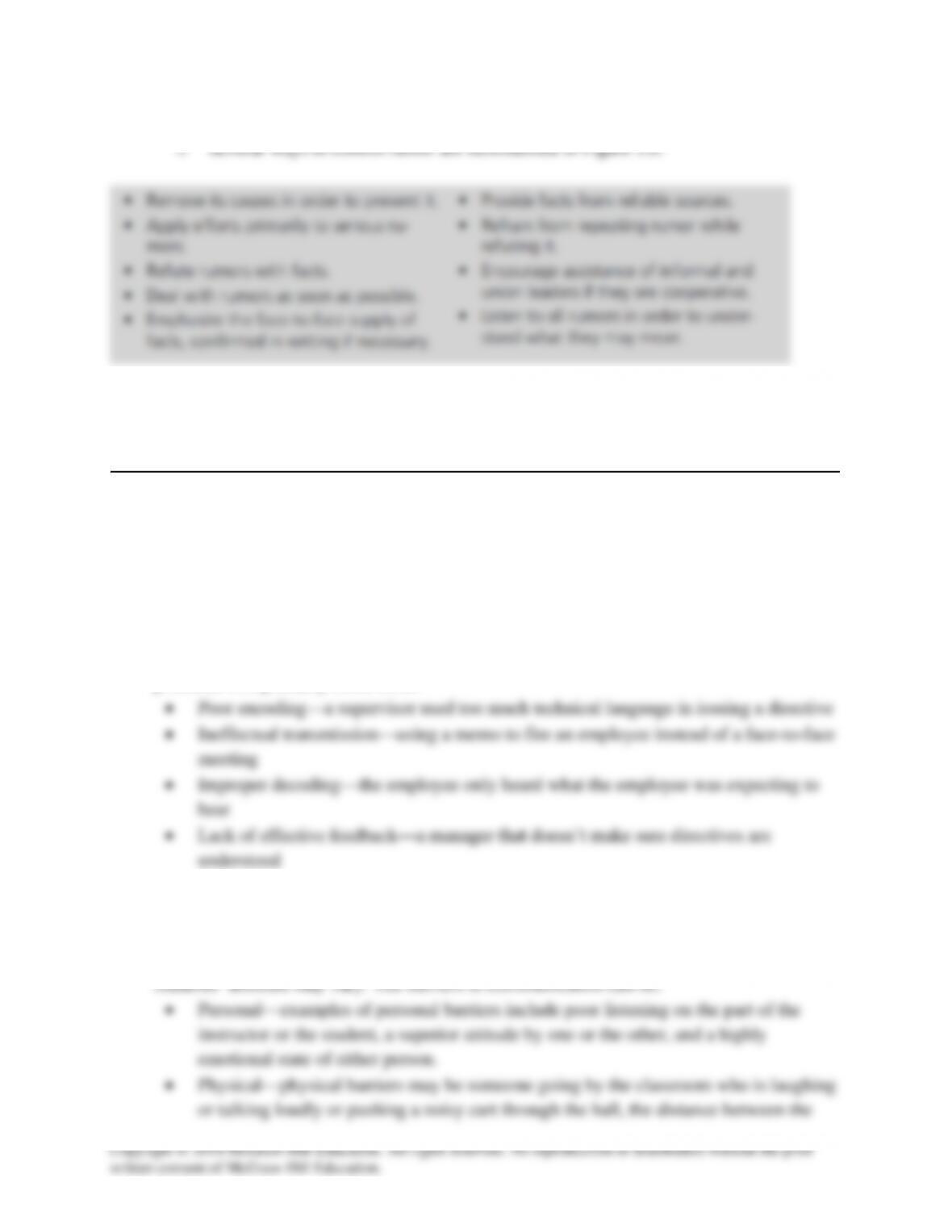
3-22
must be known.
o The best approach is to prevent it by removing its causes.
Suggested Answers to Discussion Questions
1. Think of a job you have had and a situation in which the communication failed or was
ineffective. Discuss how the communication process applied in that situation and
where (during which of the eight steps) the breakdown occurred.
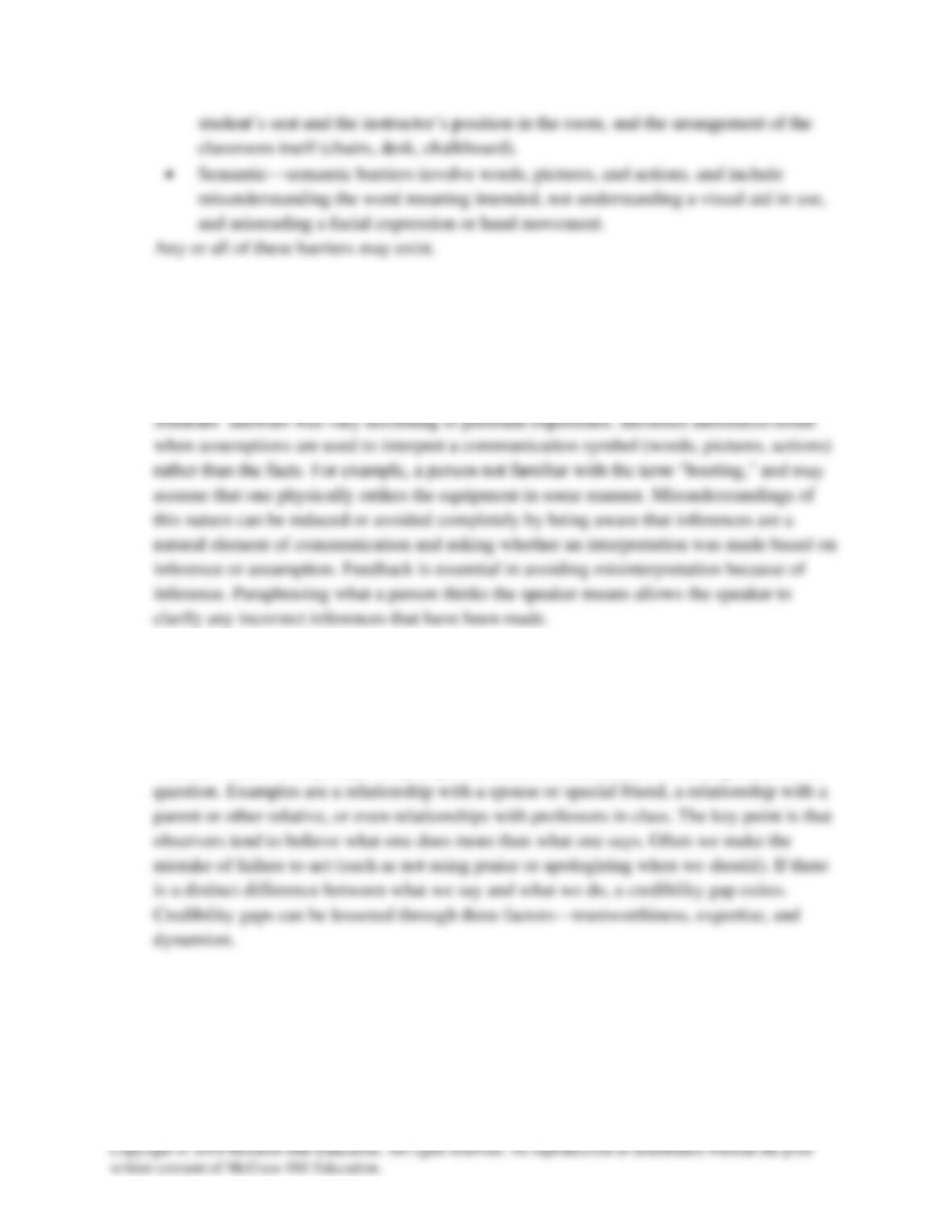
Students’ answers may vary. They should examine the eight steps in the communication
process in answering this question. Someone in the class is likely to come up with an
example of ineffective communication arising from each of the eight steps. Typical
problems will probably come from:
2. Discuss the barriers to communication that exist when you discuss a subject with your
instructor in the classroom.
3-23
Copyright © 2014 McGraw-Hill Education. All rights reserved. No reproduction or distribution without the prior
written consent of McGraw-Hill Education.
student’s seat and the instructor’s position in the room, and the arrangement of the
classroom itself (chairs, desk, chalkboard).
• Semantic—semantic barriers involve words, pictures, and actions, and include
misunderstanding the word meaning intended, not understanding a visual aid in use,
and misreading a facial expression or hand movement.
Any or all of these barriers may exist.
3. Select a situation in which you made a wrong inference. Analyze how the
misinterpretation was made, and discuss how you might avoid similar
misinterpretations in the future. How important is feedback as an aid to avoiding
inference problems?
4. Observe your own behavior and discuss what nonverbal communication habits you
typically use. What do you intend as the message of each of them? Do you have some
behaviors that may mislead receivers?
Students’ answers may vary. They may want to refer to a familiar role to help answer this
5. Visit an instructor’s office, and record your feelings of relative comfort there. What
physical elements in the office contributed to your reaction? Discuss the instructor’s
apparent use of space (proxemics).
Students’ answers will vary.
3-24
Copyright © 2014 McGraw-Hill Education. All rights reserved. No reproduction or distribution without the prior
written consent of McGraw-Hill Education.
Some physical elements students may point out relative to discomfort include arrangement
of the office such that the student is forced to stand while speaking to the instructor, the sun
is in the student’s eyes, the desk placement conveys a sense of power on the part of the
instructor, unpleasant color scheme, and extreme temperatures (hot or cold).
Elements that contribute to a feeling of comfort are soft lighting, pleasant color scheme,
uncluttered work area, informal seating arrangement where the student sits next to the
instructor, personal touches (pictures of family, trophies), and soft music.
6. Examine the guidelines for effective listening in Figure 3.4. Which ones do you
practice best? Which ones could you improve upon? Create a plan for your listening
skills, and solicit feedback from a friend in three months to monitor your
improvement.
Students’ answers may vary. They should examine each of the ten items shown in Figure
3.4 in formulating their answer—stop talking, put the talker at ease, show a talker that you
want to listen, remove distractions, empathize with talkers, be patient, keep your cool,
avoid being confrontational, ask relevant questions, and stop talking.
Emphasis should be placed on items 1 and 10, which are the same; one cannot listen while
one is talking. Also, several of the other guides involve the way in which the listener can
resist the temptation to talk and to talk in a manner that impedes communication.
7. Think of a part-time or full-time job that you have had.
a. Discuss any communication overload you experienced.
b. Discuss how well management handled downward communication to you.
c. Explain any upward communication difficulties that you had and what you did to
try to overcome them.
d. Did you engage in feedback-seeking behavior? Describe what you did, or explain
why you did not.
a. Communication overload is a common problem in organizations. The most common
examples that students may mention are too many memos, and the case of the
supervisor who “hovers” about and issues incessant orders.
3-25
Copyright © 2014 McGraw-Hill Education. All rights reserved. No reproduction or distribution without the prior
written consent of McGraw-Hill Education.
preceding item. Some students will report that they were praised by managers for
seeking feedback; others, unfortunately, will undoubtedly relate an instance when they
were rebuffed in such attempts.
8. What social networks do you belong to? Explain how you became a part of them and
what they have done for you. What are your future networking plans, both Internet-
based and personal?
Students’ answers may vary. Some of them will probably need some help in identifying the
9. Assess electronic mail in the context of this chapter. How does it fit with the eight
steps of the communication process? What barriers are most likely to arise when it is
used? How can they be overcome, or at least minimized?
Students’ answers may vary. The eight communication steps are develop an idea, encode,
transmit, receive, decode, accept, use, and feedback.
10. Select a grapevine story you heard, and discuss how it was communicated to you and
how accurate it was.
Students’ answers will vary based on their stories. Grapevine generally follows a cluster
3-26
Assess Your Own Skills
Students should honestly circle the number on the response scale that most closely reflects the
degree to which each statement accurately describes them. This section will help them
understand how well they exhibit good communication skills.
Incident
A Breakdown in Communications
This incident provides an example of the harm that can result from barriers to communication.
The first barrier in this scenario is that downward communication in the trucking firm is
inadequate. The company did not institute any type of mechanism to assure Linda knew and
understood what her permanent work schedule would be. This is also a violation of the two-way
communication model in that feedback was not sought from Linda; no one asked her, or at least
the company has no record that she was asked, if she could in fact work the shift allocated to her.
Experiential Exercise
Communication Style
Generating OB Insights
Students’ responses will vary for this exercise. They should however, highlight several of the
major topics discussed in the chapter such as the two-way communication process, the barriers to
communication, the factors leading to effective communication, the downward and upward
communications problems, the roles of questioning and listening, etc.