
3-1
Chapter 3
Managing Communications
Chapter Overview
The purpose of this chapter is to discuss the general concept of communication in organization.
First, communication is defined and the importance of communication is discussed. The eight
steps of the communication process are then identified, followed by a discussion on
communication barriers. Next, several communication symbols are presented and the different
forms of organizational communication are discussed. The final part of the chapter discusses
organizational grapevines and rumors.
Chapter Learning Objectives
After reading this chapter, students should understand
1. The two-way communication process
2. Barriers to communication
3. Factors leading to effective communication
4. Downward and upward communications problems
5. The roles of questioning and listening
6. Social networking tools
7. The impact of electronic communications
8. Organizational grapevines and rumors
Discussion and Project Ideas
The fundamental point about communication is that it is the process by which leadership takes
action. If there is no communication, leadership ceases to exist. Communication is the medium or
process by which all human interaction takes place; therefore, reasonably adequate
communication is necessary for effective organizational behavior.
The following exercises highlight many of the points made in the text. Note that another
experiential exercise appears at the end of the chapter in the textbook.
• The Process of Inference: Write the following case and the accompanying list of potential
facts on the blackboard. Ask students to call out facts about the story that they believe are
true as you write them on the board. Then ask students to indicate which facts they believe
3-2
are correct by raising their hands.
Potential facts:
• Jack is married to Mary.
• Jack drove to the beach Friday night.
• Mary went to the beach Friday night.
• Mary wrecked Jack’s car.
• It was raining on Saturday.
• Jack has two children.
All of the above are inferences, not facts. For example, the story did not mention Jack’s
wife’s name. His wife could be Sarah, and Mary might be Sarah’s sister, who lives at the
beach. Similarly, the two children could be Sarah’s, and Jack’s car might have been left at
the beach on the previous week. Nor does the phrase “wet conditions” prove rain. It could
be that people had been tracking water in from the surf or had spilled something.
• Give students the following paragraph, or make up one of your own, and ask them to
simplify it. After each student has written a simplified version, have them read it out loud.
Discuss the necessity of simple and clear communications.
• This exercise is designed to demonstrate the amount of distortion which occurs as
information is relayed through several sources. Begin the exercise by reading the following
incident to a person in class, without other students listening.

3-3
Copyright © 2014 McGraw-Hill Education. All rights reserved. No reproduction or distribution without the prior
written consent of McGraw-Hill Education.
hospital. The other driver said she was going to sue for damages.”
Have the first student relay this message verbally to another and have each recipient relay
the message along so that it travels through the entire class. Have the last person in the
chain of communication repeat the message to the class. Discuss the implications of this
exercise for large organizations which have long chains of command.
• Draw several simple objects, such as a coffee cup, house, and a sailboat. Have one student
go to the blackboard with his or her back facing the class and have a second student
describe the drawing while the first attempts to draw it. The first student is not allowed to
ask questions and the person describing the object is not allowed to name it. Next, do the
same exercise but allow the person drawing the object to ask questions. Finally, allow both
persons to communicate freely while facing each other. Discuss the exercise in terms of
limitations subordinates often perceive in questioning and initiating contact with their
supervisors.
• Social networking sites have become extremely popular over the last few years. What sites
do the students belong to? How can belonging to these sites help or hinder their careers?
Lecture Outline
Introduction
• Communication is the ever-present activity by which people relate to one another and
combine their efforts, and is necessary to perpetuate the health of the organization.
• Managers need to engage in systematic and extensive communications in upward,
downward, and lateral directions.
o Listening skills that focus on the receiver—and a healthy dose of humility—remain
highly important in the communication process.
Communication Fundamentals
• Communication is the transfer of information and understanding from one person to
another.
o Its goal is to have the receiver understand the message as it was intended and to act
upon the information.
• Communication always involves at least two people—a sender and a receiver.
• There is no effective communication until a message is received, read, and understood.
• Communication is what the receiver understands, not what the sender says

3-4
The Importance of Communication
• Organizations cannot exist without communication.
• If there is no communication, employees cannot know what their co-workers are doing,
management cannot receive information inputs, and supervisors and team leaders cannot
give instructions.
o Coordination of work is impossible, and the organization will collapse for lack of it.
o Cooperation becomes impossible, because people cannot communicate their needs
and feelings to others.
• Every act of communication influences the organization in some way.
• When communication is effective, it tends to facilitate better performance and improve
job satisfaction.
• Open and candid communication is better than restricted communication.
o This proposition is based on the contemporary desire for transparency in all
organizations and at all levels.
o If employees know the problems an organization is facing and hear what managers
are trying to do, they will usually respond favorably.
• To focus solely on communication with employees and ignore the needs of managers
would be easy, but that approach would provide a limited view.
• An executive summary is a useful tool for communicating both to employees and to
busy superiors.
o In its briefest form, an executive summary provides concise highlights of a longer
document or set of reports, often as an aid to rapid decision-making.
• Managers need timely and useful information to make sound decisions.
The Two-Way Communication Process
• The two-way communication process is the method by which a sender reaches a
receiver with a message.
o The process always requires eight steps, whether the two parties talk, use hand
signals, or employ some advanced-technology means of communication (Figure
3.1).

3-5
• Develop an Idea
o Step 1 is to develop an idea that the sender wishes to transmit.
o This is the key step, because unless there is a worthwhile message, all the other
steps are somewhat useless.
• Encode
o Step 2 is to encode (convert) the idea into suitable words, charts, or other symbols
for transmission.
o At this point, the sender determines the method of transmission so that the words
and symbols may be organized in suitable fashion for the type of transmission.
o The key to successful encoding lies in in the process of framing an issue for
presentation.
▪ Framing uses rich, colorful, carefully chosen language to shape the
perceptions, attitudes, and actions of the recipients
• Transmit
o When the message finally is developed, step 3 is to transmit it by the method
chosen.
o The sender also chooses a certain channel and communicates with careful timing.
o The sender also tries to keep the channel free of barriers or interference, so that the
message has a chance to reach the receiver and hold his or her attention.
• Receive
o Transmission allows another person to receive a message, which is step 4.
o In this step, the initiative transfers to the receiver, who tunes in to receive the
message.
o If the message is oral, the receiver needs to be a good listener.
o If the receiver does not function, the message is lost.
• Decode
o Step 5 is to decode the message so it can be understood.
o Understanding can only occur in a receiver’s mind.
o The receiver chooses whether to understand or not.
o Many employers think that someone is sufficient, but the communication cannot
proceed until there is understanding.
• Accept
o Once the receiver has obtained and decoded a message, that person has the
opportunity to accept or reject it, which is step 6.
o Acceptance is a matter of choice and degree, such that the receiver has considerable
control over whether or not to embrace all the message or just parts of it.
o Some factors affecting the acceptance decision revolve around:
▪ Perceptions of the message’s accuracy
▪ The authority and credibility of the sender

3-6
▪ The sender’s persuasive skills
▪ The behavioral implications for the receiver
• Use
o Step 7 in the communication process is for the receiver to use the information.
o The receiver may discard it, perform the task as directed, store the information for
the future, or do something else.
• Provide Feedback
o When the receiver acknowledges the messages and responds to the sender, feedback
occurs.
o Feedback completes the communication loop, because there is a message flow from
the sender to the receiver and back to the sender,
o Two-way communication, made possible by feedback, has a back-and-forth pattern.
o If necessary, the sender should seek and request the feedback from the receiver.
o When the two-way communication occurs, both parties experience greater
satisfaction, frustration is prevented, and work accuracy is greatly improved.
Potential Problems
• Two-way communication is not exclusively beneficial.
o Two people may strongly disagree about some item but not realize it until they
establish two-way communication.
▪ When they expose their different viewpoints, they may become polarized,
taking even more extreme positions.
o When threatened with the potential embarrassment of losing an argument, people
tend to abandon logic and rationality, and engage in defensive reasoning.
• Another difficulty that may emerge is cognitive dissonance.
o This is the internal conflict and anxiety that occurs when people receive information
incompatible with their value systems, prior decisions, or other information they
may have.
o Since people do not feel comfortable with dissonance, they try to remove or reduce
it.
▪ Perhaps they will try to obtain new communication inputs, change their
interpretation of the inputs, reverse their decision, or change their values.
▪ They may even refuse to believe the dissonant input, or they may rationalize it

3-7
o Sometimes people regret having said something that challenges people’s self-
concept, personal image, or social honor.
o Regrettable messages may include outright verbal blunders, personal attacks,
stereotyped slurs, sarcastic criticism, or harmful information.
• Another communication problem arises when individuals do not use the most appropriate
tone (or words) when expressing their thoughts and feelings.
o Employees are more likely (and willing) to speak up when they believe that their
managers are open, receptive, and non-judgmental.
o The positive effects of speaking up can include higher quality on decisions, better
teamwork, and more effective organizational performance.
o However, managerial receptivity depends on the nature of employee voice—the
discretionary verbal behavior that is intended to be beneficial to the organization.
o Voice can be classified as:
▪ Challenging—more extreme, questioning, and wave-making in nature, and
characterized by hostile, tactless, and angry tones
▪ Supportive—tends to raise more gentle questions, suggest incremental
changes, base proposals on evidence (versus speculation or opinion) and leave
room for modification of proposals.
Communication Barriers
• Noise, or barriers to communication, may emerge in either the physical surroundings or
within an individual’s emotions.
• Personal Barriers
o Personal barriers are communication interferences that arise from human
emotions, values, and poor listening habits.
o They may also stem from differences in education, race, sex, socioeconomic status,
and other factors.
o Personal barriers often involve a psychological distance—a feeling of being
emotionally separated—between people that is similar to actual physical distance.
▪ Emotions act as perceptual filters in nearly all communications.
▪ People see and hear what they are emotionally tunes to see and hear, so
communication is guided by their expectations.
▪ People communicate their interpretation of reality instead of reality itself.
• Physical Barriers
o Physical barriers are communication interferences that occur in the environment in
which the communication takes place.
o A typical physical barrier is a sudden distracting noise that temporarily drowns out
a voice message.
o Other physical barriers include distances between people, walls around a worker’s
cubicle, or static that interferes with radio messages.

3-8
o The study of spatial separation is called proxemics; it involves the exploration of
different practices and feelings about interpersonal space vary within and across
cultures.
o In the United States, general practice allows:
▪ Intimate communications between close friends to occur at a very short range
(6 to 18 inches).
▪ Personal distance for conversations with acquaintances at 3 to 4 feet.
▪ Social distance for work-related discussions with colleagues at 4 to 12 feet.
▪ Public communication with more impersonal and formal conversations at
greater than 12 feet.
• Semantic Barriers
o Semantics is the science of meaning, as contrasted with phonetics, the science of
sounds.
o Nearly all communication is symbolic—that is, it is achieved using symbols (words,
pictures, and actions) that suggest certain meanings.
o Symbols must be decoded and interpreted by the receiver.
o Semantic barriers arise from limitations in the symbols with which people
communicate.
▪ Symbols usually have a variety of meanings, and people have to choose one
meaning from many.
▪ This is particularly likely when communicators use jargon, which is the
specialized language of a group. It can include the use of:
❖ Acronyms—first letter of each word in a phrase
❖ Slang—words unique to an age, or ethnic, or racial group
❖ Distinctive terms that are created by professional or interest group
o Semantics presents a particularly difficult challenge when people from different
cultures attempt to communicate with each other.
▪ Not only must both parties learn the literal meanings of words in the other
language, they must also interpret the words within their context and the way
in which they are used (tone, volume, etc.).
o Whenever people interpret a symbol on the basis of their assumptions instead of the
facts, they are making an inference.
▪ Inferences are an essential part of most communication.
▪ Since inferences can give a wrong signal, people must always be aware of
them and appraise them carefully.
▪ When doubts arise, more information can be sought.
Communication Symbols
• Words
o Words are the main communication symbol used at work.
3-9
o The complexities of a single language are compounded when people from diverse
backgrounds—such as different educational levels, ethnic heritages, or cultures—
attempt to communicate.
o Context—the environment surrounding the use of a word—helps managers make
sense with words that have no single meaning while communicating with
employees.
▪ Managers need to surround key words with the context of other words and
symbols until their meanings are narrowed to fairly certain limits and
potential confusion is minimized.
▪ Effective communicators are idea-centered rather than just word-centered.
o Social Cues are positive or negative bits of information that influence how people
react to a communication.
▪ Examples of social cues are job titles, patterns of dress, and the historical use
of words in a particular region of the country or ethnic group.
▪ People’s susceptibility to being influenced by these cues varies, depending on
the credibility of the source, their past exposure to the item, the ambiguity of
the cue, and individual differences such as diverse cultural backgrounds.
o Since the meaning of words is difficult to impart even with the use of context, a
reasonable assumption is that if these symbols can be simplified, the receiver will
understand them more easily.
▪ Further, if symbols of the type that receivers prefer are used, the receivers will
Pictures
o A second type of symbol is the picture, which is used to clarify word
communication.
o Organizations make extensive use of pictures, such as blueprints, progress charts,
diagrams, causal maps, visual aids in training programs, etc.
• Action (Non-Verbal Communication)
o A third type of communication symbol is action, also known as nonverbal
communication.
▪ For example, a handshake, a smile, a raise in pay, or being late for an
appointment have meaning.
o Two significant points about action are sometimes overlooked.
3-10
▪ Failure to act is an important way of communicating—a manager who fails to
praise an employee for a job well done or fails to provide promised resources
is sending a message to that person.
❖ Since people send messages by both action and inaction, they
communicate almost all the time at work, regardless of their intentions.
▪ Actions speak louder than words—managers who say one thing but do
another will soon find that their employees “listen” mostly to what they do.
o An important part of nonverbal communication is body language, by which people
communicate meaning to others with their bodies in interpersonal interaction.
▪ Body language is an important supplement to verbal communication in most
parts of the world.
▪ Facial expressions are especially important sources of body language in work
situations.
▪ Nonverbal cues can be either inadvertent, or intentional, thus adding
complexity to the communication process.
▪ Other types of body language are physical touch, hand and hip movements,
leaning forward or back, crossing one’s arms or legs, and sighing or yawning.
▪ Despite the wealth of data available from nonverbal cues, their interpretation
is highly subjective and loaded with the potential for error.
The Impact of Barriers on the Communication Process
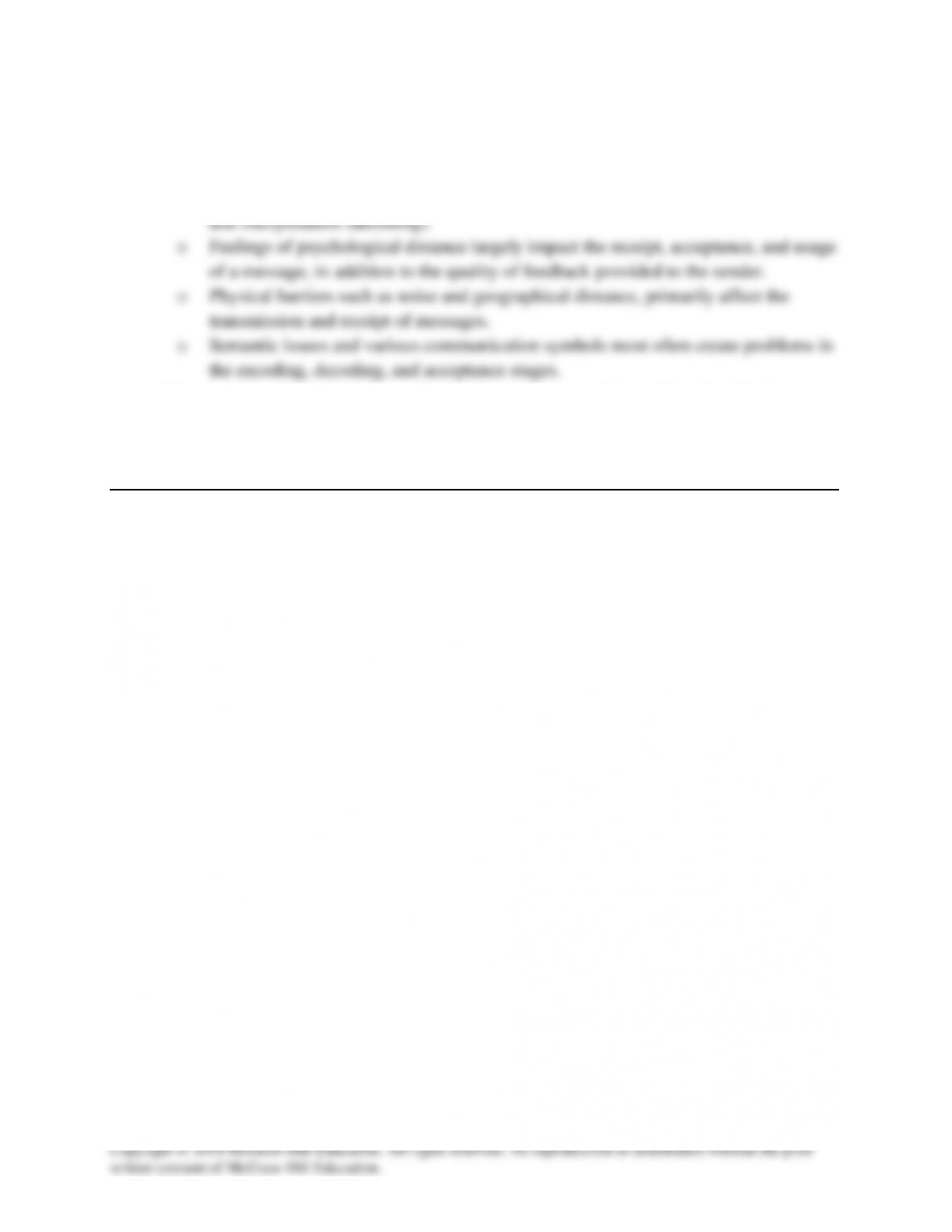
• Figure 3.3 suggests that the personal barriers have a pervasive effect on communications.
3-11
o Emotions can affect the development of an idea for presentation, the method and
form of its transmission, how it is decoded, and whether it is accepted.
o Listening skills have a powerful impact on the effectiveness of a message’s receipt
• The overall message for managers is that barriers can—and do—affect the effectiveness
of communications at all eight stages.
Downward Communication
• Downward communication in an organization is the flow of information from higher to
lower levels of authority.
o Almost one-half of managerial communications are with subordinates, with the
reminder divided among superiors, peers, and external recipients.
• To communicate downward, some executives rely on colorful booklets, flashy PowerPoint
presentations, and elaborately planned employee meetings.
o These approaches, while attention-getting, often fail to achieve employee
understanding—one of the goals of effective communication.
o Managers who communicate successfully are sensitive to human needs and open to
true dialogue with their employees.
Prerequisites and Problems
• Part of management’s failure has been that it did not prepare for effective communication.
• A solid foundation has four cornerstones that act as prerequisites for an effective
approach:
o Develop a positive communication attitude
o Get informed
o Plan for communication
o Develop trust
• Communication Overload
o Managers give employees enormous amounts of information until employees find
they are overwhelmed with data, but their understanding is not improved.
▪ What happens is a communication overload, in which employees receive
more communication inputs than they can process or more than they need.
3-12
▪ The keys to better communication are timing and quality, not quantity.
• Acceptance of a Communication
o Acceptance of a message by the receiver is critical; without acceptance,
communication breaks down.
o Several conditions encourage acceptance of a communication:
▪ Acknowledged legitimacy of the sender to send a message
▪ Perceived competence of the sender relative to the issue
▪ Trust in the sender as a leader and as a person
Communication Needs
• Managers think that they understand employees’ needs, but often their employees do not
think so.
o This causes downward communicators to be overconfident and probably not take
enough care with their downward messages.
• Job Instruction
o One communication need of employees is proper instruction regarding their work.
o Managers secure better results if they state their instructions in terms of the
objective requirements of the job as well as the opportunities and potential problem
areas.
• Performance Feedback
o Feedback helps employees know what to do and how well they are meeting their
own goals.
o Generally, performance feedback leads to both improved performance and
improved attitudes.
o Some dedicated employees engage in feedback-seeking behavior, in which they
actively search for information about their prior performance and possible areas of
o Downward messages should reach employees as fresh and timely news rather than
3-13
as a stale confirmation of what already has been learned from other sources.
o Contemporary methods include closed-circuit television, daily recorded voicemail
messages that employees can receive by dialing a certain number, electronic mail
systems, and Web sites.
Upward Communication
• If the two-way flow of information is broken by poor upward communication,
management loses touch with employee needs and lacks sufficient information to make
sound decisions.
o It is therefore, unable to provide needed task and social support for employees.
• Management needs to tune in to employees.
o This process requires:
▪ Initiative
▪ Positive action
▪ Sensitivity to weak signals
▪ Adaptability to different channels of employee information
▪ An awareness and belief that upward messages are important
Difficulties
• Several problems plague upward communication, especially in larger, more complex
organizations.
o The first is delay, which is the unnecessarily slow movement of information up to
higher levels.
▪ Indecisive managers hesitate to take a problem upward because doing so
implies an admission of failure.
o The second, and closely intertwined, factor is filtering.
▪ This partial screening out of information occurs because of the natural
tendency for an employee to tell a superior only what the employee thinks the
superior wants to hear.
• An extreme example of filtering is organizational silence.
o This is the conscious or unconscious withholding of information about potential