2-1
Chapter 2
Models of Organizational Behavior
Chapter Overview
The key purpose of this chapter is to build on the fundamental concepts presented in Chapter 1 by
showing how all behavioral factors can be combined to develop an effective organization. First, the
chapter discusses the organizational behavior (OB) system followed by the five models of OB and
their usages.
Chapter Learning Objectives
After reading this chapter, students should understand:
1. The elements of an organizational behavior system
2. The role of management’s philosophy and paradigms
3. Alternative models of organizational behavior and their effects
4. Trends in the use of these models
Discussion and Project Ideas
Because the whole book is affected by two key frameworks—organizational behavior systems and
models of organizational behavior—students’ understanding will be enhanced if they fully
understand them. Exercises that may help the students understand and process these key concepts
include the following:
• Arrange a field trip to two or three organizations with very different types of organizational
behavior systems. After the field trip, write the comments of the class regarding each
organization on the board. Then compare and contrast the differences in the two companies.
Use Likert’s system to further classify the differences between the organizations.
2-2
or Hewlett Packard. Have the students report back to the class, emphasizing how leadership
and the implicit models of organizational behavior in these organizations changed as the
companies evolved.
• The movies and television are often a great source of reference for many undergrad students as
they often have little work experience. Have the students compile a list of managers and what
model they believe the manager(s) are using. For instance, students may refer to Wall Street,
Glengarry Glenn Ross, and The Office.
Lecture Outline
Introduction
• The differences between organizations can sometimes be extreme.
• Organizations have undergone tremendous changes during the past two centuries.
• Many of the old rules are now out of date, and increasing numbers of organizations today are
experimenting with exciting new ways to of attract and motivate their employees.
• The words used to refer to employees (such as “subordinates,” as contrasted to the use in some
organizations of terms like “associates” or “partners” to convey equality) tell a lot about the
underlying OB model in use.
An Organizational Behavior System
• Organizations achieve their goals by creating, communicating, and operating an
organizational behavior system (Figure 2.1).
• These systems have a greater chance of being successful if they have been consciously created
and regularly examined and updated to meet the new and emerging conditions.
• Updating is done by drawing upon the constantly growing behavioral science base of
Elements of the System
• The philosophy (model) of OB held by management consists of an integrated set of
assumptions and beliefs about the way things are, the purpose for these activities, and the
way they should be.

2-3
• These philosophies are sometimes explicit, and occasionally implicit, in the minds of
managers.
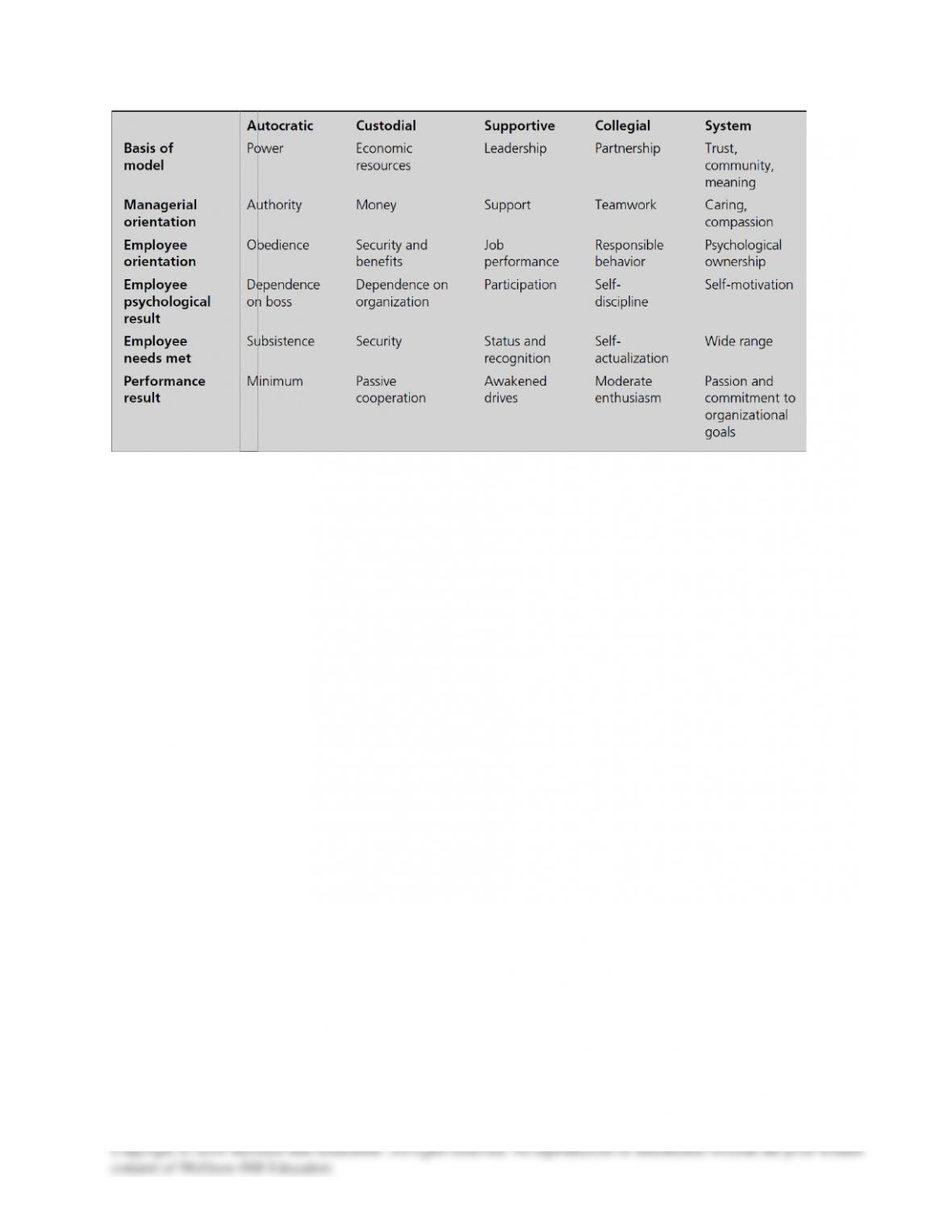
• There are five major organizational behavior philosophies:
o Autocratic
o Custodial
o Supportive
o Collegial
o System
• The philosophy of organizational behavior held by a manager stems from two sources:
o Fact premises—represent our descriptive view of how the world behaves.
▪ They are drawn from both behavioral science research and our personal
experiences (important things we have learned).
▪ They are acquired through direct and indirect lifelong learning and are very
useful in guiding our behavior.
o Value premises—represent our view of the desirability of certain goals and activities.
▪ They are variable beliefs that we hold and are therefore under our control.
▪ They can be chosen, modified, discarded, or replaced.
• Managers also have primary responsibility for instilling three other elements into the
organizational behavior system:
o Vision—represents a challenging portrait of what the organization and its members can
be—a possible, and desirable, future.
▪ Once the vision is established, persistent and enthusiastic communication is
required so employees will embrace it with commitment.
o Mission—identifies the business it is in, the market niches it tries to serve, the types of
customers it is likely to have, and the reasons for its existence.
▪ In contrast to visions, mission statements are more descriptive and less future-
oriented.
▪ They are rather broad, and need to be converted to goals to become operational
and useful.
o Goals—are relatively concrete formulations of achievements the organization is aiming
for within set periods of time.
▪ Goal setting is a complex process, for top management’s goals must be merged
with those of the employees, who bring their psychological, social, and economic
needs with them to an organization.
▪ Goals may exist at the individual, group, and larger organization level, so
substantial integration is required before a working social system can emerge.
• Together, philosophy, values, vision, mission, and goals exist in a hierarchy of increasing
specificity.
o They all help create a recognizable organizational culture.
o This culture is also a reflection of the formal organization with its formal policies,
2-4
Copyright © 2014 McGraw-Hill Education. All rights reserved. No reproduction or distribution without the prior written
consent of McGraw-Hill Education.
structures, procedures, and the existing social and cultural environment.
o Managers also must be aware of the informal organization and must work with its
members to create positive norms.
o Managers are then expected to use a leadership style, communication skills, and their
knowledge of interpersonal and group dynamics to create an appropriate quality of
work life for their employees.
o When this task is done properly, employees will become motivated toward the
achievement of organizational goals.
o The result of an effective OB system is motivation which, when combined with
employee skills and abilities, results in the achievement of performance goals as well as
individual satisfaction.
o It builds two-way relationships that are mutually supportive, meaning that manager and
employee are jointly influencing each other and jointly benefiting.
o Supportive OB systems are characterized by power with people, rather than power over
them, which is consistent with present human values regarding how people wish to be
treated.
Models of Organizational Behavior
• Varying results follow from different models of organizational behavior.
• These models constitute the belief system that dominates management’s thought and affects
management’s actions in each organization.
• Douglas McGregor presented a convincing argument that most management actions flow
directly from whatever theory of human behavior the managers hold.
• Theory X is a traditional set of assumptions about people (Figure 2.3).
o It assumes that most people dislike work and will try to avoid it if they can.
o Workers are seen as being inclined to restrict work output, having little ambition, and
avoiding responsibility if at all possible.
o Common rewards cannot overcome this natural dislike for work, so management is
almost forced to coerce, control, and threaten employees to obtain satisfactory
performance.
• Theory Y implies a more humanistic and supportive approach to managing people.
o It assumes that people are not inherently lazy; any appearance they have of being that
way is the result of their experiences with less enlightened organizations, and if
management will provide the proper environment to release their potential, work will
become as natural to them as recreational play or rest and relaxation.
o Employees are capable of exercising self-direction and self-control in the service of
objectives to which they are committed.
o Management’s role is to provide an environment in which the potential of people can be
released at work.
2-5
• McGregor’s argument was that management had been following an outmoded set of assumptions
about people because it adhered to Theory X when the facts are that the Theory Y set of
assumptions is more truly representative of most people.
o Therefore, management needed to change to a whole new set of assumptions about
people—one based on emerging behavioral science research.
• McGregor deserves credit for a number of contributions:
o He stimulated subsequent generations of managers to think consciously about their belief
systems and management models.
o He was an early advocate of the practical value of reading and using research to better
understand human behavior.
o He introduced and publicized one of the early theories of motivation—the hierarchy of
needs model by A. H. Maslow.
o He became a spokesperson for the need to bring human values into balance with other
values at work.
• Models such as Theory X & Theory Y are also called paradigms, or frameworks of possible
explanations about how things work.
o Any model that the manager holds usually begins with certain assumptions about people
and leads to interpretations, implications, and predictions of events.
o Underlying paradigms, whether consciously or unconsciously developed, become
powerful guides to managerial behavior.
• Managerial paradigms, according to popular author Joel Barker, act in several important ways:
o They influence managerial perceptions of the world around them.
o They define one’s boundaries and provide prescriptions for how to behave.
o They encourage resistance to change since they have often worked in the past.
2-6
• Although one model tends to dominate at a particular time in history, each of the other models
is still applied in some organizations.
• Just as organizations differ among themselves, so practices may vary within the departments or
branches of one organization.
• The practices of individual managers may differ from their organization’s prevailing model
because of those managers’ personal preferences or different conditions in their department.
• No one model or OB is sufficient to describe all that happens in an organization.
• The selection of a model by a manager is determined by a number of factors:
o The prevailing philosophy, values, vision, mission, and goals of managers affect, and are
affected by, their OB model.
o In addition, environmental conditions help determine which model will be most
effective.
• The model used should not be static and unchanging but reexamined and adapted across time.
The Autocratic Model
• The autocratic model depends on power.
• In an autocratic environment, the managerial orientation is formal official authority.
o The model assumes that employees have to be directed, persuaded, and pushed into
performance, and such prompting is management’s task.
o Management does the thinking; the employees obey the orders.
o This conventional view of management leads to tight control of employees at work.
o The autocratic model is intensely disliked by many employees.
• Under autocratic conditions, the employee orientation is obedience to a boss, not respect for a
manager.
o The psychological result for employees is dependence on their boss, whose power to
2-7
hire, fire, and “perspire” them is almost absolute.
o The employer pays minimum wages because minimum performance is given by
employees (who may lack the qualifications for advancement).
o Employees are willing to give minimum performance because they must satisfy
subsistence needs for themselves and their families.
• The autocratic model’s principal weaknesses are its high human cost and its tendency to
encourage high-level managers to engage in micromanagement, which is the immersion of a
manager into controlling the details of daily operations.
o Micromanagers tend to:
▪ Control and manipulate time
▪ Place their self-interest above that of employees
▪ Institute elaborate approval processes
▪ Specify detailed procedures for everything
▪ Closely monitor results
o Employees typically detest a micromanager, with the result being:
▪ Low morale
▪ Paralyzed decision making due to fear of being second-guessed
▪ High turnover
• The autocratic model was an acceptable approach to guide managerial behavior when there
were no well-known alternatives, and it can still be useful under some extreme conditions,
such as organizational crisis.
The Custodial Model
• As managers began to study their employees, they soon recognized that although
autocratically managed employees did not talk back to their boss, they certainly “thought
back.”
o Employees were filled with insecurity, frustrations, and aggressions toward their boss.
o It seemed obvious to progressive employers that there ought to be some way to develop
better employee satisfaction and security.
• To satisfy the security needs of employees, a number of companies began welfare programs
in the 1890s and 1900s.
2-8
o If an organization does not have the wealth to provide pensions and to pay for other
benefits, it cannot follow a custodial approach.
• The custodial approach leads to employee dependence on the organization.
o Rather than being dependent on their employer for just their weekly paycheck,
employees now depend on organizations for their security and welfare.
• Employees working in a custodial environment become psychologically preoccupied with
their economic rewards and benefits.
o However, contentment does not necessarily produce strong motivation; it may only
produce passive cooperation.
• The custodial model’s greatest benefit is that it brings security and satisfaction to workers,
but it does have substantial flaws.
o The most evident flaw is that most employees are not producing anywhere near their
capacities, nor are they motivated to grow to the greater capacities of which they are
capable.
o Though employees are comfortable and care for, most of them really do not feel
fulfilled or motivated.
• Although the custodial model does provide employee security, it is best viewed as simply the
foundation for growth to the next step.
The Supportive Model
• The supportive model of organizational behavior had its origins in the “principle of
supportive relationships” as stated by Rensis Likert.
• One key spark for the supportive approach was a series of research studies at the Hawthorne
Plant of Western Electric in the 1920s and 1930s.
o Led by the Elton Mayo and F. J. Roethlisberger, the researchers gave academic stature
to the study of human behavior at work by applying keen insight, straight thinking, and
sociological backgrounds to industrial experiments.
o The researchers concluded that an organization is a social system and the worker is the
most important element in it.
o The studies suggested that an understanding of group dynamics, coupled with the
application of supportive supervision, was important.
2-9
• The supportive model works well with both employees and managers, and it has been widely
accepted.
o However, the step from theory to practice is a difficult one.
• The supportive model of organizational behavior tends to be especially effective in affluent
nations because it responds to employee drives toward a wide array of emerging needs.
The Collegial Model
• A useful extension of the supportive model is the collegial model.
o The term “collegial” relates to a body of people working together cooperatively.
o The collegial model, which embodies a team concept, first achieved widespread
applications in research laboratories and similar work environments.
• The collegial model traditionally was used less on assembly lines, because the rigid work
environment made it difficult to apply there.
o A contingency relationship exists in which the collegial model tends to be more useful
with creative work, an intellectual environment, and considerable job freedom.
• The collegial model depends on management’s building a feeling of partnership with
employees.
o The managerial orientation is toward teamwork.
The System Model
• The system model is the result of a strong search for higher meaning at work by many of
today’s employees.
• Since workers are being asked to spend many hours of their day at work, they want a work
context that is ethical, infused with integrity and trust, and provides an opportunity to
experience a growing sense of community among co-workers.
o To accomplish this, managers must increasingly demonstrate a sense of caring and
compassion, being sensitive to the needs of a diverse workforce with rapidly changing
needs and complex personal and family needs.
• The system model reflects underlying positive organizational behavior, which focuses on
identifying, developing, and managing psychological strengths within employees.
• Individuals at all levels need to acquire and display the five dimensions of social
intelligence, which has the following five dimensions:
o Empathy—appreciation for, and connectedness with, others
2-10
o Presence—projecting self-worth in one’s bearing
o Situational radar—ability to read social situations and respond appropriately
o Clarity—using language effectively to explain and persuade
• As a consequence, the employee needs that are met are wide-ranging but often include the
highest-order needs (e.g., social, status, esteem, autonomy, and self-actualization).
• Because it provides employees an opportunity to meet these needs through their work as well
as understand the organization’s perspectives, this new model can stimulate employees’
passion and commitment to organizational goals.
Conclusions about the Models
• Evolving Usage
o Managerial and, on a broader scale, organizational, use of these models tends to evolve
over time.
o To assume that one particular model is a “best” model that will endure for the long run
is a mistake.
o The primary challenge for management is to identify the model it is actually using and
then assess its current effectiveness.
• Relation of Models to Human Needs
o A number of people have assumed that emphasis on one model of organizational
behavior is an automatic rejection of other models, but comparison suggests that each
(newer) model is built upon the accomplishments of the other.
o It is best to take an adaptive approach to match changing needs.
o If a manager should abandon the basic organizational needs, the system would move
back quickly to seek structure and security in order to satisfy those needs for its people.
• Increasing Use of Some Models
o The trend toward the supportive, collegial, and system models will undoubtedly
continue.
o Despite rapid advances in computers and management information systems, top
managers of giant, complex organizations cannot be authoritarian in the traditional
sense and also be effective.
▪ They must learn to depend on other centers of power nearer to operating
2-11
problems.
▪ They are often forced to literally redefine the old psychological contract and
embrace a newer, more participative one.
o Many employees are not readily motivated toward creative and intellectual duties by
the autocratic model.
• Contingent Use of All Models
o Though one model may be most used at any given time, some appropriate uses will
remain for other models.
o Knowledge and skills vary among managers.
o Role expectations of employees differ, depending upon cultural history.
o Policies, ways of life, and task conditions vary among organizations.
o Probably all five models will continue to be used, but the more advanced models will
have growing use as progress is made and employee expectations rise.
• Managerial Flexibility
o Managers not only need to identify their current behavioral model but also must keep it
flexible and current.
o Managers need to read, to reflect, to interact with others, and to be receptive to
challenges to their thinking from both colleagues and employees.
Suggested Answers to Discussion Questions
1. Interview some managers to identify their visions for their organization. What are those
visions? Where did they come from? How successfully have they been communicated to
the employees, and how successfully have they been embraced by the employees?
2. Both philosophy and vision are somewhat hazy concepts. How can they be made clear to
employees? Why are philosophy and vision included as early elements in the
organizational behavior system? Give an example of an organizational vision you have
read about or heard of.
3. What benefits do you see from allowing and encouraging spirituality at work? What are
2-12
the risks of doing so?
4. Consider an organization where you now work (or where you have worked). What model
(paradigm) of organizational behavior does (did) your supervisor follow? Is (was) it the
same as top management’s model?
5. Discuss similarities and differences among the five models of organizational behavior.
Students’ answers may vary. The five models of organizational behavior are autocratic,
custodial, supportive, collegial, and system. The models were formulated on the assumption
that managers hold attitudes about people, and these attitudes lead to different interpretations
6. What model of organizational behavior would be most appropriate in each of the
following situations? (Assume that you must use the kinds of employees and supervisors
currently available in your local labor market.)
a. Long-distance telephone operators in a very large office
b. Accountants with a small certified professional accounting firm
c. Food servers in a local branch of a prominent fast-food chain
d. Salesclerks in a large discount department store
e. Circus laborers temporarily employed to work the week that the circus is in town
Students’ answers may vary, but may include these thoughts:
2-13
Copyright © 2014 McGraw-Hill Education. All rights reserved. No reproduction or distribution without the prior written
consent of McGraw-Hill Education.
time, making the operators economic resources in the eyes of management. Little
opportunity for supportive or collegial approaches exists.
b. Probably collegial. This is a small firm, made up of professional employees. These
employees should be expected to behave responsibly and have considerable self-
discipline. Further, they all perform similar or related job tasks.
c. Students may say custodial, but chances are that the environment of this organization,
because of its service dimension and multiple tasks, is supportive.
d. This is a service oriented setting, indicating the need for a supportive approach. Again,
students may, because of their own fact premises, conclude that this scenario is custodial
or even autocratic.
e. Usually autocratic. Emphasis here is on a minimum performance expectation and task
completion.
7. Discuss why the supportive, collegial, and system models of organizational behavior are
especially appropriate for use in the more affluent nations.
Students’ answers may vary. The supportive and collegial models serve to meet employee
8. Interview a supervisor or manager to identify the model of organizational behavior that
person believes in. Explain why you think that the supervisor’s or manager’s behavior
would or would not reflect those beliefs.
Students’ answers will vary. The supervisor or manager should behave in a manner consistent
9. Examine the trends in the models of organizational behavior as they have developed over
a period of time. Why have the trends moved in a positive direction?
Students’ answers may vary. The model names show that there has been a move from tight
2-14
Copyright © 2014 McGraw-Hill Education. All rights reserved. No reproduction or distribution without the prior written
consent of McGraw-Hill Education.
autocratic to a custodial point of view occurred because management realized that employees
expressed their frustrations and hostilities by means that were affecting productivity. They
concluded that eliminating the frustrations through welfare programs would solve this
problem. However, these programs did not fulfill or motivate employees, which led to the
development of the supportive approach. This approach sought to help employees grow and
accomplish goals within the organization. The collegial model took the supportive model one
step further by establishing a partnership with employees. The system model involves
passionate commitment by employees.
10. Assume that a friend of yours contends that “the system model is obviously ‘best’ to use
with all employees, or it wouldn’t have been placed on the right side of the figure.” How
would you respond?
Students’ answers may vary. No single model is necessarily “best.” In many settings, it is
Assess Your Own Skills
Incident
The New Plant Manager
This case is a classic illustrates that from the very beginning, the plant manager, Butterfield, took an
autocratic approach toward solving problems in the Houston Plant. He severely depreciated the
human assets of the organization in order to accomplish a quick increase in productivity, based on
instructions from higher management to “straighten out” the Houston plant. The deterioration of
human assets is apparent from supervisory resignations and the severe decline in effectiveness when
Butterfield departed after his promotion to the New York home office.
2-15
reporting and evaluation procedures used by the home office to appraise performance in the Houston
plant. Apparently the home office is receiving reports on, and evaluating, only economic assets and
performance. It needs to reconsider its reporting and evaluation procedures to be sure that human
asset values as represented by organizational climate are considered in the future.
As a final step in working this case, students may be asked to recommend improved ways to manage
conditions in the Houston plant to the plant manager who follows Butterfield. The rather evident
approach is a more human-oriented climate and more of a supportive model of organizational
behavior.
Experiential Exercise
The Rapid Corporation
A policy statement is a guide to action. It will not mean much unless company actions change with
it. It would appear ridiculous and insincere if the policy statement is substantially different from
Generating OB Insights
Students’ responses will vary for this exercise. They should however, highlight several of the major
topics discussed in the chapter such as the elements of an organizational behavior system, the role of
management’s philosophy and paradigms, etc.