
16-1
Chapter 16
Organizational Behavior across Cultures
Chapter Overview
This chapter examines the nature of multinational operations, ways for an organization to integrate
social systems, and ways to improve motivation, productivity, and communications when operating
in less developed cultures. First, conditions affecting multinational operations are presented. Next,
managing an international workforce is examined. Barriers to cultural adaptation and ways of
overcoming their barriers are explored. The final section is devoted to a discussion on productivity
and cultural contingencies.
Chapter Learning Objectives
After reading this chapter, students should understand:
1. How cultural, social, legal and ethical, political, and economic conditions vary in different
countries
2. The operation of ethnocentrism and cultural shock
3. Ways to overcome barriers to cultural adaptation
4. The nuances of cross-cultural communication
Discussion and Project Ideas
• You are a president of a United States firm and are thinking about setting up a factory in a
foreign country. Would local attitudes toward work and productivity be an important
consideration in your decision? How might unfavorable attitudes toward work and productivity
affect production operations? Should your firm avoid investments in countries where there are
unfamiliar favorable attitudes?
• Ask for a show of hands of how many students have traveled abroad. How did they prepare for
their travel? What problems or difficulties did they encounter? How could these difficulties
have been reduced or eliminated? Depending on the length of their stay, did they experience
reverse cultural shock?
• Americans are accustomed to show up on time for appointments. Joe Clark is on his first
business trip to the Middle East. He learns that appointments with officials or executives may
not be held promptly and he could be waiting for an hour or more. Advise him on how to
prepare for this. How would you react to this different idea of promptness?
• The world of business has been transformed into a global economy. More and more

16-2
multinational organizations are expanding operations into other countries. Yet, there are those
who advocate legislation aimed at protectionism. Ask the students to articulate the arguments
for and against protectionism.
• Divide the class into small groups and assign a foreign country to each. Have the groups report
back to the class on their findings with regard to social distance between the foreign country
and the United States and the implications of these differences for international managers.
Lecture Outline
Introduction
• A global economy is now a reality. The shape of international trade has changed dramatically
in recent years, due to:
o The emergence of the European Union
o Revolutionary changes in the former Soviet Union and eastern Europe
o Strong markets developing in China, India, Japan, Brazil, Korea, and many emerging
nations
• As a result, many organizations now do business in more than one country, and these
multinational organizations add powerful new dimensions to organizational behavior.
o Expansion beyond national boundaries is a gigantic step into different social, legal,
political, and economic environments.
o Communication lines are lengthened, and control often becomes more difficult.
• Cultural predicaments often arise when working in an international environment.
Understanding the Context of International OB
• Multiculturalism occurs when the employees in two or more cultures interact with each other
on a regular basis.
• Managers and technical employees entering another nation to install an advanced
organizational system need to adjust the following to fit the culture of their host country:
o Leadership styles
o Communication patterns
o Other practices
• Expatriates can be:
o Parent-country nationals from the nation in which the home office is located.
o Third-country nationals from some other nation.
• The role of expatriates is to provide a fusion of cultures in which both parties adjust to the new
situation of seeking greater performance for the benefit of both the organization and the
citizens of the country in which the organization operates.

16-3
• An important quality for global leaders, especially expatriates, is cultural intelligence.
o It is an individual’s ability to understand, accept, adapt to, work alongside, and
communicate with persons of a variety of global cultures.
o It can be face-to-face or via various modes of modern communication.
• The people of the world are organized into communities and nations, each in its own way,
according to its resources and cultural heritage.
• There are similarities among nations, but there are also significant differences:
o Some nations are economically developed; others are just now developing their natural
and human resources.
o Some are still political dictatorships; others are more democratic.
o Some are educationally and socially advanced; others have minimal literacy and social
development.
• In each case, the conditions of work are different because of different attitudes, values, and
expectations from participants.
o Understanding these differences and how they influence international behavior is aided
by examination of key cultural, social, legal, ethical, political, and economic conditions.
• Based on his extensive research, Geerte Hofstede defined culture as the “collective
programming of the mind that distinguishes the members of one group or category of people
from others.”
o Culture consists of the unwritten social rules that shape individual thought and behavior.
It is learned through social interaction and thus shared, at least in part, by individuals
who live within the same social environment.
o Cultural differences can impact how managers lead, what employees expect from their
work experiences, and how expatriates adapt to foreign assignments.
Individual-Difference Factors
• Individualism/Collectivism
o Cultures that emphasize individualism tend to:
▪ Accent individual rights and freedoms
▪ Have very loosely knit social networks
▪ Place considerable attention on self-respect
▪ Place strong emphasis on a person’s own career and personal rewards
o Collectivism heavily accents the group and values harmony among members.
▪ Personal feelings are subordinated to the group’s overall good.
▪ Employees are more likely to ask, “What is best for the organization?”
▪ Face-saving is highly important in order to maintain one’s status in the group.
o The United States has an individualistic culture.
▪ Japan’s collectivistic culture is characterized by the proverb “The nail that sticks
up gets pounded down.”
▪ The Chinese culture accents the importance of quanxi, or relationships.

16-4
• Power Distance
o Power distance refers to the belief that strong and legitimate decision-making rights
separate managers and employees.
o Employees in the United States and in Scandinavian countries subscribe to beliefs of
lower power distance and are less likely to believe their managers are automatically
correct.
• Uncertainty Avoidance
o Employees in some cultures value clarity and feel very comfortable receiving specific
directions from supervisors.
▪ These employees have a high level of uncertainty avoidance and prefer to avoid
ambiguity at work.
▪ Employees elsewhere react in an opposite manger, since ambiguity does not
threaten their lower-order need for stability and security.
o Employees in the following countries have high uncertainty avoidance characteristics
and often prefer structure, stability, rules, and clarity.
▪ Greece
▪ Portugal
▪ Belgium
o Countries lower in uncertainty avoidance include:
▪ China
▪ Ireland
▪ The United States
• Masculinity/Femininity
o Masculine societies define gender roles in more traditional and stereotypical ways.
▪ They value achievement and the acquisition of wealth.
o Feminine societies have broader viewpoints on the great variety of roles that both
males and females can play in the workplace and at home.
▪ These cultures treasure relationships among people, caring for others, and a
greater balance between family and work life.
o Scandinavian countries have strongly feminine cultures.
▪ Japan has a markedly masculine culture.
▪ The United States has a moderately masculine culture.
• Time Orientation
o Cultures with a long-term orientation accent values such as:
▪ The necessity of preparing for the future
▪ The value of thrift and savings
▪ The merits of persistence
o This culture is exemplified by Hong Kong, China, and Japan.
o Cultures with a short-term orientation:
▪ Value the past and accent the present
16-5
▪ Have a rich respect for tradition
▪ Have a need to fulfill historical social obligations
o This culture is exemplified by France, Russia, and West Africa
• An Intercultural Comparison
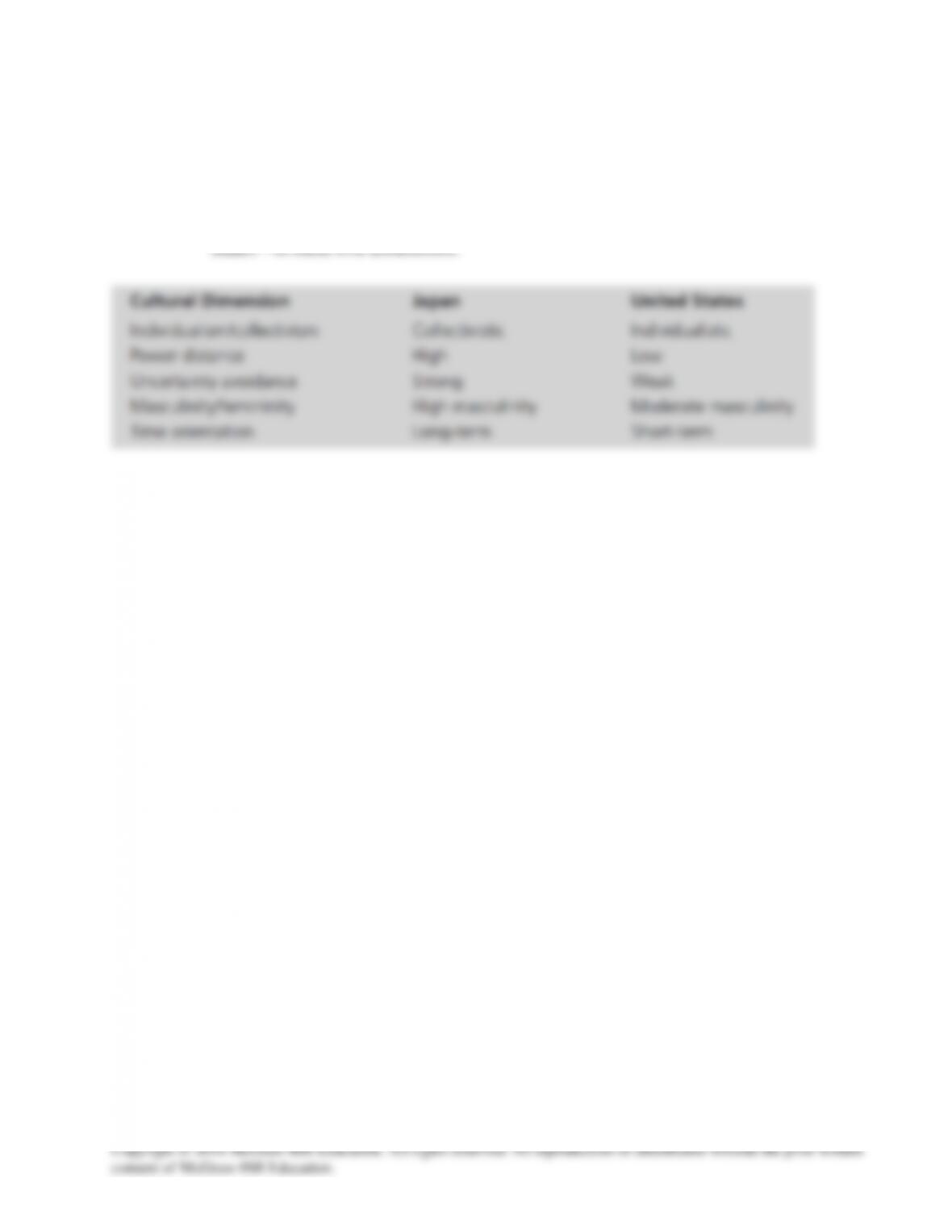
o Figure 16.1 highlights the differences between two countries—Japan and the United
States—in these five dimensions.
o Neither country has a better culture than the other; they are simply quite different.
o Managers in all countries need to:
▪ Become more aware of their own cultural characteristics
▪ Search for the uniqueness in the cultures in other countries
▪ Learn how to work effectively across cultures
o They must avoid the tendency to stereotype people whom they do not know. This is a
delicate balance to maintain.
Social Conditions
• When a highly qualified workforce is not available locally:
o Shortages of managerial personnel, scientists, and technicians limit the ability to
employ local labor productively.
o Needed skills must be imported temporarily from other countries, while vast training
programs begin to prepare local workers.
• The lending of skilled people to a nation for training their local replacements may provide a
lasting benefit to its development.
o The loaned skilled people train others, and those trained locals become the nucleus for
developing still more people.
o There is a training multiplier (ripple) effect of self-development as shown in figure
16.2.
• The occupational areas in which development will provide the greatest return are:
o Scientific personnel
o Professional personnel
o Managerial personnel
• It is important to keep in mind that a strong nationalistic drive may impel locals to desire to

16-6
run their country and organizations by themselves, without interference by foreign nationals.
Legal and Ethical Environment
• Countries around the world vary substantially in their legal systems, and especially in their
relevant employment laws and business practices.
o In the judicial system, some countries practice rapid disposition of cases; in other
countries, cases may drag on for years.
o Penalties for seemingly minor offences may vary dramatically from culture to culture.
• A major issue affecting multinational corporations has been how to deal with contrasting
local mores, customs, and ethical behaviors.
o Managers need to be aware of the possible differences in both laws and ethical values
that define acceptable and unacceptable behaviors in foreign countries.
o U.S. employees operating internationally must first be guided by the Foreign Corrupt
Practices Act of 1977 (as amended).
o This law governs the actions of American organizations abroad, particularly with
regard to bribery of officials in attempts to win business.
o They need to become familiar with local customs and practices, and they need to
recognize that the resolution of ethical issues is not always clear-cut.
• Major work issues revolve around the treatment of women and other minorities.
o Although Title VII of the Civil Rights Act of 1964 prohibits workplace discrimination
in employment based on gender and other factors, it was not until 1991 that additional
federal legislation extended those rights to U.S. citizens employed in a foreign country
by an American-owned company.
• Because global experience is sometimes a prerequisite to promotion to senior management
positions many women are interested in overseas positions offering visibility, challenge, and
the opportunity for personal growth.
• The workplace in many cultures remains a male-dominated domain.
Political Conditions
• Political conditions that have a significant effect on organizational behavior include:
o Instability of the government
o Nationalistic drives
o Subordination of employers and labor to an authoritarian state
• Instability spills over into organizations that wish to establish or expand operations in the
host country.
o This organizational instability leaves workers insecure, ultimately impacting their
performance.
• Organized labor in many nations is not an independent force but is mostly an arm of the
authoritarian state.
o In other nations, organized labor is somewhat independent.
16-7
o However, it is oriented toward political action more than direct negotiation with
organizations.
o In some nations, employee layoffs are restricted by law and made costly by requiring
dismissal pay. Even employee transfers may be restricted.
Economic Issues
• The most significant economic issues in less developed nations are:
o Low per capita income
o Rapid inflation
o Unequal distribution of wealth
• In terms of income, many nations exist in genuine poverty compared with the United States
or Canada.
o An average family in some nations may survive on less than $3,000 annually.
o Rapid population increases coupled with a lack of national economic growth make it
unlikely that family incomes will progress significantly.
o As a consequence, natives of those countries may not believe that additional effort on
their part will earn associated rewards.
• A common economic condition in many less developed countries is inflation.
o The United States has enjoyed rather moderate inflation rates over the past few
decades.
o Mexico and some countries in South America, Europe, Africa, and the Middle East
have suffered periods of dramatic inflation.
• Inflation makes the economic life of workers insecure.
o It encourages them to spend quickly before their money loses its value, and this
spending pattern adds to the country’s inflationary problem.
o Social unrest develops and is compounded by tremendous disparity in the distribution
of wealth in these nations.
o Some workers passively accept their situation, while others aggressively protest.
• Despite the challenges abroad and the political and economic backlash from home-country
workers and consumers, some firms have moved substantial parts of their operations into
countries with lower wage rates.
o In essence, depressed economic conditions in another country can represent an
opportunity for a firm—at least in the short term.

16-8
o Instead, they represent critical environmental conditions to which the managers of
international operations must adapt.
Cultural Contingencies
• Since each nation is different, effective business practices from one country cannot be
transferred directly to another.
o The idea of cultural contingency means that the most productive practices for a
particular nation will depend heavily on its culture.
o The ideas that work in one nation’s culture must be blended with the social system,
level of economic development, and employees’ values in a host country.
• The difficult lesson for both expatriate and local managers to accept is that neither the home
nation’s productivity approach nor the host nation’s traditional practices are to be used
exclusively.
o Instead, a third set of practices must be developed that integrates the most workable
ideas from both nations.
• Managerial Implications
o The idea of cultural contingency suggests that expatriate managers must learn to
operate effectively in a new environment.
▪ Although they are guided by home-office policies, managers must also be
flexible enough to respond to local conditions.
▪ Labor policy, personnel practices, and production methods need to be adapted to
a different labor force.
▪ Organization structures and communication patterns need to be suited for local
operation as well as coordinated with the home office and other branches.
o The probability of achieving productivity improvements is much greater when a
business and its expatriates adapt to host-country conditions.
o Expatriate managers need to consider what their role will be in a local community.
▪ Although they generally are respected figures with considerable economic power,
they are in a country as guests and may not be readily absorbed into the social
and power structures of a local community.
▪ Even if they speak the local language and live in a community for years, they still
may not be fully accepted into its social structure.
o Looking at cultural, social, legal, ethical, political, and economic conditions as a whole,
we see that these conditions create a complicated environment for managing overseas
operations.
▪ Managers of international operations must learn to adapt to today’s volatile and
unique environments.
Developing Managers for International Assignments
16-9
Barriers to Cultural Adaptation
• An expatriate manager may find several obstacles to a smooth adaptation to a new culture.
• An early requirement for overcoming such obstacles is to acquire cultural awareness of the
multiple ways in which cultures differ (language, religion, food, personal space, and social
behaviors).
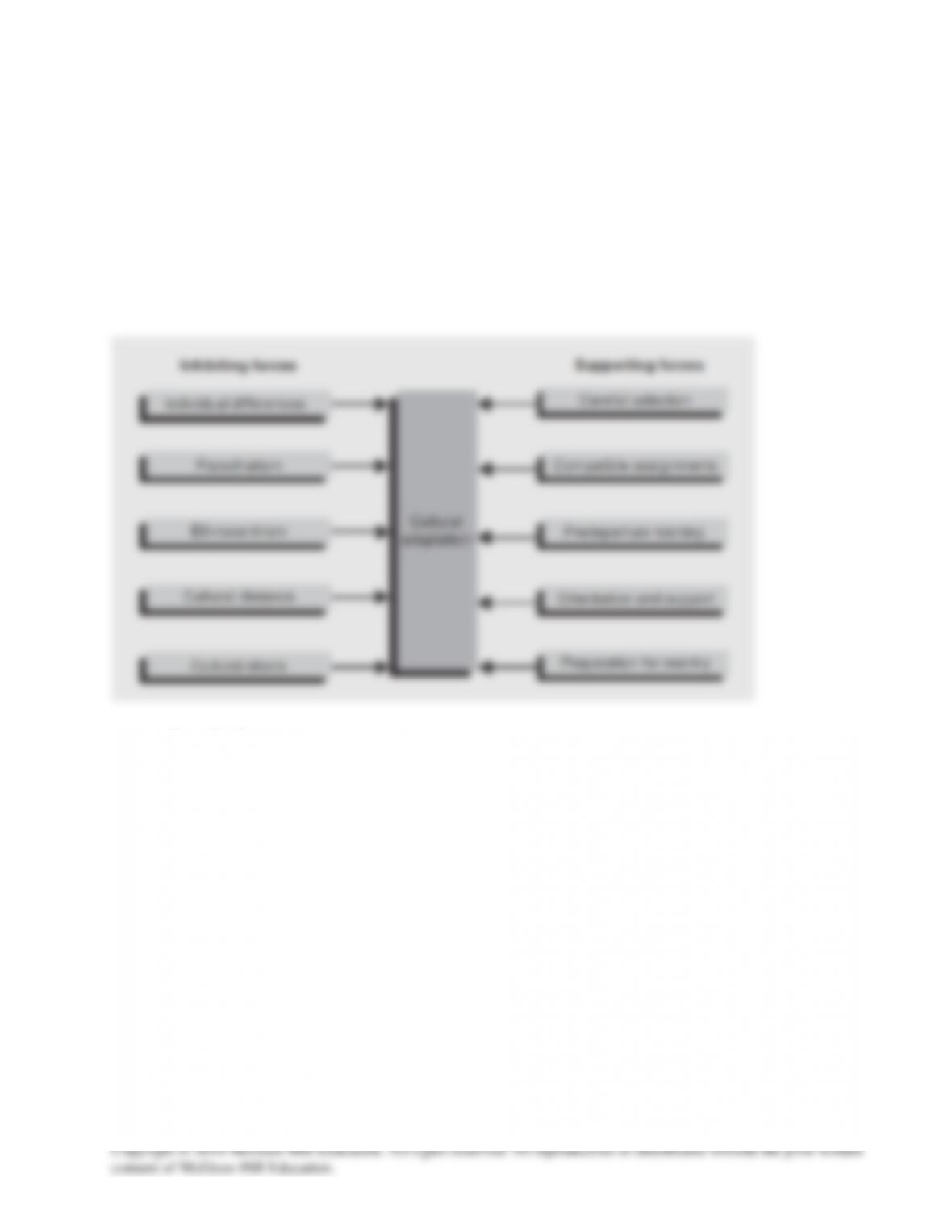
o In addition to the major areas of individual differences already discussed, parochialism,
ethnocentrism, cultural distance, and cultural shock can also have an impact (Figure
16.3).
• Parochialism
o The dominant feature of all international operations is that they are conducted in a
social system different from the one in which the organization is based.
▪ This new social system affects the responses of all persons involved.
▪ Managers and other employees who come into a host country in order to get a
new operation established naturally tend to exhibit a variety of behaviors that are
often true of citizens in their homeland.
o Many people are predisposed to parochialism, meaning they see the situation around
them from their own (often restricted) perspective.
▪ They may fail to recognize key differences between their own and others’
cultures.
▪ Even if they do, they tend to conclude that the impact of those differences is
insignificant.
▪ In effect, they are assuming that the two cultures are more similar than they
actually are, and give priority to their own views.

16–10
• Ethnocentrism
o Ethnocentrism occurs when people are predisposed to believe that their homeland
conditions (ideas, policies, personnel, practices) are the best.
▪ This predisposition is also known as the self-reference criterion.
▪ It interferes with understanding human behavior in other cultures and obtaining
productivity from local employees.
o To integrate the imported and local social systems, expatriates minimally need to
develop cultural empathy. It is:
▪ An awareness of differences across cultures.
▪ An understanding of the ways those differences affect business relationships.
▪ An appreciation of the contributions each culture makes to overall success.
o Cultural empathy is similar, on an international scale, to the idea of valuing diversity.
o When demonstrated on a consistent basis, cultural empathy results in geocentric
organizations.
▪ These organizations largely ignore a person’s nationality while accenting
employee ability in selection, assignment, and promotional decisions.
▪ They seek to integrate the interests of the various cultures involved.
▪ The attempt to build a sense of community is consistent with a supportive
approach to human behavior in its productive use of all employees.
• Cultural Distance
o Predicting the amount of adaptation that may be required when an expatriate manager
moves to another country requires an understanding of the cultural distance between
the two countries.
o Cultural distance is the amount of difference between any two social systems and may
range from minimal to substantial.
▪ Some measures of cultural distance from the United States are greater for
countries in the Mediterranean area and Asia and smaller for Scandinavian and
English-speaking countries.
▪ Whatever the amount of cultural distance, it does affect the responses of all
people to business-related issues.
• Cultural Shock
o Cultural shock is a feeling of confusion, insecurity, and anxiety caused by a strange
new environment.
▪ A cultural change does not have to be dramatic to cause some degree of shock.
▪ It can even occur when moving from a small town to a big one, or vice versa.
▪ For the unprepared, the new environment can appear to be chaotic and somewhat
overwhelming.
o Cultural shock is even greater when an employee moves from one nation to another.
o When employees enter another nation, they may experience several reactions in a series
of four phases:
16–11
▪ Excitement and stimulation
▪ Disillusionment
▪ Insecurity and disorientation
▪ Adaptation
o Cultural shock is virtually universal. It occurs in response to dramatic differences in
▪ Language
▪ Forms of courtesy
▪ Customs
▪ Housing conditions
▪ Cultural orientations in the use of space (relative emphasis on privacy)
▪ Time (focus on the past, present, or future)
▪ Activity (accent on life achievements versus life experiences)
o In the United States, people tend to
▪ Demand responses
▪ Fill voids of silence with conversation
▪ Use direct eye contact
▪ Be driven by time, deadlines, promptness, and schedules
o In other cultures, people
▪ May show respect through averting their eyes
▪ Appreciate silence as a time to think and evaluate a topic
▪ Arrive late for appointments
▪ Devote hours to developing social rapport before turning to business issues
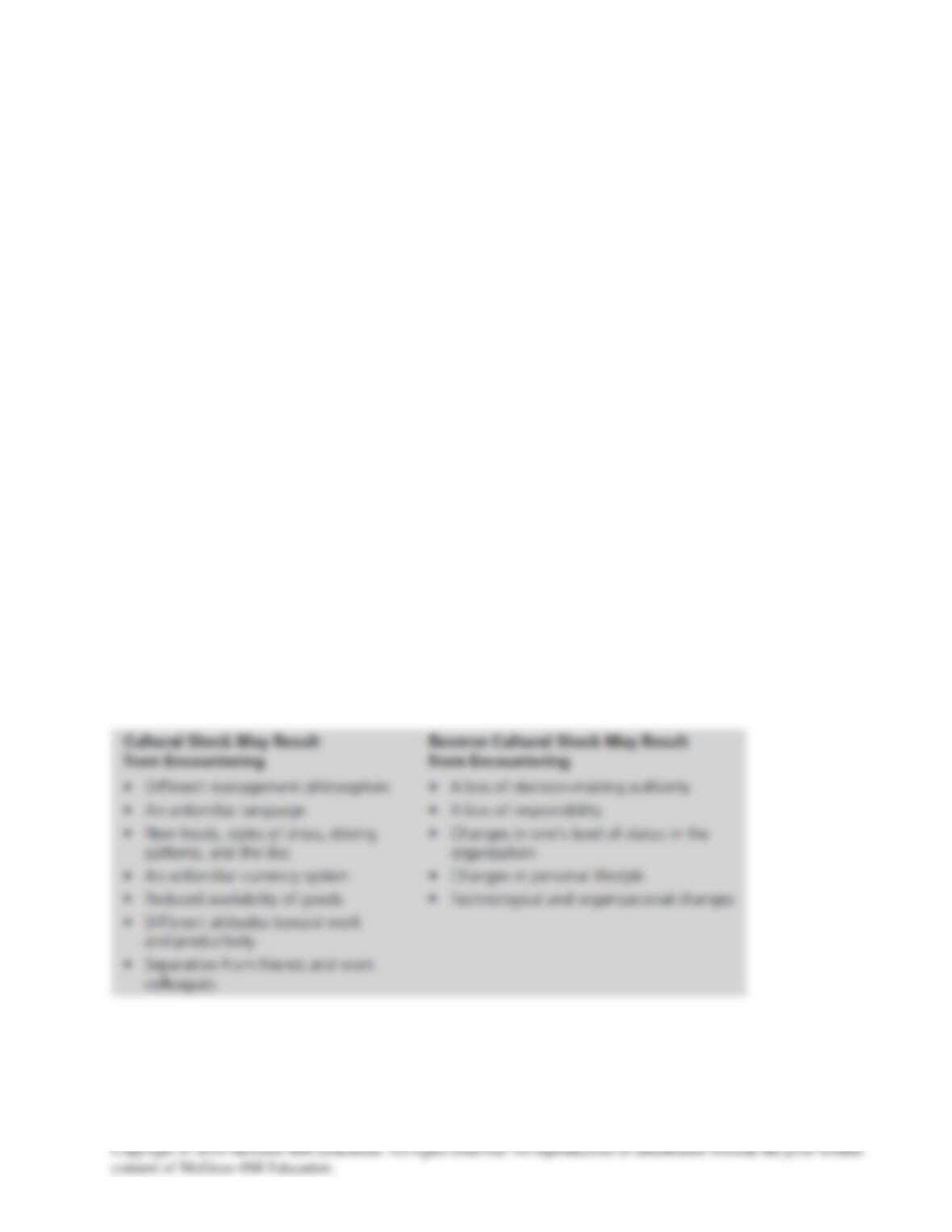
o Some of the factors most likely to contribute to cultural shock are shown in Figure
16.4.
Overcoming Barriers to Cultural Adaptation
• In spite of the strong evident need for expatriates to understand local culture and be
adaptable, they sometimes arrive unprepared.

16–12
o Their selection is typically based upon their job performance in the home country or as
a prerequisite to top-management positions.
o They may not know the local language and might have little interest in becoming a part
of the community.
o They may have been selected largely on the basis of their technical qualifications, with
the employer overlooking the need for a good fit between the expatriate and the local
culture.
• Cultural understanding is essential to avoid the errors and misunderstandings that can be
costly to an organization.
o Fortunately, firms can take several actions to prevent cultural shock and reduce the
impact of the other barriers.
• Careful Selection
o The desire to experience another culture and live in another nation may also be an
important prerequisite attitude worth assessing.
o Potential expatriates might be screened to determine which employees are already
capable of speaking the language of the nation where they will be assigned.
o Learning the attitudes of the employee’s spouse and family toward the assignment also
can be vitally important to ensure there is strong support for becoming expatriates.
o Cultural intelligence, an individual’s ability to adjust to new cultures, consists of:
▪ Cognitive strategies for learning about new cultures
▪ An intuitive sense of what is happening, and why it is occurring
▪ The confidence that one can fit into a new culture
▪ The motivation to suspend judgment and make necessary adaptations
▪ Translation of knowledge, intuition, confidence, and motivation into appropriate
cultural action
o Cultural intelligence has become an increasingly important asset as the world
accelerates its transition to a global economy.
• Compatible Assignments
o Adjustment to new surroundings is easier if employees, especially on their first
international assignment, are sent to nations that are similar to their own.
▪ This is more possible in giant firms that have widespread foreign operations.
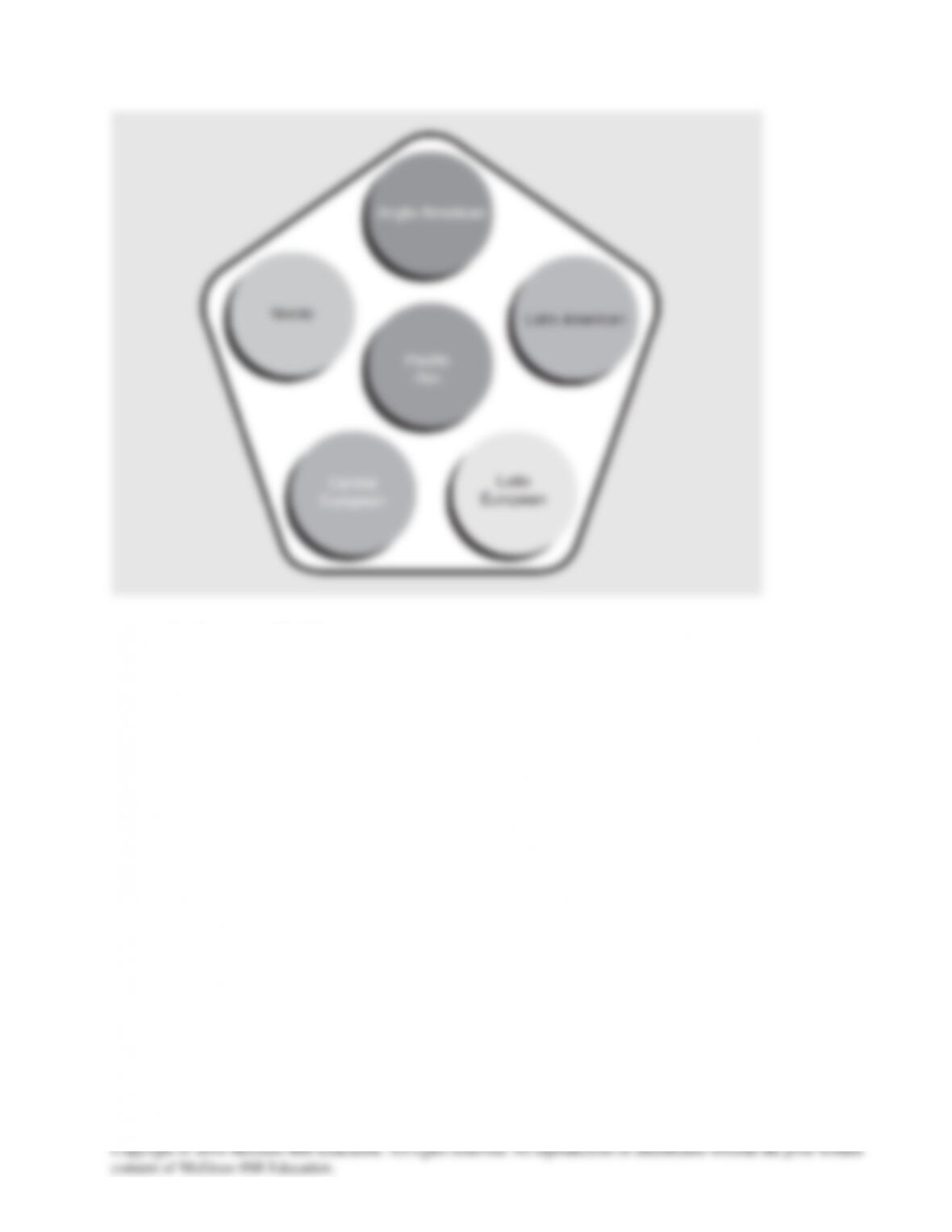
o Most industrialized nations can be grouped into six sociocultural clusters as shown in
Figure 16.5.
▪ Anglo-American, Latin European, Nordic, Latin American, Pacific Rim, Central
European.
16–13
Copyright © 2014 McGraw-Hill Education. All rights reserved. No reproduction or distribution without the prior written
consent of McGraw-Hill Education.
• Predeparture Training
o As a minimum, many organizations try to hasten adjustment to a host nation by
encouraging employees to learn the local language.
▪ They offer intensive language training prior to the assignment.
▪ Some organizations give pay differentials to expatriate employees who learn the
local language.
o Fluency in the host language contributes to cultural adaptation in two ways:
▪ It helps avoid the misunderstandings that can arise when communications have to
be translated by someone else.
▪ It creates a better impression of the expatriate as someone who is willing to invest
personal time and effort in adapting to the local environment.
o Predeparture training now often includes orientation to the target country’s:
▪ Geography
▪ Customs
▪ Food
▪ Culture
▪ Political environment
• Orientation and Support in the New Country
o Adjustment is further encouraged after arrival in the new country if a special effort is
made to help the employee and family get settled.
16–14
▪ This may include assistance with housing, transportation, and shopping.
▪ It is especially helpful if a mentor can be assigned to ease the transition.
o Mentors to the expatriate can be:
▪ The previous jobholder, who stays for a short period to share useful experiences
and make appropriate introductions before moving to a new assignment.
▪ A local national working for the same organization who is available to answer
questions and provide advice regarding culturally acceptable behavior.
o Transferring to a new culture can result in intensified need deficiencies.
▪ The lack of basic goods and services can be a major problem.
▪ The assignment may cause financial difficulties, inconveniences, insecurities, and
separation from relatives and friends.
foreign experiences will be appreciated.
o The organization’s willingness to value the expatriate’s experience is especially
important to document in advance, since some at-home managers suffer from
xenophobia, a fear, and even rejection of ideas and things foreign to them.
▪ The effect of this fear (among colleagues and executives) can be disastrous for
the returning expatriate, whose international experiences may be discounted or
even rejected by the xenophobic manager.
• Preparation for Reentry
o Employees typically return to their home country after working in another nation for
one to three years and need to be smoothly blended into the organization and
effectively utilized there. This process is called repatriation.
▪ The process of cross-cultural reentry can cause reverse culture shock as shown
in Figure 16.4.
▪ This situation is made more difficult by the multitude of changes that occurred
since they departed.
▪ Expatriates are likely to idealize the positive aspects of their homeland while they
are away, only to be surprised at the reality they later find.
o Expatriates often enjoy higher status, better pay, and special privileges in the host
country.
o Back home, they may be of equal rank with many others. Colleagues who remained at
home might have been promoted, leaving returning employees with a feeling that they
were bypassed and therefore have lost valuable advancement opportunities.
Cross-Cultural Communication
16–15
• To be effective in international situations, expatriates need to gain an appreciation for
important differences in verbal and nonverbal communication.
o If they do not, they risk making serious errors that might damage their relationships with
employees, partners, customers, and suppliers.
• Areas in which orientations to cross-cultural communication may differ:
o Contrasts in language
o The relative value placed on time efficiency
o Thought patterns
o The meaning of silence
o The legitimacy of touch
• High-context cultures, such as Arab countries, China, Korea, and Japan tend to:
o Emphasize personal relations
o Place high value on trust
o Focus on nonverbal cues
o Defer to societal status
o Accent the need to attend to social needs before business matters
o View silences as positive
o Place a high value on learning the intentions of others
• Low-context cultures, such as Germany, the United States, and Scandinavian countries tend
to:
o Rely on precise meanings of spoken words as well as those in written rules and legal
documents
o Conduct business first
• When people define and use the same word or phrase differently, it causes communication
breakdowns. This is called bypassing.
Transcultural Managers
• Eventually, a cadre of employees with cross-cultural adaptability can be developed in
organizations with large international operations.
o These employees are transcultural employees because they operate effectively in
16–16
several cultures.
o They are low in ethnocentrism and adapt readily to different cultures without major
cultural shock.
o They usually can communicate fluently in more than one language.
• For a firm to be truly multinational in character, it should have ownership, operations,
markets, and managers truly diversified without primary dominance of any one of these four
items by any one nation.
o Its leaders look to the world as an economic and social unit, but they recognize each
local culture, respect its integrity, acknowledge its benefits, and use its differences
effectively.
Suggested Answers to Review Questions
1. Select a foreign country that has recently been in the news. Seek information about key
social, legal, ethical, political, and economic factors that would help a manager who is
about to move there to understand that country’s culture.
Students’ answers may vary. First, students should look for evidence indicating parochialism,
2. Identify firms in your region that are multinational. In what parts of the world do they
operate? How recently have they become multinational? If possible, invite a
representative of one of the firms to speak to the class about policies, experiences, and
problems the firm has encountered in its multinational operations.
Students’ answers may vary. Students should begin by researching the similarity of the
3. Examine the five factors that represent major individual differences across cultures (e.g.,
power distance). To what degree do you fit the image of a person from your country on
those particular dimensions? Could you work with someone with the opposite
characteristics?
16–17
Students’ answers may vary. U.S. students will probably describe a moderately masculine, low
4. Discuss the effects of parochialism and ethnocentrism. How would employees behave if
they had those characteristics? How would you respond to workers from another country
if they demonstrated those traits?
Students’ answers may vary. Parochialism means viewing the world solely through one’s own
5. Think of a time when you may have experienced cultural shock. How did you react? How
could you have better anticipated or prevented it? Is it possible to experience cultural
shock by just traveling across the United States? Explain.
Students’ answers may vary. Cultural shock is a natural response to immersing oneself in a
6. Evaluate the various recommendations for minimizing or overcoming barriers to
cultural adaptation. Which do you think have the greatest likelihood of succeeding?
Students’ answers may vary. Some of the most useful actions used for overcoming barriers to
entry.
7. Which person do you predict will experience the greatest amount of cultural shock upon
moving to a new country, the expatriate or the person’s spouse? Why?
16–18
Students’ answers may vary. Inability of the spouse to adjust to different physical or cultural
8. Offer several suggestions for preventing or at least minimizing the problem of cross-
cultural re-entry (reverse cultural shock).
Students’ answers may vary. Companies can ease the re-entry of expatriate managers through
9. What experiences have you had dealing directly with individuals from other
international cultures? What lessons have you learned from doing so?
Students’ answers may vary. There answers may include points about differences in language,
how easily they could adapt with their colleagues and not face a lot of problems in doing so.
10. Identify a variety of ways in which you could prepare yourself for possible international
assignment as an expatriate. How long might this process take?
Students’ answers may vary. Students may include points such as learning the language of the
Assess Your Own Skills
Students should honestly circle the number on the response scale that most closely reflects the
degree to which each statement accurately describes them when they have tried to manage behavior
across cultures. This section will help them understand how well they exhibit good intercultural
management skills.
16–19
Incident
The Piedmont Company
The survey results reflect the problems associated with overseas assignments for United States
managers and nonsupervisory personnel. The foundation for successful interaction with people
anywhere in the world is sincere respect for and interest in others. Trust and relationships cannot be
rushed. Some United States expatriates believe they can do their job without ever going outside the
American community or their office, avoiding contact with all but the local social elite.
Approximate need satisfaction levels of nonsupervisory employees may very well resemble those of
middle-level managers. An international job assignment may bring about insecurities, a lower
feeling of self-esteem, separation from relatives and friends, and fewer opportunities for friendship.
However, in the host country, expatriates enjoy higher status within and outside the organization,
better pay, and special privileges. Opportunity for autonomy and level of authority would be higher
than for counterparts back home. In general, an expatriate is looked upon as an expert and thus is
held in high regard.
Experiential Exercise
Adaptability to a Multicultural Assignment

16–20
In preparing this exercise, students must review the meaning of parochialism, ethnocentrism, and
culture shock. Further, the examination of the five cultures listed helps students examine their
feelings about the international dimensions of individualism/collectivism, power distance,
uncertainty avoidance, and masculinity/femininity. Discussion can be fostered among the students
contrasting their differing opinions about which aspects of the potential assignment to a foreign
culture would be most difficult for each of them to overcome.
Generating OB Insights
Students’ responses will vary for this exercise. They should however, highlight several of the major
topics discussed in the chapter such as how cultural, social, legal and ethical, political, and economic
conditions vary in different countries; the operation of ethnocentrism and cultural shock; the ways to
overcome barriers to cultural adaptation; and the nuances of cross-cultural communication.