
15–14
o Type B people:
▪ Appear more relaxed and easygoing
▪ Accept situations and work within them rather than fight them competitively
▪ Are especially relaxed regarding time pressures
▪ Are less prone to problems associated with stress
▪ Can be highly productive workers who meet schedule expectations; they simply
obtain results in a different manner
o Some of the type A behavior patterns, such as competitiveness and a drive for career
success, appear to be consistent with society’s traditional values.
▪ At the same time, the hostility and aggression these people sometimes exhibit can
make it difficult for many employees to work with them or for them.
▪ Some studies suggest that there may be multiple forms of type A personalities.
▪ As a result, the type A’s who are more expressive and less hostile may be less
prone to heart disease.
▪ Other type A’s apparently enjoy their success so much that they disregard the
surrounding stress and do not suffer from heart attacks or other physical
consequences
o The distinction between type A and type B people raises challenging questions for
managers:
▪ Should an organization consider the type A or type B nature of employees when
making job assignments?
▪ Should it develop training programs to help change type A employees into type B
employees (or vice versa)?
▪ Does it have a responsibility to provide training that will help both A’s and B’s
cope with the work habits and expectations of supervisors who are different from
themselves?
Approaches to Stress Management
• In attempting to manage stress, individuals have three broad options:
o Prevent or control it
o Escape from it
o Learn to adapt to it
• Organizations can reduce or eliminate stressors for employees by:
o Improving managerial communication skills
o Empowering employees through participation
o Redesigning jobs to be more fulfilling
o Implementing organizational development programs
• Employees can escape stress by:
o Requesting job transfers
o Finding alternative employment
15–15
o Taking early retirement
o Acquiring assertiveness skills that allow them to confront the stressor
• Coping with stress often involves:
o Cooperative efforts among employees and management
o Social support
o Relaxation efforts
o Personal wellness programs
• Common personal strategies for managing stress include:
o Resist working long hours or accepting overtime.
o Volunteer for flextime or other alternative work schedules.
o Identify the people who cause stress and avoid them.
o Maintain a healthy diet and eat regularly.
o Obtain regular exercise and get enough sleep.
o Avoid procrastination—now.
• Social Support
o Some people experience stress because they are detached from the world around them;
they lack warm interpersonal relationships.
▪ Individuals with a driving ambition and a strong need for independence may fail
to develop close attachments to friends and colleagues
▪ To achieve their success, they often sacrifice fulfillment of their social needs.
▪ Their lack of social attachments may result in anger, anxiety, and loneliness—all
producing stress in their lives.
o Grief is the complex set of emotional, physical, and social responses to a substantial
loss in one’s life.
o A powerful antidote to this problem lies in the presence of social support at work.
▪ Social support is the network of helpful activities, interactions, and relationships
that provides an employee with satisfaction of important needs.
o There are four types of support in a total network:
▪ Instrumental (task assistance)
▪ Informational
▪ Evaluative
▪ Emotional
o Social support may come from supervisors, co-workers, friends, or family.
▪ Its focus may be on either work tasks or social exchanges and may even take the

15–16
form of games, jokes, or teasing—if done sensitively.
▪ When employees have at least one person from whom they can receive social
support, especially emotional support, they experience lower stress, higher levels
of happiness, and improved overall health.
▪ Females, in particular, not only place more value on social support but seem to
feel more comfortable, and capable, in providing it to others.
o Supervisors—male or female—need to develop the capacity to play this role for their
employees when support is needed.
▪ An alternative action is to simply provide opportunities for social support and
encourage it to develop among a group of workers.
▪ Managers may need to allow time for employees to develop and nurture their
social support networks at work.
• Relaxation
o Some employees have turned to various means of mental relaxation to adjust to the
stresses in their lives.
▪ Patterned after mediation, the relaxation response involves quiet, concentrated
inner thought in order to rest the body physically and emotionally.
▪ It helps remove people temporarily from the stressful world and reduce their
symptoms of stress.
o The ideal ingredients of this relaxation effort involve:
▪ A comfortable position in a relatively quiet location
▪ Closed eyes and deep comfortable breaths
▪ Soothing background music
o Practicing a simple relaxation response is like taking a time-out at work. It can be
especially fruitful just before or after a tense encounter.
▪ It is so highly regarded that some organizations have established special
relaxation lounges for employee use.
▪ Many employees who use them for momentary relaxation report favorable results
regarding their capacity to deal with stress.
• Sabbaticals
o Whereas relaxation may help one cope with stress, sometimes it is wisest to at least
temporarily remove oneself from it.
▪ Some employers, recognizing this need for employees to escape, have created
programs allowing sabbatical leaves to encourage stress relief and personal
education.
▪ Some sabbaticals provide unpaid time off, others give partially paid leaves, and a
few continue full pay while employees are away.
▪ Most employees return emotionally refreshed, feel rewarded and valued by their

15–17
employers, and often bring back new perspectives gained from readings and
workshops.
o A side benefit sometimes reported is the cross-training that takes place among
colleagues while one employee is on sabbatical is a side benefit.
▪ This side effect adds to organizational flexibility and raises employee
competency and self-esteem.
• Personal Wellness
o In-house programs of preventive maintenance for personal wellness, based on research
in behavioral medicine, are increasingly popular.
o Corporate wellness centers may include:
▪ Disease screening
▪ Health education
▪ Fitness centers
o Health care specialists can recommend practices to encourage changes in lifestyle, such
as:
▪ Breathing regulation
▪ Muscle relaxation
▪ Positive imagery
▪ Nutrition management
▪ Exercise
o A preventive approach is preferable for reducing the causes of stress, although coping
methods can help employees adapt to stressors that are beyond direct control.
▪ The key is to create a better fit between people and their work environment.
▪ Alternative approaches may be useful for different employees.
Employee Counseling
What Counseling Is
• Counseling is discussion with an employee of a stressful problem that usually has emotional
content in order to help the employee cope with it better.
• Counseling seeks to improve employee mental health and well-being.
o Good mental health means that people feel comfortable about themselves, can relate
well to other people, and are able to meet the demands of life.
• Counseling is an exchange of ideas and feelings between two people, nominally a manager
and employee, so it is an act of communication.
o Since it helps employees cope with problems, it should improve organizational
performance because the employee:
▪ Becomes more cooperative

15–18
o Emphasis on counseling also helps the organization become more human and
considerate of people’s problems.
• Counseling may be performed by both professionals and nonprofessionals.
o Therapists and personal physicians also counsel employees, and even an employee’s
friends may provide counseling.
• Counseling usually is confidential so that employees will feel free to talk openly about their
problems and may involve both job and personal problems.
• One employee may be experiencing the stress of new job expectations, while another may be
distraught with grief following the death of a family member. Both employees are potential
candidates for receiving the benefits of counseling at work.
Need for Counseling
• The need for counseling arises from a variety of employee problems, including stress.
o When these problems exist, employees benefit from understanding and guidance that
counseling can provide.
• Most problems that require counseling have some emotional content:
o Emotions are a normal part of life.
o On the other hand, emotions can get out of control and cause workers to do things that
are harmful to their own best interests and those of the firm.
• Managers want employees to maintain good mental health so they can:
o Channel their emotions along constructive lines
o Work together more effectively
What Counseling Can Do
• The general objectives of counseling are to improve employees’:
o Self-confidence
o Understanding
o Self-control
o Ability to work effectively
• These objectives are consistent with the supportive, collegial, and system models of
organizational behavior.
o They are also consistent with Maslow’s higher–order needs and Alderfer’s growth
needs, such as self-esteem and self-actualization.
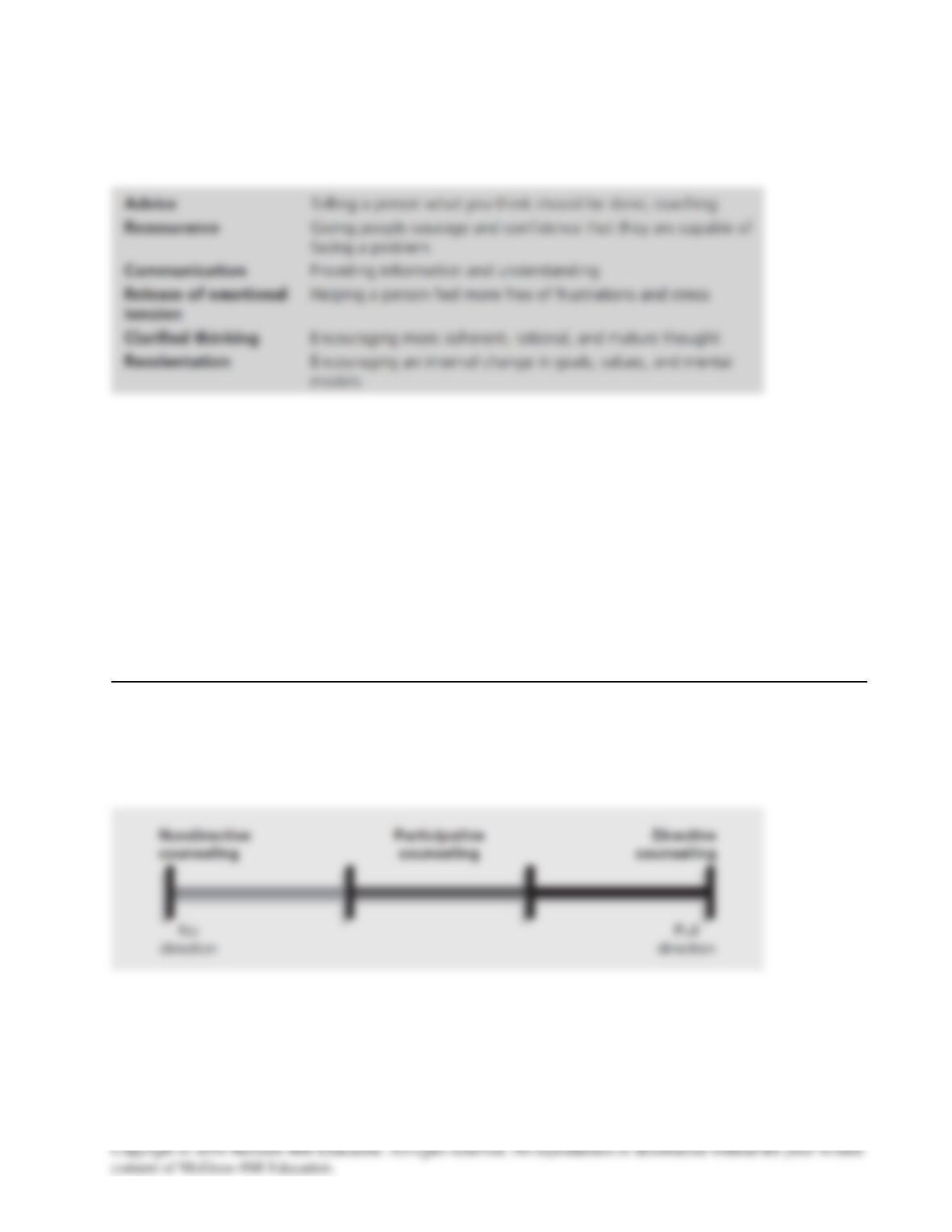
• The counseling objective is achieved through one or more of the following counseling
functions:
o Advice
o Reassurance
o Communication
o Release of emotional tension (emotional catharsis)
o Clarified thinking
15–19
o Reorientation
• The six activities performed by counseling are shown in Figure 15.6.
The Manager’s Counseling Role
• Managers are important counselors because they have day-to-day interaction with employees.
• Managers cannot, when an emotional upset arises, say, “This is not part of my job. Go see a
counselor.”
o Emotions are part of the whole employee and must be considered a part of the total
employment situation for which a manager is responsible.
o All managers, from the lowest to the highest levels, need training to help them
understand problems of employees and counsel them effectively.
Types of Counseling
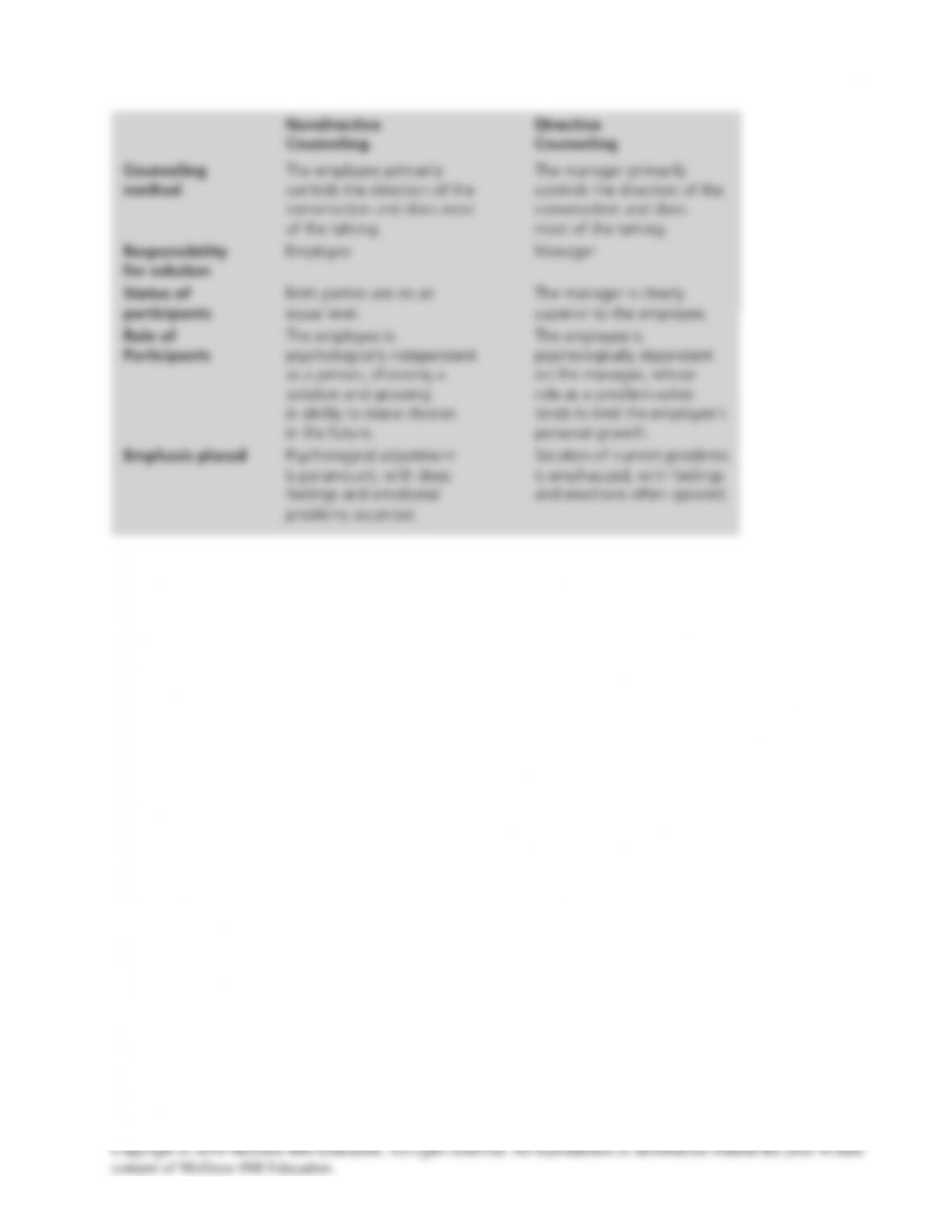
• Counseling can be viewed as a continuum from full direction (directive counseling) to no
direction (nondirective counseling)
o Between the two extremes is participative counseling (Figure 15.7).
Directive Counseling
• Directive counseling is the process of:
o Listening to an employee’s problem
o Deciding with the employee what should be done

15–20
o Telling and motivating the employee to do it
• Directive counseling mostly accomplishes the counseling function of advice but it may also
o Reassure
o Communicate
o Give emotional release
o Clarify thinking
• Reorientation is seldom achieved in directive counseling.
Nondirective Counseling
• Nondirective, or client-centered, counseling is the opposite end of the continuum. It is the
process of skillfully listening to and encouraging an employee to:
o Explain troublesome problems
o Understand them
o Determine appropriate solutions
• It focuses on the employee rather than on the manager’s roles as a judge and advisor.
• Care should be taken to make sure that managers are not be so oversold on the nondirective
approach that they neglect their normal directive leadership responsibilities.
• Nondirective counseling was developed concurrently by two groups:
o Elton Mayo, Fritz Roethlisberger, and others at Western Electric Company
o Carl R. Rogers and his colleagues
o Throughout the counseling relationship, it is important for the manager to accept
feelings, rather than judge them, offering blame or praise.
o Judgment and evaluation can discourage an employee from stating true feelings.
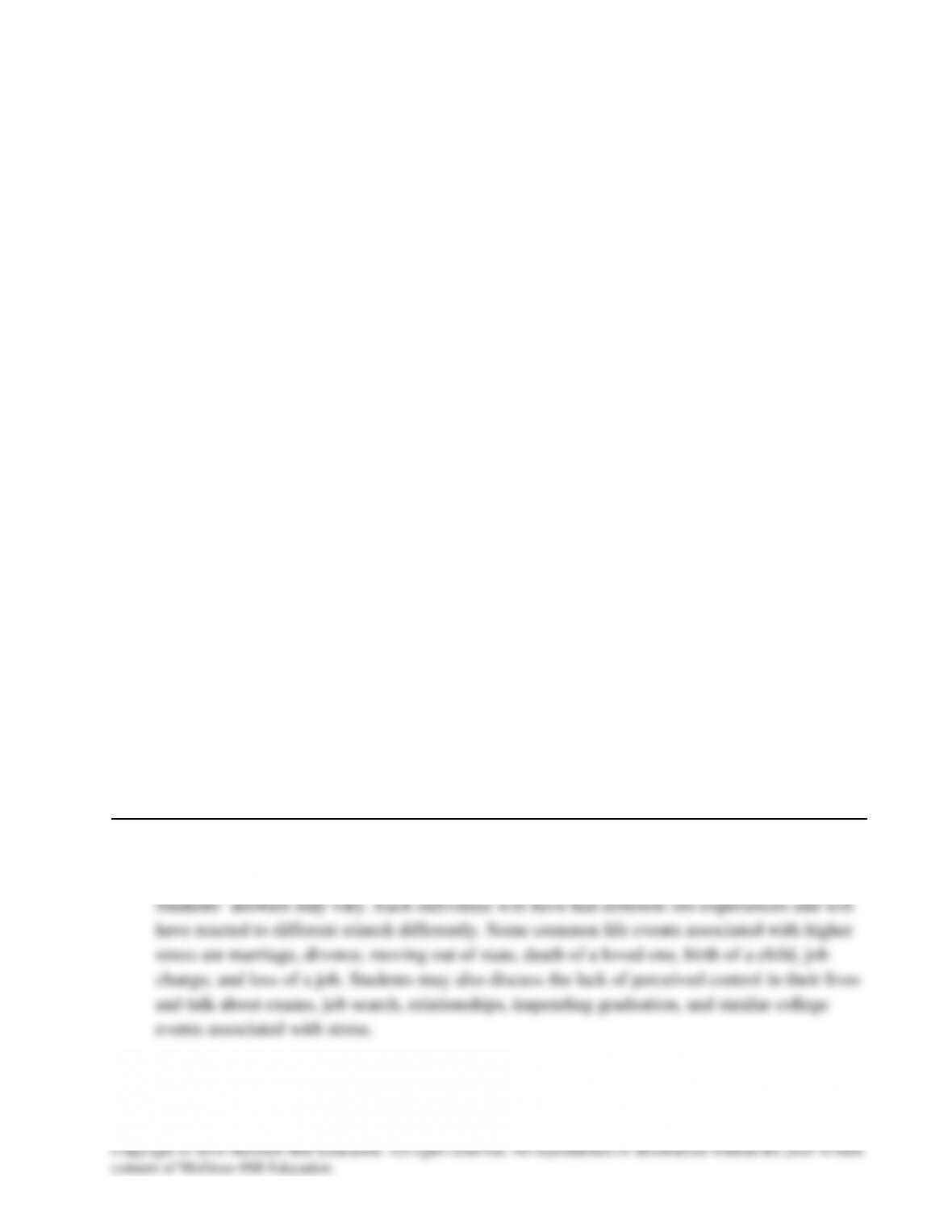
• Major differences between nondirective and directive counseling are summarized in figure
15.8.
15–21
Copyright © 2014 McGraw-Hill Education. All rights reserved. No reproduction or distribution without the prior written
consent of McGraw-Hill Education.
• The unique advantage of nondirective counseling is its ability to cause the employee’s
reorientation.
o It emphasizes changing the person instead of dealing only with the immediate problem
in the usual manner of directive counseling.
o Non-directive counselors follow an iceberg model of counseling in which they
recognize that sometimes more feelings are hidden under the surface of a counselee’s
communication than are revealed (Figure 15.9).
o They constantly encourage the counselee to open up and reveal deeper feelings that
may help solve the employee’s problem.
• Limitations
o It is more time-consuming and costly than directive counseling.
o Professional counselors require professional education and consequently are expensive.
o It depends on a capable, willing employee.
o The nondirective counselor needs to be careful not to become a crutch for emotionally
dependent employees to lean on while they avoid their work responsibilities.
Participative Counseling
• Nondirective counseling is limited because:
o It requires time, expertise, and is costly.
o It is often not accepted by modern, independent employees.
o The type of counseling typically used in organizations is between the two extremes of
directive and nondirective counseling.
15–22
• Participative counseling, also called cooperative counseling, is a mutual relationship that
establishes a cooperative exchange of ideas to help solve an employee’s problems.
o It is neither wholly manager-centered nor wholly employee-centered.
o It integrates the ideas of both participants in a counseling relationship.
• Participative counseling starts by using the listening techniques of nondirective counseling.
o As the interview progresses, participative counselors play a more active role than
nondirective counselors would.
• Participative counselors may:
o Offer bits of knowledge and insight
o Discuss the situation from their broader knowledge of the organization
o Apply the four counseling functions of reassurance, communication, emotional release,
and clarified thinking
A Contingency View
• A manager’s decision to use directive, participative, or nondirective counseling with an
employee should be based on an analysis of several contingency factors.
• It should not be made solely on the manager’s personal preference or past experience.
• Contingency elements to consider:
o Degree to which the employee’s problem appears to be focusing on facts and the need
for a timely logical solution (implying the use of a more directive approach) versus
focusing on personal feelings and emotions (implying a more nondirective approach).
o Another consideration is the degree to which the manager is willing to devote time and
effort to the growth and development of a more independent employee.
• An effective manager requires awareness of the alternatives available, the skills to be
comfortable with each method, and the analytical ability to make a choice that fits the
situation.
Suggested Answers to Discussion Questions
1. List and discuss the five major sources of stress in your life during the last five years.
2. Think of someone you know who suffers from burnout. What are the symptoms? What
may have caused it?
15–23
Students’ answers may vary. Students should think of individuals who appear to be
3. Discuss how stress and job performance are related. Is stress helping or interfering with
your performance in college? Discuss.
4. Do you see yourself as primarily a type A or type B person? Discuss the reasons for your
choice. Make a list of your five main type A characteristics and five main type B
characteristics.
5. Discuss four management practices covered in earlier chapters of this book that should
help reduce employee stress.
6. Discuss the six main counseling functions. Which are best performed by directive,
nondirective, and participative counseling?
Students’ answers may vary. The functions of counseling are advice, reassurance,
15–24
Copyright © 2014 McGraw-Hill Education. All rights reserved. No reproduction or distribution without the prior written
consent of McGraw-Hill Education.
for reassurance, communication, emotional release, and clarified thinking.
7. Identify someone who has lost his or her job because of corporate downsizing. Interview
the person to determine how stressful the situation was and how he or she successfully
managed the stress.
Students’ answers will vary based on people interviewed. However, being laid off in a
8. Should professional company counselors be provided in the following situations? Discuss
why or why not.
a. A large West Coast aircraft plant during rapid expansion
b. A government office in Valdosta, Georgia, employing 700 people
c. A marginal job-order foundry in Chicago having unstable employment needs
varying from 30 to 60 workers
Students’ answers may vary. Answers to this question depend upon the criteria used to frame
9. What should be the main type of counseling used in the following situations?
a. A traveling sales representative with 15 years of seniority has become an alcoholic.
b. A newly hired engineer engages in petty theft of office supplies.
c. A receptionist receives two job offers and must make a decision over the weekend.
d. A maintenance worker’s spouse files for divorce.
Students’ answers may vary. The sales representative is the best candidate for professional
15–25
Copyright © 2014 McGraw-Hill Education. All rights reserved. No reproduction or distribution without the prior written
consent of McGraw-Hill Education.
receptionist can probably be helped by the advice and reassurance of a directive approach,
although the participative approach will probably help this person more, as a decision is
required and in a short time. The maintenance worker may only need participative counseling
but could need nondirective counseling instead; it depends greatly upon the individual
involved and the reaction to this life event.
10. Outline a preventive program for personal wellness that you could implement for
yourself over the next five years. What are its elements?
Students’ answers may vary. Wellness programs should emphasize physical and mental health
pursuits.
Assess Your Own Skills
Students should honestly circle the number on the response scale that most closely reflects the
degree to which each statement accurately describes them. This section will help them understand
how well they exhibit facilitator skills.
Incident
Unit Electronics Company
Able inadvertently provided two very expert participative counseling sessions, one to Parcel and one
to Short. Participative counseling is between the extremes of directive counseling and nondirective
counseling. By being careful to neither overtly give advice nor make any promises about changing
anyone’s behavior, Able “lucked out” by having each employee interpret the sessions that did take
Experiential Exercise
Are Grades Motivators?

15–26
Students have been asked to evaluate themselves with regard to each of the criteria listed on the
assessment form given. They have been asked to circle the number that indicates their assessment of
the degree to which they typically experience each source of student-related stress. Then, they have
to total the scores from the items, and report the total to the instructor for tabulation. After this they
should examine the range of class scores and compute the average. Note that a higher score suggests
the possibility of greater current stress in life.
Generating OB Insights
Students’ responses will vary for this exercise. They should however, highlight several of the major
topics discussed in the chapter such as the role of stress in employee health, the extreme forms of
stress reactions, the causes and symptoms of stress, the organizational effects of stress, the actions
that may prevent or reduce stress, etc.