
15-1
Chapter 15
Stress and Counseling
Chapter Overview
This chapter discusses stress and counseling. First, employee stress is examined. Its causes and
effect on job performance are presented. Approaches to stress management are also outlined. Next,
an overview of employee counseling is presented. The final section identifies several types of
counseling.
Chapter Learning Objectives
After reading this chapter, students should understand:
1. The role of stress in employee health
2. Extreme forms of stress reactions
3. Causes and symptoms of stress
4. Organizational effects of stress
5. Actions that may prevent or reduce stress
6. Different counseling functions
7. Three types of counseling and their usefulness
Discussion and Project Ideas
An increasing amount of attention is being devoted to stress and its effects on worker health and
productivity. This chapter is designed to help students identify stress and its effects on employees.
Counseling is emphasized as a major means of helping employees cope with stress as well as other
personal and work-related problems. The perspective of counseling presented here is not so much a
professional counseling approach, but an approach and attitude regarding supervisors’ interactions
with employees on a day-to-day basis. Under these conditions, counseling is essentially a system of
listening, understanding, and respecting human values in a situation. Thus, counseling by supervisors
is as much an attitude as it is a technique. If a supervisor’s value structure gives no respect to human
values in a problem, all the technique in the world will not solve it.
The following exercises are designed to emphasize the key points stressed in this chapter.
• Role playing is an excellent vehicle for teaching counseling concepts. Ask one student to
volunteer to be a manager and another to be the employee. Have the employee and the other
members of the class (but not the manager) read the following role description:
• You are a drill-press operator and have recently had difficulty with arriving at work on time

15-2
and completing your production quota. Also, you have been absent five times in the last
month. On most of the days where you have been absent or late, you had been out drinking.
However, for the most part, your problem is not drinking. Your wife (husband) left you about a
month ago and took the children because you had stayed out late with friends a few times in
the last couple of months. You don’t think it’s fair and wish you could get back together again.
Right now, you’re just going through a period of readjustment and you probably will continue
to have some problems until things clear up. It doesn’t make much difference at work, as far as
you’re concerned, because they never fire anybody anyway.
• Have the person role-playing the manager and the rest of the class (but not the employee) read
the following role description.
• You are the manager of Jo (Joseph or Josephine), a drill-press operator who has been late five
times and absent five times in the last month. When Jo does come in, he (she) appears tired
and has bloodshot eyes. You know from other employees that Jo has been drinking a lot and
suspect that the drinking is part of the reason Jo’s spouse left about a month ago. Jo’s
performance is not yet poor enough to warrant termination, but it has been gradually declining.
You have decided that you need to talk with Jo to see if you can get him (her) back on track.
Have both the manager and employee role-play the counseling interview in front of the class,
and then discuss the following:
o Was the manager directive or nondirective? What percent of time did the employee talk?
The manager?
o Which of the six counseling functions did the manager provide?
o Ask the employee how she/he felt at the conclusion of the interview.
o What could be done to improve the process observed?
• Use the same process as before, but do it twice, once with a manager asked to use a directive
approach and once with a manager asked to use a nondirective approach. Then discuss the
following:
o What are the major differences between the directive versus nondirective approaches?
o What are the advantages and disadvantages of each approach?
o Under which approach is the employee most likely to change?
• Ask for a volunteer willing to participate in two to five minutes of nondirective counseling.
After the person volunteers, begin by asking the person how she is doing. Key in on whatever
she says and repeat it as a question. For example, if the person says “pretty good,” you say
“Pretty good. Can you tell me more about that?” Keep the person talking and analyzing what
she is saying by repeating and rephrasing what she says in terms of questions. Be careful,
because the process can become very threatening. Be prepared to stop if it appears that the
conversation becomes too personal and analytic. Within two to three minutes you should be
able to uncover some of that person’s major concerns at the time. Then it is time to stop.
o Discuss the process in terms of its power to uncover problems and help begin analysis.
o Discuss the advantages and dangers of the process.
o Ask the person how she feels about the process. Was she comfortable or uncomfortable?
15-3
• Invite someone from the local community to class to discuss stress reduction techniques, such
as biofeedback or transcendental meditation. After the presentation, have two groups conduct a
debate on the validity of the methods suggested, one taking the affirmative and the other the
negative position. Make sure they utilize research evidence and critically analyze that research
in order to support their arguments.
Lecture Outline
Introduction
• Studies of stress among American workers reveal the following:
o 39 percent of executives believe their heavy work load has adversely affected their
health.
o 75 percent of workers work often during their paid time off.
• Many people develop emotional or physical problems as a result of stress.
• The difficulties may be temporary or enduring, and they may be caused by factors at work or
out of the workplace.
o No one is totally immune to stress.
o It can affect employees at all levels of the organization.
o When it is too severe or long-lasting, it can negatively affect both the individual and the
employer.
• Fortunately, many programs exist for preventing or managing stress.
Employee Stress
What Stress Is
• Stress is the general term applied to the pressures people feel in life.
o The presence of stress at work is almost inevitable in many jobs.
• Individual differences account for a wide range of reactions to stress.
o A task viewed as moderately challenging by one person may produce high levels of
anxiety in another.
• When pressure begins to build up, it can cause adverse strain on a person’s emotions, thought
15-4
processes, behaviors, and physical condition.
o When stress becomes excessive, employees develop various symptoms of stress that
can harm their job performance and health.
o It can also threaten their ability to cope with the environment.
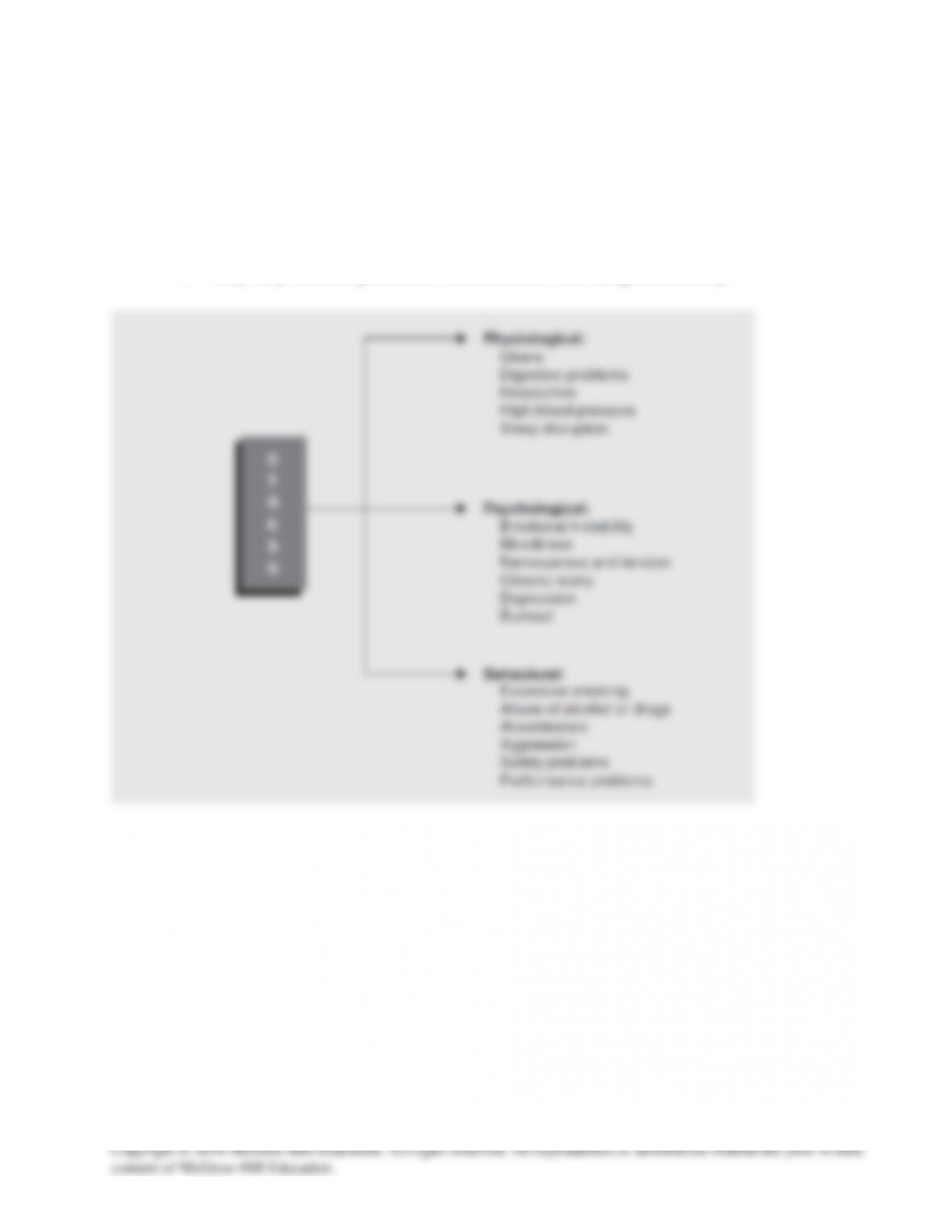
• As shown in Figure 15.1, people who are stressed may become nervous and chronically
worried. They are easily provoked to anger and are unable to relax.
o They may be uncooperative or use alcohol or other drugs excessively.
• In some situations, an organization can be held legally liable for the emotional and physical
impact of job stress on its employees.
o If liability is established, employees could claim benefits under workers’ compensation
laws, as well as sue for financial damages.
Extreme Products of Stress
• Stress can be either temporary or long-term, and can range from mild to severe.
• The effects on an employee depend mostly on
o How long its causes continue
o How powerful they are
o How strong the employees’ stress-handling and recovery powers are

15-5
• Employees need internal resilience: the capacity to handle short-term tensions and bounce
back from difficulties.
o There are four aspects to resilience—physical, mental, emotional, and social, but we
are dealing primarily with the emotional dimension here.
o Persons with emotional resilience are confident, less afraid of failure, and more
experimental.
• Burnout
o Problems predictably arise when high-intensity stress continues for an extended
duration without some form of relief from it.
▪ According to Hans Selye, the human body, when faced with stress, moves
through three phases—alarm (“fight or flight”), resistance (or, alternatively,
adaptation), and exhaustion.
▪ When employees are emotionally exhausted, they cannot instantly rebuild its
ability to cope with future stress once it is depleted.
▪ Hence, people become physically and psychologically weakened from trying to
combat it, leading to a condition called burnout.
o Burnout is a situation in which employees
▪ Are emotionally exhausted
▪ Develop cynicism about their work
▪ Feel unable to accomplish their professional goals
o Some jobs, such as those in the helping professions and jobs with continuous high
stress are more likely than others to cause burnout.
▪ For example air-traffic controllers, health care professionals, reporters, waitstaff,
customer service representatives.
o Employees who are literally addicted to work and internally driven to spend long hours
there are called workaholics.
o Workaholics:
▪ Place higher priority on work than on family or recreation
▪ Think and talk constantly about work
▪ Have difficulty delegating to others
▪ Worry about their careers
▪ Often try to accomplish multiple tasks simultaneously
▪ Place high expectations on themselves and others
▪ Have difficulty achieving a work-life balance
o When workers become burned out, they are more likely to:
▪ Complain
▪ Attribute their errors to others
▪ Magnify their dominant traits
▪ Be highly irritable
o The alienation they feel drives many of them to:
15-6
▪ Think about leaving their jobs
▪ Seek out opportunities to be trained for new careers
▪ Actually quit
o Job burnout also leads to increased absenteeism and decreased quality and quantity of
job performance.
o Organizations need to identify both the jobs that lead to early burnout and the
employees who are beginning to exhibit burnout symptoms.
o Sometimes an organization can change the parts of a job that contribute to burnout,
such as:
▪ Reducing the frequency or intensity of interpersonal contacts
▪ Diminishing the reality or perception of constant surveillance
▪ Clarifying job expectations
▪ Eliminating rotating shiftwork.
o Common suggestions for personal coping include:
▪ Becoming more realistic about career expectations
▪ Immersing oneself in helping others (volunteering in community activities)
• Trauma
o A severe product of stress, called trauma, occurs following a major threat to one’s
security. The event could be:
▪ A natural disaster
▪ An organizational crisis
▪ Dramatic employee abuse by the employer
▪ Personal job loss
o Three types of trauma have achieved notoriety in recent years:
▪ Workplace trauma
▪ Layoff survivor’s sickness
▪ Post-Traumatic Stress Disorder
o One problematic disorder is called workplace trauma, which is the disintegration of
employees’ self-concept and belief in their capabilities. It can arise from:
▪ Harassment at work
▪ Wrongful termination
▪ Discrimination
▪ An employee’s perceived incapacity to meet evolving performance expectations
o In each case, the employee may inappropriately:
▪ Assume responsibility for the event
▪ Feel like a victim of circumstances
▪ Fall into an emotional tailspin

15-7
o Attitudinal clues to workplace trauma include:
▪ Severe moodiness
▪ Concentration difficulties
▪ Alienation
▪ Tardiness
▪ Absenteeism
▪ Accident-proneness
o A common source of workplace trauma is sudden job loss with its potentially crushing
effect on one’s self-esteem.
▪ This phenomenon became widespread as a consequence of the wave of corporate
downsizings following the collapse of the housing and credit markets.
o Many workers suffered at least short-term shock to their self-esteem.
▪ The individual impact was often magnified by the lack of warning and the lack of
insularity felt by even high-performing employees.
▪ Job security has lost its meaning for many employees, not just marginal ones.
o Even those individuals remaining employed after mass downsizing suffer stress and
some experience layoff survivor’s sickness (also known as post-layoff survivor
disorder).
▪ This syndrome causes feelings of uncertainty/insecurity, anger, guilt, and distrust.
▪ They are simultaneously relieved and glad to have a job, guilty that their
workmates were displaced—sometimes without apparent reason, and even
envious.
▪ In the meantime, the job pressures on them often increase dramatically as they try
to shoulder the tasks of former colleagues.
▪ They also wonder, “Will I be next to be cut?”
o Another source of trauma, and product of stress, is to witness or be the victim of
workplace violence. Sometimes a troubled employee takes dramatic and harmful
physical action against co-workers, managers, or company property. These violent,
anger-based acts can include:
▪ Unprovoked fights
▪ Destruction of property
▪ Use of weapons to threaten, harm, or even murder others
o Workplace violence has catapulted homicide into the second-highest work-related
cause of death in the United States.
▪ Workplace violence is unique in that it is often both a product of stress and the
source of enormous stress on others.
o Any person, who witnesses violence, receives injury from it, or lives under the fear of
repeated future violence may suffer from post-traumatic stress disorder (PTSD).
▪ The shock of sudden and dramatic violent incidents often produces immediate
stress-related symptoms.
15-8
▪ The effects may last for years and require lengthy treatment.
A Model of Stress
• Conditions that tend to cause stress are called stressors.
o Even a single stressor may cause major stress.
o Usually stressors combine to pressure an employee in a variety of ways until major
feelings of stress develop.
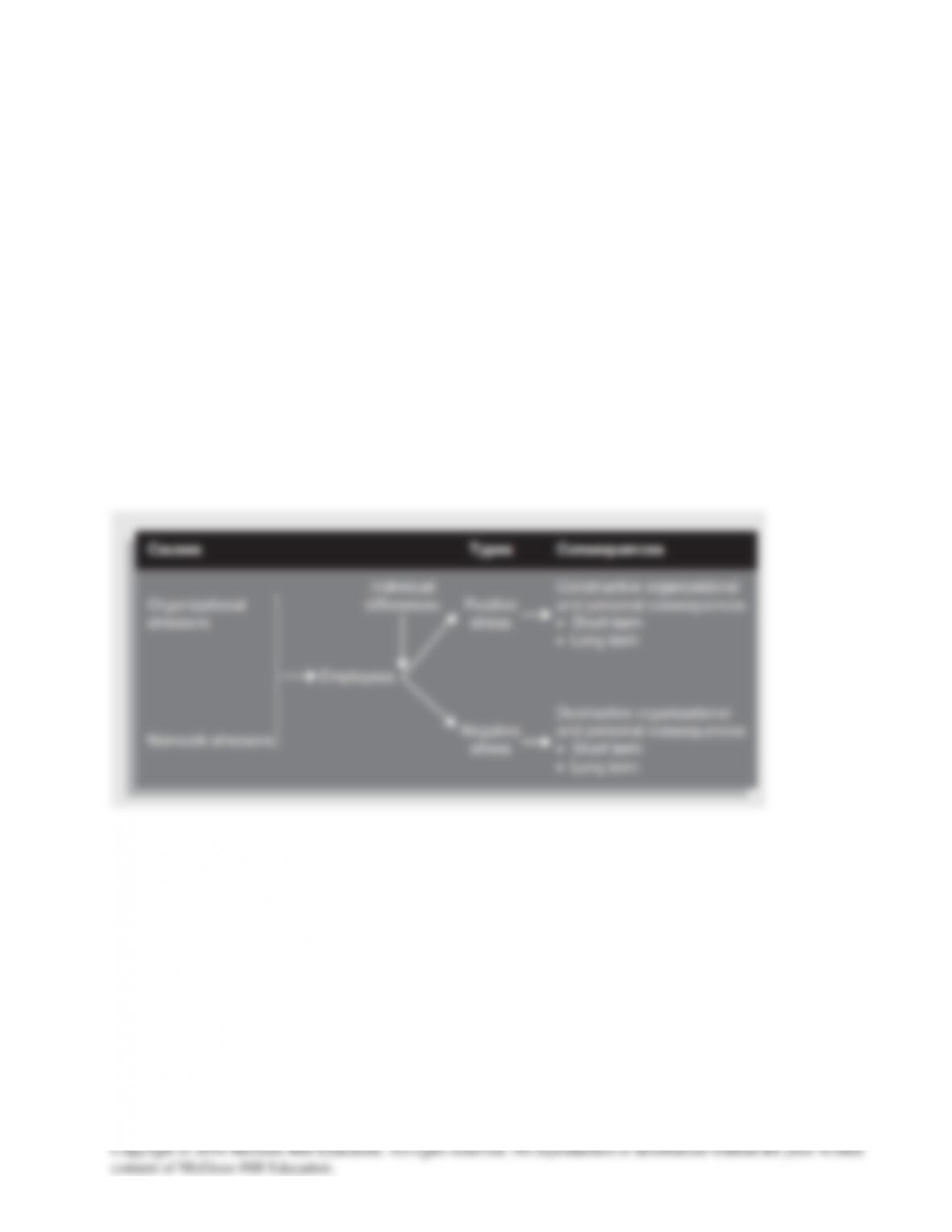
o Major sources of employee stress are evenly divided between organizational factors
and the nonwork environment, as shown in figure 15.2.
• Individual differences among employees may cause some to interpret these stressors as
positive stress or negative stress.
o As a result, either constructive or destructive consequences may arise for both the
organization and the employee.
o These effects may be short-term and diminish quickly, or they may last a long time.
• To control stress, organizations usually begin by exploring its job-related causes.
Job-Related Causes of Stress
• Almost any job condition can cause stress, depending on an employee’s reaction to it.
o Part of the difference lies in each employee’s experiences, general outlooks, and
expectations, which are all internal factors.
• Typical causes of stress on the job:
o Work overload
o Time pressures
o Poor quality of management
o Insecure job climate
o Lack of control over one’s job
o Inadequate authority to match one’s responsibilities
15-9
o Role conflict and ambiguity
o Difference between company values and ethical practices
• Work overload and time deadlines put employees under pressure and lead to stress.
o These pressures arise from management, and a poor quality of management can cause
stress.
o Examples of stress-producing factors related to management are an autocratic
supervisor, an insecure job climate, lack of control over one’s own job, and inadequate
authority to match one’s responsibilities.
• Role conflict and ambiguity are also related to stress. In situations of this type people have
different expectations of an employee’s activities on a job, so the employee does not know
what to do and cannot meet all expectations.
o Since the job often is poorly defined, the employee has no official model on which to
depend.
o A further cause of stress lies in the difference between company values and ethical
practices, as often reflected in the organization’s culture, and employee ethics and
values.
Nonwork Stressors
• A vast array of stressors also arises away from work, and these can have powerful spillover
effects on work performance. Examples of nonwork stressors include:
o Relationship breakdowns between spouses or partners
o Financial difficulties
o Psychological problems
• Some managers feel that they should be increasingly tuned in to events occurring in the
personal lives of their employees.
• One way to accomplish this is through the use of a stress audit—which is a survey
administered anonymously to employees, that solicits their responses to a variety of questions
related to working conditions. Examples of topics include:
o Unrealistic time pressures
o Inadequate respect
o Unachievable deadlines
o Pressure to work long hours
o Strained relationships
o Unclear expectations
15–10
Frustration
• Another cause of stress is frustration.
o It is a result of a motivation (drive) being blocked to prevent one from reaching a
desired goal.
• Reactions to frustrations are known as defense mechanisms.
• Types of Reactions
o One of the most common reactions to frustration is aggression.
o Some individuals become apathetic by not responding to their job or associates.
o Another reaction is withdrawal, such as asking for a transfer or quitting one’s job.
o Regression to less mature behavior, such as self-pity and pouting, also is possible.
• Sources of Frustration
o Sources of frustration include:
▪ Management
▪ Co-workers
▪ The work itself
▪ The environment
o Some research suggests that the little things called hassles, rather than major life crises,
produce frustration.
▪ Hassles are conditions of daily living that are perceived to threaten one’s
emotional well-being.
o Common hassles include:
▪ Having too many things to do
▪ Losing items
▪ Being interrupted
▪ Having to do unchallenging work
o Some of the hassles with the greatest average severity are related to either the job or the
employee’s personal environment, such as:
▪ Dealing with problems of aging parents
▪ Facing mild prejudice and discrimination
▪ Having insufficient personal energy
o The cumulative effects of multiple hassles may well result in a feeling of unwelcome
stress
o Some abusive supervisors engage in sustained hostile actions that demean those
around them.
o These workplace bullies intentionally engage in repeated verbal and even nonverbal
15–11
mistreatment of employees.
o Their actions include:
▪ Publicly ridiculing others
▪ Throwing tantrums
▪ Extending insults
▪ Invading one’s privacy
▪ Practicing the silent treatment
o In short, workplace bullies threaten, intimidate, and humiliate others, whether
unconsciously or intentionally.
o Effects of abusive behavior include:
▪ Psychological distress
▪ Feelings of inefficacy
▪ Depression
▪ Lower job and life satisfaction
▪ Higher turnover
o Organizations have a moral obligation to monitor, prevent, and stop such abusive
actions.
• Frustration and Management Practice
o The stronger one’s motivation or drive toward a blocked goal, the stronger one’s
frustration will be, other things being equal.
▪ If motivation is lacking, then little frustration is likely to develop.
o The required management role is a supportive one.
▪ The idea is not to remove all difficulties so the assignment loses its challenge, but
rather to provide enough support to make the project possible.
o Counseling can help reduce frustrations by helping employees choose mature courses
of action to overcome blockages preventing goal accomplishment.
Stress and Job Performance
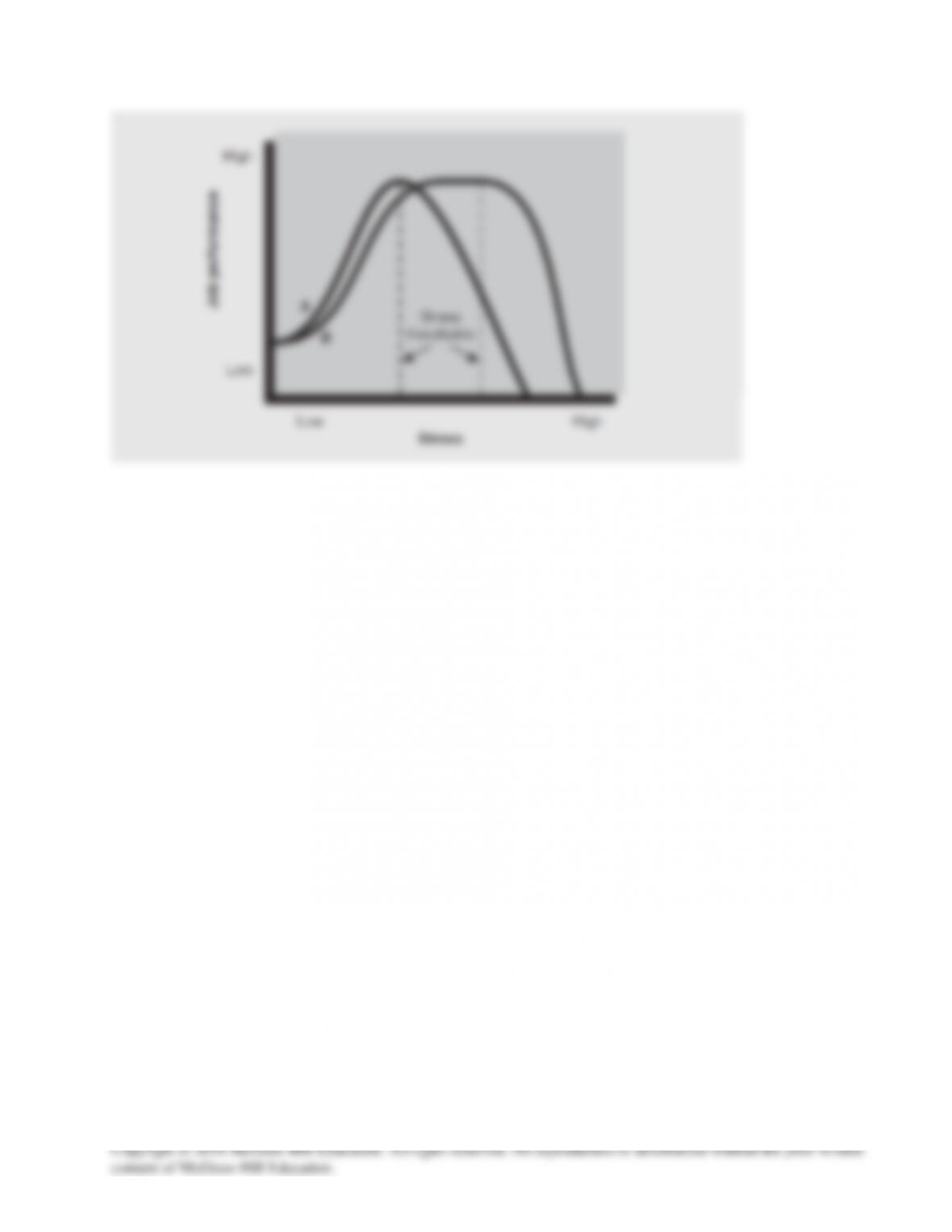
• Stress can be either helpful or harmful to job performance, depending on its level.
o Figure 15.4 presents a stress-performance model that shows the relationship between
stress and job performance.
15–12
Copyright © 2014 McGraw-Hill Education. All rights reserved. No reproduction or distribution without the prior written
consent of McGraw-Hill Education.
• When there is little or no stress, job challenges are absent and performance tends to be low.
o As stress increases, performance tends to increase, because stress helps a person call up
resources to meet job requirements.
o Constructive stress is a healthy stimulus that encourages employees to respond to
challenges.
o Eventually, stress reaches a peak or a plateau that corresponds approximately with a
person’s top day–to-day performance capability. At this point, additional stress
produces no more improvement.
o Finally, if stress becomes too great, it turns into a destructive force. performance begins
to decline at some point because excess stress interferes with performance.
o An employee:
▪ Loses the ability to cope
▪ Becomes unable to make decisions
▪ Exhibits erratic behavior
o If stress increases to a breaking point, performance becomes zero. The employee has a
breakdown, becomes too ill to work, is fired, quits, or refuses to come to work to face
the stress.
o Managers play a key role, too. When they are stressed and disengaged, employees
report being less likely to stay with the firm, less innovative, less valued, and less
recognized.
o The stress-performance relationship may be compared to strings on a violin. When
there is either too little or too much tension on the strings, they will not produce
suitable music. When tension on an employee is either too high or too low, the
employee’s performance will deteriorate.
o The managerial challenge is to monitor tension levels and make periodic adjustments.

15–13
Stress Vulnerability
• Stress Threshold
o Worker vulnerability to stress is a function of both internal (organizational) and
external (nonwork) stressors (Figure 15.2).
o One internal factor is an employee’s stress threshold—the level of stressors
(frequency and magnitude) that the person can tolerate before negative feelings of
stress occur and adversely affect performance.
▪ Some people have a low threshold and the stress of a few hassles or even
relatively small changes or disruptions in their work routines causes a reduction
in performance.
▪ Others have a higher threshold, staying cool, calm, and productive longer under
the same conditions.
▪ This response may stems partly from their experience and confidence in their
ability to cope.
o A higher stress threshold and greater resiliency help prevent lowered performance
unless a stressor is major or prolonged.
• Perceived Control
o The second internal factor affecting employee stress is the amount of perceived
control they have over their work and working conditions.
▪ Employees who have a substantial degree of independence, autonomy, and
freedom to make decisions handle work pressures better.
▪ Since two employees may have the same actual control and flexibility, it is
clearly their relative perception of that freedom that counts.
o Managers can respond to this need for control through a variety of measures as:
▪ Allowing flexible work schedules
▪ Enriching jobs
▪ Placing individuals on self-managing teams
▪ Empowering employees by using participative leadership styles
• Type A and Type B People
o Stress vulnerability is often related to type A and B characteristics.
o Type A people:
▪ Are aggressive and competitive
▪ Set high standards
▪ Are impatient with themselves and others
▪ Thrive under constant time pressures
▪ Make excessive demands on themselves even in recreation and leisure
▪ Often fail to realize that many of the pressures they feel are of their own making
rather than products of their environment
▪ Are more prone to physical ailments related to stress, such as heart attacks