
14–14
o Employees need to participate in change before it occurs, not after.
• Shared Rewards
o Another way to build employee support for change is to ensure sufficient rewards for
employees in the change situation.
o Rewards say to employees, “We care. We want you as well as us to benefit from this
change.”
▪ Rewards also give employees a sense that progress accompanies a change.
▪ Employees appreciate a pay increase or promotion, but they also appreciate
emotional support, training in new skills, and recognition from management.
• Employee Security
o Security during a change is essential.
o Many employers guarantee workers protection from reduced earnings when new
technology, new methods, and new compensation programs are introduced.
o Others offer retraining and delay installation of labor-saving equipment until normal
labor turnover can absorb displaced workers.
o Seniority rights, opportunities for advancement, and other benefits are safeguarded
when a change is made.
o Grievance systems give employees a feeling of security that benefits will be protected
and differences about them fairly resolved.
• Communication and Education
o Communication is essential in gaining support for change.
o Even though a change will affect only one or two in a work group of ten persons, all of
them must be informed clearly and regularly about the change in order to feel secure
and to maintain group cooperation.
• Stimulating Employee Readiness
o Change is more likely to be accepted if the people affected by it recognize a need for it
before it occurs.
o This awareness may happen naturally, as when a crisis, threat, or sudden new
competition emerges, or it can be induced by management through sharing operating
information with employees.
o One of the more powerful ways, however, occurs when workers discover for
themselves that a situation requires improvement.
• Working with the Total System
o Resistance to change can be reduced by a broader understanding of employee attitudes
and natural reactions to change.
o Management’s role is to help employees recognize the need for each change and to
invite them to participate in it and gain from it.
o It is essential for managers to take a broader systems-oriented perspective on change to
identify the complex relationships involved.
14–15
Understanding Organization Development
• Organizational Development (OD) is the systematic application of behavioral science
knowledge at various levels (group, intergroup, and total organization) to bring about
planned change.
o OD helps managers recognize that organizations are not just a collection of individuals but
Foundations of OD
• Systems Orientation
o Change is so abundant in modern society that organizations need all their parts working
together in order to solve the problems—and capitalize on the opportunities—that are
brought about by change.
▪ Some organizations have grown so large that maintaining coordinated effort
among their parts is difficult.
themselves.
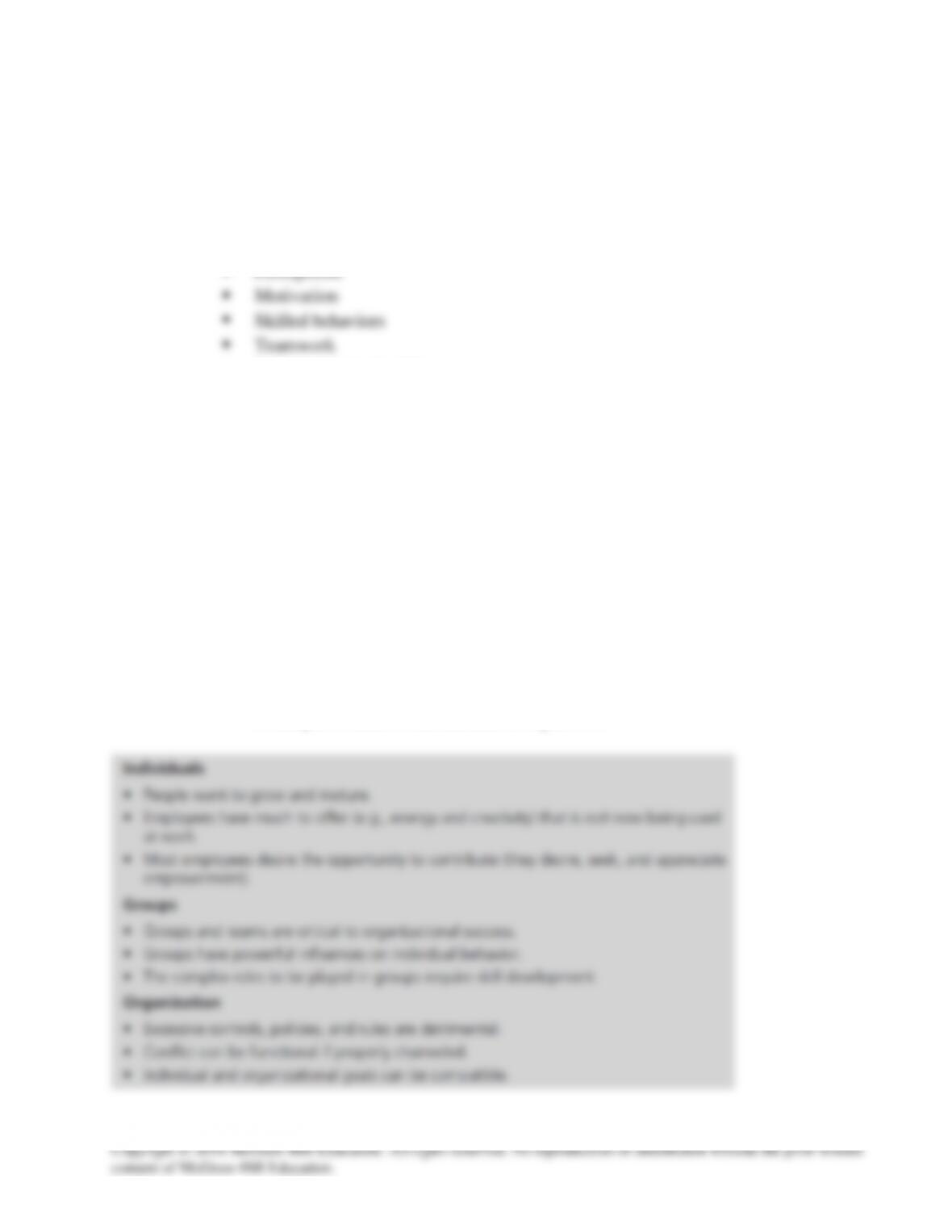
• Understanding Causality
o One contribution of the systems orientation is to help managers view their
organizational processes in terms of a model with three types of variables
o They are causal, intervening, and end-result variables (Figure 14.6).
o The causal variables are the ones that management can change most directly; they
include:
▪ Organizational structure
▪ Controls
▪ Policies
14–16
▪ Training
▪ A broad range of leadership behaviors
▪ OD efforts
o Intervening variables are those immediately affected by the causal variables; they
include:
▪ Employee attitudes
▪ Intergroup relationship
o The end-result variables represent the multitude of objectives sought by management.
They usually include:
▪ Improved productivity
▪ Increased sales
▪ Lower costs
▪ More loyal customers
▪ Higher earnings
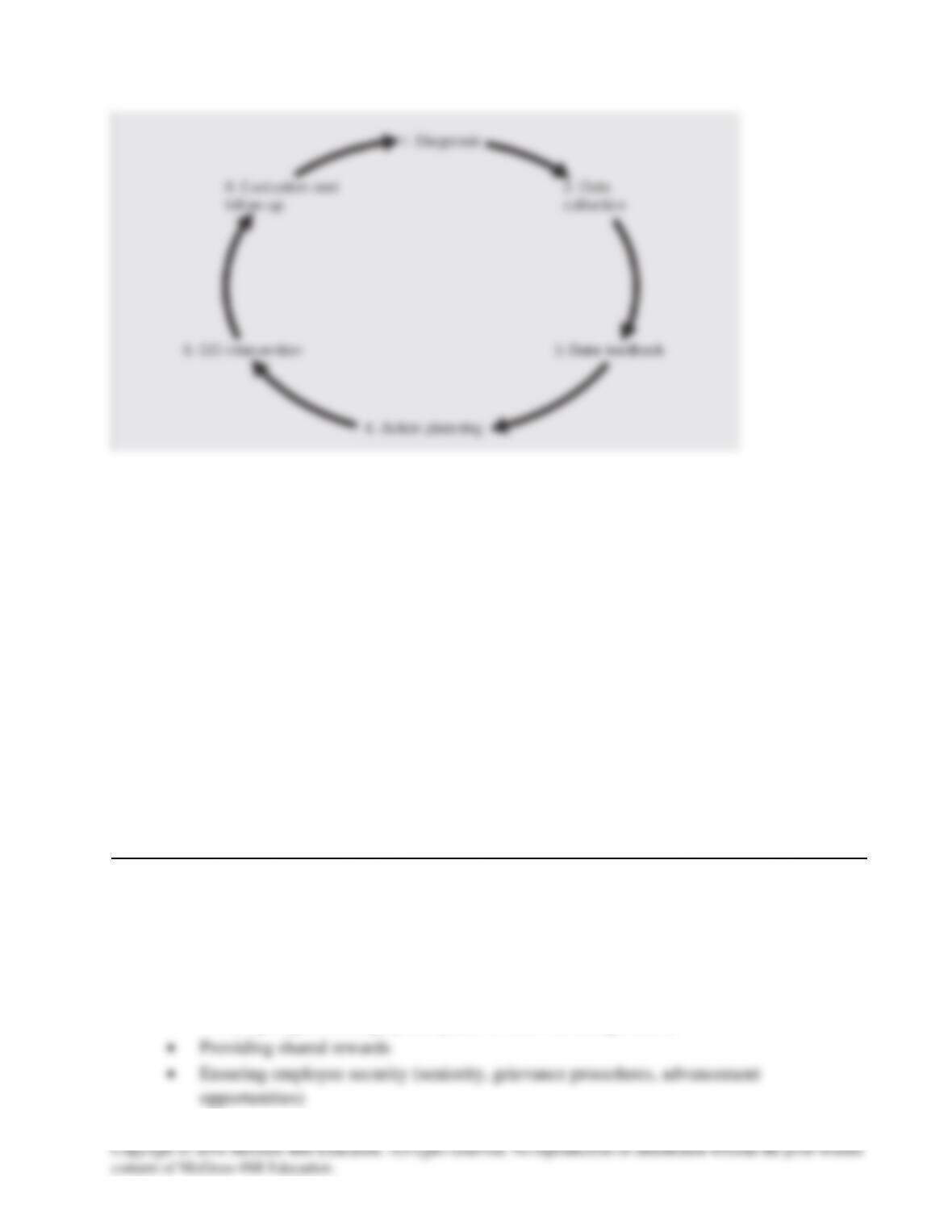
• Assumptions Underlying Organization Development
o OD practitioners make a set of assumptions that guide their actions.
▪ Sometimes these assumptions are implicit and need to be examined to enable
double-loop learning.
o A wide range of assumptions can be made, but certain ones are relatively common at
the individual, group, and organizational level.
▪ A sample of them is summarized in Figure 14.7.

14–17
Characteristics of Organization Development
• Although some of the characteristics of organization development differ substantially from
traditional change efforts, OD has begun to have an impact on the way organizational change
programs are designed and presented.
• Humanistic Values
o OD programs are typically based on humanistic values, which are positive beliefs
about the potential and desire for growth among employees.
o To be effective and self-renewing, an organization needs employees who want to
expand their skills and increase their contributions.
o The best climate for such growth is one that stresses collaboration, open
communications, interpersonal trust, shared power, and constructive confrontation.
• Use of a Change Agent
o OD programs generally use one or more change agents, whose role is to stimulate,
facilitate, and coordinate change.
o The change agent usually acts as a catalyst, sparking change within the system while
remaining somewhat independent of it.
▪ Although change agents may be either external or internal to the organization;
they are usually consultants from outside the organization.
o Advantages of using external change agents are that they are more objective and have
diverse experiences.
▪ They are also able to operate independently without ties to the hierarchy and
politics of the firm.
o To offset their limited familiarity with the organization, external change agents usually
are paired with an internal coordinator from the human resources department.
▪ These two then work with line management.
▪ The result is a three-way relationship that draws on the strengths of each
component for balance.
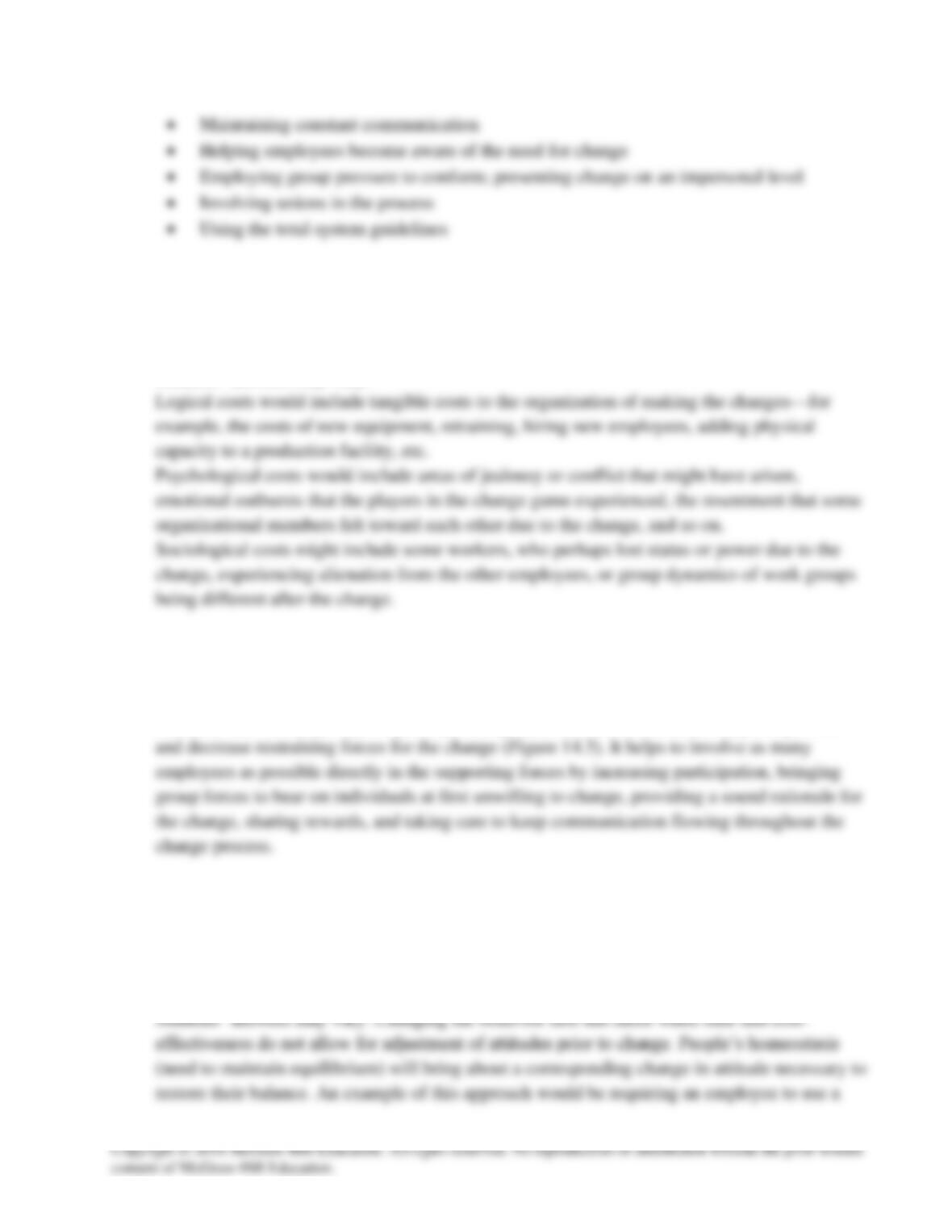
• Problem Solving
o OD trains participants to identify and solve problems that are important to them.
o The approach commonly used to improve problem-solving skills is to have employees:
▪ Identify system problems
▪ Gather data about problems
▪ Take corrective action
▪ Assess progress
▪ Make ongoing adjustments
o This cyclical process of using research to guide action, which generates new data as the
basis for new actions, is known as action research, or action science.
Interventions at Many Levels
• OD recognizes that problems may occur at the individual, interpersonal, group, intergroup,

14–18
and total organization level.
o An overall OD strategy is then developed with one or more interventions, which are
structured activities designed to help individuals or groups improve their work
effectiveness.
• Interventions are often classified by their emphasis on individuals (such as career planning)
or groups (such as team building).
o Another way to view interventions is to look at whether they focus on what people are
doing or on how they are doing it.
• An example of an OD intervention process that has gained considerable popularity is
appreciative inquiry.
o This approach turns employee attention away from a negative focus on problems,
missteps, deficiencies, shortcomings, and blaming.
o It asks individuals and groups to respond to these questions:
▪ What is working for us already?
▪ What are we doing well that we can build upon?
▪ What do we value most around here?
▪ What are our hopes and dreams for this organization (or work unit)?
• Appreciative inquiry recognizes that people are energized by success and like to publicly
celebrate their achievements.
The Organizational Development Process
• OD is a complex process.
o Design and implementation may take a year or more, and the process may continue
indefinitely.
14–19
Copyright © 2014 McGraw-Hill Education. All rights reserved. No reproduction or distribution without the prior written
consent of McGraw-Hill Education.
• A firm that applies only two or three steps is likely to be disappointed with the results;
however the whole process can produce quite favorable results.
• When OD is used effectively to manage major change processes, it produces a wide range of
potential benefits:
o Increased quality and productivity
o Higher job satisfaction and teamwork
o Reduced absenteeism and turnover
o Smoother relationship (less conflict)
• However, some difficulties are also reported in some OD efforts:
o Major time requirements for implementation and related expenses
o Delayed payoffs—sometimes in years
o Difficult to clearly evaluate results of OD program
o Incompatibility with existing culture
Suggested Answers to Discussion Questions
1. Think of an organizational change you have experienced. Was there resistance to the
change? Discuss. What could have been done to prevent or diminish resistance?
Students’ answers may vary. Personal experiences with change and resistance to change will
vary among the students. Suggestions for preventing or diminishing change could include:
• Building support through participation before the change occurs
14–20
Copyright © 2014 McGraw-Hill Education. All rights reserved. No reproduction or distribution without the prior written
consent of McGraw-Hill Education.
• Maintaining constant communication
• Helping employees become aware of the need for change
• Employing group pressure to conform; presenting change on an impersonal level
• Involving unions in the process
• Using the total system guidelines
2. Consider again the change mentioned in question 1. List both the costs and benefits
under the three headings of “logical,” “psychological,” and “sociological.” Were the
benefits greater than the costs for the employees? For the employer? Discuss.
Students’ answers may vary.
3. Continue the analysis of this change. How did management alter the supporting and
restraining forces for it? Was this approach successful?
Students’ answers may vary. Hopefully, management was able to increase supporting forces
4. There is a classic debate about the relationship between attitudes and behaviors. Some
people argue that attitude changes must precede behavioral responses, but other people
believe it is easier to change an employee’s behavior first and then let attitude change
follow. Discuss the merits and probabilities of both approaches to change.
14–21
Copyright © 2014 McGraw-Hill Education. All rights reserved. No reproduction or distribution without the prior written
consent of McGraw-Hill Education.
new, undesirable process, with a resulting change in attitude so that the process is seen as
desirable.
5. Resistance to change is often viewed negatively. Discuss some possible benefits of
resistance to change in an organization.
Students’ answers may vary. Suggestions may include:
• Discourages haphazard management decisions
6. The chapter implies that a proactive role is preferable to a reactive one. Is that always
true? Explain.
Students’ answers may vary. Being proactive is generally going to be preferable to being
7. Discuss the pros and cons of Charles Darwin’s (adapted) statement: “It’s not the
strongest (organization) that survives, but the ones most responsive to change.”
Students’ answers may vary. Organizations that are most responsive to change are the most
14–22
resources and lose focus and cohesion.
8. Argue against the necessity of having vision, charisma, and an emphasis on double-loop
learning for a transformational leader to bring about change in an organization. Are
these elements really needed?
Students’ answers may vary. According to Jim Collins, author of Good to Great: Why Some
9. Numerous methods for building support for change are introduced. What is one risk
associated with each method that could make it backfire?
Students’ answers will vary. Suggestions may include:
• Use of group forces—the change may upset the group’s social system to the extent that the
group itself will feel resistance, which will increase member resistance.
14–23
Copyright © 2014 McGraw-Hill Education. All rights reserved. No reproduction or distribution without the prior written
consent of McGraw-Hill Education.
employee resentment and probable failure of the change.
• Shared rewards—the rewards must be timely and appropriate or they will lose the desired
effect of building support.
• Employee security—employees must value the benefits offered; individual preferences
may cause comparisons and dissatisfaction if inequities are seen to exist.
• Communication—communication must be clear and constant; too little information can
cause rumors to circulate, increasing resistance and damaging chances for successful
implementation.
• Stimulating employee readiness—self-discovery of the need for change may cause some
employees to cover up potential problems because they fear they will be blamed for the
problem and possibly be dismissed from their jobs.
• Working with unions—management takes the risk that the union will use its involvement
in the change process to undermine management’s goals and maintain or enhance its
position. Also, union involvement does not guarantee employee support.
• Working with the total system—management may not have the necessary skills and
knowledge to understand the total system; incorrectly applying any of the guidelines to
this approach will create a snowball resistance effect.
10. Review the significant benefits and limitations of OD. Do you think the benefits outweigh
the costs? Report your choices, giving reasons for your selections.
Assess Your Own Skills
Students should honestly circle the number on the response scale that most closely reflects the
degree to which each statement accurately describes them when they have tried to implement a
change. This section will help them understand how well they exhibit good change management
skills.
Incident
The New Sales Procedures
Perhaps the company is only experiencing an unfavorable period on the learning curve for change,

14–24
but the situation merits further analysis. Opposition to this change seems to result from three
different factors:
• One is the extra time in the workday that is required.
• A second is opposition because of the inconvenience and relearning required by the new
procedures.
The leadership for this change may be questioned. It seems to have been introduced without any
participation by the sales representatives. Management apparently has not followed guides for
introducing change successfully, as discussed in the textbook. Examples are as follows:
• Management seems to have considered only the logical needs for change, ignoring the
psychological and sociological.
• Employees are not sharing in benefits of the change.
• There is no evidence for employees that benefits are greater than costs.
Experiential Exercise
The Industrial Engineering Change
The causes of this problem are fear of change and the uncertainty it brings, as well as a natural
tendency for persons to oppose changes that they do not originate. Further, if a major production
increase is as easy as the first day’s work indicates, some employees may be laid off. As a result of
this perceived attack on their security, employees appear to have banded together against their
common enemy, the industrial engineer. He is the one who has upset the equilibrium of their work
group.
Though the industrial engineer has given some attention to human factors, he apparently does not
recognize that change of this type is as much a human problem as it is a technical problem. He needs
to spend much more time using supportive behavior, participation, and communication. The thirty
percent increase in productivity represents a major change in the standards of the group. Changes
which require a person to deviate from the standards of his or her group will meet with resistance.
The engineer needs to work with both the supervisor and employees to develop more supporting
forces for the changes while reducing restraining forces on the change.
Applying Force-Field Analysis

14–25
The students are asked to assume that the class is extremely unhappy with the professor’s grading
system and has banded together to demand a dramatic change in it. Meeting in small groups, the
students are asked to identify the major behavioral reasons their professor might both be inclined to
accept and reject their recommendation (forces for change and reasons for resistance to it). Then
they are asked to attempt to predict the strength of each factor (high, medium, or low). On the basis
of their analysis, they are asked to predict their professor’s overall response to the recommended
change.
Generating OB Insights
Students’ responses will vary for this exercise. They should however, highlight several of the major
topics discussed in the chapter such as the nature of change, the costs and benefits of change, the
basic frameworks for interpreting change, the role of transformational leadership in change, the
practices to build support for change, etc.