
14-1
Chapter 14
Managing Change
Chapter Overview
This chapter describes the nature, cost, and benefits of change and provides practical strategies to
build support for constructive change. First, the nature of work change and responses to change are
discussed, followed by the cost and benefits of change. The next section deals with resistance to
change, its nature and effects, types of resistance, and possible benefits of resistance, followed by the
process of implementing change successfully. The final section deals with understanding
organizational development.
Chapter Learning Objectives
After reading this chapter, students should understand:
1. The nature of change
2. Costs and benefits of change
3. Resistance to change
4. Basic frameworks for interpreting change
5. Role of transformational leadership in change
6. Practices to build support for change
7. Meaning and characteristics of OD
Discussion and Project Ideas
Change is a major upsetting factor in organizational behavior. Always present in a dynamic world, it
is aggravated by the fact that workers often have change pushed upon them, rather than participating
in its introduction. The objective of this chapter and the next one is to help students perceive the role
of change in organizational behavior. Some exercises that will help illustrate the points emphasized
in the chapter are as follows:
• Locate an organization in town which has undergone a major reorganization within the last 5
years. After securing permission, have three or four students interview managers in the
organization and report their results back to class. Have them focus on the following questions
and issues.
o What was done to prepare the employees for the change?
o Did the employees participate in planning the change?
o What were the immediate psychological and social results of the change?
14-2
o In retrospect, how effective has the change been?
o In retrospect, what might have been done differently?
• Before starting this chapter, suggest to the class that you might eliminate a term paper
requirement and include an additional test. Ask students to write down and discuss their
immediate reactions in small groups. Discuss the reactions to change in a large group setting.
Afterward, assure them that no changes will be made.
• Have students scan newspapers and other periodicals for examples of resistance to change and
present them to class. Discuss how the situations might have been avoided.
• Have the students form groups of four or five and develop plans for implementing a major
organizational change. The subject for the change should be a situation close to home so that
the students are knowledgeable of the situation. It could be changes in the university such as:
o Changing from a quarter to a semester system
o Changing grading procedures
o Changing methods of billing students for tuition
Lecture Outline
Introduction
• The following are the three facts of life about change:
o It is everywhere.
o It is constant.
o Its pace is accelerating.
• A person learns to meet change by being adaptive.
o Each hour of the day offers people new experiences and challenges.
• To survive, organizations need to decide not whether to change, but when and how to make it
occur most successfully.
o When managers use their most logical arguments and persuasive skills to support a
change, they frequently discover that employees remain unconvinced of the need for it.

14-3
Change at Work
The Nature of Change
• Change is any alteration occurring in the work environment that affects the ways in which
employees must act.
o These changes may be planned or unplanned, catastrophic or evolutionary, positive or
negative, strong or weak, slow or rapid, and stimulated either internally or externally.
o Regardless of their source, nature, origin, pace, or strength, changes can have profound
effects on their recipients.
• A safe generalization is that the whole organization tends to be affected by change in any
part of it.
o Change is a human as well as a technical problem.
• Changes may lead to pressures and conflicts that eventually cause a breakdown somewhere
in the organization.
• Organizations tend to achieve an equilibrium in their social structure—a state of relative
balance between opposing forces.
o This equilibrium is established when people develop a relatively stable set of relations
with their environment.
• On the one hand, the manager’s role is to introduce continual organizational changes so as to
bring about a better fit between the firm and its evolving environment.
o Here, the manager’s role is to be proactive—anticipating events, initiating change, and
taking control of the organization’s destiny.
• On the other hand, part of the manager’s role is to restore and maintain the group
equilibrium and personal adjustment that change upsets.
o In this role, the manager is more reactive—responding to events, adapting to change,
and tempering the consequences of change.
• A wide variety of forces may bring about dramatic changes that touch the entire core of the
organization.
o Many of these have become much more common as the economy, competition, and
pace of technological change have become more volatile.
o Examples include hostile takeovers of firms, leveraged buyouts and subsequent
organizational restructuring, acts of public violence and terrorism, and natural disasters
like oil spills and gas leaks.
• Crises, whether positive or negative, demand that managers help guide employees through
the emotional shock that accompanies them, thereby bringing the organization to a new
equilibrium.
Responses to Change
• Work change is complicated by the fact that it does not produce a direct adjustment.
o Instead, it operates through each employee’s attitudes, to produce a response that is
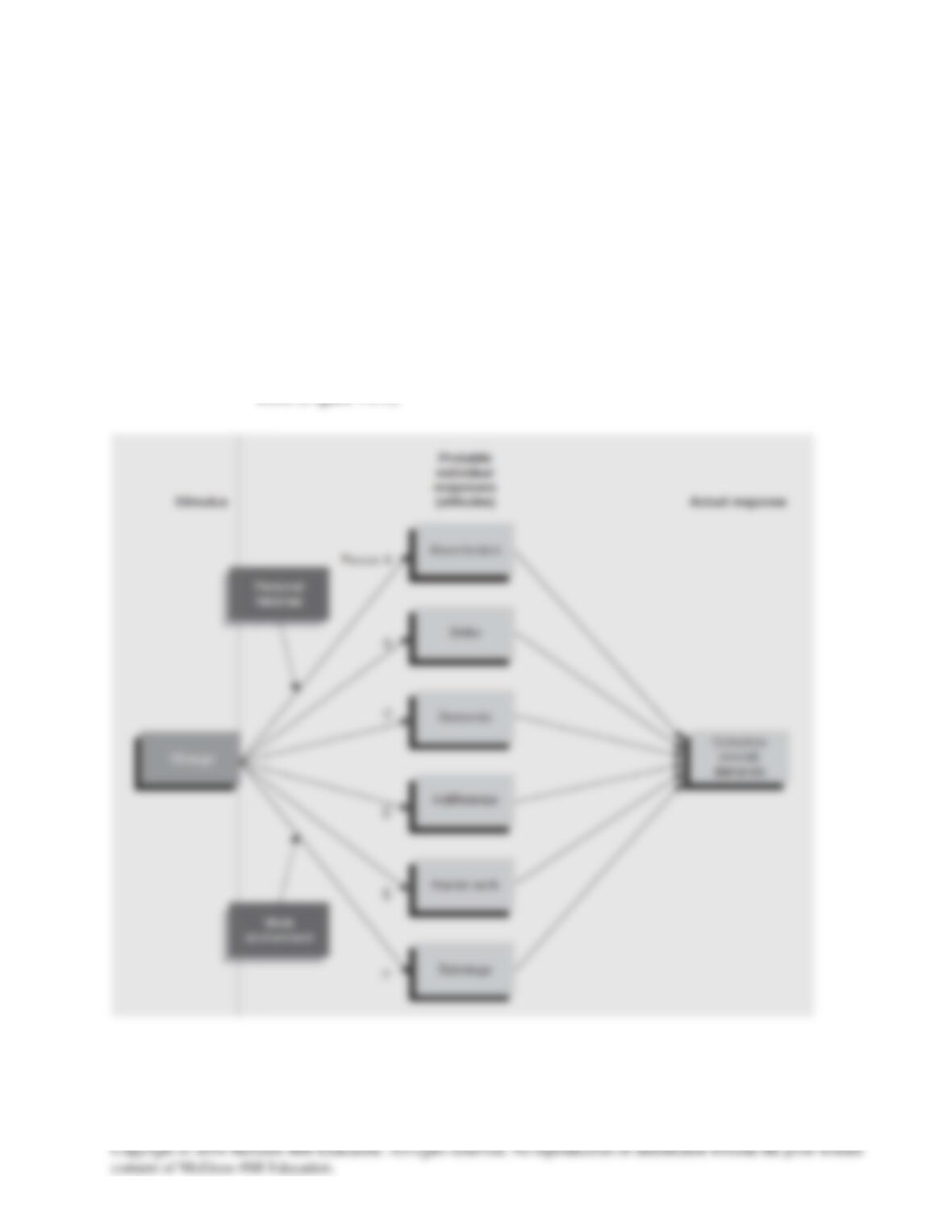
14-4
conditioned by feelings toward the change.
o This relationship was illustrated in a series of classical experiments—the Hawthorne
studies, conducted by F. J. Roethlisberger and his associates.
• How Individual Attitudes Affect Response to Change
o Roethlisberger explained that each change is interpreted by individuals according to
their attitudes.
▪ The way that people feel about a change is one factor that determines how they
will respond to it.
▪ These feelings are not the result of chance; they are caused.
▪ One cause is personal history, which refers to people’s biological processes, their
backgrounds (e.g., family, job, etc.), and all their social experiences away from
work (Figure 14.1).
▪ A second cause is the work environment itself.
o Feelings are not a matter of logic.
▪ They are neither logical nor illogical, but entirely apart from logic.

14-5
▪ They are nonlogical.
▪ For that reason, logic alone is an ineffective means of trying to modify feelings
because it does not get at them directly.
• The Hawthorne Effect
o The Hawthorne effect means that the mere observation of a group—or more precisely,
the perception of being observed and one’s interpretation of its significance—tends to
change the group.
o When people are observed, or believe that someone cares about them, they act
differently.
o These changes usually are unintended and not even recognized by the members
themselves.
• Group Response to Change
o People interpret change individually and have their own probable response to it.
o However, they often show their attachment to the group by joining with other group
members in some uniform response to the change.
o This uniformity makes possible such seemingly illogical actions as walkouts when
obviously only a few people actually want to walk out.
• Homeostasis
o In trying to maintain equilibrium, a group is often inclined to return to its perceived
best way of life whenever any change occurs.
o Each pressure, therefore, elicits a counterpressure within the group.
o The net result is a self-correcting mechanism by which energies are called up to restore
balance whenever change threatens.
o This self-correcting characteristic of organizations is called homeostasis—that is,
people act to establish a steady state of need fulfillment and to protect themselves from
disturbance of that balance.
Costs and Benefits
• All changes are likely to have some costs.
o These costs usually must be paid in order to gain the benefits of proposed changes.
• Because of the costs associated with change, proposals for change are not always desirable.
o They require careful analysis to determine usefulness.
o The organizational goal should always be to produce benefits greater than costs.
• A parallel cost-benefit analysis is appropriate at the individual level, when persons desire to
make an intentional (planned) change, whether it occurs in their behavior, thoughts,
feelings, or perceptions.
• In a determination of benefits and costs, all types must be considered.
o To examine only economic benefits and costs is useless, because even if a net
economic benefit accrues, the social or psychological costs may be too large.
o Although it is not very practical to reduce psychological and social costs to numbers,

14-6
they must nevertheless be included in the decision-making process.
o Almost any change, for example, involves some psychological loss because of the
strain it imposes on people as they try to adjust.
o Psychological costs also are called psychic costs because they affect a person’s inner
self, the psyche.
• Knowledge of individual differences helps predict that people will react in different and
widely varying ways to change.
o Some will perceive only the benefits, while others see only what it costs them.
o Others will react fearfully at first, even though all the effects are actually positive for
them.
o Others will appear initially to embrace the change but then gradually let their real
feelings emerge.
• In some cases, the psychic costs of change can be so severe that they affect the psychological
and even physical health of employees.
o The tolerance level for change within a group of employees can range from relatively
high for one person to relatively low for another.
o Whenever that level is exceeded, stressful responses develop that can undermine health.
o In some instances, there is a sustained series of small or moderate changes over a
period of time, producing cumulative effects that finally overload a person’s system;
some writers refer to this circumstance as repetitive change syndrome.
• Repetitive change syndrome is often caused by a:
o Series of organizational initiatives that are started but not completed
o Blurring of one program and another
o Pandemic of employee cynicism
• Although managers can initiate changes, the resulting stress can also slow the pace of change
and ultimately cause it to fail.
o In other instances, a single major change of high significance overloads a person’s
ability to cope with the situation.
• The supportive, collegial, and system models of organizational behavior imply that
management should:
o Consider each substantial change
o Try to help each person understand it
o Seek to have each person experience a net gain from it
Resistance to Change
• Resistance to change consists of any employee behaviors designed to discredit, delay, or
prevent the implementation of a work change.
• Employees resist change because it threatens their needs for security, social interaction, status,
competence, or self-esteem.
14-7
• Other causes of resistance or passivity include:
o Organizational cultures that overvalue criticism of new ideas
o Employees who mouth support in public but undercut changes behind the scenes
Nature and Effects
• The perceived threat stemming from a change may be real or imagined, intended or
unintended, direct or indirect, large or small.
o Regardless of the nature of the change, some employees will try to protect themselves
from its effects.
o Their actions may range from complaints, foot-dragging, and passive resistance to
passionate arguments, absenteeism, sabotage, and work slowdown.
• All types of employees tend to resist change because of the psychic costs that accompany it.
o Managers as well as workers may resist it.
• Not all changes are resisted; some are actively sought by employees.
o Other changes are so trivial and routine that resistance, if any, is too weak to be
evident.
• A change is likely to be either a success or a problem, depending on how skillfully it is
managed to prevent, minimize, or overcome resistance.
• A chain-reaction effect is a situation in which a change, or other condition, that directly
affects only one person or a few persons may lead to a direct or indirect reaction from many
people, even hundreds or thousands, because of their mutual interest in it.
Reasons for Resistance
• Employees may resist changes for three broad reasons:
o They may feel uncomfortable with the nature of the change itself.
o They may resent the method by which change is introduced.
o A third reason for resistance revolves around personal factors.
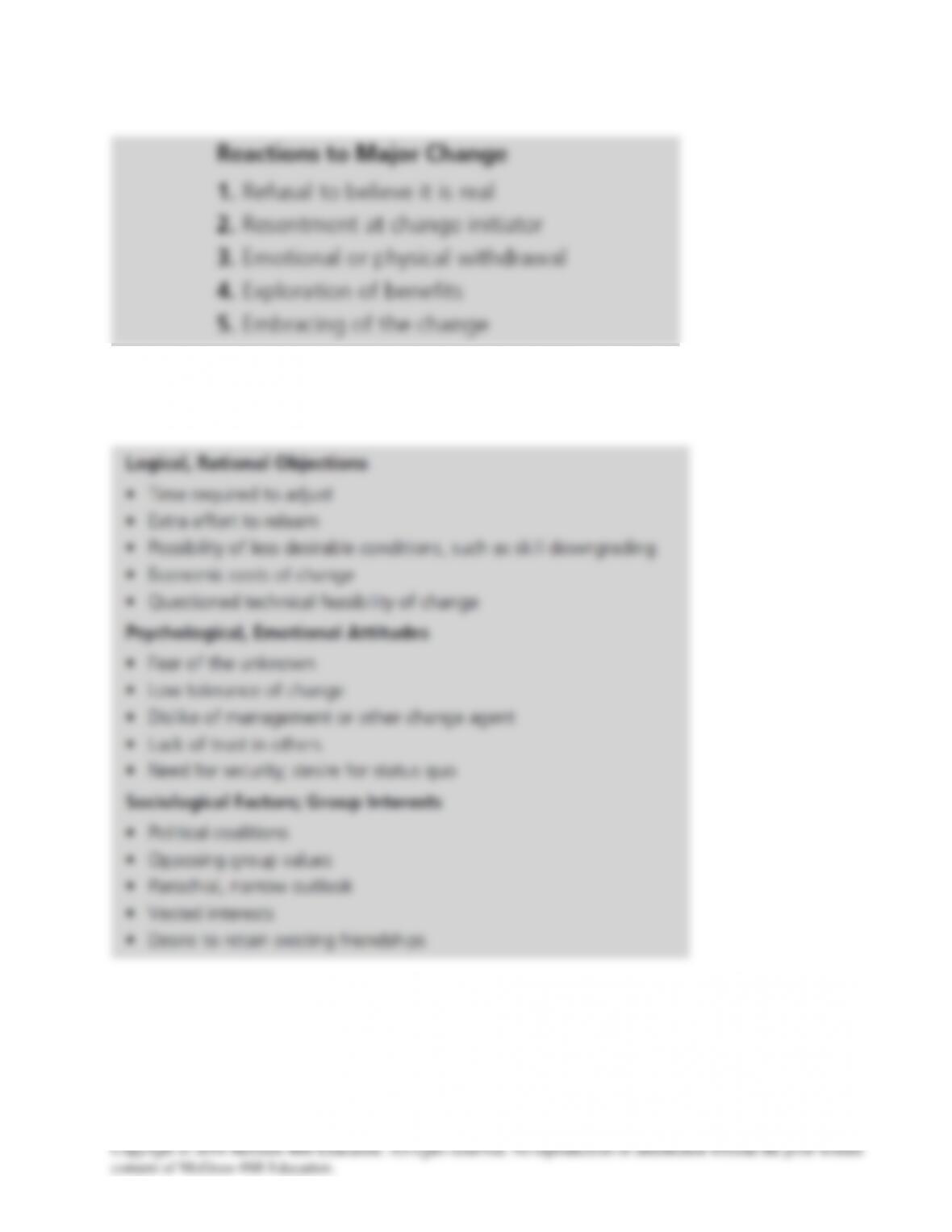
• Elizabeth Kübler-Ross, in her book Death and Dying, concluded that individuals when told
they had an incurable illness and faced death, go through a series of five stages:
o Denial
o Anger
o Depression
o Search for alternative
o Eventual acceptance of the prognosis
• Many change managers also believe that employees go through a comparable experience,
although certainly on a lesser scale, when faced with organizational change (Figure 14.2).
14-8
Copyright © 2014 McGraw-Hill Education. All rights reserved. No reproduction or distribution without the prior written
consent of McGraw-Hill Education.
Types of Resistance
• The three different types of resistance to change are shown in Figure 14.3.
o These types work in combination to produce each employee’s total attitude toward a
change.
• Logical Resistance
o This is based on disagreement with the facts, rational reasoning, logic, and science.
o This arises from the actual time and effort required to adjust to change, including new

14-9
job duties that must be learned.
o These are true costs borne by the employees.
• Psychological Resistance
o This is typically based on emotions, sentiments, and attitudes.
o This is internally logical from the perspective of the employees’ attitudes and feelings
about change.
o Employees may fear the unknown, mistrust management’s leadership, or feel that their
security and self-esteem are threatened.
o Even though management may believe these feelings are not justified, they are very
real to employees, and managers must acknowledge, accept, and deal with them.
• Sociological Resistance
o Sociological resistance also is logical, when it is seen as a product of a challenge to
group interests, norms, or values.
o Since social values are powerful forces in the individual’s work or social environment,
they must be carefully considered.
o There are political coalitions, labor union values, and even different community values.
o On a small-group level, work friendships and status relationships may be disrupted by
changes.
o Managers must try to make changes as favorable as possible if they intend to deal
successfully with sociological resistance.
• Implications of Resistance
o All three types of resistance must be anticipated and treated effectively if employees
are to accept change cooperatively.
o Psychological resistance and sociological resistance are not illogical or irrational; rather
they are logical according to a different set of values.
o The following are four suggestions to address these types of resistance:
▪ Acknowledging (not denying) employee feelings.
▪ Encouraging employees to mourn what they have lost.
▪ Insisting on an outstanding effort to make the change, while accepting short-term
problems.
▪ Breaking overwhelming tasks down into manageable immediate steps.
o In a typical operating situation, full support cannot be gained for every change that is
made.
▪ People are different and will not give identical support to each change.
▪ What managers seek is a climate in which people trust managers, have a positive
feeling toward most changes, and feel secure enough to tolerate other changes.
▪ If management cannot win support, it may need to use authority.
▪ However, if authority is overused, it eventually will become worthless.
Possible Benefits of Resistance
14–10
• Resistance can bring a broad range of benefits, such as the following:
o It may encourage management to reexamine its change proposals, thus making
modifications to the process of change to be sure they are appropriate.
o It also can help identify specific problem areas where a change is likely to cause
difficulties, so that management can take corrective action before serious problems
develop.
• It may encourage management to do a better job of communicating the change, an approach
that in the long run should lead to better acceptance.
Implementing Change Successfully
• Some changes originate within the organization, but many come from the external
environment:
o Government passes laws, and the organization must comply.
• Although stable environments mean less change, dynamic environments are now the norm, and
they require more change.
Transformational Leadership and Change
• Management has a key role in initiating and implementing change successfully.
o Not only do managers sometimes overlook simple but important details, but they may
fail to develop a master strategy for planned change.
• An overall plan should address behavioral issues, such as:
o Employees’ difficulty in letting go of old methods
o The uncertainties inherent in change that cause workers to be fearful
o The general need to create an organization that welcomes change.
• Transformational leaders are instrumental in this process.
o They are managers who initiate bold strategic changes to position the organization for
its future.
o They articulate a vision and promote it vigorously.
o They help employees rise above their narrow focus on their individual jobs or
better prepared for the unknown challenges that lie ahead.
• Creating Vision
o A vision is a crystallized long-range image or idea of what can and should be

14–11
accomplished.
▪ It typically stretches people beyond their current capabilities and thinking, ignites
passion for accomplishment within them, and excites them to new levels of
commitment and enthusiasm.
▪ It may also integrate the shared beliefs and values that serve as a basis for
changing an organization’s culture.
• Communicating Charisma
o Even if employees are intellectually convinced that the vision is desirable, leaders still
have two tasks:
▪ To persuade employees that the vision is urgent
▪ To motivate the employees to achieve it
o Charisma is a leadership characteristic that can help influence employees to take early
and sustained action.
o Charismatic leaders are dynamic risk takers who:
▪ Show their depth of expertise and well-deserved self-confidence
▪ Express high performance expectations
▪ Use provocative symbols and language to inspire others
o Charismatic leaders can also be warm mentors who treat employees individually and
guide them to take action.
▪ In response, employees respect and trust charismatic leaders as they introduce
change.
▪ They are willing to exert extra effort and make personal sacrifices.
▪ They exhibit loyalty.
▪ They tend to be more emotionally committed to the vision of such leaders.
o Charismatic leaders need to recognize the “emotional vulnerability” that employees
experience during change and to allay employees’ fears while stimulating their energy
for change.
o An important tool that charismatic leaders use involves the art of storytelling.
▪ These are engaging and compelling tales that captivate people, tug at their
emotions and heartstrings, and provide useful principles that call followers to
action.
▪ Storytelling can be used for a variety of purposes, including dramatic self-
introduction of a new leader, fostering collaboration across groups, transmitting
essential values, stimulating ethical behavior, or sparking action.
• Stimulating Learning
o Transformational leaders recognize that the legacy they leave behind is not simply the
change itself but an organization that will continue to change.
o The critical task is to develop people’s capacity to learn from the experience of change;
this process is called double-loop learning.
▪ Its name is derived from the fact that the way a change is handled should not only

14–12
reflect current information gathered (the first loop) but also prepare the
participants to manage future changes even more effectively (the second loop).
▪ Double-loop learners develop the ability to anticipate problems, prevent many
situations from arising, and, in particular, challenge their own limiting
assumptions and paradigms
Three Stages in Change
• Behavioral awareness in managing change is aided by viewing change as a three-phase
process, initially proposed by social psychologist Kurt Lewin.
• However, in reality most change is actually an evolutionary process that is continuous and
flowing, with no clear separation between its following phases:
o Unfreezing—means that old ideas and practices are cast aside so that new ones can be
learned.
▪ It is an easy step to overlook while concentrating on the proposed change itself,
but failure to cast aside old attitudes, beliefs, and values, is what often leads to
resistance to change.
o Changing—step in which new ideas, new methods, and new technologies are learned.
▪ Initially, it can be a time of confusion, disorientation, overload, self-doubt, and
even despair.
▪ Fortunately, the changing step usually is also mixed with hope, discovery, and
excitement.
o Refreezing—means that what has been learned is integrated into actual practice.
▪ Merely knowing a new procedure is not enough to ensure its use.
▪ Successful and repeated on-the-job practice must be the ultimate goal of the
refreezing step.
Manipulating the Forces
• Kurt Lewin, suggested that any organization (as a social system) is a dynamic balance of
forces supporting and restraining any existing practice—an equilibrium exists (Figure 14.4).
• Change is introduced by a variety of methods, as follows:
o Adding new supporting forces
o Making recipients more aware of support services
o Removing restraining forces
o Increasing the actual strength of a supporting force
o Helping recipients perceive that the organization is willing to use its reward or coercive
power to induce change
o Being more persistent in the use of supporting forces until the change is completed
o Decreasing the strength of a restraining force
o Converting restraining force into a supporting force
• At least one of these approaches must be used to change the equilibrium, with greater success

14–13
likely when more than one is adopted.
o The idea is to help change be accepted and integrated into new practices.
Building Support for Change
• If management follows the model of change process in Figure 14.4, then forces of support
need to be built, introduced, strengthened and sustained before, during and after a change.
o Manipulation and coercion typically antagonize employees and sabotage the long-term
success of the change program; they should be avoided if at all possible.
• Use of Group Forces
o Effective change focuses not only on the individuals but also on the group itself.
o The group is an instrument for bringing strong pressure on its members to change.
o The power of a group to stimulate change in its members depends partly on the strength
of their attachment to it.
▪ The more attractive the group is to each member, the greater its influence on a
group member can be.
▪ Influence is further increased if members with high status in the group support a
change.
• Providing a Rationale for Change
o Capable leadership reinforces a climate of psychological support for change.
o The effective leader presents change on the basis of the impersonal requirements of the
situation—objective (performance-related) reasons for the change—rather than on
personal grounds.
o Change is more likely to be successful if the leaders introducing it become champions
for it—persons who voice their own strong confidence and high expectations of
success.
▪ Managerial and employee expectations of change may be as important as the
technology of change.
▪ Creating positive expectations of change is a demonstration of the powerful self-
fulfilling prophecy.
o Expectations alone are not powerful enough to induce or discourage significant change.
▪ The process really works when expectations tend to get translated into specific
managerial behaviors that increase or decrease the likelihood of change.
▪ By believing that change will work, the manager acts to fulfill that belief.
▪ This belief is transferred to employees, who buy into the probability of success
and change their behaviors accordingly.
• Participation
o Participation encourages employees to discuss, to communicate, to make suggestions
and to become interested in change.
o It encourages commitment and engagement rather than mere compliance with change.
o As participation increases, resistance to change tends to decrease.