
13–12
strategic directions, or the reward system.
o When there is confusion about work relationships between people and tasks, job
functions may need definition, authority relationships might be revisited, and patterns
of work flows might require clarification.
o When interpersonal conflict seem to dominate the workplace, issues of respect and
trust might be explored, listening skills might be reviewed, or various models for
understanding interpersonal styles might be introduced.
• In effect, the best team-building approach is one that is carefully built upon a database
uncovered during the second stage and then tailored to fit the specific team and team
problem.
Skills Useful in Team-Building
• The facilitators who assist the development of effective teams need to apply a broad range of
skills, including:
o Consultation skills—diagnosing issues, negotiating between conflicting parties,
designing programs for change
o Interpersonal skills—trust building, coaching, and listening
o Research skills—planning and conducting a study and evaluating results
o Presentational skills—public speaking and report preparation
• Two additional and closely related skills stand out as critical to success—process
consultation and feedback.
• Process Consultation
o Process consultation is a set of activities that help others focus on what is currently
happening around them.
o The intent of process consultation is straightforward: to help team members perceive,
understand, and react constructively to current behavioral events.
o Process consultants or team facilitators encourage employees to examine:
▪ The explicit and implicit communication patterns
o Process consultants are helpers, drawing upon several key facilitating behaviors.
▪ They observe team meetings, recording conversational patterns and nonverbal
behaviors.
▪ They ask probing questions designed to help others identify problems or examine
their own values and beliefs.
▪ If necessary, they confront individuals by asking them to examine their behavior
and its consequences or to explore new alternatives.
▪ They observe a group unobtrusively to gain both information and insight about its
inner workings.
13–13
• Feedback
o Team members need feedback so they have useful data on which to base decisions.
o Feedback encourages them to understand how they are seen by others within their team
and to take self-correcting action.
o Any team can use process consultation and feedback for self-development, and many
teams can benefit from doing so.
o The need for continuous improvement is a cornerstone of total quality management
programs, and a focus on teams is a critical structural element of many organizations as
they operate in the twenty-first century.
Characteristics of Mature Teams
• When teams regularly find themselves achieving and even surpassing their goals, they have
attained the fourth stage of the team development model.
• Many teams have become highly effective, although it seldom happens overnight.
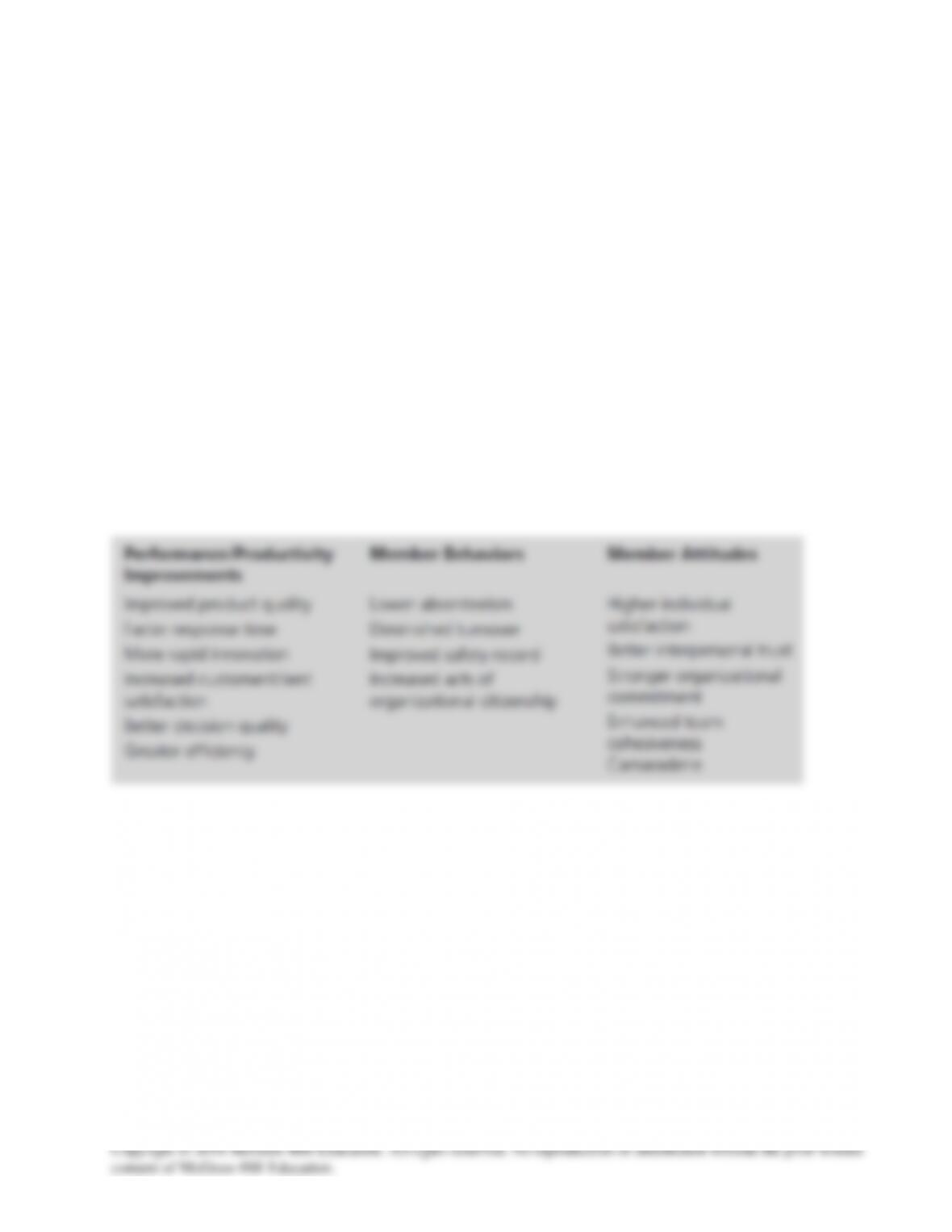
• Successful teams typically exhibit several attitudinal and behavioral characteristics that
organizations value (Figure 13.6), as well as achieve desirable organizational outcomes.
Individual Territories vs. Team Spaces
• The use of teams at work has increased at an astounding pace.
o As a consequence, one interesting office design issue that arose was the use of physical
space for employees.
o Specifically, managers needed to decide whether to provide enclosed work cubicles for
each employee or to create a more open, landscaped work area with lower, or no,
partitions between work spaces.
o A basic issue revolved around the desire of some employees for privacy and personal
space while they worked.
o Many workers felt a need to establish their own employee territories—spaces they
could call their own, within which they could control what happens.
o Cubicles provide an opportunity for them to have their own territory, design and
13–14
modify their work layout, and even decorate to their own satisfaction.
• Alternatively, a team-based organization may want a layout that encourages easy interaction,
an exchange of ideas among employees engaged in related tasks, and a stronger feeling of
team identity.
o Some firms have accomplished this goal by creating offices designed as activity
settings, which include both home-base areas for privacy and bullpen areas for group
interaction.
o Other organizations have created neighborhoods of offices, which are centers of
related individual offices to encourage the formation of social groups.
Self-Managing Teams
• Self-managing teams are also known as self-reliant or self-directed teams.
o They are natural work groups that are given substantial autonomy and in return are
asked to control their own behavior and produce significant results.
o The combination of empowerment and training to plan, direct, monitor, and control
their own activities distinguishes these teams from many others.
• Team members learn a wide range of relevant skills; this practice is called multi-skilling.
o Considerable time is spent in team meetings as members progressively take over many
tasks that were formerly their manager’s.
• As self-managing teams gain additional experience, these teams may even move beyond
operational topics to refine their organization’s mission statement, carve out a new
compensation system, or provide input into expansion plans:
• Organizations using self-managing teams report several advantages:
o Improved flexibility of staff
o More efficient operations through the reduced number of job classifications
o Lower absenteeism and turnover rates
o Higher levels of organizational commitment and job satisfaction
• Disadvantages of this approach include:
o The extended time to implement them
o The high training investment as members learn new skills
o Early inefficiencies due to job rotation
o The inability (or unwillingness) of some employees to adapt to a team structure
• Self-managing teams have increased in organizational use for several reasons.
o As a formal practice they are not likely to lose organizational support.
o They often directly involve 100 percent of the workforce.
o They wield substantial authority in many cases.
13–15
o They are ongoing structures (not devoted to a single issue).
• Firms have found that it may take several years for the teams to achieve their full potential.
o Cultural values emphasizing individualism can get in the way.
o Rigid job classifications protected by labor contracts can be impediments.
o Managers can feel threatened by the loss of control and personal job security.
• Members of self-managing high-performance teams usually exhibit most of the following
characteristics:
o Listening intently to discover the ideas and opinions of others
o Exploring ideas from outside the group, and integrating alternative points of view and
different facts
o Acting as “charismatic connectors” who circulate widely and democratically give all
team members the chance to contribute
• Managers of self-managing teams are encouraged to use the principle of intentionality.
o They need to use their analytical ability to sort out which roles are needed at the
moment, have the flexibility to shift from role to role at a moment’s notice, be willing
to attempt playing even the “uncomfortable” ones, and prepare the team to expect and
be receptive to multiple roles.
• Successful self-managing teams often require that their leaders (whether internal or external
to them) play boundary-spanning roles.
o These are the abilities to interact with a variety of other groups in order to help the team
succeed.
• Boundary spanners keep communication channels open and active by constantly sharing
information with other units in the organization and with people at other levels.
• Boundary spanners often have little or no authority, and so their task is best accomplished
through skills such as:
o Social awareness
o Relating to others
o Genuine caring for team members
o Investigating problems
o Obtaining external support
o Influencing the team
o Persuading
Virtual Teams
• Information technology has had a powerful effect on individual behavior in organizations,
and its effect is equally strong on social networks at the team level.
13–16
• Technology has allowed the emergence of virtual teams—groups of individuals from around
the globe that meet through the use of technological aids without all of their members being
present in the same location.
o These teams can be either dramatic successes or dismal failures.
o They often go through a development process parallel to that of other teams.
• The explosion in the use of virtual teams came about due to several compelling reasons.
o For example, the global marketplace has created a demand for placing employees near
their customers.
o Also, the most highly qualified team members may be located thousands of miles from
each other, and the costs and time constraints of travel to a central location would be
prohibitive.
• Unique problems can arise, too.
o There can also be the belief that virtual team projects are not as visible or important as
local ones.
• To overcome the inherent problems of individualistic behavior, feelings of isolation, lack of
trust, and the extra coordination needed in virtual teams, managers can use one or more
approaches to substitute for daily face-to-face interaction with their employees.
o These devices include:
▪ Clarified goals and definition of major issues
▪ Conduct of a few short face-to-face meetings at the initiation of a project to
humanize fellow team members
▪ Temporary on-location projects among virtual team members
▪ Explicit definition of role expectations
▪ Identification of potential problems likely to arise
▪ Frequent use of email and video-conferencing to encourage information exchange
and collaboration
Answers to Discussion Questions
1. Discuss how to build a unified team within a whole organization.
Students’ answers may vary. Just calling a group a team does not change its basic character or
13–17
superordinate goals, and institute team rewards.
2. Explain how matrix organization gives rise to the need for teams.
Students’ answers may vary. The effect of matrix structure is to separate activities into projects
3. How do temporary groups and committees (discussed in Chapter 12) compare with
teams? What are their similarities and differences?
Students’ answers may vary. Groups, committees, and teams are similar in that they are groups
of people tasked with accomplishing one or more objectives. The differences between a team
and other types of groups include:
• The frequency of team members’ interaction
4. Review the typical stages in a team’s life cycle. Think of a time when you were a member
of a work team. Were all those stages represented? Did they appear in a different order?
Did some of them emerge more than once? Explain.
5. Assume you are to be placed in charge of a student group in this class. Outline the key
action steps you will take to make sure that the group develops into a real team.
13–18
Copyright © 2014 McGraw-Hill Education. All rights reserved. No reproduction or distribution without the prior written
consent of McGraw-Hill Education.
• Data feedback and confrontation
• Problem-solving experience
• On-the-job application and follow-up
Students should also realize that the group has to evolve through its normal life cycle stages
(Figure 13.2).
6. Think of a time when you observed, or exhibited, social loafing. What contributed to it?
How could it have been prevented or minimized?
Students’ answers may vary. If students are being honest, they will probably admit that they
7. Think about self-managing teams. Would you like to work in one? Why or why not?
8. The authors assert that “it may take several years for [self-managing] teams to achieve
their full potential.” Why might this be so? How could the process be shortened?
Students’ answers may vary. There are various reasons for this. For example, cultural values
9. In what ways do you think the boundary-spanning roles of a traditional manager might
differ from those of team members in self-managing teams? Explain.
Students’ answers may vary. In a traditional situation, the manager of a group is seen as an
13–19
Copyright © 2014 McGraw-Hill Education. All rights reserved. No reproduction or distribution without the prior written
consent of McGraw-Hill Education.
In a self-managed team situation, team members have more authority to resolve situations
themselves. Therefore, there is likely to be more subordinate-to-subordinate interaction
between teams. And because these boundary spanners have little or no official authority, they
must rely on social skills to influence and persuade others.
10. What are the key advantages to using virtual teams? Disadvantages? On balance, are
they worth using?
Students’ answers may vary. There are many advantages to using virtual teams. For instance,
On the other hand, managing a virtual team requires a great deal of manager involvement to
ensure that work is being done on time and in a satisfactory manner. He or she must work
harder to develop and maintain team identity as well. And because a great deal of
communication happens electronically, more attention must be paid to developing the reading
and writing skills of team members.
Assess Your Own Skills
13–20
Copyright © 2014 McGraw-Hill Education. All rights reserved. No reproduction or distribution without the prior written
consent of McGraw-Hill Education.
Students should honestly circle the number on the response scale that most closely reflects the
degree to which each statement accurately describes them when they have tried to participate in, or
lead, a team. This section will help them understand how well they exhibit good team management
skills.
Incident
Conflict in the Division
There are clearly conflicting views of the divisional mission and a significant amount of
interpersonal and intergroup hostility. As a consultant one would recommend that the division
become involved in a complete team buildup that could take two years or more. The steps explained
in the chapter can be used for this purpose.
• Identification of the problem—the consultant gets the commitment of top organizational
management and the general manager of the division to fully support the team building
process. At the same time, the consultant interviews a cross-section of divisional employees to
gain an in-depth perspective of the problem.
• Collection of relevant data—an organizational climate survey instrument is administered to all
divisional personnel to determine the overall climate and major areas of problems and
employee dissatisfaction.
• On-the-job application and follow-up—during the entire team-building program the consultant
works with each department to develop a spirit of teamwork and dedication to departmental
and divisional goals. Encounter groups, properly conducted, might be considered here. The
consultant reviews the progress of the OD program with a standing representational divisional
task force and develops additional programs as needed.
Experiential Exercises
Readiness for Self-Managing Teams
The students have been asked to assume that they are the new owner of a fast-food restaurant
employing approximately 75 employees across two shifts. Most of the employees are relatively
young and inexperienced, but willing to learn. The students are trying to decide to what degree to
13–21
involve the employees in various decisions, in addition to the employees’ specific job assignments.
In the first column of the list indicated in the text, students are asked to check those roles and
responsibilities for which they are inclined to allow the employees to take control. Afterward, each
student has to discuss the issue with three or four other students. They are then asked to combine
their perspectives and indicate the group’s response in the second column of the list given in the text.
Finally, they have to review the pattern of items selected, and determine the apparent rationale used
by the group for its choices.
Team Building
Generating OB Insights
Students’ responses will vary for this exercise. They should however, highlight several of the major
topics discussed in the chapter such as the organizational context for teams, the nature of teams, the
life cycle of teams, teamwork and the characteristics of mature teams, process consultation and
team-building skills, etc.