
13-1
Chapter 13
Teams and Team Building
Chapter Overview
This chapter discusses the issues related to teams and team building. The first part of the chapter
addresses the organizational context for teams. It presents various organizational designs and their
effects. The next section explores teamwork. It discusses the life cycle of a team, ingredients of
effective teams and potential team problems. The final section of the chapter deals with team
building.
Chapter Learning Objectives
After reading this chapter, students should understand:
1. Organizational context for teams
2. The nature of teams
3. Life cycle of a team
4. Teamwork and the characteristics of mature teams
5. Process consultation and team-building skills
6. Self-managing teams
Discussion and Project Ideas
Teamwork and team building do not replace traditional methods in organizational behavior, but they
are important instruments for developing the human organization. Some exercises which help to
demonstrate the points emphasized in this chapter follow.
• Throughout the semester or quarter, various work groups have been formed as a result of tasks
that have been assigned. Ask these groups to go through a “team building” process by applying
the steps in the book as follows:
o Steps 1 and 2: Identification of a problem and data collection—one member of the group
interviews the other members (privately) and asks the following questions:
▪ What do you see as the major strengths of our group?
▪ What do you see as the major weaknesses of our group?
▪ If you could change two things concerning the operation of our group, what would
you change?
o Step 3: Data feedback and confrontation—the interviewer passes back to the group a
written summary of the interview responses. The group agrees among itself on major
13-2
issues.
o Step 4: Problem-solving experiences—the group takes each problem, one at a time, and
develops a concrete plan of action with responsibilities for carrying out actions and
follow-up assigned to specific persons.
o Step 5: The group meets at some later date to evaluate progress.
Steps 1 and 2 may be assigned as homework. The other meeting may take place in class or
could also be assigned as outside work. When the task is completed, discuss the differences
and similarities between this mini-process and comprehensive team building efforts.
• Using intact work groups from previous class projects, ask the members of all groups to
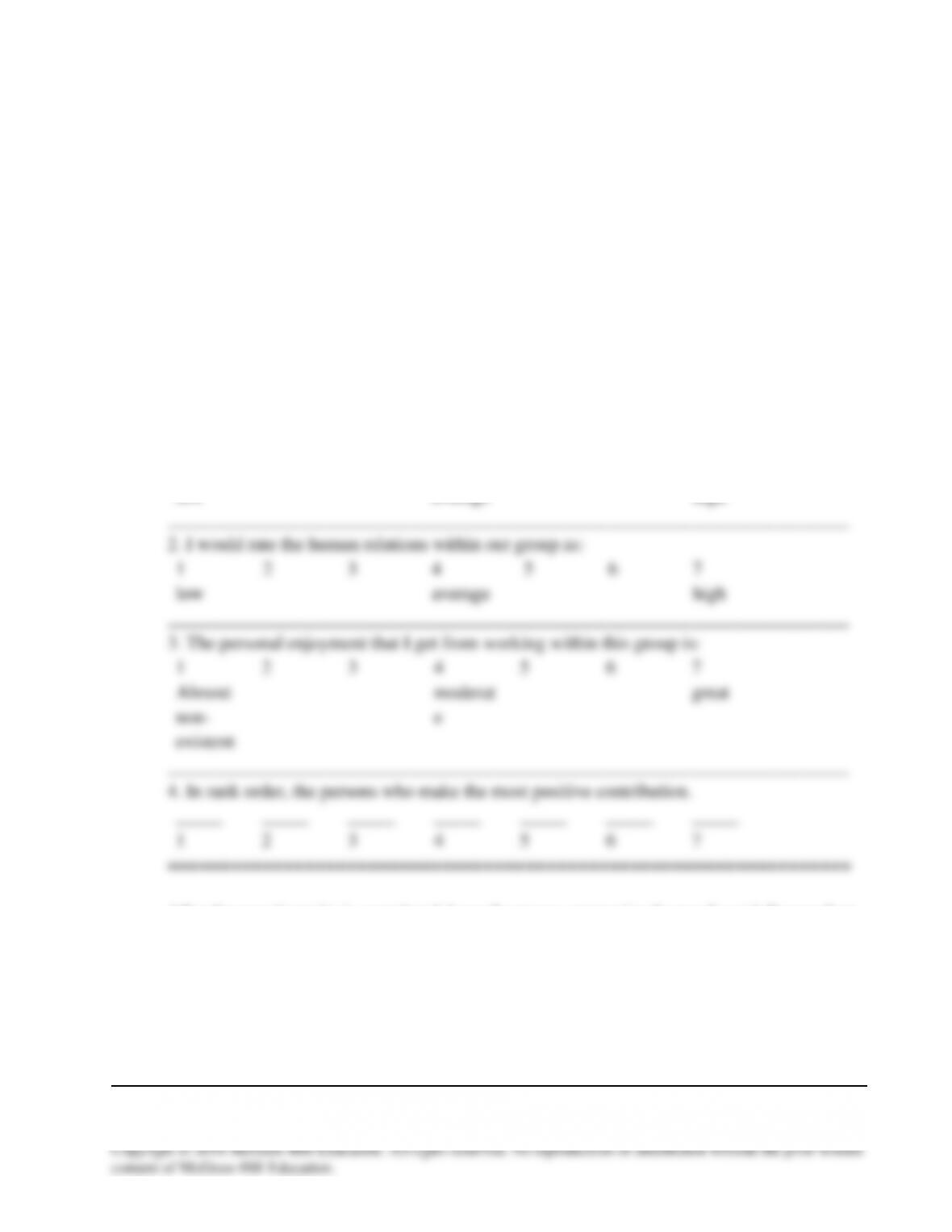
answer the following questionnaire:
=================================================================
1. In general, the performance of our group is:
1
2
3
4
5
6
7
low
average
high
low
average
high
_____
_____
_____
_____
_____
_____
_____
1
2
3
4
5
6
7

13-3
• Organizations are the grand strategies created to bring order out of chaos when people work
together.
o They provide the skeletal structure that helps create predictable relationships among
people, technology, jobs, and resources.
o Whenever people join in a common effort, organization must be used to get productive
results.
Organizational Context for Teams
Classical Concepts
• Efficiency and integration of efforts are achieved through division of work—creating levels
of authority, and functional units—and delegation—assigning duties, authority, and
responsibility to others.
o The result is an operating hierarchy consisting of multiple levels of authority.
• Classic organizational structures are essentially mechanistic in their attempts to get people to
act as efficiently and predictably as machines.
o People are specialized into many activities that are directed by layers of supervision.
o Each higher level has more power and influence until the top is reached, where central
direction of the whole organization takes place.
o Work is carefully scheduled, tasks are specified, roles are defined strictly, and most
formal communication flows along the lines of hierarchy.
• Classical structure provides much task support through such things as specialized assistance,
appropriate resources, security, and fairly dependable work conditions.
o On the other hand, although classical structure is strong in task support, it is weak in
psychological support.
o What is needed is an organizational system that provides both task support and
psychological support.
• New viewpoints have led to a decline in the use of structure and authority in modern
organizations:
o Many organizations have reduced the number of levels in their hierarchy through
downsizing and the elimination of some middle-management positions.
o Others have attempted to eliminate the rigid barriers between functional units (known
as “silos”) by focusing on the creation of “boundaryless” organizations without
artificial internal walls.
o The modern approach is to be more flexible with organizational systems, changing
them rapidly according to the needs of their environment.
o Horizontal relations between chains of command are more important for effectiveness
than was formerly realized.
▪ The pace and complexity of work today make horizontal communication and
flexible structures more necessary.
13-4
• Modern organizations are more flexible, organic, and open.
o Tasks and roles are less rigidly defined, allowing people to adjust them to situational
requirements.
o Communication is more multidirectional.
o Communication consists more of information and advice and joint problem solving
rather than instructions and decisions.
o Authority and influence flow more directly from the person who has the ability to
handle the problem at hand.
• Organic forms work better if the environment is dynamic, requiring frequent changes within
the organization.
o They also work better when the tasks are not defined well enough to become routine.
o Because many younger employees desire autonomy, openness, variety, change, and
opportunities to try new approaches, an organic form is often a better match for them.
• Teams are more likely to be used within an organic form of organization, because they
provide the flexibility that modern organizations require.
Matrix Organization
• One development to meet changing organizational needs is matrix organization.
o It is an overlay of one type of organization on another so that two chains of command
are directing individual employees.
o It is used especially for large specialized projects that temporarily require large
numbers of technical people with different skills to work in project teams.
• The effect of matrix structure is to separate some of the organization’s activities into projects
that then compete for allocations of people and resources.
o Employee are assigned to a project team for its limited life or as long as their specialty
is needed on the project.
• In spite of its complexity, matrix organization is used for a number of reasons.
o Its teams focus on a single project, permitting better planning and control to meet
budgets and deadlines.
o Especially on repetitive projects, the members gain valuable experience and the team
develops a strong identity.
o Since the structure is more open and flexible (organic) than a traditional hierarchy, it
can better handle the changes that occur in complex projects.
o Its distribution of authority and status also is better aligned with employee desires for
increased autonomy.
• The matrix organizational process, when applied on a large scale across internal
organizational boundaries, creates cross-functional teams.
13-5
o These are teams that draw their members from more than one specialty area and often
several.
Teamwork
• Individual employees perform operating tasks, but the vast majority of them work in regular
small groups where their efforts must fit together like the pieces of a picture puzzle.
o Where their work is interdependent, they act as a task team and seek to develop a
cooperative state called teamwork.
• A task team is a cooperative small group in regular contact that is engaged in coordinated
action.
o The frequency of team members’ interaction and the team’s ongoing existence make a
task team clearly different from either a short-term decision-making group (committee)
or a project team in a matrix structure.
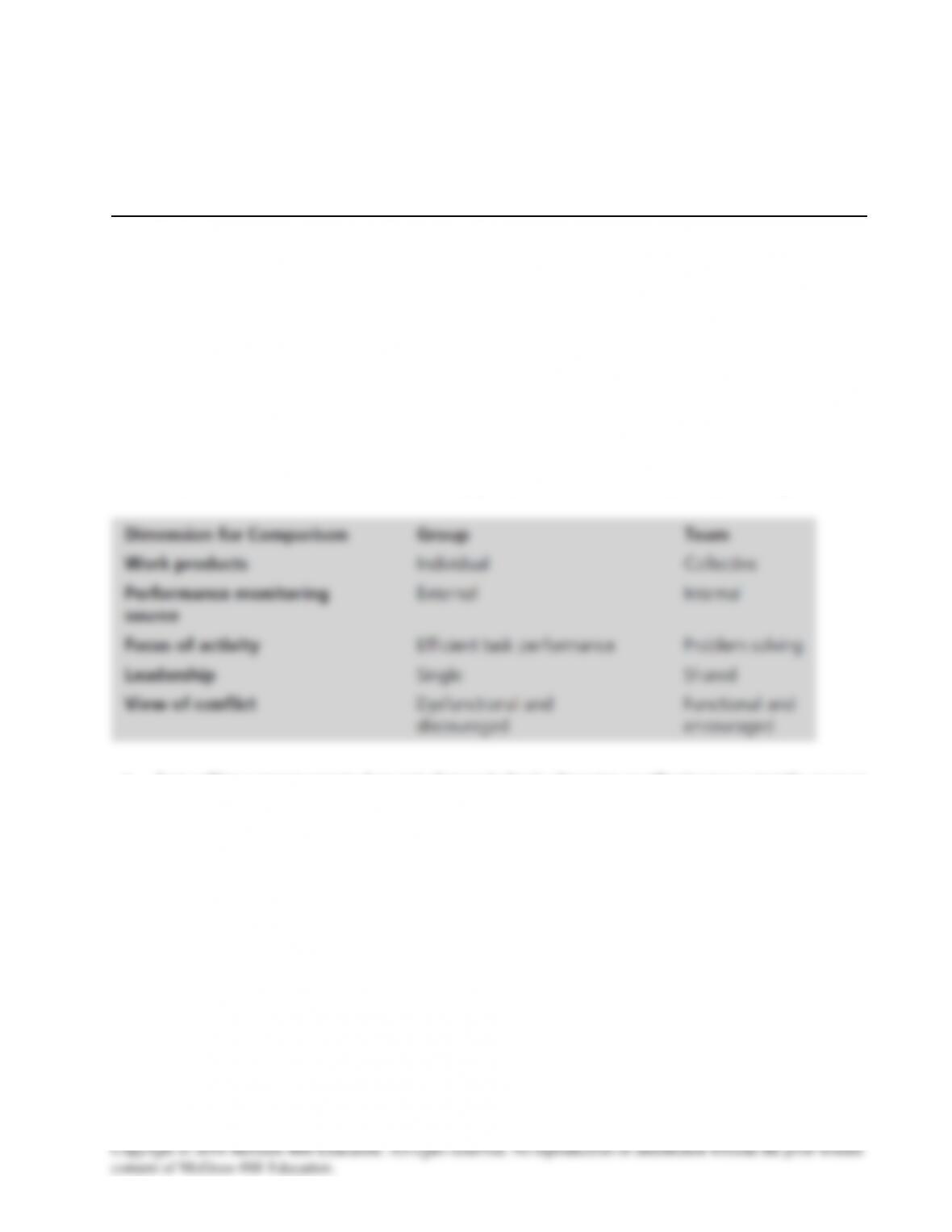
• Ways in which teams differ from ordinary groups or committees are portrayed in Figure 13.1.
• Just calling a group a team does not change its basic character or effectiveness; months or even
years may be needed for a team to achieve high-performance status.
• When the members of a task team know their objectives, contribute responsibly and
enthusiastically to the task, and support one another, they are exhibiting teamwork.
Life Cycle of a Team
• When a number of individuals begin to work at interdependent jobs or on a special project,
they often pass through several stages as they learn to work together as a team (Figure 13.2).
o These stages of team development are not rigidly followed but they do represent a
broad pattern that may be observed and predicted in many settings across the team’s
time together.
• The typical stages in a team’s evolution can be described as follows:
o Forming—members share and exchange basic personal information, start to get to
know and accept one another, ask questions about their assignment and objectives, and

13-6
begin turning their attention toward the group’s tasks.
▪ An aura of courtesy prevails, uncertainty is in the air, and interactions are often
cautious.
o Storming—members compete for status, jockey for positions of relative control, and
argue about appropriate directions for the group.
▪ External pressures interfere with the group, and tensions rise between individuals
as they assert themselves and disagree about initial actions.
o Norming—the group begins moving together in a cooperative fashion, and a tentative
balance among competing forces is struck.
▪ Group norms emerge to guide individual behavior, role clarity emerges,
cooperative feelings are increasingly evident, and a sense of cohesion becomes
apparent.
o Performing—the group matures and learns to handle complex challenges.
▪ Functional roles are performed and fluidly exchanged as needed, and tasks are
efficiently accomplished.
o Adjourning—even the most successful groups, committees, and project teams disband
sooner or later.
▪ Their breakup is called adjournment, which requires dissolving intense social
relations and returning to permanent assignments or moving on to other jobs.
▪ The adjournment stage is becoming more frequent with the advent of flexible
organizations, which feature temporary groups.
• Advising new teams of these likely stages can helpful to group members and their leaders.
o Awareness by all team members can help them better understand what is happening
and work through the issues involved.
o Groups are always different; consequently, not all groups will clearly experience all the
stages of the life cycle.
o Some groups may be temporarily stuck in a certain stage, and others may find
themselves reverting to an earlier stage from time to time.
Potential Team Problems
• Effective teams in action have members who are committed to the organization’s success;
share common values regarding product quality, safety, and customer satisfaction; and share
the responsibility for completing a project on schedule.
• However many different problems can arise within groups.
o One study examined the experiences of 245 team developers.
▪ The respondents reported experiencing problems with goal clarity,
communications, role issues, problem solving and decision making, conflict
management, and numerous other issues.
• Two particularly troublesome team problems involve changing team membership and social
loafing.

13-7
• Changing Composition
o Teamwork grows slowly, but on occasion it declines quickly.
o Rarely does a team’s composition remain constant from the beginning to the end of its
task life.
o Most teams must learn to manage their internal turnover. They do this by engaging in
three important types of action:
▪ They anticipate and accept that turnover within the team will happen and come to
grips with that likelihood.
▪ They develop a plan for managing team turnover right from the start.
▪ They think through how best to integrate new members.
• Social Loafing
o Experimentation with team activities may lead to charges of partiality from other
employees.
o The combination of individual efforts may not result in improved overall performance.
o When some employees think their contributions to a group cannot be measured they
may lessen their output and engage in social loafing (the free-rider effect).
o Causes of social loafing include a:
▪ Perception of unfair division of labor
▪ Low achievement motivation
▪ Belief that co-workers are lazy
▪ Perception of a meaningless or largely ‘invisible’ task
▪ Feeling of being able to hide in a crowd and not be singled out for blame
▪ Member believes others intend to withhold their efforts and thus he or she would
be foolish not to do the same—the sucker effect.
o The impact of social loafing extends beyond simply the heavier workload on
responsible team members.
▪ Colleagues may experience anger toward the low performer, feel moments of
empathy, or complain to their peers or to their supervisor.
▪ Co-workers may express expectations for improvement to the loafer, attempt to
train the individual, or offer pep talks.
o Since an improperly managed team can result in numerous problems, an effective
manager needs to apply a contingency framework to determine whether to use a team
approach.
• Lack of Trust
o Five major impediment to the creation of cohesive teams have been identified by one
consultant:
▪ Inattentiveness to team results
▪ Failure to hold individuals accountable to their goals
▪ A lack of commitment to group effort
▪ Reluctance to engage in debate and conflict
13-8
▪ Absence of trust
• Other Problems
o Numerous mannerisms, personality quirks, and behaviors may be exhibited in team
settings that often detract from performance and cohesiveness.
o Distractions may include splitting hairs, non-stop talking, side conversations, put-
downs, uncontrolled anger, interrupting, and doodling during discussions.
Ingredients of Effective Teams
• Many studies have been conducted in an attempt to isolate the factors that contribute most
directly to team success. Common items identified include:
o Careful composition
o Stimulation of openness to learning
• Supportive Environment
o Teamwork is most likely to develop when management builds a supportive
environment for it. Creating such an environment involves:
▪ Encouraging members to think like a team
▪ Developing member tolerance for ambiguity and uncertainty
▪ Providing adequate time for meetings
▪ Setting up physical spaces conducive to creative interaction (sometimes called
“playgrounds”)
▪ Demonstrating faith in members’ capacity to achieve
• Skills and Role Clarity
o Team members must be reasonably qualified to perform their jobs, as well as have the
desire to cooperate.
o Beyond these requirements, members can work together as a team only after all the
members of the group know the roles of all others with whom they will be interacting.
o When this understanding exists, members can act immediately as a team on the basis of
the requirements of that situation, without waiting for someone to give an order.
• Superordinate Goals
o A major responsibility of managers is to try to keep the team members oriented toward
their overall task.
▪ Sometimes, unfortunately, an organization’s policies, record-keeping
requirements, and reward systems may fragment individual efforts and
discourage teamwork.
o Supervisors might consider the creation of a superordinate goal, which is a higher

13-9
goal that integrates the efforts of two or more persons.
▪ Superordinate goals can be attained only if all parties carry their weight.
▪ Such goals serve to focus attention, unify efforts, and stimulate more
cohesiveness within teams.
o Superordinate goals are an example of a shared mental model in teamwork.
▪ It is important that teams have a common understanding of the nature of their
task as well as what it will take to accomplish that task.
▪ This requires a strong ethic of collaboration, empathy, solidarity, and candid
communication, as well as an explicit or implicit “helping” norm among the
members.
• Trust
o The presence of trust is essential to most effective teams, and it begins with a group’s
manager demonstrating honesty, integrity, openness and willingness to let team
members exert their influence.
o Trust can be built by giving frequent praise, keeping promises, showing concern,
respecting others, behaving dependably, and sharing information on a timely basis.
• Team Rewards
o Another element that can stimulate teamwork is the presence of team rewards.
o These may be financial, or they may be in the form of recognition.
o Rewards are most powerful if they are:
▪ Valued by the team members
▪ Perceived as possible to earn
▪ Administered contingent on the group’s task performance
o Innovative (non-financial) rewards for responsible behavior may include the authority
to select new group members of the group, make recommendations regarding a new
supervisor, or propose discipline for team members.
• Empowerment
o Member motivation plays a powerful role in team success.
o Team members will likely feel more motivated and empowered when they:
▪ Share a sense of potency (have a can-do attitude)
▪ Experience meaningfulness (have a commitment to a worthwhile purpose)
▪ Are given autonomy (have freedom and discretion to control resources and make
decisions)
▪ See their impact on results (can assess, monitor, and celebrate their contributions
and results)
o The interactive combination of these four forces can produce dynamic teams capable of
being productive and proactive as well as providing outstanding customer service.
• Positive Norms
o Teams are strongest when they consciously examine their own behaviors and agree on
their own internal requirements for their actions.

13–10
o Highly effective teams also examine their own processes, and agree to faithfully attend
meetings, share responsibility for mutual outcomes, think before speaking and focus on
issues and problems instead of personalities.
o A powerful norm is to allow and encourage dissent, whereby team members find it
acceptable to “agree to disagree”.
▪ Dissent can stimulate a more intense discussion, and this can be formalized
through the use of a rotated assignment as devil’s advocate.
Team Building
• Team building encourages team members to examine how they work together, identify their
weaknesses, and develop more effective ways of cooperating.
o The goal is to make the team more effective.
• Team coaching is vital to team success—especially for new teams.
o It involves a leader’s intentional effort and interaction with a team to help its members
make appropriate use of their collective resources.
• Research has shown that coaching is most effective when it is:
o Task-focused
o Timely
o Recognized as necessary by the team
o Oriented toward one of the three unique issues—motivation of members, performance
method improvements, or knowledge/skill deficiencies.
The Need for Team Building
• Not every team needs to engage in team building, nor does even a poor team need to devote
constant attention to it.
o However, many teams could benefit from at least occasionally re-examining how they
operate.
• A varieties of clues can be detected that provide evidence when it is more appropriate to
devote attention to the team-building process. These signals include:
o Interpersonal conflicts among team members, or between the team and its leader
o Low degree of team morale or low team cohesiveness
o Confusion or disagreement about roles within the team
o Large influx of new members
o Disagreement over the team’s purpose and tasks
o Negative climate within the team, evidenced by criticism and bickering
o Stagnation within the team, with members resisting change and new ideas
The Process
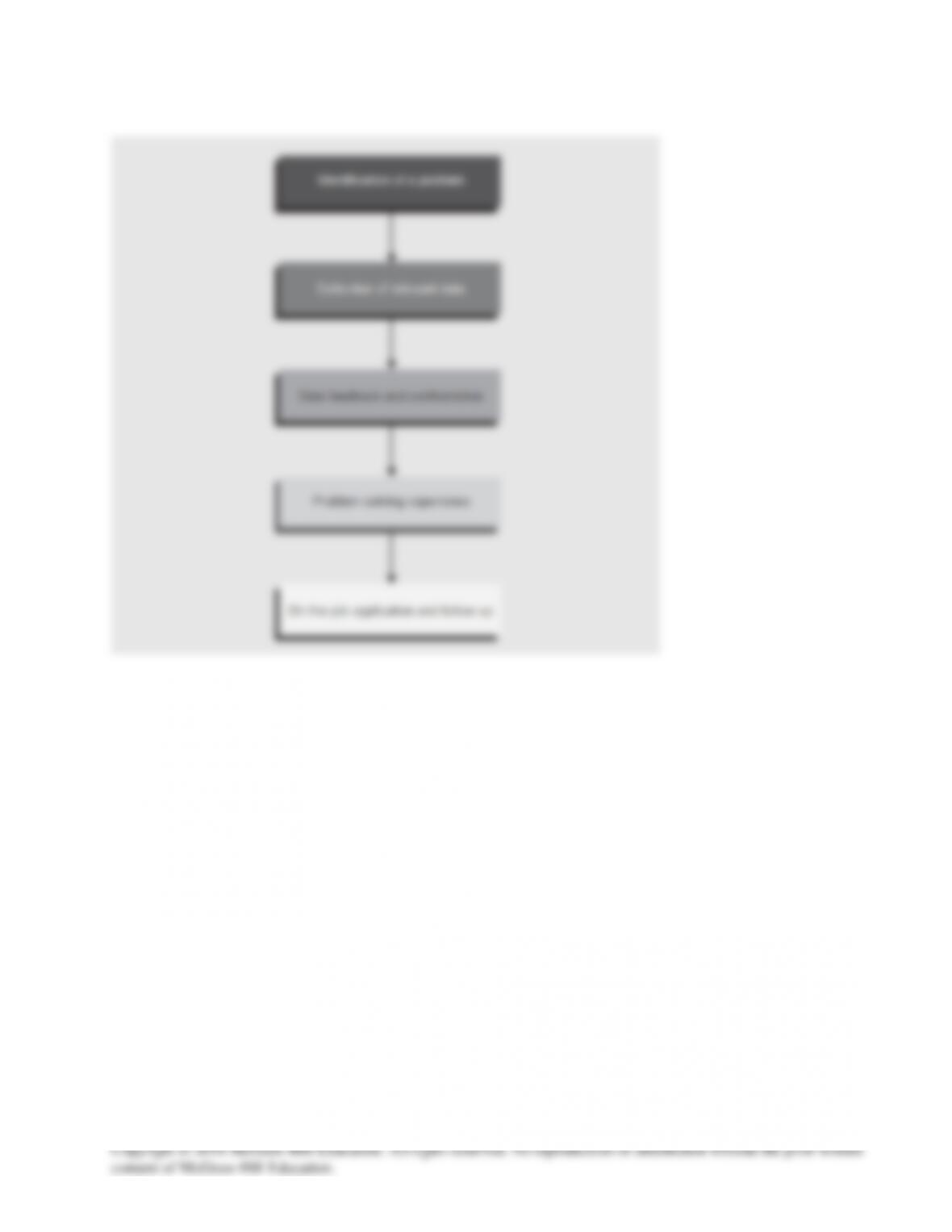
• The team-building follows the pattern shown in Figure 13.4.
13–11
Copyright © 2014 McGraw-Hill Education. All rights reserved. No reproduction or distribution without the prior written
consent of McGraw-Hill Education.
o A highly participative process is used, with team members providing “data” and then
using the data for self-examination.
o Often a skilled facilitator may assist the members in diagnosing and addressing their
problems.
o Data are collected from individual group members by surveys or interviews and then
fed back to the entire team for airing and analysis.
o While the group works on development of action plans, members are also encouraged
to direct equal attention toward the group’s interaction process.
Specific Team-Building Issues
• Team building usually focuses on one or more specific types of problems identified in the
first stage of the developmental process portrayed in Figure 13.4.
o If team members seem to be unaware of, or in disagreement about, the purpose of the
team, then the focus might best be placed on clarifying the goals and priorities of the
team.
o When the team is confused about its fit within the larger organizational system, the
focus might be on the nature of the organization’s culture, its workplace facilities, its