
12-1
Chapter 12
Informal and Formal Groups
Chapter Overview
This chapter calls attention to the importance of informal and formal groups. The chapter begins
with a discussion of group dynamics, followed by the nature of informal organizations and an
exploration of formal groups. Task and social leadership roles, group meetings, and their weaknesses
are discussed. Four alternative structured approaches to committee meetings are presented, along
with the potential outcomes and weaknesses of group meetings.
Chapter Learning Objectives
After reading this chapter, students should understand:
1. Group dynamics
2. The nature and effects of informal groups
3. Informal leaders
4. Differences between task and social leadership roles
5. Brainstorming, nominal, Delphi, and dialectic techniques
6. Weaknesses of group meetings
Discussion and Project Ideas
This chapter discusses how people interact when they get together in formal and informal groups.
From a formal groups’ perspective, special emphasis is given to meetings and teamwork, because
these are major areas of an employee’s work life and they also represent different kinds of
interaction.
In a logical sense, informal organization is one-half of the organization structure in an institution. In
a practical sense, informal organization can sometimes carry even more weight. Informal
organization is discussed throughout the book, but this chapter gives an overview of its main ideas.
Perhaps a good place to begin talking about informal organization is to ask the class to consider its
own informal organization. For example, have any thought leaders developed in the class? What
kinds of informal rules and procedures have developed? Have informal study groups arisen? Have
informal recreational groups developed, such as a coffee group after class? In addition, the following
exercises will help to convey the key points in the chapter.
12-2
• Bring a road atlas to class with you. Divide the class into three parts. Assign one-third of the
group to the Delphi technique and appoint a coordinator and two persons to help summarize
information. Assign the nominal group technique to the second group and appoint a facilitator
to moderate its activities. Divide the other one-third of the class into groups of four or five and
ask them to interact in traditional consensus groups. Then, ask all groups to estimate the
population of a reasonably large city such as San Diego, Portland, or Toronto. Use the figure in
the atlas as the standard. Compare the relative effectiveness of the Delphi, consensus, and
nominal groups.
Lecture Outline
Group Dynamics
• Small groups have functioned since the time of the first human family.
• In recent years, researchers have studied scientifically the processes by which small groups
evolve and work.
• The social process by which people interact face-to-face in small groups is called group
dynamics.
o The word “dynamics” comes from the Greek word meaning “force”,; hence group
dynamics refers to the study of forces operating within a group.
• Two important historical landmarks in the study of group dynamics are the research of:
o Elton Mayo and associates in the 1920s and 1930s—their research showed that workers
tend to establish informal groups that affect job satisfaction and effectiveness.
o Kurt Lewin, the founder of the group dynamics movement in the 1930s—he observed
that different kinds of leadership produce different responses in groups.
• Groups have properties of their own that differ from the properties of the individuals who
make up the group.
• In the world of group dynamics, it is entirely rational to say that “one plus one equals three”.
o In a group there is no such thing as only two people, for no two people can be

12-3
understood without examining their relationship.
Types of Groups
• A key difference exists between formal and informal groups.
o Formal groups are established by the organization and have a public identity and goal
to achieve.
o Informal groups emerge on the basis of common interests, proximity, and friendships.
• Another fundamental distinction is between two types of formal groups.
o Some have a relatively temporary life; they are created to accomplish a short-term task
and then disband.
▪ An example of a temporary group is a task force.
o The other type of formal group is a more natural and enduring work group.
▪ This type of group is formed when people regularly perform tasks together as part
of their job assignments and is called a team.
• Beneath the cloak of formal relationships in every organization is a more complex system of
social relationships consisting of many small informal groups.
o These informal groups are a powerful influence on productivity and job satisfaction.
The Nature of Informal Organizations
Comparison of Informal and Formal Organizations
• Widespread interest in the informal organization developed as a result of the Western Electric
studies in the 1930s, which concluded that it was an important part of the total work
situation.
• These studies showed that the informal organization is a network of personal and social
relations not established or required by the formal organization but arising spontaneously as
people associate with one another.
• The emphasis within the informal organization is on people and their relationships, whereas
the formal organization emphasizes official positions in terms of authority and responsibility.
• The differences between informal and formal organizations are summarized in Figure 12.1.
• Power in an informal organization is given by group members, rather than being delegated by
managers; therefore, it does not follow the official chain of command.
o It is more likely to come from peers than from superiors in the formal hierarchy; and it
may cut across organizational lines into other departments.
o It is usually more unstable than formal authority, since it is subject to the sentiments of
people.
• Because of its subjective nature, the informal organization cannot be controlled by
management in the way that the formal organization can.
• A manager typically holds some informal (personal) power along with formal (positional)
power, but usually a manager does not have more informal power than anyone else in the

12-4
group.
o This means that the manager and the informal leader are usually two different persons
in work groups.
• As a result of differences between formal and informal sources of power, formal
organizations may grow to immense size, but informal organizations tend to remain small in
order to keep within the limits of personal relationships.
o The result is that a large organization tends to have hundreds of informal organizations
operating throughout it.
▪ Some of them are wholly within the institution; others are partially external to it.
• Because of their naturally small size and instability, informal organizations are not a suitable
substitute for the large formal aggregates of people and resources needed for modern
institutions.
o Instead, informal organizations complement (and often enhance) the formal one.
How Does the Informal Organization Emerge?
• The organization’s structure is designed by management to be consistent with its
environment, technology, and strategy.
o This structure, with its rules, procedures, and job descriptions, creates a set of broad
policy guidelines and narrower prescriptions for employees to follow.
o If individuals and groups perform their tasks as prescribed, the organization is efficient.
• The informal organization emerges from within the formal structure.
o The result of this combination is different from what managers may have expected in at
least three ways:
▪ Employees act differently than required.
▪ Employees often interact with different people, or with different frequencies, than
their jobs require.
▪ Workers may embrace a set of attitudes, beliefs, and sentiments different from
those the organization expects of them.
• The combination of required and emergent behaviors makes it difficult to predict levels of
employee performance and satisfaction (Figure 12.2).
Informal Leaders
• The employee with the largest amount of status in the informal organization usually becomes
its informal leader.
o This person emerges from within the group, often acquiring considerable informal
power.
• The informal leader plays several useful roles for a work unit.
o The informal leader is expected to model and explain the key norms (informal
standards of behavior) of the informal group for new members.
o If someone fails to comply with the group’s norms, the informal leader will likely play

12-5
a dominant role in applying various forms and degrees of pressure or punishment to the
individual to induce the desired behavior in the future.
• In return for their services, informal leaders usually enjoy certain informal rewards and
privileges.
o A predictable reward is the high esteem in which the informal leader is held, and this is
significant enough to balance the responsibilities the person shoulders.
• Informal groups overlap to the extent that one person may be a member of several different
groups, which means there is not just one leader but several of varying importance.
o The group may look to one employee on matters pertaining to wages and to another to
lead recreational plans.
• Identifying and Rewarding Informal Leaders
o Informal leaders often exhibit distinct behaviors that allow them to be identified.
▪ Acting as a spokesperson, being the center of social attention, and offering well-
received wisdom and guidance all provide useful clues regarding informal
leadership.
o To some workers, informal leadership is a form of job enrichment, providing them with
variety in their workday and a feeling of greater significance.
▪ Others find that it helps satisfy their social needs by dramatically increasing their
interpersonal contacts during the day.
o Although several persons in a group may be informal leaders of various types, usually
one primary leader has more influence than the others.
▪ Each manager needs to learn who the key informal leader is in any group and to
work with that leader to encourage behavior that furthers rather than hinders
organizational objectives.
▪ When an informal leader is working against an employer, the leader’s widespread
influence can undermine motivation and job satisfaction.
• Some Cautions
o The informal organization is a desirable source of potential formal leaders, but an
informal leader doesn’t always make the best formal manager.
o History is filled with examples of successful informal leaders who became arrogant
bosses once they received formal authority.
▪ Some informal leaders fail as formal ones because they fear official
responsibility.
▪ Some informal leaders become conservative because they are afraid to make a
mistake.
▪ Other informal leaders fail because their area of official managerial authority is
broader and more complex than the tiny area in which they had informal power.
Benefits of Informal Organizations
• Although informal systems may lead to problems, they also bring a number of benefits to
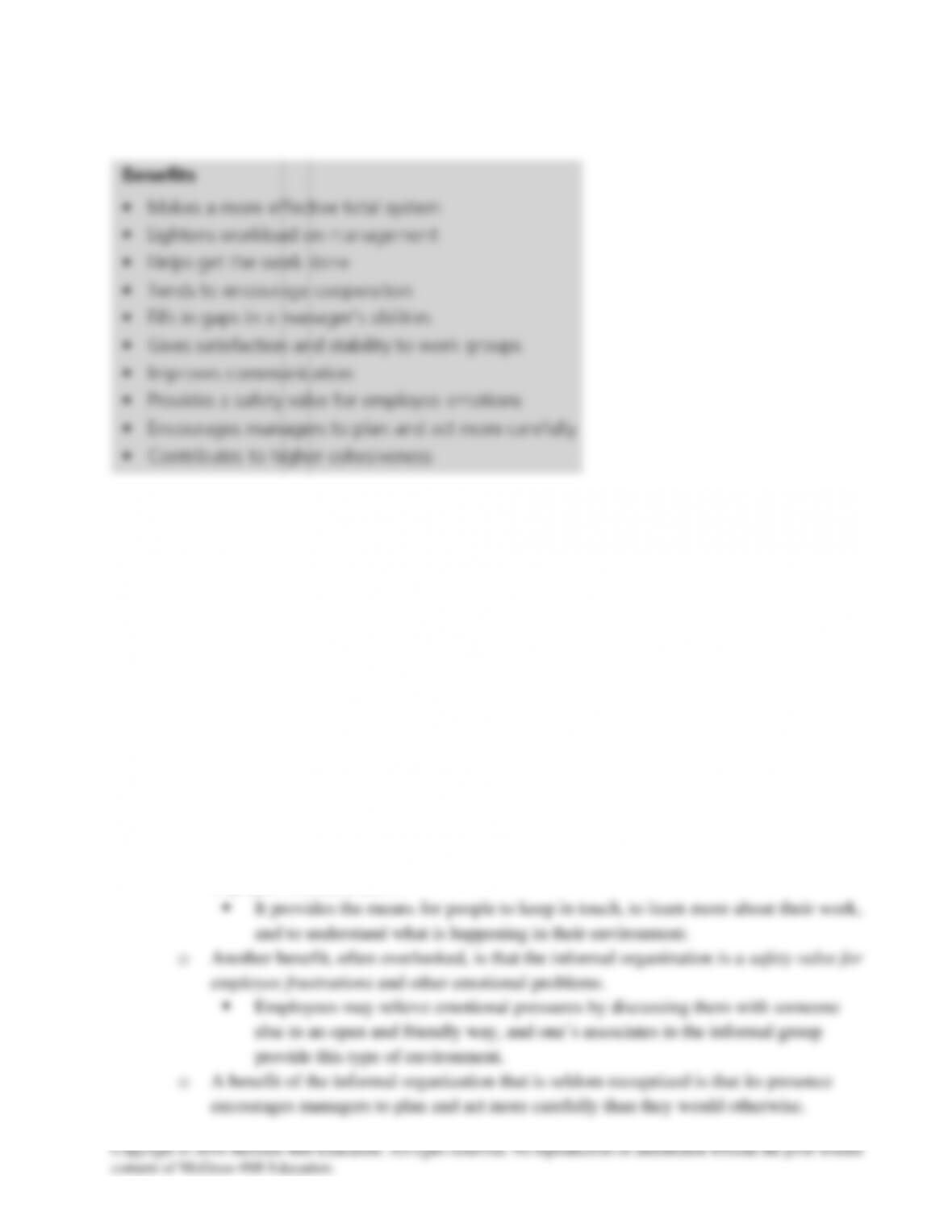
12-6
both employers and employees (Figure 12.3).
o Most important is that they blend with formal systems to make an effective total
system.
o Another benefit of the informal organization is to lighten the workload on management.
▪ When managers know that the informal organization is working with them, they
feel less compelled to check on the workers to be sure everything is working
well.
o The informal organization also may act to compensate for gaps in a manager’s
abilities.
▪ If a manager is weak in planning, an employee may informally help with goal-
setting.
o A significant benefit of the informal organization is that it gives satisfaction and
stability to work groups.
▪ It is the means by which workers feel a sense of belonging and security, so
satisfaction is increased and turnover reduced.
o An additional benefit is that the informal organization can be a useful channel of
employee communication.

12-7
▪ Managers who understand its power know that the informal organization
provides a check on their unlimited use of authority
• The benefits of the informal organization are more likely to appear if the group is cohesive
and its members have favorable attitudes toward the firm.
o Cohesiveness is indicated by how strongly the employees stick together, rely on each
other, and desire to remain members of the group.
• Cohesiveness can be increased by several factors, such as:
o Creating competitions (such as sales or safety competitions) against other groups
o Providing opportunities for frequent interactions among members
o Selecting members with similar attitudes, backgrounds, and values
o Identifying a challenging group goal that unifies member efforts
o Recognizing a major threat or common enemy to the group
Problems Associated with Informal Organizations
• Many of the benefits of informal systems can be reversed to show potential problems.
o Both positive and negative effects exist side by side in most informal systems.
• One major problem with informal organizations is resistance to change.
o The group tends to become overly protective of its way of life and to stand like a rock
in the face of change.
• A related problem is that the informal organization can be a significant cause of employee
conformity.
o The informal side of organizations is so much a part of the everyday life of workers
that they hardly realize it is there, so they usually are unaware of the powerful pressures
it applies to persuade them to conform to its way of life.
o Conformity is encouraged by norms, which are informal group requirements for the
behavior of members.

12-8
o The norms may be strong or weak (depending on the importance of the behavior to the
group) and positive or negative (depending on their impact on the organization).
o An example of the impact of norms at the societal level lies in the term social norms.
o The group whose norms a person accepts is a reference group.
▪ Employees may have one or more reference groups.
• Another problem that may develop is role conflict.
o Workers may want to meet the requirements of both their group and their employer, but
frequently those requirements are somewhat in conflict.
• A major difficulty with any informal organization is that it is not subject to management’s
direct control.
o The authority it depends on is the social system rather than management.
• Informal organizations also develop interpersonal and intergroup conflicts that can be
damaging to their organization.
o When employees give more of their thoughts and energies to opposing one another,
they are likely to give less to their employer.
Monitoring Informal Organizations
• One way to gain a better understanding of an informal system is to prepare a visual portrait of
it.
o These diagrams are called network charts, or informal organization charts.
o They usually focus on either interpersonal feelings expressed among individuals or
actual behaviors exhibited.
• Identifying the feelings within a group can be useful for determining who trusts whom, or for
selecting an individual to negotiate a compromise on a sticky issue.
• Determining patterns of behaviors can be done either through personal observation of
interactions, through collecting data on communication patterns, or by directly asking
Influencing Informal Organizations
• Management does not establish informal organizations, and it cannot abolish them.
• But management can learn to live with them and have some measure of influence on them.
• Management guidelines for action include the following:
o Accept and understand informal organizations.
o Identify various levels of attitudes and behaviors within them.
o Consider possible effects on informal systems when taking any kind of action.
o Integrate as far as possible the interests of informal groups with those of the formal
organization.

12-9
o Keep formal activities from unnecessarily threatening informal organizations.
• The informal organization needs to be strong enough to be supportive, but not strong enough
to dominate.
Formal Groups
• Whether called meetings, conferences, task forces, or committees, the time spent in formal
groups has variously been criticized as a total waste of time, a source of confusion and
misinformation, and an excuse for indecision on the part of an individual decision maker.
• The following are some factors that contribute to the often-pervasive negative attitudes about
time spent on committee meetings:
o A lack of trust causes participants to withhold their true feelings.
o A negative mind-set exists that “meetings aren’t real work” and hence people don’t take
them seriously.
o Missing or incomplete information prevents participants from making important
decisions when appropriate.
o Meetings are poorly run.
o Meetings are viewed as the end result, not the means to an end.
• Meetings are necessary, but they do introduce more complexity and more chances for
problems to arise when improperly used.
o Some committees are used not to reach decisions but to put them off, not to obtain
employee input but to sell a previously reached conclusion, and not to develop
subordinates but to hide incompetence.
o On occasion, emotional issues overshadow the factual aspects of the decisions to be
made, and the sensitive interpersonal relations that emerge require understanding and
delicate handling.
Committees
• A committee is a specific type of group in which members who have been delegated the
authority to handle the problem at hand meet one or more times to address and resolve it.
o The group’s authority usually is expressed in terms of one vote for each member.
o If a supervisor and a worker serve as members of the same committee, both usually
have equal committee roles.
o Committees often create special human problems because people are unable to make
adjustments from their normal work roles and relationships.
Systems Factors to Consider
• A useful way to approach the management of committees is to apply the systems idea.
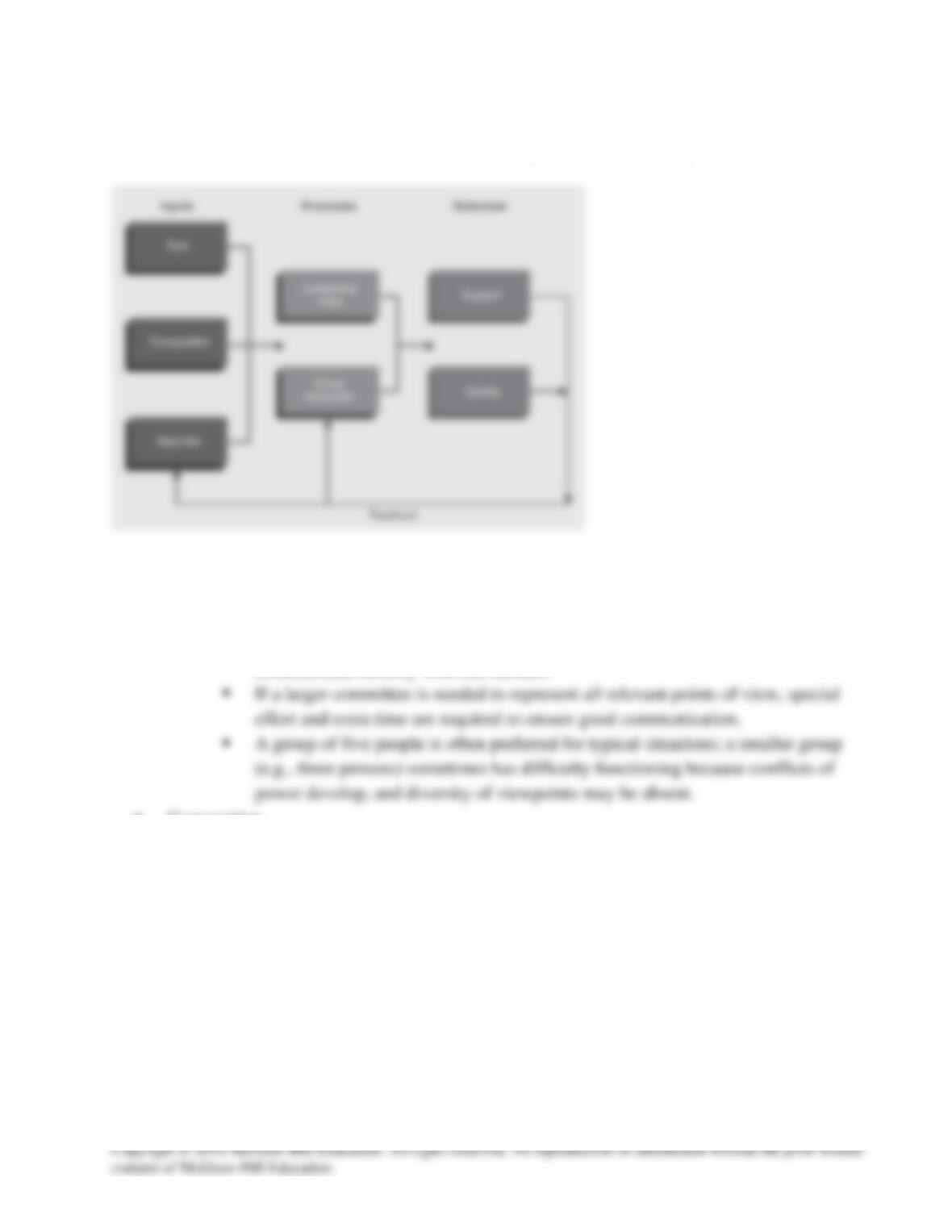
• As shown in figure 12.5, effective committees require:
o Careful consideration of their inputs (size, composition, and agendas)
12–10
o The group process (leadership roles and alternative group structures)
o Outcomes (quality of the decision and the group’s support for it).
• Size
o The size of a group tends to affect the way it works.
▪ If membership rises about seven, communication tends to be focused within a
few members, with others feeling like they do not have adequate opportunity to
communicate directly with one another.
• Composition
o Leaders of committees, problem-solving groups, and task forces often have the
opportunity to select the members.
o When doing so, the leaders need to consider various factors, such as the committee’s
objective, the members’ expertise, interest level, time available to serve, and the past
history of working relationships among the potential members.
• Agendas
o Meetings work simultaneously at two different levels—surface and hidden.
o The official task of the group is known as the surface agenda.
▪ Effective surface agendas are critical to the success of a committee meeting.
▪ Agendas should make it clear to attendees why the meeting is to be held, and
what it should accomplish.

12–11
o The other level at which meetings operate involves members’ private emotions and
motives, which they have brought with them but keep hidden.
▪ These are the hidden agendas of the meeting.
▪ When a group reaches a crisis in its surface agenda, hidden agendas come to life
and complicate the situation.
▪ A hidden agenda when resolved, makes it easy to settle the surface agenda.
• Leadership Roles
o Groups tend to require not one but two types of complementary leadership roles—that
of the task leader and that of the social leader.
o Figure 12.6 provides illustrations of the contrasting nature of each role.
o The task leader’s job in a meeting is to help the group accomplish its objectives and
stay on target.
▪ The idea is to provide necessary structure by stating the problem, giving and
seeking relevant facts, periodically summarizing the progress, and checking for
agreement.
o One role of the social leader is to restore and maintain group relationships by
recognizing contributions, reconciling disagreements, and playing a supportive role to
help the group develop.
o Although one person can fill both the task and social roles, often they are separate.
▪ When they are separate, it is important for the task leader to recognize the social
leader and try to form a coalition so the two leaders are working together for
improved effectiveness of the group.
o Effective meetings are facilitated by the application of a number of commonsense
practices:
▪ Carefully considering who should be present, and who does not need to be there
▪ Selecting a good site for the meeting
▪ Using technology to help capture ideas, allow for anonymous inputs, organize
and expand upon them, record insights and criticisms, and create and edit

12–12
documents before the participants leave
▪ Giving appropriate credit to those who participated, and drawing out those who
didn’t
▪ Using open questions to stimulate thought and directed questions to encourage a
focus on a particular topic
• Individualistic behaviors
o Some meeting attendees lose sight of the purpose of a meeting and fail to contribute.
▪ Instead, they lapse into self-centered actions that can delay or even sidetrack
productive discussions.
o Examples of these individualistic behaviors include:
▪ Distractions (joke-telling; checking their smartphones)
▪ Seeking personal recognition (bragging)
▪ Dominating (monopolizing conversations or pushing favored solutions)
▪ Attacking (making insulting or dismissive comments)
▪ Withdrawing (claiming inadequacy or confusion)
Structured Approaches
• Brainstorming
o Brainstorming is a popular method for encouraging creative thinking in groups of
about eight people.
o It is built around four basic guidelines for participants:
▪ Generate as many ideas as possible
▪ Be creative, freewheeling, and imaginative
▪ Build upon (piggyback), extend, or combine earlier ideas
▪ Withhold criticism of others’ ideas
o The success of brainstorming depends on each member’s capacity and willingness to
listen to others’ thoughts, to use these thoughts as a stimulus to spark new ideas of their
own, and then to feel free to express them.
o Two main principles underlie brainstorming:
▪ Deferred judgment—its purpose is to separate creation of novel ideas from idea
censorship.
▪ Quantity is valued most, for it breeds quality.
o Group brainstorming typically produces more ideas than provided by a single person.
▪ Brainstorming sessions last from 10 minutes to one hour and require very little
preparation.