11–13
o Assertive people are direct, honest, and expressive
• Assertive people feel confident, gain self-respect, and make others feel valued.
• Aggressiveness is a poor alternative to confronting conflict in which people may humiliate
others, and passive (unassertive) people who elicit either pity or scorn from others and seldom
have much positive impact.
o Both alternatives to assertiveness typically are less effective for achieving a desired goal
during a conflict.
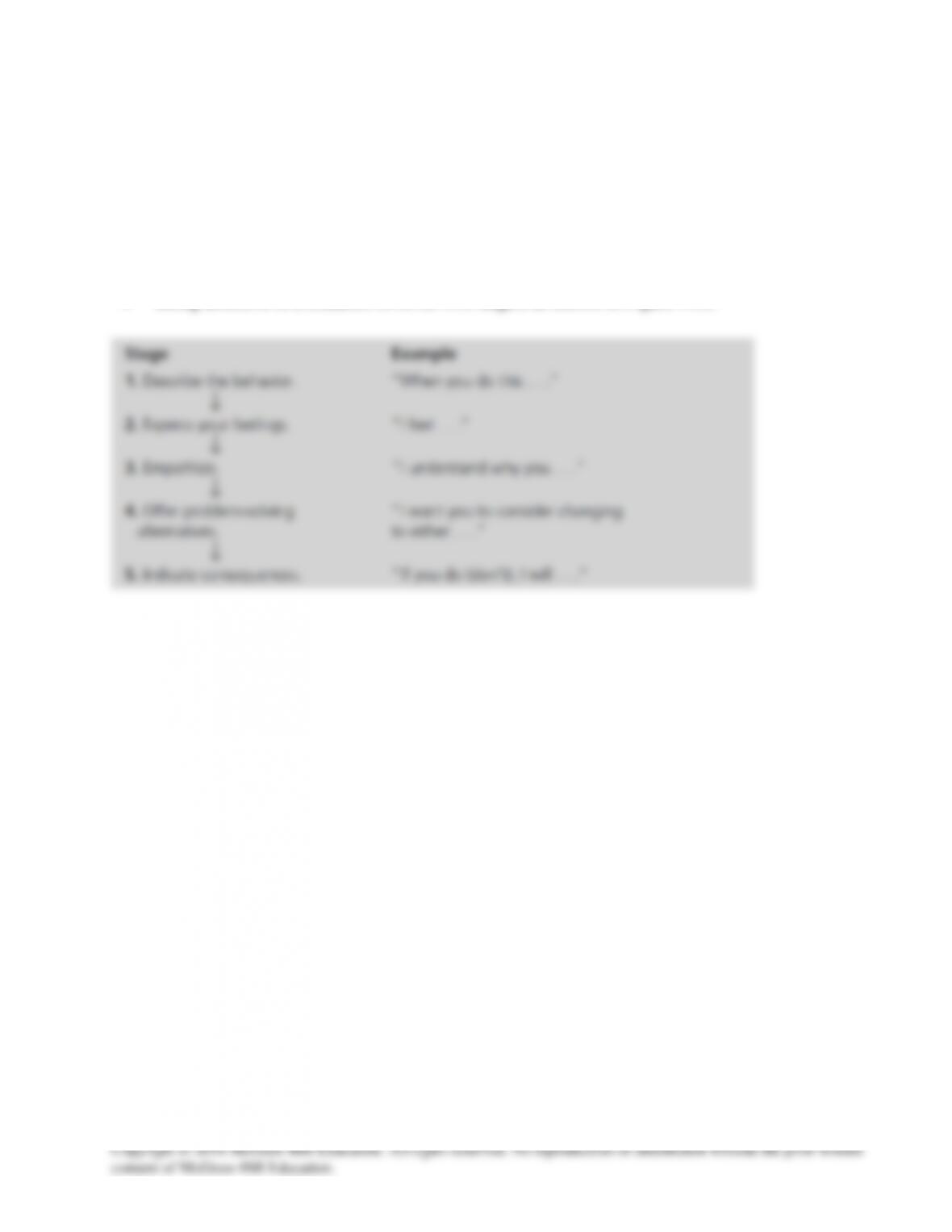
• Being assertive in a situation involves five stages, as shown in Figure 11.5.
• Assertive behavior generally is most effective when it integrates a number of verbal and
nonverbal components:
o Eye contact is a means of expressing sincerity and self-confidence in many cultures, and
an erect body posture and direct body positioning (close proximity and leaning forward)
may increase the impact of a message.
o Appropriate gestures may be used, congruent facial expressions are essential, and a
strong but modulated voice tone and volume will be convincing.
o Spontaneous and forceful expression of an honest reaction is perhaps most important.
Facilitating Smooth Relations
• Good interpersonal relationships among co-workers and across organizational levels take
time, effort, knowledge, and skill.
o A key skill involves interpersonal facilitation—the capacity to focus on others’
personal needs, sensitivities, and idiosyncrasies and then work to keep conflict under
control and collaboration high among team members.
▪ This requires awareness of which personality traits create synergy within a team,
which employees have “hot buttons” that might set off emotional explosions and
when to intervene behind the scenes.
• Caring underlies compassion for others, which is a four-step action oriented process:
o Noticing that someone else is suffering or distressed.

11–14
o Appraising that the other person is self-relevant (has compatible values, preferences,
and beliefs).
o Feeling that the person is worried or hurt (empathizing with them).
o Compassionate responding is the process of taking actions that will diminish or
eliminate the other person’s discomfort or anguish.
• Managers with well-developed interpersonal facilitation skills often engage in one or more of
the following behaviors:
o Build on their emotional intelligence
o Learn about co-workers’ personal lives
o Make mental notes about employee likes and dislikes, values, interests, and preferences
o Monitor others’ degree of job involvement, mood level, commitment, and satisfaction
o Develop and apply their facilitative skills in a variety of social settings
Stroking
• People seek stroking in their interactions with others, and this provides a prime opportunity
for interpersonal facilitation.
o Stroking is any act of recognition for another, whether physical, verbal, or nonverbal
contact between people.
• Strokes may be positive, negative, or mixed.
o Positive strokes feel good when they are received, and they contribute to the
recipient’s sense of well-being and self-esteem.
o Negative strokes hurt physically or emotionally and make recipients feel less proud of
themselves.
o Example of a mixed stroke would be, “Oscar, that’s a good advertising layout,
considering the small amount of experience you have in this field.”
• There also is a difference between conditional and unconditional strokes.
o Conditional strokes are offered to employees if they perform correctly or avoid
problems.
o Unconditional strokes are presented without any connection to behavior.
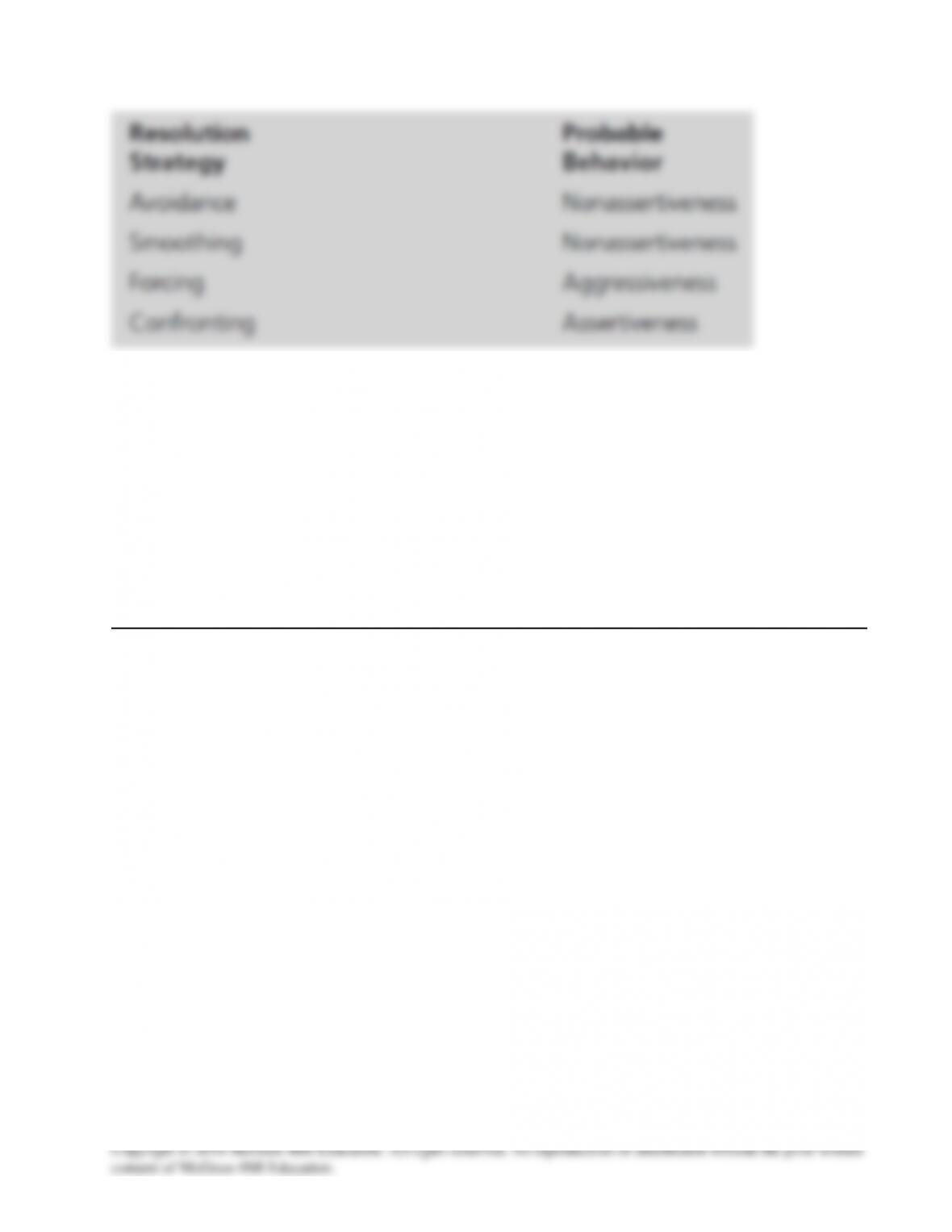
• Applications to Conflict Resolution
o There are several natural connections between assertiveness and the approaches to
resolving conflict.
o Probable connections are shown in Figure 11.6.
11–15
Copyright © 2014 McGraw-Hill Education. All rights reserved. No reproduction or distribution without the prior written
consent of McGraw-Hill Education.
o Assertiveness training and stroking when used in combination can be powerful tools for
increasing one’s interpersonal effectiveness.
▪ They share the goal of helping employees feel good about themselves and others.
▪ The result is improved communication and interpersonal cooperation.
▪ These tools will be most effective when they are widely used throughout the
organization and supported by top management.
▪ Together, they form an important foundation for the more complex challenges
that confront people who work in small groups and committees.
Power and Politics
• Power is the ability to influence other people and events.
o It is somewhat different from authority, in that authority is delegated by higher
management.
o Power is earned by leaders on the basis of their personalities, activities, resources, and
the situations in which they operate.
Types of Power
• There are five bases of power, and each has a unique source:
• Personal Power
o Personal power, also called referent power or charismatic power comes from each
leader individually.
o It is the ability of leaders to develop followers from the strength of their own
personalities.
o They have personal magnetism, an air of confidence, and a passionate belief in
objectives that attract and hold followers.
o The leader senses the needs of people and promises success in reaching them.
o Well known examples are Joan of Arc, Mahatma Gandhi, Winston Churchill, John F.
Kennedy, and Martin Luther King.
• Legitimate Power

11–16
o Legitimate power is also known as position power and official power; it comes from a
higher authority.
o It gives leaders the power to control resources and to reward and punish others.
o People accept this power because they believe it is desirable and necessary to maintain
order and discourage anarchy in the society.
o In work organizations, there is social pressure from peers and friends who accept
legitimate power and then expect others to accept it.
• Expert Power
o Expert power, also known as the authority of knowledge, comes from specialized
learning.
o This power arises from a person’s knowledge of, and information about, a complex
situation.
o It depends on education, training, and experience, so it is an important type of power in
a modern, technological society.
• Reward Power
o Reward power is the capacity to control and administer items that are valued by
another.
o It arises from one’s ability to give pay raises, recommend promotions or transfers, or
make favorable work assignments.
o Rewards are not limited to material items; they can stem from providing organizational
recognition, including an employee in a social group, or giving positive feedback.
o Reward power serves as the basis for reinforcing desirable behavior.
• Coercive Power
o Coercive power is the capacity to punish another, or at least to create a perceived
threat to do so.
o Managers with coercive power can threaten an employee’s job security, make punitive
changes in work schedules, or, at extreme, administer physical force.
o Coercive power uses fear as a motivator, which can be a powerful force in inducing
short-term action.
o Overall, coercive power has a negative impact on the receiver and therefore its use
should be limited.
Effects of Power Bases
• The five types of power are developed from different sources, but they are interrelated in
practice.
o Reward, coercive, and legitimate power are derived from one’s position in the
organization.
o Expert and personal power reside within the person.
• When one power base is removed from a supervisor, employees may perceive that other
bases of influence will decline as well.
11–17
• The use of a power base must fit its organizational context in order to be effective.
• Employees can respond to the use of power in one of three ways as shown in Figure 11.7.
o They may resist the leader’s initiative, especially if coercive power is used consistently,
without apparent cause, or in an arrogant manner.
o They may comply with the leader’s wishes by meeting minimal expectations while
withholding extra effort.
o The most desirable outcome from wielding power is commitment, which is the
enthusiastic release of energy and talent to satisfy the leader’s requests.
• Referent and expert power are most likely to produce commitment, but legitimate and reward
power can also work well under certain conditions.
Organizational Politics
• Organizational politics refers to intentional behaviors that are used to enhance or protect a
person’s influence and self-interest while also inspiring confidence and trust by others.
• Political skill consists of four key dimensions:
o Being socially astute (accurately perceiving and understanding what is taking place in
o Expressing sincerity (exhibiting honest and authentic intentions in one’s interactions
with others such that they trust you)
• One survey of more than 400 managers provided insight into their views toward
organizational politics. To a large extent, the managers agree that:
o Politics is common in most organizations.
Influence and Political Power
• Managers, and all employees, in contemporary organizations must learn to produce results,
elicit cooperation, and make things happen without reliance on traditional forms of power.
o As difficult as this goal sounds, it is still possible if managers begin with the premise
that everyone is motivated primarily by her or his own self-interest.
o Knowing this, a person can influence others by making mutually beneficial exchanges
with them to gain their cooperation.
• The following are eight steps to follow for increasing one’s influence:
o Treat the other party as a potential ally; avoid making enemies.
o Clearly identify your own objectives, and pick your battles to fight.
11–18
o Learn about other party’s needs, interests, expectations, and goals.
o Inventory your own resources to identify something of value you can offer.
o Assess your current relationship with the other person.
o Decide what to ask for and what to offer.
o Make the actual exchange that produces a gain for both parties.
o Even if you ‘win’, don’t gloat; be gracious and avoid boasting.
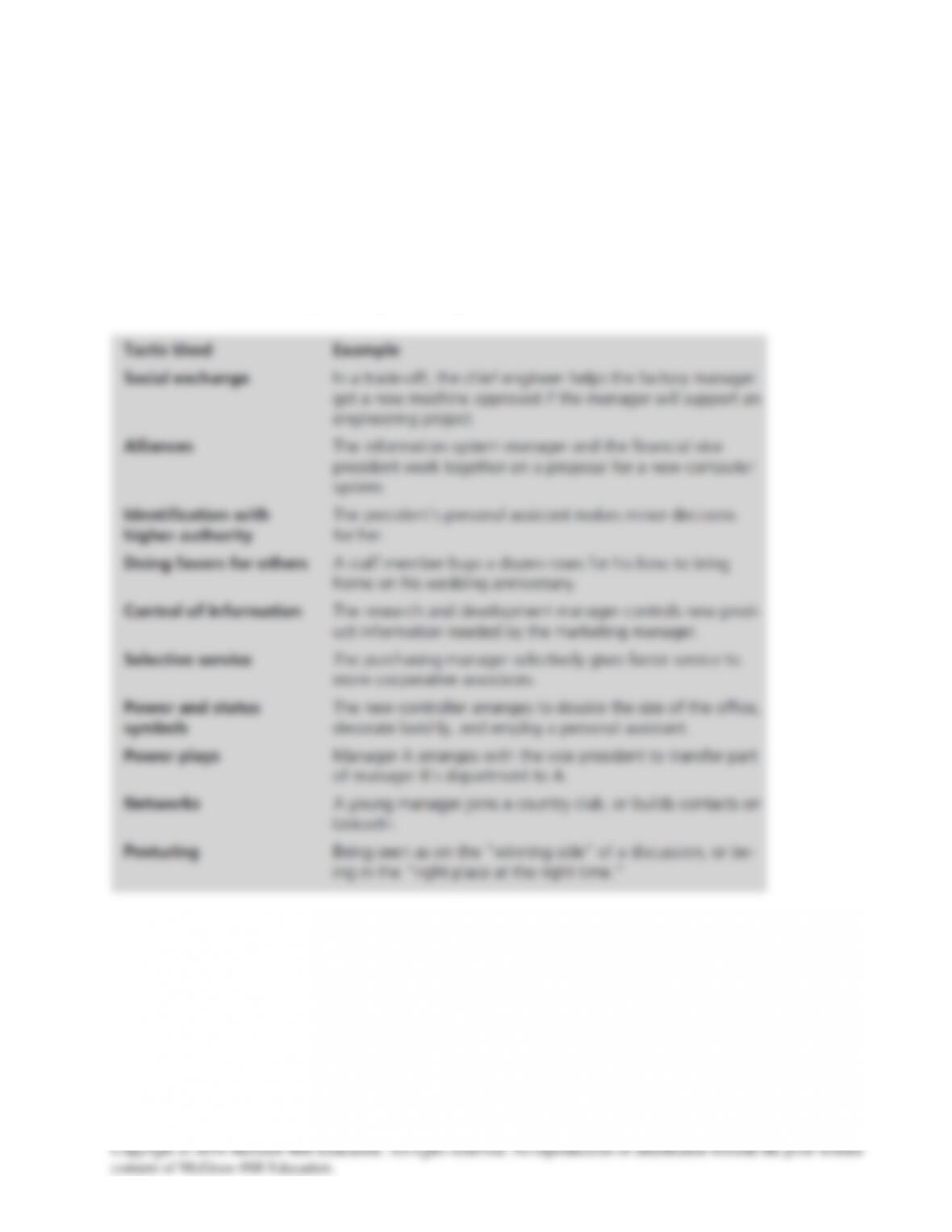
• Leaders can use a number of tactics to gain political power.
o Several examples are given in Figure 11.8.
• Networking—developing and maintaining contacts among a group of people with shared
interests—is a source of influence.
• Social exchange implies that “if you’ll do something for me, I’ll do something for you.”
o It relies on the powerful norm of reciprocity in society, where two people in a
continuing relationship feel a strong obligation to repay their social “debts” to each
other.
• Continuing exchanges of “IOUs” and favors over a period of time usually lead to an alliance
in which two or more persons join in a temporary or longer-term relationship to get benefits
11–19
that they mutually desire.
• One popular path toward political power is to become identified with a higher authority or a
powerful figure in an organization.
• Closely related to the previous technique is the traditional method of simply doing favors for
others.
o In a relationship with a higher authority, this practice of ingratiation is commonly
called “apple–polishing” or “kissing up” to a supervisor.
• Another oft-used way to acquire political power is to give service selectively to your
supporters.
• Another tactic is to acquire power and status symbols that imply you are an important person
in the firm, although this tactic can backfire if you do not have power equal to your symbols.
• Some managers use the more aggressive tactic of applying power plays to grab power from
others.
o This approach is risky because others may retaliate in ways that weaken the power-
grabbing manager’s power.
• A common tactic for increasing power is to join or form interest groups that have a common
objective.
o These networks operate on the basis of friendships and personal contacts, and may
provide a meeting place for influential people.
• Posturing is also used to gain influence.
o Posturing consists of positioning oneself for visibility, making sure that others know
about your successes, and practicing skills of “one-upmanship” over others.
• Managers realize that their political power comes from the support of key individuals or the
group around them.
o It arises from a leader’s ability to work with people and social systems to gain their
allegiance and support.
• Research suggests that some people (self-monitors) are more effective at using
organizational politics than others.
o In particular, high self-monitors are more adept at regulating themselves and adapting
to situational and interpersonal cues.
11–20
using flattery, and doing favors for others.
o A variety of other approaches are listed in Figure 11.9.
Suggested Answers to Discussion Questions
1. Discuss the relationship between Theory X and Theory Y, conflict resolution strategies.
Students’ answers may vary. Theory X and Theory Y, conflict resolution strategies, and life
2. Pair up with another student and explore the concept of trust as a foundation for
productive human relationships. Develop several strategies for increasing mutual trust.
Students’ answers may vary. Every relationship requires some degree of trust, which is the
3. How assertive are you (rate yourself from 1 low to 10 high)? Should you be more or less
11–21
assertive? Under what conditions?
Students’ answers may vary. Students should recognize their own positions in regard to the
4. “Resolved: That all employees should be trained to become more assertive.” Prepare to
present the pros and cons in a class debate.
Students’ answers may vary. Arguments for the pros will probably be couched in terms of the
5. Many people do not receive as many strokes as they feel they deserve on a regular basis.
Why do they feel this way? What could their managers do about it? What could they do
themselves?
Students’ answers may vary. People feel this way for two reasons:
6. Think of an organization you are familiar with. What types of power are used there?
How do people react to those bases? What changes would you recommend?
Students’ answers may vary. Evidence of all five sources of power will probably be given.
11–22
Copyright © 2014 McGraw-Hill Education. All rights reserved. No reproduction or distribution without the prior written
consent of McGraw-Hill Education.
emphasis on coercive and position power and encouraging proper use of the other bases of
power.
7. Identify which tactics of organizational politics you have seen used or read about
previously. Develop an action plan for responding to these behaviors if you were to
encounter them.
8. Review and explain the idea of a norm of reciprocity as a basis for influencing others.
Explain how you have seen it used in interpersonal relationships. How could you make
use of it in the future?
Students’ answers may vary. “If you do something for me, I’ll do something for you,” and,
9. Review the definition of organizational politics. Can an organization be totally free of
political behavior? What would it be like? How could you make it happen?
Students’ answers may vary. It would be virtually impossible to construct an organization that
10. Think about the idea of impression management. In what ways do students use it
effectively in the classroom? What additional strategies could they adopt?
Students’ answers may vary. Impression management is the ability to protect one’s self-image
Assess Your Own Skills
11–23
Students should honestly circle the number on the response scale that most closely reflects the
degree to which each statement accurately describes them when they have tried to work
constructively with someone else. This section will help them understand how well they exhibit
good interpersonal skills.
Incident
The Angry Airline Passenger
How should James respond to the passenger?
Would stroking help her?
Use of positive strokes and negative strokes will likely be most useful in this case. Positive strokes
Would assertiveness training help?
An assertive training would certainly help in dealing with confrontational customers, as it will teach
Experiential Exercise
Assessing Political Strategies
Students have been asked to work individually, and rank-order the given political (influence)
strategies according to their willingness to use them (1 greatest; 8 least) to advance their own self-
interest at work. When they are through, they are to form groups of about five persons and develop a
group assessment (consensus) of the proportion of managers (0–100 percent) who might use each
strategy. Afterward, they should examine the key and discuss any differences, and also talk about
how use of these strategies might have changed over time.

11–24
Generating OB Insights
Students’ responses will vary for this exercise. They should however, highlight several of the major
topics discussed in the chapter such as the nature and types of conflict, conflict outcomes and
resolution strategies, different personality types, assertive behavior and trust-building, etc.