
11-1
Chapter 11
Conflict, Power and, Organizational Politics
Chapter Overview
This chapter discusses how conflict can arise in interpersonal interaction, and how it can be
managed. The nature of conflict, conflict outcomes, and assertive behavior are covered. The five
bases of power are presented, followed by a discussion of organizational politics, and tactics.
Chapter Learning Objectives
After reading this chapter, students should understand:
1. The nature and types of conflict
2. Conflict outcomes and resolution strategies
3. Different personality types
4. Assertive behavior and trust-building
5. Interpersonal facilitation and stroking
6. Types of power
7. Organizational politics and influence
Discussion and Project Ideas
• The keys to this chapter are how interpersonal and intergroup conflicts arise, and what
methods exist for resolving conflict. Using the topics in the chapters what issues can be
identified in the following scenarios:
Pick two students to role-play the situation which follows. Have the rest of the class serve as
observers and identify specific topics covered in the chapter:
Person A: You are the manager for Roadspeed Trucking Co. Lately, one of your dispatchers
has been coming in late, up to forty-five minutes on some occasions. This means that the other
dispatcher has to stay late (and be paid time-and-a-half for overtime) or that you have to do the
dispatching yourself. This morning you had to interrupt negotiations with a potentially large
customer because your dispatcher was late again. You are totally fed up. At this very moment,
the dispatcher is coming in the door. Instructions: Develop and carry on whatever dialogue you
think is appropriate.
Person B: You are a dispatcher for Roadspeed Trucking Co. You have been with the company
seven years and are generally considered the company’s best dispatcher. Lately, you have had
a lot of family problems. Both your father and mother have had to be hospitalized in the last

11-2
two weeks and one of your three children broke her leg. Your spouse, who is a salesperson,
has been out of town for the last couple of weeks. This morning you are late for work because
your father has respiratory problems and had to be taken to the hospital. Because of all of these
problems, you have been late several times in the last couple of weeks. Also, because you
work the late shift, you have not really discussed these problems with anyone. The exercise
begins with you coming to work late. Your supervisor will have a discussion with you.
Respond in any way you feel is appropriate.
• Pick two students to role-play the exercise below. Have the class serve as observers and
discuss the interaction in terms of guidelines for conflict resolution through confrontation. You
may assign persons to individually monitor eye contact, voice modulation, and facial
expressions.
Person A: You work in the advertising department of a large computer manufacturing
company. Every Friday there is a staff meeting with your boss and four other co-workers
where you are all asked to brainstorm marketing strategies and proposals. Lately you have hit
on several excellent ideas, particularly the proposal for marketing the Peach Mini-Computer.
Yet, every time, your manager takes your idea and assigns it to another member of the group.
Person B: Mary (or Frank), one of your best idea people, has just requested a meeting with
you. You know she is very upset because, lately, she feels that some of the ideas she
contributes in Friday staff meetings are given to other employees. It’s true, but not for the
reasons she thinks. The facts behind the situation are that although Mary is very creative, she is
poor on follow-through. You have tried to let her run with her ideas in the past, but she always
drops them in midstream to start on something else. This is not a problem for you because
there are enough people to take up where Mary leaves off. Mary’s real value is as an idea
person. She is going to see you in just a second. Respond in any way you see appropriate.
• The best leaders or managers understand bases of power and use of power in organizations.
Examples abound of the different sources of power exhibited by leaders and managers. Assign
students the task of researching the career of a well-known figure, such as John F. Kennedy or Lee
Iacocca. Ask them to concentrate on examples of the five bases of power that they found in
researching the person they chose or were assigned. Have them discuss in class the extent to which
all of the bases of power tend to be available to the very best leaders, and why.
Lecture Outline
Introduction

11-3
• Almost every working relationship will produce some degree of conflict across time.
o Whether the conflicts will be destructive or constructive depends on the attitudes and
skills of the participants.
• Employees may need to develop assertiveness and trust-building skills in order to be heard and
respected by their peers.
o Interpersonal behavior in complex organizations inevitably produces power differences.
Conflict in Organizations
The Nature of Conflict
• Conflict can occur in any situation in which two or more parties feel themselves in
opposition.
• Conflict is an interpersonal process that arises from disagreements over the goals to attain,
the methods to be used to accomplish those goals, or even the tone of voice used as people
express their positions.
o In addition to conflicts over goals or methods, conflicts also arise due to:
▪ Task interdependence
▪ Ambiguity of roles
▪ Policies and rules
▪ Personality differences
▪ Ineffective communications
▪ Competition over scarce resources
▪ Personal stress
▪ Underlying differences in attitudes, beliefs, and experiences
• In organizations everywhere, conflict among different interests is inevitable, and sometimes
the amount of conflict is substantial and destructive.
o Managers estimate that they spend about 20 percent of their time dealing with conflict.
o They may be either direct participants or mediators trying to resolve a conflict.
• Knowledge and understanding of conflict and the methods for resolving it are important.
Levels of Conflict
• Conflict can occur within an employee, between individuals or groups, and across
organizations as they compete.
• Intrapersonal Conflict
o Most role conflict occurs when an employee’s supervisor or peers send conflicting
expectations to an employee.
o Intrapersonal role conflict can also emerge from within an individual, as a result of
competing roles taken.
• Interpersonal Conflict
o Interpersonal conflicts are a serious problem to many people because they deeply affect

11-4
a person’s emotions.
o People have a need to protect their self-image and self-esteem from damage by others.
o When a person’s self-concept is threatened, serious upset occurs and relationships
deteriorate.
o Sometimes the temperaments of two persons are incompatible and their personalities
clash.
o In other cases, conflict develops from failures of communication or differences in
perception.
• Intergroup Conflict
o On a major scale, intergroup conflict is similar to the wars between juvenile gangs.
▪ Each group sets out to undermine the other, gain power, harness available
resources, and improve its image.
o Conflict also arises from:
▪ Different viewpoints
▪ Group loyalties
▪ Poor communication
o Some conflict can be constructive, especially at the intergroup level.
▪ The conflict may indicate that a critical problem between two departments needs
to be resolved rather than allowed to smolder.
▪ It can create a motivating force, encouraging groups to resolve conflict so as to
move the relationship to a new equilibrium.
o Conflict is sometimes escalated—intentionally stimulated in organizations because of
its constructive consequences.
o At other times it may be desirable to de-escalate it—intentionally decrease it because of
its potentially destructive consequences.
o The challenge for management is to keep conflict at a moderate level where it is most
likely to stimulate creative thought, but not interfere with performance.
o Conflict should not become so intense that individual parties either hide it or escalate it
to destructive levels.
Sources of Conflict
• Interpersonal conflict arises from a variety of sources.
o Organizational change—people hold differing views over the direction to go, the route
to take, the likelihood of success, the resources to be used, and the probable outcomes.
With the pace of technological, political, and social change increasing and the
marketplace having become a global economy, organizational changes will be ever
present.
o Different sets of values—people hold different beliefs and adhere to different value
systems. The resulting disputes can be difficult to resolve because they are less
objective than disagreements over alternative products, inventory levels, or

11-5
promotional campaigns.
o Threats to status—when one’s status is threatened, face-saving becomes a powerful
driving force as a person struggles to maintain a desired image. Conflict may arise
between the defensive person and whoever created a threat to status.
o Contrasting perceptions—perceptions vary as a result of prior experiences and
expectations. Since their perceptions are very real to them, and they assume these
perceptions must be equally apparent to others, they sometimes fail to realize that
others hold contrasting perceptions of the same object or event.
o Lack of trust—every continuing relationship requires some degree of trust—the
capacity to voluntarily depend on each other’s word and actions. When someone has a
real or perceived reason not to trust another, the potential for conflict rises.
o Incivility—mutual respect, empathy, and caring are the glues that hold work groups
together. Many organizations are torn apart by rudeness and a lack of “common”
courtesy. Workplace incivility occurs when employees fail to exhibit concern and
regard for others, or disrespect each other on the job. Simple solutions to the incivility
problem include:
▪ Paying attention to others
▪ Listening to their points of view
▪ Inclusively welcoming others
▪ Giving constructive criticism objectively
• Difficult tasks—occasionally managers are charged with performing distasteful tasks that
predictably result in conflict. These tasks—referred to by some as “necessary evils” include.
mass layoffs, personal firing for underperformance, negative performance reviews, and
disciplinary actions. Employees can strike back at their manager—either orally or physically.
• Personality clashes—the concept of individual differences is fundamental to organizational
behavior. Personality differences can cause conflict, but they are also a rich resource for
creative problem solving.
• Many personality traits have been identified to find how do personality traits differ, but they
seem to cluster around five major factors:
o Agreeableness
o Conscientiousness
o Openness to experience
o Emotional stability
o Extroversion
• Conscientious employees:

11-6
o Have lower absenteeism rates
o Are careful about the quality of their work
o Set challenging performance goals for themselves
o Demonstrate more frequent organizational citizenship behaviors
• Emotionally stable individuals seem to handle stress better than others.
o Employees high on the openness to experience trait are less resistant to rapid
organizational change.
o Extroverted individuals are outgoing and often interact well with customers.
o Agreeable people tend to be patient, cooperative, and empathetic.
• Emotional stability, agreeableness, and conscientiousness imply a lower likelihood of
interpersonal conflict.
o These individuals are courteous, self-disciplined, and sensitive to the feelings and
positions of others.
• Myers-Briggs Type Indicator (MBTI) is a highly popular personality test used in a wide array
of organizations.
o The MBTI draws upon the work of Carl Jung, a psychiatrist, and differentiates people
into 16 major categories bases upon their preferences for:
▪ Thinking (using rational logic) versus feeling (considering the impact on others)
▪ Judging (rapidly solving ordered problems) versus perceiving (preferring
spontaneity)
▪ Extroversion (asserting themselves confidently) versus introversion (preferring to
work alone)
▪ Sensing (organizing details in a structured fashion) versus intuition (relying on
subjective evidence and gut feelings)
Effects of Conflict
• Conflict may result in either productive or nonproductive outcomes.
o A more positive view, then, is to see that conflict is nearly inevitable and to search for
ways in which it can result in constructive outcomes.
• Benefits of conflict include:
o Parties learn useful information about each other’s preferences and views
o Provides stimulus to find improved approaches that lead to better results
o Energizes creativity
o Once the conflict is resolved, individuals may be more committed to the outcome
• Disadvantages of conflict include:
o Cooperation and teamwork may deteriorate
o Distrust may grow

11-7
o Individuals may feel distracted and defeated
o Self-image may decline
o Personal anxiety and stress levels may rise
o Reduced motivation
o Erosion of employee satisfaction and commitment.
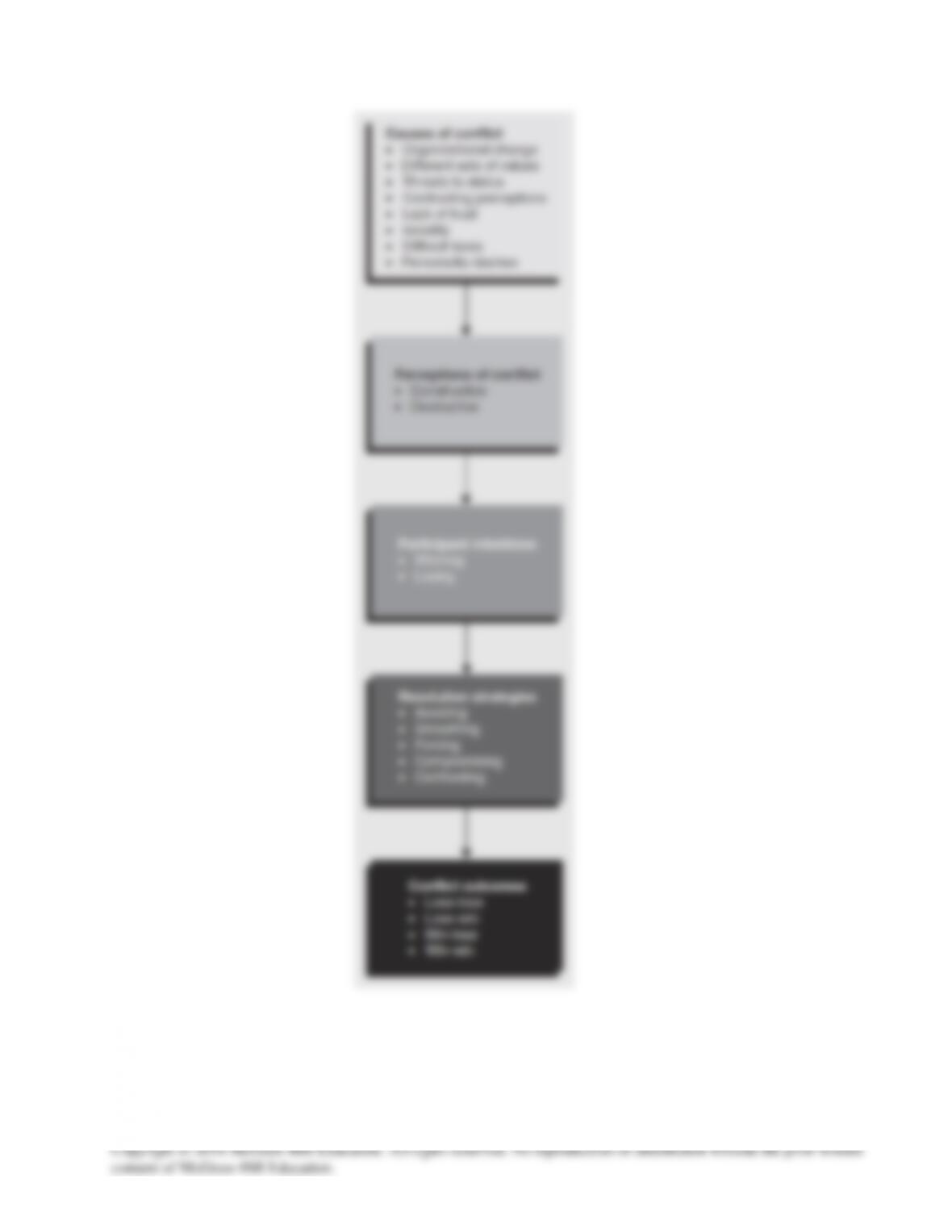
A Model of Conflict
• Conflict arises from many sources and directions.
o It varies in the speed of its emergence and the degree of its predictability.
o It can be constructive or destructive.
• Managers must know when to stimulate conflict and when to resolve it.
• Figure 11.1 portrays the conflict resolution process.
11-8
Copyright © 2014 McGraw-Hill Education. All rights reserved. No reproduction or distribution without the prior written
consent of McGraw-Hill Education.
• If conflict will be harmful, managers must apply a conflict resolution strategy to prevent,
diminish, or remove it.
• Conflict Outcomes
o Conflict may produce four distinct outcomes; depending on the approaches taken by
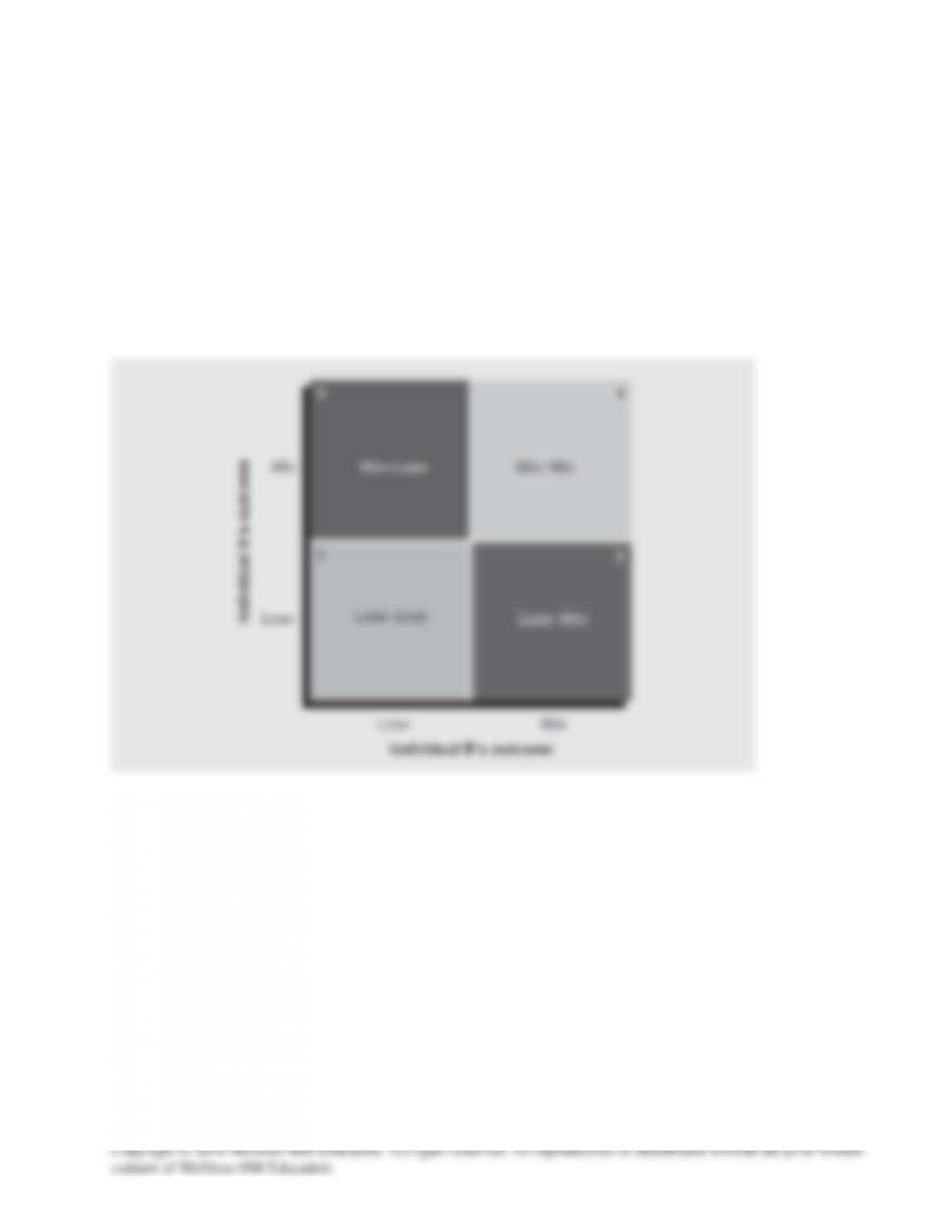
11-9
the people involved. Figure 11.3 illustrates these outcomes.
▪ Lose-Lose
▪ Lose-Win
▪ Win-Lose
▪ Win-Win
o The fourth quadrant is the win–win outcome of conflict, in which both parties perceive
they are in a better position than they were before the conflict began.
▪ This is the preferred outcome to try to achieve in ongoing relationships, such as
with suppliers, customers, and employees.
• Participant Intentions
o Conflict outcomes are a product of the participants’ intentions as well as their
strategies.
o An individual may seek a lose-win outcome with another individual because of the
perceived benefits of being defeated on a particular issue.
▪ He or she may fear the consequences of retribution from too many earlier
victories over the same individual.
▪ He or she may try to lose so the other individual will reciprocate on another issue
in the future.
• Resolution Strategies
o Intentions help participants select their strategies.
o Once chosen, the strategies implemented will have a substantial impact on the
11–10
outcomes reached.
o There are at least four clearly different strategies, plus a combination one, called
compromising. Each strategy represents different degrees of concern for one’s own and
another’s results, and each has a predictable outcome:
▪ Avoiding—physical or mental withdrawal from the conflict; low concern for
either party’s outcomes; often results in a lose-lose situation.
▪ Smoothing—accommodating the other party’s interests; emphasis on concern for
▪ Confronting—facing the conflict directly and working it through to a mutually
satisfactory resolution; known as problem solving or integrating; this tactic seeks
to maximize the achievement of both party’s goals; results in a win-win outcome.
o The avoiding and smoothing approaches are useful for hiding or diminishing the
conflict process:
▪ These approaches control the degree of conflict and reduce its harmful side
effects, but the source of conflict still exists.
▪ The same is true when two parties compromise their positions for the sake of
reaching a solution.
▪ The idea of compromise is seductive if the objective is to escape conflict at
minimal cost, but it often stifles creativity.
▪ A forcing approach may achieve a short-term goal, but often irreparably harms
the long-term relationship between the parties.
o Only the confronting strategy can truly be viewed as a resolution approach since this
method addresses the basic differences involved and eventually removes them through
creative problem solving.
▪ Both parties are likely to see the recent conflict as productive, since both received
gains.
11–11
Copyright © 2014 McGraw-Hill Education. All rights reserved. No reproduction or distribution without the prior written
consent of McGraw-Hill Education.
o A wide variety of other tools and ideas have been successfully used to resolve conflicts:
▪ Sometimes the simple application of a relevant rule or policy can solve a dispute.
▪ Other times, the parties can be separated by reassigning work spaces, removing
one person from a committee, or placing workers on different shifts.
▪ Another alternative is to insert a third party into the interaction—a consultant,
mediator, or other neutral person who can ignore personal issues and facilitate
resolution.
▪ A constructive approach is to challenge the parties to work together toward a
unifying goal, such as higher revenues or better customer satisfaction.
• Relationship-Restoring Approaches
o Stable working relationships sometimes get damaged through actions or statements by
another.
o Goffman and other suggest this rebuilding is best viewed as requiring four stages:
▪ Signaling the offense
▪ Acknowledgment of error
▪ Acceptance
▪ Appreciation
• Negotiating Tactics
o Guidelines for resolving conflicts in a win-win fashion
▪ Select a neutral site
▪ Arrange the seating in a comfortable fashion
▪ Don’t permit observers to be present
▪ Set deadlines to force a resolution
o Individual negotiators are advised to
▪ Set minimum and optimum goals in advance
▪ Engage in a thorough data gathering process
▪ Listen carefully to what the other party says and how it is said
▪ Avoid blaming and name-calling

11–12
▪ Focus on issues, not personalities
▪ Separate facts from feelings
▪ Search for areas where concessions on important topics can be obtained, while
making matching concessions in areas of lesser interest
• Trust-Building
o The absence of trust increases the chance of conflict.
o Trust, the capacity to depend voluntarily on each other’s words and actions, implies a
willingness to take interpersonal risks and to be vulnerable.
o Trust is an essential ingredient in enduring relations between two or more people
working together.
o Trust toward another person can be expressed by showing respect, exhibiting sincere
caring and concern, by being honest and true to one’s word, and by demonstrating
dependability and reliability.
o By contrast, trust can be rapidly dissolved by:
▪ Telling half-truths and lies,
▪ Showing inconsistencies between promises and actions
▪ Threatening the goal achievement or self-image of others
▪ Withholding needed information from others
o The benefits of trust are manifold.
▪ Its presence encourages risk-taking, facilitates free flows of information, and
contributes to cooperative relationships.
▪ It eliminates much of the perceived need to monitor someone else’s behavior in a
tightly controlling way.
▪ Overall, trust leads to a more satisfying relationship with others—supervisors, co-
workers, and subordinates.
Assertive Behavior
• Confronting conflict is not easy for some people.
o Some managers may feel inferior, lack necessary skills, or be awed by the other person’s
power.
▪ Under these conditions, they are likely to suppress their feelings or strike out in
unintended anger. Neither response is productive.
• A constructive alternative to confronting conflict is to practice assertive behaviors.
o Assertiveness is the process of expressing feelings, asking for legitimate changes, giving
and receiving honest feedback.
• An assertive individual is not afraid to request another person to change an offensive behavior
and is willing to refuse unreasonable requests from someone else.
o Assertiveness training involves teaching people to develop effective ways of dealing
with a variety of anxiety-producing situations.