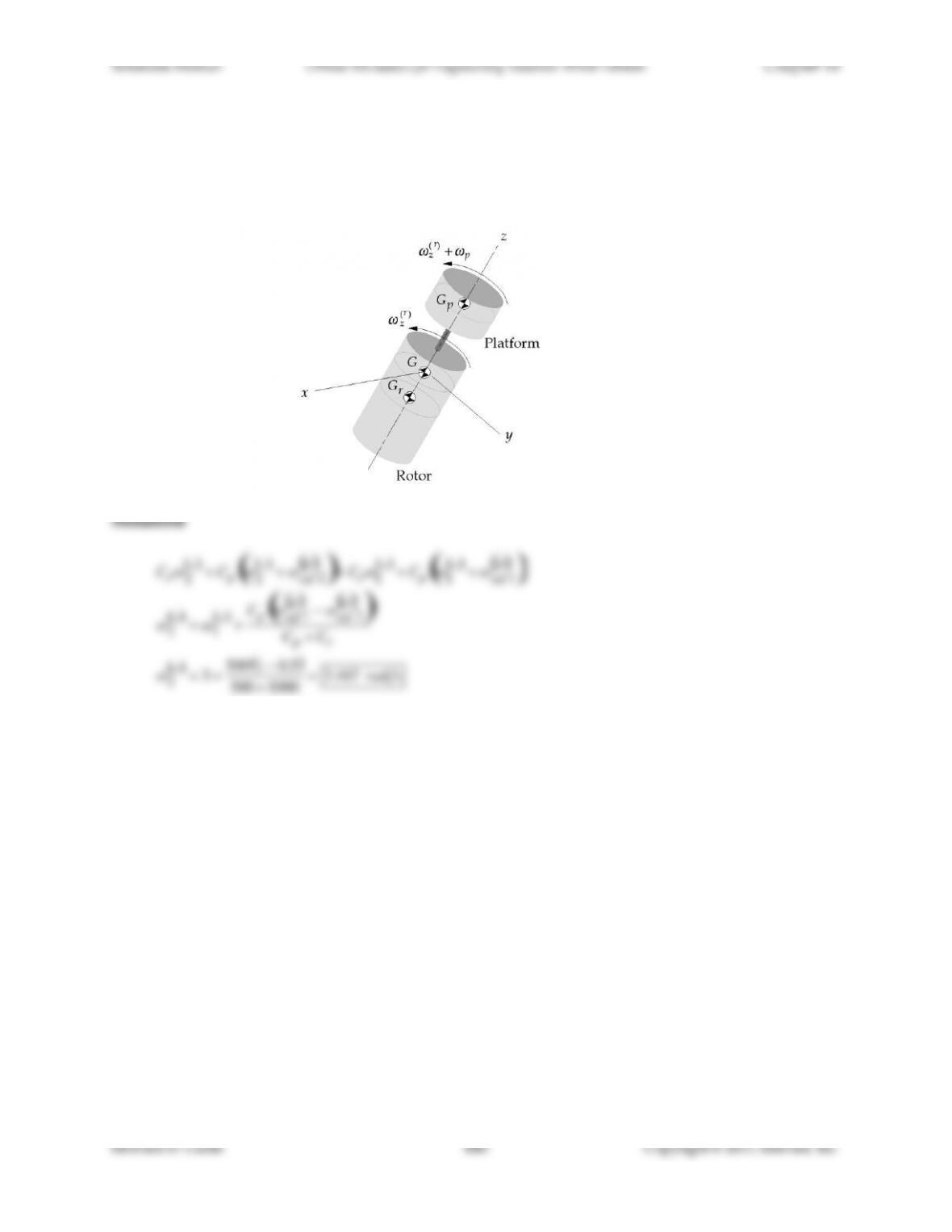
Problem 10.12 For a nonprecessing, dual-spin satellite,
Cr1000 kg m2
and
Cp500 kg m2
. The
angular velocity of the rotor is
3ˆ
k
rad/s and the angular velocity of the platform relative to the rotor is
1ˆ
k
rad/s. If the relative angular velocity of the platform is reduced to
0.5 ˆ
k
rad/s, what is the new
angular velocity of the rotor?
2
1
CpCr
2
r
3500 1 0.5
500 1000 3.167 rad s
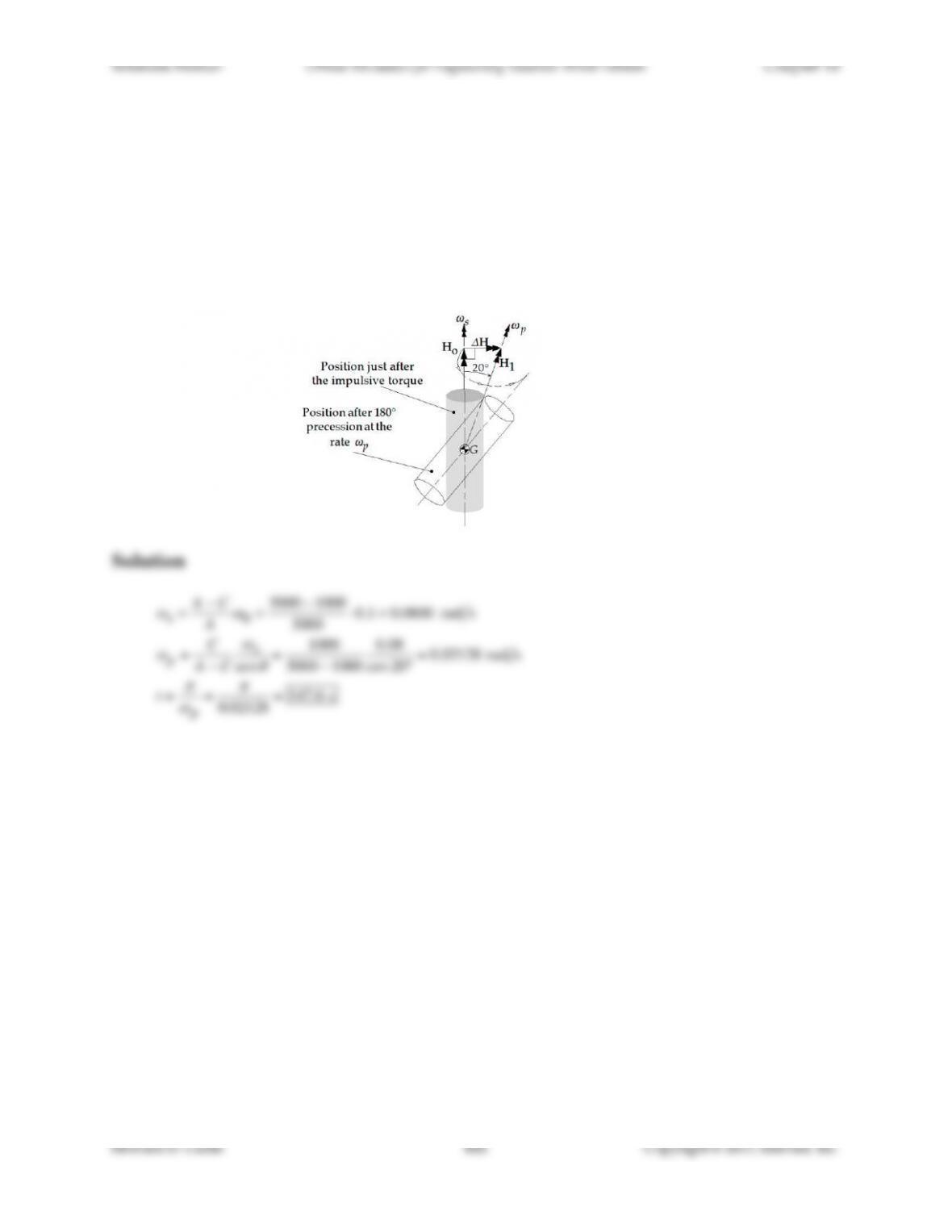
Problem 10.13 For a rigid axisymmetric satellite, the mass moment of inertia about its long axis is
1000 kg m2
, and the moment of inertia about transverse axes through the center of mass is
5000 kg m2
.
It is initially spinning about the minor principal body axis in torque-free motion at
s0.1 rad/ s
, with
the angular velocity lined up with the angular momentum vector
H0
. A pair of thrusters exert an
external impulsive torque on the satellite, causing an instantaneous change
H
of angular momentum in
the direction normal to
H0
, so that the new angular momentum is
H1
, at an angle of 20° to
H0
, as
shown in the figure. How long does it take the satellite to precess (“cone”) through an angle of 180°
around
H1
?
pC
AC
cos
5000 1000
cos 200.02128 rad s
t
p
0.02128 147.6 s
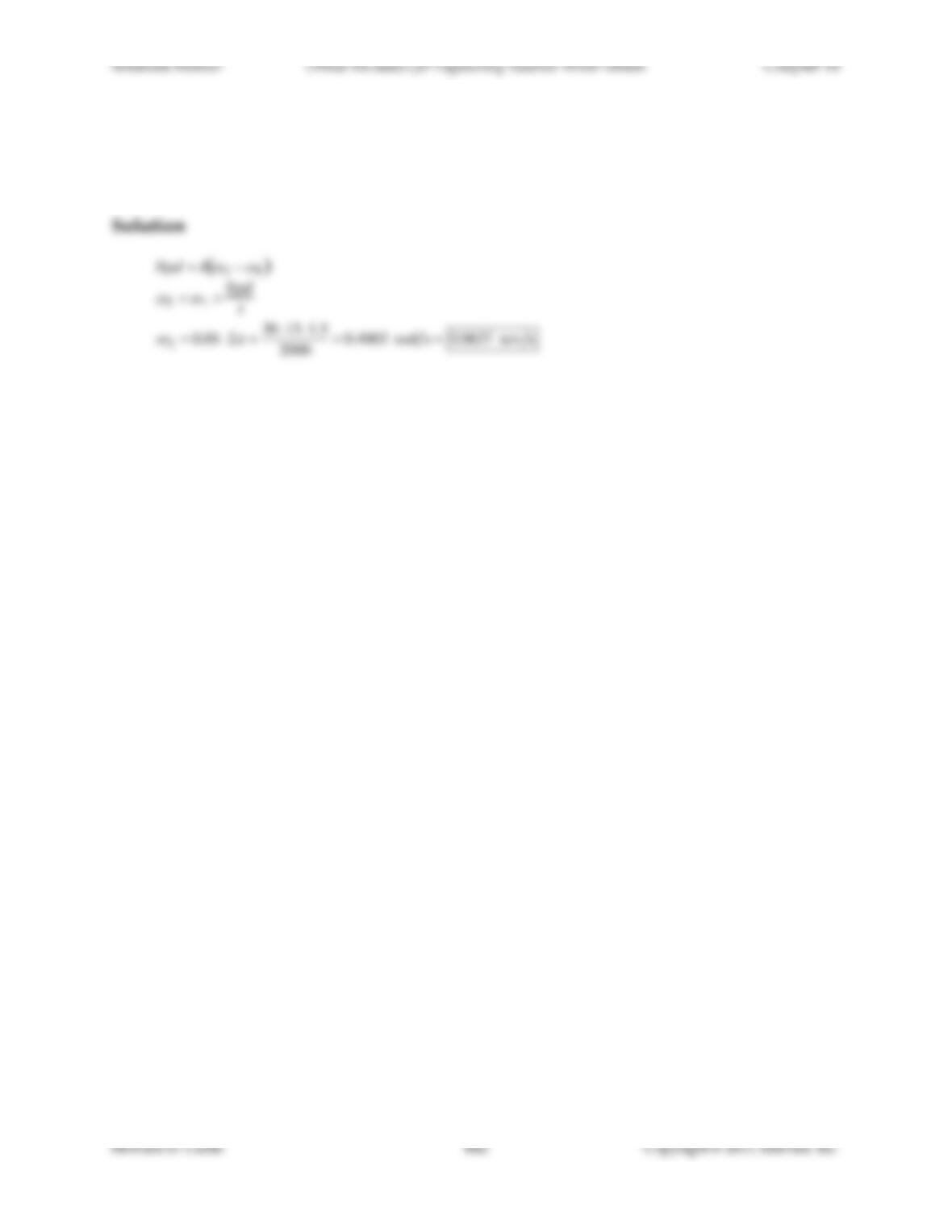
Problem 10.14 A satellite is spinning at 0.01 rev/s. The moment of inertia of the satellite about the spin
axis is 2000 kg-m2. Paired thrusters are located at a distance of 1.5 m from the spin axis. They deliver their
thrust in pulses, each thruster producing an impulse of 15 N-s per pulse. At what rate will the satellite be
spinning after 30 pulses?
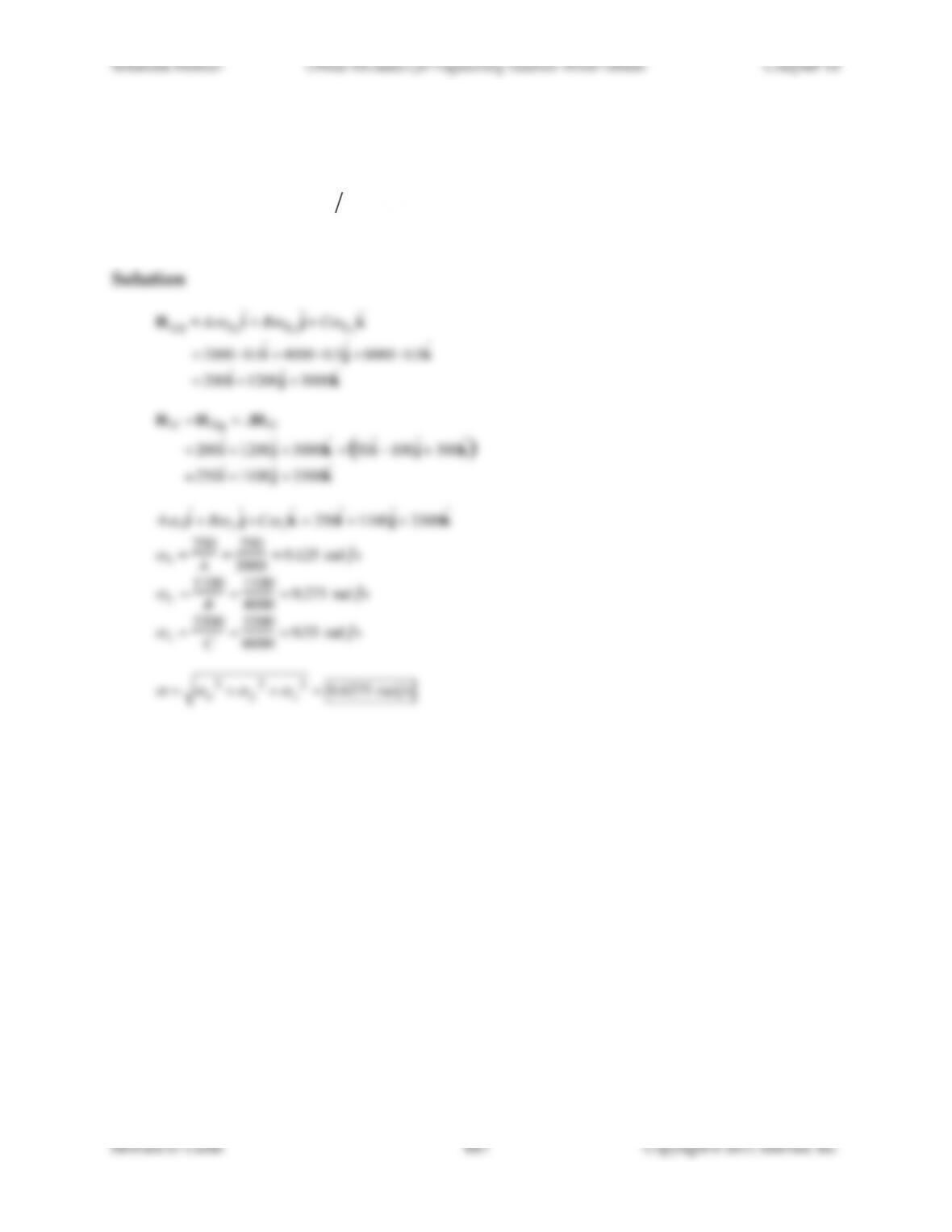
Problem 10.15 A satellite has moments of inertia
A2000 kg m2
,
B4000 kg m2
and
C6000 kg m2
about its principal body axes xyz. Its angular velocity is
0.1ˆ
i0.3ˆ
j0.5 ˆ
k
(rad/s). If
thrusters cause the angular momentum vector to undergo the change
HG50ˆ
i100ˆ
j300 ˆ
k kg m2s
, what is the magnitude of the new angular velocity?
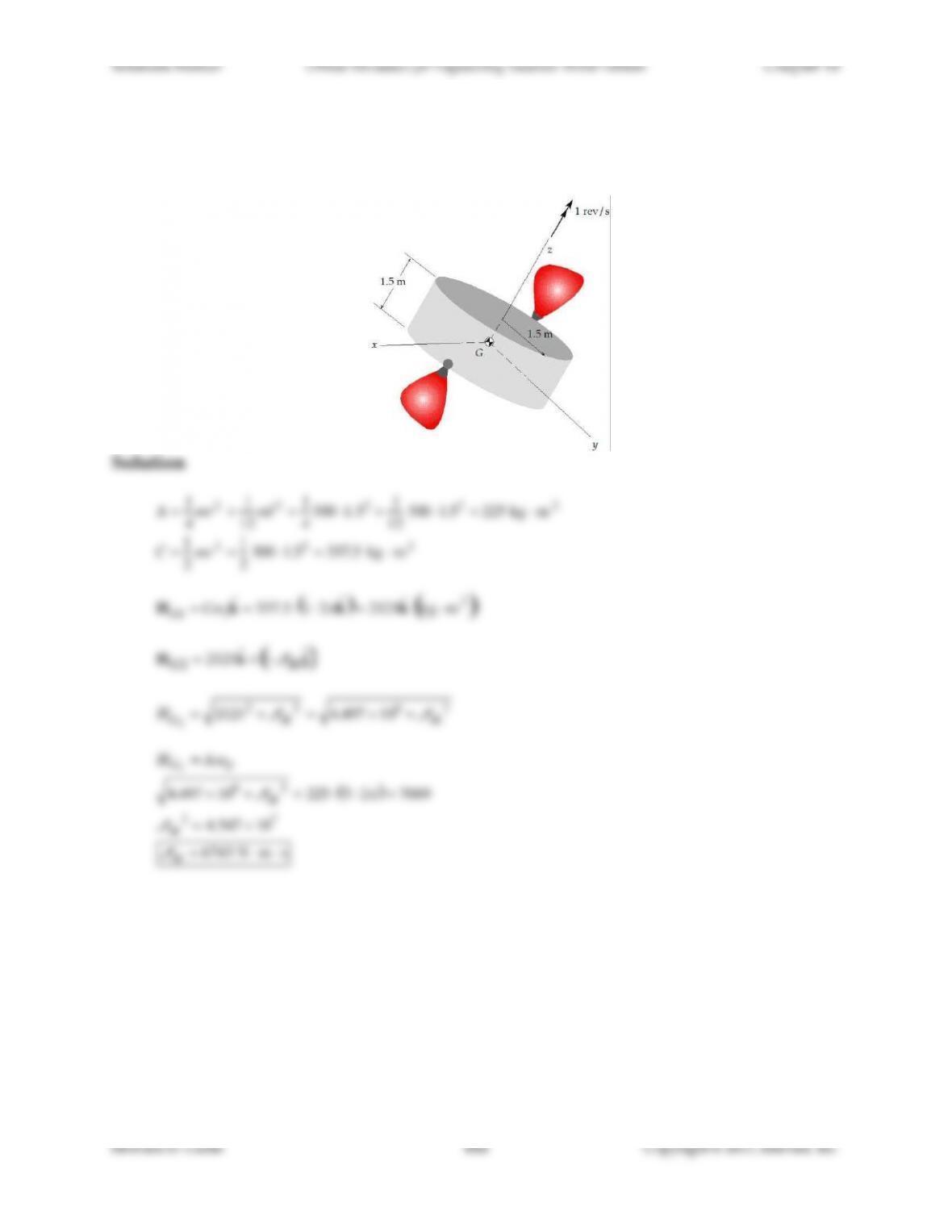
Problem 10.16 The body-fixed xyz axes are principal axes of inertia passing through the center of mass
of the 300 kg cylindrical satellite, which is spinning at 1 revolution per second about the z axis. What
impulsive torque about the y axis must the thrusters impart to cause the satellite to precess at 5
revolutions per second?
Problem 10.17 A satellite is to be despun by means of a tangential-release yo-yo mechanism consisting
of two masses, 3 kg each, wound around the mid plane of the satellite. The satellite is spinning around its
axis of symmetry with an angular velocity
s5 rad sec
. The radius of the cylindrical satellite is 1.5 m
and the moment of inertia about the spin axis is
C300 kg m2
.
(a) Find the cord length and the deployment time to reduce the spin rate to 1 rad/s.
(b) Find the cord length and time to reduce the spin rate to zero.
t=K
02
0
f
0
f
23.22
52
50
500.9636 s
Problem 10.18 A cylindrical satellite of radius 1 m is initially spinning about the axis of symmetry at
the rate of two revolutions per second with a nutation angle of 15. The principal moments of inertia
are,
AB30 kg m2
,
C60 kg m2
. An energy dissipation device is built into the satellite, so that it
eventually ends up in pure spin around the z axis.
(a) Calculate the final spin rate about the z axis.
(b) Calculate the loss of kinetic energy.
(c) A tangential release yo-yo despin device is also included in the satellite. If the two yo-yo
masses are each 7 kg, what cord length is required to completely despin the satellite? Is it
wrapped in the proper direction in the figure?
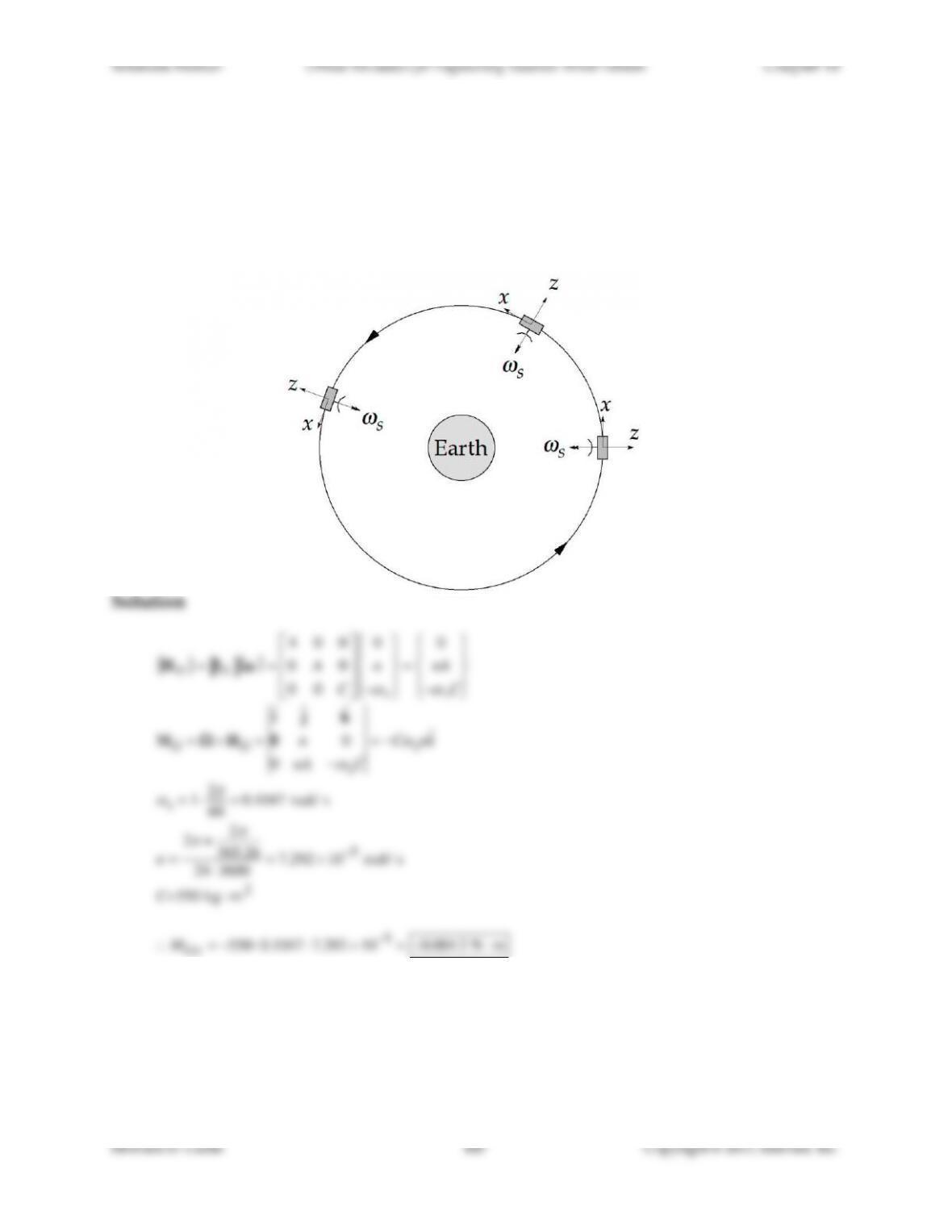
Problem 10.19 A communications satellite is in a GEO (geostationary equatorial orbit) with a period of
24 hours. The spin rate
s
about its axis of symmetry is 1 revolution per minute, and the moment of
inertia about the spin axis is
550 kg m2
. The moment of inertia about transverse axes through the mass
center G is
225 kg m2
. If the spin axis is initially pointed towards the earth, calculate the magnitude and
direction of the applied torque
MG
required to keep the spin axis pointed always towards the earth.
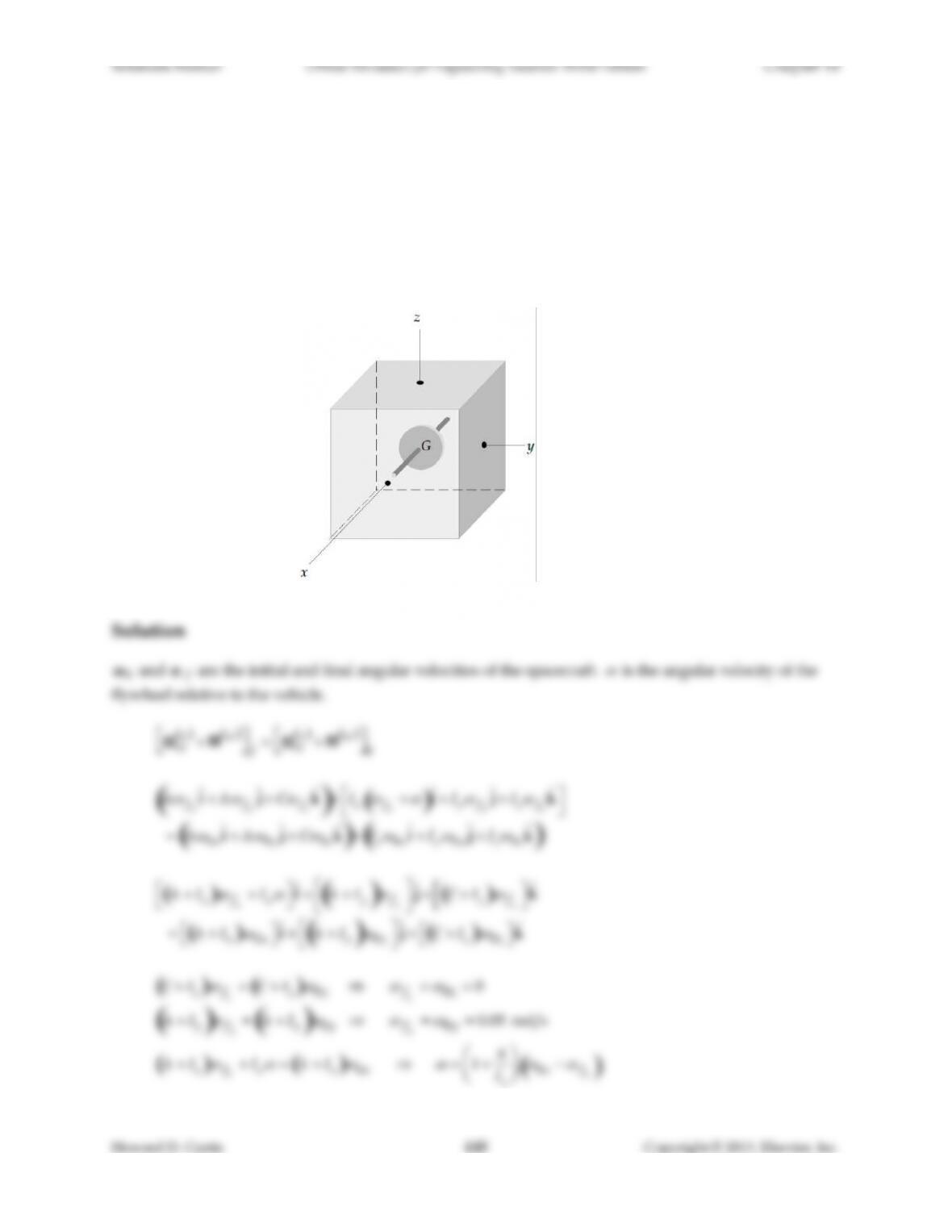
Problem 10.20 The moments of inertia of a satellite about its principal body axes xyz are
A1000 kg m2
,
B
600 kg
m
2
, and
C500 kg m2
, respectively. The moments of inertia of a
momentum wheel at the center of mass of the satellite and aligned with the x axis are
Ix20 kg m2
and
IyIz6 kg m2
. The absolute angular velocity of the satellite with the momentum wheel locked is
00.1ˆ
i0.05ˆ
j
(rad/s). Calculate the angular velocity
of the momentum wheel (relative to the
satellite) required to reduce the x–component of the absolute angular velocity of the satellite to 0.003
rad/s.

20
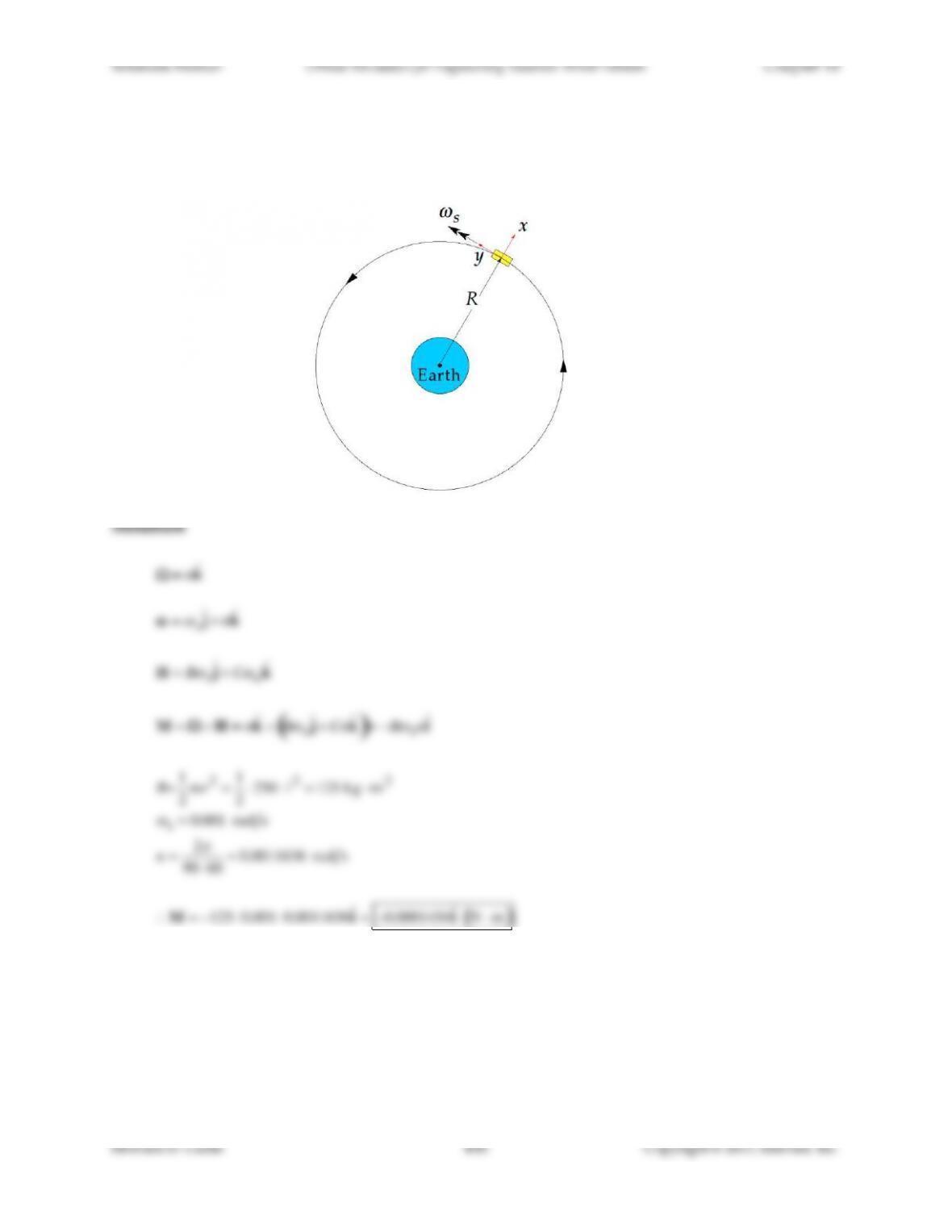
Problem 10.21 A solid circular cylindrical satellite of radius 1 m, length 4 m and mass 250 kg is in a
circular earth orbit with period 90 minutes. The cylinder is spinning at 0.001 radians per second (no
precession) around its axis, which is aligned with the y axis of the Clohessy-Wiltshire frame. Calculate the
magnitude of the external torque required to maintain this attitude.
Problem 10.20 A satellite has principal moments of inertia
A300 kg m2
,
B400 kg m2
,
C500 kg m2
. Determine the permissible orientations in a circular orbit for gravity gradient
stabilization. Specify which axes may be aligned in the pitch, roll and yaw directions. (Recall that, relative
to a Clohessy-Wiltshire frame at the center of mass of the satellite, yaw is about the x-axis (outward radial
from earth’s center); roll is about the y-axis (velocity vector); pitch is about the z-axis (normal to orbital
plane.)