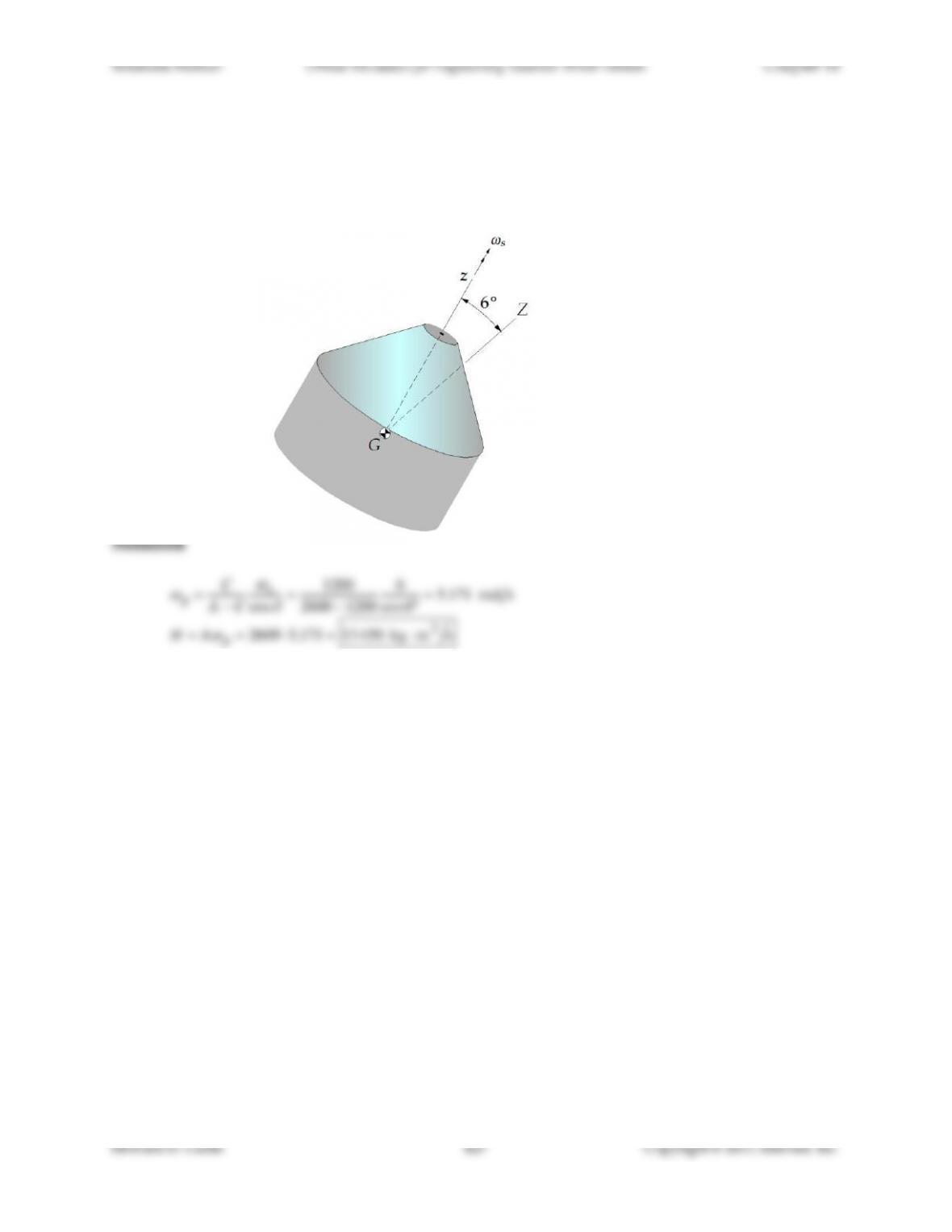
Problem 10.1 The axisymmetric satellite has axial and transverse mass moments of inertia about axes
through the mass center G of
C1200 kg-m2
and
A2600 kg–m 2
, respectively. If it is spinning at
s6 rad/ s
when it is launched, determine its angular momentum. Precession occurs about the inertial
Z axis.
HA
p2600 5.171 13 450 kg m2s
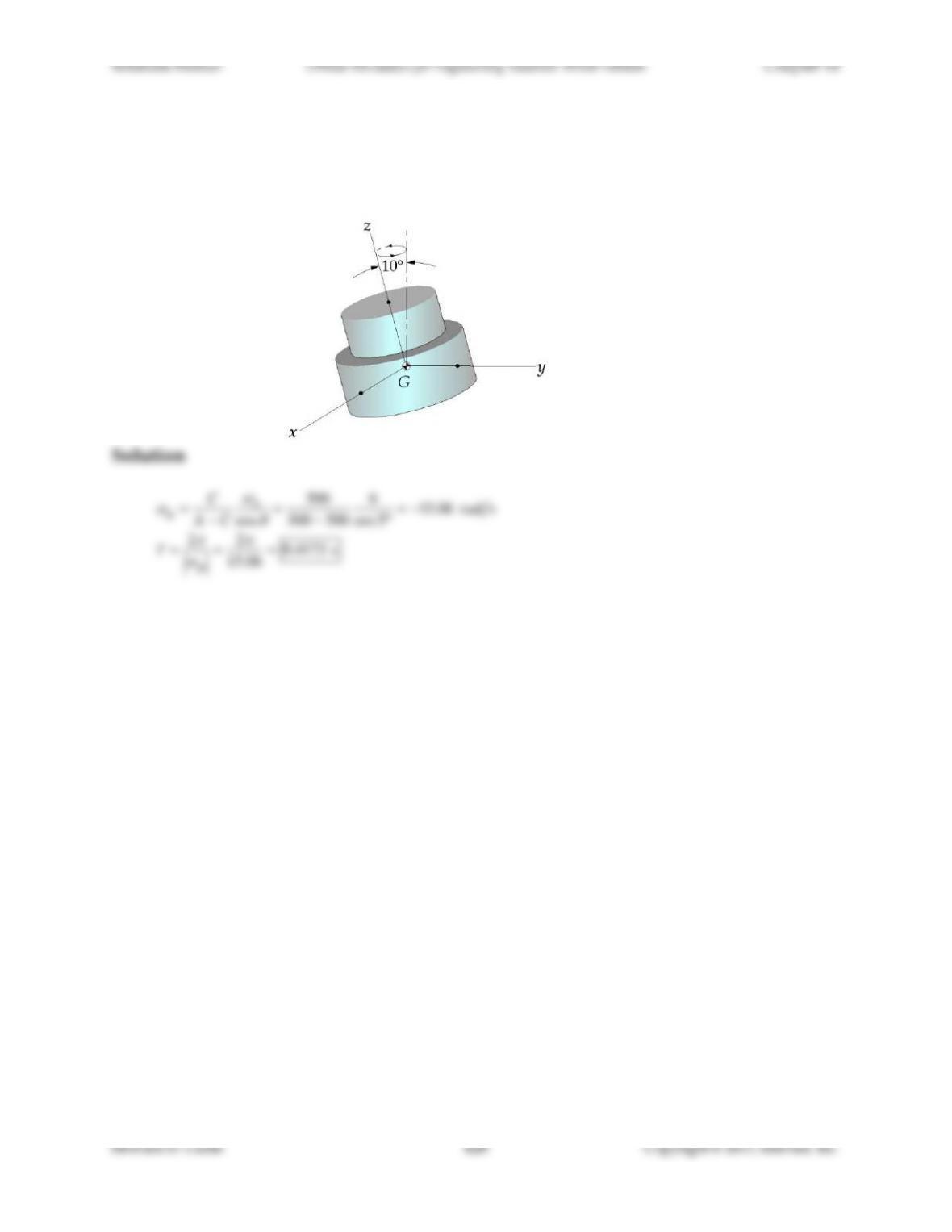
Problem 10.2 A spacecraft is symmetrical about its body-fixed z-axis. Its principal mass moments of
inertia are
AB300 kg-m2
and
C500 kg-m2
. The z axis sweeps out a cone with a total vertex angle
of 10° as it precesses around the angular momentum vector. If the spin velocity is 6 rad/s, compute the
period of precession.
T2
p
2
15.06 0.4173 s
Solutions Manual Orbital Mechanics for Engineering Students Third Edition Chapter 10
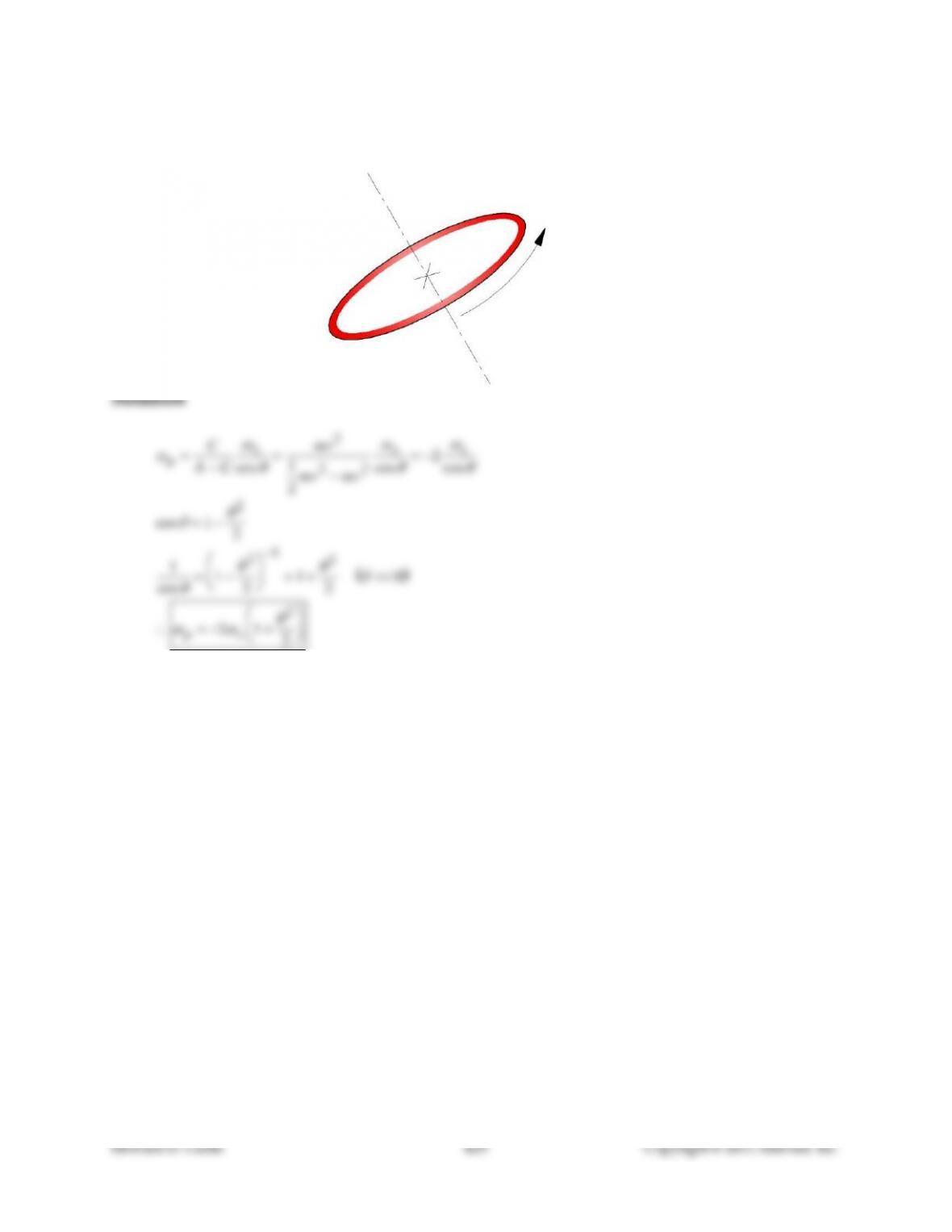
Problem 10.3 A thin ring tossed into the air with a spin velocity of
s
has a very small nutation angle
(in radians). What is the precession rate
p
?
1
cos
1
2
2
1
1
2
2
0
p 2
s1
2
2
Problem 10.4 For an axisymmetric rigid satellite,
IG
Ixx 0 0
0Iyy 0
0 0 Izz
1000 0 0
0 1000 0
0 0 5000
kg m2
It is spinning about the body z-axis in torque-free motion, precessing around the angular momentum
vector H at the rate of 2 rad/sec. Calculate the magnitude of H.
HA
p1000 22000 kg m2s
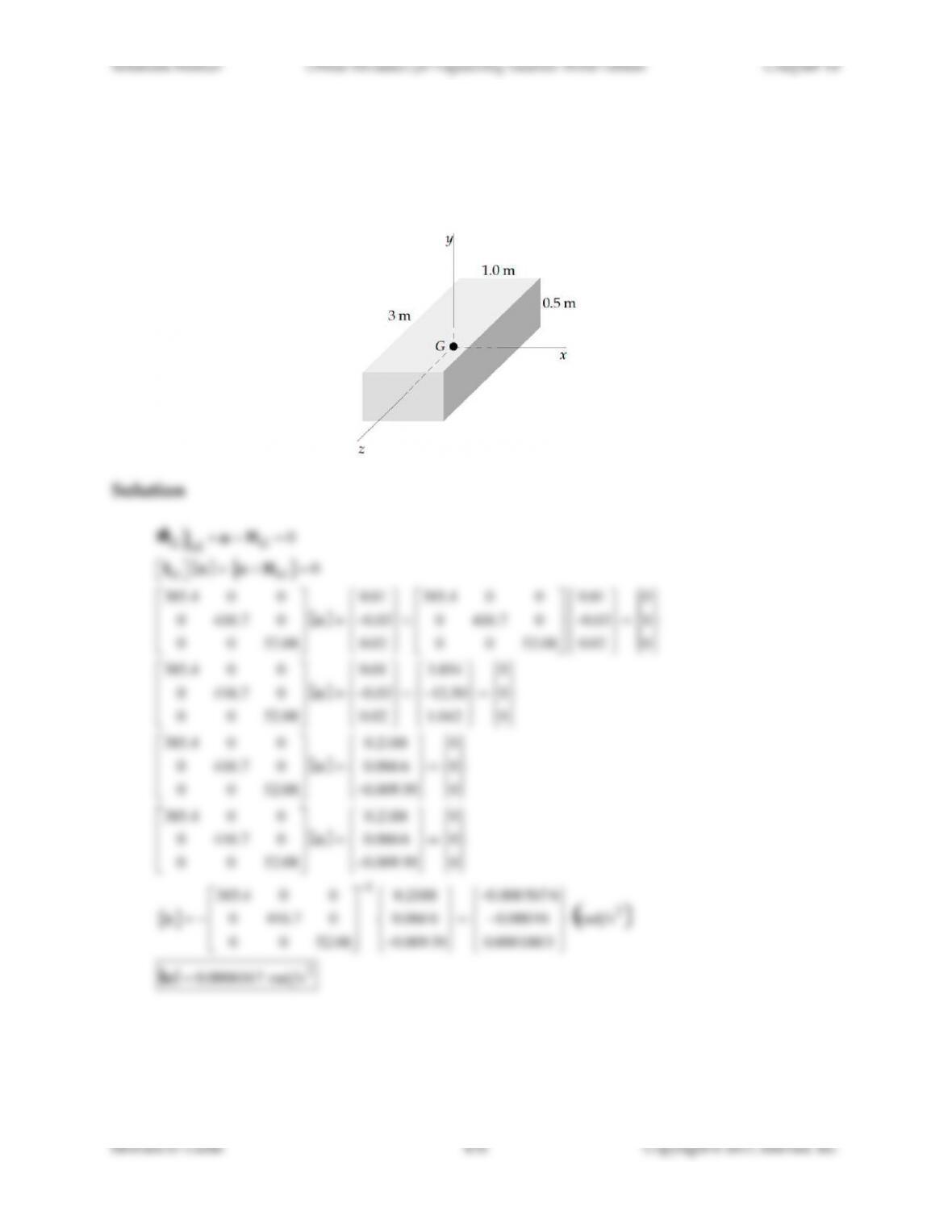
Problem 10.5 At a given instant the box-shaped 500 kg satellite (in torque-free motion) has an absolute
angular velocity
0.01ˆ
i0.03ˆ
j0.02 ˆ
k
(rad/s). Its moments of inertia about the principal body axes
xyz are
A385.4 kg m2
,
B416.7 kg m2
and
C52.08 kg m2
, respectively. Calculate the magnitude
of its absolute angular acceleration.
0.000616 7 rad s2
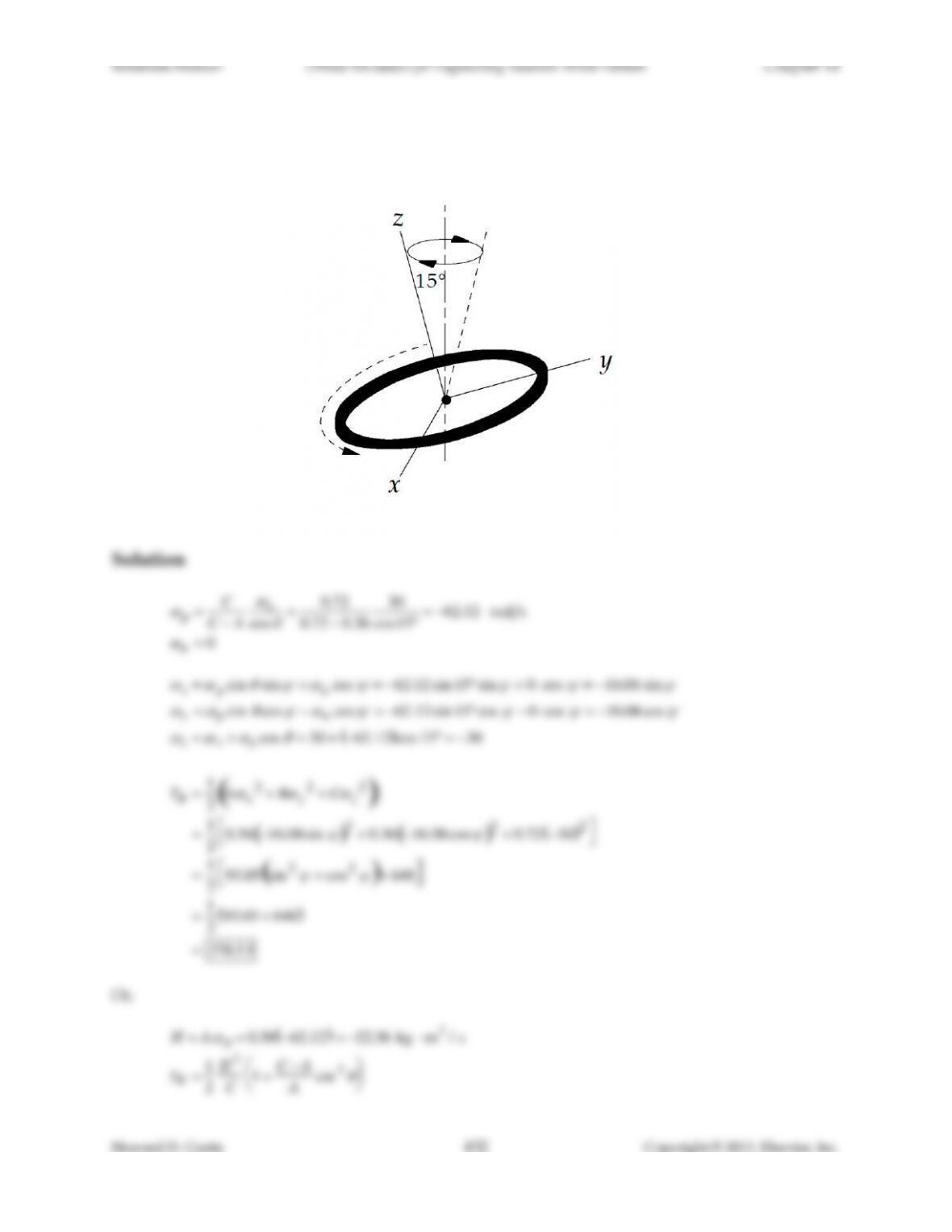
Problem 10.6 An 8 kg thin ring in torque-free motion is spinning with an angular velocity of 30 rad/s
and a constant nutation angle of 15°. Calculate the rotational kinetic energy if
AB0.36 kg-m2
,
C0.72 kg–m 2
.
22.36
2
Solutions Manual Orbital Mechanics for Engineering Students Third Edition Chapter 10
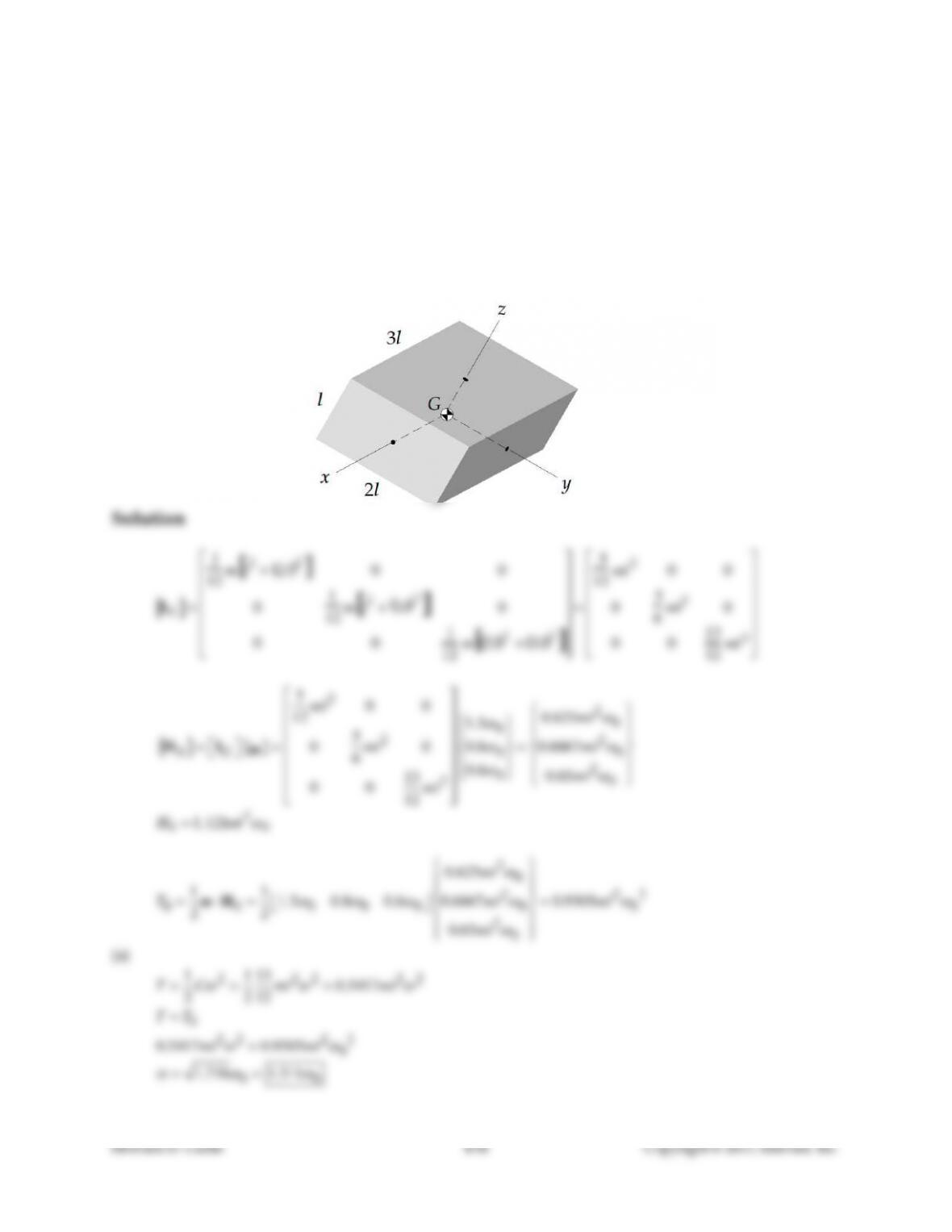
Problem 10.7 The rectangular block has an angular velocity
1.5
0
ˆ
i0.8
0
ˆ
j0.6
0
ˆ
k
, where
0
has units of rad/s.
(a) Determine the angular velocity
of the block if it spins around the body z axis with the same
rotational kinetic energy.
(b) Determine the angular velocity
of the block if it spins around the body z axis with the same
angular momentum.
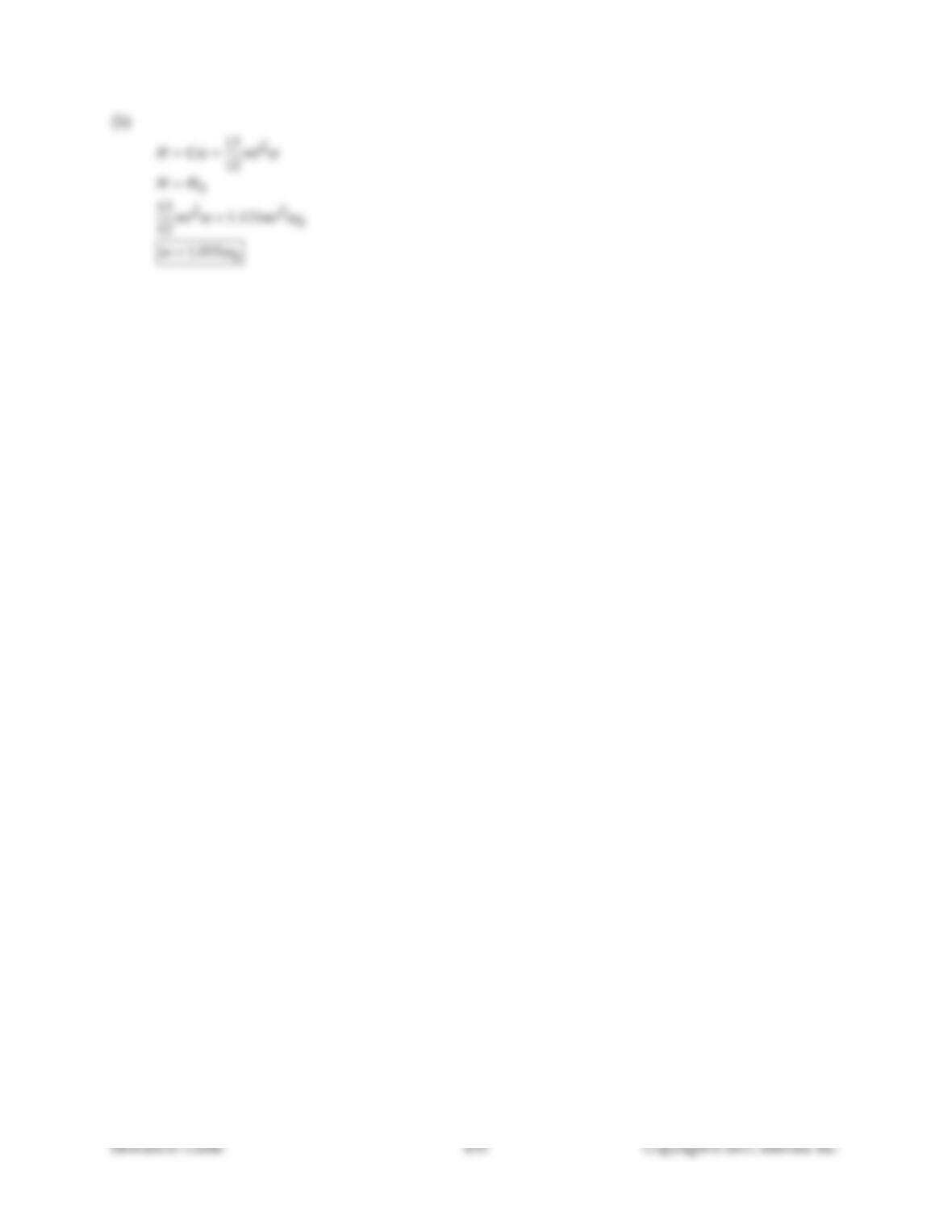
0.5417ml2
20.9305ml2
02
1.718
01.311
0
Solutions Manual Orbital Mechanics for Engineering Students Third Edition Chapter 10
13
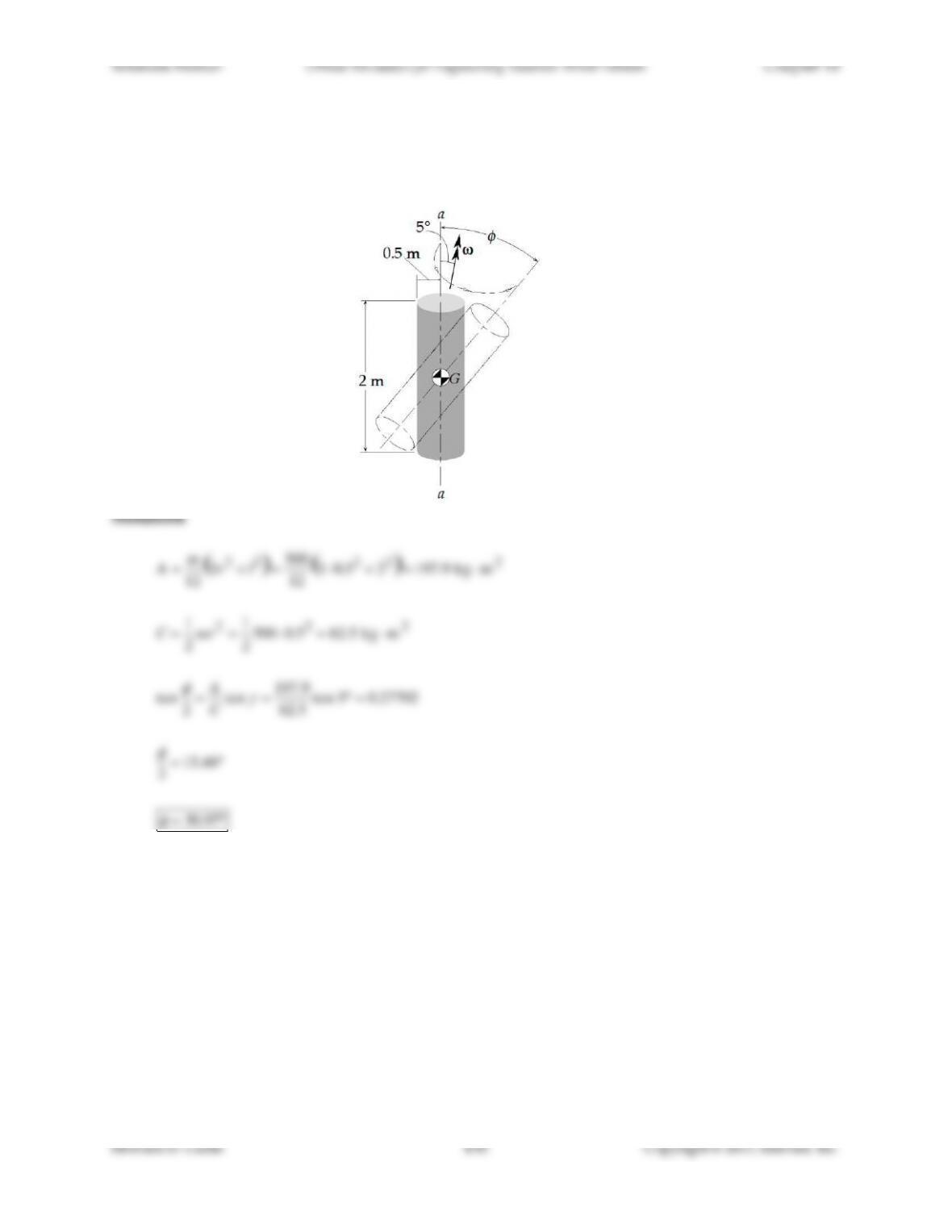
12 ml2
1.121ml2
0
1.035
0
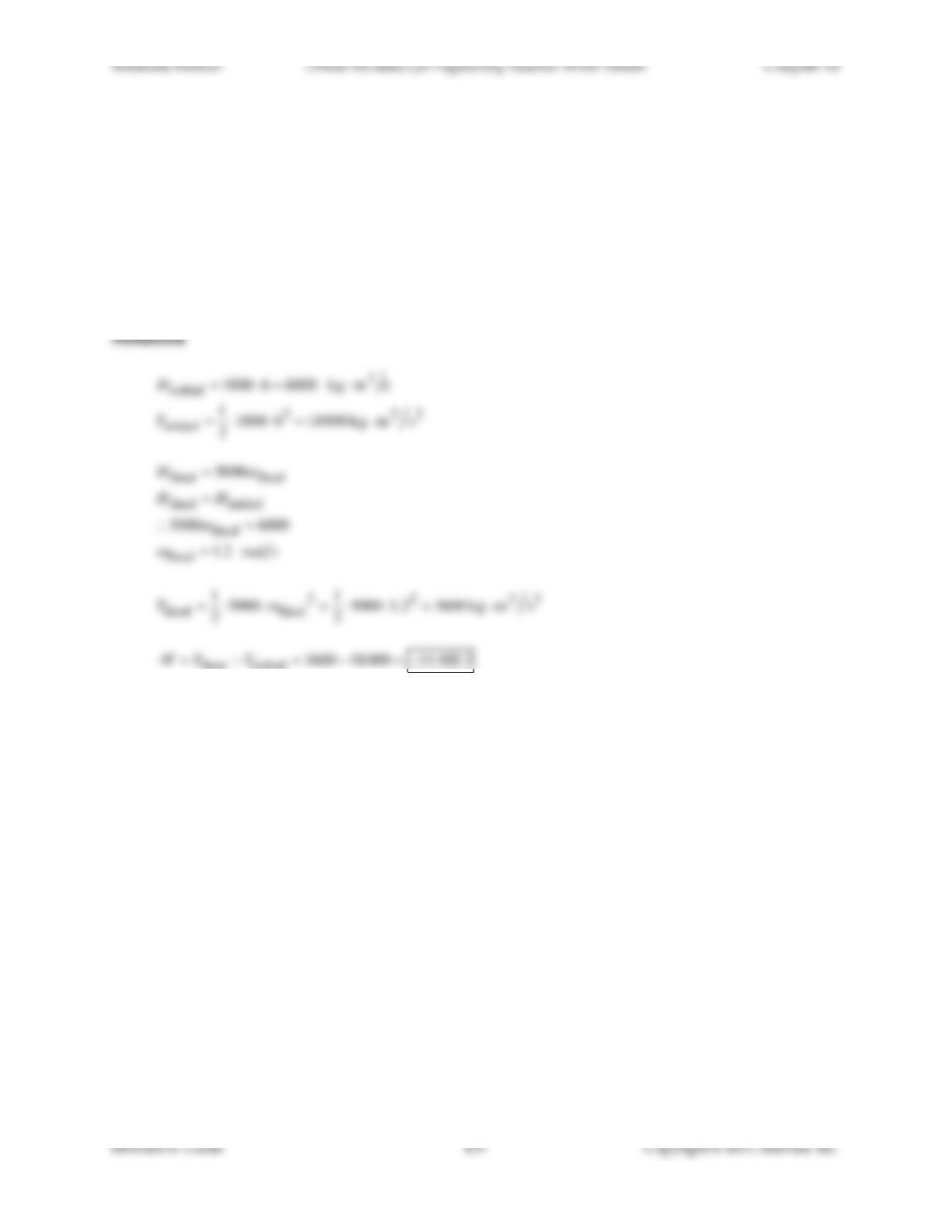
Problem 10.8 The solid right-circular cylinder of mass 500 kg is set into torque–free motion with its
symmetry axis initially aligned with the fixed spatial line a-a. Due to an injection error, the vehicle’s
angular velocity vector
is misaligned 5° (the wobble angle) from the symmetry axis. Calculate the
maximum angle
between fixed line a-a and the axis of the cylinder.
Problem 10.9 For a rigid axisymmetric satellite, the mass moment of inertia about its long axis is
1000 kg m2
, and the moment of inertia about transverse axes through the center of mass is
5000 kg m2
.
It is spinning about the minor principal body axis in torque-free motion at 6 rad/s with the angular
velocity lined up with the angular momentum vector H. Over time, the energy degrades due to internal
effects and the satellite is eventually spinning about a major principal body axis with the angular velocity
lined up with the angular momentum vector H. Calculate the change in rotational kinetic energy between
the two states.
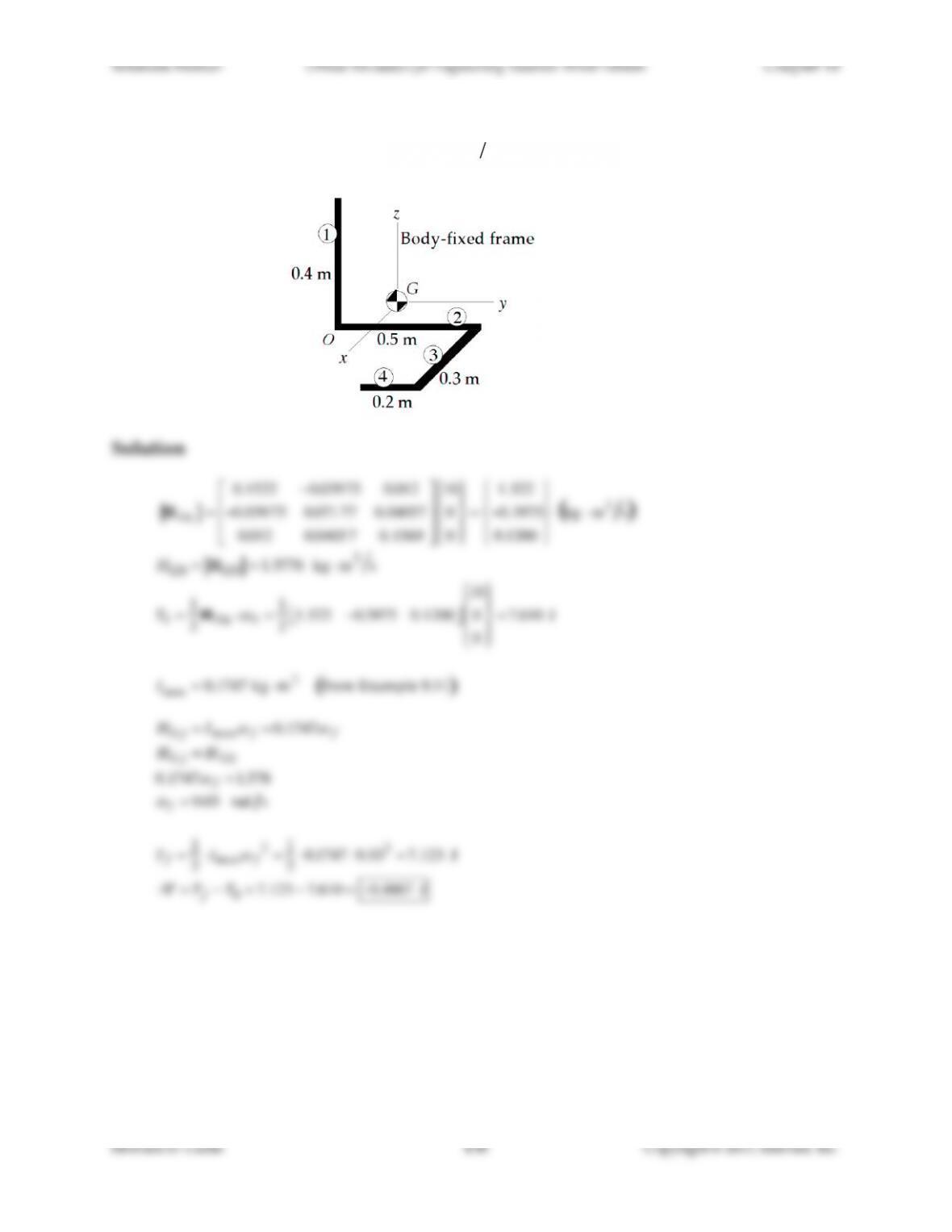
Problem 10.10 Let the object in Example 9.11 be a highly dissipative torque-free satellite, whose
angular velocity at the instant shown is
10ˆ
i rad s
. Calculate the decrease in kinetic energy after it
becomes, as eventually it must, a major axis spinner.
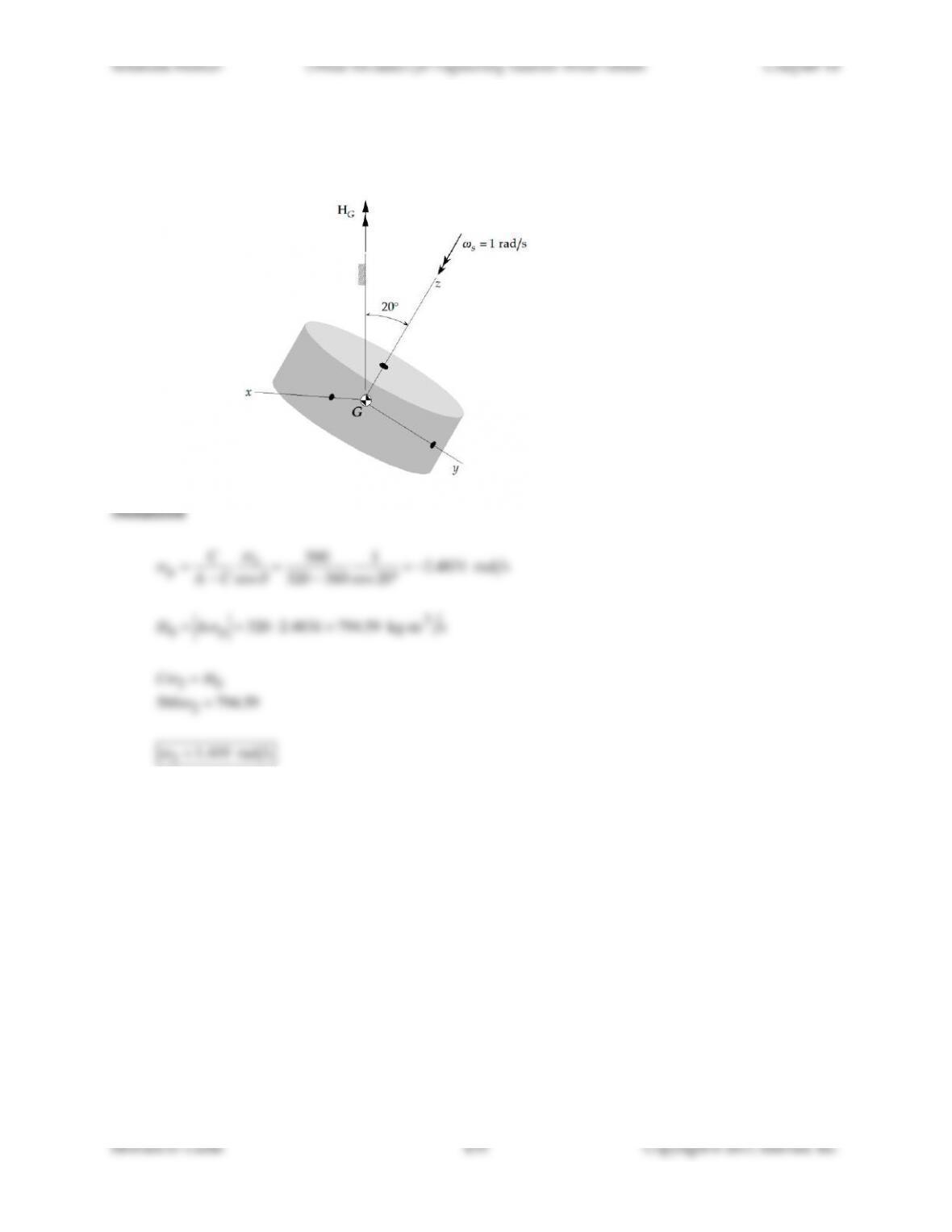
Problem 10.11 The dissipative torque-free cylindrical satellite has the initial spin state shown.
AB320 kg m2
and
C560 kg m2
. Calculate the magnitude of the angular velocity when it reaches
its stable spin state.
C
2H0
560
2794.59
21.419 rad s