10-14
Copyright © 2014 McGraw-Hill Education. All rights reserved. No reproduction or distribution without the prior written
consent of McGraw-Hill Education.
Applying Job Enrichment
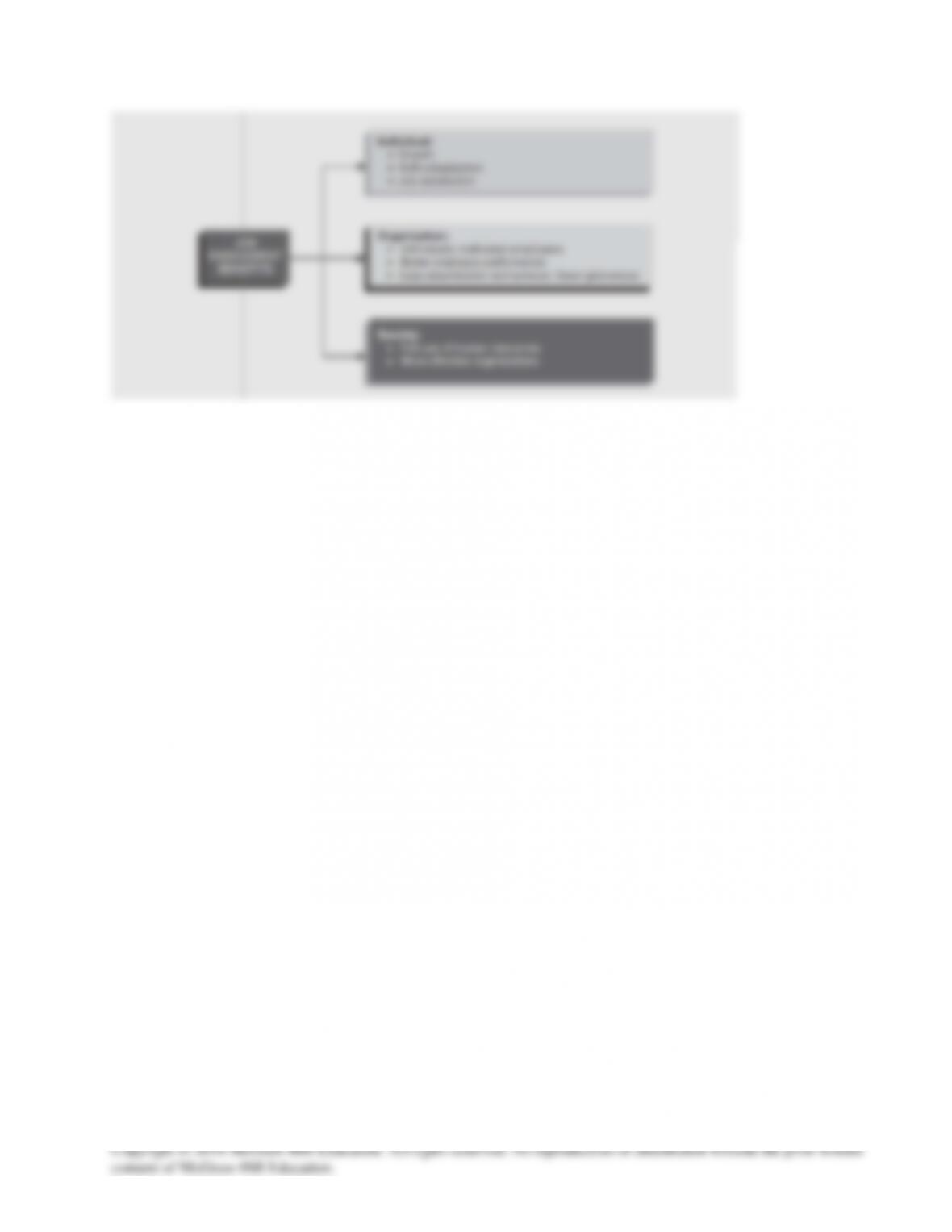
• In terms of Herzberg’s motivational factors, job enrichment occurs when:
o The work itself is more challenging
o Achievement is encouraged
o There is opportunity for growth
o Responsibility, feedback, and recognition are provided
• Employees are the final judges of what enriches their jobs.
o All that management can do is to gather information about what tends to enrich jobs,
try those changes in the job system, and determine whether employees feel that
enrichment has occurred.
• Management must also give attention to maintenance factors.
o If maintenance factors decline during an enrichment program, employees will be less
responsive to the enrichment program.
• Since job enrichment must occur from each employee’s personal viewpoint, not all
employees will choose enriched jobs if given the option.
Core Dimensions: A Job Characteristics Approach
• J. Richard Heckman and Greg Oldham developed a job characteristics approach to job
enrichment that identifies five core dimensions:
o Skill variety
o Task identity
o Task significance
o Autonomy
o Feedback
▪ Ideally a job must have all five dimensions to be fully enriched.
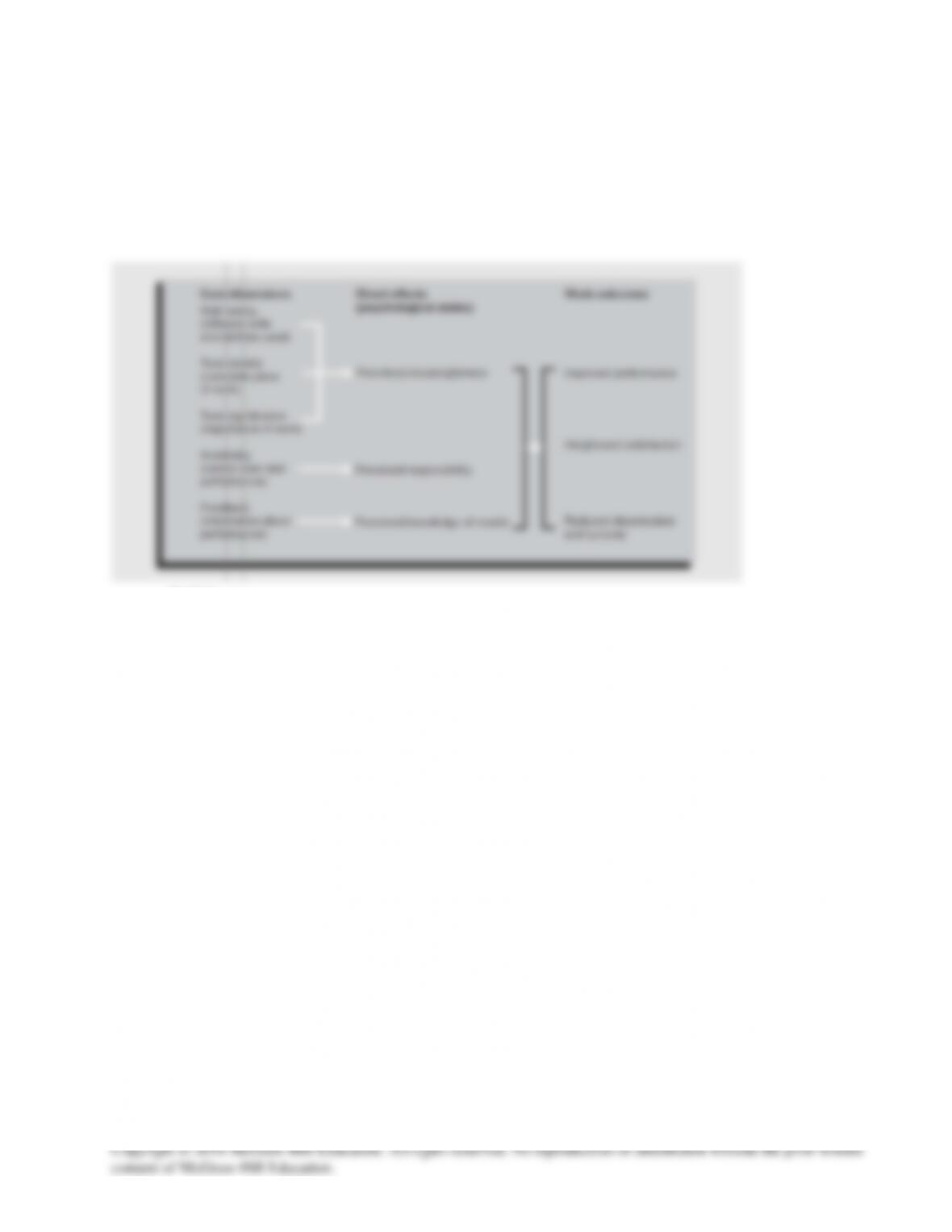
• The core dimensions affect an employee’s psychological state, which tends to:
o Improve performance, satisfaction, and quality of work
10-15
o Reduce turnover and absenteeism
▪ Their effect on quality of work is less dependable.
• Although there are large individual differences in how employees react to core dimensions,
the typical employee finds them to be basic for internal motivation.
• The dimensions and their effects are shown in Figure 10.7.
• Skill Variety
o Skill variety allows employees to perform different operations that often require
different skills.
▪ It differs from the job breadth element because an enlarged job may still use the
same skills on different tasks or products.
o Jobs high in variety are seen as more challenging because of the range of skills
involved.
▪ These jobs relieve the monotony that develops from any repetitive activity.
▪ Variety gives employees a greater sense of competence, because they can
perform different kinds of work in different ways.
• Task Identity
o Task identity allows employees to perform a complete piece of the work, which
provides a sense of completion or responsibility for the whole product.
• Task Significance
o Task significance refers to the amount of impact, as perceived by the worker that the
work has on other people.
▪ The impact can be on others in the organization or on those outside the firm.
o The key point is that workers should believe that they are doing something important in
their organization or society, or both.
• Autonomy
o Autonomy is the job characteristic that gives employees some discretion and control

10-16
over job-related decisions.
▪ It appears to be fundamental in building a sense of responsibility in workers.
• Feedback
o Feedback refers to information that tells workers how well they are performing.
▪ It can come directly from the job itself, or it can be given verbally by
management and other employees.
▪ It can be positive or negative, but is best when appropriately balanced.
▪ It should be early and continuous, rather than delayed and sporadic.
o Feedback is highly significant to people at work.
▪ They are investing a substantial part of their lives in their work, so they want to
know how well they are doing.
▪ Because performance does vary, they need to know how they are performing
often (now).
Enrichment Increases Motivation
• The degree to which the five core dimensions are present in jobs must be evaluated before
job enrichment can take place.
o Employees need to be involved in this assessment, because their perceptions are most
important.
• After data are collected, usually by survey, an overall index for a job may be computed.
o The overall index indicates the degree to which the job is perceived to:
▪ Be meaningful (a combination of variety, identity, and significance)
▪ Foster responsibility (autonomy)
▪ Provide knowledge of results (feedback)
• Enriched jobs increase the probability of high motivation, provided that employees:
o Have adequate job knowledge and skills
o Desire to learn, grow, and develop
o Are satisfied with their work environment (are not distracted by negative hygiene
factors)
• Most job enrichment attempts have been conducted in manufacturing operations, but many
have been attempted in banks, insurance companies, and other service organizations.
Social Cues Affect Perceptions
• Not all attempts to enrich jobs have been successful.
o Employee perceptions of the core characteristics may not change, despite objective
evidence that the job actually was changed.
• One explanation for the lack of predicted changes from enrichment lies in the presence of
social cues, which are often rather subtle bits of positive or negative information workers
receive from their social surroundings.
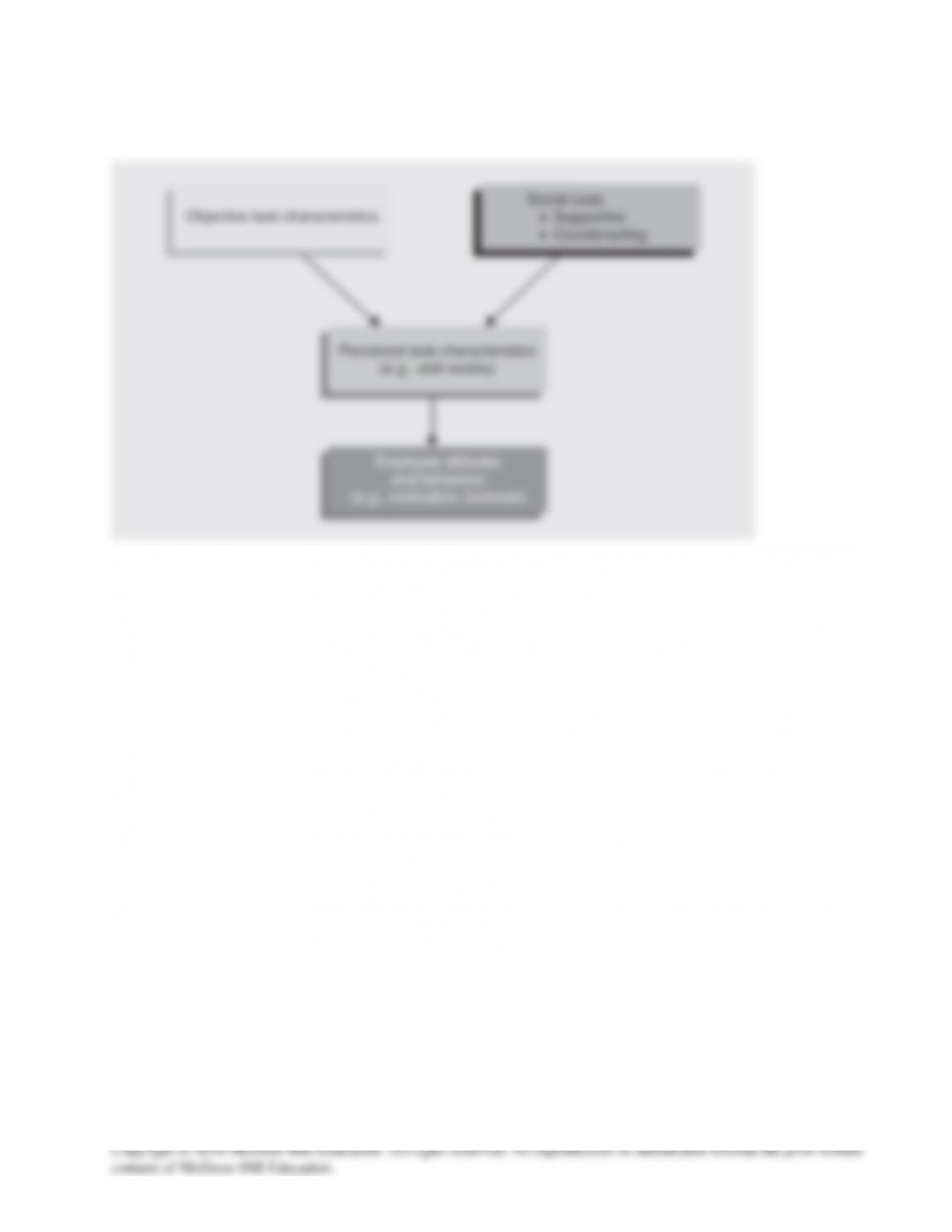
o Social cues may serve either to support or to counteract the direction of the objective
10-17
task characteristics, as shown in Figure 10.8.
• The key to job enrichment lies in how employees use the social cues provided by their peers
and others to arrive at their own perception of their jobs.
o This activity, called social information processing, covers three elements:
▪ Peers may suggest which of the job characteristics really count to them.
▪ They may offer their personal model regarding the weighting of each core
dimension.
▪ They may provide direct or indirect clues about their own judgments of the
dimensions.
• An integrated approach to job design suggests that managers focus on managing the social
context of job changes, as well as the job enrichment process itself.
o They must discover which groups are important sources of social cues.
o They can also create expectations that the enriched jobs will have more of certain
dimensions and thereby be more satisfying.
Contingency Factors Affecting Enrichment
• Job enrichment does not apply to all types of situations.
o It applies more easily to higher-level jobs, which are less likely to be dictated by
technological processes.
o If the technology is stable and highly automated, the costs may be too great in relation
to rewards.
o Some workers do not want increased responsibility or more complex tasks, and other
workers do not adapt to the groups interaction that is sometimes required.
10-18
• Job enrichment may upset pay relationships.
o Employees may expect more than intrinsic satisfaction for the additional duties and
responsibilities they assume.
o Many other costs and limitations exists other than pay.
o Equipment and floor space may have to be redesigned.
o Inventories may need to be increased, training costs may go up, and turnover may
initially increase.
o Union may resist enrichment attempts if existing job classifications are upset.
The Individual’s Responsibilities to the Organization
• The employment relationship is two-way.
o The organization has responsibilities to the individual.
o The individual has responsibilities to the organization.
• Employment is a mutual transaction and a social exchange.
o Each employee makes certain membership investments in the organization and expects
profitable rewards in return.
• A relationship is profitable for either party when benefits (outputs) are larger than costs (inputs)
measured in a total value system.
o The profitable relationship deteriorates if either party fails to act responsibly toward the
needs of the other.
maintain a successful operating system.
• Individual’s responsibilities to the organization include:
o Dues-paying
Organizational Citizenship
10-19
• Employees are expected to go beyond their job descriptions and be good organizational
citizens.
o This parallels the way the organization is expected to behave in the broader society in
which it operates.
• Employees who are organizational citizens engage in positive social acts designed to benefit
others.
• Typical categories of citizenship include:
o Helping others (altruism) and cooperating with them (sharing time and resources)
o Civic virtue (attending meetings and complying with rules and procedures)
Dues-Paying
• Dues-paying consists of the total “costs” that a person’s group believes an individual should
pays for the privileges of full acceptance and continuing membership in it. These costs might
include:
o Minimum qualifications of the employee
o Willingness to work without complaining about undesirable tasks
o Showing respect to others
o Not acting superior to others
o Spending the appropriate amount of time at one’s job
• Dues-paying has several key characteristics:
o It is a perceptual phenomenon
o It is judged by many different observers
o It is situation-specific
o A group’s memory of dues paid may be faulty or even diminish over time
• The idea of dues paid is based on the concept of idiosyncrasy credits:
o Over time, a person earns credits that can be “cashed in” when necessary—somewhat
similar to a personal bank account.
• The significance of dues lies in the importance of recognizing one’s own obligations to
others, both objective and subjective in nature.
• When well-earned rewards are received, employees would be wise to:
o Downplay the accomplishment
o Deflect the praise
o Share the credit
Blowing the Whistle on Unethical Behavior
• Some people act in dishonest ways at some points in their work careers for the following

10-20
reasons:
o Direct benefits gained (self-interest)
o The mere opportunity to cut corners
o The thrill of the challenge to do so and not get caught
o Organization’s pressure on employees to perform amid the existence of incompatible
demands
• Tighter controls, ethical codes, and ethical training programs are often unsuccessful or short-
lived.
• Two powerful forces can work to diminish dishonesty:
o Basic honesty and respect for truth-telling among some people
o Availability of ethical role models
• Four characteristics of ethical mentors and leaders:
o Positive interpersonal behaviors (hardworking, supportive, caring, concerned,
compassionate)
o Ethical expectations for themselves (honest, trustworthy, humble, self-sacrificial)
o Fairness toward others (solicit and use inputs, not condescending, fair distributors of
resources)
o Articulation of ethical standards to others (put ethics above themselves,
uncompromising in support of high ethical standards, hold others accountable)
• Being a good organizational citizen does not extend to blind conformity, such as:
o Supporting illegal activities of the organization
o Bending to organizational pressures
o Engaging in any other activities that seriously violate social standards
o Figure 10.9 shows alternative employee responses to wrongful acts.
• Whistle-blowing is the act of disclosing alleged misconduct to an internal or external source.
o This misconduct might be violation of a rule or law, fraud, safety violation, or
corruption.
10-21
• Some employees are more likely than others to be whistle-blowers in organizations.
o They are workers who have strong evidence of having observed wrongdoing, who
believe it to be a serious problem, and who feel it directly affects them.
o Such conscientious people are likely to be professionals with long service, people
previously recognized as good performers, and those who work in organizations
perceived by others to be responsive to complaints.
• Some employees blow the whistle because they feel obligated to protect the public; some do
it because they are afraid of the legal consequences of being prosecuted themselves, and
others do so in retaliation for the treatment they have received from their employer
• Although there are laws to protect whistle-blowers, some employees have been the subject of
employer retaliation such as harassment, transfer, or discharge (firing).
o The need for whistle-blowing can be diminished by creating a variety of ways for
employees to voice their concerns inside the organization—and encouraging this
behavior.
Mutual Trust
• Whistle-blowing often occurs because a previous mutual trust has deteriorated or been
broken.
• Mutual trust is the joint faith in the responsibility and actions of the parties involved; when
it is present, each person has a strongly positive expectation that the other person will do the
Suggested Answers to Discussion Questions
1. Explain the basic model of legitimacy of organizational influence. Does it seem to be a
reasonable one within which you could work? Provide personal examples for each of the
four cells.
Students’ answers may vary. The two key variables in the model are where it occurs (conduct
10-22
2. Think of a job you have had or now have. Did you feel that the employer invaded your
right to privacy in any way? Discuss. Did the employer have a policy, explicit or implicit,
with regard to right of privacy?
Students’ answers may vary. The answer will be dependent upon the answer to question 1. One
3. Assume you are going to interview for a job as a teller with a bank and heard in advance
that an honesty test would be used to explore your history and probability of honesty.
Describe how you would feel about each type of test, and explain why you would feel that
way.
Students’ answers may vary. Honesty tests, also known as integrity tests, attempt to get the
4. Form small groups and visit a company to discuss its program for the treatment of
alcoholism and hard-drug abuse. What other behaviors is the company concerned about
from a health standpoint? Report the highlights of the program to your class, and give
your appraisal of its probable effectiveness.
Students’ answers may vary. Employers today are likely to have an integrated wellness
5. Assume one of your employees has recently tested positive for the AIDS virus. Although
he is still fully capable of performing his job duties, another employee has come to you
and objected to working closely with him. How would you respond?
10-23
6. Form discussion groups of four to five people, and develop a list of the top six QWL items
your group wants in a job. Present your group report, along with your reasons, to other
class members. Then, discuss similarities and differences among group responses.
Students’ answers may vary. Answers should concentrate on items that provide evidence of
7. Think of the job you now have or a job you formerly had. Discuss both the favorable and
unfavorable QWL characteristics contained in it.
Students’ answers may vary. Students should discuss the presence, or absence, of the five core
8. Debate this issue in class: “Job breadth is more important than job depth in motivating
workers.”
9. Think of a job you have had or now have. Were there any ways in which you did not act
responsibly (ethically) toward the organization or took unfair advantage of it? Discuss.
10-24
Copyright © 2014 McGraw-Hill Education. All rights reserved. No reproduction or distribution without the prior written
consent of McGraw-Hill Education.
This is an item that is specific to individuals and situations; answers will obviously vary.
10. Consider your own role as a possible whistle-blower. Under what conditions would you
publicly criticize your employer or another employee?
Students’ answers will vary, but the following comments are likely to be given. Individuals
Assess Your Own Skills
Incident
Two Accounting Clerks
Janis’ conduct is a major violation of organizational standards and the employment contract, so it is
clearly subject to punitive disciplinary action and discharge. The behavior also is criminal from the
state’s point of view.
The situation with Lopez is primarily one of individual responsibility to the organization. She made
a social transaction with the organization in which she became obligated to support the organization,
just as it became obligated to provide support to her. Does she have the right to remain silent about
criminal behavior that is dysfunctional to the organization? What if the criminal behavior is serious
enough to be a felony? What if the behavior concerns a co-worker so close that her behavior may
eventually involve Lopez in an investigation? Since Lopez handles money but has not reported a
known embezzlement, serious questions now are raised about her credibility, and these may threaten
her ability o continue in a trusted role of handling money. Thus, she might also be dismissed or at
least transferred to another position. However, because she did not directly steal from the company,
corrective discipline would probably be sufficient to obtain reasonable behavior in similar future
situations.
10-25
Copyright © 2014 McGraw-Hill Education. All rights reserved. No reproduction or distribution without the prior written
consent of McGraw-Hill Education.
Regardless of the final actions decided upon in this case, a lawyer or legal representative of the
company should be contacted to ensure that due process has been followed for both employees.
Because of the serious nature of the accusations which must be made, management will expose itself
to a costly lawsuit if it cannot substantiate the employee’s behaviors. Both employees should receive
a written copy of the final decision.
The text’s comments about “blowing the whistle on the organization” apply in about the same way
to “blowing the whistle” on employee criminal behavior that is a threat to the organization. In a
social system, mutual responsibilities arise out of the mutual interests and social transactions that
created it.
Experiential Exercise
The Enriched Student
In this exercise students are asked to consider their academic “job” as student, and rate each of the
five core dimensions of skill variety, task identity, task significance, autonomy, and feedback, on
how much of each is presently in it. Next they are asked to form groups of four to six persons and
share their scores and compute the average group scores for each dimension, and discuss the five
important steps that university administrators and professors could take to enrich their job as a
student.
Generating OB Insights
Students’ responses will vary for this exercise. They should however, highlight several of the major
topics discussed in the chapter such as a model of legitimacy of organizational influence, how rights
to privacy are interpreted, bases for discrimination at work, using discipline to change behaviors, etc.